Inbound Sales Techniques: 12 Plays That Convert in 2026
Inbound leads raise their hand and then go cold. Here are the 12 inbound sales techniques that actually move a form fill to a booked call, plus the qualification, routing, and data checks behind them.
TL;DR
- Inbound sales techniques are not "wait for the form, then pitch." They are a defined sequence: route fast, enrich silently, open with the buyer's own context, and qualify on fit before you qualify on budget.
- Speed still beats sophistication. The vendor who responds first to an inbound request wins a disproportionate share of the meetings — every hour of delay compounds against you.
- Research the account before the call, not during it. Enriched contact and company data lets you skip the four questions everyone else opens with.
- Inbound leads convert 3-5x better than cold lists in most B2B funnels, but only if routing, data quality, and follow-up cadence are tight. Sloppy execution erases the advantage.
- The metrics that matter: speed-to-first-touch, contact rate, inbound-to-meeting rate, and meeting-to-opportunity rate. Track those four and you'll find your leak in a week.
What is inbound sales, and how is it different from outbound?#
Inbound sales is the practice of selling to buyers who have already signaled interest — a demo request, a pricing page visit, a trial signup, a content download, a reply to your newsletter. Outbound is the opposite motion: you pick the account, you pick the moment, you interrupt.
The everyday analogy: outbound is knocking on doors in a neighborhood you researched. Inbound is working the counter at a store where people already walked in. Same product, completely different opening line. If you walk up to someone browsing your shelves and deliver a cold-call script, you've wasted the fact that they showed up.
Technically, inbound sales inverts the information asymmetry. In outbound, you know more about the prospect than they know about you. In inbound, they've read your docs, your pricing page, and probably two competitor comparisons. HubSpot's inbound sales methodology frames the stages as Identify, Connect, Explore, Advise — and the "Identify" step is where most teams lose the deal, because they treat every hand-raise as identical.
The context that makes this urgent: Gartner research on the B2B buying journey has consistently found that buyers spend only a small fraction of their total buying time with any single supplier's reps. By the time an inbound lead reaches you, they've done most of their homework alone. Your job is not to educate from zero. It's to remove the last three obstacles between them and a decision.
Why do most inbound sales techniques fail after the form fill?#
Because the handoff is broken. The lead fills out a form at 2:47pm, the CRM assigns it via round-robin at 3:00pm, the rep sees the notification at 4:15pm between calls, and the first email goes out the next morning at 9:30am. That's an 18-hour gap during which your prospect evaluated two other vendors.
Three specific failure modes account for most of it:
- Routing latency. Round-robin assignment that doesn't account for who is actually available right now. A lead sitting in an unavailable rep's queue is a lead going cold.
- Generic first touch. "Hi {{FirstName}}, saw you downloaded our guide — do you have 15 minutes?" This is indistinguishable from a cold email, so it gets treated like one.
- Missing context. The rep has an email address and a company name. They don't know headcount, tech stack, funding stage, or who else at that company already touched your site. So they open with discovery questions the buyer has answered on three other calls this month.
Fix the latency first — it's the cheapest win. Then fix the context. A rep with 90 seconds of real preparation beats a rep with a perfect script and no information.
What are the core inbound sales techniques that actually convert?#
Here are the twelve plays, grouped by where they sit in the motion. The first six are the highest-leverage; run those before you touch anything else.
- Sub-five-minute first touch on high-intent forms. Demo requests, pricing-page contact forms, and trial signups get an immediate response — automated acknowledgment plus a real human attempt within five minutes. Lower-intent actions (blog subscription, ebook download) can wait for a nurture sequence.
- Silent enrichment before the first word. Append firmographics, role, seniority, tech stack, and verified contact details automatically on form submit. Ask for email only; infer the rest. Every extra form field costs you conversions, and you can recover the data with contact enrichment instead of interrogation.
- Open with their context, not yours. "You looked at the API docs and the pricing page — most teams doing that are deciding between building this in-house and buying it. Which one are you weighing?" That opener demonstrates you did work. Generic openers demonstrate you didn't.
- Qualify on fit before budget. For inbound, budget questions in the first three minutes read as disqualifying. Establish problem-fit and timeline first; money follows naturally once the buyer believes you can solve the thing.
- Multithread on the first response. If a mid-level employee filled the form, identify the likely economic buyer at the same company in the same session and reference the broader team in your reply. Inbound rarely arrives from the decision maker.
- Match the channel they chose. A chat-widget lead wants chat. A form lead expects email. A phone-number submission expects a call. Switching channels unilaterally feels like a bait-and-switch and drops response rates.
- Use a two-track cadence. Track A (high intent): call, email, LinkedIn, call again — six touches over eight business days. Track B (low intent): educational email sequence, no calls, until a second intent signal fires.
- Kill the "just checking in" follow-up. Replace every check-in with a piece of new information: a relevant customer story, a config they didn't know existed, a comparison against the specific alternative they're evaluating.
- Send an agenda before every inbound call. Three bullets, sent the day before. It raises show rates and forces you to have an actual plan.
- Ask the disqualification question early. "What would make this a bad fit for you?" Buyers respect it, and it surfaces the real objection twenty minutes before it would otherwise arrive.
- Recycle no-shows within the hour, not the week. A same-day "sorry we missed each other, here are two slots" recovers a meaningful share of ghosted meetings. A three-day-later email recovers almost none.
- Feed closed-lost reasons back into marketing. Inbound quality is a marketing output. If half your demo requests are students and job seekers, that's a targeting problem, not a rep problem.
How does inbound compare to outbound in practice?#
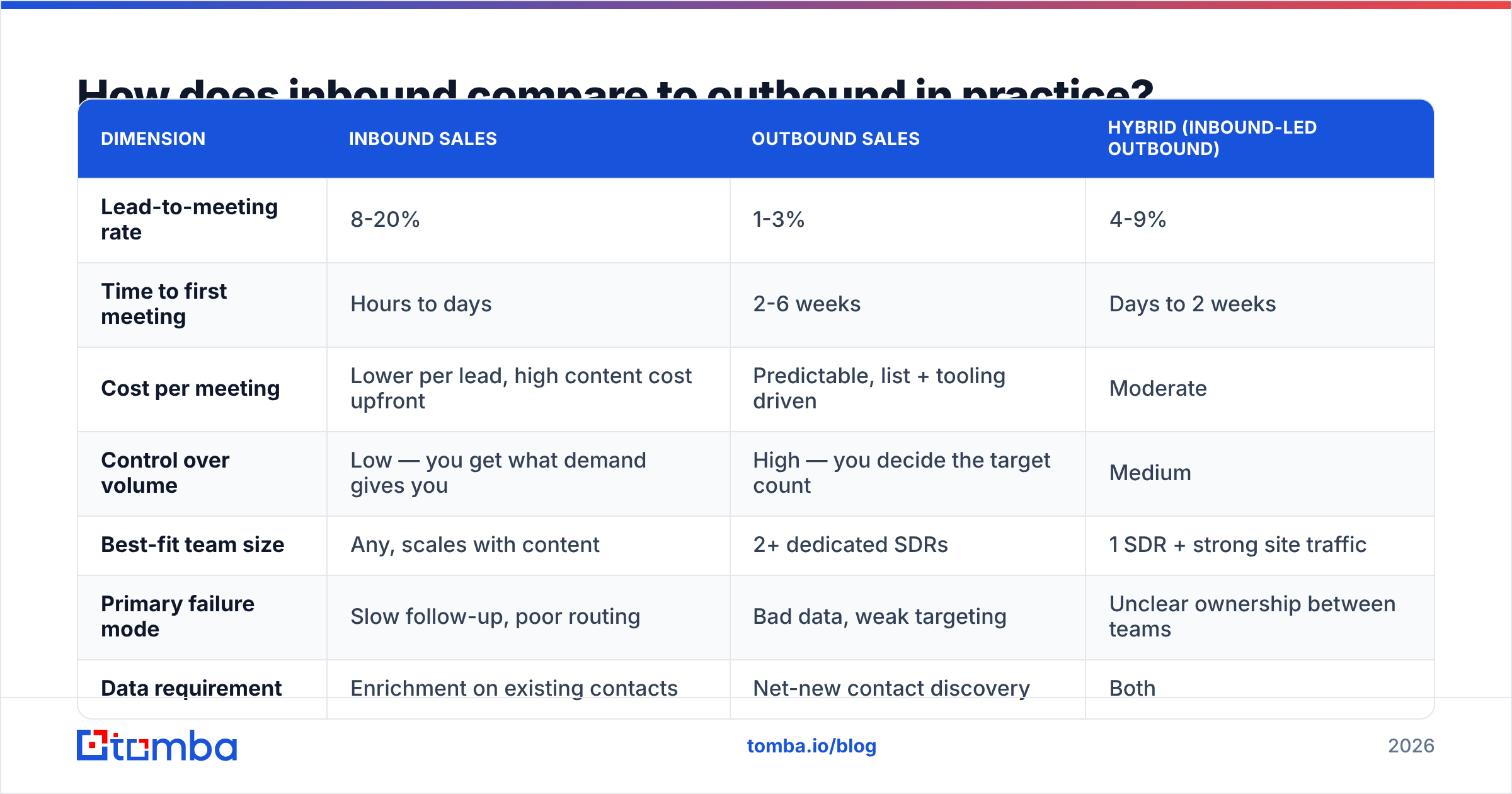
Neither motion wins outright. They cost differently, scale differently, and fail differently. The table below reflects typical mid-market B2B SaaS ranges — your numbers will vary, but the relative shape holds.
| Dimension | Inbound sales | Outbound sales | Hybrid (inbound-led outbound) |
|---|---|---|---|
| Lead-to-meeting rate | 8-20% | 1-3% | 4-9% |
| Time to first meeting | Hours to days | 2-6 weeks | Days to 2 weeks |
| Cost per meeting | Lower per lead, high content cost upfront | Predictable, list + tooling driven | Moderate |
| Control over volume | Low — you get what demand gives you | High — you decide the target count | Medium |
| Best-fit team size | Any, scales with content | 2+ dedicated SDRs | 1 SDR + strong site traffic |
| Primary failure mode | Slow follow-up, poor routing | Bad data, weak targeting | Unclear ownership between teams |
| Data requirement | Enrichment on existing contacts | Net-new contact discovery | Both |
The hybrid row is where most teams should be by 2026. Inbound-led outbound means you use the inbound signal — someone from Acme visited your pricing page — as the trigger for a targeted outbound sequence to the right people at Acme, not just the one person who filled the form. That requires visitor identification plus the ability to find the other stakeholders at that domain.
What data do you actually need before the first inbound call?#
Less than you think, but it has to be right. Here's the minimum viable prep, in priority order:
- Verified contact details. A bounced first email on an inbound lead is a self-inflicted wound. Run every submitted address through an email verifier before the sequence starts — free-mail typos and role addresses are extremely common on inbound forms.
- Company shape. Headcount, industry, and rough revenue band. This determines which case study you reference and whether you're talking to a self-serve buyer or a procurement-heavy one.
- The other stakeholders. Two to four names at the same domain who plausibly own the budget or the implementation. A domain search gets you there in seconds.
- Behavioral trail. Which pages, how many sessions, which content. This is the single best source of opening lines.
- Existing CRM history. Has anyone from this company talked to you before? Nothing kills credibility faster than pitching a company that churned nine months ago.
Note what's not on this list: a fully researched account plan, a custom deck, or a competitive teardown. Those are for the second call. Spending forty minutes preparing for a first inbound call means you responded forty minutes late.
How do you qualify an inbound lead without interrogating them?#
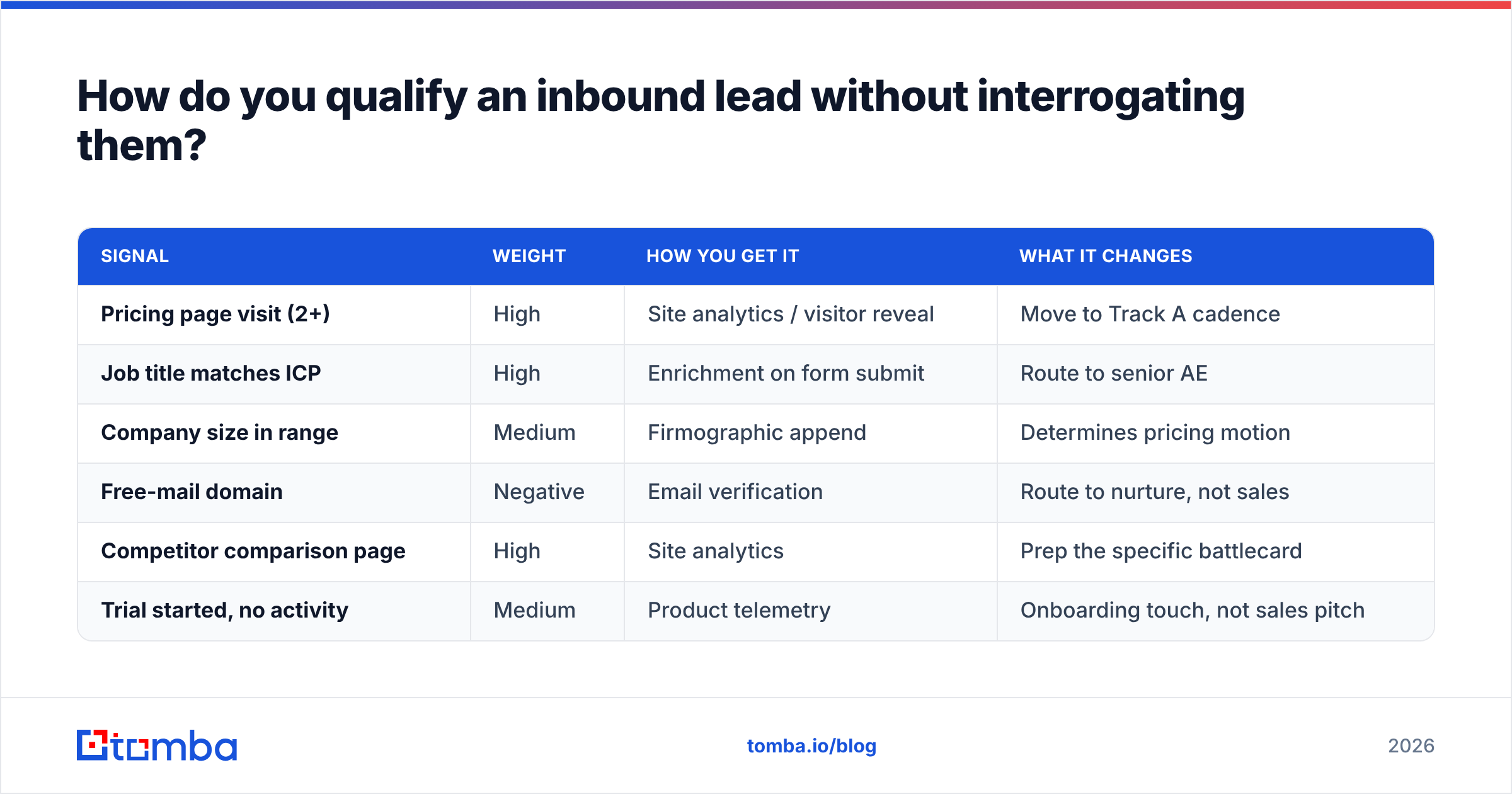
Score the lead before the conversation, then use the conversation to confirm — not to collect. If you're asking "how many employees do you have?" on a live call, your data layer failed.
A workable inbound qualification frame:
| Signal | Weight | How you get it | What it changes |
|---|---|---|---|
| Pricing page visit (2+) | High | Site analytics / visitor reveal | Move to Track A cadence |
| Job title matches ICP | High | Enrichment on form submit | Route to senior AE |
| Company size in range | Medium | Firmographic append | Determines pricing motion |
| Free-mail domain | Negative | Email verification | Route to nurture, not sales |
| Competitor comparison page | High | Site analytics | Prep the specific battlecard |
| Trial started, no activity | Medium | Product telemetry | Onboarding touch, not sales pitch |
The distinction between a marketing qualified lead and a sales-ready one is exactly this scoring layer. Get it wrong in the permissive direction and your reps waste hours on students. Get it wrong in the restrictive direction and you nurture buyers who were ready to sign.
One caveat worth stating plainly: scoring models decay. Re-fit yours quarterly against closed-won data. A model built on 2024 behavior will happily route your best 2026 leads into a drip campaign.
How do you handle the "I'm just looking" inbound lead?#
Take them at their word, then be useful anyway. The mistake is treating a research-stage inbound lead as a closing opportunity — you'll push them away permanently. The other mistake is dropping them into a generic newsletter and forgetting them.
The middle path:
- Ask one question: "What triggered the search?" Trigger events (new hire, tool sunset, board mandate, failed migration) tell you the real timeline better than any BANT question.
- Offer asymmetric value: a teardown of their current setup, a benchmark against similar companies, or a template. Something they'd keep even if they never buy.
- Set an explicit re-contact date. "Sounds like Q1. Can I ping you the first week of January?" Then actually do it. Calendared follow-ups on stated timelines convert far better than random nurture.
- Watch for the second signal. When that same contact — or a colleague from the same domain — returns to the pricing page, that's your re-entry point.
Which metrics prove your inbound sales techniques are working?#
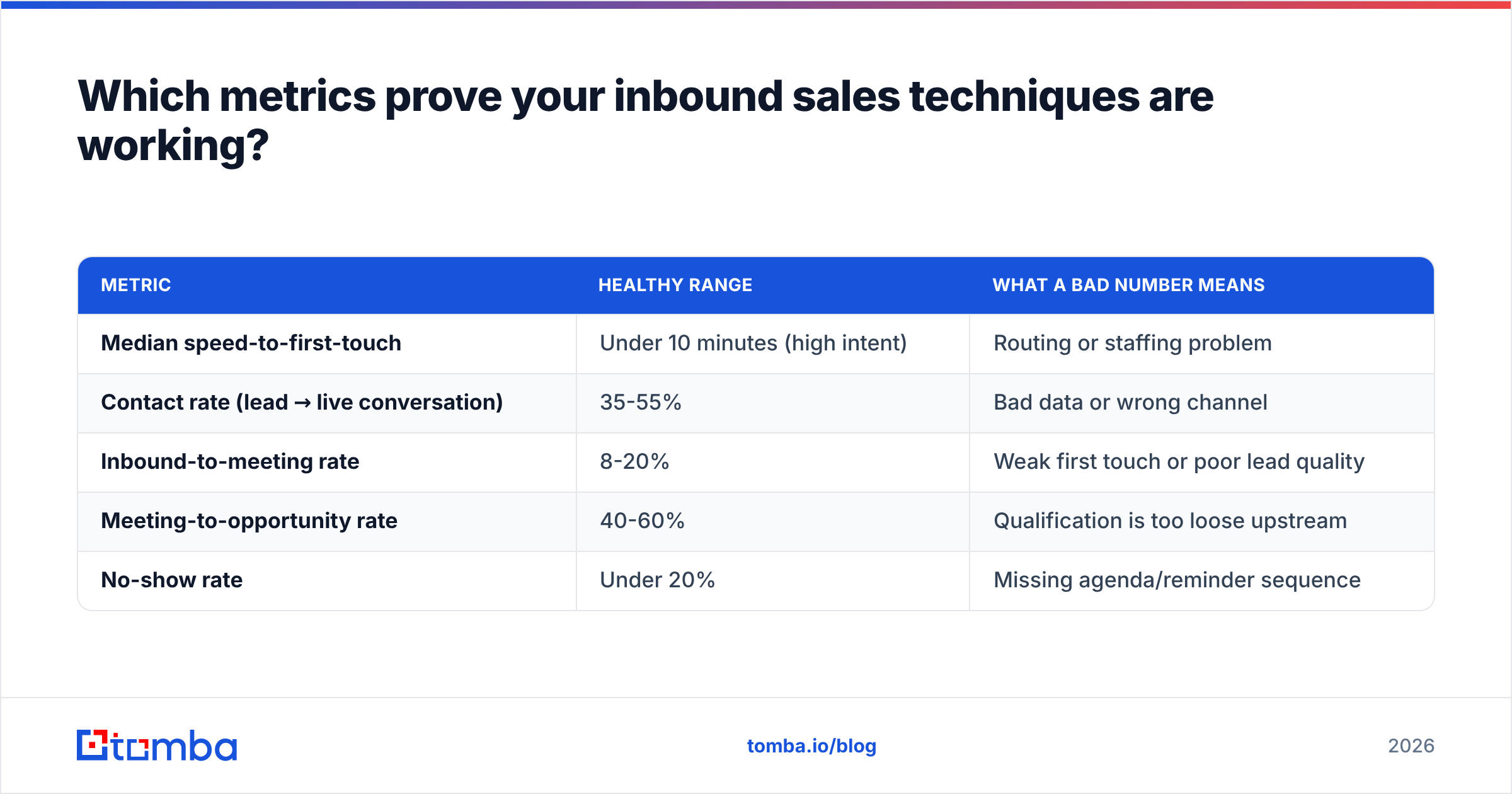
Four numbers, reviewed weekly:
| Metric | Healthy range | What a bad number means |
|---|---|---|
| Median speed-to-first-touch | Under 10 minutes (high intent) | Routing or staffing problem |
| Contact rate (lead → live conversation) | 35-55% | Bad data or wrong channel |
| Inbound-to-meeting rate | 8-20% | Weak first touch or poor lead quality |
| Meeting-to-opportunity rate | 40-60% | Qualification is too loose upstream |
| No-show rate | Under 20% | Missing agenda/reminder sequence |
If contact rate is low but meeting-to-opportunity is high, you have a data problem, not a selling problem — the leads are good, you just can't reach them. If contact rate is high and meeting-to-opportunity is low, your qualification bar is too low and reps are booking anything with a pulse. Those two diagnoses lead to completely different fixes, which is why you need both numbers.
For broader context on how inbound fits into modern selling motions, Salesforce's State of Sales research is a reasonable annual read, and the general history of the discipline is summarized well on Wikipedia's inbound marketing entry.
What should you fix first?#
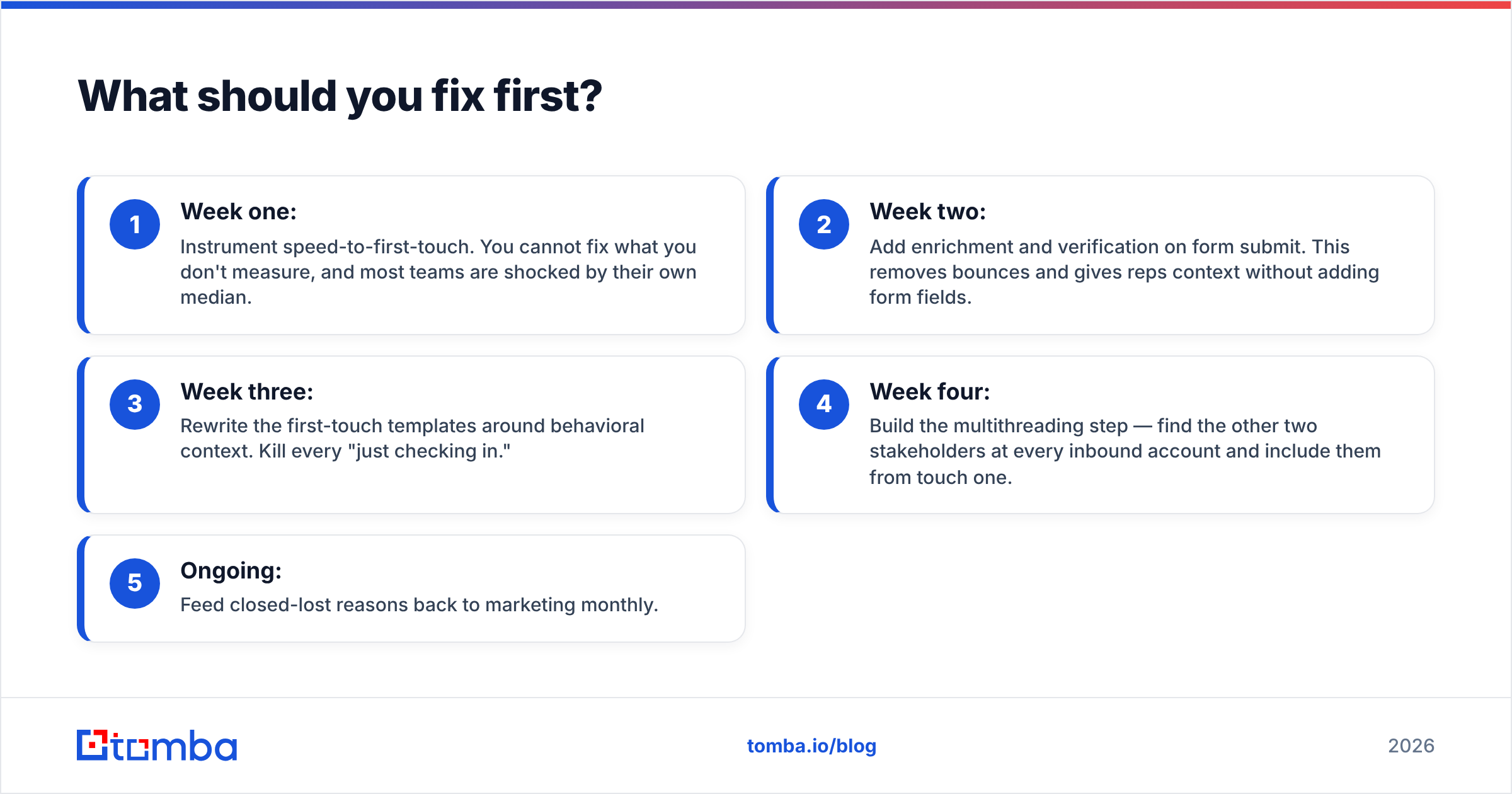
In order, because sequence matters:
- Week one: Instrument speed-to-first-touch. You cannot fix what you don't measure, and most teams are shocked by their own median.
- Week two: Add enrichment and verification on form submit. This removes bounces and gives reps context without adding form fields.
- Week three: Rewrite the first-touch templates around behavioral context. Kill every "just checking in."
- Week four: Build the multithreading step — find the other two stakeholders at every inbound account and include them from touch one.
- Ongoing: Feed closed-lost reasons back to marketing monthly.
None of this requires a new CRM. It requires that the data attached to each inbound lead be accurate and complete at the moment the rep opens it.
That last part is where most inbound programs quietly break. If you want your reps opening every inbound lead with a verified address, the right job title, and two named stakeholders at the same company already in the record, start with Tomba Email Finder — the free tier gives you 25 searches a month to test it against your real inbound list, and paid plans start at $49/mo on Starter with Growth at $99/mo. Check current Tomba pricing for the full breakdown, run your last 50 inbound leads through it, and see how many were reachable all along.
Related guides#
Ready to find emails that actually work?
Join 150,000+ professionals who stopped guessing and started sending. Free credits on signup — no credit card required.
Get the Tomba newsletter
Practical outbound tactics and product updates — once every two weeks.
About the author