How to Increase Close Rate in 2026: 9 Proven Tactics
Most teams try to increase close rate by coaching objection handling. The data says the leak starts three stages earlier. Here's where deals actually die and the nine fixes that move the number.
TL;DR
- Close rate is a lagging indicator. By the time a deal is in "negotiation," 80% of the outcome was decided during qualification and discovery.
- The fastest lever for most B2B teams is not better closing technique — it's stricter pipeline entry. Teams that disqualify aggressively report win rates 10-20 points higher on a smaller pipeline.
- Multi-threading is the single most predictive behavior in enterprise deals. Deals with 3+ engaged contacts close far more reliably than single-threaded ones.
- Bad contact data quietly caps your ceiling: if 20% of your outreach never reaches a human, your close rate math is broken before the first call.
- Track close rate by segment, by source, and by stage — one blended number tells you nothing actionable.
What does "close rate" actually measure?#
Close rate is the percentage of qualified opportunities that become closed-won deals in a given period. If you worked 100 opportunities last quarter and won 22, your close rate is 22%.
Simple formula, three traps.
Trap one: the denominator is political. If reps decide what counts as an "opportunity," they will define it in whatever way flatters their number. One rep counts every discovery call; another counts only deals with a signed mutual action plan. Their close rates aren't comparable, and neither is coachable.
Trap two: close rate and win rate get used interchangeably. They're close cousins but not twins. Win rate usually means won ÷ (won + lost), excluding open deals. Close rate often includes everything that entered the stage. Pick one definition, write it down, and enforce it in your CRM.
Trap three: blended close rate hides everything useful. A 22% blended rate might be 41% on inbound demo requests and 6% on cold outbound. Averaging them tells you to do nothing. Splitting them tells you exactly where to spend next quarter.
Before you try any tactic below, fix the measurement. You cannot increase close rate you cannot see.
Where do deals actually die?#
Here's the uncomfortable finding from pipeline audits across most B2B orgs: the majority of losses trace back to decisions made before the demo, not during the close.
The four common failure points, in order of how much damage they do:
- Wrong-fit accounts entered the pipeline. The rep needed coverage, the account had a pulse, so it got a stage. It was never going to buy. This is the single largest source of "closed-lost — no decision."
- Discovery never surfaced a cost of inaction. The prospect liked the product but had no consequence for doing nothing. These deals don't lose to a competitor; they lose to the status quo.
- The deal stayed single-threaded. One champion, no economic buyer, no technical validator. When your champion goes quiet, changes roles, or gets overruled, the deal evaporates and you never learn why.
- The close was a surprise. No agreed timeline, no procurement mapping, no security review scheduled. The deal slips a quarter, then two, then dies of exposure.
Notice that none of these are solved by a better closing line. They're solved by earlier discipline.
Which levers actually increase close rate?#
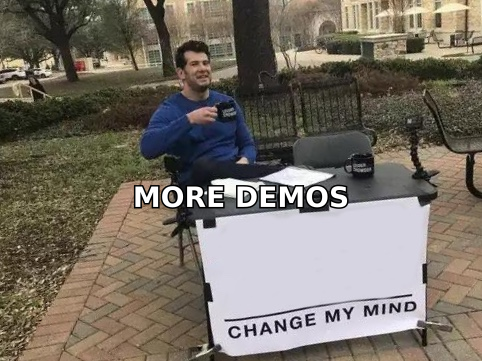
Here's the comparison that matters — what each common intervention costs, how fast it moves the number, and how much lift you should realistically expect.
| Lever | Time to impact | Effort | Typical close-rate lift | Best for |
|---|---|---|---|---|
| Tighter qualification / disqualify early | 1 quarter | Medium | +5 to +12 pts | Teams with bloated pipeline |
| Multi-threading (3+ contacts) | 1-2 quarters | Medium | +8 to +15 pts | Enterprise / committee buys |
| Clean, verified contact data | 2-6 weeks | Low | +2 to +6 pts | Outbound-heavy teams |
| Mutual action plans | 1 quarter | Low | +4 to +9 pts | Deals with procurement/legal |
| Sales-engineer involvement earlier | 1-2 quarters | High | +3 to +8 pts | Technical products |
| Competitive battlecards | 6-8 weeks | Medium | +2 to +5 pts | Crowded categories |
| Pricing / packaging simplification | 2 quarters | High | +5 to +10 pts | Long negotiation cycles |
| Rep coaching on objection handling | 2-3 quarters | High | +1 to +4 pts | Mature, disciplined teams |
The ranking surprises people. Objection-handling coaching — the thing most sales orgs spend the most training budget on — sits near the bottom, because it only helps deals that were already viable. Qualification discipline sits at the top because it changes which deals you count at all.
How does qualification discipline raise the number?#
Because close rate is a ratio, and you control the denominator.
Think of it like a restaurant kitchen. You can train your line cooks endlessly on plating technique, or you can stop accepting spoiled ingredients at the back door. The second fix is cheaper, faster, and improves everything downstream.
Practical implementation:
- Write a disqualification checklist, not just a qualification one. MEDDIC, BANT, and SPICED all list what a good deal has. Far more useful: list the three conditions that mean you walk away. No budget owner identified by call two. No compelling event in the next two quarters. No named business problem with a number attached.
- Make disqualification a celebrated act. Report "deals disqualified" as a positive metric in pipeline review. If a rep is punished for shrinking their pipeline, they will never clean it.
- Set a stage-entry gate with evidence, not opinion. "Stage 2 requires a documented pain, a named economic buyer, and a scheduled next meeting." No evidence, no stage.
- Audit closed-lost reasons quarterly. If "no decision" is over 30% of losses, your problem is entry criteria, not closing skill. Gartner's research on B2B buying consistently shows most stalled deals never had a real decision process to begin with.
Teams that do this see pipeline volume drop 20-40% and close rate jump. Revenue usually holds flat or rises, because the removed deals weren't going to convert anyway — they were just consuming rep hours.
Why does data quality cap your close rate?#
Because a deal you never reached is a deal you can't win, and it still lands in your denominator if a rep logged it.
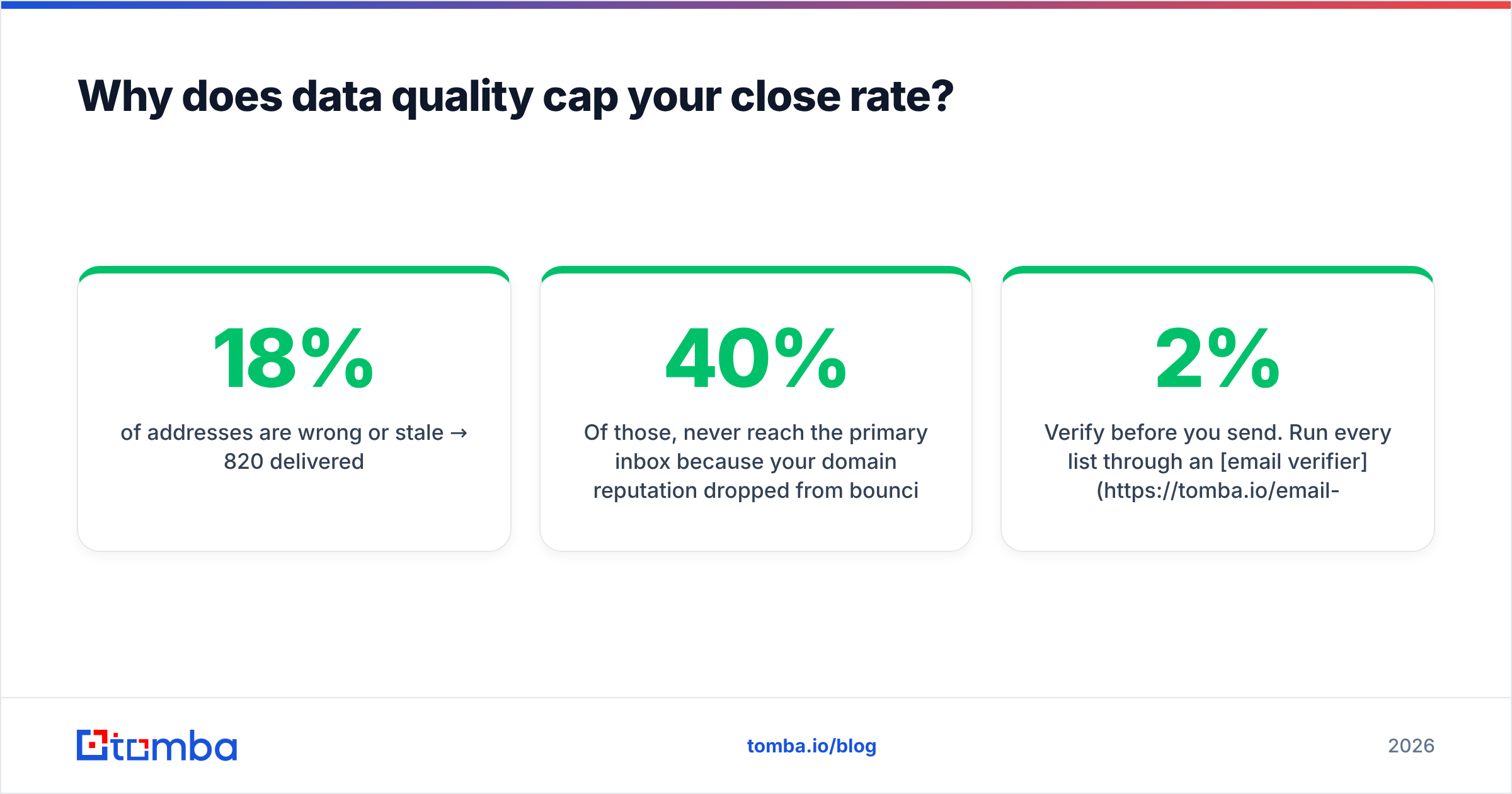
Run the arithmetic. Say your team sends 1,000 outbound emails a month:
- 18% of addresses are wrong or stale → 820 delivered
- Of those, 40% never reach the primary inbox because your domain reputation dropped from bouncing the first 180 → ~490 real impressions
- Your true reply rate on the addressable set looks like half what it actually is
Now your reps compensate by working more accounts, which means looser qualification, which means the pipeline fills with junk, which means close rate falls. Bad data doesn't just hurt outreach — it corrupts the whole funnel.
The fix is unglamorous:
- Verify before you send. Run every list through an email verifier so hard bounces never leave the building. A bounce rate under 2% is the practical threshold for protecting sender reputation.
- Find contacts at the account, not just the one name you have. Domain search surfaces the other stakeholders on the buying committee — which feeds directly into the multi-threading lever below.
- Enrich before qualification, not after. Knowing headcount, tech stack, and funding stage before the first call lets reps disqualify in 90 seconds instead of three meetings. Data enrichment at the top of the funnel pays for itself in rep hours.
- Deduplicate ruthlessly. Duplicate records inflate your opportunity count and depress every ratio built on top of it.
How much does multi-threading matter?#
More than anything else you can control inside an active deal.
The mechanism is simple risk math. A single-threaded deal has one point of failure. Your champion is one reorg, one job change, or one bad quarter away from disappearing. Add a second engaged contact and you halve that risk. Add a third and you've usually reached the economic buyer or a blocker you needed to know about anyway.
The tactics that work:
- Ask for the org map in discovery, explicitly. "Who else will need to weigh in before this gets signed?" — asked on call one, not call four.
- Never accept "I'll bring it to my boss." Offer instead: "Happy to join that conversation — would a 15-minute overview help?"
- Send value to non-champions directly. A security one-pager to IT, an ROI model to Finance. Use a LinkedIn finder or email finder to reach them without waiting for an intro that may never come.
- Track thread count as a pipeline field. If your CRM shows contact count per opportunity, you can forecast on it. Deals stuck at one contact past stage 2 should be flagged automatically.
- Use a mutual action plan as the threading vehicle. A shared document listing every step to go-live naturally exposes who's missing.
Which tactic should you run first?#
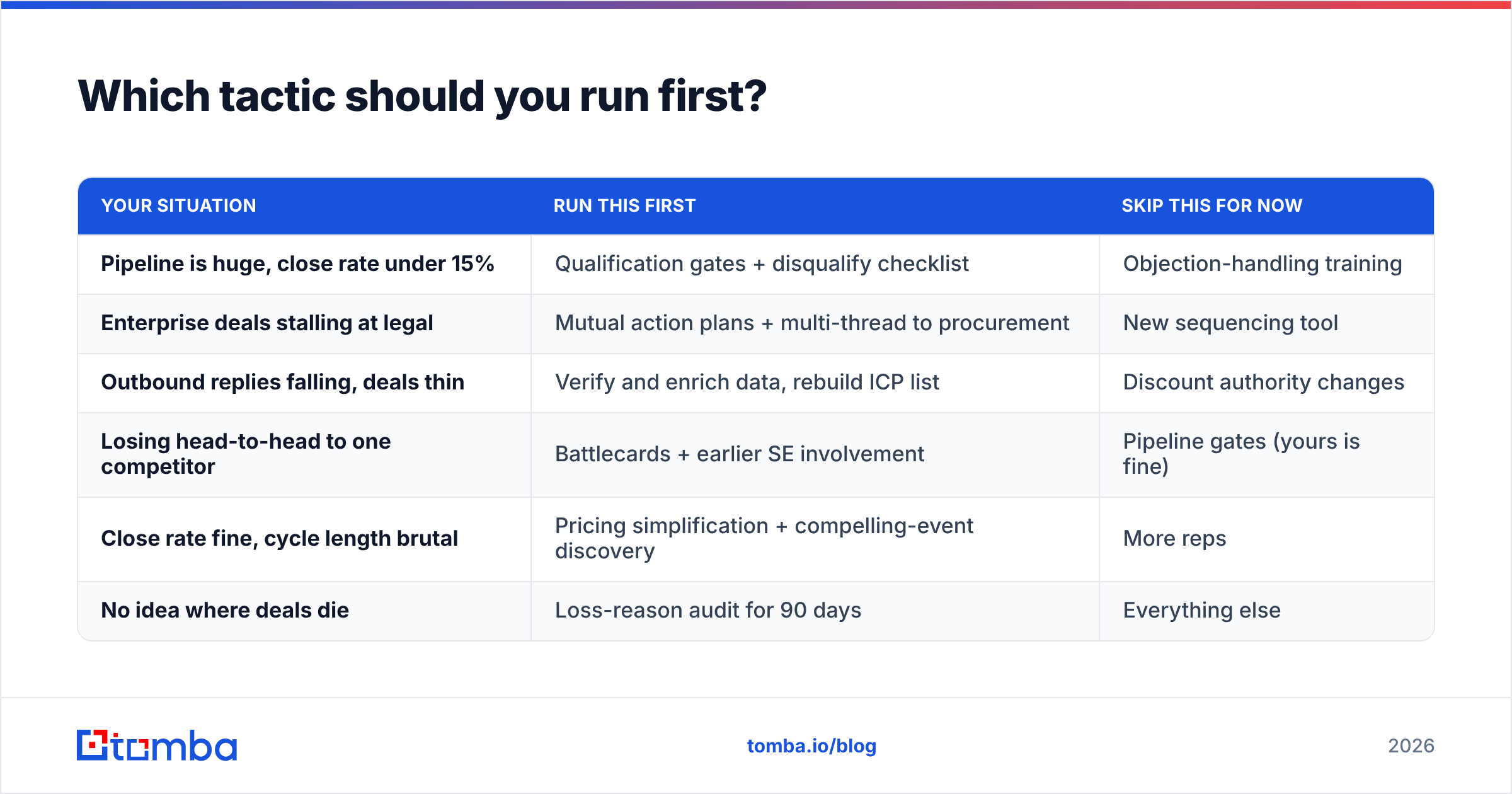
Depends on your motion. Here's the honest triage.
| Your situation | Run this first | Skip this for now |
|---|---|---|
| Pipeline is huge, close rate under 15% | Qualification gates + disqualify checklist | Objection-handling training |
| Enterprise deals stalling at legal | Mutual action plans + multi-thread to procurement | New sequencing tool |
| Outbound replies falling, deals thin | Verify and enrich data, rebuild ICP list | Discount authority changes |
| Losing head-to-head to one competitor | Battlecards + earlier SE involvement | Pipeline gates (yours is fine) |
| Close rate fine, cycle length brutal | Pricing simplification + compelling-event discovery | More reps |
| No idea where deals die | Loss-reason audit for 90 days | Everything else |
The last row deserves emphasis. If you cannot name your top loss reason with data, every tactic you pick is a guess. Spend one quarter instrumenting before you spend one dollar optimizing.
What should you actually measure?#
Six metrics, reviewed monthly, segmented by source and segment:
- Close rate by lead source. Inbound, outbound, partner, and expansion behave nothing alike. Blending them is how teams accidentally defund their best channel.
- Stage-to-stage conversion. A healthy funnel has one obvious choke point. Find yours before you optimize anything else.
- Average contacts per closed-won vs closed-lost. If won deals average 4.1 contacts and lost deals average 1.6, you've just proved the multi-threading case internally with your own data.
- No-decision rate as a share of losses. Over 30% means a qualification problem. Under 15% with high competitive losses means a product or positioning problem.
- Time in current stage. Deals rotting in stage 3 for 60+ days are usually dead and inflating your denominator.
- Response rate on first touch. A leading indicator that predicts pipeline quality two quarters out.
Set thresholds, not targets. "Flag any deal with one contact past day 21" is an operational rule. "Improve close rate by 5%" is a wish.
What common advice should you ignore?#
"Create urgency." Manufactured urgency is transparent and it damages trust. Real urgency comes from a compelling event the buyer already has — a contract expiring, a compliance deadline, a headcount plan. Your job is to find it, not fabricate it.
"Always be closing." Written for a different era and a different sale. Modern B2B committees respond to relevance and reduced risk, not pressure. HubSpot's sales research has documented the shift toward buyer-led processes for over a decade now.
"Discount to get it over the line." Discounting at the end teaches procurement to wait you out next renewal. If price is a genuine blocker, restructure scope or terms instead — reduce what they get, not what they pay for it.
"More activity fixes everything." Doubling calls on a broken ICP just doubles the noise. Activity metrics belong in the leading-indicator column, not the diagnosis column.
"Buy a better tool." Tools amplify a working process. They cannot create one. If your discovery is weak, an AI notetaker will produce beautifully transcribed weak discovery.
What does a 90-day plan look like?#
Days 1-30 — instrument. Lock down close-rate definitions in the CRM. Add required loss-reason picklists. Backfill contact-count-per-opportunity. Run a data hygiene pass on your existing database so your baseline isn't measuring ghosts.
Days 31-60 — gate. Publish stage-entry evidence requirements. Introduce the disqualification checklist and celebrate the first ten walkaways publicly. Expect pipeline coverage to look scary; hold the line.
Days 61-90 — thread and plan. Roll out mutual action plans for every deal over your median ACV. Require a second contact before stage 3 advancement. Review the contacts-per-won-deal delta at the end of the quarter and let the data make the argument for you.
Most teams see the number move in quarter two, not quarter one, because the deals you fixed at entry need a full cycle to reach close. Budget patience accordingly.
Getting started#
Close rate improves when fewer bad deals enter and more good deals get properly worked. Both halves start with knowing who's actually at the account — the economic buyer you haven't met, the security lead who'll block you in week six, the second champion who saves the deal when the first one leaves.
That's a data problem before it's a selling problem. Tomba's Email Finder gets you verified addresses for every stakeholder on the buying committee, so multi-threading stops depending on whether your champion agrees to make an introduction. The free tier gives you 25 searches a month to test it against your own open pipeline; paid plans start at $49/mo when you're ready to run it across the team.
Pick your ten largest open deals. Count the contacts. If any of them sit at one, you already know what to do this week.
Related guides#
Ready to find emails that actually work?
Join 150,000+ professionals who stopped guessing and started sending. Free credits on signup — no credit card required.
Get the Tomba newsletter
Practical outbound tactics and product updates — once every two weeks.
About the author