Influencers Club Pricing 2026: Reviews, Pros and Cons
A neutral breakdown of Influencers Club pricing in 2026 — what each tier actually buys, where credits disappear, honest pros and cons, and when a cheaper contact-data stack does the job better.
TL;DR
- Influencers Club is a creator-data platform: a searchable index of Instagram, TikTok and YouTube profiles with audience demographics and, critically, contact details attached.
- Pricing is credit-based and seat-based. The published entry point sits in the low-hundreds-per-month range, and most of the features buyers actually want (bulk export, API, lookalike search) live above that line.
- The real cost driver is not the sticker price — it is credit burn on searches that return profiles you never contact, plus annual commitments that remove your ability to walk away mid-quarter.
- Strong fit: consumer brands and agencies running creator campaigns at volume. Weak fit: B2B teams who just need verified work emails for named companies and people.
- If your job is "find the email for this person at this company," a dedicated email finder like Tomba costs a fraction of a creator-data seat and does that one job better.
What is Influencers Club and who is it actually for?#
Influencers Club is a creator discovery and contact database. You search a pool of social profiles by follower count, engagement rate, location, niche, audience gender split, and dozens of other filters, then pull the creator's contact information — usually a business email — so you can pitch a collaboration.
That last part is the whole product. Creator discovery tools are commodity; scraping follower counts is not hard. What buyers pay for is the join between "this creator matches my brief" and "here is a mailbox that a human actually reads." The platform's own homepage leans on that: search, filter, get contacts, export.
The audience is narrower than the marketing suggests. In practice three groups get real value:
- Influencer marketing agencies running multiple client briefs at once, where the cost of a seat is amortised across five or six campaigns per month.
- DTC and consumer brands with a standing creator programme — beauty, fitness, supplements, apparel, gaming peripherals — that need a steady inflow of new profiles.
- Talent and casting teams using audience demographics as a screening filter before a human ever opens a DM.
Everyone else tends to churn. If you run B2B outbound and you landed here because "contact database" sounded like what you needed, this is the wrong shelf — creator databases index people by audience, not by employer, title, or buying committee. That distinction matters more than any pricing table below.
How does Influencers Club pricing actually work?#
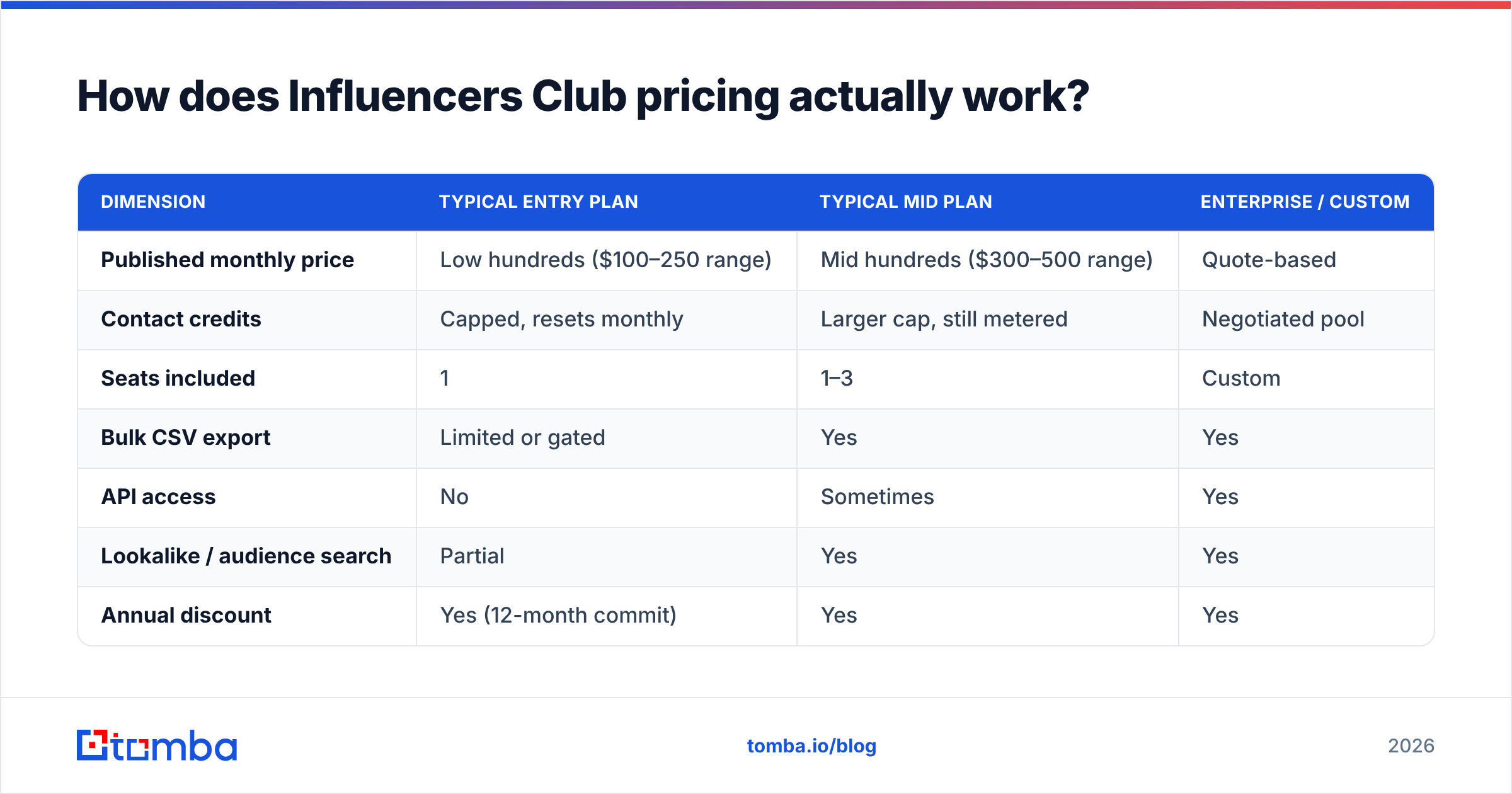
Three variables set your bill: plan tier, credit allowance, and seats. Miss any one of them and your budget estimate will be wrong.
A credit is consumed when you reveal or export a contact — not when you browse. That sounds generous until you watch a junior media buyer reveal 400 profiles to shortlist 30. Credits are the meter, and the meter runs on curiosity.
Pricing pages in this category change often and vendors regularly run unpublished discounts, so treat the figures below as the shape of the pricing rather than a quote. Confirm current numbers on the vendor's own page before you commit to anything.
| Dimension | Typical entry plan | Typical mid plan | Enterprise / custom |
|---|---|---|---|
| Published monthly price | Low hundreds ($100–250 range) | Mid hundreds ($300–500 range) | Quote-based |
| Contact credits | Capped, resets monthly | Larger cap, still metered | Negotiated pool |
| Seats included | 1 | 1–3 | Custom |
| Bulk CSV export | Limited or gated | Yes | Yes |
| API access | No | Sometimes | Yes |
| Lookalike / audience search | Partial | Yes | Yes |
| Annual discount | Yes (12-month commit) | Yes | Yes |
| Credit rollover | Typically no | Typically no | Negotiable |
Two structural details deserve more attention than the prices:
Credits usually do not roll over. A slow month is money burned. If your campaign cadence is lumpy — three big pushes a year rather than steady monthly sourcing — a metered subscription is the wrong billing shape for you, regardless of how good the data is.
Annual commitment is where the discount lives. The month-to-month price is materially higher than the annualised one. That is standard SaaS practice, but it means the honest comparison is not "$X per month" — it is "$X times twelve, decided today, based on a two-week trial."
What do Influencers Club reviews say?#
Public reviews cluster into a consistent pattern. Read across G2's influencer marketing platform category and the sentiment is easy to summarise, because the same four themes repeat across nearly every vendor in the space, Influencers Club included.
What reviewers consistently praise:
- Contact hit rate on mid-tier creators. The 10k–500k follower band is where the database is strongest. That is also the band where most brand deals actually happen, so it is the right place to be strong.
- Filter depth. Audience age, gender, location and interest filters go further than the free tools, and the filters are fast enough to iterate on inside a single working session.
- Speed to first list. Reviewers routinely mention going from brief to exported shortlist in under an hour — a genuine improvement over manual Instagram scrolling.
What reviewers consistently complain about:
- Credit anxiety. The most common negative theme in this entire product category. Users describe rationing reveals, which defeats the purpose of paying for discovery.
- Stale contacts on smaller accounts. Below roughly 10k followers, business emails go out of date fast — creators switch management, abandon Gmail aliases, or never had a business inbox at all.
- Support responsiveness during trials. Common for mid-size vendors; worth testing deliberately before you sign.
- Export friction on lower tiers. Gating bulk export behind an upgrade is a well-known upsell lever, and reviewers notice.
Weight these carefully. A complaint about credit burn from an agency running 20 campaigns is a different signal than the same complaint from a solo founder who bought the wrong tier.
Is Influencers Club worth it, or should you use something cheaper?#
Answer first: it is worth it if creator sourcing is a recurring, budgeted workflow — and it is a poor purchase if you are buying it as a general-purpose contact database.
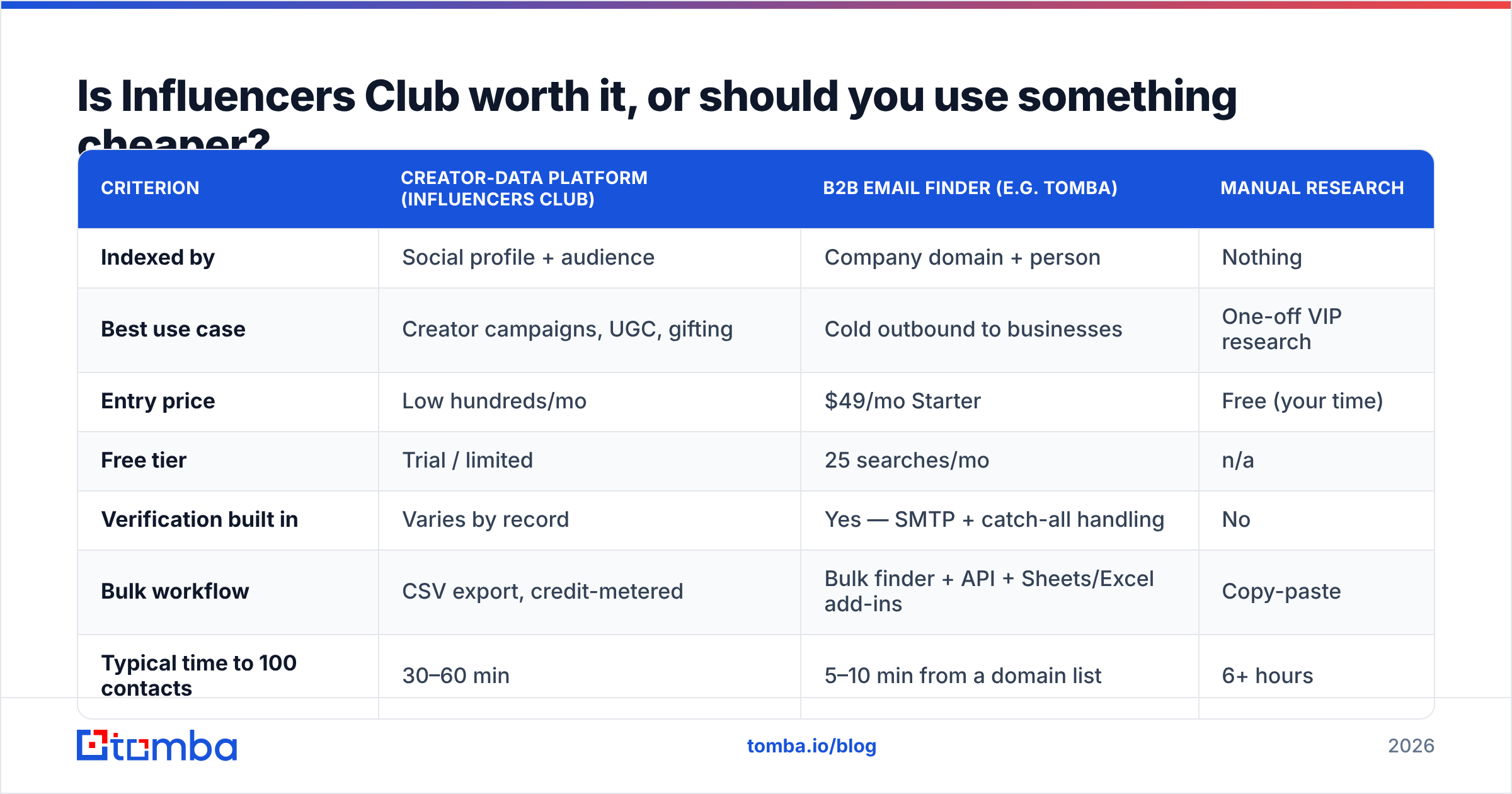
Here is the decision framed as a straight comparison against the alternative most people are actually weighing: a dedicated B2B contact-data stack.
| Criterion | Creator-data platform (Influencers Club) | B2B email finder (e.g. Tomba) | Manual research |
|---|---|---|---|
| Indexed by | Social profile + audience | Company domain + person | Nothing |
| Best use case | Creator campaigns, UGC, gifting | Cold outbound to businesses | One-off VIP research |
| Entry price | Low hundreds/mo | $49/mo Starter | Free (your time) |
| Free tier | Trial / limited | 25 searches/mo | n/a |
| Verification built in | Varies by record | Yes — SMTP + catch-all handling | No |
| Bulk workflow | CSV export, credit-metered | Bulk finder + API + Sheets/Excel add-ins | Copy-paste |
| Typical time to 100 contacts | 30–60 min | 5–10 min from a domain list | 6+ hours |
| Contract | Often annual for best price | Monthly, cancel anytime | n/a |
The two products are not really competitors — they answer different questions. The mistake is buying the expensive one to answer the cheap one's question.
If your target list looks like "200 skincare creators, US, 25–34 female audience, 3%+ engagement," you need a creator database. If it looks like "the head of partnerships at these 200 DTC brands," you need a domain-based email finder and a verification step, and you will spend roughly a fifth as much doing it.
What are the honest pros and cons?#
Pros#
- Contact data is the differentiator, and it works. Discovery filters are table stakes; attaching a reachable email to the profile is the part that saves real hours.
- Audience-side filtering beats creator-side filtering. Follower count lies. Audience demographics are much harder to fake, and the filters here let you screen on them before you spend outreach effort.
- Export and API paths exist. On higher tiers you can push records into your own systems rather than living inside the vendor's UI, which matters if you already have a CRM of record.
- Faster than agency sourcing for straightforward briefs. For a standard "find me 50 creators in this niche" task, the tool beats a junior researcher on both speed and cost.
Cons#
- Credit metering encourages the wrong behaviour. Rationing reveals means you shortlist on thinner information, which is the opposite of what you bought.
- No rollover punishes lumpy usage. Seasonal campaign calendars and monthly credit resets are a bad match.
- Data decay on the long tail. Micro-creator emails go stale quickly. Any contact you pull is a hypothesis until it is verified — which is why an independent email verifier pass before you send is not optional, whatever the source.
- Wrong tool for B2B. No company-domain search, no title-based filtering, no buying-committee logic. It was never built for that.
- Annual pressure at the point of sale. The best price requires a decision you cannot fully justify from a trial.
How should you evaluate it before you pay?#
Run a structured trial rather than a vibe check. Five steps, roughly two hours of work, and it will tell you more than any review roundup.
- Write one real brief first. Not a test query — an actual campaign you intend to run this quarter, with real constraints. Generic searching makes every database look good.
- Measure contact coverage, not result count. Pull 50 profiles and count how many have a business email attached. Coverage percentage is the number that predicts your future frustration; total results is vanity.
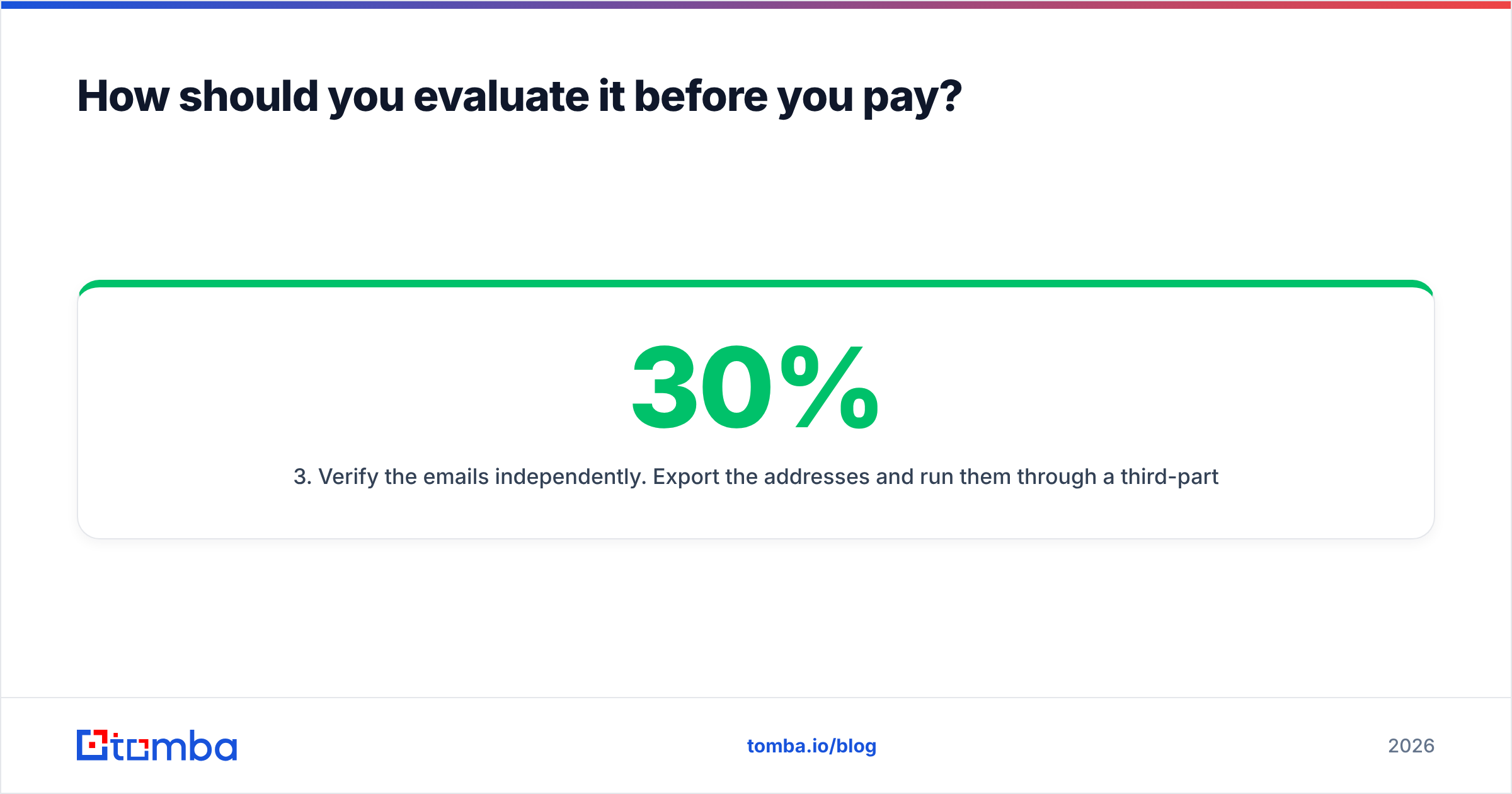
- Verify the emails independently. Export the addresses and run them through a third-party checker. If 30% bounce, your effective cost per usable contact just went up 43% — and no vendor's marketing page will tell you that.
- Model your credit burn honestly. Take your reveal count from the trial, multiply by your real monthly campaign load, and compare against the tier caps. Most buyers undercount by 2–3x.
- Price the alternative in parallel. Run the same brief through a cheaper stack — a domain-based finder plus data enrichment — and compare cost per verified, replied-to contact, not cost per record.
That third step is where most evaluations fall apart. Contact databases in every category — creator, B2B, local business — report coverage generously and verification conservatively, because verification is expensive and coverage sells. The influencer marketing industry has grown fast enough that data hygiene standards vary wildly between vendors, and the only reliable check is your own.
What are the best alternatives by use case?#
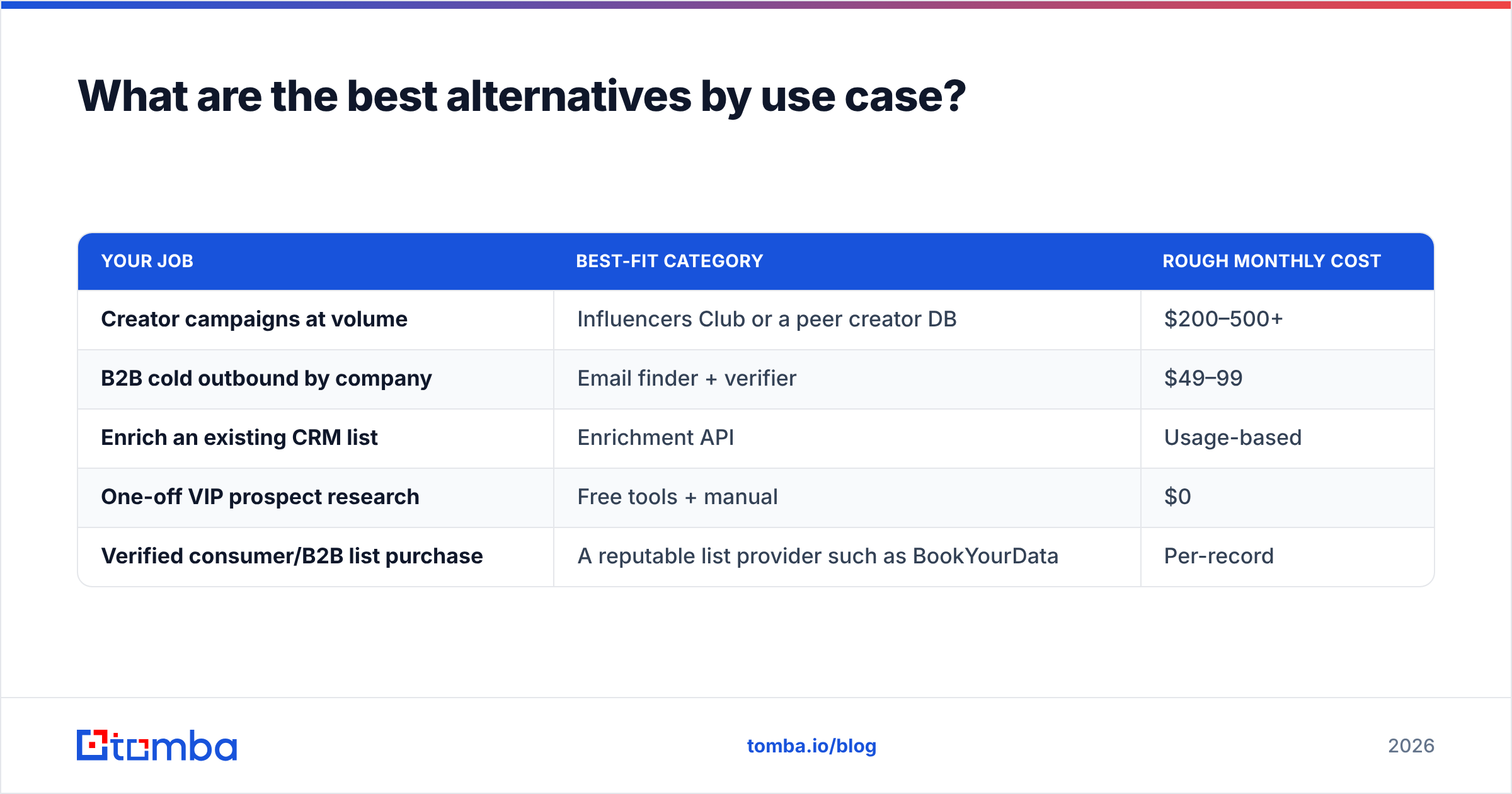
| Your job | Best-fit category | Rough monthly cost |
|---|---|---|
| Creator campaigns at volume | Influencers Club or a peer creator DB | $200–500+ |
| B2B cold outbound by company | Email finder + verifier | $49–99 |
| Enrich an existing CRM list | Enrichment API | Usage-based |
| One-off VIP prospect research | Free tools + manual | $0 |
| Verified consumer/B2B list purchase | A reputable list provider such as BookYourData | Per-record |
For the second row — the one most readers of this blog are actually in — the maths is unsentimental. Tomba's pricing runs a free tier at 25 searches per month, Starter at $49/mo, Growth at $99/mo and Pro at $249/mo, with domain search, verification, bulk processing and API access rather than credit-metered profile reveals. That is a different product solving a different problem, and if it is your problem, you should not be reading a creator-database pricing page at all.
For the first row, Influencers Club is a legitimate contender. Just buy it with your eyes open: model the credits, test the coverage, and negotiate the annual term rather than accepting it.
The bottom line#
Influencers Club prices like a creator-data platform because that is what it is — strong on audience filtering, genuinely useful contact coverage in the mid-tier follower band, and metered in a way that rewards steady monthly usage and punishes lumpy campaign calendars. If creator sourcing is a line item in your budget every month, it earns its keep. If it is a twice-a-year push, the billing model will fight you.
And if you got here because you need work emails for people at companies — not creators with audiences — you are shopping in the wrong aisle entirely. Start with the Tomba Email Finder: search by domain, name or company, get verified professional addresses, and test the whole workflow on the free tier before you spend a dollar. It costs less than one seat of a creator database and it answers the question you actually asked.
Related guides#
// get started
Find, verify and enrich your first contacts today
Start on the free plan with 25 searches a month, then scale when your team is ready.
Free plan · No credit card required · GDPR & CCPA
// about the author