Influencersclub vs Kaspr: Which Data Tool Wins in 2026?
One tool sells creator emails, the other sells LinkedIn phone numbers. Here is an honest breakdown of coverage, accuracy, pricing and compliance so you pick the right database instead of the loudest one.
TL;DR
- These two tools are not really competitors. Influencersclub is a creator/influencer database (TikTok, Instagram, YouTube profiles plus contact details). Kaspr is a LinkedIn-first B2B contact tool built around phone numbers and work emails.
- Pick Kaspr if your ICP is a job title at a company and you want mobile numbers pulled straight off LinkedIn profiles.
- Pick Influencersclub if your ICP is a person with an audience — a creator, a niche YouTuber, a Shopify-adjacent affiliate — and firmographics are useless to you.
- Both charge per seat or per credit, and both leave you responsible for verification. Neither replaces a dedicated email verification step before you send.
- If you mostly need clean work emails at scale, a domain-first email finder like Tomba is cheaper per contact than either and doesn't force a per-seat licence on every SDR.
What are Influencersclub and Kaspr, actually?#
Different animals, sold with similar words.
Influencersclub indexes social profiles. Its pitch is a searchable database of millions of creators with filters that only make sense in creator-land: follower count, engagement rate, audience geography, audience age, average views, platform, niche. Attached to each profile it tries to surface a contact method — the business email in a bio, a linked website, sometimes an enriched personal or work address. Brands, agencies and affiliate managers use it to build outreach lists for gifting, UGC and paid partnerships.
Kaspr indexes professionals. It is a Chrome extension plus a web app, owned by Cognism, that reveals contact details when you open a LinkedIn profile, a LinkedIn search result page, or a Sales Navigator list. Its headline feature is mobile phone numbers — the thing most B2B databases are weakest at — with work emails alongside. SDRs use it for cold calling and multichannel sequences.
So the honest framing of influencersclub vs kaspr is not "which is better." It is: which shape of person are you trying to reach, and does the tool's data model match that shape? Buy the wrong shape and no amount of credits will save the campaign.

How do their data models actually differ?#
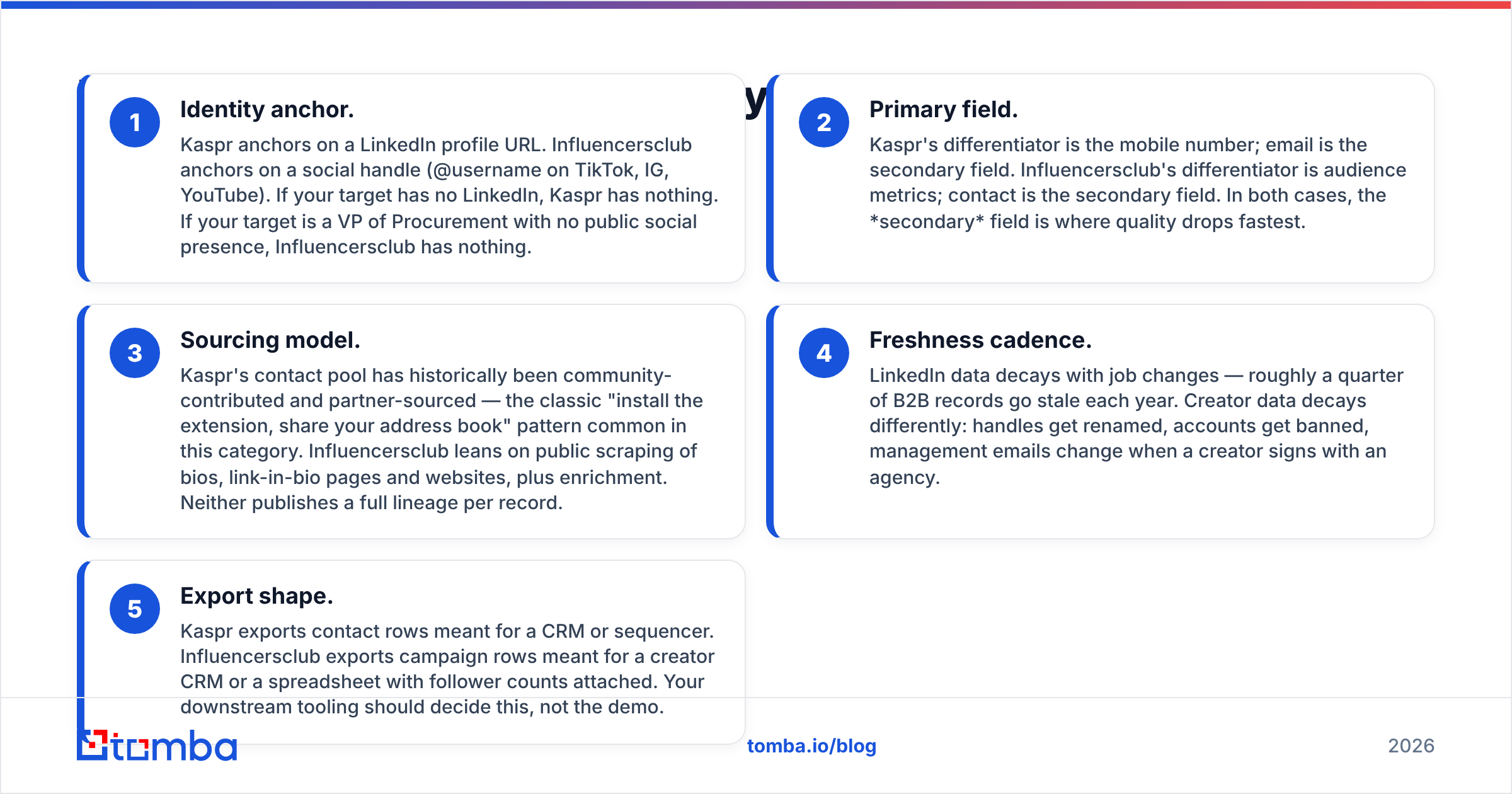
Five differences that decide the outcome of your first month:
- Identity anchor. Kaspr anchors on a LinkedIn profile URL. Influencersclub anchors on a social handle (@username on TikTok, IG, YouTube). If your target has no LinkedIn, Kaspr has nothing. If your target is a VP of Procurement with no public social presence, Influencersclub has nothing.
- Primary field. Kaspr's differentiator is the mobile number; email is the secondary field. Influencersclub's differentiator is audience metrics; contact is the secondary field. In both cases, the secondary field is where quality drops fastest.
- Sourcing model. Kaspr's contact pool has historically been community-contributed and partner-sourced — the classic "install the extension, share your address book" pattern common in this category. Influencersclub leans on public scraping of bios, link-in-bio pages and websites, plus enrichment. Neither publishes a full lineage per record.
- Freshness cadence. LinkedIn data decays with job changes — roughly a quarter of B2B records go stale each year. Creator data decays differently: handles get renamed, accounts get banned, management emails change when a creator signs with an agency.
- Export shape. Kaspr exports contact rows meant for a CRM or sequencer. Influencersclub exports campaign rows meant for a creator CRM or a spreadsheet with follower counts attached. Your downstream tooling should decide this, not the demo.
Which one gives you more usable emails?#
Neither publishes an audited accuracy figure you can hold them to, so treat any vendor number — including the ones below — as directional.

Here is what actually moves your bounce rate:
Kaspr returns a mix of work emails and personal emails. Work emails on well-known domains are usually solid. Personal Gmail addresses inflate the "found" count but perform badly in B2B sequences and can be a compliance problem in the EU. Filter for professional addresses only, then verify — reviewers on G2 consistently praise the phone numbers more than the emails, which tells you where the engineering effort went.
Influencersclub returns whatever the creator published, which is the good news and the bad news. A business email in a TikTok bio is a genuinely deliverable inbox — often more deliverable than a guessed corporate pattern, because the creator wants to be pitched. But coverage is uneven: micro-creators frequently list nothing, and you fall back to enriched guesses with far weaker confidence.
The practical takeaway: both tools hand you a list that still needs a verification pass. Running exports through an email verifier before import is not optional — it is the difference between a 2% bounce rate and a 12% one that torches your sending domain. For domains that accept everything, a dedicated catch-all verifier is the only way to avoid flying blind.

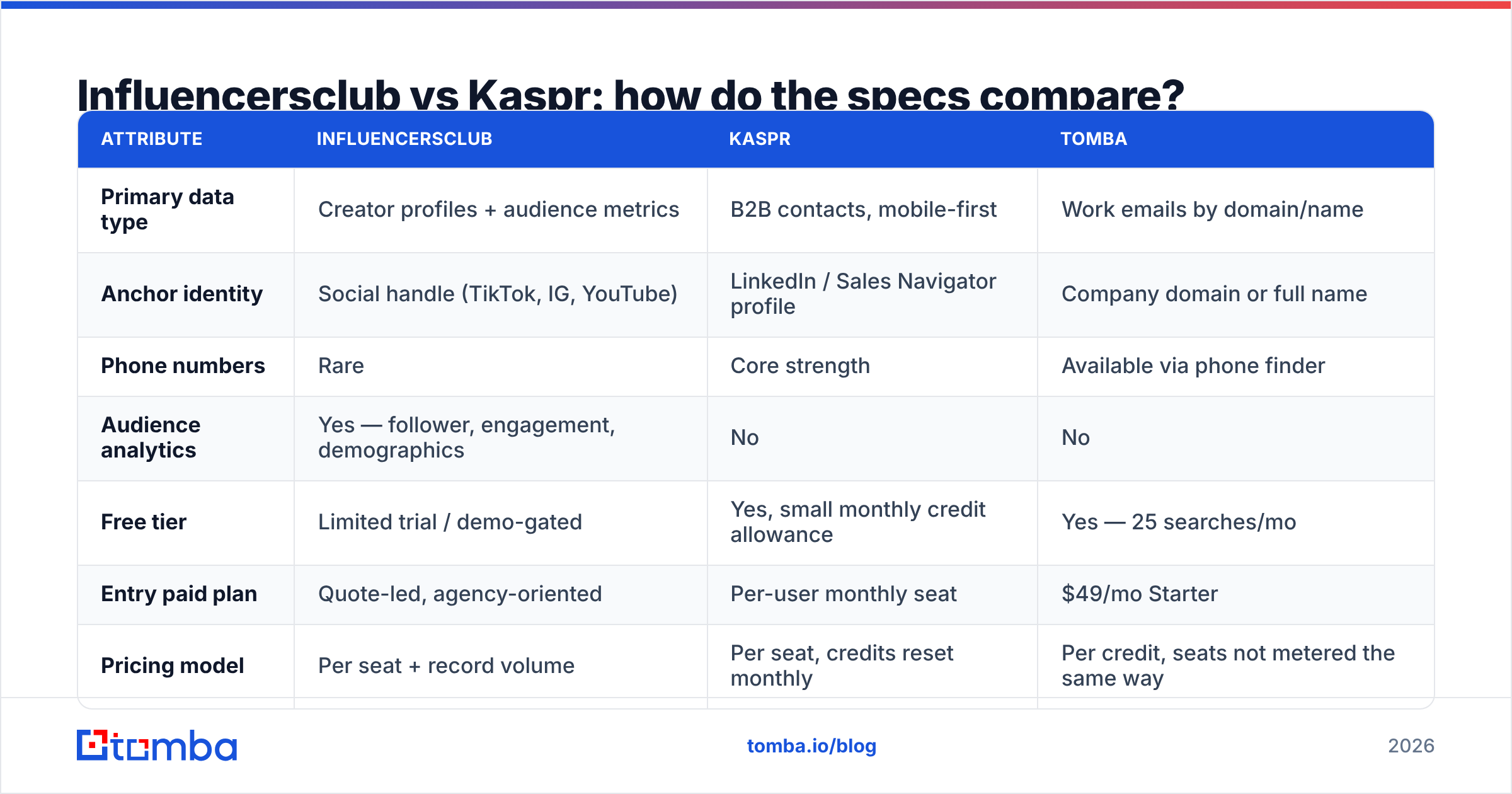
Influencersclub vs Kaspr: how do the specs compare?#
Pricing and packaging move often. The table reflects publicly advertised positioning at the time of writing — confirm on each vendor's page before you sign anything.
| Attribute | Influencersclub | Kaspr | Tomba |
|---|---|---|---|
| Primary data type | Creator profiles + audience metrics | B2B contacts, mobile-first | Work emails by domain/name |
| Anchor identity | Social handle (TikTok, IG, YouTube) | LinkedIn / Sales Navigator profile | Company domain or full name |
| Phone numbers | Rare | Core strength | Available via phone finder |
| Audience analytics | Yes — follower, engagement, demographics | No | No |
| Free tier | Limited trial / demo-gated | Yes, small monthly credit allowance | Yes — 25 searches/mo |
| Entry paid plan | Quote-led, agency-oriented | Per-user monthly seat | $49/mo Starter |
| Pricing model | Per seat + record volume | Per seat, credits reset monthly | Per credit, seats not metered the same way |
| Bulk / CSV enrichment | Yes | Yes, on higher tiers | Yes — bulk finder and verifier |
| API access | Enterprise tiers | Available on paid tiers | Yes, on all paid plans |
| Best for | Influencer and affiliate outreach | Cold calling and LinkedIn-sourced outbound | Domain-wide B2B email discovery |

Two structural things this table hides:
Per-seat pricing punishes teams. Kaspr's model charges per user. Five SDRs means five licences, whether or not all five prospect daily. Credit-based tools let one ops person enrich centrally and distribute rows. Compare Tomba pricing — Free, $49 Starter, $99 Growth, $249 Pro — against five seats of anything and the math changes fast.
Quote-led pricing punishes small buyers. Influencersclub's agency orientation means the real number often arrives after a sales call. If you are a two-person brand doing gifting campaigns, budget for that friction.
Is Kaspr the better pick for B2B outbound?#
For classic B2B outbound, yes — with caveats.
If your motion is "find 200 heads of ops in DACH fintech, call them, then email," Kaspr is built for exactly that. The extension workflow is fast, Sales Navigator integration is native, and mobile coverage in Europe is genuinely competitive because of the Cognism relationship.
The caveats:
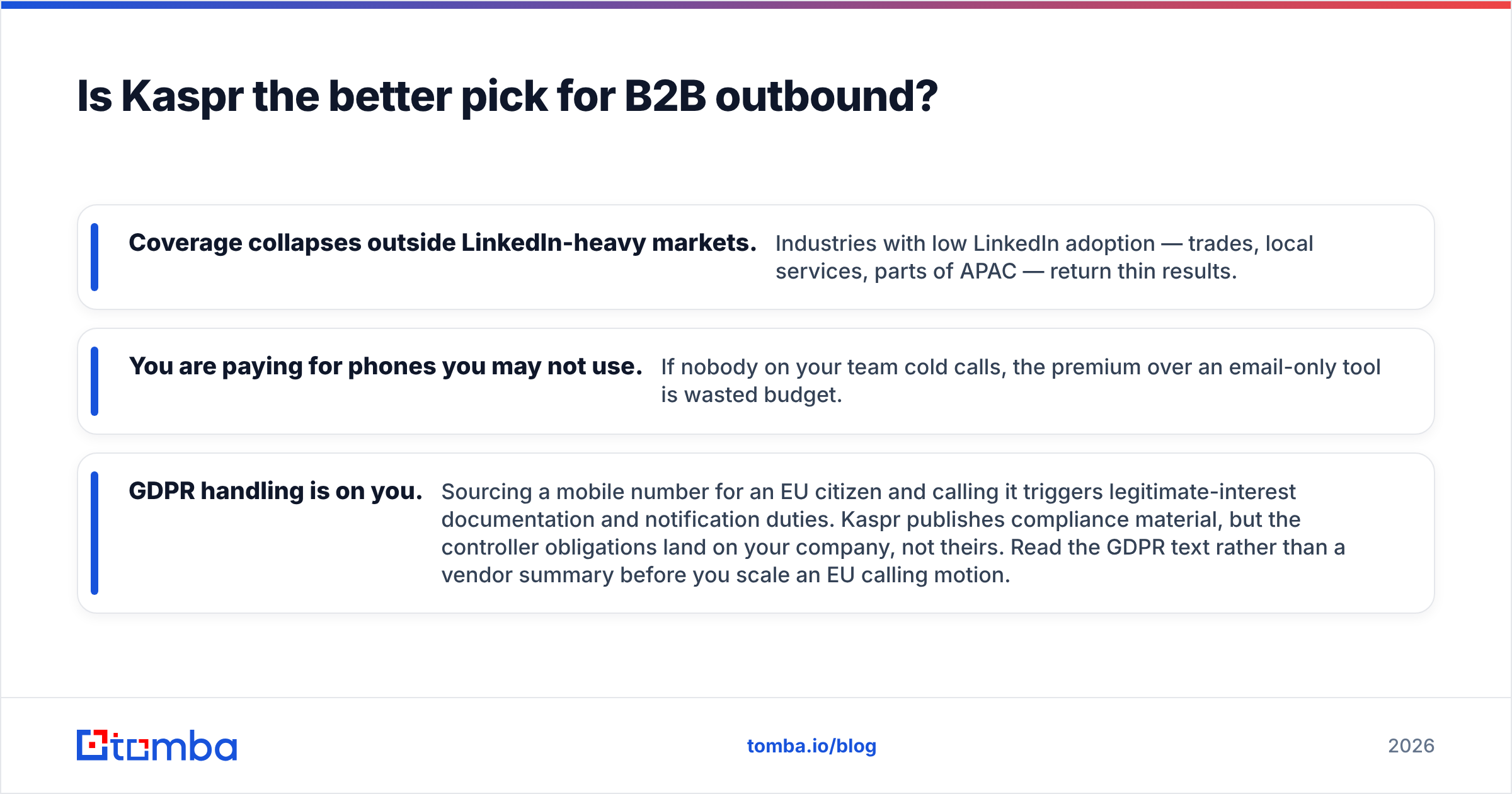
- Coverage collapses outside LinkedIn-heavy markets. Industries with low LinkedIn adoption — trades, local services, parts of APAC — return thin results.
- You are paying for phones you may not use. If nobody on your team cold calls, the premium over an email-only tool is wasted budget.
- GDPR handling is on you. Sourcing a mobile number for an EU citizen and calling it triggers legitimate-interest documentation and notification duties. Kaspr publishes compliance material, but the controller obligations land on your company, not theirs. Read the GDPR text rather than a vendor summary before you scale an EU calling motion.
If you want the same LinkedIn-sourced motion without per-seat pricing, a LinkedIn finder resolves profile URLs to verified work emails and skips the phone premium entirely.
When does Influencersclub actually win?#
When the person you want has an audience, not a job title.
Concrete cases where it beats every B2B database:
- Affiliate recruitment. You need creators in a niche with a specific audience size and geography. No B2B tool has follower counts.
- UGC sourcing at volume. You are contacting 500 micro-creators for paid content. Firmographics are meaningless; engagement rate is everything.
- Gifting and seeding campaigns. Audience demographic filters (age, gender split, country) drive the shortlist.
- Creator-adjacent SaaS sales. If you sell tools to creators, the creator database is your prospect list.
What it is not: a replacement for a B2B contact database. Searching Influencersclub for "CFOs at Series B companies" is the wrong tool for the job, and no amount of enrichment fixes that.
What about the third path — domain-first email finding?#
There is a workflow both tools skip: you know the company, not the person.
Neither Influencersclub nor Kaspr is designed for "give me every reachable contact at these 300 target accounts." Kaspr wants a profile; Influencersclub wants a handle. When you start from an account list — the normal shape of ABM and partnership work — domain search is the faster route: feed the domain, get the pattern plus every discoverable mailbox with confidence scores and sources.
That approach has three practical advantages:
- No seat tax. One operator enriches, the whole team consumes.
- Auditable sourcing. Each address comes with where it was seen, which matters when legal asks.
- Bulk-native. A CSV of 5,000 domains is a normal job, not an enterprise upsell.
It also has a real limitation, and pretending otherwise would be dishonest: it won't give you a creator's engagement rate, and it won't give you a cold-call mobile number. Different tools, different jobs.
How should you choose in practice?#
Run this in order:
- Describe your target in one sentence. If it contains a follower count → Influencersclub. If it contains a job title and you call people → Kaspr. If it contains a company domain → an email finder.
- Count the seats. Multiply the per-user price by headcount before comparing to credit-based tools. Per-seat models look cheap on the pricing page and expensive on the invoice.
- Test on 100 records you can verify. Not the vendor's sample — your own known-good list. Measure found rate after verification, not before.
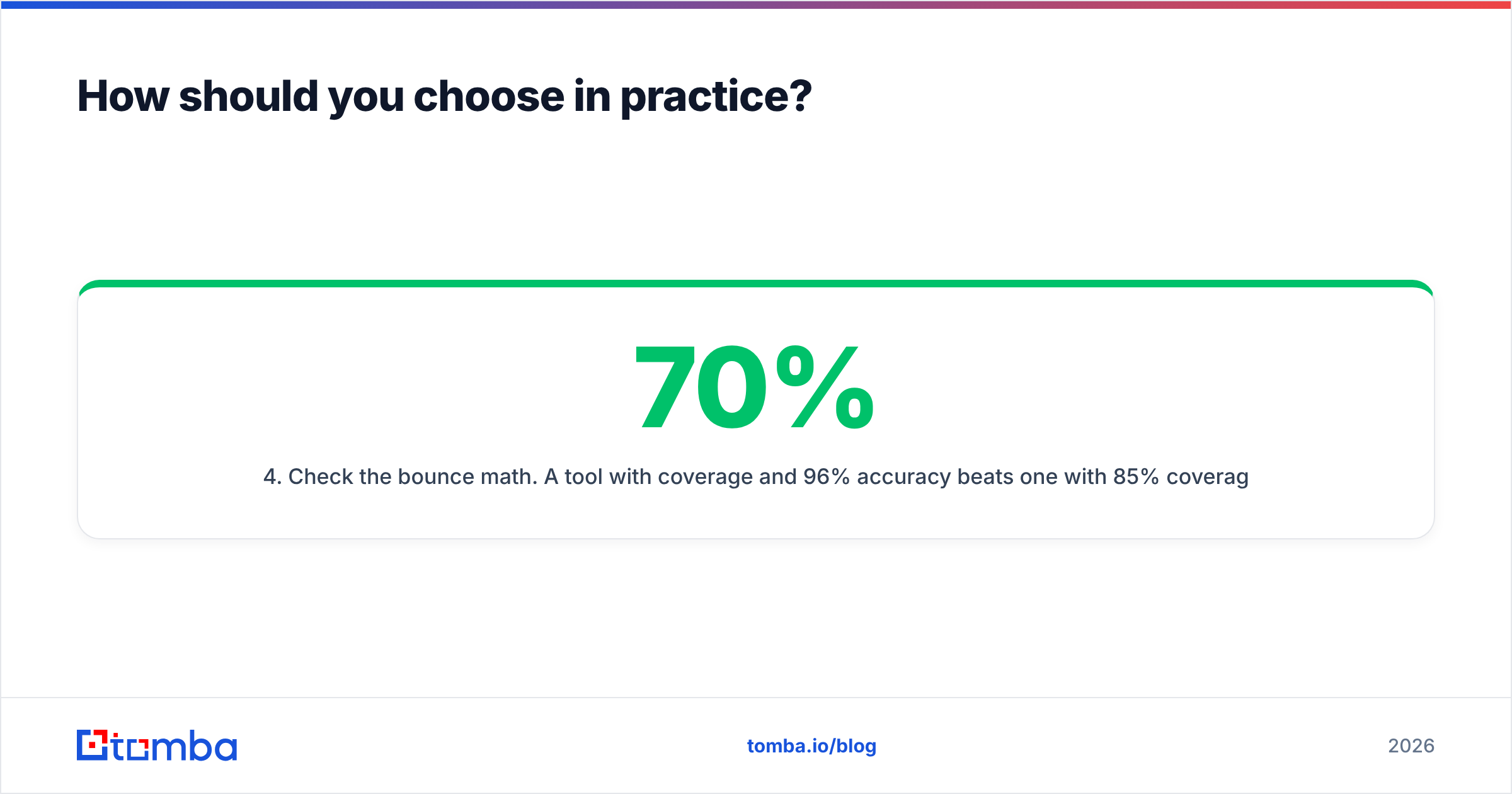
- Check the bounce math. A tool with 70% coverage and 96% accuracy beats one with 85% coverage and 82% accuracy for anything that touches a sending domain.
- Budget a verification line item regardless of which you choose. Every provider on this page ships some stale rows.
The verdict#
Kaspr wins B2B outbound. Influencersclub wins creator outreach. Neither wins both, and the marketing pages will not tell you that.
The failure mode we see most often is a team buying a creator database for a B2B motion because a demo looked impressive, or buying seats of a LinkedIn tool for a partnerships job where half the targets aren't on LinkedIn at all. Match the data model to your ICP shape first; argue about credits second.
And whichever you land on, treat the export as raw material. Verify it, dedupe it, and only then load it into your sequencer.
Need work emails without the per-seat bill? The Tomba Email Finder resolves names and domains to verified professional addresses with confidence scores and source attribution, starting free with 25 searches a month and $49/mo on Starter. Run your Kaspr or Influencersclub export through it as a verification and gap-fill layer — or use it as your primary source when the target is a company, not a creator.
Related guides#
// get started
Find, verify and enrich your first contacts today
Start on the free plan with 25 searches a month, then scale when your team is ready.
Free plan · No credit card required · GDPR & CCPA
// about the author