Influencersclub vs Lead411 (2026): Which Data Tool Wins?
One sells creator contact data, the other sells B2B sales intelligence with intent signals. Here's an honest breakdown of coverage, accuracy, pricing and which one actually fits your outbound motion in 2026.
Influencersclub vs Lead411 is an odd matchup. One tool sells creator contact data. The other sells B2B sales intelligence with intent signals. This guide compares both on coverage, accuracy, price and fit, so you can choose fast.
TL;DR#
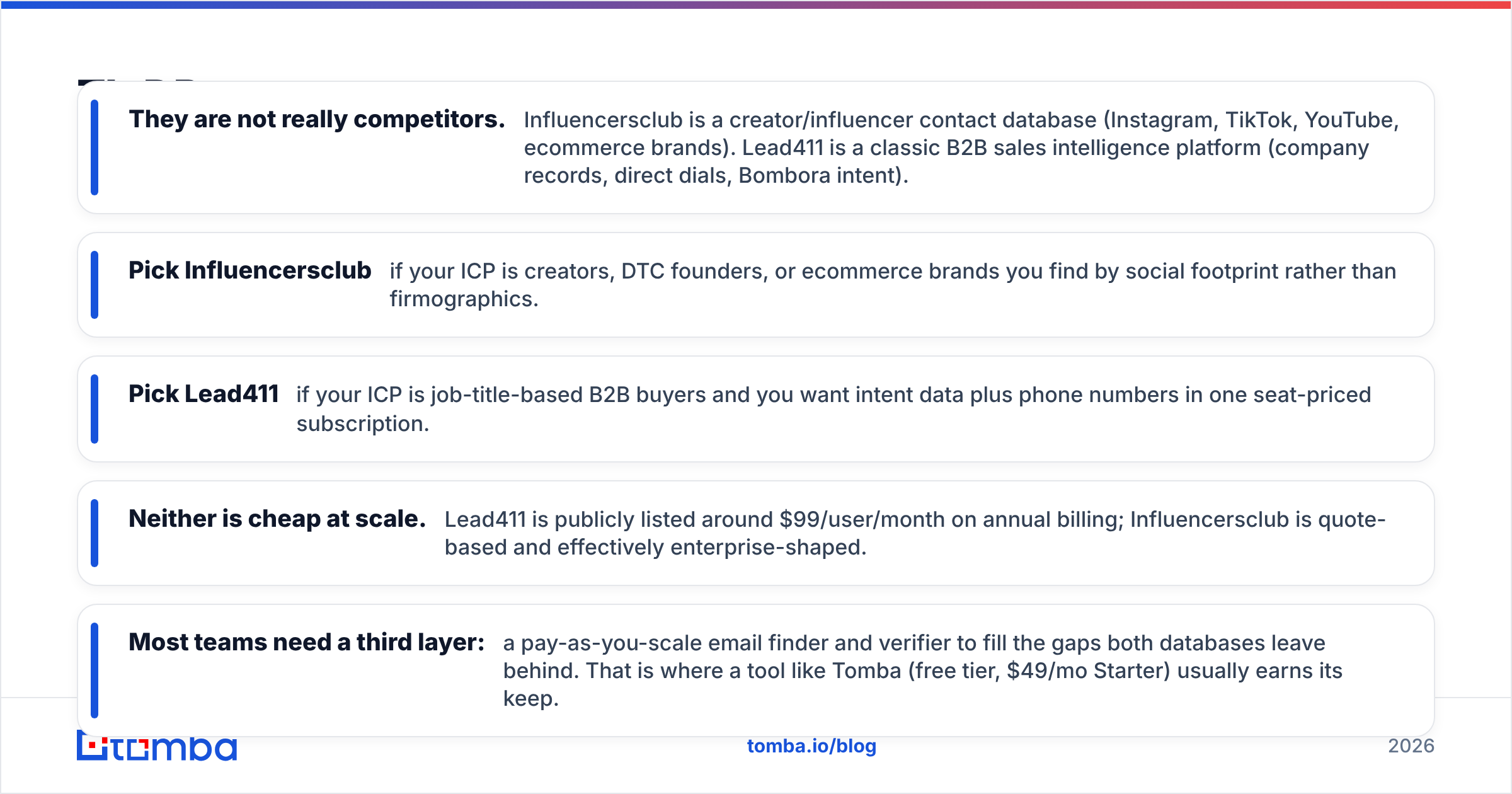
- They are not really competitors. Influencersclub is a creator contact database. It covers Instagram, TikTok, YouTube and ecommerce brands.
- Lead411 is a classic B2B sales intelligence platform. You get company records, direct dials and Bombora intent data.
- Pick Influencersclub if you sell to creators, DTC founders, or ecommerce brands you find by their social footprint.
The money side is just as lopsided:
- Pick Lead411 if you sell to job titles. You get intent data and phone numbers in one seat-priced plan.
- Neither is cheap at scale. Lead411 lists near $99/user/month on annual billing. Influencersclub is quote-based and enterprise-shaped.
- Most teams need a third layer. A pay-as-you-scale email finder and verifier fills the gaps both databases leave. A tool like Tomba (free tier, $49/mo Starter) usually earns its keep there.
Influencersclub vs Lead411: what is each tool, exactly?#
Start here. The biggest mistake buyers make is treating these two as the same kind of "lead database." They index very different worlds.
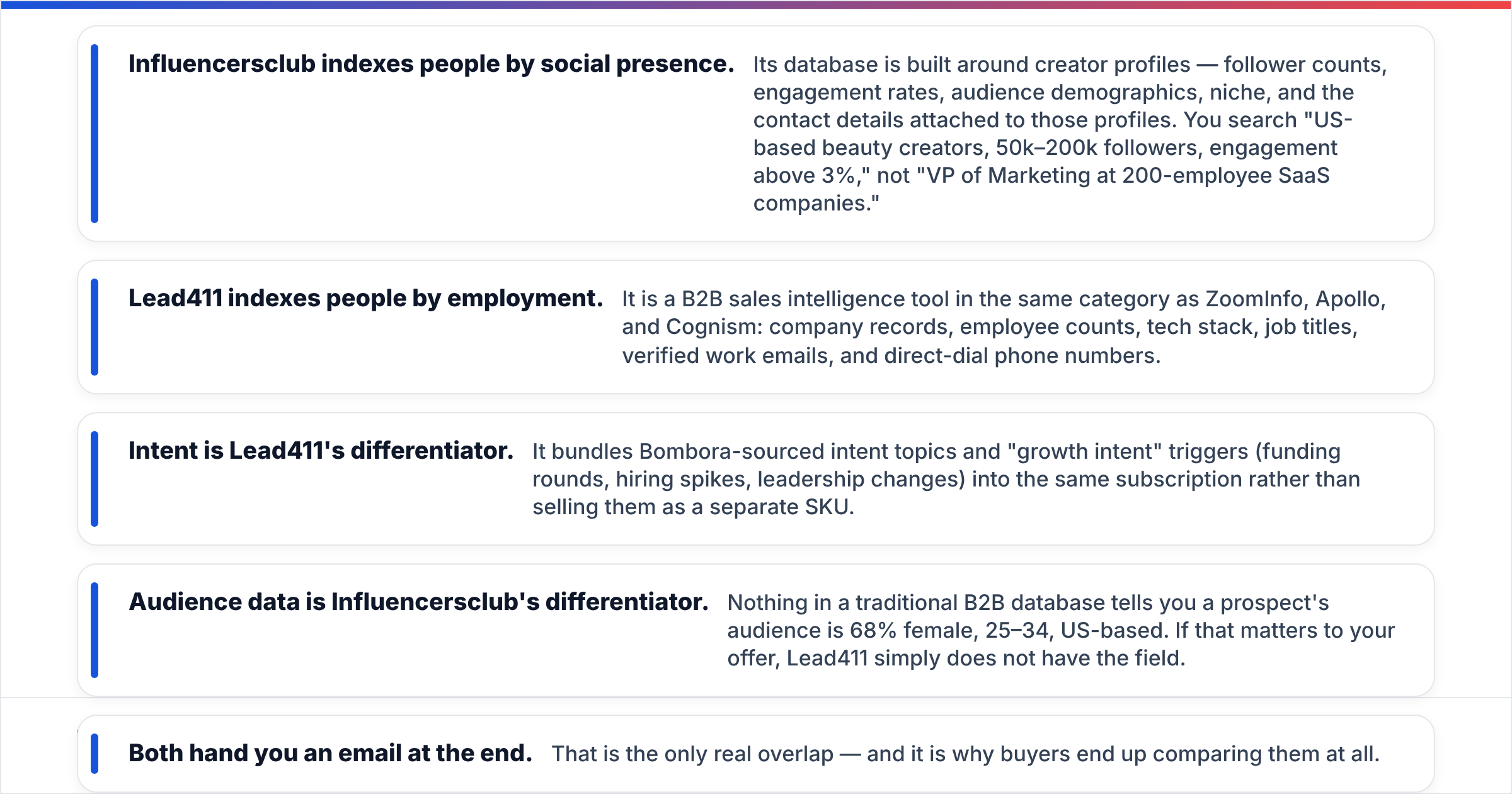
- Influencersclub indexes people by social presence. The database is built around creator profiles. Think follower counts, engagement rates, audience demographics and niche, plus the contact details on each profile. You search "US beauty creators, 50k–200k followers, engagement above 3%." You do not search "VP of Marketing at a 200-person SaaS company."
- Lead411 indexes people by employment. It sits in the same category as ZoomInfo, Apollo and Cognism. You get company records, employee counts, tech stack, job titles, verified work emails and direct-dial phone numbers.
- Intent is Lead411's differentiator. Bombora intent topics and growth triggers come inside the subscription. Funding rounds, hiring spikes and leadership changes are included, not sold as a separate SKU.
- Audience data is Influencersclub's differentiator. No traditional B2B database tells you a prospect's audience is 68% female, aged 25–34 and US-based. If that matters to your offer, Lead411 simply lacks the field.
- Both hand you an email at the end. That is the only real overlap. It is also why buyers compare them at all.
Strip both platforms down and you are buying two things. First, a filter: how you find the right people. Second, a record: what you get once you find them. Influencersclub wins on social filters. Lead411 wins on firmographic filters and fresh signals.

Influencersclub vs Lead411: whose data is more accurate?#
Accuracy is where vendor marketing gets loudest. Both companies claim 95%+ accuracy. Treat those numbers as a rough guide, not a promise. Nobody audits them, and the vendor picks the sample.
Here is what we can say from how each system is built.
Lead411's work emails are easier to check. Corporate mail servers answer SMTP checks. Patterns stay consistent, like first.last@company.com. Job changes show up in public sources. Lead411 re-verifies on a rolling basis, and its bounce guarantee reflects that. The weak spot is the one every B2B database shares. Mid-market and SMB records decay fast. Catch-all domains also hide bad addresses behind an "accept everything" reply.
Influencersclub's emails are harder to source and check. Creator emails are often free-mail addresses, such as @gmail.com. Others are business inboxes listed in a bio, or management agency addresses. Free-mail providers do not reveal validity over SMTP the way corporate servers do. So verification leans on the provider's own send history. Coverage in the creator niche is genuinely strong. But "we have an email for this profile" and "this email reaches the decision-maker" are two different claims.

The takeaway is the same either way. Run the export through an independent email verifier before it touches your sending domain. A 3% bounce rate on a 5,000-contact export is 150 hard bounces. That is enough to dent sender reputation on a new domain. Verification costs pennies per record. Rebuilding a burned domain costs weeks.
Watch catch-all domains closely. Both databases return addresses at domains that accept all mail. Both mark them valid, because the server said yes. A dedicated catch-all verifier is the only way to tell real mailboxes from black holes.
How do Influencersclub and Lead411 compare feature by feature?#
Here is the head-to-head. The pricing figures were public at the time of writing. Both vendors move fast, so check their pricing pages before you commit budget.
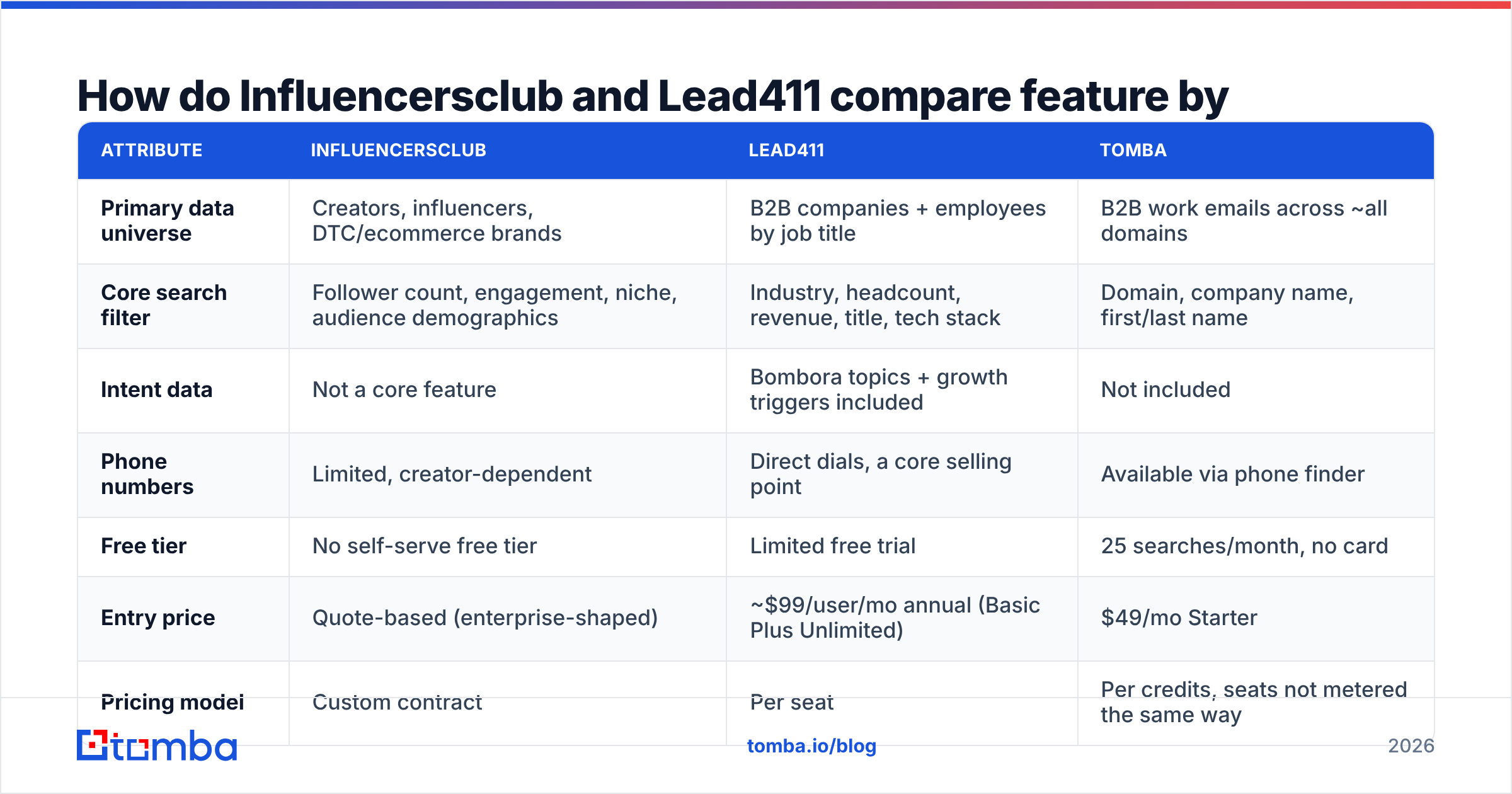
| Attribute | Influencersclub | Lead411 | Tomba |
|---|---|---|---|
| Primary data universe | Creators, influencers, DTC/ecommerce brands | B2B companies + employees by job title | B2B work emails across ~all domains |
| Core search filter | Follower count, engagement, niche, audience demographics | Industry, headcount, revenue, title, tech stack | Domain, company name, first/last name |
| Intent data | Not a core feature | Bombora topics + growth triggers included | Not included |
| Phone numbers | Limited, creator-dependent | Direct dials, a core selling point | Available via phone finder |
| Free tier | No self-serve free tier | Limited free trial | 25 searches/month, no card |
| Entry price | Quote-based (enterprise-shaped) | ~$99/user/mo annual (Basic Plus Unlimited) | $49/mo Starter |
| Pricing model | Custom contract | Per seat | Per credits, seats not metered the same way |
| API access | Yes, on higher plans | Yes, typically add-on/enterprise | Yes, on all paid plans |
| Best fit | Influencer marketing, creator recruiting, DTC partnerships | Mid-market B2B outbound with intent-led prioritisation | Targeted email finding + verification at any volume |

Two things stand out in that table.
First, the pricing models are hard to compare. Lead411 charges per seat, with generous view limits and capped exports. That suits a five-rep team prospecting every week. It punishes a two-person team that needs 20,000 records once a quarter. Influencersclub quotes every deal, so you cannot benchmark it without a sales call. That fact alone tells you who they want as customers.
Second, neither vendor covers the other's ground. Some teams sell to creators and to classic B2B buyers at once. That is common in DTC tooling, agency software and creator-economy SaaS. For those teams, Influencersclub vs Lead411 is not really a choice. It is two subscriptions.
Influencersclub vs Lead411: which one fits your outbound motion?#
Match the tool to the shape of your list, not to the feature grid.
Choose Influencersclub when:
- Your targets are defined by audience, not employer. Only a creator database can answer "fitness creators with 40k+ followers in Germany."
- You run partnerships or affiliate recruiting. You need engagement metrics next to contact details, so you can qualify before you reach out.
- You sell to DTC brands. You want to find them by social and ecommerce footprint, not by SIC code.
- You need audience demographics in the record. That data decides whether a creator is worth contacting at all.
Choose Lead411 when:
- You sell to job titles. Find the VP of RevOps, get an email and a direct dial, then sequence it.
- Intent-led prioritisation is part of your process. Bombora topics inside the subscription beat buying intent data separately.
- You want phones and emails from one vendor. If your reps really dial, this is Lead411's strongest edge over email-only tools.
- You have a stable rep headcount. Per-seat pricing rewards teams that grow slowly and use every seat.
Choose neither, or add a third tool, when:
- You already know your target accounts. Buying a full database to look up 300 known companies is expensive dead weight.
- Your volume is spiky. Seat licences and annual contracts punish irregular usage.
- You need bulk verification more than discovery. List hygiene is a different problem from list building.
What do reviewers actually say about each?#
Public review sites are a useful sanity check on vendor claims. On G2, Lead411 scores well on ease of use and support. The recurring criticisms are export limits on lower tiers and data gaps outside North America. EMEA and APAC records draw the most complaints. Test that hard if your ICP is not US-centric.
Influencersclub has a smaller public review footprint. That is normal for quote-based tools with a narrow buyer profile. Reviewers praise the depth of the creator filters. They also flag the usual creator-database problem: emails that route to a manager or a generic inbox instead of the creator.
Before you sign either contract, run the same test on both. Take 50 contacts from your real ICP that you can confirm yourself. Then check what share each platform returns correctly. Vendor demos always use their best-covered segment. Your list is the only benchmark that predicts your results. To run that test cheaply, pull baseline data via domain search or the Tomba API, then compare fill rates side by side.
Check both vendors' sites for current specifics. lead411.com publishes its plan tiers openly. influencers.club routes most pricing questions through sales.
Do you still need a dedicated email finder alongside these?#
Usually yes. The reason is coverage shape, not data quality.
Both platforms are databases. They return what they already hold. When a record is missing, you get nothing, and you burn a query to learn that. An email finder works the other way. It takes a name and a domain, then resolves the address on demand. Pattern inference plus live verification does the work. That covers the long tail both databases miss: new hires, small companies, non-US domains, and the one person you actually need.
The economics differ too. Under Lead411's per-seat model, a contractor who needs 400 lookups a month costs as much as an SDR who needs 4,000. A credit-based email finder scales with usage, not headcount. That is why many teams run one next to their main database, rather than instead of it.
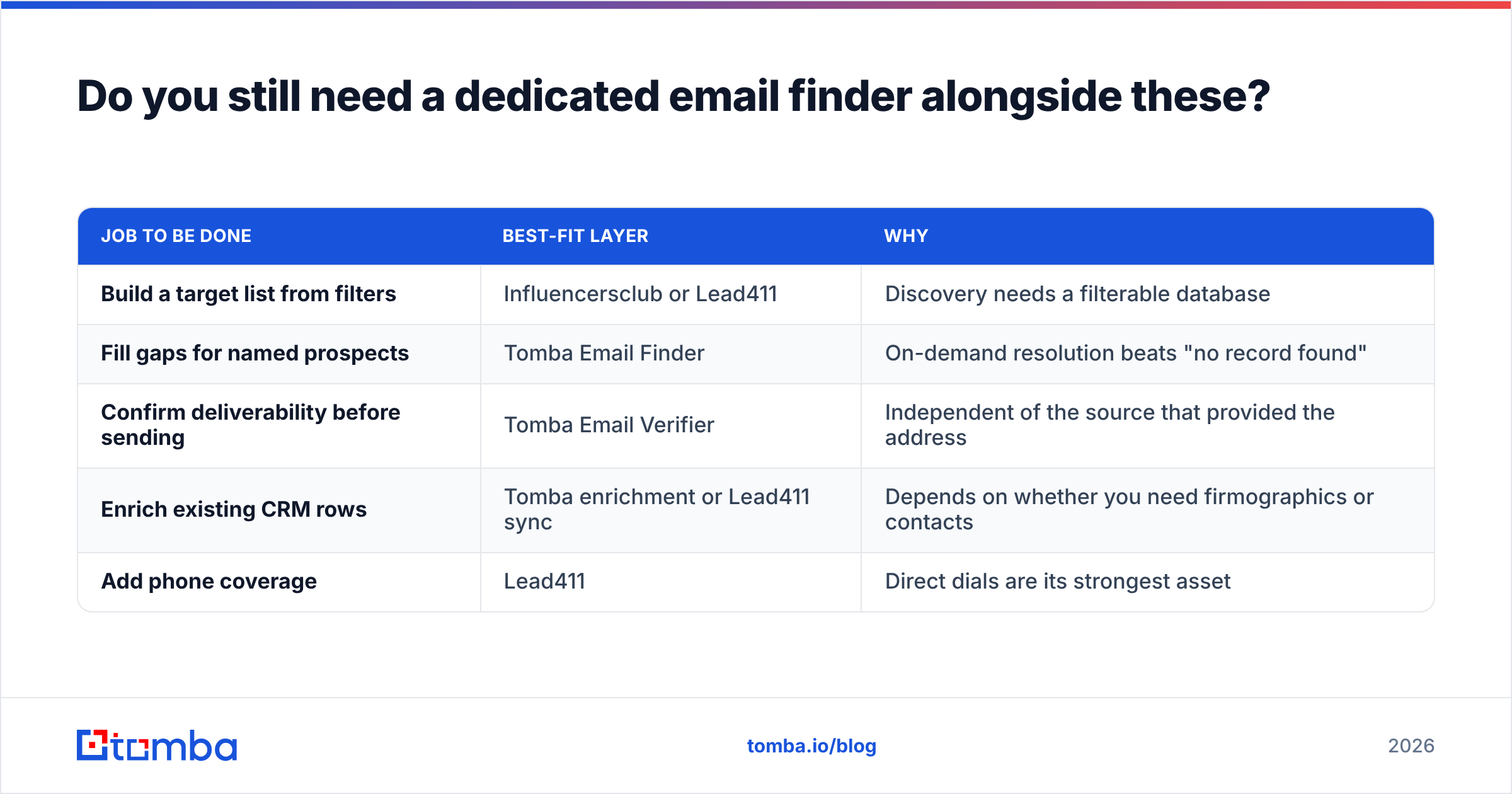
A realistic stack looks like this:
| Job to be done | Best-fit layer | Why |
|---|---|---|
| Build a target list from filters | Influencersclub or Lead411 | Discovery needs a filterable database |
| Fill gaps for named prospects | Tomba Email Finder | On-demand resolution beats "no record found" |
| Confirm deliverability before sending | Tomba Email Verifier | Independent of the source that provided the address |
| Enrich existing CRM rows | Tomba enrichment or Lead411 sync | Depends on whether you need firmographics or contacts |
| Add phone coverage | Lead411 | Direct dials are its strongest asset |
That layered approach also protects you from vendor lock-in. Swap databases next year and your verification and enrichment layer stays put. Your data enrichment workflows keep running.
What is the final verdict on Influencersclub vs Lead411?#
Lead411 is the better buy for standard B2B outbound. Pricing is public, intent data is included, and direct dials are strong. The product is mature. Its weak points, export caps and thin non-US coverage, are known and manageable.
Influencersclub is the better buy if creators are your ICP. No general B2B database can copy audience-level filtering. If that is how you qualify, nothing else substitutes. Budget for a sales cycle and expect an enterprise-style commitment.
They rarely belong in the same shortlist. If Influencersclub vs Lead411 still feels like a close call, your ICP definition is probably fuzzy. Fix that first. The tool choice then follows on its own.
Whichever you pick, keep a light finder-and-verifier layer underneath. Databases decay and contracts expire. The prospect who matters most this quarter is always the one that returns "no record found."
Ready to fill the gaps your database leaves behind? Tomba Email Finder resolves work emails from a name and domain in seconds. Verification is built in, so nothing untested reaches your sending domain. Start free with 25 searches a month, no card required. Scale to $49/mo Starter or $99/mo Growth only when your volume justifies it. See full Tomba pricing for details.
Related guides#
// get started
Find, verify and enrich your first contacts today
Start on the free plan with 25 searches a month, then scale when your team is ready.
Free plan · No credit card required · GDPR & CCPA
// about the author