Influencers Club vs Leadsforge: Which Data Tool Wins in 2026?
One sells creator contact data, the other sells AI-generated B2B lead lists. They get compared constantly and they solve different problems. Here is the honest breakdown of fit, data quality, and cost.
TL;DR — Influencers Club vs Leadsforge in one minute
- They are not really rivals. Influencers Club is a creator contact database. Leadsforge is an AI B2B lead-list builder. If you are still comparing them, you have not picked your buyer yet.
- Pick Influencers Club if your buyer is a creator, a talent manager, or a social-first brand. You get handles, audience data, and creator emails in one place.
- Pick Leadsforge if your buyer is a company. You describe an ICP in plain words and get back a list of firms and contacts. There is no filter-heavy UI to learn.
- Both leave the same gap: contact-level accuracy. Neither one checks that an email still works. A list that looks clean in the UI can still bounce at 20–40% on your domain.
- The practical setup: source from the platform that fits your buyer. Then run every address through a dedicated email verifier before the first send.
What is Influencers Club, and what is Leadsforge?#
Start with the category, not the feature list. Influencers Club vs Leadsforge is not a feature fight. The two tools sit in different aisles of the same store.
- Influencers Club is creator-data infrastructure. Its index is built around social profiles — Instagram, TikTok, YouTube. It then attaches contact details and audience data to each profile. You search by follower count, niche, engagement rate, location, or audience type. See their own positioning at influencers.club.
- Leadsforge is an AI lead-list builder. You skip the filters and describe your ideal customer in a sentence ("Series A fintech companies in the UK with an in-house RevOps lead"). It then builds the list. The pitch is speed and zero learning curve.
That is the heart of Influencers Club vs Leadsforge. Three knock-on effects follow from it.
- The unit of data is different. The atom in Influencers Club is a person with an audience. The atom in Leadsforge is a company with buying signals. That one difference drives the pricing model, the extra fields you get, and who on your team logs in.
- The output overlaps. Both hand you a CSV or a CRM push with names and email addresses. That overlap is why the comparison exists, and why teams get confused about which one to buy.
- Neither is a verification layer. Both surface emails. Neither one promises the address still works on the day you export it. That is the failure point most reviews skip.
If you sell to brands and companies, Leadsforge is in the right aisle. If you sell to people with followings, Influencers Club is. Buy the wrong one and you have made a targeting mistake, not a pricing mistake. No discount fixes that.
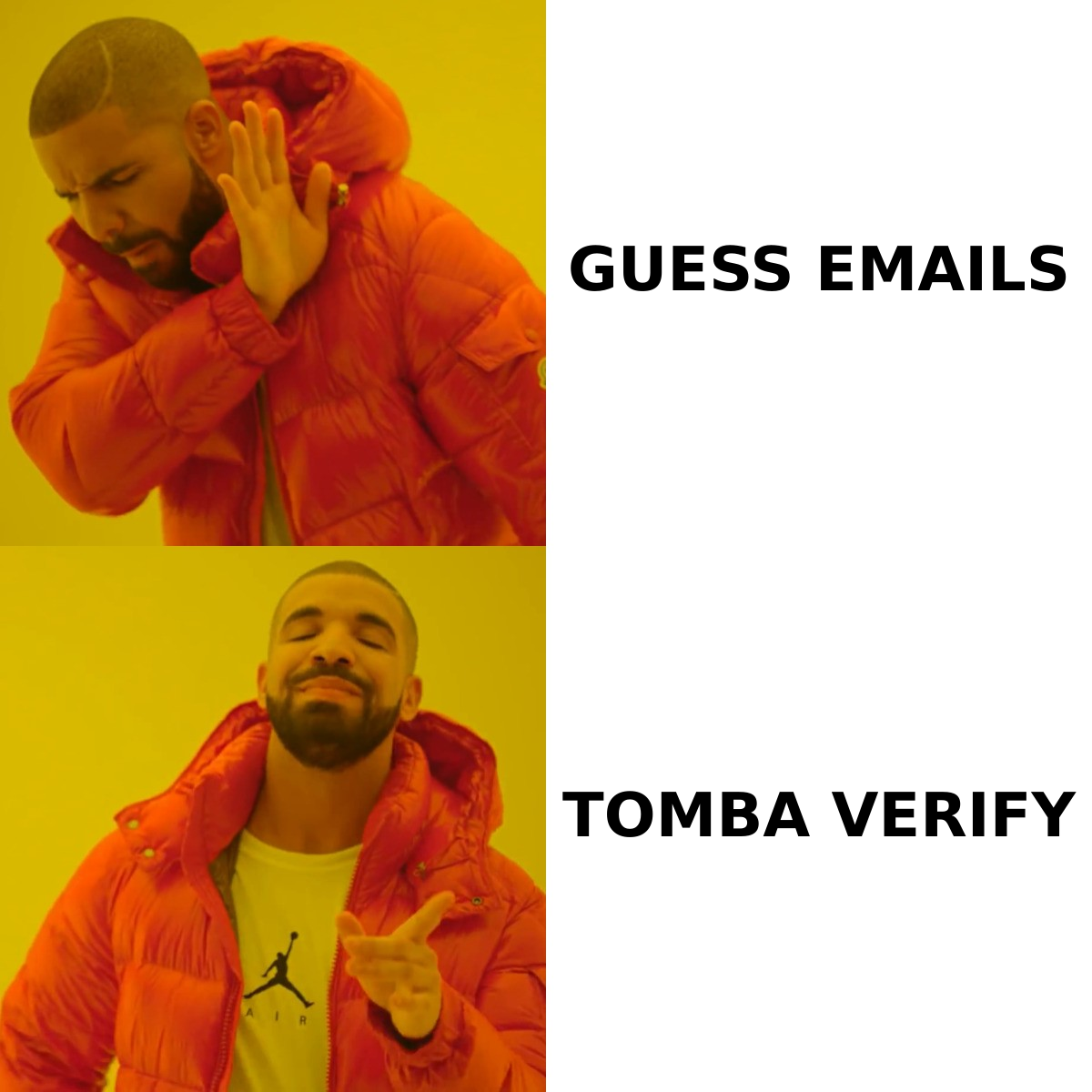
Influencers Club vs Leadsforge: how do they compare head-to-head?#
Here is the side-by-side on the things that actually change your workflow. Pricing moves often. Treat published tiers as a starting point and confirm on each vendor's site before you commit.
| Attribute | Influencers Club | Leadsforge |
|---|---|---|
| Primary data type | Creator/influencer profiles + contact info | B2B companies + decision-maker contacts |
| Search method | Structured filters (niche, followers, engagement, audience demo) | Natural-language prompt to an AI agent |
| Best-fit buyer | Influencer marketing, DTC brands, agencies, creator platforms | SDR teams, founders, B2B SaaS, agencies selling to companies |
| Social/audience data | Deep — follower counts, engagement, audience geography | Minimal to none |
| Firmographics (size, funding, tech) | Limited | Core strength |
| Email verification | Contact data included; verification not the core product | Contacts included; verification not the core product |
| Learning curve | Moderate — filter-heavy | Low — type a sentence |
| Typical entry pricing | Mid-market SaaS tier, quote-driven at scale | Entry tier plus credit-based usage |
| Exports / CRM | CSV export, integrations | CSV export, integrations |
| Where it breaks down | Useless for non-creator B2B ICPs | Thin for creator/social targeting; prompt quality drives output quality |
Two honest caveats about that table. First, "AI-generated list" is a workflow claim, not a data claim. An AI interface still queries a database underneath, and that database sets the quality. Second, "deep social data" does not mean the email is right. A creator profile can be current while the contact address on it is two agencies out of date.
Who is Influencers Club actually built for?#
Buy Influencers Club when the person you want to reach has an audience. That is the first fork in Influencers Club vs Leadsforge.
Concrete fits:
- Influencer marketing teams building seeding campaigns and needing to filter by audience geography, not just follower count.
- DTC and ecommerce brands running always-on creator programs where you contact hundreds of micro-influencers a month.
- Agencies that need to show a client a shortlist with engagement and audience-quality evidence attached.
- Creator-economy SaaS doing outbound to creators themselves — course platforms, monetization tools, brand-deal marketplaces.
Where it disappoints: say half your pipeline is "VP of Marketing at a 200-person B2B software company." Then you are paying for an audience engine you will never open. Creator databases index the wrong axis for that buyer. You are better served by a plain domain search that returns every public address at a target company, plus the pattern it uses.
One more practical note: creator contact data goes stale fast. Creators switch managers, move from a personal Gmail to an agency inbox, and drop the "business email" in a bio. Check any creator list older than a quarter again before you send to it.
Who is Leadsforge actually built for?#
Buy Leadsforge when your bottleneck is list-building time, not list-building depth. In Influencers Club vs Leadsforge, this is the side that sells speed.
Concrete fits:
- Founders doing their own outbound who do not want to learn a 40-filter interface at 11pm.
- Small SDR teams that need a fresh list per campaign and cannot wait on a RevOps ticket.
- Agencies running many ICPs where the prompt-per-client model is faster than saving dozens of filter sets.
- Anyone testing new segments — the cost of asking a bad question is one prompt, not an afternoon.
Where it disappoints: plain-language search is a convenience layer over a database, and you inherit that database's coverage. Vague prompts produce vague lists. Say your ICP is truly narrow. You want firms that run one specific payment processor and raised in the last six months. A filter-based platform with real tech and funding fields will beat a prompt here. You can see exactly what you asked for. Check current user reviews on G2 before you assume coverage in your vertical. Review volume alone tells you how mature a dataset is.
How accurate is the data, and how do you actually test it?#
Neither vendor's marketing number should be your number. Influencers Club vs Leadsforge is settled by data quality, and only your own test measures that. It takes an hour, and it is the best hour you will spend before you sign an annual contract.
The five-step accuracy test:
- Pull 100 contacts from a segment you know well. Pick one where you can eyeball whether the companies or creators are right.
- Manually check 20 by hand. Does the person still work there? Is the creator still active? This catches staleness that no verifier can detect.
- Run all 100 through an independent verifier. Record valid / invalid / catch-all / unknown counts. A free email checker is enough for a spot test; use an API for volume.
- Send a small warm batch — 50 addresses, from a domain you are willing to risk, and measure hard bounces.
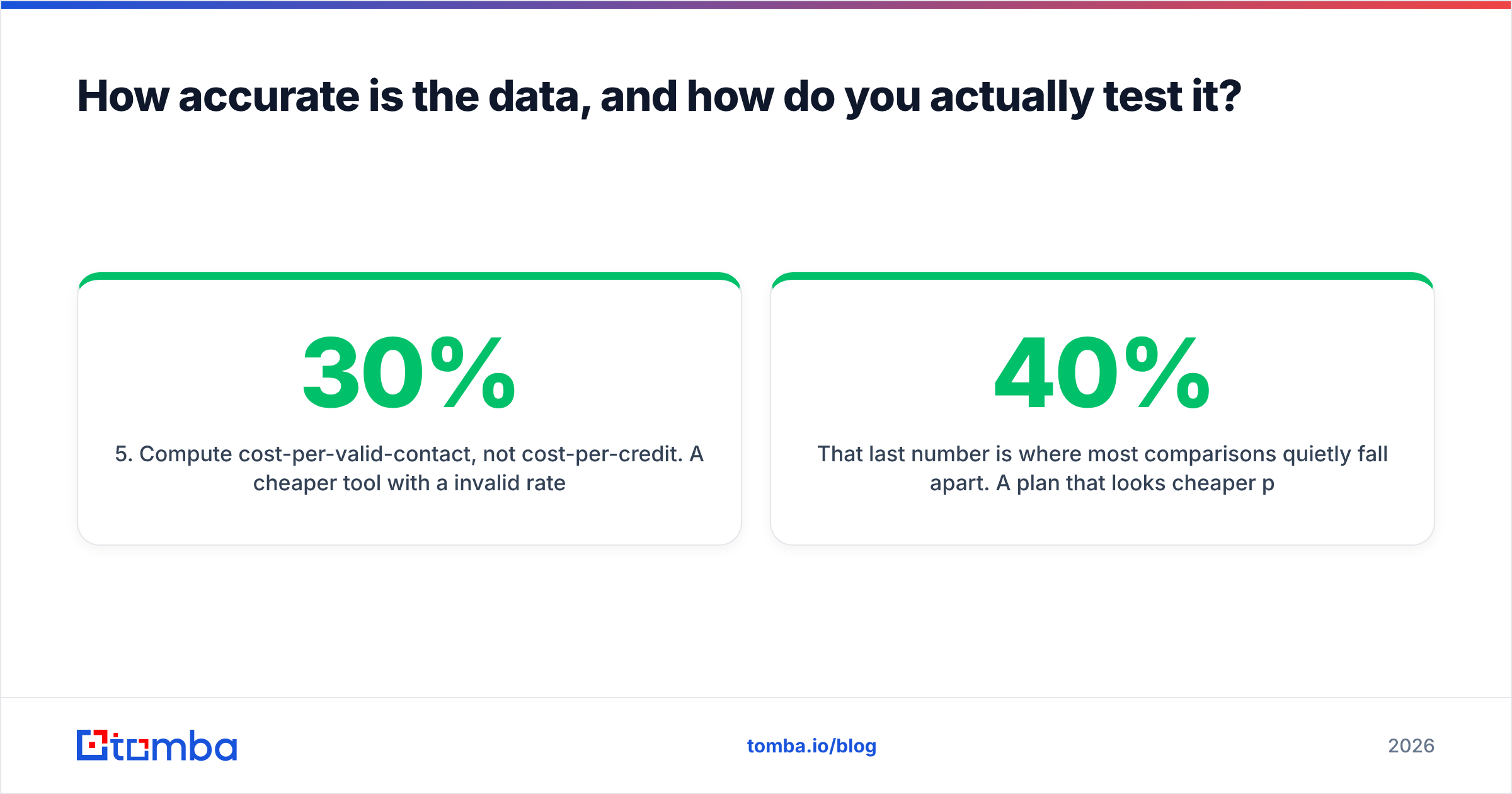
- Compute cost-per-valid-contact, not cost-per-credit. A cheaper tool with a 30% invalid rate is more expensive than a pricier tool at 5%.
That last number is where most comparisons quietly fall apart. A plan that looks 40% cheaper per record can cost 20% more per usable record. The damage is not only financial. Hard bounces above roughly 2% put your sender name and long-term email deliverability at risk, and that taxes every campaign you run after it.
Pay close attention to catch-all domains. Many mid-market and enterprise mail servers accept every address at the domain. A naive verifier marks those "valid," so your list looks clean right up until the bounces land. Catch-alls need a dedicated catch-all verifier, not a generic syntax-and-MX check.
What do they cost — and where do the hidden costs hide?#
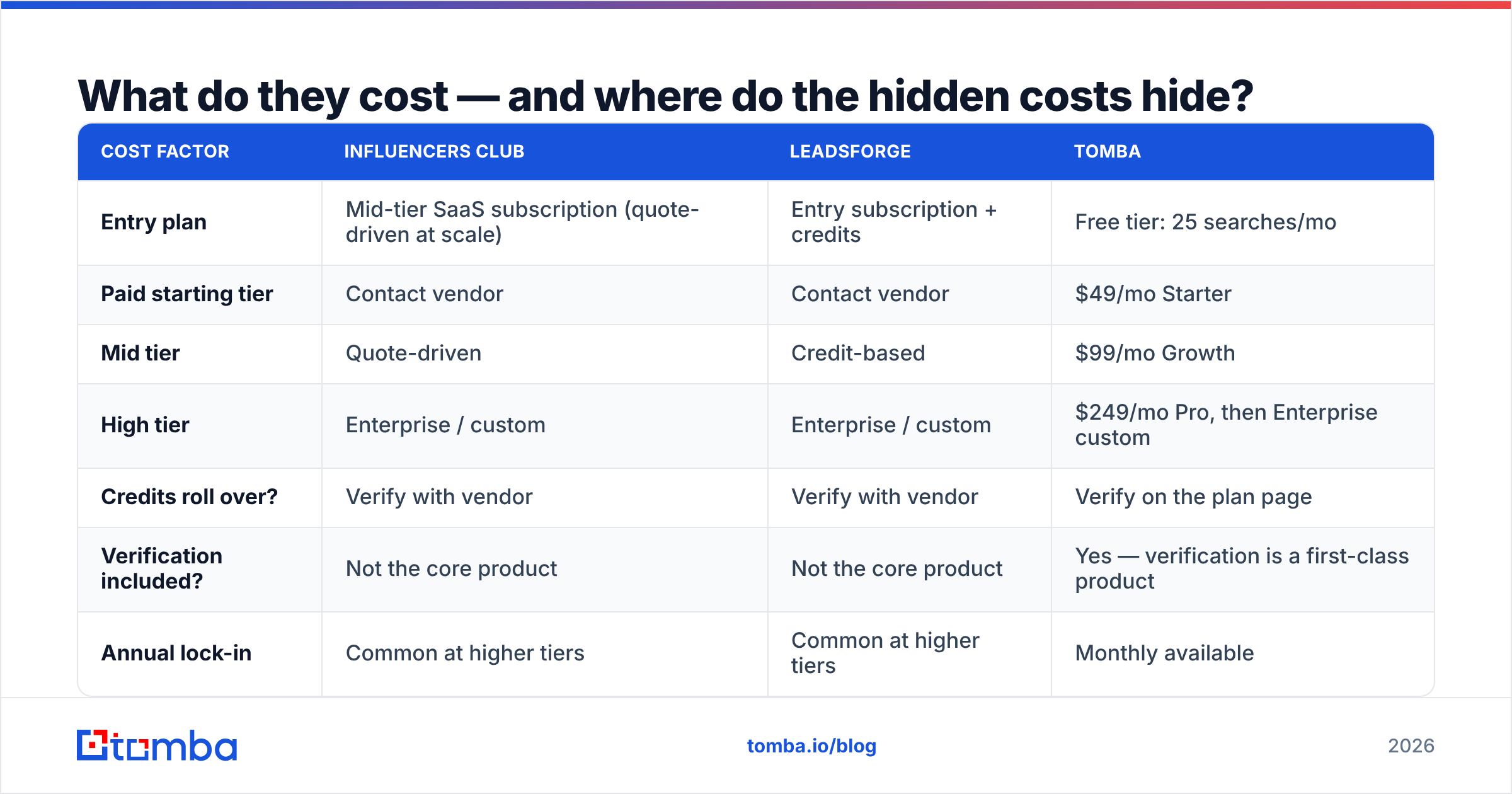
Sticker price is the smallest part of the bill. Here is the full cost of Influencers Club vs Leadsforge, plus how a dedicated email-finding layer compares as a line item.
| Cost factor | Influencers Club | Leadsforge | Tomba |
|---|---|---|---|
| Entry plan | Mid-tier SaaS subscription (quote-driven at scale) | Entry subscription + credits | Free tier: 25 searches/mo |
| Paid starting tier | Contact vendor | Contact vendor | $49/mo Starter |
| Mid tier | Quote-driven | Credit-based | $99/mo Growth |
| High tier | Enterprise / custom | Enterprise / custom | $249/mo Pro, then Enterprise custom |
| Credits roll over? | Verify with vendor | Verify with vendor | Verify on the plan page |
| Verification included? | Not the core product | Not the core product | Yes — verification is a first-class product |
| Annual lock-in | Common at higher tiers | Common at higher tiers | Monthly available |
| API access | Available on higher plans | Available on higher plans | Available, documented |
The four costs that never appear on a pricing page:
- Wasted credits on invalid records. If a tool charges you for a contact it cannot deliver, your effective price is
list price ÷ valid rate. At 70% valid, a $0.10 record costs $0.14. - Seat minimums. Several data platforms price per seat with a floor of three or five. A two-person team pays for five.
- Annual-only tiers. The month-to-month option often disappears exactly at the tier where the data gets good.
- Deliverability cleanup. A burned sending domain costs weeks of warmup. That is the most expensive line item on this list and it never shows up in procurement.
Want a wider view of how the B2B data market prices and packages? HubSpot's sales blog runs solid benchmark surveys on outbound cost and conversion. Use them to sanity-check a vendor's ROI math against a source that is not a sales rep.
Which one should you pick?#
Short version of Influencers Club vs Leadsforge: choose by buyer, not by feature list.
- Your buyer has an audience → Influencers Club. Nothing in a B2B lead tool replicates audience demographics or engagement quality.
- Your buyer is a company → Leadsforge, if you value speed and a low learning curve over surgical filtering.
- Your buyer is a company and your ICP is narrow → neither, on its own. A filter-first B2B database with real tech and funding fields will serve you better. Weigh options like BookYourData too, for verified, pay-as-you-go B2B contact records.
- You run both motions — creator partnerships and B2B outbound — → you need two sources and one verification standard applied to both. That is the setup most agencies land on.
The honest summary: Influencers Club vs Leadsforge is not a "which tool is better" question. Influencers Club is very good at a job Leadsforge does not attempt, and the reverse is true too. Anyone who tells you one clearly beats the other is comparing a hammer to a wrench.
Where does a dedicated email finder fit alongside these tools?#
In the gap both platforms share: contact-level accuracy at the moment of send.
The layered stack that works:
- Sourcing layer — Influencers Club or Leadsforge (or both) to decide who to contact.
- Finding layer — fill the gaps. Sourcing platforms routinely return a name and a company with no email, or a generic
info@. A bulk email finder resolves those into named addresses. - Verification layer — every address, every time, including catch-all handling, before it enters a sequence.
- Enrichment layer — data enrichment to add the fields your CRM needs for routing and personalization.
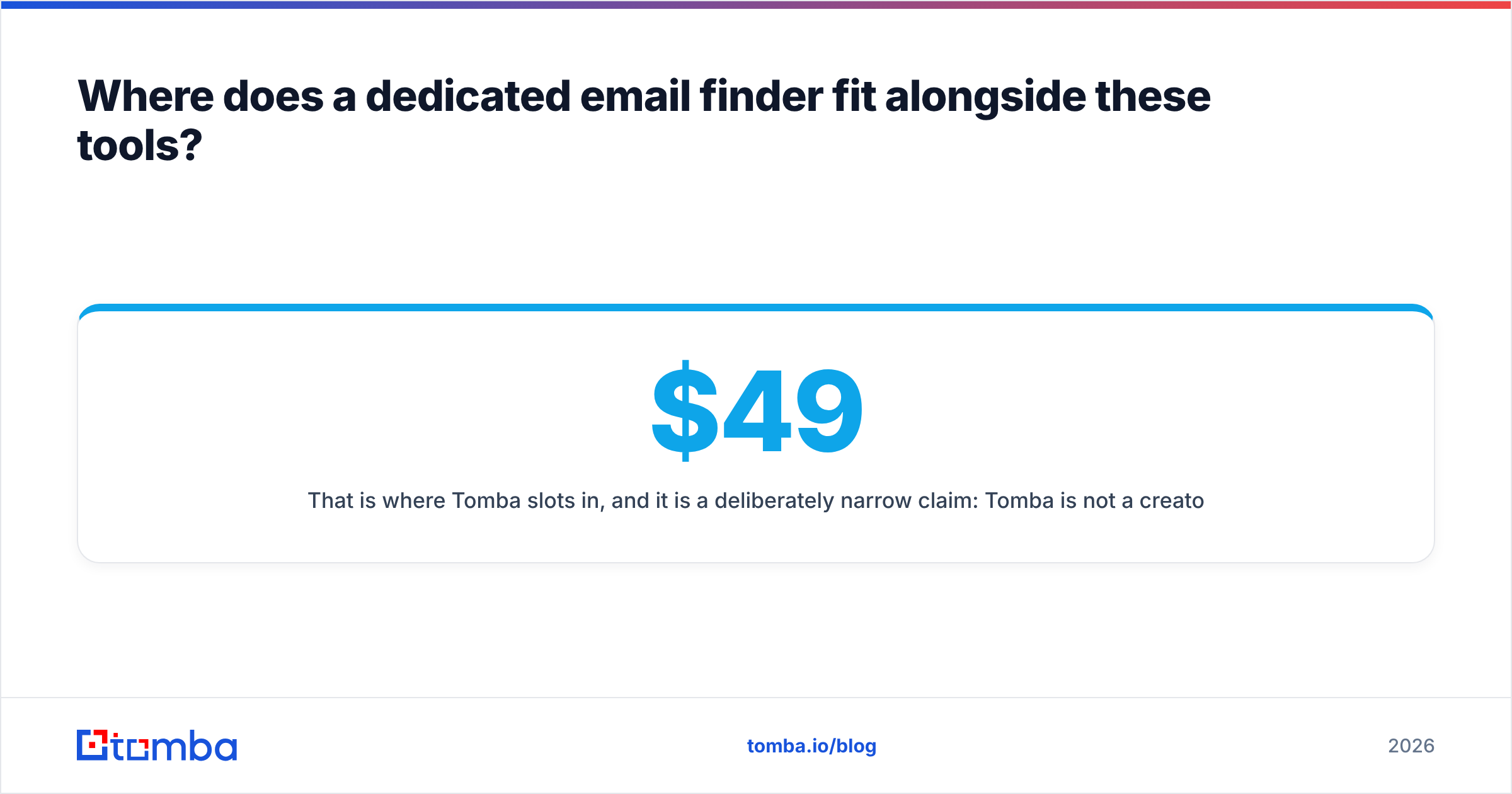
That is where Tomba slots in, and the claim is a narrow one. Tomba will not find you creators and it will not build an ICP from a sentence. It turns I know who I want to reach into I have a verified address for that person. There is an email finder API too, if you want it wired into your pipeline instead of run from a UI. Tomba pricing is public — free tier at 25 searches/mo, then $49/mo Starter, $99/mo Growth, and $249/mo Pro. That makes it cheap to run as an accuracy check on top of either sourcing tool.
What should you do this week?#
Run the test, do not read more reviews.
- Trial both tools, or the one matching your buyer.
- Export 100 contacts from each.
- Verify all of them independently.
- Compare cost-per-valid-contact, not cost-per-credit.
- Buy the winner, keep the verification layer permanently.
Maybe your sourcing tool is already chosen and a third of the emails bounce. Start with the Tomba Email Finder. Run your list through it and see the valid rate for yourself on the free tier. Settle Influencers Club vs Leadsforge with your own data, not with a comparison post — including this one.
Related guides#
Ready to find emails that actually work?
Join 150,000+ professionals who stopped guessing and started sending. Free credits on signup — no credit card required.
Get the Tomba newsletter
Practical outbound tactics and product updates — once every two weeks.
About the author