Influencersclub vs Salesbot (2026): Which Data Tool Wins?
Influencersclub sells creator contact data. Salesbot automates conversations. They solve different problems — and most teams buying one actually need the other. Here's the honest breakdown, plus where a dedicated email finder beats both.
TL;DR
- Influencersclub and Salesbot are not really competitors. One is a creator/consumer contact database; the other is a category of AI sales bots that automate conversations. Comparing them is like comparing a phone book to a receptionist.
- Pick Influencersclub if your ICP is creators, influencers, or social-first ecommerce brands and you need contact data attached to social profiles.
- Pick a Salesbot-style tool if your problem is response speed and follow-up volume, not data sourcing.
- Neither is a great fit if what you actually need is verified B2B work emails at company domains — that is a dedicated email finder job, and it costs a fraction of either.
- Budget reality: creator-data platforms are usually quote-based and land in the hundreds per month; Tomba's Starter plan is $49/mo with a free tier for testing.
What is Influencersclub and what is Salesbot?#
Start with the honest framing, because the search term hides a category mismatch.
Influencersclub (influencers.club) is a creator-data platform. Its core asset is an index of social profiles — Instagram, TikTok, YouTube — enriched with contact details, audience demographics, engagement metrics, and (in newer versions) ecommerce signals like which brands a creator has worked with. You search by audience criteria, not by company domain. The output is a list of people with a social handle and, where available, an email address.
Salesbot is trickier, because the name is used for at least two different things:
- Salesbot as a CRM chatbot — the best-known example is the Salesbot feature inside Kommo (formerly amoCRM), a no-code bot builder that answers inbound messages on WhatsApp, Instagram DM, and web chat, qualifies the lead, and pushes it into a pipeline stage.
- Salesbot as a generic AI SDR — a growing class of tools marketed as "your AI sales bot" that draft and send outbound sequences, sometimes with a bundled contact database of uneven quality.
Either way, a sales bot is an automation layer. It does not create data; it acts on data you already have. So the real question behind "influencersclub vs salesbot" is usually: do I have a sourcing problem or an execution problem?
Is influencersclub vs salesbot even a fair comparison?#
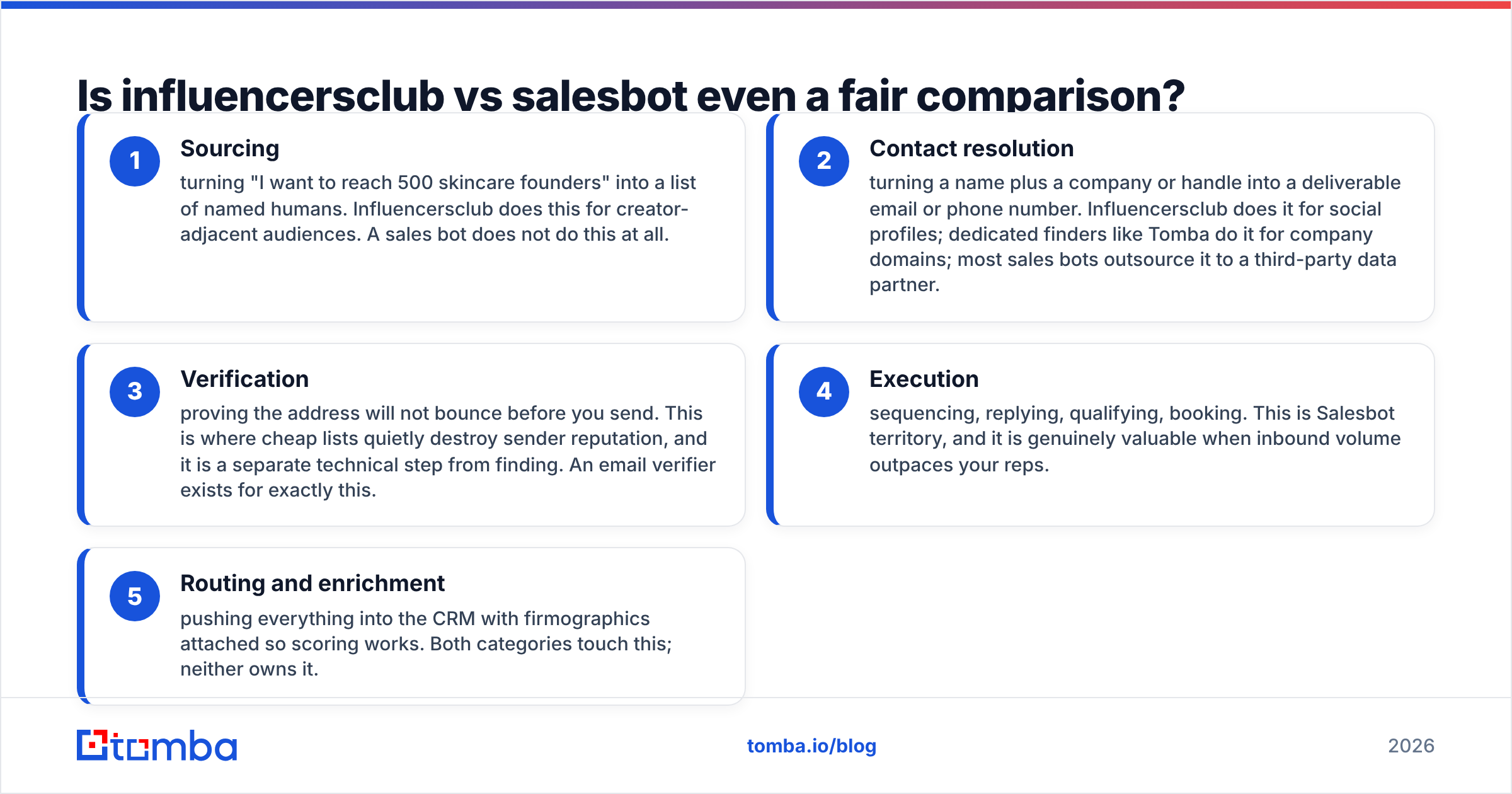
Only if you decide first which of these four jobs you are buying for. Use this as the filter before you look at a single pricing page:
- Sourcing — turning "I want to reach 500 skincare founders" into a list of named humans. Influencersclub does this for creator-adjacent audiences. A sales bot does not do this at all.
- Contact resolution — turning a name plus a company or handle into a deliverable email or phone number. Influencersclub does it for social profiles; dedicated finders like Tomba do it for company domains; most sales bots outsource it to a third-party data partner.
- Verification — proving the address will not bounce before you send. This is where cheap lists quietly destroy sender reputation, and it is a separate technical step from finding. An email verifier exists for exactly this.
- Execution — sequencing, replying, qualifying, booking. This is Salesbot territory, and it is genuinely valuable when inbound volume outpaces your reps.
- Routing and enrichment — pushing everything into the CRM with firmographics attached so scoring works. Both categories touch this; neither owns it.
If you map your bottleneck onto that list, the comparison usually resolves itself in about thirty seconds. Teams that buy the wrong side of it end up paying for a database they never query or a bot with nothing to talk to.
Which one gives you more usable email addresses?#
Neither tool is optimised for B2B work emails, and that is the single most important thing to understand before you spend.
Influencersclub's contact coverage is strongest on public creator emails — the business@ or hello@ addresses creators publish in bios and media kits, plus resolved personal addresses. That is genuinely hard data to assemble, and for influencer outreach it is the right shape. But those addresses behave differently from B2B addresses: they are frequently Gmail or Outlook consumer accounts, often shared with a manager, and often already saturated with pitches. Deliverability is fine; response is the constraint.
Sales-bot tools that bundle data are the riskier end. When a bot's contact database is a resold aggregate, you inherit whatever staleness the upstream vendor has. The tell is the absence of a published, independent accuracy figure and no bounce guarantee.

For B2B outbound, the numbers that matter are hit rate on a target domain and bounce rate after verification. Any vendor that will not talk about both is asking you to underwrite their data quality with your sending domain. Run a sample of 100 known contacts through any tool before you commit — a fifteen-minute test that saves months of degraded email deliverability.
How do Influencersclub, Salesbot and a dedicated email finder compare?#
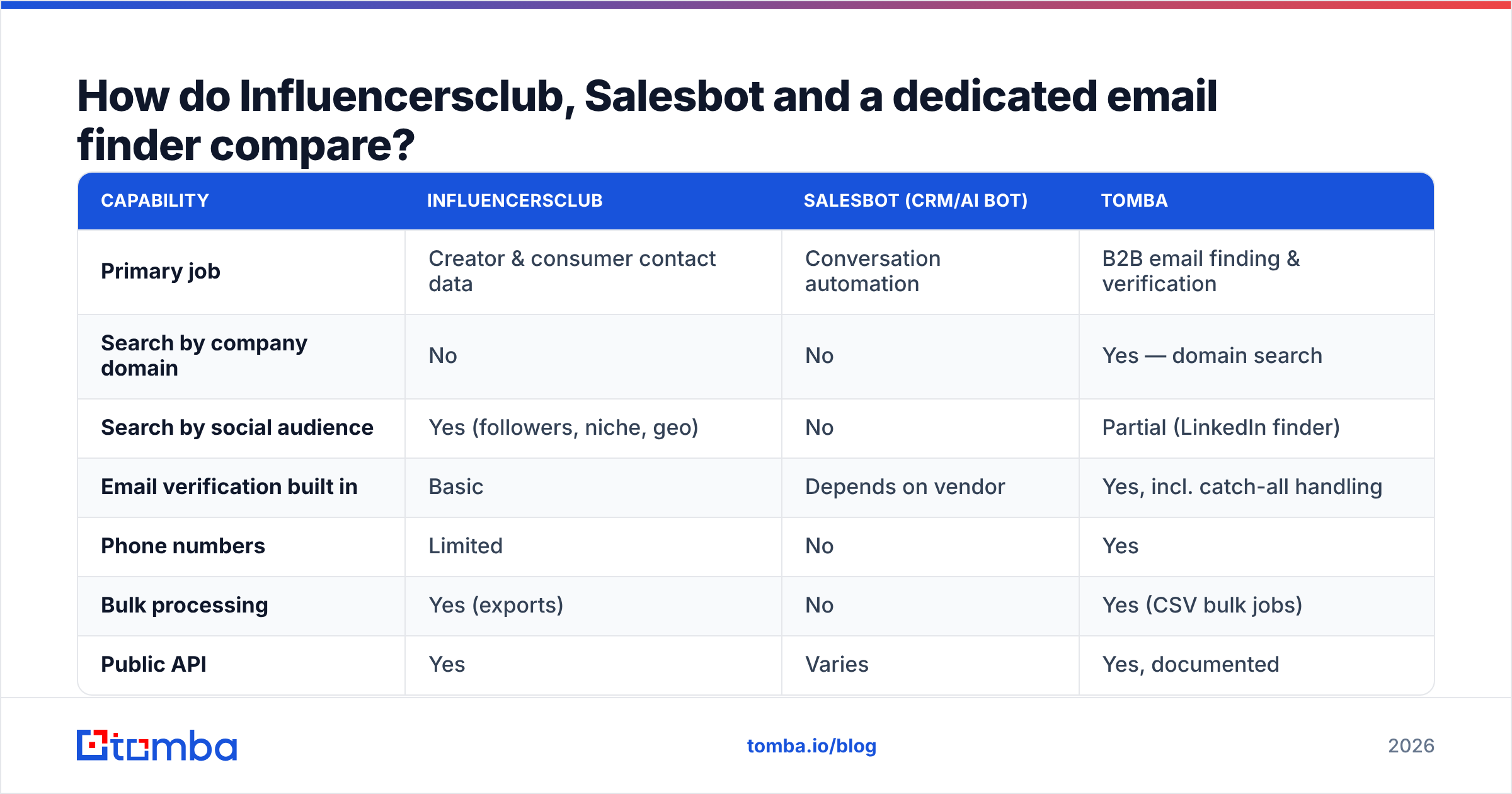
Here is the feature-by-feature view, with a purpose-built finder included as the third column because most readers landing on this comparison are actually shopping in that lane.
| Capability | Influencersclub | Salesbot (CRM/AI bot) | Tomba |
|---|---|---|---|
| Primary job | Creator & consumer contact data | Conversation automation | B2B email finding & verification |
| Search by company domain | No | No | Yes — domain search |
| Search by social audience | Yes (followers, niche, geo) | No | Partial (LinkedIn finder) |
| Email verification built in | Basic | Depends on vendor | Yes, incl. catch-all handling |
| Phone numbers | Limited | No | Yes |
| Bulk processing | Yes (exports) | No | Yes (CSV bulk jobs) |
| Public API | Yes | Varies | Yes, documented |
| Spreadsheet add-ons | Limited | No | Google Sheets, Excel, Airtable |
| Best-fit buyer | Influencer/affiliate marketers | Inbound-heavy sales teams | Outbound B2B & agencies |

Two rows do most of the work here. Search by company domain is binary: if your ICP is "VP of Engineering at Series B SaaS companies," a creator database cannot answer that query at any price. And verification with catch-all handling is where teams get burned — roughly a fifth of business domains accept all mail, which means an unverified address looks valid right up until it hard-bounces. A catch-all verifier is the difference between a clean list and a list that quietly poisons your domain.
What does each option cost in 2026?#
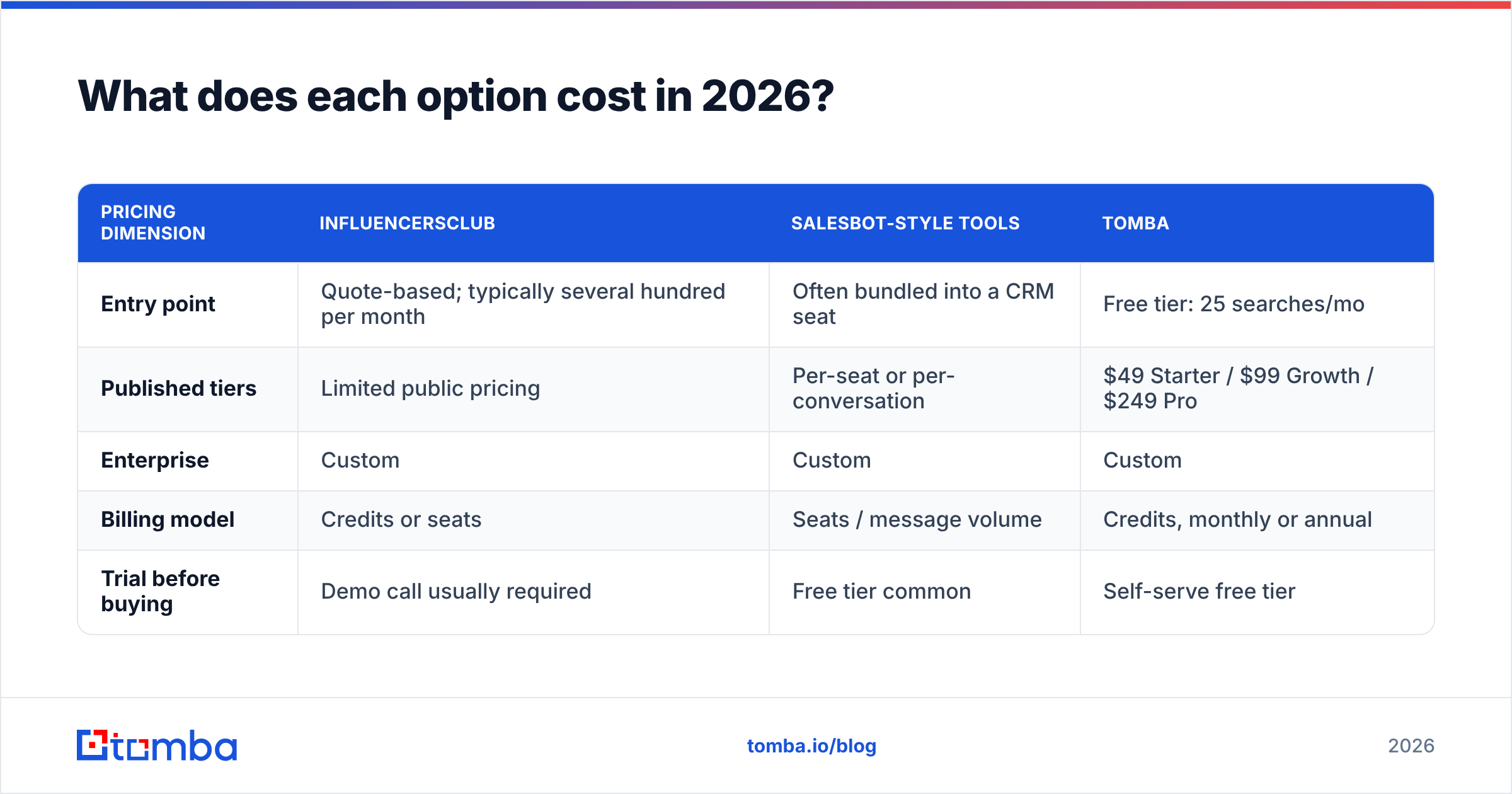
Pricing transparency is itself a signal, so treat this table as a shape rather than a quote — verify current numbers on each vendor's own page before you budget.
| Pricing dimension | Influencersclub | Salesbot-style tools | Tomba |
|---|---|---|---|
| Entry point | Quote-based; typically several hundred per month | Often bundled into a CRM seat | Free tier: 25 searches/mo |
| Published tiers | Limited public pricing | Per-seat or per-conversation | $49 Starter / $99 Growth / $249 Pro |
| Enterprise | Custom | Custom | Custom |
| Billing model | Credits or seats | Seats / message volume | Credits, monthly or annual |
| Trial before buying | Demo call usually required | Free tier common | Self-serve free tier |
The structural difference matters more than the absolute numbers. Quote-based pricing means a sales call, an annual commitment, and a floor set by the vendor's ideal customer — not yours. Self-serve pricing means you can test on a Tuesday afternoon and cancel on Wednesday. If you are validating a new outbound motion, optionality is worth more than a marginal discount. You can see the current Tomba pricing without talking to anyone.
Who should choose Influencersclub?#
Buy it when creators are your market, not a channel into your market. Specifically:
- You run influencer or affiliate programs at scale and need to source 200+ creators per quarter with audience filters that actually hold up.
- You need audience demographics — age, geo, gender split, authenticity scoring — to justify spend to a client or a CFO. This is real analytical value a generic B2B database does not have.
- Your outreach is partnership-shaped: gifting, commission, whitelisting. Those conversations tolerate a
hello@inbox in a way that enterprise sales does not. - You are already tracking social selling performance and want the sourcing layer to match the channel.
Where it disappoints buyers: teams that assumed a creator database would double as a B2B prospecting tool. The overlap is thinner than the marketing suggests. Check current user reviews on G2's influencer marketing category for pattern-matching before a demo, and read them for what people complain about rather than what they praise.
Who should choose a Salesbot?#
Buy it when your problem is latency, not volume. The research on inbound response time is unambiguous — HubSpot's sales data and a decade of lead-response studies all point the same direction: minutes matter, and most teams answer in hours. A bot that qualifies an inbound WhatsApp message at 11pm and books a slot is worth real money.
Signals you are in this bucket:
- Inbound volume exceeds what your reps can triage within an hour.
- A large share of your pipeline arrives through chat channels rather than forms.
- Your qualification logic is stable enough to encode — if every deal is bespoke, a bot will frustrate more prospects than it converts.
- You already have a working CRM with clean stages. A bot on top of a messy pipeline just automates the mess.
Where it disappoints buyers: cold outbound. A bot with a mediocre bundled list sends more bad email faster. That is not leverage; that is a reputation problem with a subscription attached.
What does a stack that actually works look like?#
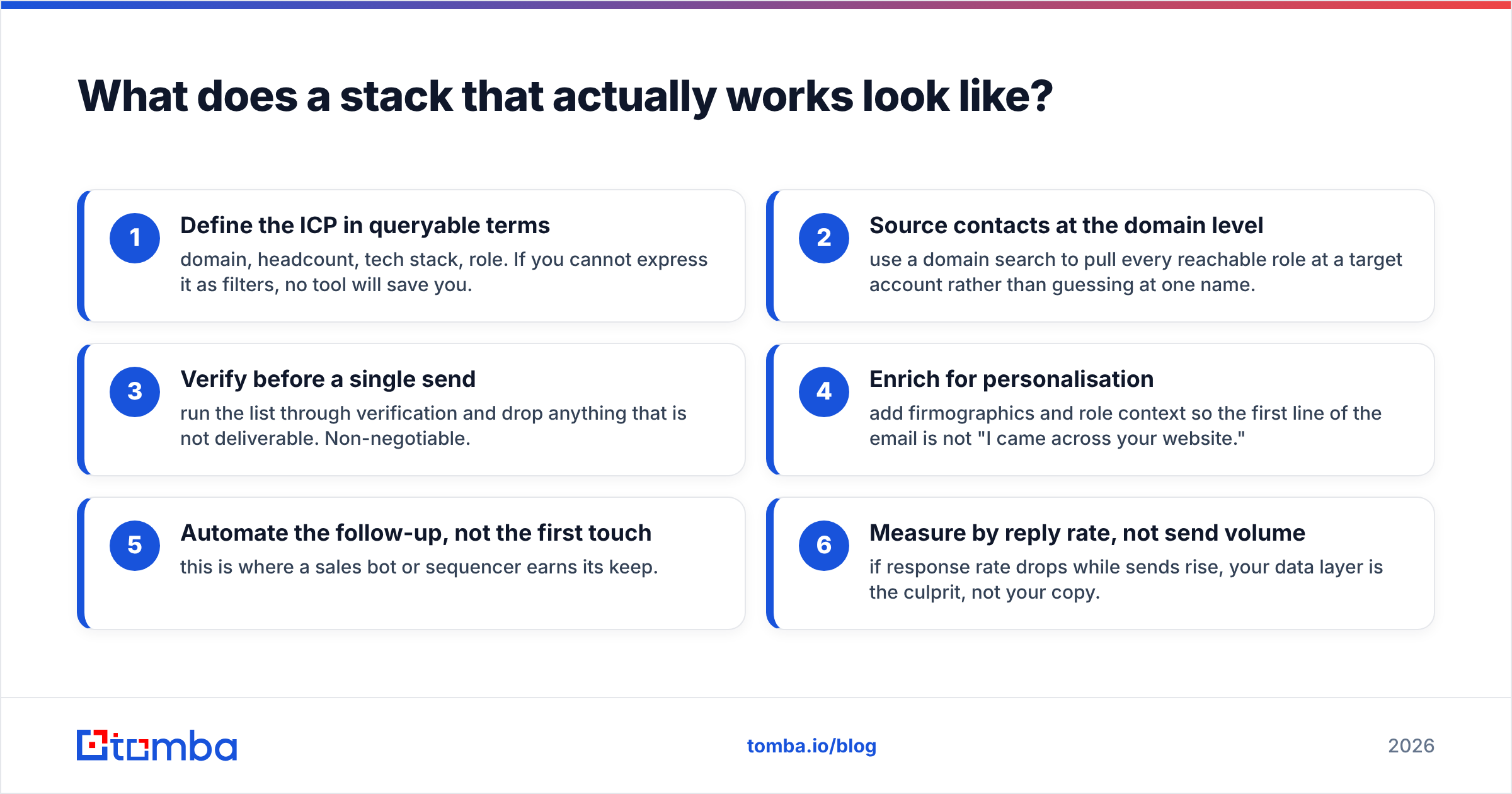
Most teams comparing these two end up needing pieces of both, plus a dedicated data layer underneath. A practical build order:
- Define the ICP in queryable terms — domain, headcount, tech stack, role. If you cannot express it as filters, no tool will save you.
- Source contacts at the domain level — use a domain search to pull every reachable role at a target account rather than guessing at one name.
- Verify before a single send — run the list through verification and drop anything that is not deliverable. Non-negotiable.
- Enrich for personalisation — add firmographics and role context so the first line of the email is not "I came across your website."
- Automate the follow-up, not the first touch — this is where a sales bot or sequencer earns its keep.
- Measure by reply rate, not send volume — if response rate drops while sends rise, your data layer is the culprit, not your copy.
That sequence is deliberately boring. Every step teams skip — usually verification — shows up two months later as a deliverability incident that costs more than a year of subscription fees.
So which one wins?#
For creator and influencer outreach: Influencersclub, comfortably. Nothing in the B2B data world matches audience-level filtering on social platforms, and the demographic data has genuine analytical value.
For inbound triage and follow-up at volume: a Salesbot, provided your qualification logic is stable and your CRM hygiene is decent.
For B2B outbound prospecting — which is what most people searching this comparison actually need: neither. You want a purpose-built finder with published accuracy, catch-all handling, bulk processing, and self-serve pricing. Influencer data indexes people by audience; sales bots index conversations. Neither indexes companies by domain, which is the primary key for B2B.
The category confusion is understandable. Both product pages talk about "leads," "contacts," and "outreach at scale." The words overlap; the underlying data models do not.
If your bottleneck is getting verified work emails for named people at named companies — not creators, not inbound chats — start with the Tomba Email Finder. Search by domain or by name, verify every result before it reaches your sequencer, and export straight to your CRM or spreadsheet. The free tier gives you 25 searches a month with no card and no demo call, which is enough to run the 100-contact accuracy test on your own ICP and see the hit rate for yourself. If the numbers hold up, Starter is $49/mo; if they do not, you have lost an afternoon instead of an annual contract.
Related guides#
// get started
Find, verify and enrich your first contacts today
Start on the free plan with 25 searches a month, then scale when your team is ready.
Free plan · No credit card required · GDPR & CCPA
Get the Tomba newsletter
Product and data updates
// about the author