InfluencersClub vs ZoomInfo: Which Data Tool Wins in 2026?
One sells creator contact data, the other sells enterprise sales intelligence, and most buyers only discover the difference after signing. Here is the honest head-to-head on coverage, pricing, contracts, and accuracy.
InfluencersClub vs ZoomInfo is an odd matchup. One tool sells creator contact data. The other sells enterprise B2B sales intelligence. Most buyers learn the difference only after they sign. Here is the short version first, then the pricing, accuracy, and contract detail behind it.
TL;DR
- They are not really competitors. Influencers Club is a creator and social-audience database. ZoomInfo is B2B sales intelligence. If you are comparing the two, one of them is probably wrong for your motion.
- ZoomInfo is the expensive one, and the cost is structural. Annual contracts, seat minimums, credit caps, and auto-renewal terms drive the complaints in public reviews. Data quality is rarely the issue.
- Influencers Club wins on creator coverage. It maps Instagram, TikTok, and YouTube profiles, with audience data and contact details. It does not cover CFOs at manufacturing firms.
- Neither is a cheap way to get verified work emails. If that is the whole job, a focused email finder at $49/mo does it for far less.
- Pick by output, not by feature list. Creator partnerships → Influencers Club. Enterprise account-based outbound → ZoomInfo. Verified B2B emails at volume → a focused finder plus verification.
What are Influencers Club and ZoomInfo, actually?#
They solve different problems. The products just look alike: a searchable database of people, filters, and an export button.
Influencers Club is a creator-data platform. It indexes social profiles on Instagram, TikTok, and YouTube. Each profile carries contact details, audience demographics, engagement metrics, and brand-affinity signals. The buyer is usually an influencer marketing manager, an agency, or a DTC brand. The job is simple: find 200 creators in a niche with real audiences in one country.
ZoomInfo is B2B sales intelligence. It indexes companies and the people inside them. On top sit org charts, technographics, intent signals, website visitor identification, and an AI assistant that drafts outreach. The buyer is a RevOps or sales leader arming a team of SDRs against a defined market.
The confusion happens because both are sold as "the database." Here is the practical split:
- Entity type. Influencers Club's unit is a creator profile with an audience. ZoomInfo's unit is a business contact tied to a company record.
- Enrichment depth. ZoomInfo goes deep on firmographics, funding, headcount, tech stack, and buying intent. Influencers Club goes deep on follower demographics, engagement rate, and content categories.
- Contact surface. Influencers Club gives you creator business emails and social handles. ZoomInfo gives you work emails, direct dials, and mobile numbers.
- Contract model. Influencers Club sells self-serve and custom plans. ZoomInfo almost always sells an annual contract through a rep.
- Who signs off. A marketing manager can expense Influencers Club. ZoomInfo usually needs procurement, legal, and a budget line.
If your buyer has a LinkedIn profile and a work email, ZoomInfo is the right tool. If your buyer has a follower count, it is Influencers Club. Very few teams truly need both.
InfluencersClub vs ZoomInfo: how do they compare head-to-head?#
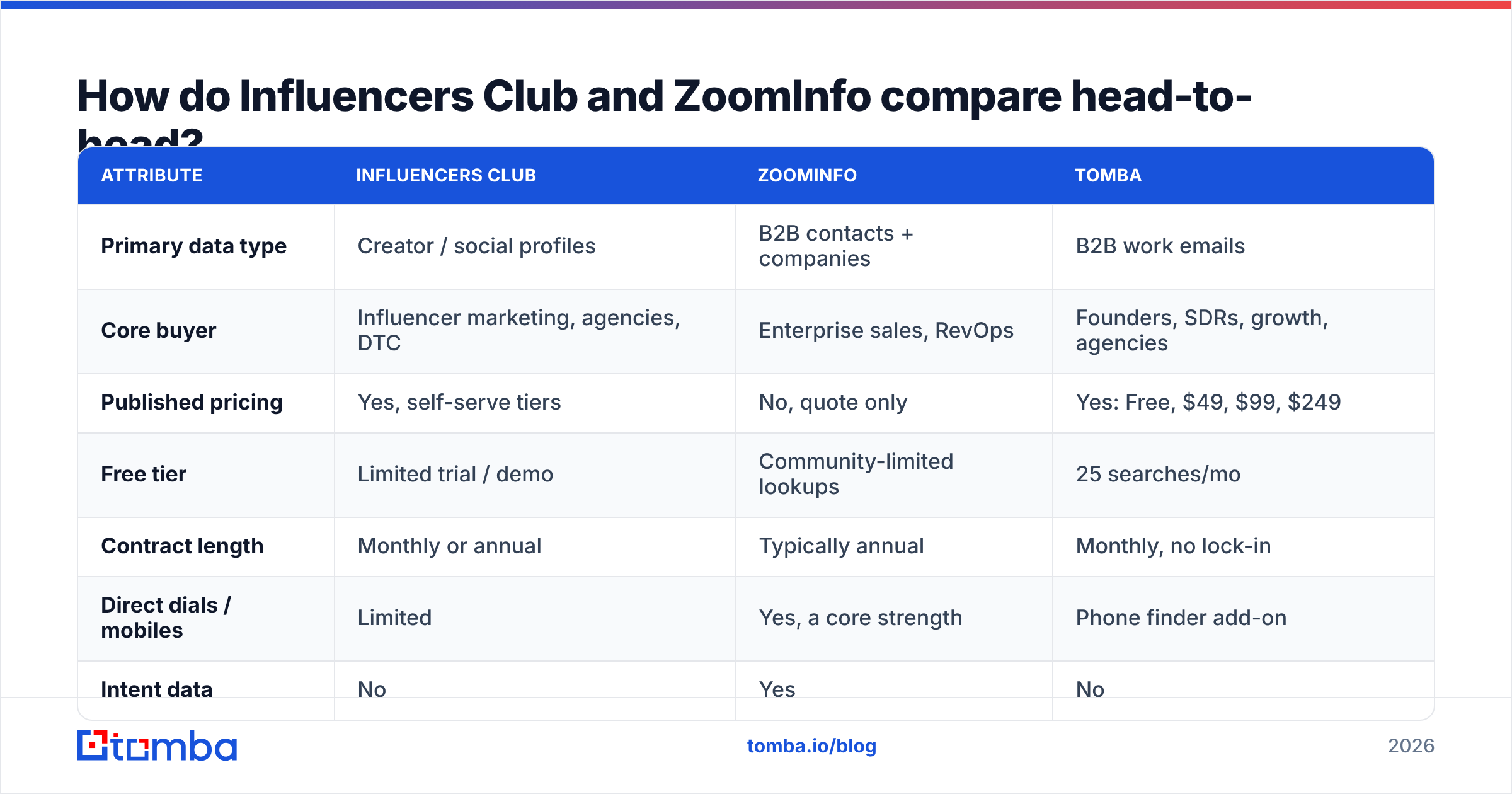
Treat the numbers below as directional. ZoomInfo does not publish list pricing. Both vendors change packaging often, so check current terms before you budget.
| Attribute | Influencers Club | ZoomInfo | Tomba |
|---|---|---|---|
| Primary data type | Creator / social profiles | B2B contacts + companies | B2B work emails |
| Core buyer | Influencer marketing, agencies, DTC | Enterprise sales, RevOps | Founders, SDRs, growth, agencies |
| Published pricing | Yes, self-serve tiers | No, quote only | Yes: Free, $49, $99, $249 |
| Free tier | Limited trial / demo | Community-limited lookups | 25 searches/mo |
| Contract length | Monthly or annual | Typically annual | Monthly, no lock-in |
| Direct dials / mobiles | Limited | Yes, a core strength | Phone finder add-on |
| Intent data | No | Yes | No |
| Audience demographics | Yes, detailed | No | No |
| Email verification built in | Partial | Basic | Yes, full verifier |
| API access | Yes | Yes, enterprise tiers | Yes, all paid plans |
| Time to first export | Minutes | Days to weeks (sales cycle) | Minutes |
The row that decides most deals is not a feature. It is "contract length." Say your team needs 3,000 verified emails this quarter, and next quarter is still open. That team should not sign a twelve-month enterprise deal, however good the demo looked.
What does each one actually cost in 2026?#
ZoomInfo costs much more, and the pricing is opaque by design.
Public review sites are the only reliable source here. Buyer reports on G2 put ZoomInfo contracts in the five figures a year, once you add seats, credits, and modules. The entry price climbs fast if you want mobile numbers, intent, or the website-visitor product. Credits are metered as well. Exports, enrichment calls, and API pulls all draw from the same pool, and overages are negotiated rather than self-served.
Influencers Club publishes its plans and lets you start without a sales call. That alone changes the risk. You can test the data in a niche you know well, decide in a week, and cancel if creator coverage is thin.
Three cost traps are worth naming before you sign either one:
- Credit math is not export math. On most platforms, viewing, exporting, and enriching a record each burn credits. Budget on the number of actions your team takes, not the contacts you plan to keep.
- Seat minimums inflate small teams. A three-person team on a five-seat minimum pays 40% more per useful seat on day one.
- Auto-renewal windows are short. Data contracts often renew unless you cancel inside a notice period. Put the date in a calendar the day you sign.
For comparison, Tomba pricing runs Free (25 searches/mo), Starter at $49/mo, Growth at $99/mo, and Pro at $249/mo, with Enterprise quoted. That is not a swap for ZoomInfo's intent data or org charts. It is a swap for the part most teams actually use: finding and verifying work emails.
Whose data is more accurate, and how would you know?#
Accuracy claims from data vendors mean little until you test them on your own list.
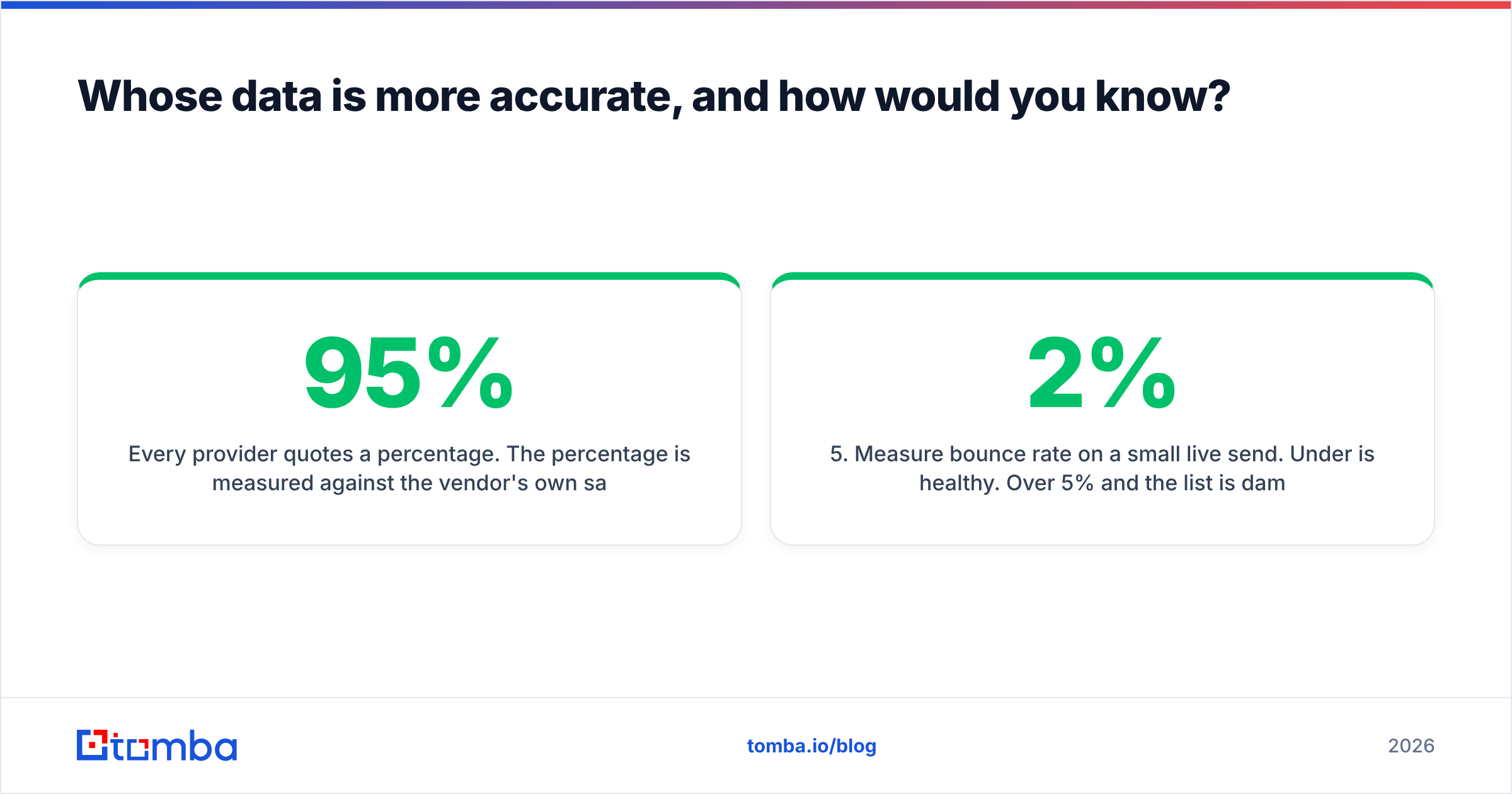
Every provider quotes a percentage. That number comes from the vendor's own sample, in the vendor's own markets, at the vendor's own refresh rate. B2B contact data decays fast. People change jobs, companies rebrand, and mail servers change. A database that was 95% accurate in January is not 95% accurate in September without constant re-verification.
Run this test before you commit to either platform:
- Build a control list of 100 contacts you can confirm yourself. Customers, partners, people who replied to you last quarter.
- Pull the same 100 from each vendor's trial or demo. Record match rate (did they have the person at all) apart from accuracy (was the record right).
- Verify every returned email with a neutral third-party tool. Use an independent email verifier, so the vendor is not grading its own homework.
- Count catch-all domains separately. A catch-all accepts everything, so "valid" there means almost nothing. Segment those and treat them as unconfirmed.
- Measure bounce rate on a small live send. Under 2% is healthy. Over 5% and the list is hurting your sending domain.
Match rate is where the two platforms split hardest. For creator profiles, Influencers Club finds people ZoomInfo has never heard of. For a VP of Procurement at a 4,000-person logistics firm, the reverse is true, and the gap is not close.
One structural note on creator data. Creator emails are often public business-inquiry addresses, watched by managers or agencies rather than the creator. Deliverability is high, but reply rates are low. Corporate work emails behave the opposite way. Factor that in before you blame the data.
Which platform fits your use case?#
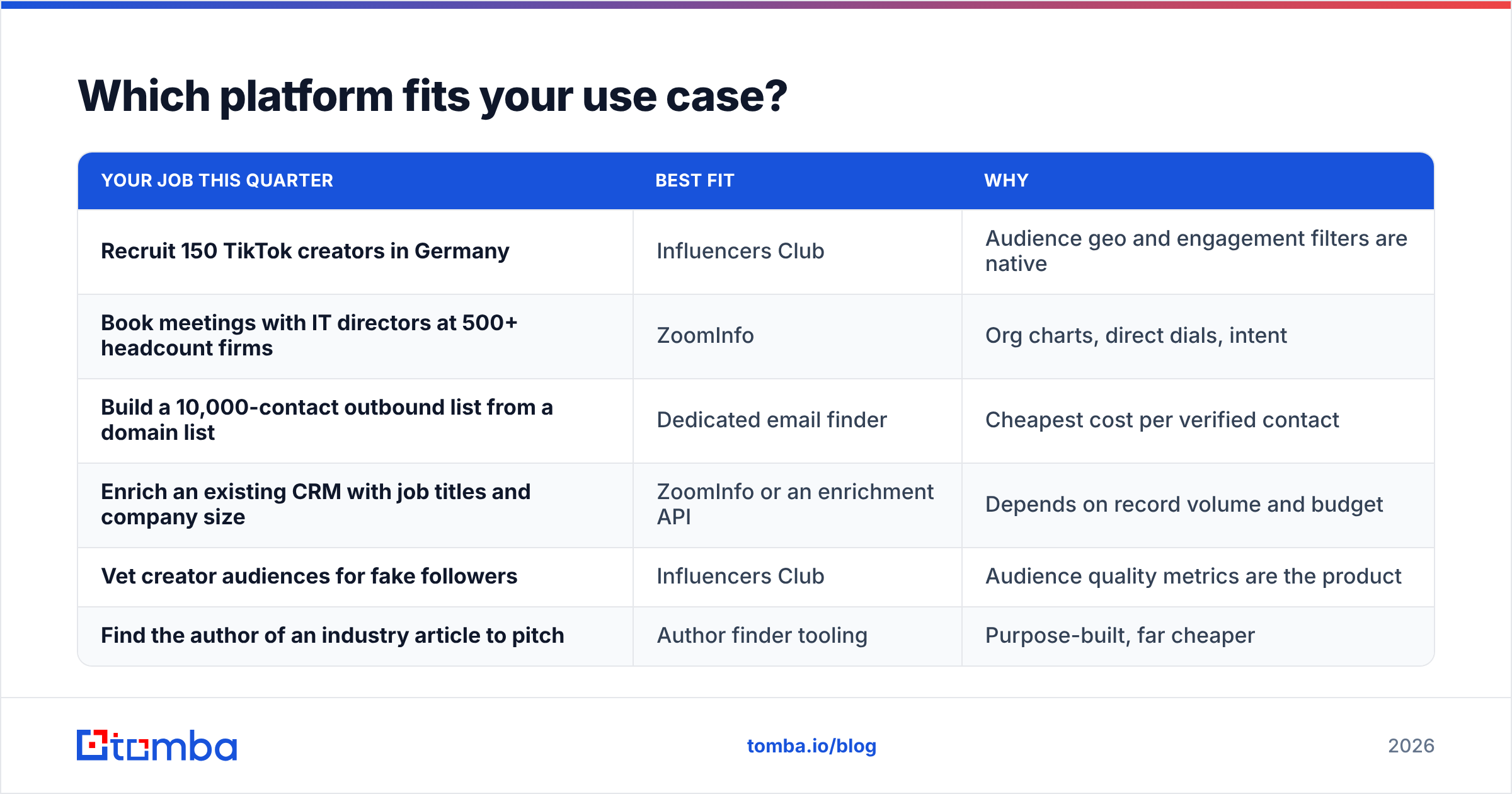
Map the job to the tool. Do not shortlist on feature counts.
| Your job this quarter | Best fit | Why |
|---|---|---|
| Recruit 150 TikTok creators in Germany | Influencers Club | Audience geo and engagement filters are native |
| Book meetings with IT directors at 500+ headcount firms | ZoomInfo | Org charts, direct dials, intent |
| Build a 10,000-contact outbound list from a domain list | Dedicated email finder | Cheapest cost per verified contact |
| Enrich an existing CRM with job titles and company size | ZoomInfo or an enrichment API | Depends on record volume and budget |
| Vet creator audiences for fake followers | Influencers Club | Audience quality metrics are the product |
| Find the author of an industry article to pitch | Author finder tooling | Purpose-built, far cheaper |
Notice the pattern. Three of those six jobs are served better by neither platform. Large suites win on breadth and lose on cost per outcome. If your quarter has one clear output, a focused tool almost always beats a suite.

What do real users complain about?#
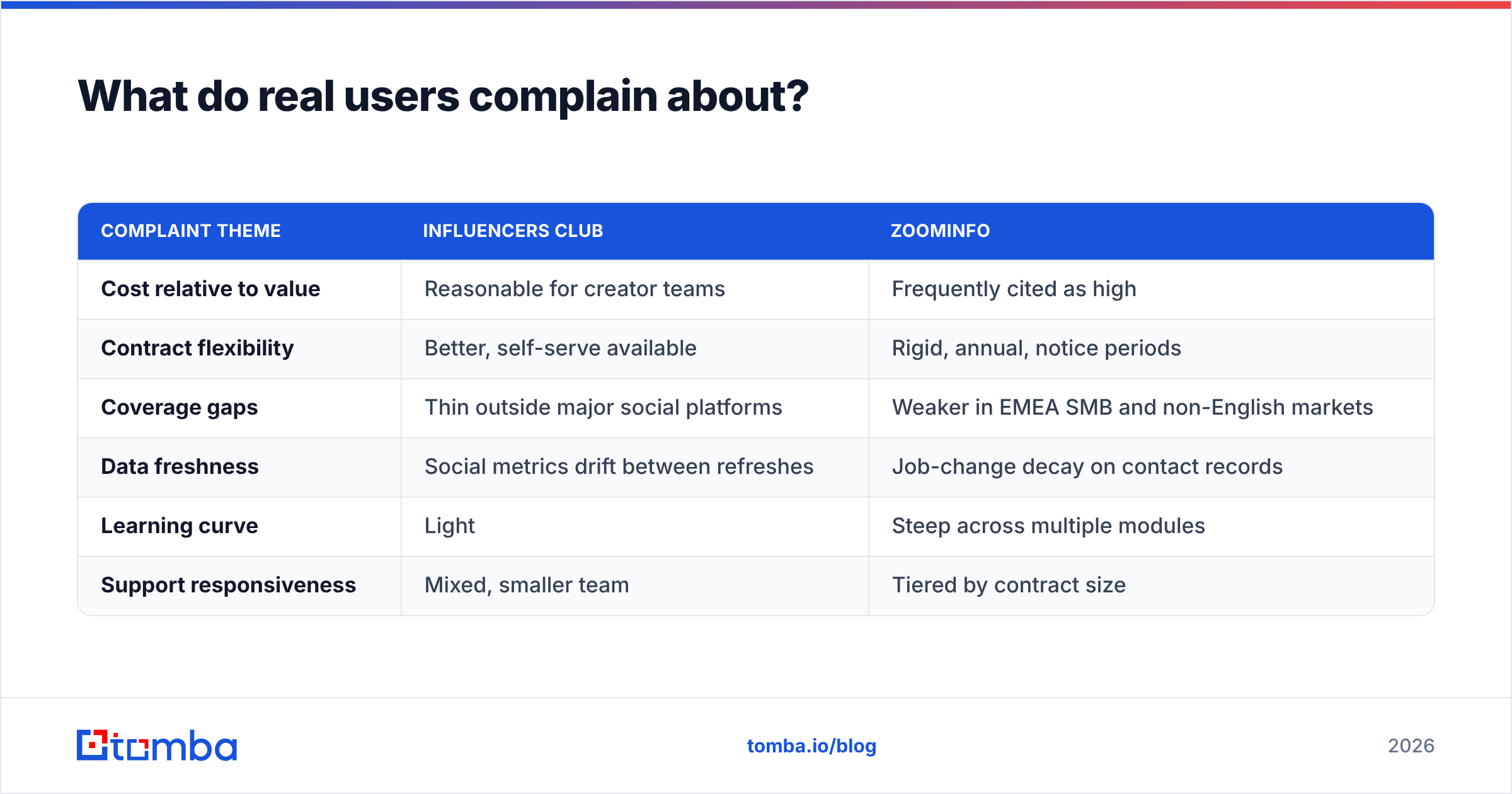
Both platforms draw steady, predictable criticism. Neither set is disqualifying. Price it in anyway.
| Complaint theme | Influencers Club | ZoomInfo |
|---|---|---|
| Cost relative to value | Reasonable for creator teams | Frequently cited as high |
| Contract flexibility | Better, self-serve available | Rigid, annual, notice periods |
| Coverage gaps | Thin outside major social platforms | Weaker in EMEA SMB and non-English markets |
| Data freshness | Social metrics drift between refreshes | Job-change decay on contact records |
| Learning curve | Light | Steep across multiple modules |
| Support responsiveness | Mixed, smaller team | Tiered by contract size |
ZoomInfo's criticism is almost never "the data is bad." It is "the terms are harsh for how little of the platform we use." That is a real finding. Teams routinely buy a suite and use two features. Before you renew, audit which modules built pipeline and which only collected logins.
Influencers Club draws the mirror image. The product does one category very well and does not stretch past it. That is a fair trade if creators are your category. It is a dead end if your buyer is a B2B exec.
Is there a cheaper middle ground for B2B contact data?#
Yes, if what you need is verified work emails rather than a full suite.
Most outbound teams that look at ZoomInfo need three things. A list of target companies. The right people inside them. An address that does not bounce. You can build that stack without an annual contract:
- Start from domains. A domain search returns the known email patterns and published addresses at a company. That is usually faster than filtering a 100-million-row database.
- Resolve names to addresses. An email finder takes a first name, last name, and domain. It returns the verified work email with a confidence score you can threshold on.
- Verify before every send. Run the list through verification. Segment catch-all domains instead of blasting them.
- Enrich only what converts. Use data enrichment on replies and open deals. Do not pay to enrich 40,000 records you will never contact.
This is not a claim that Tomba replaces ZoomInfo. It has no intent data, no org charts, and no visitor identification, and pretending otherwise would waste your time. The claim is narrower. A large share of ZoomInfo spend goes to the email-finding job, and that job costs $49 to $249 a month with no procurement cycle.
Here is the honest decision tree. If intent signals and direct dials change how your team sells, ZoomInfo earns its price, and nothing cheaper replaces it. If they are nice-to-haves nobody has operationalized, you are funding a suite to use one feature.
Verdict: InfluencersClub vs ZoomInfo, which should you buy?#
Choose Influencers Club if creators are your channel. Audience demographics, engagement quality, and creator contact data are the product. Pricing is transparent, and you can check coverage in your niche within a week.
Choose ZoomInfo if you sell to defined enterprise accounts. It pays off when an SDR team uses direct dials daily and intent data really routes their day. Negotiate hard, get the credit policy in writing, and diary the renewal notice date.
Choose neither if you just need verified B2B emails, at volume, this quarter. That problem is solved, and paying suite prices for it is the most common overspend in outbound tooling.
Ready to test the cheap path first? Run your next target list through the Tomba Email Finder on the free tier. Verify the output, then measure bounce rate against whatever quote is sitting in your inbox. If 25 free searches settle the question, you just saved a procurement cycle. If they do not, you walk into the vendor call with your own accuracy numbers instead of theirs.
Related guides#
// get started
Find, verify and enrich your first contacts today
Start on the free plan with 25 searches a month, then scale when your team is ready.
Free plan · No credit card required · GDPR & CCPA
// about the author