Influno vs Jet Leads Pro (2026): Which One Should You Pick?
Two outbound tools, two very different bets. We break down Influno vs Jet Leads Pro on data quality, sending infrastructure, pricing transparency, and the one gap both leave open in your stack.
TL;DR — Influno vs Jet Leads Pro
- Influno is the more complete outreach product: sequences, inbox rotation, deliverability controls, and reporting built around sending email at scale.
- Jet Leads Pro sits closer to the lead sourcing end. It pulls contact lists and pushes them into your pipeline, with a lighter sending layer.
- Neither tool is really a contact-data company, and it shows. Both lean on bundled or resold databases. That's where bounce rates come from.
- If you only buy one, pick by the bottleneck: no meetings because nobody replies → Influno. No meetings because your list is 40 names long → Jet Leads Pro.
- The cheapest real fix is to pair the sender you like with a dedicated email finder and verifier. Bundled databases rarely hold up.
What are Influno and Jet Leads Pro?#
Influno vs Jet Leads Pro is a choice between two tools that both promise "more meetings." They're built on opposite assumptions about why you don't have them.
Think of it like a restaurant. Influno is the kitchen and the waitstaff. It assumes customers already walk in, and its job is to serve them well enough that they come back. Jet Leads Pro is the guy handing out flyers on the corner. It assumes the food is fine and nobody knows you exist. Technically, one is a sales engagement platform and the other is a lead generation platform. That difference shapes everything downstream.
Influno sells itself as an all-in-one cold email and outreach platform. You connect mailboxes and build multi-step sequences. It handles scheduling, follow-ups, reply detection, and reporting. It competes with the tools listed under sales engagement software on G2 — Instantly, Smartlead, Lemlist, Saleshandy. The bet is that execution quality separates a 1% reply rate from a 6% one.
Jet Leads Pro markets itself further upstream. It sources prospects, builds lists, and gets them into an outbound motion with little setup. It belongs to the cluster of lead generation tools on Capterra where the headline number is contacts available, not emails sent. The bet there is that most SMB teams are starved for volume, not craft.
That framing matters more than any feature checkbox. It tells you what each company invests in. Influno invests in sending. Jet Leads Pro invests in sourcing. Neither invests much in the thing between them: verified, current contact data.
Influno vs Jet Leads Pro: how do they compare feature by feature?#
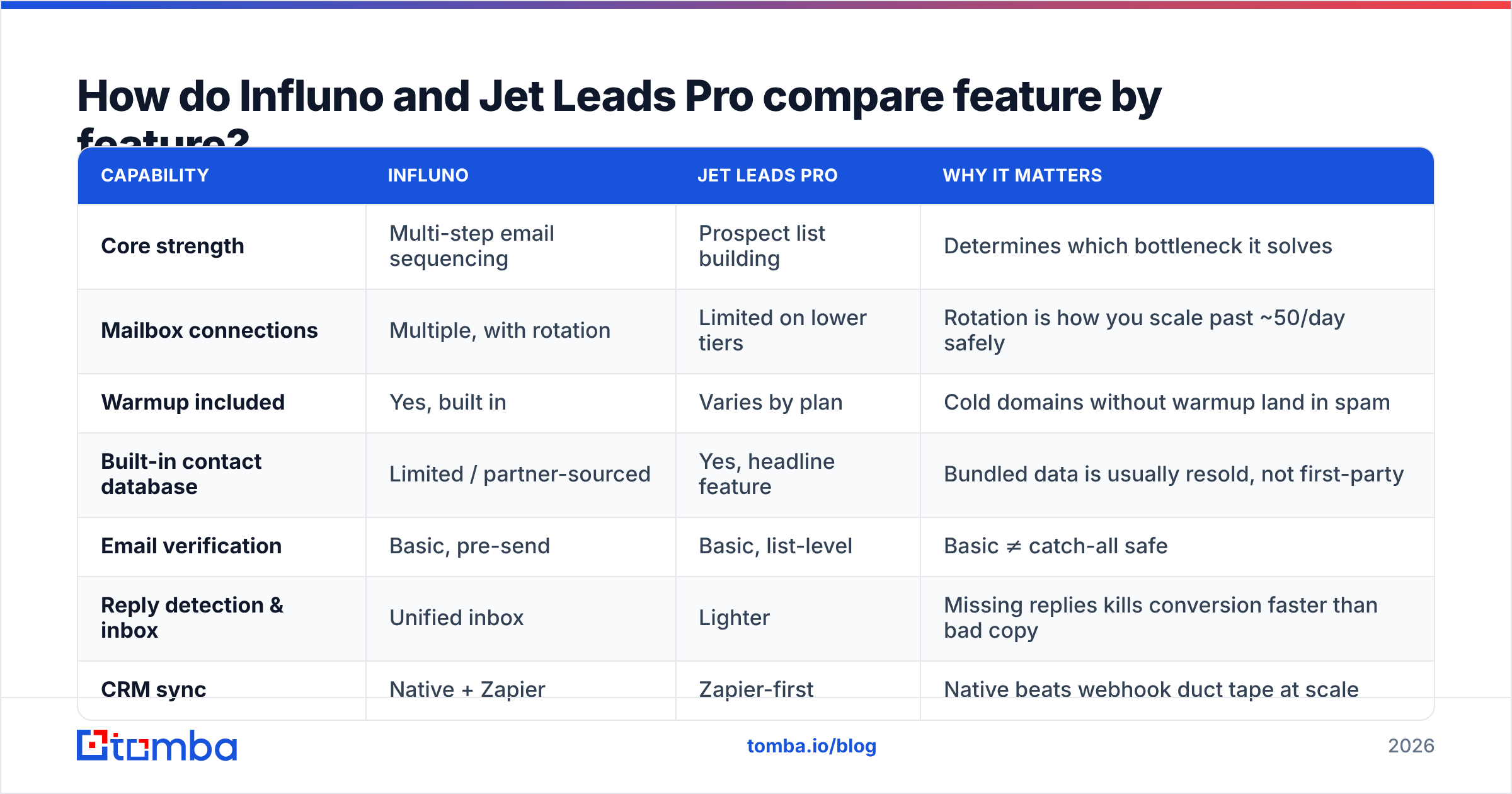
Here's the honest structural comparison. Feature sets at this tier move fast. Treat the specifics as a snapshot, and check each vendor's current page before you buy.
| Capability | Influno | Jet Leads Pro | Why it matters |
|---|---|---|---|
| Core strength | Multi-step email sequencing | Prospect list building | Determines which bottleneck it solves |
| Mailbox connections | Multiple, with rotation | Limited on lower tiers | Rotation is how you scale past ~50/day safely |
| Warmup included | Yes, built in | Varies by plan | Cold domains without warmup land in spam |
| Built-in contact database | Limited / partner-sourced | Yes, headline feature | Bundled data is usually resold, not first-party |
| Email verification | Basic, pre-send | Basic, list-level | Basic ≠ catch-all safe |
| Reply detection & inbox | Unified inbox | Lighter | Missing replies kills conversion faster than bad copy |
| CRM sync | Native + Zapier | Zapier-first | Native beats webhook duct tape at scale |
| API access | Yes, higher tiers | Limited | Matters if you automate enrichment |
| Learning curve | Moderate | Low | Low-touch tools trade control for speed |
| Best for | Teams sending 500+/mo | Teams with no list at all | Pick by your actual constraint |
The pattern is consistent with how these categories mature. The sequencer builds sending depth. The lead engine builds list breadth. Both ship a shallow version of the other side, so the demo looks complete.

Which one gives you better data quality?#
Neither, reliably — and that's the most useful thing in this comparison.
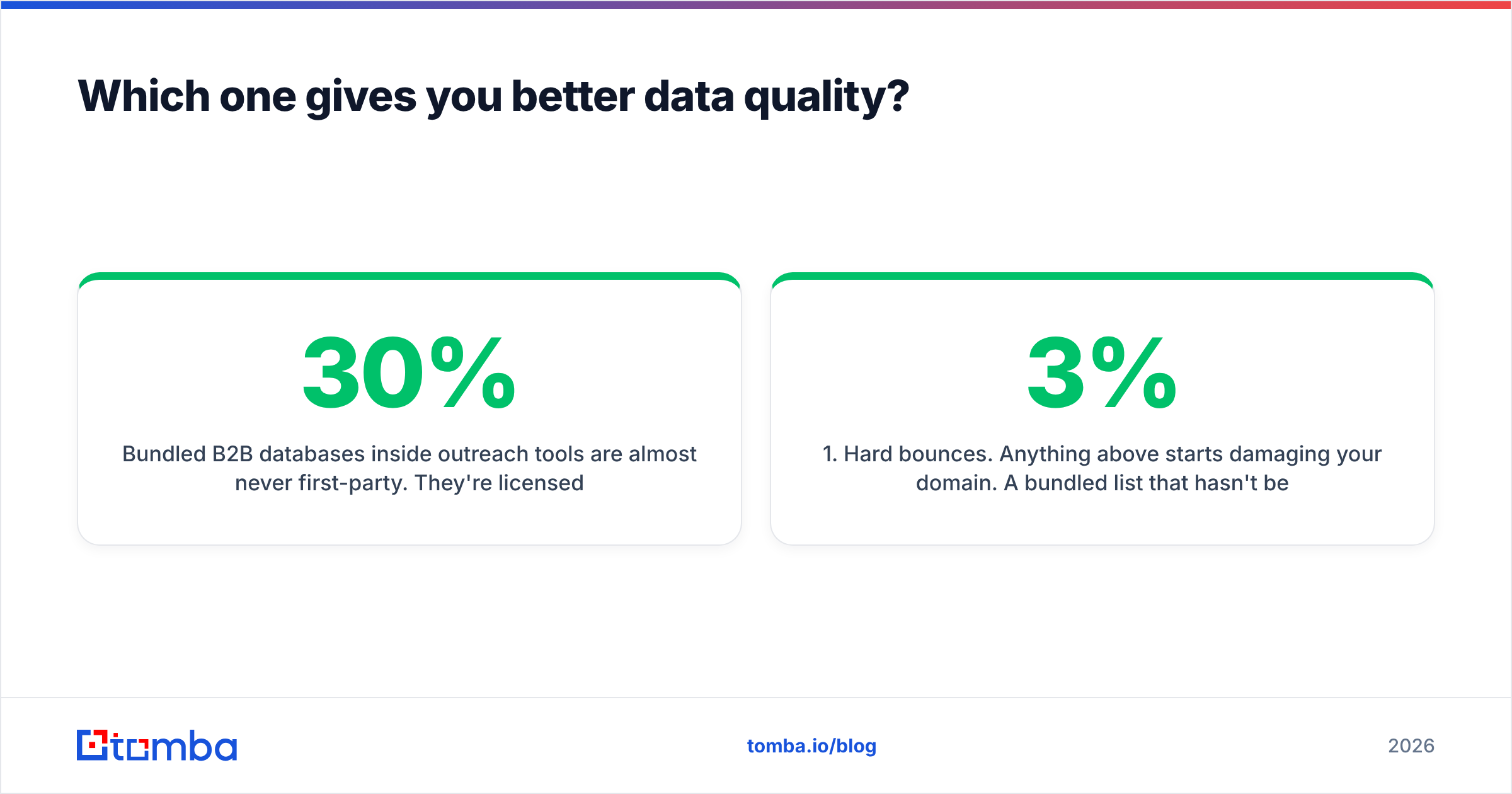
Bundled B2B databases inside outreach tools are almost never first-party. They're licensed, scraped, or aggregated, then refreshed on a schedule you don't control. The result is decay. B2B contact data goes stale at roughly 25-30% per year. People change roles, companies rebrand, and mail servers get reconfigured. A record that was accurate in March is a coin flip by December.
You feel this in three places:
- Hard bounces. Anything above 3% starts to damage your domain. A bundled list that hasn't been re-verified in six months often lands at 8-15%.
- Catch-all limbo. Many B2B domains accept every address at the SMTP layer. A basic "syntax + MX" check marks them valid when they aren't. Use a catch-all verifier to resolve those, not a checkbox.
- Wrong-person sends. The address works, but the human left. You get silence, and silence looks just like "bad copy" in your reporting. So you rewrite the email instead of fixing the list.
This is why experienced outbound teams run a three-layer stack instead of a monolith: a source for contacts, a dedicated verifier, and a sender. It costs a little more each month. It's also the difference between a domain that lasts two years and one you burn in six weeks. Tomba publishes where its data comes from because "we have 700 million contacts" means nothing without provenance.
Influno vs Jet Leads Pro pricing: what do the plans cost?#
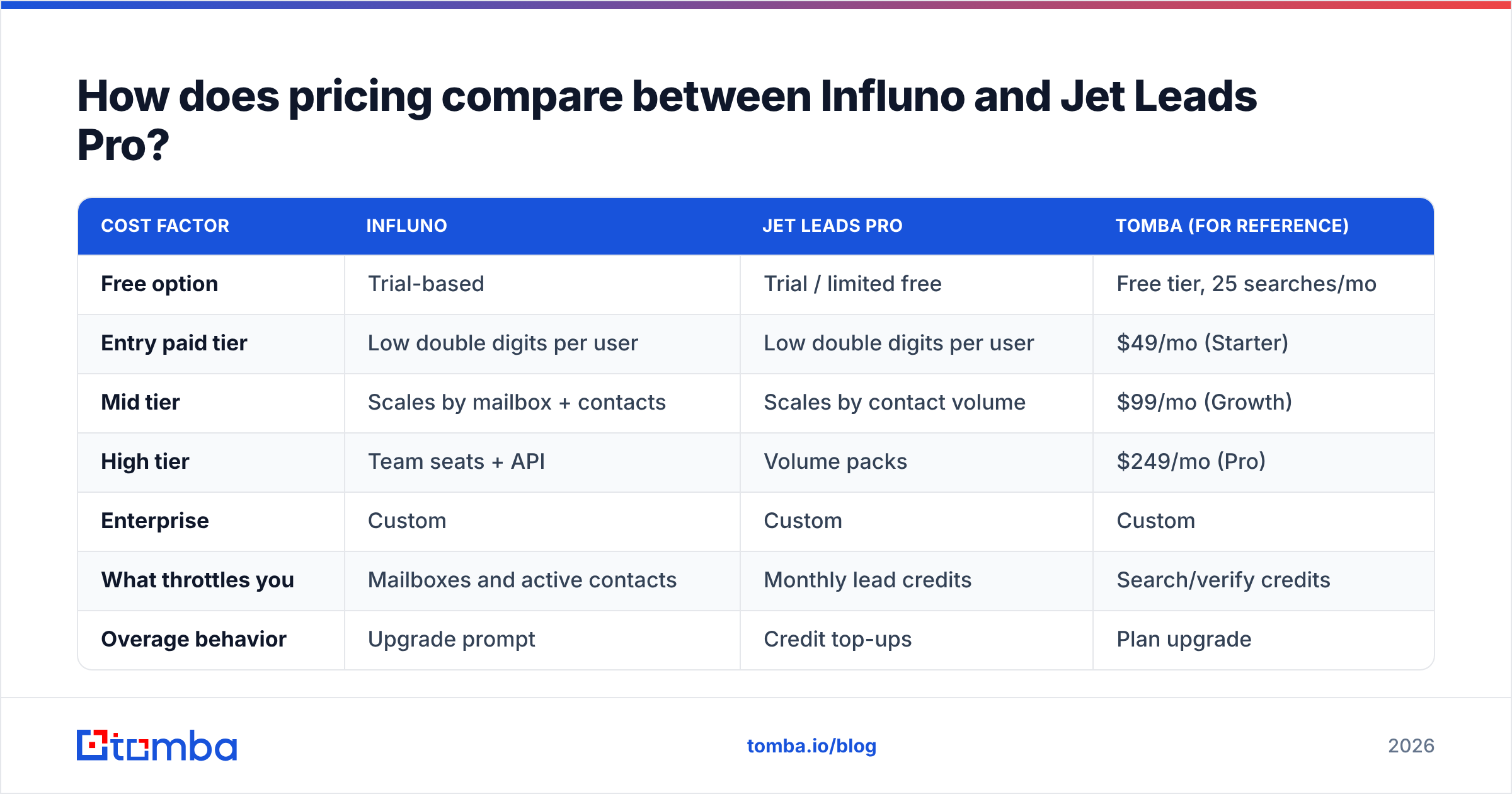
Both sit in the SMB-friendly band. Both use the same lever: credits or contact limits that look generous until you run a real campaign.
| Cost factor | Influno | Jet Leads Pro | Tomba (for reference) |
|---|---|---|---|
| Free option | Trial-based | Trial / limited free | Free tier, 25 searches/mo |
| Entry paid tier | Low double digits per user | Low double digits per user | $49/mo (Starter) |
| Mid tier | Scales by mailbox + contacts | Scales by contact volume | $99/mo (Growth) |
| High tier | Team seats + API | Volume packs | $249/mo (Pro) |
| Enterprise | Custom | Custom | Custom |
| What throttles you | Mailboxes and active contacts | Monthly lead credits | Search/verify credits |
| Overage behavior | Upgrade prompt | Credit top-ups | Plan upgrade |
Two things to check before you commit to either:
- Whether "contacts" means stored or contacted. Some platforms count every record in your workspace against the cap. An imported 20k list can eat a plan you thought was for sending.
- Whether credits roll over. Non-rolling credits punish the natural rhythm of outbound. You build a list in week one and send across weeks two through six.
See the full Tomba pricing tiers for a like-for-like sense of what dedicated data costs. It's usually the smallest line item in an outbound stack, and the one that decides whether the other two work.
Which tool fits which team?#
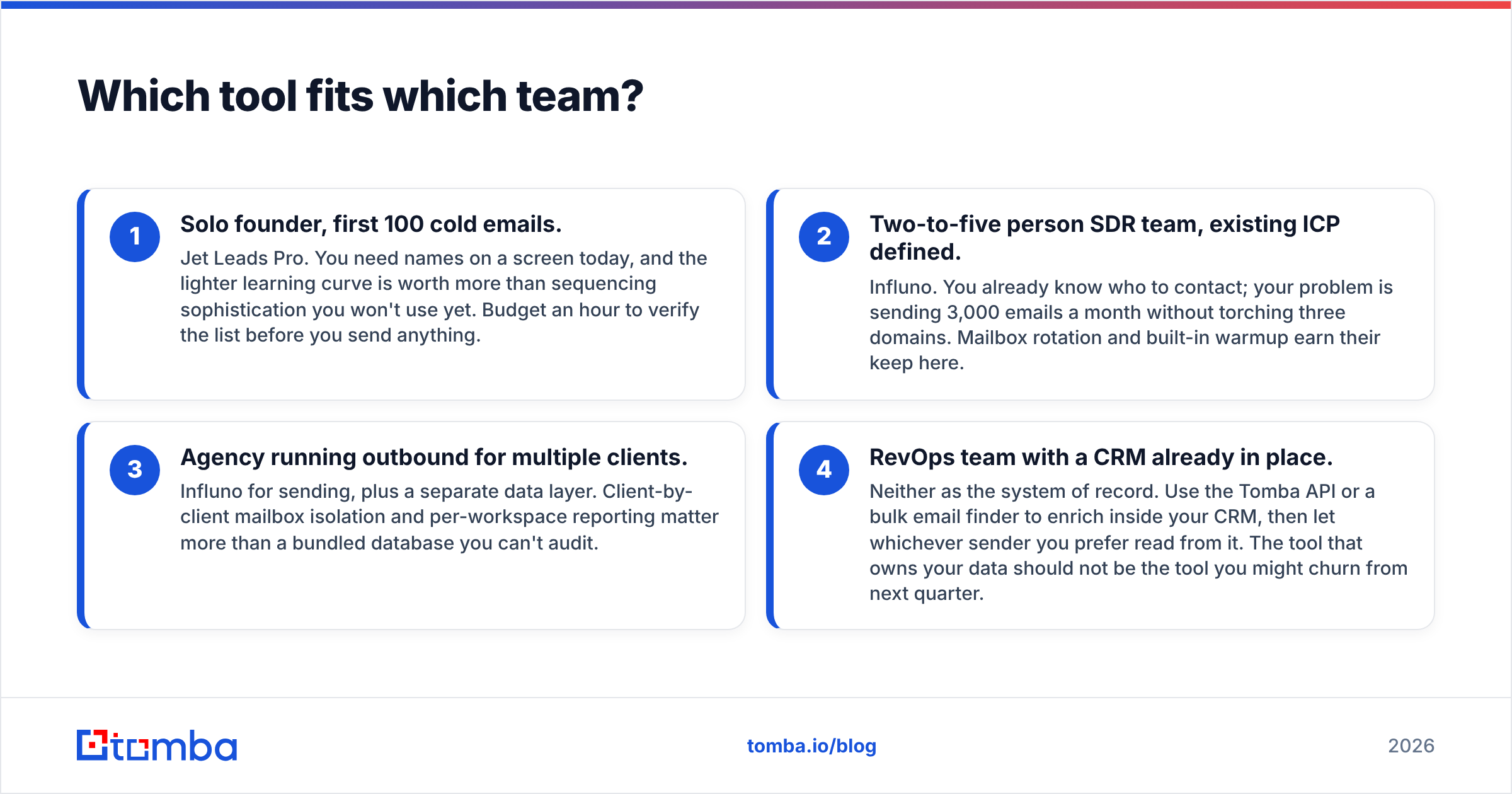
Pick by constraint, not by feature count. Influno vs Jet Leads Pro comes down to which profile you match. Start with the two smallest:
- Solo founder, first 100 cold emails. Jet Leads Pro. You need names on a screen today. The lighter learning curve is worth more than sequencing you won't use yet. Budget an hour to verify the list before you send.
- Two-to-five person SDR team, existing ICP defined. Influno. You already know who to contact. Your problem is sending 3,000 emails a month without torching three domains. Mailbox rotation and built-in warmup earn their keep here.
The bigger the operation, the more the data layer decides the outcome:
- Agency running outbound for multiple clients. Influno for sending, plus a separate data layer. Per-client mailbox isolation and per-workspace reporting matter more than a bundled database you can't audit.
- RevOps team with a CRM already in place. Neither as the system of record. Use the Tomba API or a bulk email finder to enrich inside your CRM. Then let whichever sender you prefer read from it. The tool that owns your data shouldn't be the tool you might churn from next quarter.

Where does each tool actually fall short?#
Influno's weak point is upstream. If your list is thin or unqualified, the best sequencing engine just delivers a better-formatted version of the wrong message to the wrong person. The reporting will show a 48% open rate and a 0.4% reply rate. You'll spend three weeks testing subject lines when the real fix was targeting.
Jet Leads Pro's weak point is downstream. Sourcing volume without deliverability discipline is how teams end up on blocklists. If a platform lets you import 10,000 unverified contacts and start sending on day one, it's selling you a fast route to a burned domain. Run an SPF check and a warmup plan before volume, not after.
Both share a third weakness: they're vague about where the data comes from. A vendor may not tell you whether a record came from a public web page, a partner license, or a user contribution pool. Then you can't judge compliance risk or freshness. For EU-facing outbound, that's not a nice-to-have question.
Do you need a third tool for contact data?#
Usually yes, and it's cheaper than the alternative. The Influno vs Jet Leads Pro decision matters far less than this one.
The math is simple. Say you send 2,000 cold emails a month. At a 12% bounce rate from unverified bundled data, that's 240 hard bounces. That's enough to drag your sender reputation down and start landing the good addresses in spam. Recovering a damaged domain takes 4-8 weeks of reduced volume plus warmup. Verifying those same 2,000 addresses costs less than one lost month of pipeline.
A practical stack looks like this:
- Source — pull target companies, then run domain search to get the pattern and the people at each one.
- Verify — push everything through an email verifier that handles catch-all domains explicitly, not with a blanket "risky" label.
- Send — Influno, Jet Leads Pro, or whatever sequencer your team already likes.
- Sync — write results back to the CRM, so the next campaign starts from clean data instead of a fresh export.
Swapping the sending layer later is a one-week migration. Swapping your data layer after you've built workflows on top of it is not. Build the stack so the replaceable part is the sequencer.
What's the verdict for 2026?#
The short Influno vs Jet Leads Pro verdict: Influno wins on execution, and Jet Leads Pro wins on time-to-first-list. If you have an ICP and a domain you care about, Influno is the safer investment. Deliverability infrastructure is harder to replicate than a contact export. If you're at zero and need momentum this week, Jet Leads Pro gets you moving faster, and you can graduate later.
But the real decision isn't between these two. It's whether you let either of them own your contact data. Bundled databases inside outreach tools are a convenience feature. They're priced like one and maintained like one. Teams with durable outbound programs treat data as its own layer, with its own vendor, its own accuracy standard, and its own audit trail.
One more practical note. Whichever you choose, track your response rate by list source, not just by campaign. It's the fastest way to prove whether your data or your copy is the real constraint. Most teams are surprised by the answer.
Ready to fix the layer both tools skip?#
Your sequencer decides how your email gets sent. Your data decides whether it should have been sent at all. Start with a clean list. The Tomba Email Finder returns verified professional addresses by domain, name, or company. Each result carries a confidence score and the sources behind it, so you know what you're sending to before you spend a mailbox on it. The free tier gives you 25 searches a month. Run both lists, compare the bounce rates, and let the numbers pick your stack.
Related guides#
// get started
Find, verify and enrich your first contacts today
Start on the free plan with 25 searches a month, then scale when your team is ready.
Free plan · No credit card required · GDPR & CCPA
// about the author