Influno vs Kaspr (2026): Which Outbound Tool Wins for You?
Influno sends cold email. Kaspr pulls contact data off LinkedIn. They are not the same product - and buying the wrong one costs you a quarter of pipeline. Here is the honest breakdown, plus what actually belongs in your outbound stack.
TL;DR
- Influno and Kaspr are not competitors in the strict sense. Influno is an outbound sending platform (campaigns, sequences, inboxes). Kaspr is a contact data tool (a LinkedIn-first Chrome extension for emails and mobile numbers).
- If you already have a list and need to email it, Influno is the relevant purchase. If you have no list and live inside LinkedIn Sales Navigator, Kaspr is the relevant purchase.
- Kaspr bills per seat with a credit system; Influno bills per workspace with sending volume limits. Per-seat pricing punishes teams that grow; volume pricing punishes teams that scale sends. Know which failure mode you can absorb.
- Neither tool solves the part that kills most campaigns: list hygiene. Bounces come from unverified addresses, not from your subject line.
- Realistic answer for most teams: one data source, one verification layer, one sender. Buying a single "all-in-one" almost always means one of the three is mediocre.
What are Influno and Kaspr, exactly?#
Start here, because half the confusion in the Influno vs Kaspr debate comes from people comparing a hammer to a bag of nails.
Influno (influno.com) is a cold email outreach platform. Its center of gravity is the campaign: you connect sending mailboxes, load a list, build a multi-step sequence, and the tool handles scheduling, rotation between inboxes, reply detection, and reporting. Like most modern senders it has layered on list-building and AI copy features, but the reason anyone buys it is to get messages out the door and replies back into one place.
Kaspr (kaspr.io) is a B2B contact data tool, acquired by Cognism in 2022. Its center of gravity is the LinkedIn profile: install the Chrome extension, open a prospect or a Sales Navigator list, and Kaspr surfaces email addresses and — its real differentiator — direct mobile numbers. Credits are consumed per reveal. It is a prospecting tool, not a sending tool.
So the honest framing is not "which is better." It is: which half of the outbound problem do you currently not have solved?
Influno vs Kaspr: how do they compare head-to-head?#
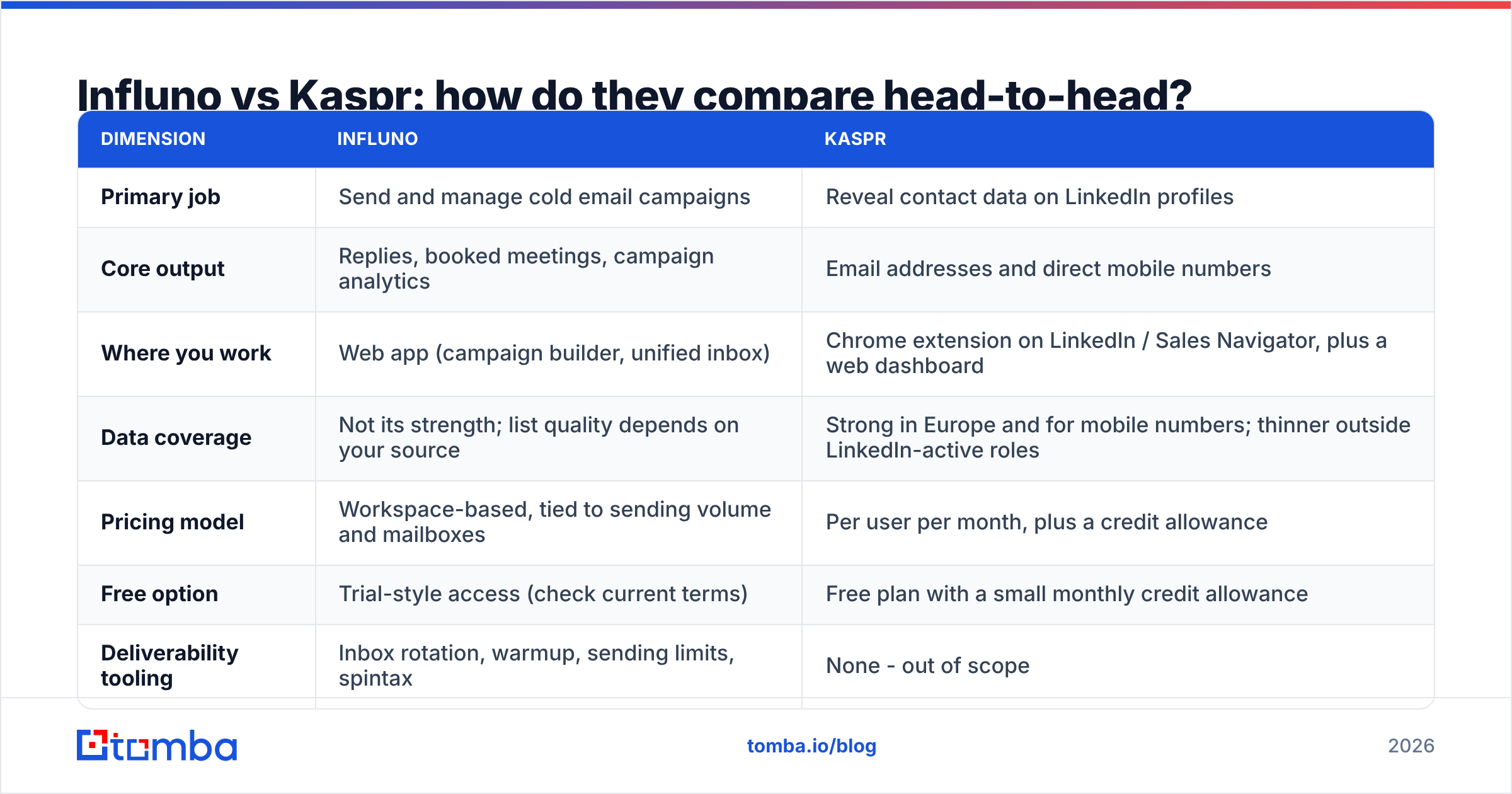
| Dimension | Influno | Kaspr |
|---|---|---|
| Primary job | Send and manage cold email campaigns | Reveal contact data on LinkedIn profiles |
| Core output | Replies, booked meetings, campaign analytics | Email addresses and direct mobile numbers |
| Where you work | Web app (campaign builder, unified inbox) | Chrome extension on LinkedIn / Sales Navigator, plus a web dashboard |
| Data coverage | Not its strength; list quality depends on your source | Strong in Europe and for mobile numbers; thinner outside LinkedIn-active roles |
| Pricing model | Workspace-based, tied to sending volume and mailboxes | Per user per month, plus a credit allowance |
| Free option | Trial-style access (check current terms) | Free plan with a small monthly credit allowance |
| Deliverability tooling | Inbox rotation, warmup, sending limits, spintax | None - out of scope |
| Who it replaces | Instantly, Smartlead, Lemlist, Saleshandy | Lusha, ContactOut, RocketReach, Apollo's data layer |
| Weak spot | You still need a list from somewhere | You still need somewhere to send |
If that table reads like "these two belong in the same stack rather than on the same shortlist," you have understood the point.

How does each tool actually get you a contact?#
The mechanics matter more than the feature lists, because they determine where your pipeline breaks.
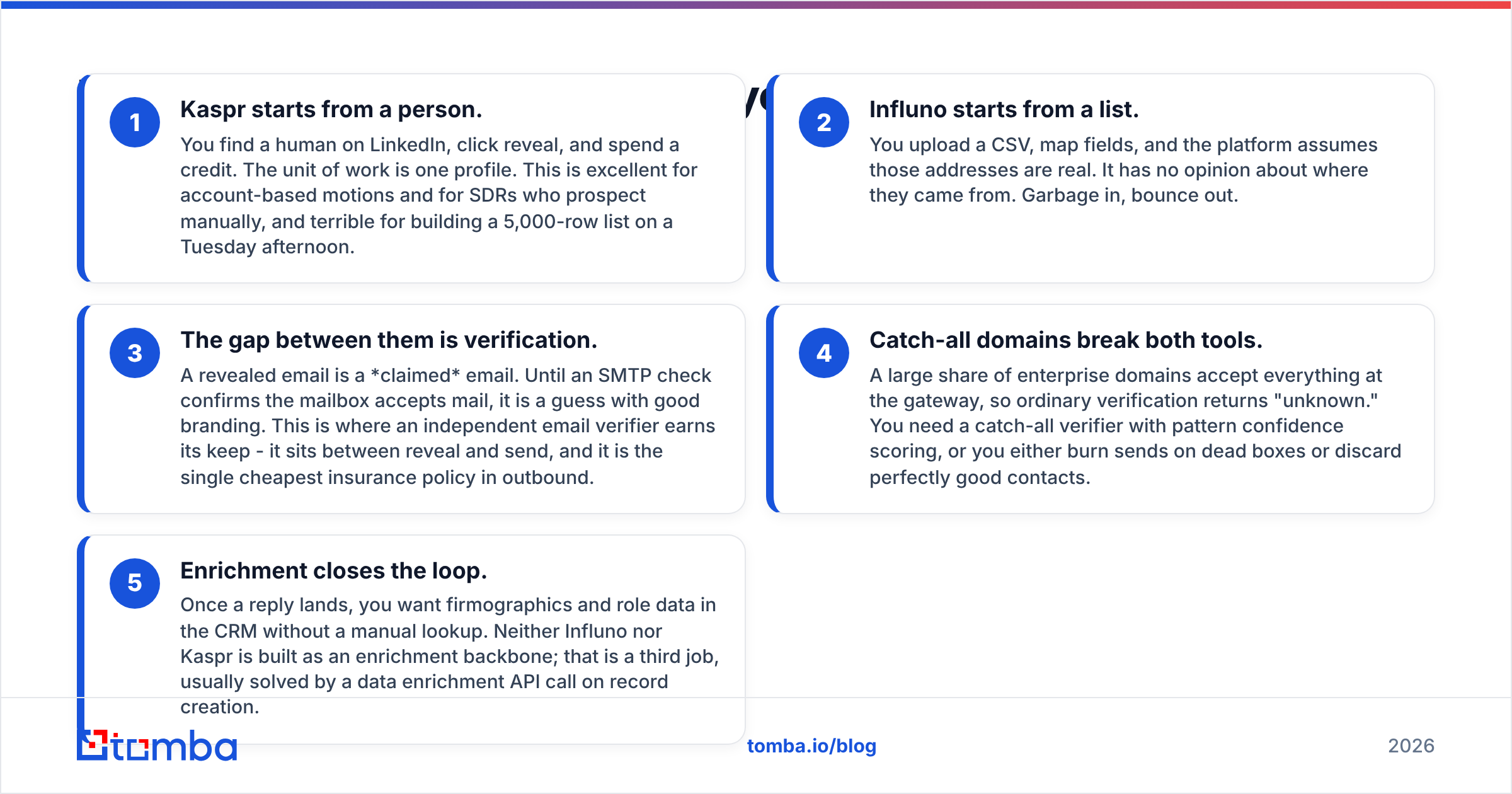
- Kaspr starts from a person. You find a human on LinkedIn, click reveal, and spend a credit. The unit of work is one profile. This is excellent for account-based motions and for SDRs who prospect manually, and terrible for building a 5,000-row list on a Tuesday afternoon.
- Influno starts from a list. You upload a CSV, map fields, and the platform assumes those addresses are real. It has no opinion about where they came from. Garbage in, bounce out.
- The gap between them is verification. A revealed email is a claimed email. Until an SMTP check confirms the mailbox accepts mail, it is a guess with good branding. This is where an independent email verifier earns its keep - it sits between reveal and send, and it is the single cheapest insurance policy in outbound.
- Catch-all domains break both tools. A large share of enterprise domains accept everything at the gateway, so ordinary verification returns "unknown." You need a catch-all verifier with pattern confidence scoring, or you either burn sends on dead boxes or discard perfectly good contacts.
- Enrichment closes the loop. Once a reply lands, you want firmographics and role data in the CRM without a manual lookup. Neither Influno nor Kaspr is built as an enrichment backbone; that is a third job, usually solved by a data enrichment API call on record creation.
Map your process against those five steps and the buying decision stops being a debate about brands.
Is Kaspr's data accurate enough for cold outbound?#
Mostly yes for mobile numbers, with the usual caveats for email.
Kaspr's reputation was built on direct dials, and reviews on G2 consistently praise phone coverage in European markets while flagging two recurring issues: credit burn on profiles that return nothing useful, and email accuracy that lags the phone data. That pattern is normal for LinkedIn-sourced providers. Phone numbers come largely from contributory networks; email is often pattern-inferred from a domain and a name, which is exactly the guess that a verification layer exists to catch.
Two practical rules:
- Never send to a revealed email without verifying it. A 4-6% bounce rate quietly degrades sender reputation long before it triggers a hard block, and by the time open rates fall you have burned a domain.
- Treat mobile numbers as the premium asset. If you are paying Kaspr seat pricing and only using emails, you are paying for the expensive half and using the cheap half. Either work the phones or buy email data somewhere cheaper.
For teams that want a second source to cross-check reveals, running the same contact through an independent email finder and comparing results is a five-second sanity test that catches a surprising number of pattern-guessed addresses.
Does Influno replace a dedicated sequencer?#
For small and mid-sized outbound teams, largely yes - with the same caveat that applies to every sender in this bracket.
Influno covers the core requirements: multiple connected mailboxes, rotation across them, warmup, follow-up steps with conditional logic, reply detection, and a consolidated inbox. That is table stakes in 2026, and Influno delivers it at a price point below the enterprise sequencers.
What it does not replace:
- A real sales engagement platform. If your team needs task queues, dialer integration, manager-level coaching views, and deep CRM bi-directional sync, you are shopping in the Outreach and Salesloft tier, not here. Compare it honestly against an Outreach alternative shortlist rather than against Kaspr.
- Your domain infrastructure. No sender fixes a missing DMARC policy or a shared IP with a bad neighbor. Check your SPF record and authentication before you blame a platform for landing in spam.
- Your list. Worth repeating because it is where budget gets wasted: a sender with a bad list produces bounces faster and more efficiently than a manual process would.

What do they cost, and which pricing model hurts more?#
Both vendors adjust pricing regularly, so treat published figures as directional and confirm on their own pages before you sign. The structural difference is what matters, and it is stable.
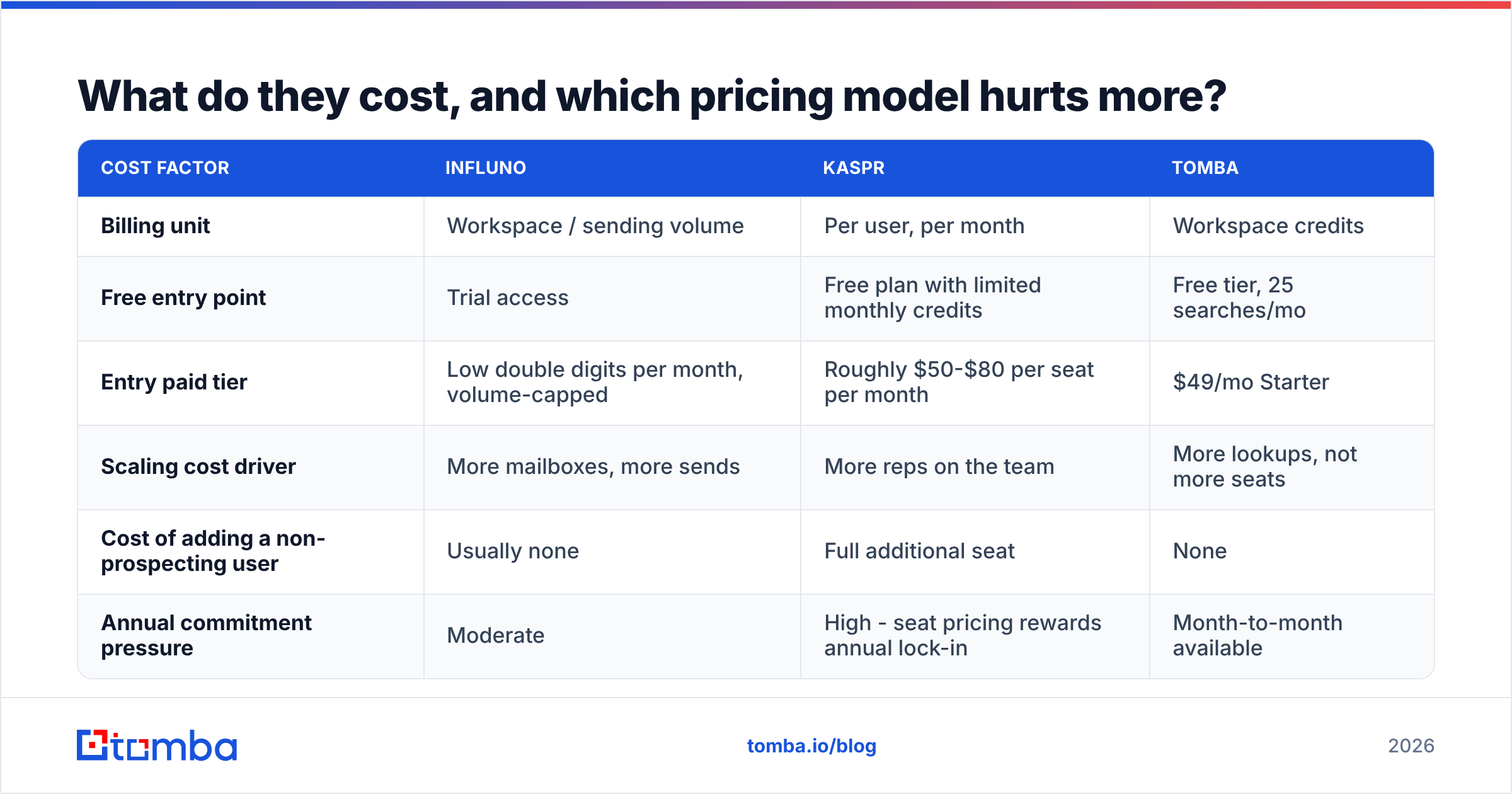
| Cost factor | Influno | Kaspr | Tomba |
|---|---|---|---|
| Billing unit | Workspace / sending volume | Per user, per month | Workspace credits |
| Free entry point | Trial access | Free plan with limited monthly credits | Free tier, 25 searches/mo |
| Entry paid tier | Low double digits per month, volume-capped | Roughly $50-$80 per seat per month | $49/mo Starter |
| Scaling cost driver | More mailboxes, more sends | More reps on the team | More lookups, not more seats |
| Cost of adding a non-prospecting user | Usually none | Full additional seat | None |
| Annual commitment pressure | Moderate | High - seat pricing rewards annual lock-in | Month-to-month available |
The per-seat model is the one that surprises people. A five-person SDR team on a $65 seat is $3,900 a year before a single credit is used, and half those seats typically go dormant within two quarters. Volume-based pricing fails differently: it is cheap until you scale, then the tier jumps are steep. Look at Tomba pricing alongside both to see what credit-based, seat-free billing does to a team of five.
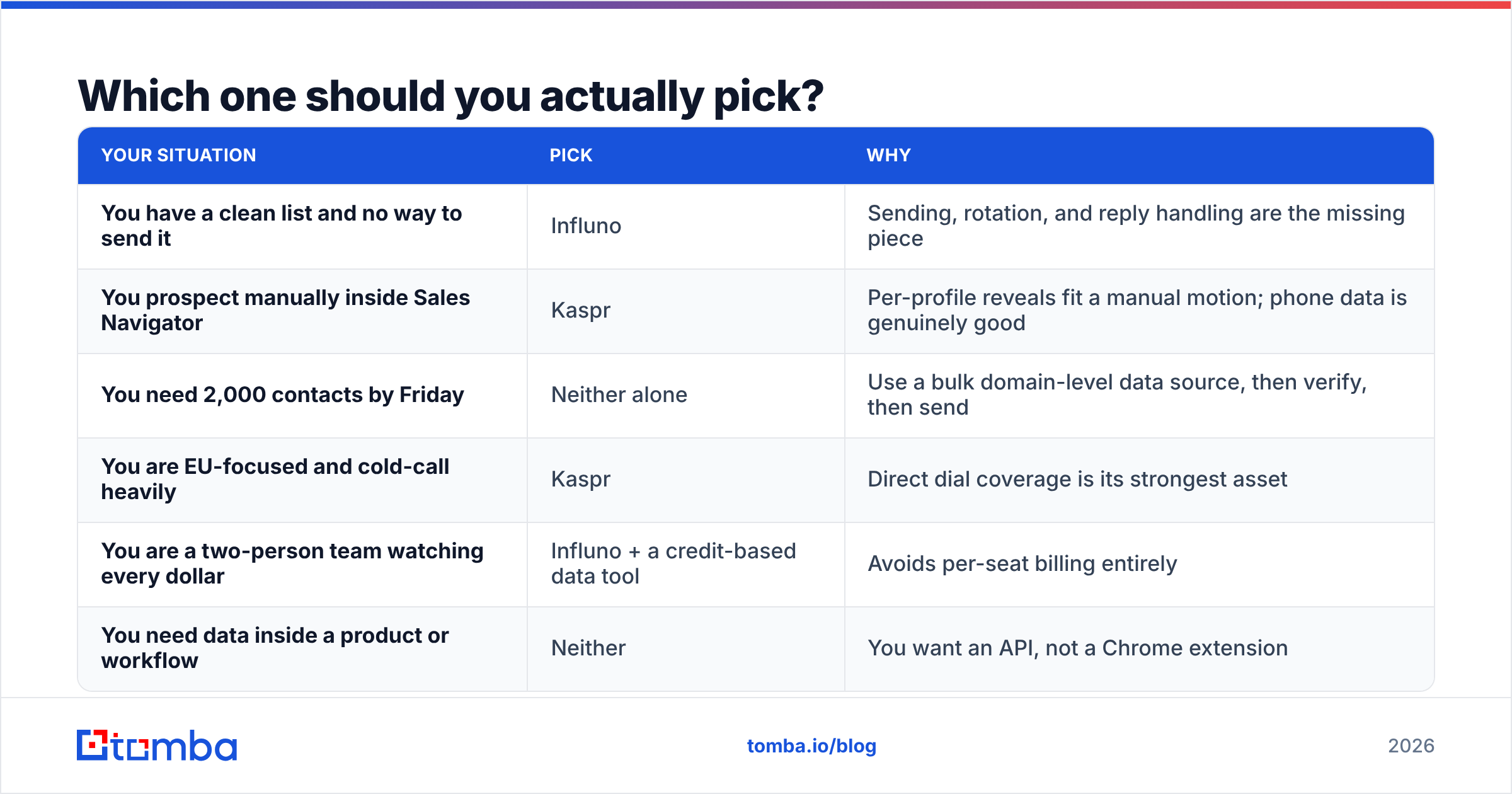
Which one should you actually pick?#
| Your situation | Pick | Why |
|---|---|---|
| You have a clean list and no way to send it | Influno | Sending, rotation, and reply handling are the missing piece |
| You prospect manually inside Sales Navigator | Kaspr | Per-profile reveals fit a manual motion; phone data is genuinely good |
| You need 2,000 contacts by Friday | Neither alone | Use a bulk domain-level data source, then verify, then send |
| You are EU-focused and cold-call heavily | Kaspr | Direct dial coverage is its strongest asset |
| You are a two-person team watching every dollar | Influno + a credit-based data tool | Avoids per-seat billing entirely |
| You need data inside a product or workflow | Neither | You want an API, not a Chrome extension |
That third row is the one most teams land on and the one no vendor page will tell you. Reveal-by-profile does not scale to list building, and a sender does not source contacts. If your motion is volume outbound, your stack is: a domain search or bulk source for the list, verification for hygiene, then a sender.
It is also worth benchmarking against list vendors before you commit to a reveal-based workflow at all. Providers like BookYourData sell pre-built, verified lists outright, which is a fundamentally different economic model from per-credit reveals and often cheaper for broad ICP coverage. Neutral advice: price all three models against the same 1,000-contact target before deciding.
What does a sane 2026 outbound stack look like?#
Three layers, clearly separated, each replaceable without tearing down the others:
- Source. Where contacts come from. Kaspr if your motion is profile-by-profile. A domain-level finder or database if your motion is list-first. Keep it swappable - data vendors change coverage constantly.
- Hygiene. Verification, catch-all handling, deduplication. Non-negotiable and cheap. This layer is why two teams with identical lists get 2% and 9% bounce rates.
- Send. Influno, or any competent sequencer. Judge it on inbox rotation, reply attribution, and how fast you can clone a working campaign - not on how many AI features it advertises.
The failure mode to avoid is buying one product that claims all three and discovering that the data layer is a thin reseller agreement. Ask any all-in-one vendor exactly where the emails come from, and whether verification is a real SMTP check or a syntax filter. Vendors that publish their data sources are making a harder promise than vendors that do not.
The verdict#
Buy Influno if your problem is sending. Buy Kaspr if your problem is finding people on LinkedIn, especially by phone. Buy neither expecting it to solve the other half.
Kaspr is a good tool held back by seat-based pricing and email accuracy that trails its phone data. Influno is a capable, reasonably priced sender that assumes you arrive with a list. Both are defensible purchases for the job they were built for, and both are disappointing purchases for the job they were not.
Before you commit budget to either, fix the layer neither one owns. Run your existing list through Tomba's Email Finder and verifier to see how many addresses in your CRM are already dead - the free tier gives you 25 searches a month, no card, and the Starter plan is $49/mo flat with no per-seat penalty when your team grows. Most teams find the bounce problem was never the sender.
Related guides#
// get started
Find, verify and enrich your first contacts today
Start on the free plan with 25 searches a month, then scale when your team is ready.
Free plan · No credit card required · GDPR & CCPA
Get the Tomba newsletter
Product and data updates
// about the author