Influno vs Limeleads (2026): Which B2B Lead Tool Wins?
One sells you a sending engine, the other sells you a list. Here is how Influno and Limeleads actually compare on data accuracy, pricing, and what breaks when you scale past 5,000 contacts a month.
TL;DR
- Influno and Limeleads are not really competitors. Influno is an outreach suite (sequences, inboxes, warmup, light contact lookup). Limeleads is a B2B contact database you query, filter, and export. Buying one does not remove the need for the other.
- If your bottleneck is sending, Influno is the closer fit. If your bottleneck is finding people to send to, Limeleads is.
- Limeleads' credit model punishes bad data. You pay per exported lead whether or not it bounces, so verification hygiene is on you.
- Neither ships a serious standalone verification layer, which is where most teams bolt on a dedicated email verifier and end up paying for three tools instead of two.
- Our pick for most teams under 20 SDRs: a dedicated finder/verifier for data + a sending tool you already own, rather than either all-in-one bet.
What are Influno and Limeleads?#
Influno is a cold email platform. Its center of gravity is the send: multi-inbox rotation, sequence building, reply detection, deliverability tooling, and a lookup feature for filling in missing addresses. You point it at a list and it runs the campaign.
Limeleads is a B2B lead database. You build a search — industry, job title, company size, geography, technology — preview the matching records, and spend credits to unlock and export them. There is no sending engine. The output is a CSV or a CRM push.
That distinction matters more than any feature table, so say it plainly: Influno vs Limeleads is a comparison between a delivery mechanism and a supply of names. Teams shopping both usually have a vague problem ("outbound isn't working") and have not yet diagnosed which half is broken. Diagnose it first. If your open rates are fine and your list runs dry in nine days, the database is the gap. If you have 40,000 contacts sitting in a spreadsheet and nothing lands in the inbox, buy sending infrastructure.
How do Influno and Limeleads differ at the core?#
Six differences do most of the work when you evaluate these two:
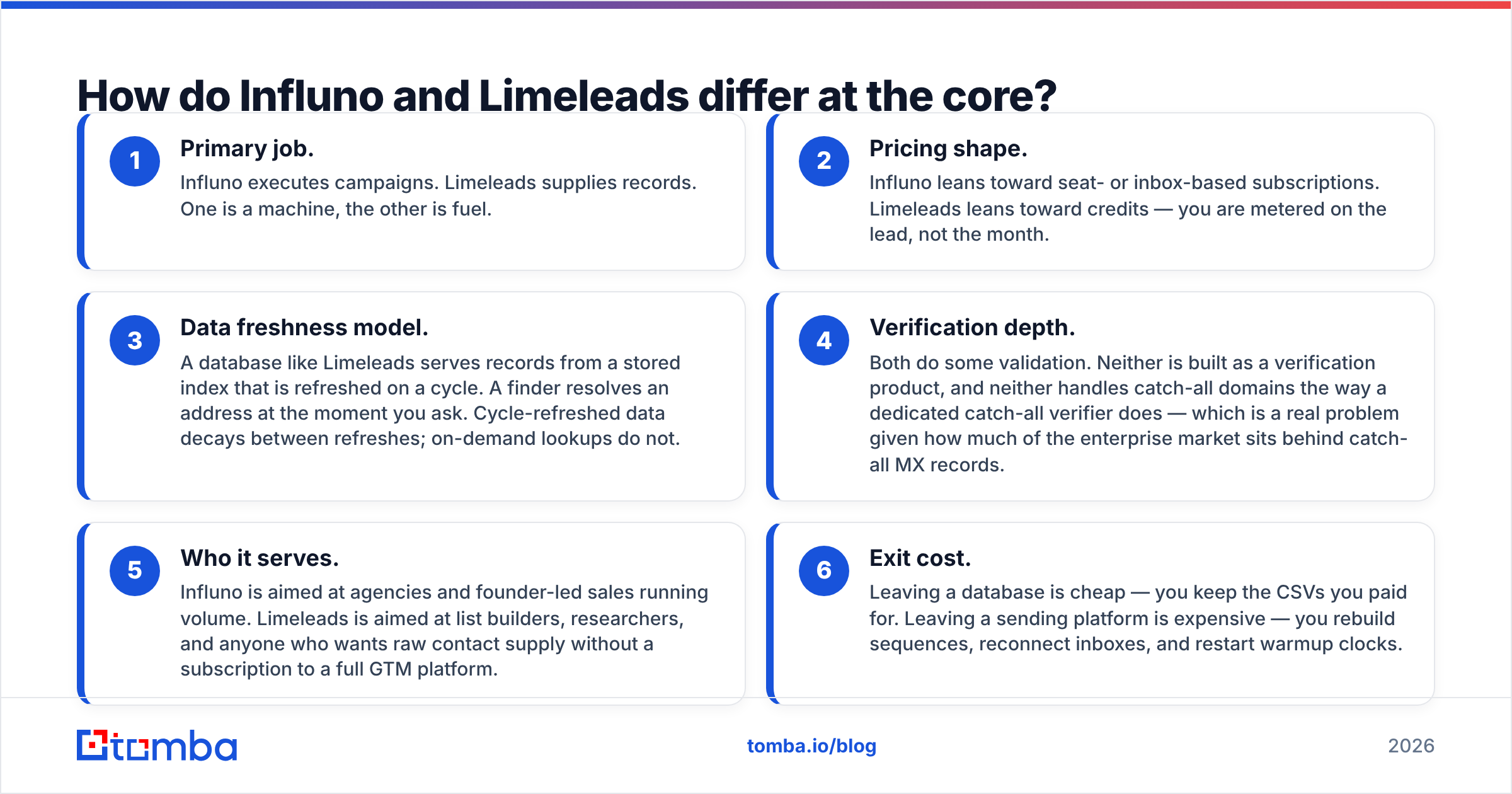
- Primary job. Influno executes campaigns. Limeleads supplies records. One is a machine, the other is fuel.
- Pricing shape. Influno leans toward seat- or inbox-based subscriptions. Limeleads leans toward credits — you are metered on the lead, not the month.
- Data freshness model. A database like Limeleads serves records from a stored index that is refreshed on a cycle. A finder resolves an address at the moment you ask. Cycle-refreshed data decays between refreshes; on-demand lookups do not.
- Verification depth. Both do some validation. Neither is built as a verification product, and neither handles catch-all domains the way a dedicated catch-all verifier does — which is a real problem given how much of the enterprise market sits behind catch-all MX records.
- Who it serves. Influno is aimed at agencies and founder-led sales running volume. Limeleads is aimed at list builders, researchers, and anyone who wants raw contact supply without a subscription to a full GTM platform.
- Exit cost. Leaving a database is cheap — you keep the CSVs you paid for. Leaving a sending platform is expensive — you rebuild sequences, reconnect inboxes, and restart warmup clocks.

Which one has better data accuracy?#
Neither publishes an audited bounce rate, so treat every accuracy number from either vendor — or from any vendor, including us — as marketing until you test it on your own ICP.
What you can reason about is the mechanism, and the mechanisms differ.
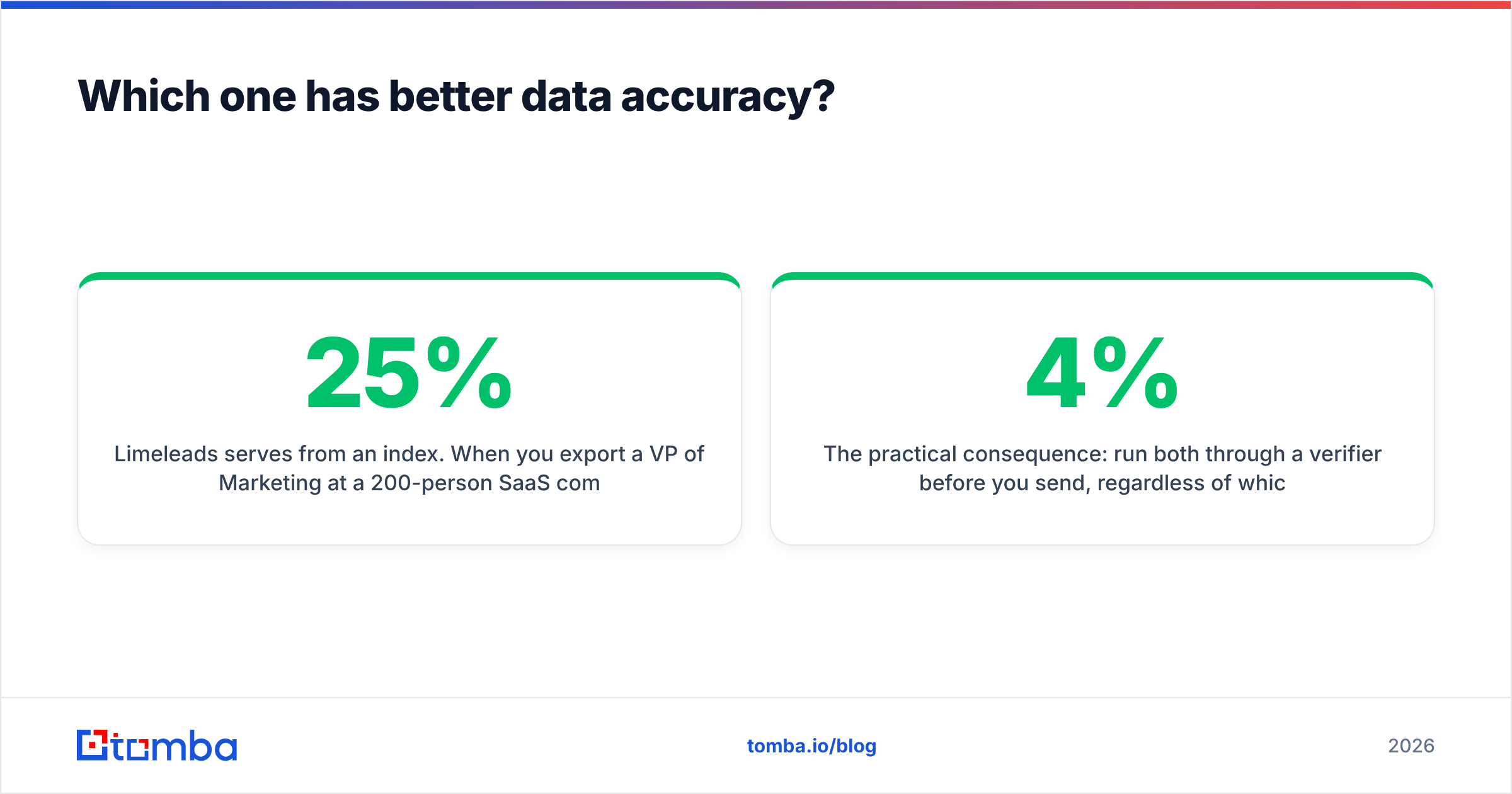
Limeleads serves from an index. When you export a VP of Marketing at a 200-person SaaS company, you get whatever the index last recorded. If that person changed jobs in March and the record was refreshed in January, you paid a credit for a contact who no longer exists. Job-change churn in B2B runs somewhere around 20–25% annually depending on whose research you read, and it concentrates in exactly the seniority bands SDRs target. That is not a Limeleads flaw specifically — it is the structural cost of any stored-database model, including the big enterprise vendors.
Influno's lookup works differently: it resolves against the domain when you ask. Fresher by design, but coverage is narrower. Domain-pattern resolution works beautifully for a 300-person company with a clean first.last@ convention and poorly for conglomerates with a dozen acquired subdomains.

The practical consequence: run both through a verifier before you send, regardless of which you buy. A 4% bounce rate is survivable. An 8% bounce rate on a new domain will cost you the domain. If you are exporting in volume, a bulk email finder pass that re-checks every record before it enters the sequence is cheaper than the reputation repair.
One more thing worth checking on any database vendor: where the records come from. Scraped-only sources age badly and carry compliance risk in the EU. Vendors that publish their data sources are giving you something you can actually audit.
How do Influno and Limeleads compare feature by feature?#
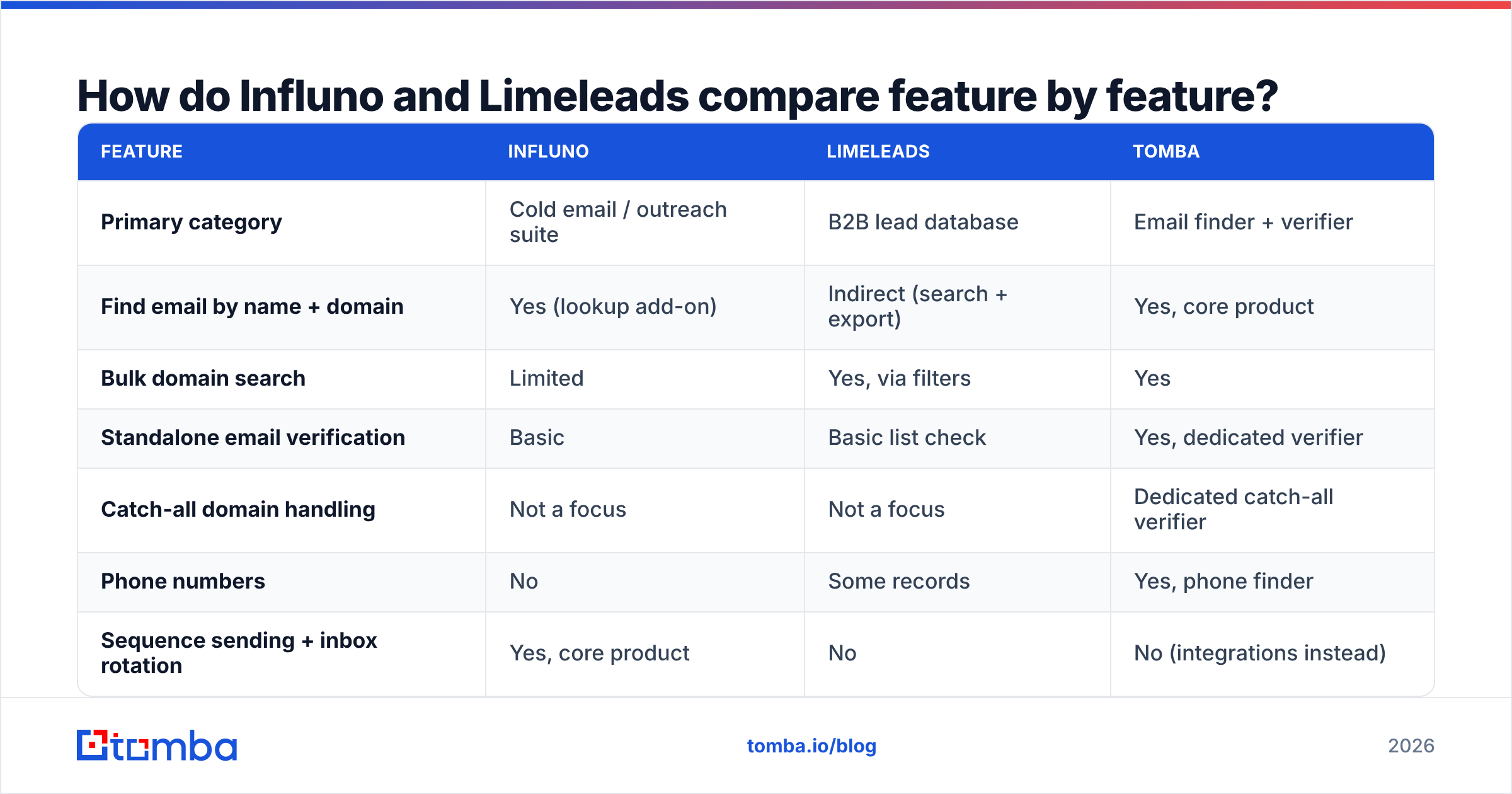
| Feature | Influno | Limeleads | Tomba |
|---|---|---|---|
| Primary category | Cold email / outreach suite | B2B lead database | Email finder + verifier |
| Find email by name + domain | Yes (lookup add-on) | Indirect (search + export) | Yes, core product |
| Bulk domain search | Limited | Yes, via filters | Yes |
| Standalone email verification | Basic | Basic list check | Yes, dedicated verifier |
| Catch-all domain handling | Not a focus | Not a focus | Dedicated catch-all verifier |
| Phone numbers | No | Some records | Yes, phone finder |
| Sequence sending + inbox rotation | Yes, core product | No | No (integrations instead) |
| Email warmup | Yes | No | No |
| API access | Limited | Available on higher tiers | Full REST API + CLI + MCP |
| Chrome extension | Yes | Yes | Yes |
| Native CRM sync | HubSpot, Pipedrive | Export / Zapier | HubSpot, Salesforce, Pipedrive, Zapier, Make |
| Free tier | Trial-based | Limited free preview | 25 searches/mo, no card |

Read the table as three columns of different jobs, not three ranked contenders. Influno owns the send column. Limeleads owns the supply column. A finder/verifier owns the accuracy column. Most functioning outbound stacks contain all three — they just do not always buy all three at once.
What does each one actually cost?#
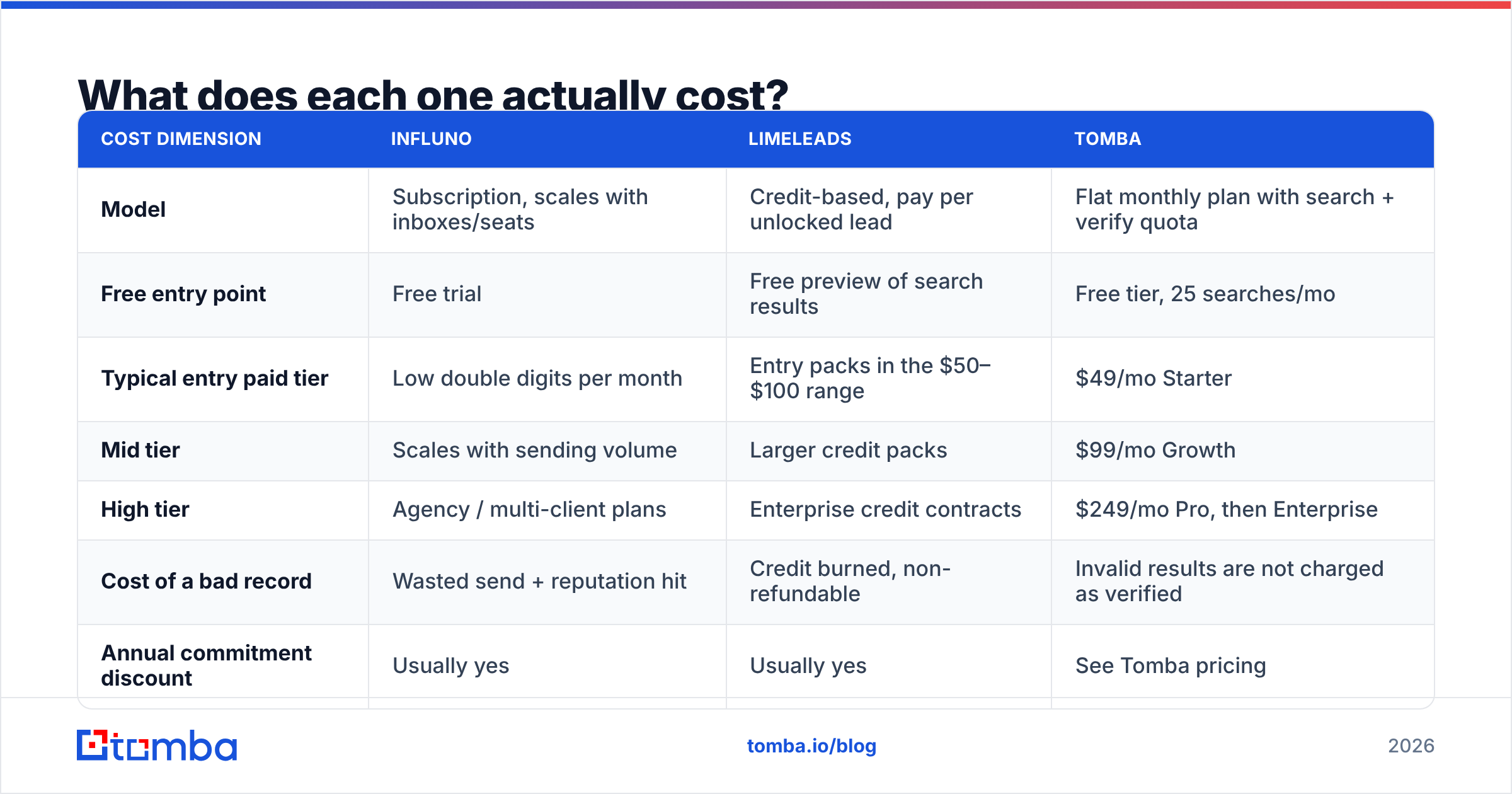
Published pricing on both platforms changes, and both run promotional tiers, so verify on their sites before you commit budget. The shape of the pricing is the stable part and the part that determines your real annual spend.
| Cost dimension | Influno | Limeleads | Tomba |
|---|---|---|---|
| Model | Subscription, scales with inboxes/seats | Credit-based, pay per unlocked lead | Flat monthly plan with search + verify quota |
| Free entry point | Free trial | Free preview of search results | Free tier, 25 searches/mo |
| Typical entry paid tier | Low double digits per month | Entry packs in the $50–$100 range | $49/mo Starter |
| Mid tier | Scales with sending volume | Larger credit packs | $99/mo Growth |
| High tier | Agency / multi-client plans | Enterprise credit contracts | $249/mo Pro, then Enterprise |
| Cost of a bad record | Wasted send + reputation hit | Credit burned, non-refundable | Invalid results are not charged as verified |
| Annual commitment discount | Usually yes | Usually yes | See Tomba pricing |
Two things to model before you sign anything.
First, the credit-burn math. If you export 5,000 leads a month and 18% are stale, you paid for 900 contacts that do you no good. At ten cents a lead that is $90 of pure waste monthly, plus the downstream bounce damage. Credit models look cheap at the unit level and stop looking cheap once you apply a realistic decay rate.
Second, the inbox math. Sending platforms priced per inbox get expensive fast when your deliverability strategy is "more domains, fewer sends each." A five-domain, fifteen-inbox setup is standard practice now, and it can triple your quoted price.

Which tool fits which team?#
- Agency running client campaigns at volume. Influno. You need inbox rotation, per-client separation, and warmup more than you need another database. Source data elsewhere.
- Founder doing 50 highly targeted emails a week. Neither, initially. Build the list manually, resolve addresses with a domain search, and send from your real inbox. Tooling is premature.
- List-building or research operation. Limeleads. The credit model fits lumpy, project-based demand better than a subscription you underuse in slow months.
- SDR team of 5–20 with an existing sequencer. You already have the send. Buy accuracy: a finder plus verifier plugged into your CRM via the Tomba API or a HubSpot integration.
- RevOps enriching an existing CRM. Neither is ideal. You want data enrichment that runs on a schedule against records you already own, not a new export destination.
- Teams that need verified, pre-built lists by geography. Worth looking at BookYourData alongside Limeleads — it takes a different approach to list construction and publishes clear accuracy guarantees, which makes it a reasonable peer to evaluate in the same bake-off.
Where do both tools fall short?#
Influno's gap is supply. Its lookup is a convenience feature attached to a sending product, not a data product with its own research team. Coverage outside mid-market North American SaaS thins out. If your ICP is European manufacturing or APAC logistics, test hard before you trust it.
Limeleads' gap is freshness and finality. Credits spent on stale records are gone. Some vendors offer bounce credits back; check the current refund policy in writing before you buy a large pack, because "we'll look into it" is not a policy.
Both share a verification gap. Neither treats catch-all domains, role accounts, spam traps, and disposable addresses as a first-class problem. That is a specialist's job, and the specialists are cheap relative to the damage. Running a list through a free email checker before a send takes minutes and catches the obvious failures; running the full list through a dedicated verifier catches the rest.
Both under-serve compliance documentation. If you sell into the EU or UK, you need a defensible answer for where a contact record came from. Ask both vendors directly and get it in writing.
How should you run a test before committing?#
Do not evaluate on the vendor's demo data. Run this instead, in a week:
- Build one seed list of 100 real prospects in your actual ICP — names, companies, domains. Use accounts you already know something about, so you can spot-check results.
- Run the same 100 through each tool. Record match rate (how many returned anything) and confidence rate (how many were flagged high-confidence).
- Verify all outputs through a neutral third-party verifier. This is the step teams skip, and it is the only one that produces an honest number. You want valid / invalid / catch-all / unknown counts per tool.
- Send a 50-contact test campaign from a throwaway subdomain, not your primary. Measure hard-bounce rate at 48 hours.
- Price the winner at your real monthly volume, not the entry tier. Multiply by 12. Include the verifier you will need regardless.
- Check the support response time during the trial by asking one hard technical question. The answer tells you what renewal will feel like.
Third-party review sites are useful for spotting patterns in complaints — filter G2 reviews to the most recent six months and read the two-star reviews, which are usually more informative than either extreme. Vendor review counts mean little; recurring specific complaints mean a lot.
So which one wins?#
For sending, Influno. For sourcing, Limeleads. For accuracy, neither — and accuracy is what determines whether the other two matter.
That is the honest verdict. A perfect sequence sent to a 22%-stale list underperforms a mediocre sequence sent to a verified one, every time. The sequencing layer and the database layer are commodities with a dozen credible vendors each; the data layer is where outcomes actually separate.
If you are building the stack from scratch, the order that works is: get the data right, then buy sending capacity, then optimize copy. Teams routinely do it backwards and conclude that outbound is dead.
Start with the layer that decides everything else. Tomba Email Finder resolves professional addresses by name, domain, or company, with verification built into the same request — so contacts enter your sequencer already checked rather than getting checked by your prospects' mail servers. The free tier gives you 25 searches a month with no card, which is enough to run the 100-contact bake-off above and see the match rates for yourself before you spend a credit anywhere else.
Related guides#
// get started
Find, verify and enrich your first contacts today
Start on the free plan with 25 searches a month, then scale when your team is ready.
Free plan · No credit card required · GDPR & CCPA
// about the author