Influno vs ReachStream 2026: Outreach vs Data Compared
Influno sends the emails. ReachStream sells the contacts. Comparing them head-to-head only makes sense once you know which half of the outbound stack you're actually missing — here's the honest breakdown.
TL;DR
- They are not the same category. Influno is a cold email sending and sequencing platform. ReachStream is a B2B contact database you buy records from. Picking "the winner" depends on which half of your outbound stack is broken.
- Influno wins if you already have contacts and need inbox rotation, warmup, sequences, and reply detection in one tool.
- ReachStream wins if you need volume list-building fast and you're comfortable doing your own verification before sending.
- Neither one fully replaces the other. The common failure mode is buying a database, dumping it into a sender, and torching a domain in three weeks.
- The verification layer is the gap. Whichever you choose, run every record through a dedicated email verifier before the first send — that single step protects deliverability more than any feature on either pricing page.
What are Influno and ReachStream?#
Influno is a cold email outreach platform. Its job starts after you have a list: connect mailboxes, warm them, build multi-step sequences, rotate sending across inboxes, personalize at scale, and track opens, clicks, and replies. In the taxonomy of outbound tools it sits next to Instantly, Smartlead, and Lemlist — an execution layer, not a data layer.
ReachStream is a B2B contact data provider. Its job ends before you send anything: search a database of business contacts by industry, title, geography, company size, and technology, then export what you need as a list. In the taxonomy it sits next to Apollo's data side, Lusha, and traditional list vendors — a data layer, not an execution layer.
So when people search "influno vs reachstream," they're usually asking one of two different questions:
- "I have $X for outbound tooling this quarter — which single purchase moves the needle more?"
- "Do I need both, and if so, what does the combined stack cost and look like?"
This post answers both, honestly, including where each tool leaves you exposed.

How do Influno and ReachStream actually differ?#
The clearest way to see the split is by the job each one does in the outbound sequence. Here is the practical breakdown:
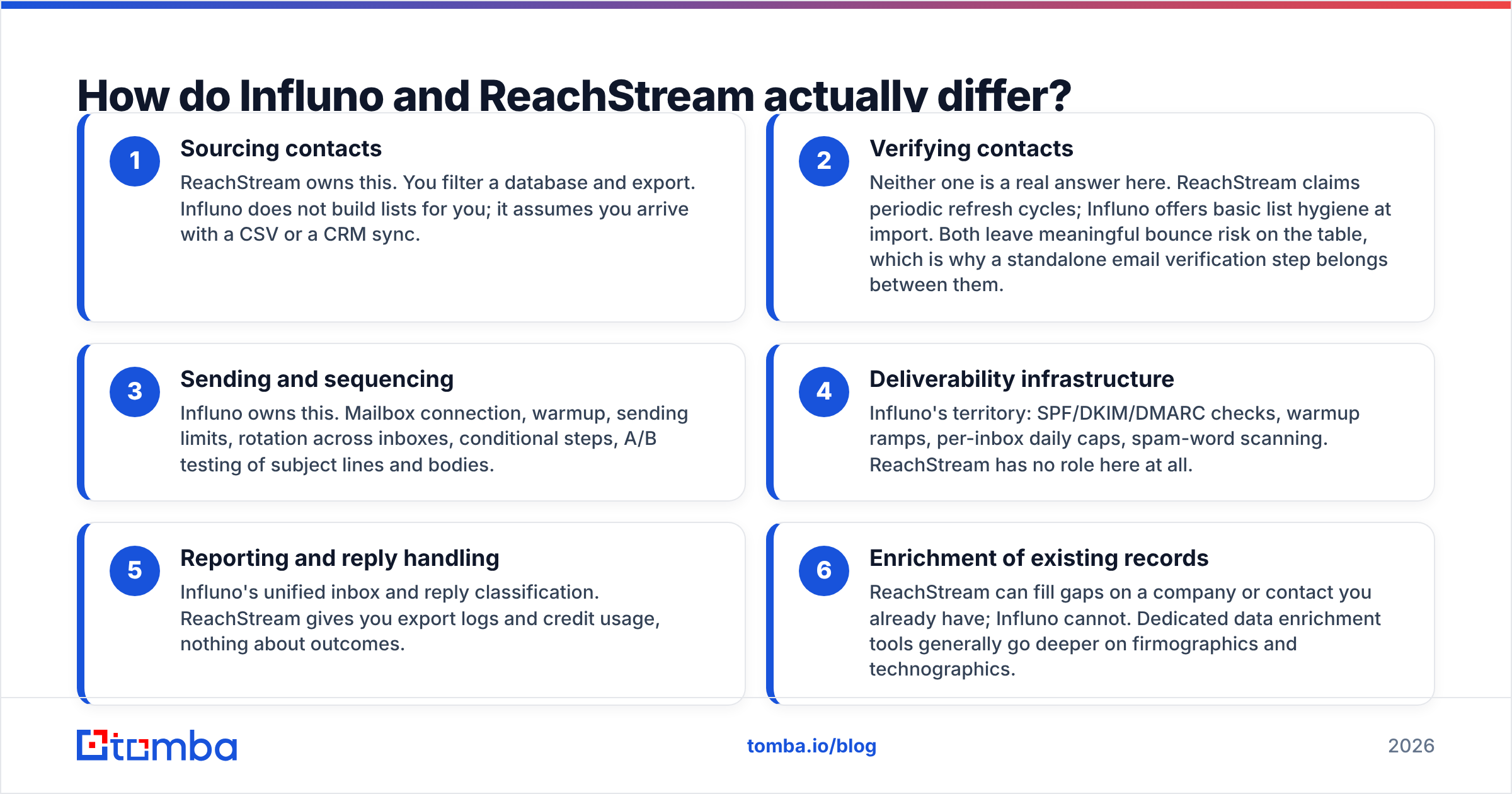
- Sourcing contacts — ReachStream owns this. You filter a database and export. Influno does not build lists for you; it assumes you arrive with a CSV or a CRM sync.
- Verifying contacts — Neither one is a real answer here. ReachStream claims periodic refresh cycles; Influno offers basic list hygiene at import. Both leave meaningful bounce risk on the table, which is why a standalone email verification step belongs between them.
- Sending and sequencing — Influno owns this. Mailbox connection, warmup, sending limits, rotation across inboxes, conditional steps, A/B testing of subject lines and bodies.
- Deliverability infrastructure — Influno's territory: SPF/DKIM/DMARC checks, warmup ramps, per-inbox daily caps, spam-word scanning. ReachStream has no role here at all.
- Reporting and reply handling — Influno's unified inbox and reply classification. ReachStream gives you export logs and credit usage, nothing about outcomes.
- Enrichment of existing records — ReachStream can fill gaps on a company or contact you already have; Influno cannot. Dedicated data enrichment tools generally go deeper on firmographics and technographics.
Put simply: ReachStream fills the top of the funnel with raw material; Influno turns that material into conversations. Comparing them feature-for-feature is like comparing a quarry to a bricklayer.
Which one should you buy first?#
Here is the head-to-head on the attributes that actually change a buying decision.
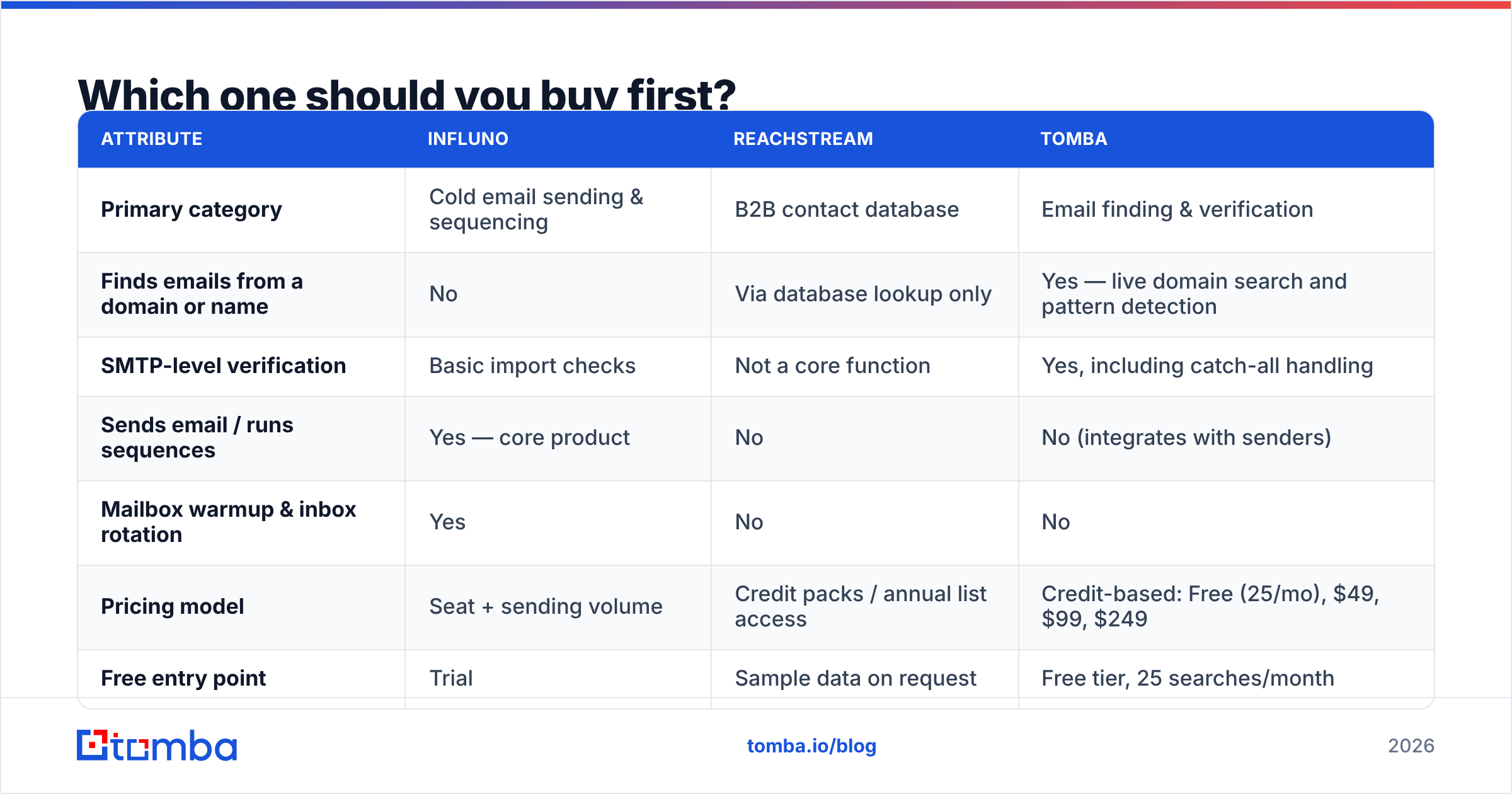
| Attribute | Influno | ReachStream | Tomba |
|---|---|---|---|
| Primary category | Cold email sending & sequencing | B2B contact database | Email finding & verification |
| Finds emails from a domain or name | No | Via database lookup only | Yes — live domain search and pattern detection |
| SMTP-level verification | Basic import checks | Not a core function | Yes, including catch-all handling |
| Sends email / runs sequences | Yes — core product | No | No (integrates with senders) |
| Mailbox warmup & inbox rotation | Yes | No | No |
| Pricing model | Seat + sending volume | Credit packs / annual list access | Credit-based: Free (25/mo), $49, $99, $249 |
| Free entry point | Trial | Sample data on request | Free tier, 25 searches/month |
| API access | Sending & campaign API | Data API on higher tiers | Full email finder API, CLI, MCP server |
| Best for | Teams with a list, no sending infra | Teams needing volume lists fast | Teams needing accurate, verified contacts on demand |
Two things stand out in that table.
First, the pricing models aren't comparable. Influno charges for capacity to send — seats and monthly volume. ReachStream charges for access to records, typically as credits or an annual subscription to a slice of the database. A $99 month on one buys you a completely different unit of value than a $99 month on the other. Always price the full stack, not one line item. And always check both vendors' current pricing pages directly; list prices in this category change quarterly and published tiers frequently omit onboarding or minimum-commit terms.
Second, neither column has a strong "verification" row. That's not an oversight on my part — it's the structural gap in this comparison, and it's the one that costs money.
How accurate is the data you'll actually send to?#
This is where a lot of outbound programs quietly fail. A purchased database is a snapshot. The moment it's exported, it starts decaying — people change jobs, companies rebrand, domains migrate, mailboxes get deprovisioned.
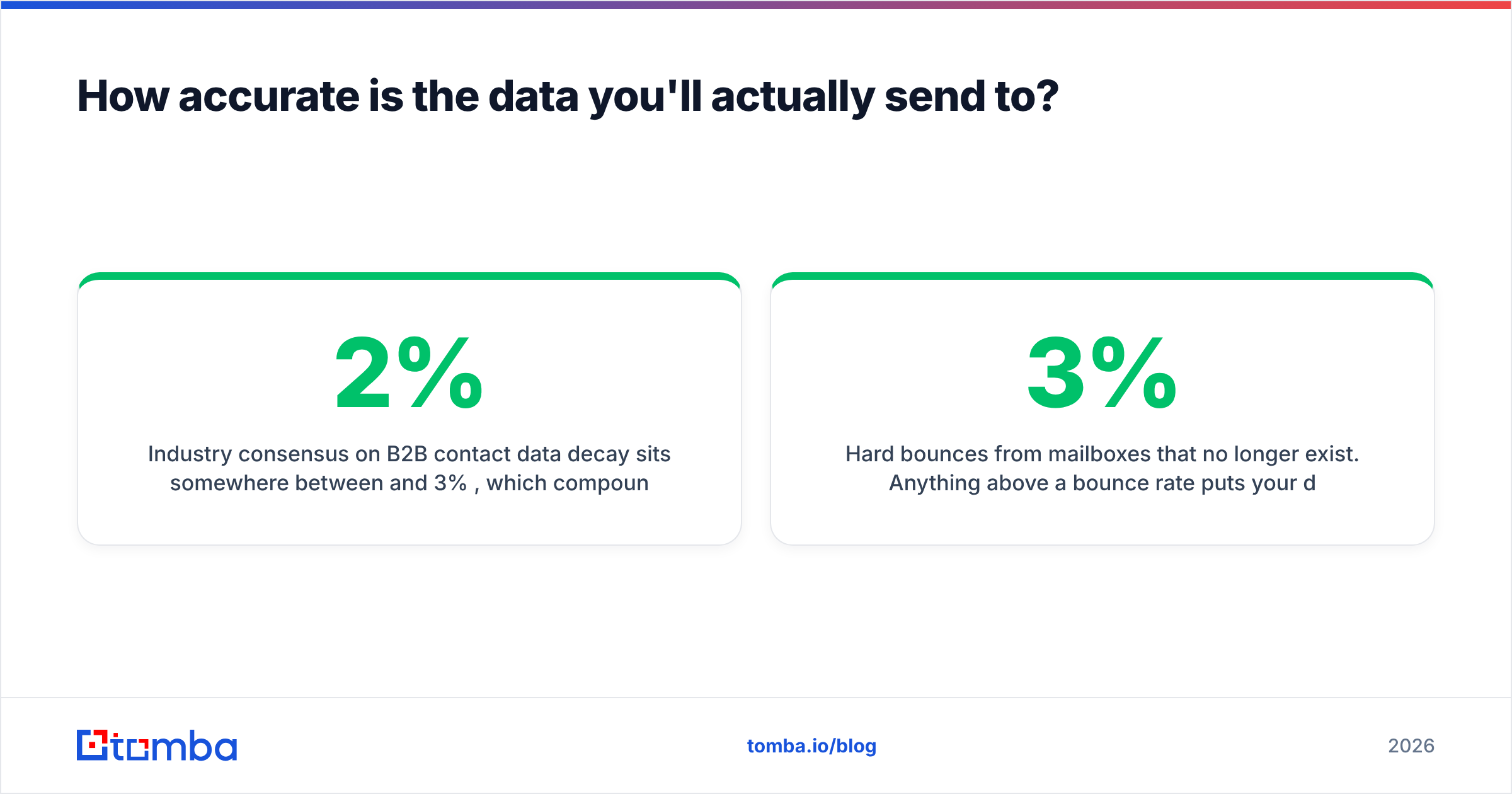
Industry consensus on B2B contact data decay sits somewhere between 2% and 3% per month, which compounds to roughly 25–30% annually. Gartner and others have flagged data quality as a top constraint on sales productivity for years. That means a list exported in January and sent in June has already lost a meaningful chunk of its validity, even if it was 95% accurate on export day.
What that looks like in practice:
- Hard bounces from mailboxes that no longer exist. Anything above a 3% bounce rate puts your domain reputation at risk with Google and Microsoft; above 5% you're actively being filtered.
- Role accounts (info@, sales@, support@) padding the count. They inflate list size and depress reply rates.
- Catch-all domains that accept everything and tell you nothing. A naive verifier marks these "valid." A good catch-all verifier applies deeper checks before you commit sends to them.
- Stale titles. The contact is real, the mailbox works, but the person left that role 14 months ago. Your "Hi {{first_name}}, as VP of Ops..." opener lands wrong.
Influno's warmup and rotation features mitigate the symptoms of a bad list — they spread the damage across more mailboxes. They don't fix the cause. ReachStream's refresh cadence helps, but no vendor refreshes every record every month.
The fix is unglamorous: verify immediately before the send, not at export. Run the export through a bulk verify pass, strip hard bounces and role accounts, segment catch-alls into a lower-volume test batch, and only then load into your sender.

Is Influno better than ReachStream for cold outreach?#
If "cold outreach" means the act of sending, then yes — trivially, because ReachStream doesn't send. But the more useful version of the question is: which purchase produces more meetings per dollar?
Work through the two scenarios.
Scenario A: you already have a list. Maybe it came from your CRM, a conference attendee export, inbound signups that went cold, or a previous data purchase. Your bottleneck is execution — you're sending from one Gmail account, hitting limits, and have no visibility into replies. Influno is the right buy. Sequencing plus inbox rotation plus warmup will roughly multiply your throughput while keeping deliverability intact. ReachStream would just give you more names you also can't send to properly.
Scenario B: you have sending infrastructure but no addressable market. You've already got Smartlead or Instantly, your domains are warm, your SPF and DKIM are clean — you just don't know who to contact. Then a data source is the right buy. Whether that's ReachStream specifically depends on your ICP: database vendors have uneven coverage by geography and vertical, and the only reliable test is a sample. Ask for 200 records matching your exact ICP filters, verify them yourself, and calculate the real valid-and-relevant rate before committing to an annual plan. Vendors that decline to sample are telling you something.
Scenario C — the honest one for most teams: you're missing both, plus the layer between them. You need contacts, you need to verify them, and you need to send. That's three line items, and the middle one is the cheapest and highest-leverage of the three.
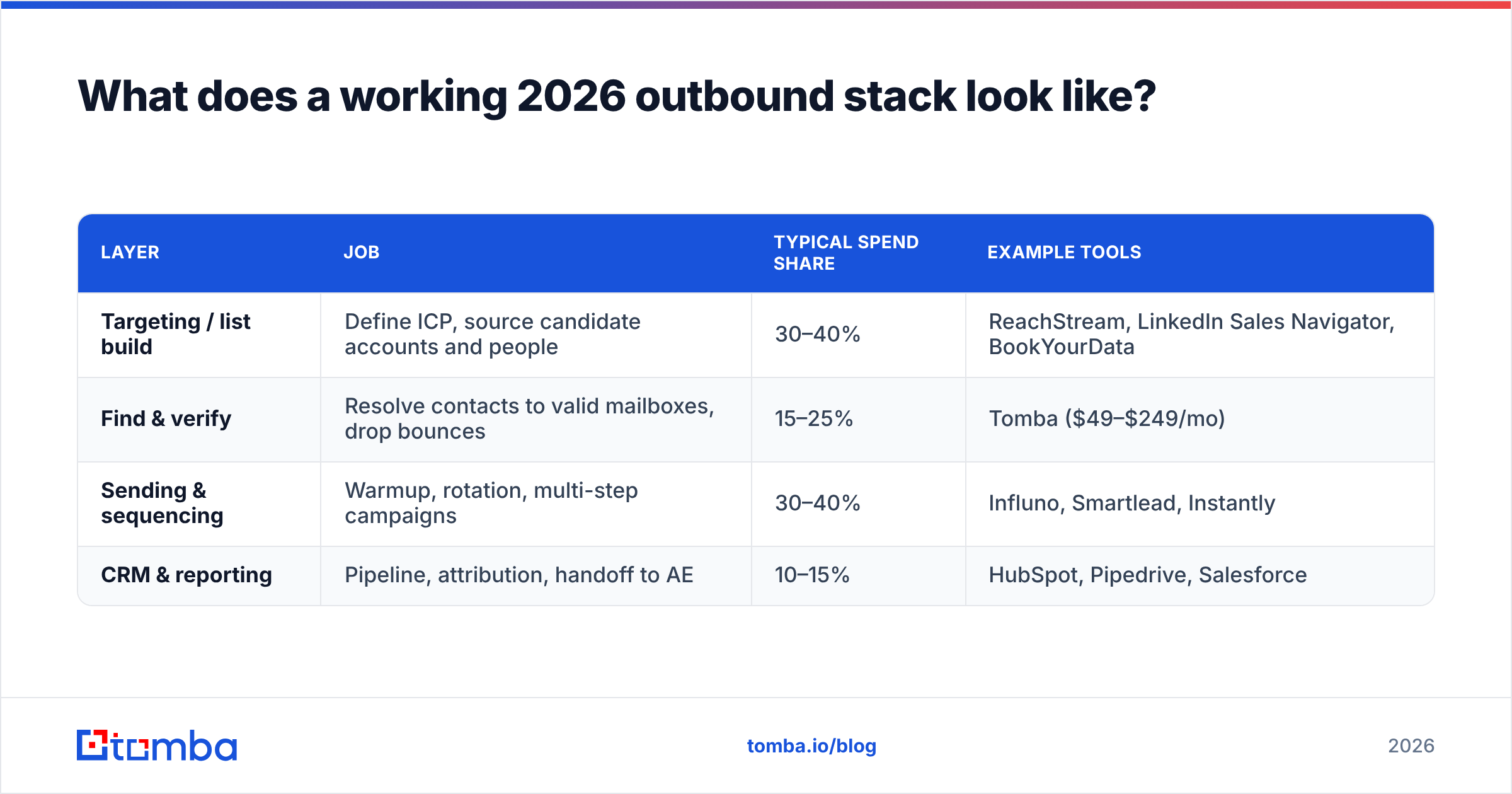
What does a working 2026 outbound stack look like?#
Here's how the pieces assemble, with rough cost-share for a small team running 3,000–5,000 contacts per month:
| Layer | Job | Typical spend share | Example tools |
|---|---|---|---|
| Targeting / list build | Define ICP, source candidate accounts and people | 30–40% | ReachStream, LinkedIn Sales Navigator, BookYourData |
| Find & verify | Resolve contacts to valid mailboxes, drop bounces | 15–25% | Tomba ($49–$249/mo) |
| Sending & sequencing | Warmup, rotation, multi-step campaigns | 30–40% | Influno, Smartlead, Instantly |
| CRM & reporting | Pipeline, attribution, handoff to AE | 10–15% | HubSpot, Pipedrive, Salesforce |
Notice that the find-and-verify layer is the smallest share of spend and the one most teams skip. It is also the only layer whose failure degrades every layer above it: bad data wastes your database credits, wastes your sending capacity, and poisons your CRM.
A concrete workflow that works:
- Build an account list in your data source (ReachStream, Sales Navigator, or a scraped vertical list).
- For each target account, run a domain search to surface real, currently-active mailboxes and the company's email pattern.
- Verify the full set, including catch-all handling. Discard anything that isn't deliverable.
- Segment into tiers — verified-valid goes into full sequences, catch-all goes into a small, slow test batch.
- Load into Influno (or your sender of choice), keep per-inbox volume conservative, and monitor bounce rate daily for the first two weeks.
- Push replies and positive signals to the CRM with an integration instead of copy-paste.
Step 3 is the one you cannot skip. G2 reviews across every vendor in this category are full of the same complaint pattern: "the data was fine at first, then bounce rates climbed." That's not a vendor defect — it's decay, and verification at send-time is the only countermeasure.
Where do Influno and ReachStream each fall short?#
Fair assessment of both:
Influno's limitations. It's a sender, so its quality ceiling is set by your list. It gives you no help finding contacts, and its enrichment is thin. If your deliverability problems stem from data quality rather than infrastructure, more sequencing features won't save you. As with every sending platform, you also carry the cost of secondary domains and mailboxes on top of the subscription — budget for that separately.
ReachStream's limitations. Coverage varies sharply by region and vertical; strong in some segments, thin in others. Records are database-sourced rather than verified live at export time, so you inherit whatever decay has accumulated since the last refresh. And export-and-forget pricing encourages you to pull more records than you can responsibly send to.
Both. Neither gives you a defensible answer to "is this specific mailbox going to accept my email right now?" That question requires an SMTP-level check at the moment of sending, which is a different technical operation than a database lookup.
Which one should you choose?#
- Choose Influno if your list exists and your sending is the constraint. Warmup, rotation, and sequencing will return their cost quickly if — and only if — the underlying data is clean.
- Choose ReachStream if you have sending infrastructure and need volume list-building in segments where their coverage is genuinely strong. Sample first. Always sample first.
- Choose neither, yet, if your bounce rate is already above 3%. Fix data quality before you add capacity in either direction. Adding sending capacity to a bad list accelerates the damage; adding more bad records to a good sender does the same.
- Run both plus verification if you're scaling past a few thousand contacts a month. That's the configuration that actually holds up.
The honest verdict on influno vs reachstream: it's not a fight, it's a division of labor, and the referee — verification — is the piece most teams never buy.
Ready to fix the layer in the middle?#
You can source contacts anywhere. What determines whether your campaigns land is whether those contacts are real, current, and safe to send to today. Tomba's Email Finder resolves names and domains to verified professional mailboxes, flags catch-alls and role accounts before they hit your sequencer, and exports straight into the sending tool you already use. Start on the free tier with 25 searches a month, or move to Starter at $49/mo when you're running real volume — and stop paying for sends that were never going to arrive.
Related guides#
// get started
Find, verify and enrich your first contacts today
Start on the free plan with 25 searches a month, then scale when your team is ready.
Free plan · No credit card required · GDPR & CCPA
// about the author