Influno vs Zintlr 2026: Outreach vs Sales Intelligence
Influno sends the emails. Zintlr tells you who to send them to. Here is an honest, feature-by-feature breakdown of where each one actually earns its seat in your outbound stack — and where you still need a third tool.
TL;DR
- They are not the same category. Influno is a cold email sending and sequencing platform. Zintlr is a B2B data and sales-intelligence platform. Comparing them head-to-head only makes sense if you are deciding which gap in your stack to fill first.
- Pick Influno if you already have a clean contact list and your bottleneck is sending, warming, rotating inboxes, and tracking replies.
- Pick Zintlr if your bottleneck is finding and qualifying people — company search, contact records, and its personality-profiling angle.
- Most teams end up needing both halves, and neither tool fully covers the other's job. That is the honest verdict.
- Verification is the silent third requirement. Whichever you buy, bad addresses still torch your domain. Budget for a dedicated finder/verifier layer.
What is Influno, and who actually uses it?#
Influno is an outbound email platform. Its center of gravity is the send: you connect mailboxes, warm them, build multi-step sequences with conditional follow-ups, and watch opens, clicks, and replies land in a unified inbox.
The buyer profile is predictable and narrow in a good way — a founder, an agency, or a two-to-ten-person SDR team running cold email at moderate volume. The pitch is "replace a $200/month sequencer with something simpler and cheaper," and the feature list reads accordingly: inbox rotation, spintax, warmup, deliverability hygiene prompts, campaign analytics, a lightweight CRM-ish pipeline view.
What Influno is not is a database. It does not hand you 200 million contact records. You bring the list. If you upload garbage, Influno will faithfully send garbage at scale and your sender reputation pays the bill.
That distinction matters more than any feature-checkbox comparison, so hold onto it.
What is Zintlr, and how is it different?#
Zintlr sits on the other side of the workflow. It is a prospecting and B2B intelligence platform: search companies and people by filters, pull contact details, and enrich what you already have. Its differentiator — the thing it markets hardest — is personality intelligence: inferred behavioral profiles attached to a prospect so you can supposedly tailor tone and pitch before the first touch.
That feature is genuinely interesting and genuinely unverifiable. Inferred personality typing from public digital exhaust is a probabilistic exercise. Treat it as a tiebreaker signal for messaging tone, not as a qualification criterion. If a rep starts disqualifying accounts because an algorithm called the CFO "analytical," you have misused the tool.
Zintlr also does not send your campaigns at scale the way a dedicated sequencer does. So again: different halves of the same machine.
Influno vs Zintlr: what does the side-by-side actually show?#
Here is the structural comparison. I have deliberately left exact prices out of the middle columns where public tiers shift frequently — check both vendor pricing pages before you commit, because entry tiers and credit definitions change quarterly in this category.
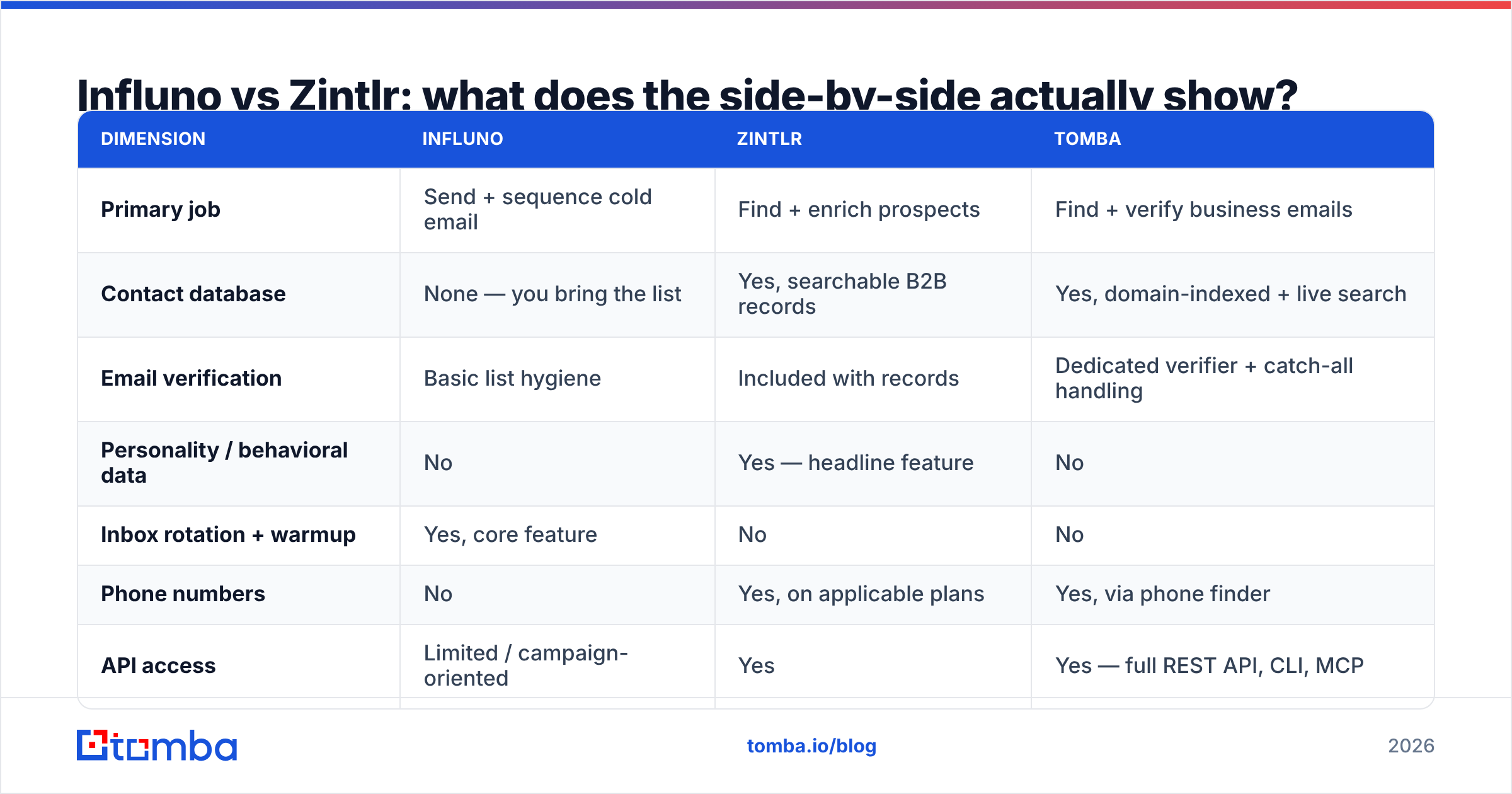
| Dimension | Influno | Zintlr | Tomba |
|---|---|---|---|
| Primary job | Send + sequence cold email | Find + enrich prospects | Find + verify business emails |
| Contact database | None — you bring the list | Yes, searchable B2B records | Yes, domain-indexed + live search |
| Email verification | Basic list hygiene | Included with records | Dedicated verifier + catch-all handling |
| Personality / behavioral data | No | Yes — headline feature | No |
| Inbox rotation + warmup | Yes, core feature | No | No |
| Phone numbers | No | Yes, on applicable plans | Yes, via phone finder |
| API access | Limited / campaign-oriented | Yes | Yes — full REST API, CLI, MCP |
| Free tier | Trial-based | Limited free credits | 25 searches/month, no card |
| Published entry paid tier | Budget-positioned, per-mailbox logic | Mid-market, credit-based | $49/mo Starter |
| Best fit | Agencies, founder-led outbound | SDR teams needing net-new lists | Any team needing accurate addresses |
Read that table one more time and notice how few rows actually overlap. Two rows — verification and contact data — are the only genuine head-to-head cells. Everything else is complementary.

Which one is better for cold email deliverability?#
Influno, and it is not close — but with a large asterisk.
Influno owns the sending infrastructure side: mailbox rotation so no single inbox burns, warmup to build history, throttling so you do not dump 400 sends in an hour, and spintax to reduce content fingerprinting. Zintlr does not compete here because it is not trying to.
The asterisk: sending infrastructure cannot save you from a dirty list. Google and Microsoft both weight unknown-user bounce rates heavily in reputation scoring, and Google's bulk sender requirements formalized spam-complaint thresholds for high-volume senders. A 12% bounce rate on a warmed, rotated, perfectly throttled setup still tanks you.
This is where a lot of Influno reviews on G2 and similar sites get misread. Users report deliverability problems and blame the platform. Nine times out of ten the list was never verified. Run every import through an email verifier before it touches a sequencer — and specifically handle catch-all domains, which standard SMTP checks return as "unknown" and most cheap verifiers silently pass as valid.
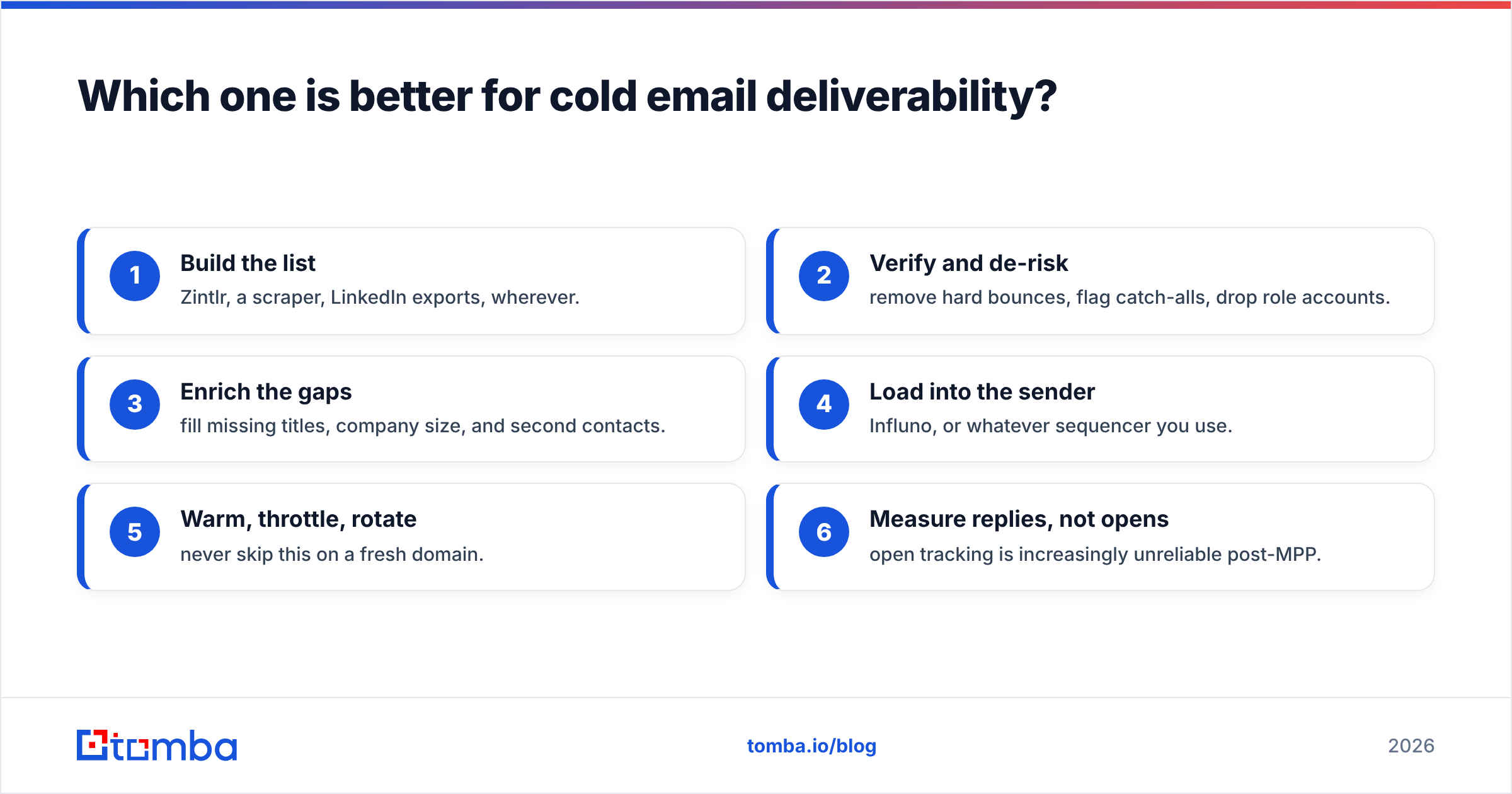
Practical ordering that works:
- Build the list — Zintlr, a scraper, LinkedIn exports, wherever.
- Verify and de-risk — remove hard bounces, flag catch-alls, drop role accounts.
- Enrich the gaps — fill missing titles, company size, and second contacts.
- Load into the sender — Influno, or whatever sequencer you use.
- Warm, throttle, rotate — never skip this on a fresh domain.
- Measure replies, not opens — open tracking is increasingly unreliable post-MPP.
Skip step 2 and steps 4 through 6 stop mattering.
Which one gives you better prospect data?#
Zintlr, obviously — Influno does not offer a database at all. The more useful question is whether Zintlr's data is good enough to be your only data source.
Three things to test during a trial, on your actual ICP, not the vendor's demo list:
- Coverage depth in your niche. Broad databases are excellent for US mid-market SaaS and thin for European SMBs, regulated industries, and non-English markets. Run 50 target accounts you already know and count how many return a usable contact.
- Freshness. Ask when records were last validated. A 2023 address for a person who changed jobs in 2024 is worse than no address, because it bounces and you paid for it.
- Verified vs. guessed. Many platforms return pattern-generated addresses (first.last@domain) without SMTP confirmation. Those inflate coverage stats and destroy bounce rates. Ask directly whether returned emails are verified or inferred.
Zintlr's personality layer is the genuinely novel piece, and it is worth a trial if your team writes bespoke first-touch copy. If your team sends 2,000 templated emails a week, the personality data will sit unused in a column and you are paying for it anyway.
For teams who mainly need addresses rather than a full intelligence suite, a focused finder is usually cheaper per usable contact. Tomba's domain search returns every discoverable address on a company domain with confidence scoring and source attribution — you can see why the tool believes an address is real, which is the single most underrated feature in this category.
How do Influno and Zintlr compare on pricing logic?#
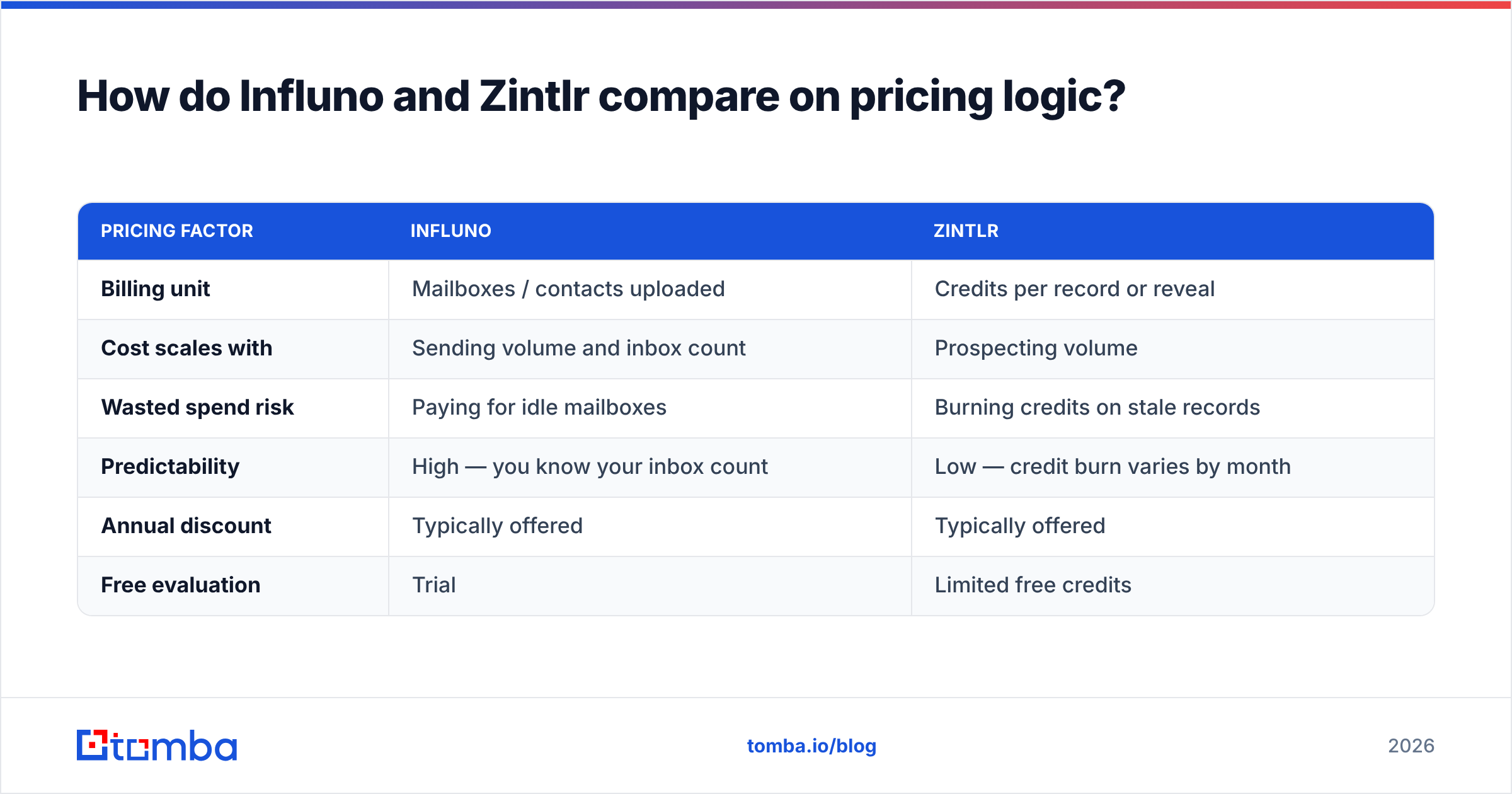
Forget headline prices for a second and compare pricing models, because that is what actually determines your bill.
| Pricing factor | Influno | Zintlr |
|---|---|---|
| Billing unit | Mailboxes / contacts uploaded | Credits per record or reveal |
| Cost scales with | Sending volume and inbox count | Prospecting volume |
| Wasted spend risk | Paying for idle mailboxes | Burning credits on stale records |
| Predictability | High — you know your inbox count | Low — credit burn varies by month |
| Annual discount | Typically offered | Typically offered |
| Free evaluation | Trial | Limited free credits |
Credit-based pricing is the one to scrutinize. A credit consumed on an invalid record is a double loss: you paid for the data and you will pay again in reputation damage when it bounces. Ask every credit-based vendor what their refund policy is on invalid returns. Good vendors do not charge for records they cannot verify. Weaker ones charge for the lookup regardless of outcome.
For reference on the third-tool question: Tomba pricing starts free at 25 searches/month, then $49/mo Starter, $99/mo Growth, and $249/mo Pro, with enterprise custom. That is the ballpark you should budget for the data/verification layer if you go the "best tool per job" route rather than the all-in-one route.

Should you buy one, both, or neither?#
Here is the decision tree I would actually give a revenue leader:
- You have a list, replies are the problem → Influno. Your gap is sending infrastructure and sequence logic, not data.
- You have a sequencer, but no one to send to → Zintlr or a dedicated finder. Your gap is top-of-funnel supply.
- You have neither → Do not buy an all-in-one on day one. Buy the data layer first and send from your existing mailbox manually for two weeks. You will learn your actual reply rate before you commit to a sending platform's annual plan.
- You have both and it still is not working → It is almost always the list or the offer. Check bounce rate first, then the first line of your email. Tooling is rarely the culprit at that stage.
- You are an agency running many clients → Influno's per-mailbox model plus a separate high-volume data source usually beats a single all-in-one, because you can reassign data credits across clients.
The uncomfortable truth is that the "Influno vs Zintlr" framing is mostly a search-query artifact. Very few teams are genuinely choosing between them. They are choosing between buying a sender and buying a data source, and the right answer depends entirely on which half they already own.
What does a complete 2026 outbound stack look like?#
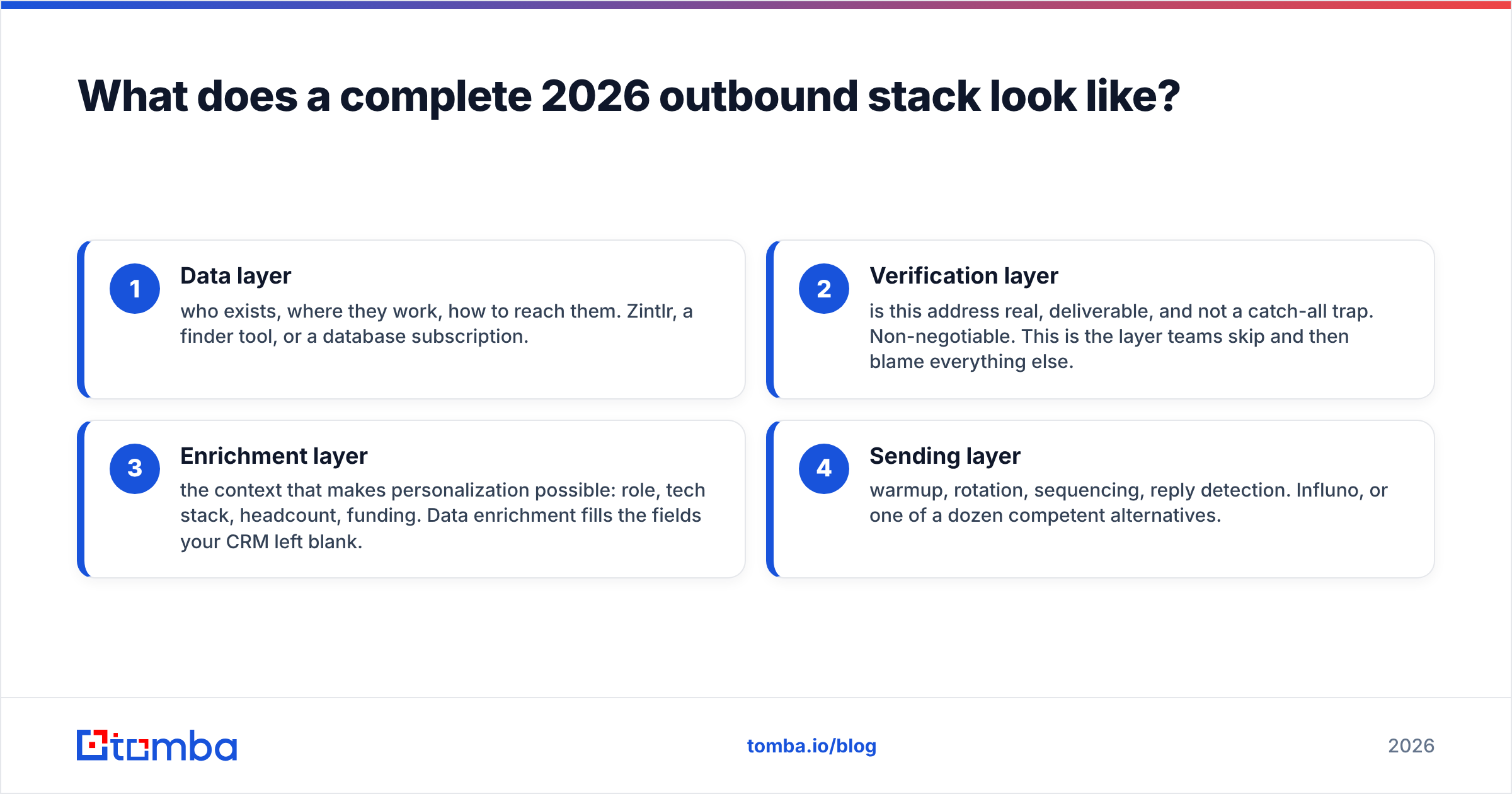
Four layers, and you need all four whether you buy them separately or bundled:
- Data layer — who exists, where they work, how to reach them. Zintlr, a finder tool, or a database subscription.
- Verification layer — is this address real, deliverable, and not a catch-all trap. Non-negotiable. This is the layer teams skip and then blame everything else.
- Enrichment layer — the context that makes personalization possible: role, tech stack, headcount, funding. Data enrichment fills the fields your CRM left blank.
- Sending layer — warmup, rotation, sequencing, reply detection. Influno, or one of a dozen competent alternatives.
If you are building this programmatically rather than clicking through dashboards, the layer that matters most is whichever one exposes a real API. Batch jobs, CRM sync, and enrichment-on-signup all die without one. The Tomba API covers finder, verifier, and enrichment endpoints from a single key, which removes one integration from the list.
What should you test during the trial?#
Do not evaluate on the vendor's demo data. Run this in both tools, same week:
- Pull 100 contacts from your real ICP. Count usable, verified addresses — not total rows returned.
- Send the same sequence to a matched 50/50 split. Compare bounce rate first, reply rate second.
- Time the export-to-send workflow. If it takes 40 minutes of CSV wrangling per campaign, that is a real cost.
- Check support response time on a weekday. This category has wildly variable support quality.
- Read the credit rollover and cancellation terms before the trial ends, not after.
Whichever tool wins on verified contacts per dollar and bounce rate under 2% is the one to keep. Everything else is a preference.
The bottom line#
Influno wins the sending comparison because Zintlr is not competing in it. Zintlr wins the data comparison because Influno is not competing in it. If you came here expecting a single winner, the honest answer is that you are shopping for two different products and should price them as such.
What both depend on — and neither fully solves — is address accuracy. A sequencer with a dirty list burns your domain. A database with unverified records burns your budget.
Start with the layer that makes the other two work. Try Tomba Email Finder free — 25 searches a month, no card required — run it against 100 accounts from your real ICP, and compare the verified-contact count against whatever your current stack returns. If the numbers favor your existing setup, keep it. If they do not, you just found your bottleneck.
Related guides#
// get started
Find, verify and enrich your first contacts today
Start on the free plan with 25 searches a month, then scale when your team is ready.
Free plan · No credit card required · GDPR & CCPA
// about the author