Infofree vs Lead411: Which B2B Lead Database Wins in 2026
Infofree sells unlimited small-business leads for a flat fee. Lead411 sells verified contacts with buying intent. They solve different problems — here is which one fits your pipeline, and where both fall short.
TL;DR
- Infofree is a flat-fee, unlimited-lead database aimed at small businesses, insurance agents, and local B2B/B2C sellers. Volume is the selling point; contact-level email quality is not.
- Lead411 is a sales intelligence platform with verified emails, direct-dial phones, and buying-intent signals. It costs more per seat and caps exports, but the records are meant for outbound.
- Pick Infofree if you dial local businesses and consumers by SIC code. Pick Lead411 if you run email and phone sequences against tech-defined B2B accounts.
- Neither is a great fit if you already know which companies you want — at that point a targeted email finder is cheaper and more accurate than renting a whole database.
- Whatever you pick, verify before you send. Both platforms ship stale records, and bounce rate is the tax you pay for skipping that step.
What are Infofree and Lead411, really?#
They get compared because both sell "B2B leads." That's where the similarity ends.
Infofree (infofree.com) descends from the Infogroup/American Business Information lineage — compiled business listings assembled from phone directories, public filings, and telephone verification. You pay a flat monthly fee and get unlimited lookups against roughly 15 million U.S. businesses and 250+ million consumers, plus a bundled CRM and mailing-list builder. It's the spiritual successor to buying a printed directory: broad coverage, firmographic filters (SIC code, sales volume, employee count, radius search), and a phone number for the main line.
Lead411 (lead411.com) is a modern sales intelligence tool. It sells triple-verified email addresses, mobile direct dials, technographic filters (what software a company runs), and Bombora-powered intent data that flags accounts researching your category this week. Exports are metered. The pitch is not "more records," it's "fewer, better-timed records."
So the honest framing for Infofree vs Lead411 is not "which database is bigger." It's: are you prospecting by geography and industry, or by buying signal and job title?

How do Infofree and Lead411 compare on features and price?#
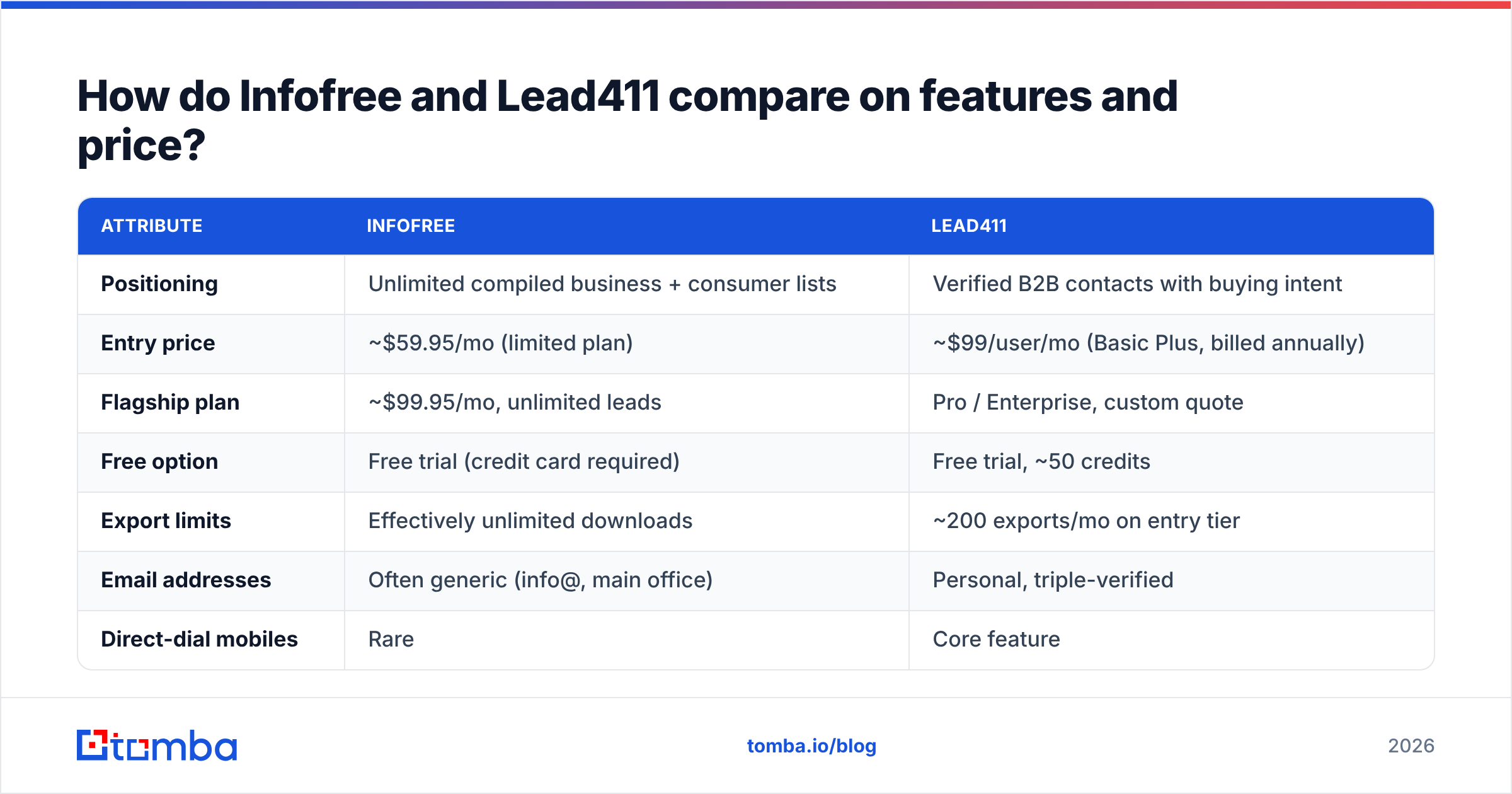
Pricing on both platforms moves, and both run promotions and annual discounts. The figures below reflect publicly listed rates at the time of writing — confirm on the vendor's own pricing page before you budget.
| Attribute | Infofree | Lead411 |
|---|---|---|
| Positioning | Unlimited compiled business + consumer lists | Verified B2B contacts with buying intent |
| Entry price | ~$59.95/mo (limited plan) | ~$99/user/mo (Basic Plus, billed annually) |
| Flagship plan | ~$99.95/mo, unlimited leads | Pro / Enterprise, custom quote |
| Free option | Free trial (credit card required) | Free trial, ~50 credits |
| Export limits | Effectively unlimited downloads | ~200 exports/mo on entry tier |
| Email addresses | Often generic (info@, main office) | Personal, triple-verified |
| Direct-dial mobiles | Rare | Core feature |
| Intent data | No | Yes (Bombora) |
| Technographics | No | Yes |
| Consumer (B2C) records | Yes, 250M+ | No |
| Built-in CRM | Yes, bundled | No — integrates with yours |
| Chrome extension | Limited | Yes |
| API access | Limited / not core | Available on higher tiers |
| Best-fit buyer | Local services, insurance, B2C+B2B mix | SaaS, staffing, agency SDR teams |
Read that table as two different products that happen to share a shelf. Infofree gives you a haystack for a flat fee. Lead411 sells you fewer needles at a higher unit price.
The export cap is the line item most teams underestimate. If an SDR works 300 new accounts a month and each account needs two or three contacts, 200 exports evaporates in week two. Lead411's higher tiers lift the ceiling, but that's a quote conversation, not a checkout button.

Which one has better data accuracy?#
Different failure modes, and that matters more than a single accuracy percentage.
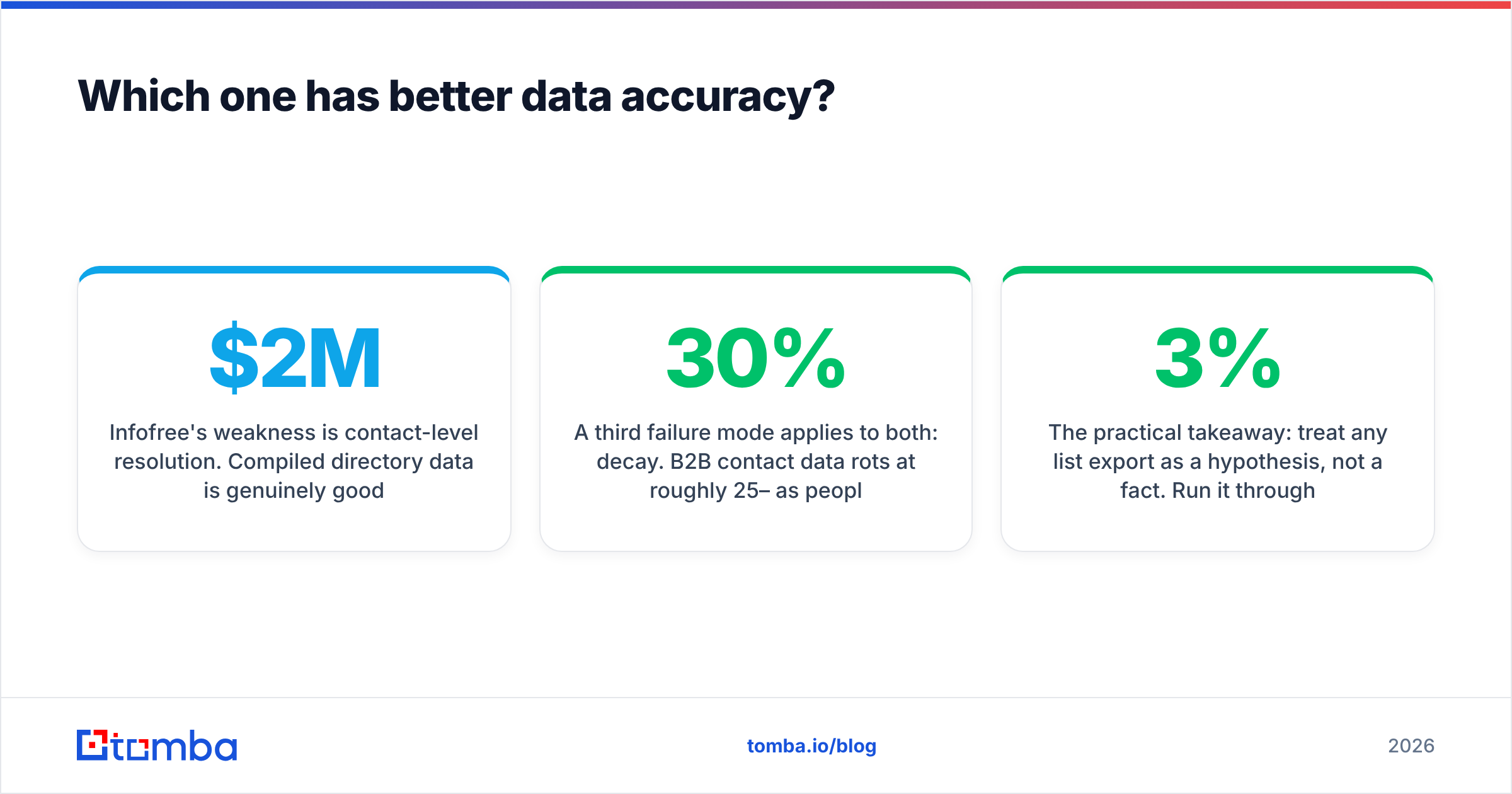
Infofree's weakness is contact-level resolution. Compiled directory data is genuinely good at answering "which HVAC companies in Dallas County have 10–50 employees and $2M+ in revenue." It is much weaker at "who is the operations director there and what is her email." You frequently get a company record with a main switchboard number and a generic inbox. That's workable for cold calling and direct mail. It's close to useless for a personalized cold email sequence, because generic inboxes convert poorly and hurt your sender reputation when they bounce or route to a shared mailbox nobody reads.
Lead411's weakness is coverage depth outside its sweet spot. Verification is real — the platform re-checks emails and flags them — but the database skews toward North American tech, staffing, and mid-market companies. Search for a niche European manufacturer or a 6-person local agency and the results thin out fast. Users on G2 consistently praise the direct dials and consistently flag gaps in non-U.S. coverage and occasional job-change lag.
A third failure mode applies to both: decay. B2B contact data rots at roughly 25–30% per year as people change roles. A record verified in March is a guess by November. No vendor escapes this; the ones that claim they do are marketing at you.
The practical takeaway: treat any list export as a hypothesis, not a fact. Run it through an email verifier before it touches your sending domain, and use a catch-all verifier for the domains that return ambiguous SMTP responses instead of guessing. A 3% bounce rate is survivable. A 12% bounce rate gets your domain throttled by Google and Microsoft within two campaigns.
When should you choose Infofree?#
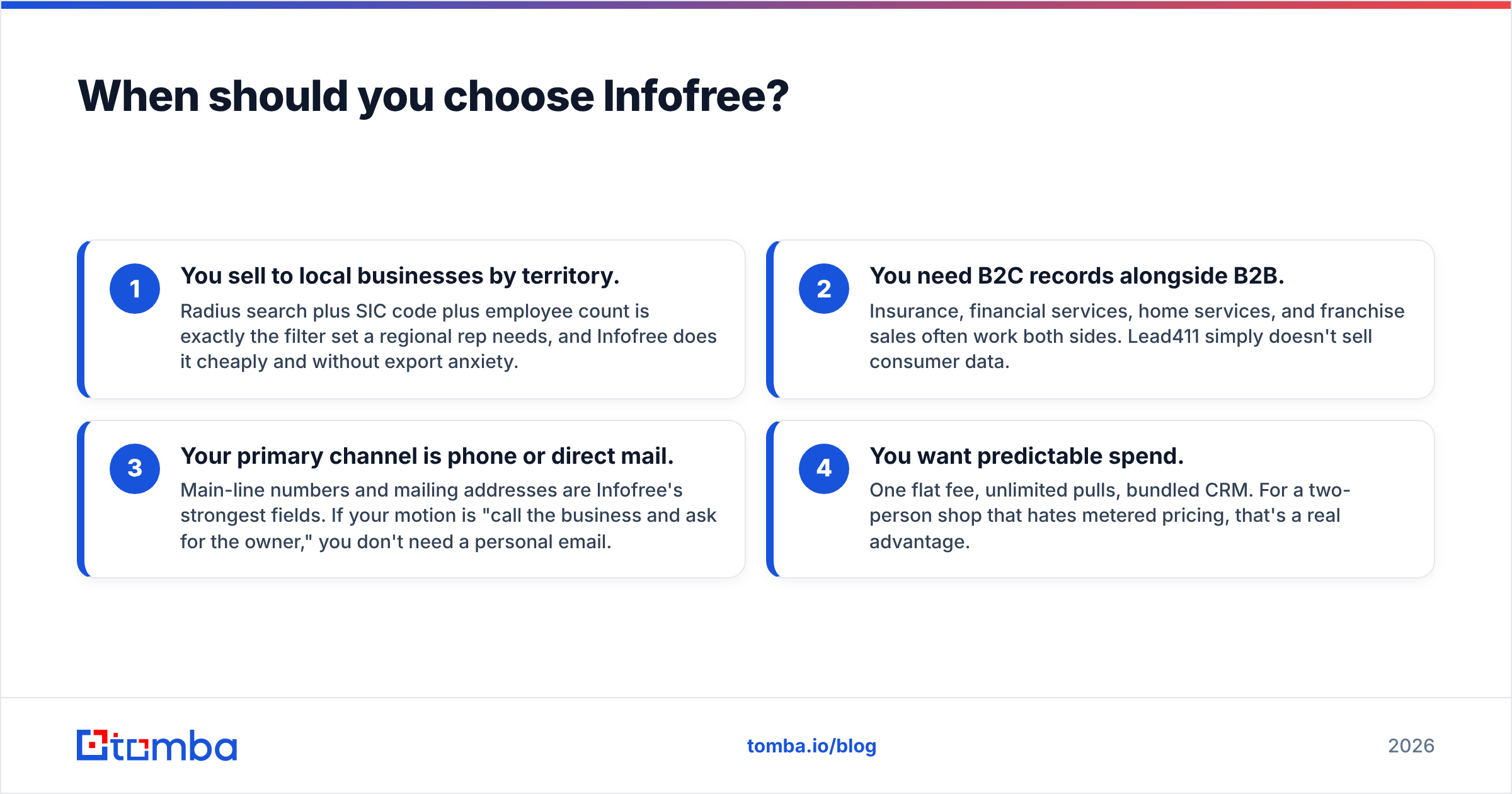
Infofree makes sense in four specific situations:
- You sell to local businesses by territory. Radius search plus SIC code plus employee count is exactly the filter set a regional rep needs, and Infofree does it cheaply and without export anxiety.
- You need B2C records alongside B2B. Insurance, financial services, home services, and franchise sales often work both sides. Lead411 simply doesn't sell consumer data.
- Your primary channel is phone or direct mail. Main-line numbers and mailing addresses are Infofree's strongest fields. If your motion is "call the business and ask for the owner," you don't need a personal email.
- You want predictable spend. One flat fee, unlimited pulls, bundled CRM. For a two-person shop that hates metered pricing, that's a real advantage.
Where it breaks down: modern outbound. If your plan is multi-touch email sequencing to named decision-makers, Infofree hands you the company and leaves the hard part — the person — to you.
When should you choose Lead411?#
Lead411 earns its higher price in three scenarios:
- You run an SDR team with sequencing software. Verified personal emails and mobile numbers are the raw material for Outreach, Salesloft, or Instantly. Generic inboxes break those workflows.
- Timing matters to your pitch. Intent data is the feature people actually renew for. Knowing that an account spiked on "applicant tracking system" research last week changes your opening line from a guess to a relevant observation.
- You sell software and need technographics. Filtering for companies running a specific CRM, cloud provider, or payment processor is a genuinely differentiated filter that compiled databases can't replicate.
Where it breaks down: budget-constrained teams and non-U.S. territories. At roughly $99 per seat per month with a 200-export cap, a five-person team is spending ~$6,000 a year before anyone sends an email. And if half your ICP sits in EMEA or APAC, you'll fill a lot of gaps manually.
Is there a third option between the two?#
Yes — and for a lot of teams it's the cheaper answer.
Both Infofree and Lead411 are database purchases. You rent access to a pile of records and hope your ICP is well represented inside it. That model makes sense when you don't know who to target and need discovery. It makes much less sense when you already have a target list from a conference roster, a funding announcement, a LinkedIn Sales Navigator search, or your own website traffic.
In that second case you don't need a database. You need resolution: given a company domain and a person's name, return the working email address. That's a different tool, priced per lookup instead of per seat.
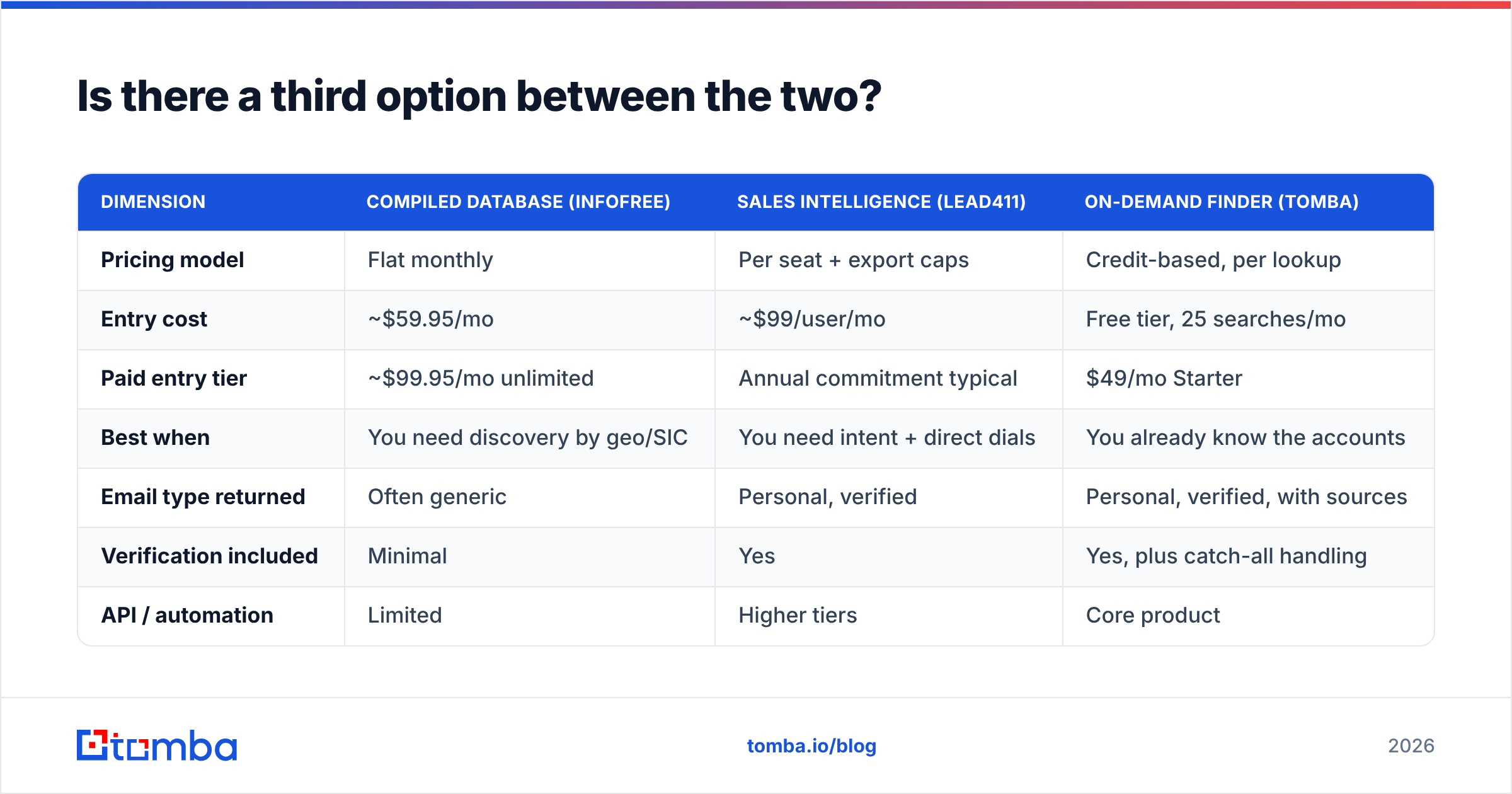
Here's how the three approaches stack up:
| Dimension | Compiled database (Infofree) | Sales intelligence (Lead411) | On-demand finder (Tomba) |
|---|---|---|---|
| Pricing model | Flat monthly | Per seat + export caps | Credit-based, per lookup |
| Entry cost | ~$59.95/mo | ~$99/user/mo | Free tier, 25 searches/mo |
| Paid entry tier | ~$99.95/mo unlimited | Annual commitment typical | $49/mo Starter |
| Best when | You need discovery by geo/SIC | You need intent + direct dials | You already know the accounts |
| Email type returned | Often generic | Personal, verified | Personal, verified, with sources |
| Verification included | Minimal | Yes | Yes, plus catch-all handling |
| API / automation | Limited | Higher tiers | Core product |
| Seat licensing | Per user | Per user | Credits shared across team |
The three aren't mutually exclusive. A common stack: use a database for account discovery, then run contact-level resolution on the accounts that survive qualification. You stop paying database rates for records you'll never touch.

What questions should you ask before signing either contract?#
Run this checklist on the demo call. Vendors answer these honestly when asked directly, and vaguely when you don't ask.
- What is the bounce guarantee, in writing? Lead411 markets verification; ask what happens when a "verified" email bounces. Credit refund or nothing?
- How many of my target accounts are actually in there? Bring a list of 20 real accounts to the demo and have them run it live. Coverage claims are averages; your ICP is not average.
- What's the export ceiling and the overage price? Then double your estimate of how many you'll need.
- Can I get data out via API, or only CSV? If your RevOps process is automated, CSV-only is a hidden cost paid in analyst hours.
- What's the cancellation term? Annual contracts with auto-renew are standard in this category. Read the clause.
- How recently was each record verified? A timestamp per record is the difference between a defensible list and a liability.
That last point deserves emphasis. Any vendor that can't show per-record recency is asking you to trust an aggregate. Combine it with data enrichment at the point of use rather than at the point of download, and your CRM stays clean instead of slowly filling with 2023 job titles.
So which one wins?#
Lead411 wins for modern B2B outbound. Infofree wins for local, phone-first, mixed B2B/B2C selling. That's the honest verdict, and it's less a tie-breaker than an admission that these tools were built for different decades of sales.
If your rep picks up the phone and asks for the owner of a plumbing company in a three-county radius, Infofree at ~$99/month is hard to beat on cost per usable record, and the bundled CRM removes a line item.
If your rep runs a five-touch email-and-call sequence into VP Engineering at Series B SaaS companies showing intent, Lead411 is the better instrument, and the export cap is the price of that precision.
And if your rep already knows the 400 companies that matter this quarter, you may be overpaying for both. Building the target list from your own research and then resolving contacts on demand is usually the cheapest path to the same inbox — especially when domain search returns every public email pattern at a company in one call, and Tomba pricing starts free at 25 searches a month before a $49/mo Starter tier.
Ready to stop renting a database you barely use?#
If the accounts are already on your list and the only missing piece is a working address, skip the seat license. The Tomba Email Finder takes a name and a company domain and returns a verified professional email with its confidence score and sources, so you know why the result is trustworthy before you send. Start on the free tier with 25 searches a month, test it against the same 20 accounts you'd bring to an Infofree or Lead411 demo, and compare hit rates on your own ICP instead of on a vendor's marketing page.
Related guides#
// get started
Find, verify and enrich your first contacts today
Start on the free plan with 25 searches a month, then scale when your team is ready.
Free plan · No credit card required · GDPR & CCPA
// about the author