Infofree vs LeadIQ: Which B2B Lead Data Tool Wins in 2026?
Infofree sells unlimited compiled business lists. LeadIQ captures verified contacts straight from LinkedIn into your sequencer. They solve different problems — here's which one actually fits your pipeline, and when a third option beats both.
TL;DR
- Infofree and LeadIQ are not really competitors. Infofree sells subscription access to a large compiled database of U.S. businesses and consumers. LeadIQ is a capture-and-sync tool that pulls verified contacts off LinkedIn into your CRM and sequencer.
- Pick Infofree if you sell locally to small businesses, want unlimited list pulls at a flat monthly rate, and your reps live on the phone.
- Pick LeadIQ if you run structured outbound into mid-market or enterprise accounts, already use Salesforce plus Outreach or Salesloft, and need mobile numbers plus job-change alerts.
- Both charge you for records you may never contact. Flat-rate list access breeds bloated, unverified CSVs; seat-based capture tools get expensive fast across a team.
- A third path exists: pull only the contacts you need, on demand, through a verification-first email finder or API, and skip the subscription-to-database model entirely.
What are Infofree and LeadIQ, exactly?#
They come from two different decades of B2B data, and it shows.
Infofree.com is a compiled-database business. It sells subscription access to tens of millions of U.S. business records and consumer records — company name, address, phone, SIC code, estimated revenue, employee count, owner name — plus a lightweight built-in CRM. The pitch is volume and predictability: pay a flat monthly fee, pull unlimited lists, export them, and start dialing. It is built for insurance agents, local service businesses, franchise sales, and small B2B teams that work a geographic territory.
LeadIQ sits at the other end. It is a Chrome extension and platform built around LinkedIn Sales Navigator: you browse a prospect list, click capture, and LeadIQ resolves work emails and mobile numbers, then pushes the contact into Salesforce, HubSpot, Outreach, Salesloft, or your sequencer of choice. Around that core it layers job-change tracking on saved accounts and AI message drafting. It is built for SDR teams running account-based outbound.
So the honest framing of infofree vs leadiq is not "which has better data." It is "which data model matches how your team prospects."
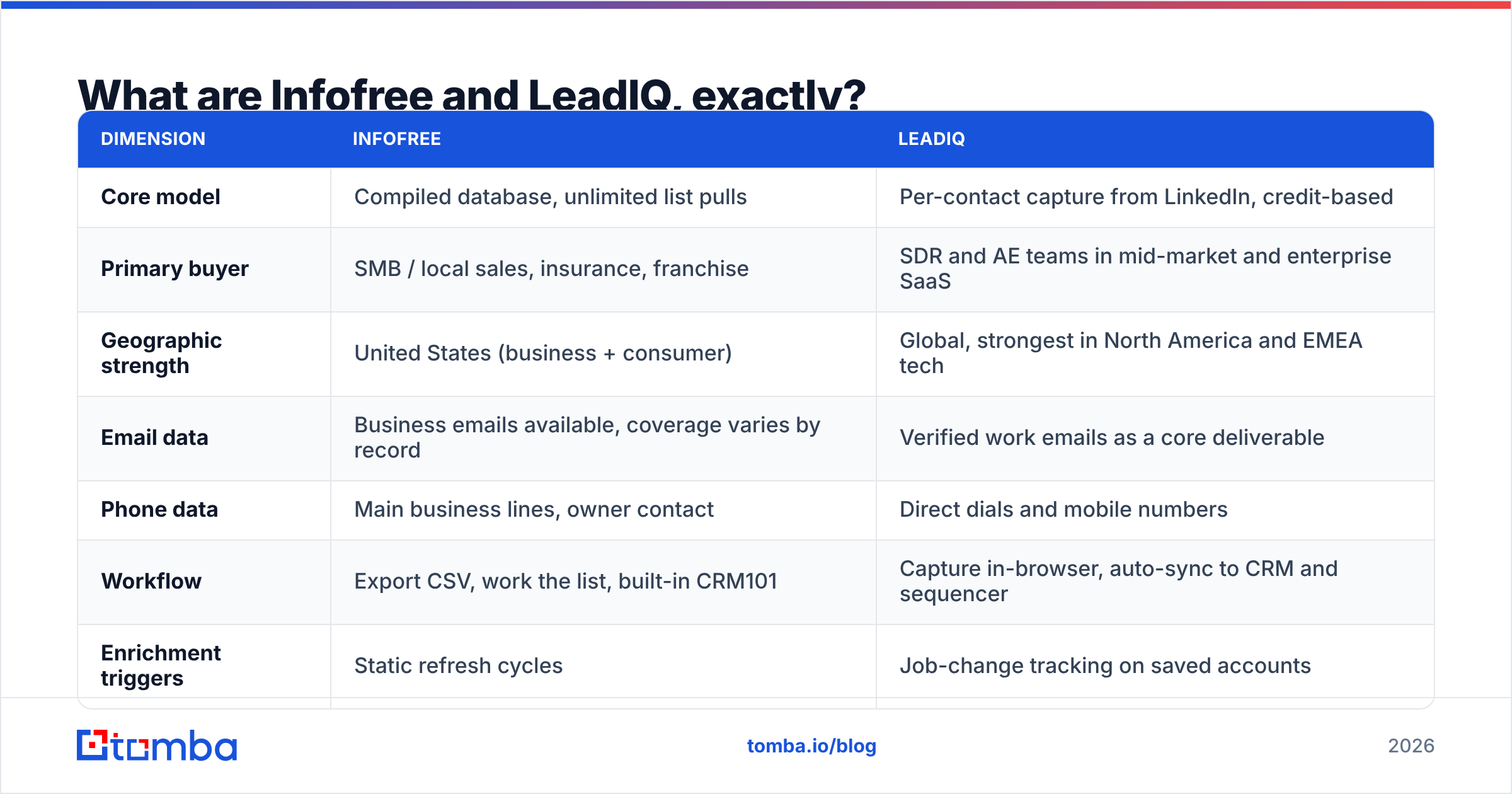
| Dimension | Infofree | LeadIQ |
|---|---|---|
| Core model | Compiled database, unlimited list pulls | Per-contact capture from LinkedIn, credit-based |
| Primary buyer | SMB / local sales, insurance, franchise | SDR and AE teams in mid-market and enterprise SaaS |
| Geographic strength | United States (business + consumer) | Global, strongest in North America and EMEA tech |
| Email data | Business emails available, coverage varies by record | Verified work emails as a core deliverable |
| Phone data | Main business lines, owner contact | Direct dials and mobile numbers |
| Workflow | Export CSV, work the list, built-in CRM101 | Capture in-browser, auto-sync to CRM and sequencer |
| Enrichment triggers | Static refresh cycles | Job-change tracking on saved accounts |
| Typical entry price | Flat monthly subscription (~$99/mo range, promos vary) | Free tier, then roughly $45–$89 per user/month annually |
Treat those price cells as directional. Both vendors change packaging, and LeadIQ's credit allowances in particular have shifted more than once — confirm on their own pricing pages before you sign anything.
How does each one actually get its data?#
This is where the two diverge hardest, and where most buyer disappointment starts.
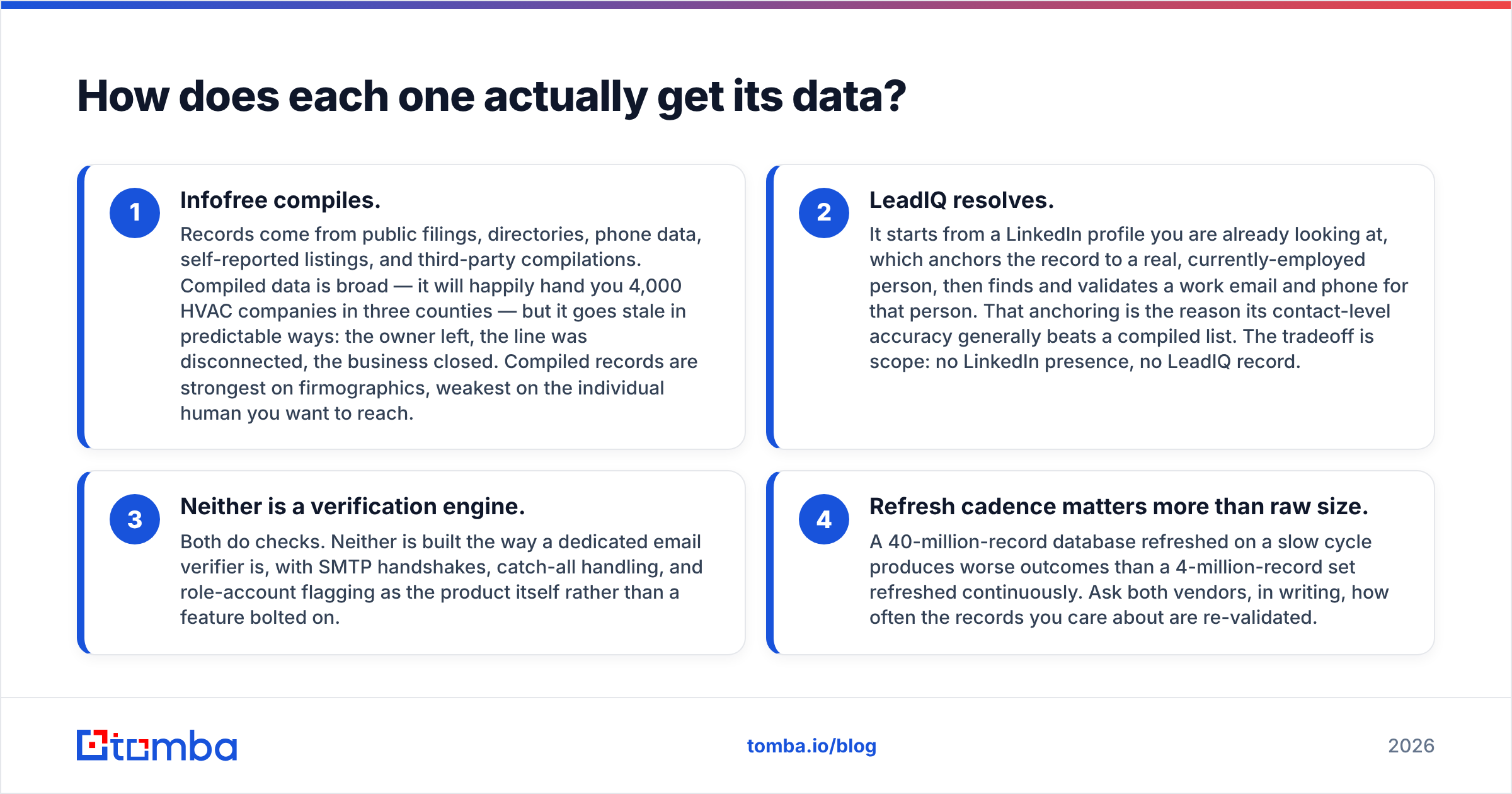
- Infofree compiles. Records come from public filings, directories, phone data, self-reported listings, and third-party compilations. Compiled data is broad — it will happily hand you 4,000 HVAC companies in three counties — but it goes stale in predictable ways: the owner left, the line was disconnected, the business closed. Compiled records are strongest on firmographics, weakest on the individual human you want to reach.
- LeadIQ resolves. It starts from a LinkedIn profile you are already looking at, which anchors the record to a real, currently-employed person, then finds and validates a work email and phone for that person. That anchoring is the reason its contact-level accuracy generally beats a compiled list. The tradeoff is scope: no LinkedIn presence, no LeadIQ record.
- Neither is a verification engine. Both do checks. Neither is built the way a dedicated email verifier is, with SMTP handshakes, catch-all handling, and role-account flagging as the product itself rather than a feature bolted on.
- Refresh cadence matters more than raw size. A 40-million-record database refreshed on a slow cycle produces worse outcomes than a 4-million-record set refreshed continuously. Ask both vendors, in writing, how often the records you care about are re-validated.

What do Infofree and LeadIQ cost in 2026?#
Infofree's model is the simpler one to reason about: a flat monthly or annual subscription that includes unlimited list downloads within your plan's scope, with a built-in CRM thrown in. Higher tiers add consumer data and additional users. There is no credit math to track, which is genuinely a relief if you have ever watched a rep burn 300 credits on a bad ICP query.
LeadIQ is seat-plus-credit. There is a free tier for evaluation, an entry paid plan in the mid-$40s per user per month on annual billing, a pro tier roughly double that, and custom enterprise pricing where mobile-number volume, job-change tracking scale, and CRM governance features live. Verified work emails and mobile numbers draw from separate credit pools on most packagings, which is the detail that trips up new teams.
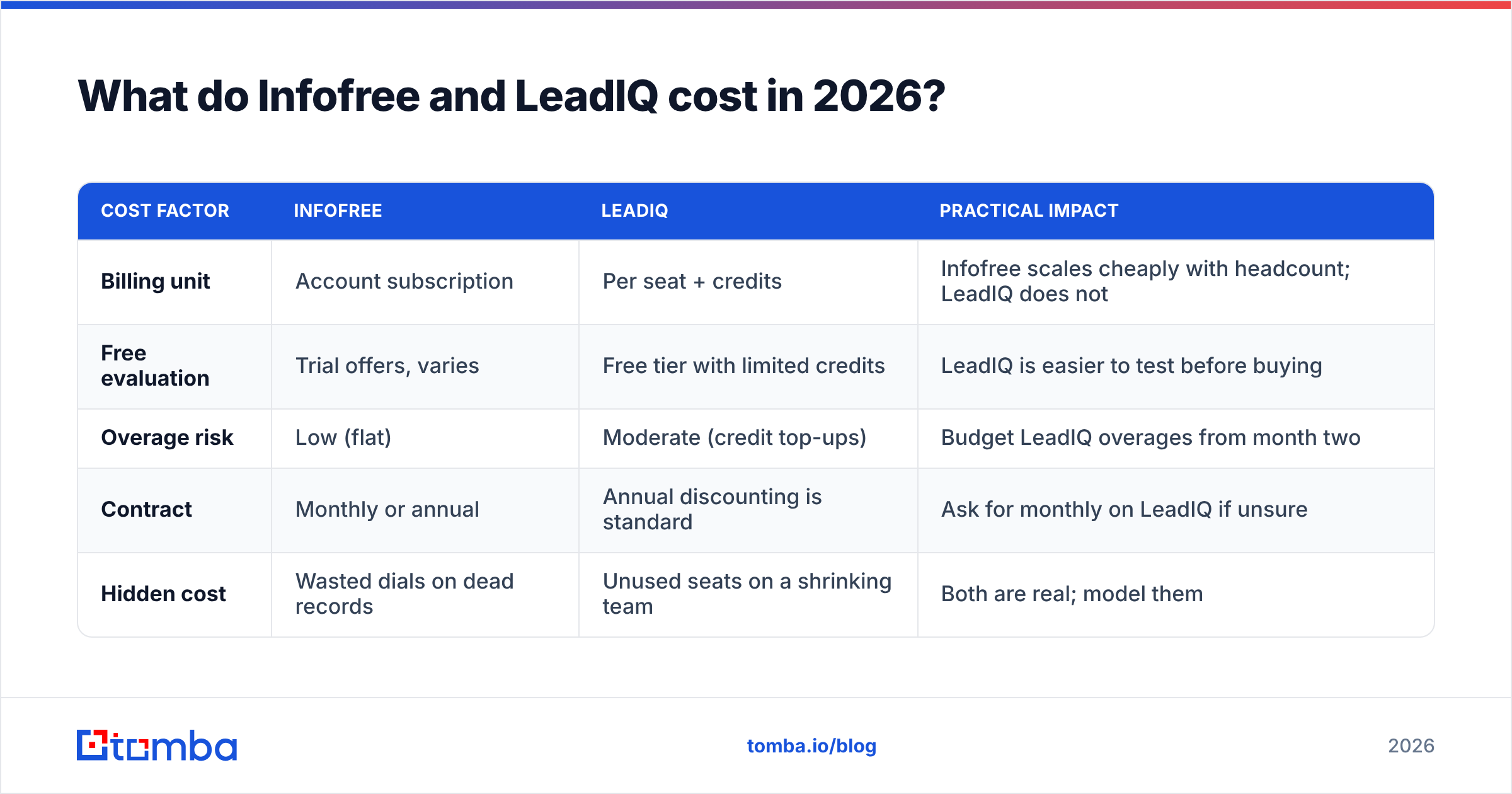
| Cost factor | Infofree | LeadIQ | Practical impact |
|---|---|---|---|
| Billing unit | Account subscription | Per seat + credits | Infofree scales cheaply with headcount; LeadIQ does not |
| Free evaluation | Trial offers, varies | Free tier with limited credits | LeadIQ is easier to test before buying |
| Overage risk | Low (flat) | Moderate (credit top-ups) | Budget LeadIQ overages from month two |
| Contract | Monthly or annual | Annual discounting is standard | Ask for monthly on LeadIQ if unsure |
| Hidden cost | Wasted dials on dead records | Unused seats on a shrinking team | Both are real; model them |
The flat-rate trap is worth naming. "Unlimited leads" sounds like it removes cost per record, but it relocates it. If 30% of a 5,000-row pull is undeliverable or disconnected, you did not save money — you moved the expense into rep hours and sender reputation. That is why plenty of teams pair a bulk list source with a separate verification pass before anything touches a mailbox. Running a list through bulk verify before the first send is cheap insurance next to a burned domain.
Which one is more accurate?#
Nobody can honestly hand you a single accuracy number that covers both, because they measure different things.
LeadIQ will generally give you a higher hit rate on "is this the right email for this specific person, today" — because the record starts from a live profile. Public reviews on G2 consistently praise capture speed and CRM sync while flagging credit consumption and occasional mobile-number misses.
Infofree will give you a higher hit rate on "does a business matching this profile exist at this address in this ZIP code." For territory-based prospecting, that is the accuracy that matters. For finding the VP of Engineering at a Series B startup, it is not.
Three rules for testing either one yourself:
- Build a 200-row gold set of accounts you already know cold — current contacts, current titles, current phone numbers — and run both tools blind against it.
- Measure bounce rate, not match rate. A vendor claiming 95% match means nothing if 12% of those matches bounce. Bounce rate is the only number your mail server cares about.
- Segment your test by ICP. A tool that wins on 20-person local contractors can lose badly on 2,000-person software companies, and vice versa. One blended average hides both facts.
If you want a neutral referee for that test, run every candidate's output through the same third-party verification step. A standalone free email checker or a scripted pass through an email verification API gives you an apples-to-apples bounce number across vendors, which is far more useful than either vendor's marketing claim.
Which tool fits your outbound motion?#
Match the tool to the motion, not to the feature list.
- Territory-based SMB selling (insurance, local services, franchise, merchant services). Infofree. You need coverage and a flat cost, your dials go to main lines, and the decision-maker is usually the owner listed on the record.
- Account-based SaaS outbound into named accounts. LeadIQ. Your reps already live in Sales Navigator, and the value is removing the copy-paste step between research and sequence.
- High-volume cold email at the domain level. Neither, on its own. You want pattern-level discovery across a company — a domain search that returns every reachable address at a target company, then verification before send.
- Programmatic enrichment inside your own product or data warehouse. Neither, cleanly. Both are built around a UI. You want an API-first provider where enrichment runs as a job, not as a click.
- Mixed motion — some list-building, some named accounts. Budget for two tools or one flexible one. Forcing a compiled database to do ABM, or a capture extension to do territory coverage, produces exactly the frustration you would expect.

Where do both tools fall short?#
Infofree's weak spots. The interface and CRM feel dated next to modern sales tools. Consumer data on the higher tiers raises compliance questions you need to answer before you touch it — check your obligations under state privacy rules and DNC registries, not just the vendor's terms. Contact-level data (the actual named human, with a valid direct email) is the thinnest part of the offering, which is a problem if email is your primary channel rather than the phone.
LeadIQ's weak spots. Cost scales with headcount, so a 15-rep team feels it. Coverage outside tech and outside North America thins out. Credit exhaustion mid-month is a common complaint, and the workarounds — buying top-ups or rationing captures — both hurt. And because capture is tied to LinkedIn browsing, the workflow collapses if LinkedIn changes its interface or throttles your reps' sessions.
Shared weak spot. Neither treats deliverability as a first-class concern. Getting an address is step one; knowing whether it is a catch-all domain, a role account, or a spam trap is step two, and that step is where cold email campaigns actually live or die. If your target list is heavy on catch-all domains, a dedicated catch-all verifier will tell you more than either tool's confidence score.
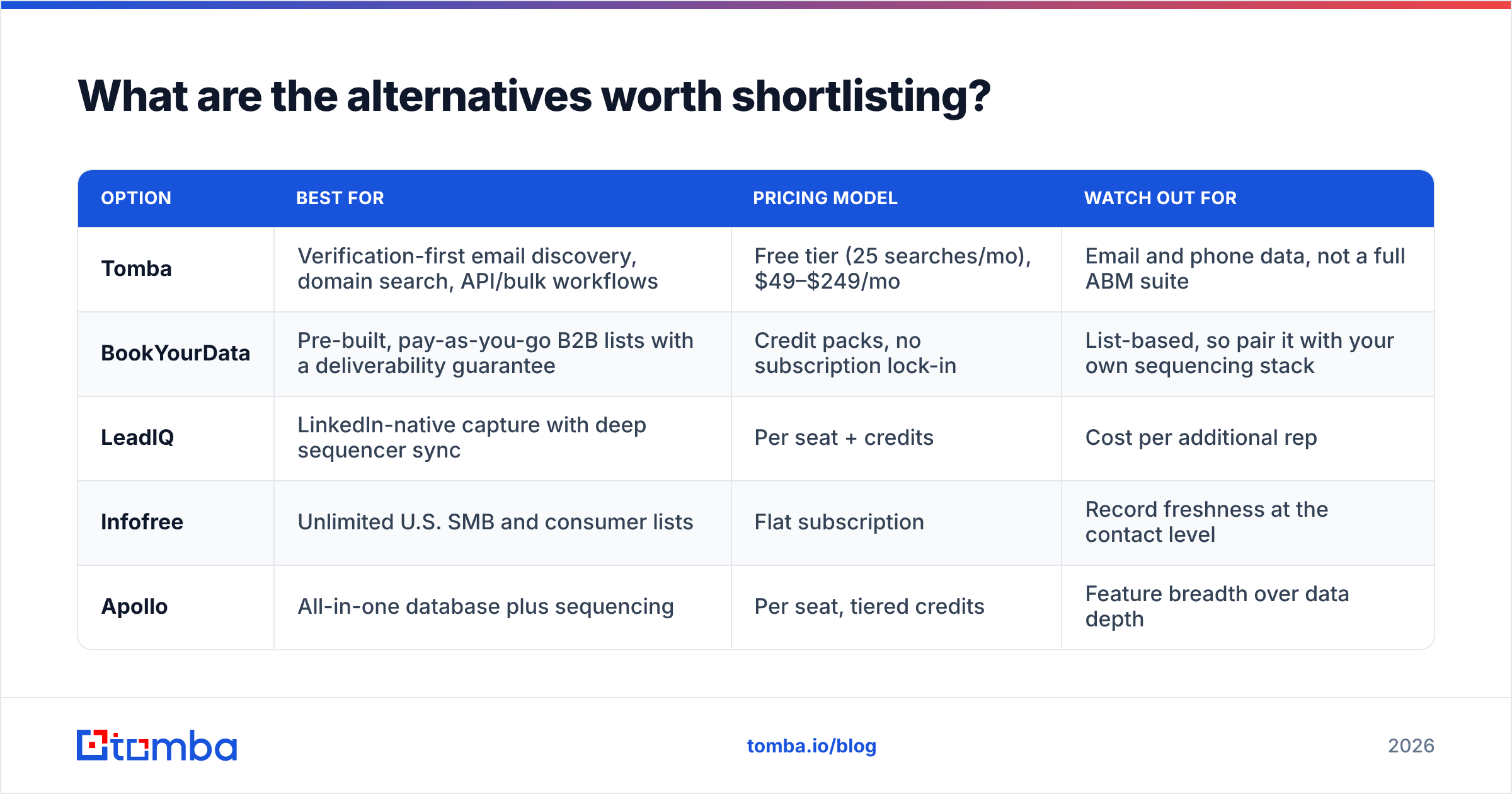
What are the alternatives worth shortlisting?#
| Option | Best for | Pricing model | Watch out for |
|---|---|---|---|
| Tomba | Verification-first email discovery, domain search, API/bulk workflows | Free tier (25 searches/mo), $49–$249/mo | Email and phone data, not a full ABM suite |
| BookYourData | Pre-built, pay-as-you-go B2B lists with a deliverability guarantee | Credit packs, no subscription lock-in | List-based, so pair it with your own sequencing stack |
| LeadIQ | LinkedIn-native capture with deep sequencer sync | Per seat + credits | Cost per additional rep |
| Infofree | Unlimited U.S. SMB and consumer lists | Flat subscription | Record freshness at the contact level |
| Apollo | All-in-one database plus sequencing | Per seat, tiered credits | Feature breadth over data depth |
BookYourData deserves a specific mention for teams that hate subscriptions: buying a clean, pre-verified slice of a market once, without a seat commitment, is a legitimately different purchasing model from both tools in this comparison — and for a one-off campaign it is often the cheaper answer.
If your objection to LeadIQ is purely price or seat math rather than capability, it is worth reading a direct LeadIQ alternative breakdown before you renew, since the per-seat model is the single most common reason teams churn off it.
Infofree vs LeadIQ: which should you buy?#
Buy Infofree if your revenue comes from calling small U.S. businesses in a defined geography, you need thousands of records a month, and a flat, predictable bill matters more than per-contact precision. Just plan to verify anything you intend to email.
Buy LeadIQ if you run a named-account motion, your reps already work Sales Navigator daily, and the bottleneck is the manual handoff between research and sequence. The seat cost is justified when it removes real minutes from every rep, every day — and it usually does.
Buy neither if what you actually need is accurate, deliverable email addresses at companies you have already identified. That is a narrower job than either platform is designed for, and paying for a database subscription or a per-seat capture tool to do it is the expensive way around.
That narrow job is exactly what the Tomba Email Finder is built for: give it a name and a domain, or just a domain, and get back verified, deliverability-scored addresses — with a free tier at 25 searches a month, plans starting at $49/mo, and the same engine available through the API, Sheets, or bulk upload when you outgrow the browser. Test it against whatever Infofree or LeadIQ returns on your own gold-set list, measure the bounce rate, and let the numbers pick your stack.
Related guides#
// get started
Find, verify and enrich your first contacts today
Start on the free plan with 25 searches a month, then scale when your team is ready.
Free plan · No credit card required · GDPR & CCPA
// about the author