Infofree vs Salesgenie (2026): Which Lead Database Wins?
Two US lead databases with a shared family tree and wildly different price tags. Here is how Infofree and Salesgenie compare on data freshness, list limits, email quality, and real cost per usable contact in 2026.
TL;DR
- Infofree and Salesgenie sell from the same broad US business-data lineage (infoUSA → Infogroup → Data Axle), which is why their records look suspiciously alike. The difference is packaging, limits, and price.
- Infofree is the budget play: flat monthly access, generous record counts, thin tooling, and a UI that feels like 2014. Good for door-knocking SMB sales and local prospecting.
- Salesgenie is the enterprise-ish play: better filters, list hygiene options, CRM exports, and support — usually on an annual contract with per-record or per-seat economics.
- Neither is built for modern cold email. Both hand you company-level data plus a lot of generic
info@addresses, so you still need a verification and email-finding layer before you send. - Best combo for most outbound teams in 2026: use a firmographic list source for targeting, then resolve and verify the actual person-level emails with a dedicated tool.
What Are Infofree and Salesgenie, and Why Do They Feel So Similar?#
Because they share a family tree. Salesgenie is the SMB-facing product of Data Axle, the company that grew out of infoUSA and Infogroup — the compiled-data business that has been phone-verifying US companies since the 1970s. Infofree was founded by Vin Gupta, the same person who founded infoUSA before leaving it. Infofree has historically licensed compiled business and consumer files from that same ecosystem.
Practical translation: if you pull a list of HVAC contractors in Phoenix from both tools, expect heavy overlap in company names, addresses, SIC codes, and switchboard numbers. The divergence shows up in the parts that cost money to maintain — contact-level detail, recency, email coverage, and how hard the platform makes it to get data out.
Here is what actually separates them:
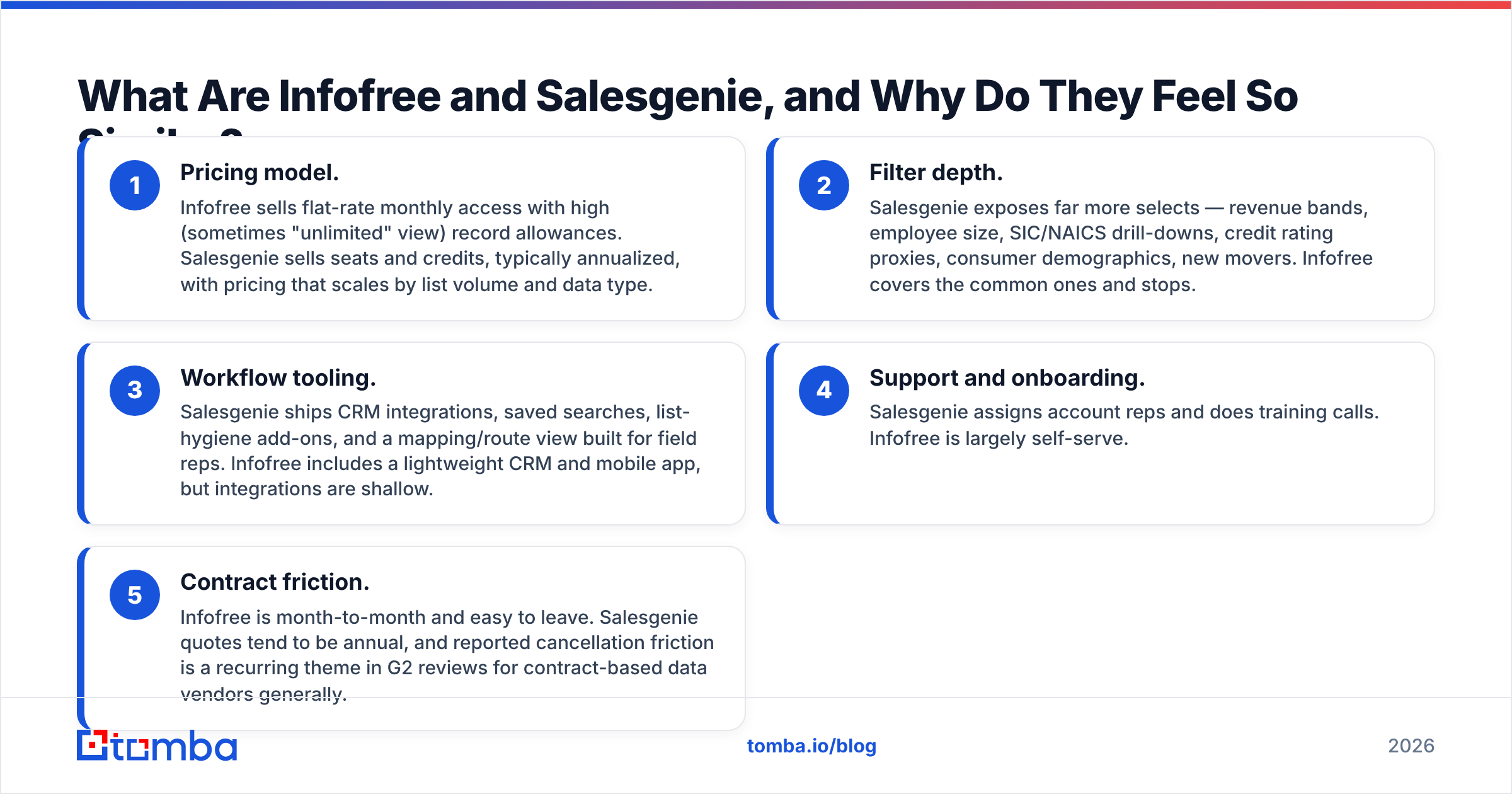
- Pricing model. Infofree sells flat-rate monthly access with high (sometimes "unlimited" view) record allowances. Salesgenie sells seats and credits, typically annualized, with pricing that scales by list volume and data type.
- Filter depth. Salesgenie exposes far more selects — revenue bands, employee size, SIC/NAICS drill-downs, credit rating proxies, consumer demographics, new movers. Infofree covers the common ones and stops.
- Workflow tooling. Salesgenie ships CRM integrations, saved searches, list-hygiene add-ons, and a mapping/route view built for field reps. Infofree includes a lightweight CRM and mobile app, but integrations are shallow.
- Support and onboarding. Salesgenie assigns account reps and does training calls. Infofree is largely self-serve.
- Contract friction. Infofree is month-to-month and easy to leave. Salesgenie quotes tend to be annual, and reported cancellation friction is a recurring theme in G2 reviews for contract-based data vendors generally.

How Do Infofree and Salesgenie Compare Feature by Feature?#
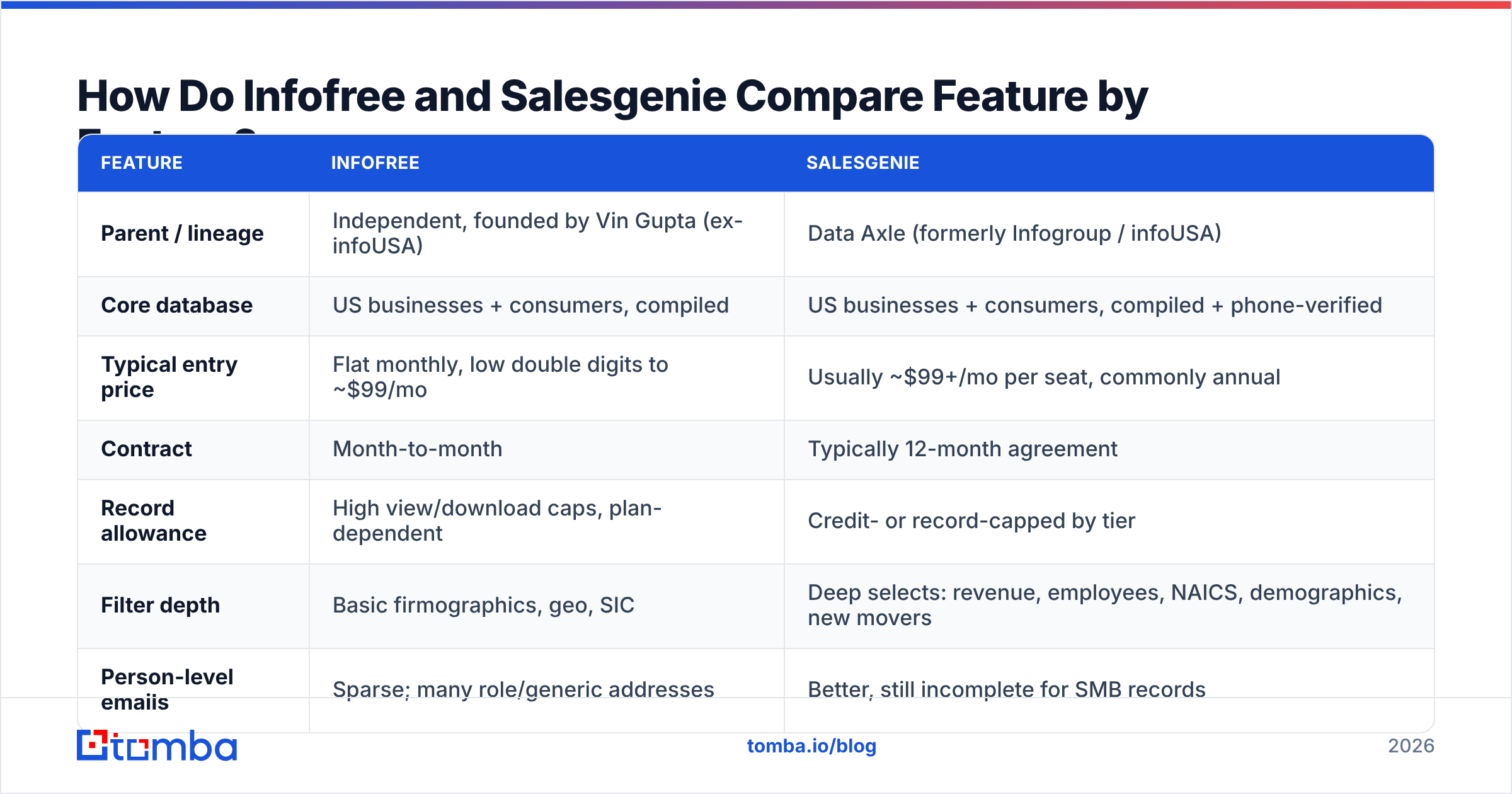
| Feature | Infofree | Salesgenie |
|---|---|---|
| Parent / lineage | Independent, founded by Vin Gupta (ex-infoUSA) | Data Axle (formerly Infogroup / infoUSA) |
| Core database | US businesses + consumers, compiled | US businesses + consumers, compiled + phone-verified |
| Typical entry price | Flat monthly, low double digits to ~$99/mo | Usually ~$99+/mo per seat, commonly annual |
| Contract | Month-to-month | Typically 12-month agreement |
| Record allowance | High view/download caps, plan-dependent | Credit- or record-capped by tier |
| Filter depth | Basic firmographics, geo, SIC | Deep selects: revenue, employees, NAICS, demographics, new movers |
| Person-level emails | Sparse; many role/generic addresses | Better, still incomplete for SMB records |
| Email verification | Not a core feature | Available as paid hygiene add-on |
| CRM integrations | Built-in lite CRM, limited export targets | Salesforce/HubSpot-oriented exports, API options |
| Field-sales tooling | Mobile app, basic mapping | Route mapping, territory views, rep assignment |
| Support model | Self-serve, ticket-based | Named rep + onboarding |
| Best fit | Solo reps, local SMB prospecting, tight budgets | Multi-rep teams needing filters, hygiene, and support |
Treat every price above as directional. Both vendors move list pricing and neither publishes a complete rate card, so confirm current numbers before you sign anything.
What Does Each Platform Actually Cost per Usable Contact?#
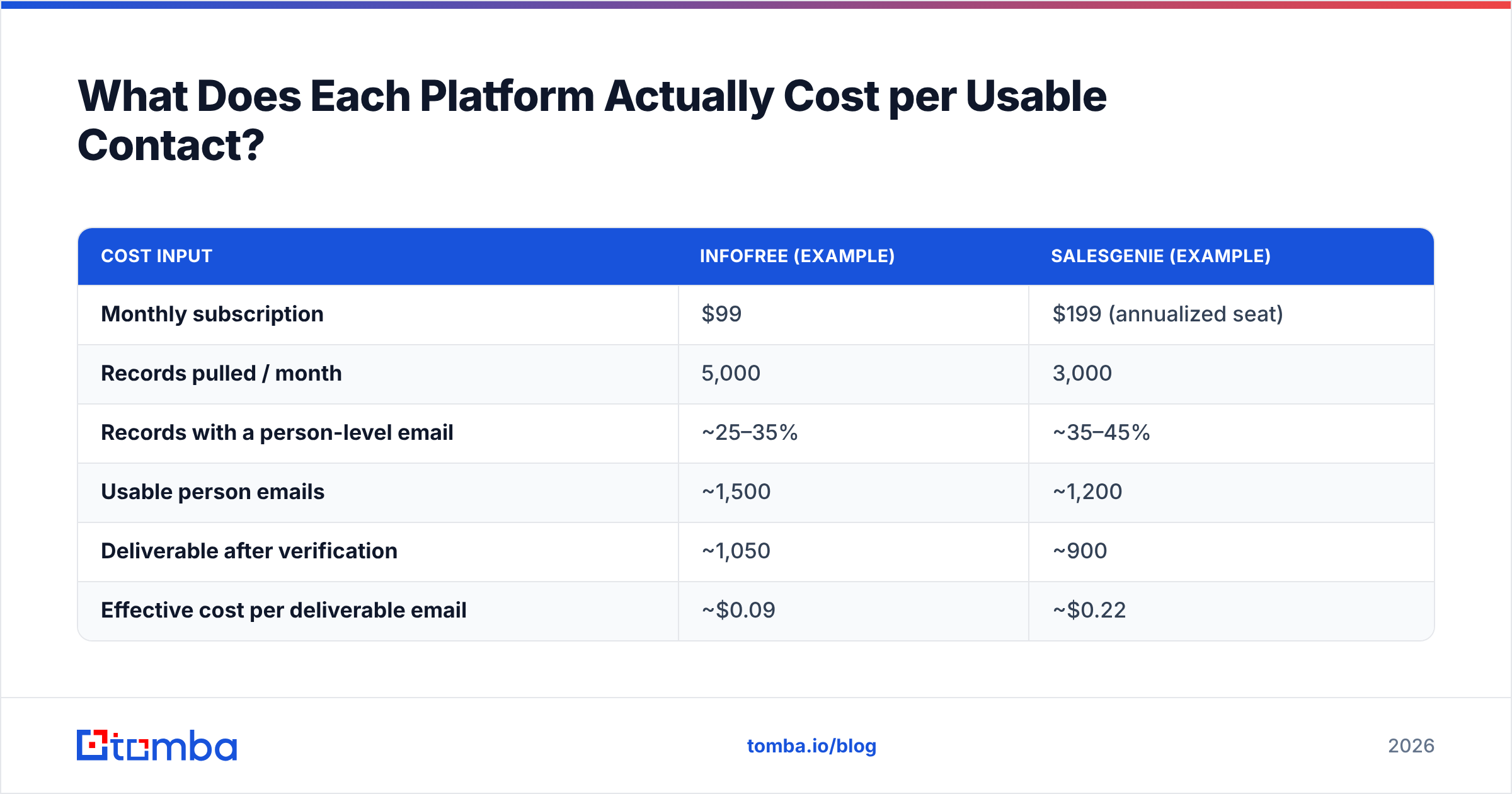
Sticker price is the wrong metric for a lead database. The number that matters is cost per contact you can actually reach.
Run the math the way a CFO would:
| Cost input | Infofree (example) | Salesgenie (example) |
|---|---|---|
| Monthly subscription | $99 | $199 (annualized seat) |
| Records pulled / month | 5,000 | 3,000 |
| Records with a person-level email | ~25–35% | ~35–45% |
| Usable person emails | ~1,500 | ~1,200 |
| Deliverable after verification | ~1,050 | ~900 |
| Effective cost per deliverable email | ~$0.09 | ~$0.22 |
Those percentages are planning assumptions, not vendor SLAs — your mix of industry, company size, and geography swings them hard. Compiled SMB files are weakest exactly where most outbound teams want to sell: sub-50-employee companies with no public contact directory. A 5,000-record pull that looks like a steal turns into 1,000 real prospects after you strip out generic inboxes, closed businesses, and dead domains.
This is also why "unlimited leads" marketing is mostly noise. Unlimited access to records that bounce is unlimited access to sender-reputation damage. Before any compiled list goes into a sequence, push it through an email verifier and quarantine anything that comes back risky, catch-all, or unknown.
How Accurate Is the Data in Each One?#
Both are strong on the things compiled data does well and weak on the things it does poorly.
What compiled files get right:
- Business existence and location. Phone-verified street addresses for millions of US companies is genuinely hard data to replicate. Data Axle's verification operation is the reason Salesgenie's firmographics hold up.
- SIC/NAICS classification. Useful for territory carving and TAM sizing.
- Switchboard phone numbers. Still the best channel for many local-services verticals.
- Consumer/new-mover data. Relevant if you sell B2C or hybrid (insurance, home services, financial advisory).
What both get wrong often enough to hurt:
- Job titles drift. Compiled contact titles can be years stale. The "Owner" you email may have sold the business in 2023.
- Email coverage is thin at the person level. Expect a lot of
info@,sales@, andcontact@. Those addresses get routed to a shared inbox and ignored, and they inflate your complaint rate. - No real-time signal. Neither tool tells you that a prospect just raised funding, changed their website stack, or posted a job req this week.
- Catch-all domains are invisible. A domain that accepts everything will look "valid" to naive checks. You need a proper catch-all verifier to separate real mailboxes from accept-all noise.
If your motion is phone-first field sales in a defined territory, the accuracy profile of either tool is acceptable. If your motion is cold email to named decision-makers, the accuracy profile of both is a problem you have to solve with other tooling.
Is Salesgenie Better Than Infofree for Outbound Email?#
Marginally — and not enough to change your plan.
Salesgenie gives you tighter targeting and an optional hygiene pass, which means fewer wasted records. Infofree gives you volume at a price that makes waste tolerable. Neither produces the thing a modern outbound stack actually needs: a verified, person-level email for a named individual at a named company, resolved on demand.
The gap shows up the moment you scale. You export 2,000 "qualified" records, you sequence them, and your ESP starts throttling because 30%+ of the sends hit dead mailboxes or spam traps that have been sitting in a compiled file for years.

The durable fix is to treat the list vendor as a targeting layer, not a contact layer:
- Pull the account list from Infofree or Salesgenie — company names, domains, size, location, industry.
- Resolve real contacts per domain using a domain search to see which people and which email pattern a company actually uses.
- Find the specific decision-maker's address with an email finder rather than guessing from a permutation.
- Verify everything, including catch-alls, before it touches a sequence.
- Enrich the survivors with firmographic and technographic context via data enrichment so your first line is not generic.
That pipeline costs less than upgrading to a premium list tier and it protects the asset you can't buy back: your sending domain's reputation.
Who Should Choose Infofree, and Who Should Choose Salesgenie?#
Choose Infofree if:
- You are a solo rep, agency, or small team with a hard ceiling on tool spend.
- Your motion is phone and door — local services, insurance, restaurants, contractors.
- You want month-to-month with no procurement process.
- You mainly need "who exists in this ZIP code" rather than "who is the VP of Ops."
Choose Salesgenie if:
- You have 3+ reps who need shared territories, saved searches, and assignment logic.
- You need deep selects (revenue bands, employee counts, credit proxies) to build defensible ICP segments.
- You want a human to call when a list looks wrong.
- You can absorb an annual commitment and want hygiene bundled.
Choose neither if:
- Your primary channel is cold email to specific named roles at tech, SaaS, or non-US companies.
- You need API access to resolve contacts programmatically inside your own workflow.
- You need international coverage — both are US-centric by design.
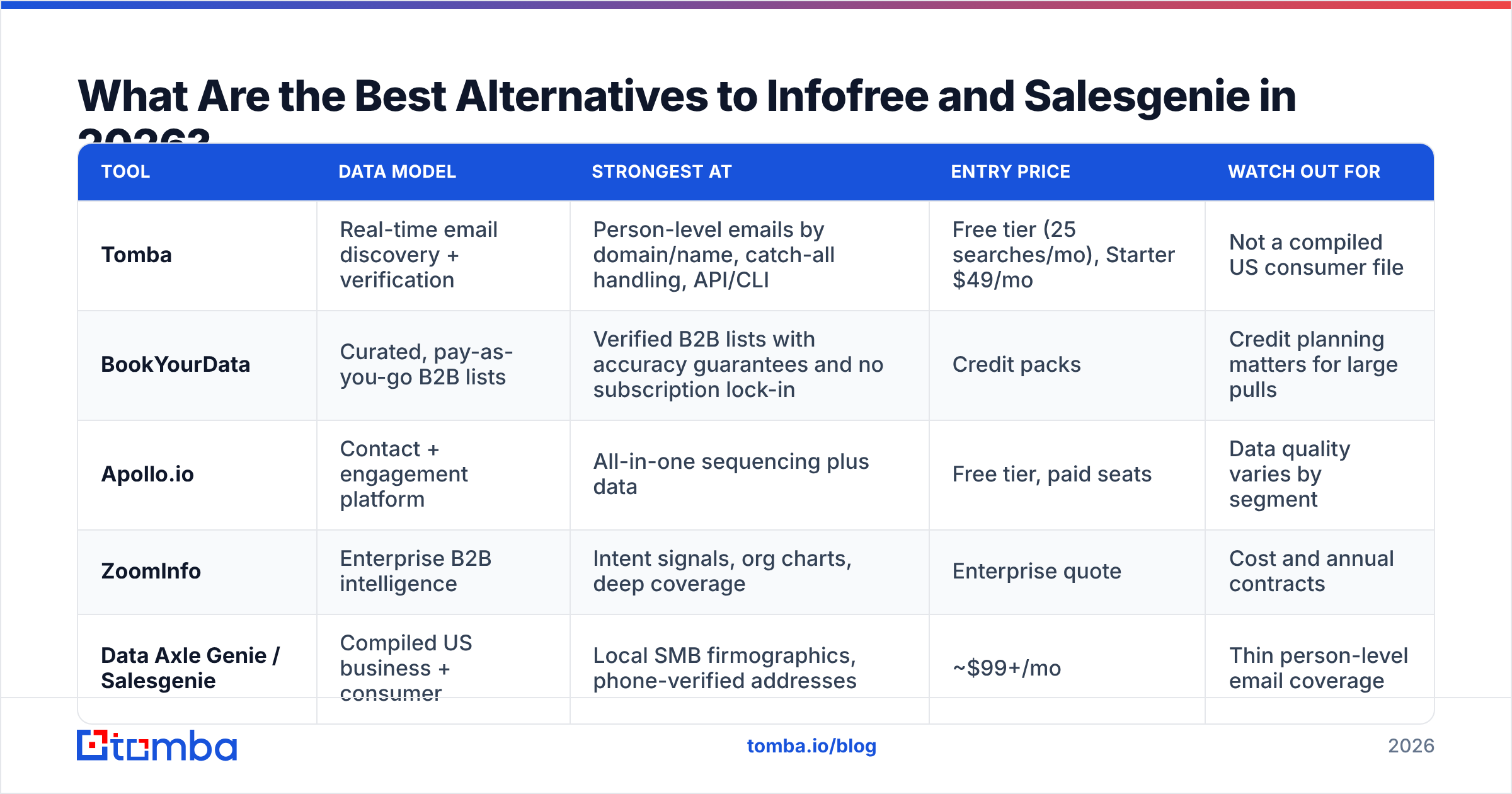
What Are the Best Alternatives to Infofree and Salesgenie in 2026?#
| Tool | Data model | Strongest at | Entry price | Watch out for |
|---|---|---|---|---|
| Tomba | Real-time email discovery + verification | Person-level emails by domain/name, catch-all handling, API/CLI | Free tier (25 searches/mo), Starter $49/mo | Not a compiled US consumer file |
| BookYourData | Curated, pay-as-you-go B2B lists | Verified B2B lists with accuracy guarantees and no subscription lock-in | Credit packs | Credit planning matters for large pulls |
| Apollo.io | Contact + engagement platform | All-in-one sequencing plus data | Free tier, paid seats | Data quality varies by segment |
| ZoomInfo | Enterprise B2B intelligence | Intent signals, org charts, deep coverage | Enterprise quote | Cost and annual contracts |
| Data Axle Genie / Salesgenie | Compiled US business + consumer | Local SMB firmographics, phone-verified addresses | ~$99+/mo | Thin person-level email coverage |
A sensible 2026 stack for most SMB outbound teams looks like: one broad targeting source (Salesgenie, Infofree, or a curated list vendor such as BookYourData for verified B2B segments), one real-time resolution and verification layer, and one sequencer. Trying to make a single compiled database do all three jobs is where teams burn domains.
For teams that want to skip the compiled-list step entirely, the alternative is domain-first prospecting: build your account list from public signals (job boards, review sites, tech stacks, funding news), then resolve contacts on demand. It is slower to start and far cheaper to maintain, and every record is fresh at the moment you use it. Compare what that costs against a list subscription on the Tomba pricing page before you renew anything annual.
What Else Do Buyers Ask About Infofree vs Salesgenie?#
Is Infofree the same company as Salesgenie? No. They are separate companies with a shared origin story through infoUSA's founder, and overlapping compiled-data sources. Salesgenie is a Data Axle product; Infofree is independent.
Does either include email verification? Salesgenie offers hygiene and verification as a paid add-on. Infofree does not treat verification as a core feature. Either way, verify independently before sending — a vendor grading its own data is not a control.
Can I use Infofree or Salesgenie data for cold email legally? US CAN-SPAM permits cold B2B email with proper identification and opt-out. GDPR and CASL are stricter, and neither platform's US-centric consumer data should be used for EU or Canadian outreach without a lawful basis. Check your jurisdiction before importing anything.
Which has better customer support? Salesgenie, consistently. Named reps and onboarding are part of what the higher price buys.
Do they offer APIs? Salesgenie/Data Axle offers enterprise data licensing and API arrangements. Infofree is primarily a UI product. If programmatic access matters, evaluate a purpose-built email-finding API instead of forcing a list tool into that role.
The Bottom Line#
Infofree wins on price and simplicity. Salesgenie wins on filters, hygiene, and support. Both win on US SMB firmographics and both lose on person-level email coverage — which is the exact field most outbound teams care about most.
Pick one for targeting based on your budget and team size, then stop asking it to do a job it was never built for. Resolve and verify your actual sending addresses with a tool designed for it: run your account list through the Tomba Email Finder to get named, verified, person-level emails per domain — starting free with 25 searches a month, and $49/mo on Starter when you scale. Your bounce rate, your reply rate, and your domain reputation will all read the difference.
Related guides#
// get started
Find, verify and enrich your first contacts today
Start on the free plan with 25 searches a month, then scale when your team is ready.
Free plan · No credit card required · GDPR & CCPA
Get the Tomba newsletter
Product and data updates
// about the author