Infofree vs Seamless.AI: Which B2B Lead Database Wins?
One sells unlimited flat-rate lists built on decades-old business files. The other sells AI-sourced contacts by the credit. Here is how Infofree and Seamless.AI actually compare on price, accuracy, and exit costs.
Infofree vs Seamless.AI comes down to one choice. Rent a flat-rate legacy list, or pay per AI-sourced contact. Here is how the two compare on price, data quality, and what it costs to leave.
TL;DR
- Infofree sells flat-rate, unlimited access to a legacy US business and consumer file. Cost is predictable. The data model is older, and work emails and direct dials are weak.
- Seamless.AI sells AI-sourced contacts by the credit, with quote-based enterprise pricing. B2B coverage is fresher. Credit burn and annual contracts are the usual complaint.
- Neither tool is a verification engine. Both hand you addresses that still need an SMTP check before you send.
- Need verified work emails at named companies? A focused finder plus a verifier is usually cheaper and cleaner than either.
- Pick Infofree for local and SMB list pulls. Pick Seamless.AI for mid-market B2B with CRM push. Pick a dedicated finder if accuracy per contact is what you get paid on.
What are Infofree and Seamless.AI?#
They solve the same surface problem — "give me people to contact" — from opposite ends of the data industry.
Infofree.com is the flat-rate side. It descends from the infoUSA/Database101 lineage founded by Vin Gupta. The pitch has barely changed in a decade: pay one monthly fee, download as many business and consumer records as you want, and get a light CRM bundled in. Coverage is heavily US-centric — the company publishes figures in the range of 14 million US businesses and 200+ million US consumers. You filter by SIC code, geography, sales volume, employee count, and a handful of demographic fields, then export.
Seamless.AI is the AI-sourced side. Instead of licensing a static compiled file, it crawls and stitches public web signals in near-real-time to assemble contact records, then charges you credits to unlock them. There is a free tier (50 credits) and paid seats are quote-based. Its centre of gravity is the SDR desk: a Chrome extension, a LinkedIn workflow, CRM writeback to Salesforce and HubSpot, and "Buyer Intent" and "Autopilot" add-ons layered on top.
The mental model that helps: Infofree is a phone book with filters. Seamless.AI is a research assistant with a meter running. One charges you for access, the other charges you for answers.
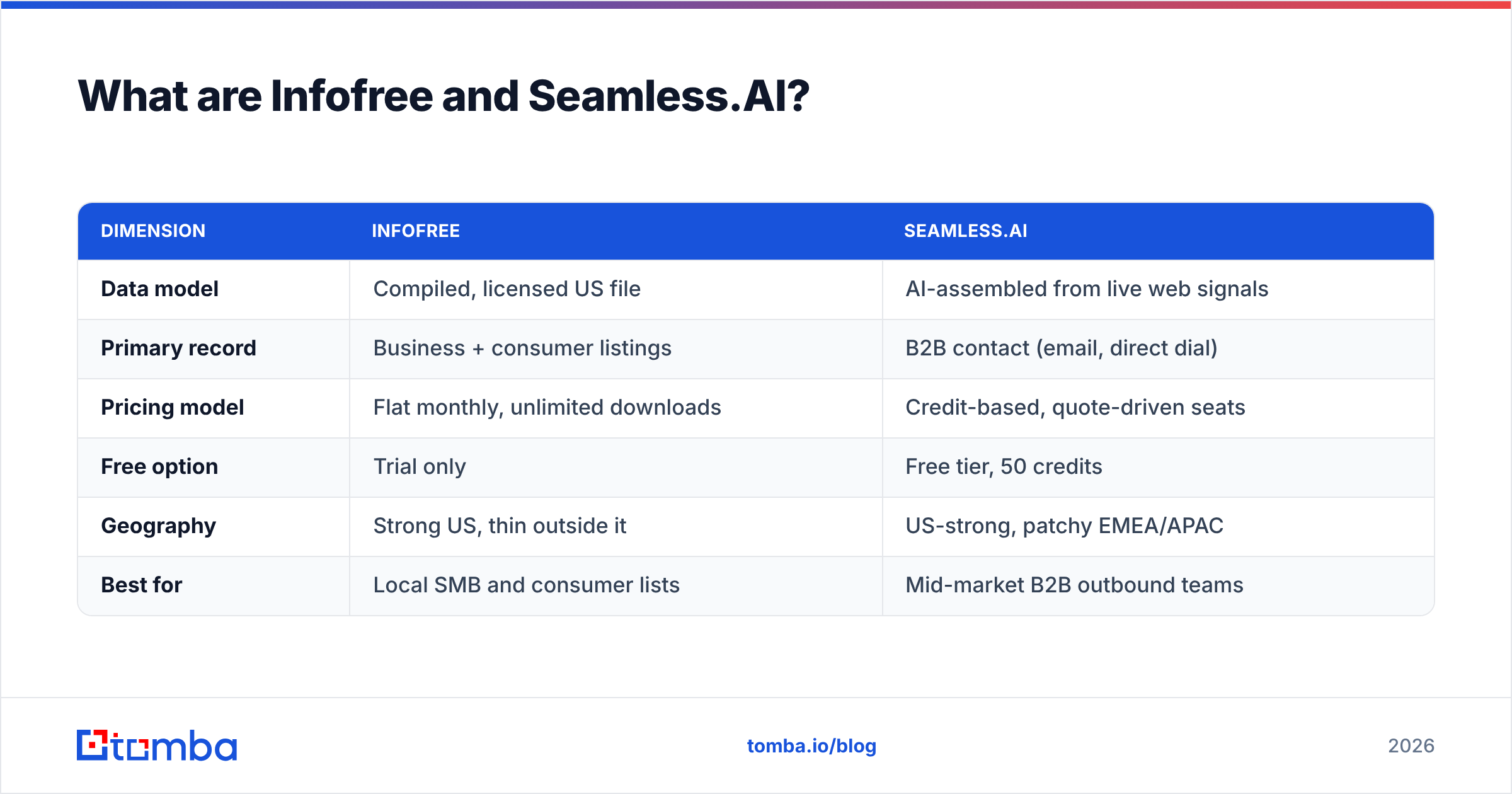
| Dimension | Infofree | Seamless.AI |
|---|---|---|
| Data model | Compiled, licensed US file | AI-assembled from live web signals |
| Primary record | Business + consumer listings | B2B contact (email, direct dial) |
| Pricing model | Flat monthly, unlimited downloads | Credit-based, quote-driven seats |
| Free option | Trial only | Free tier, 50 credits |
| Geography | Strong US, thin outside it | US-strong, patchy EMEA/APAC |
| Best for | Local SMB and consumer lists | Mid-market B2B outbound teams |
Infofree vs Seamless.AI: how do they compare on pricing?#
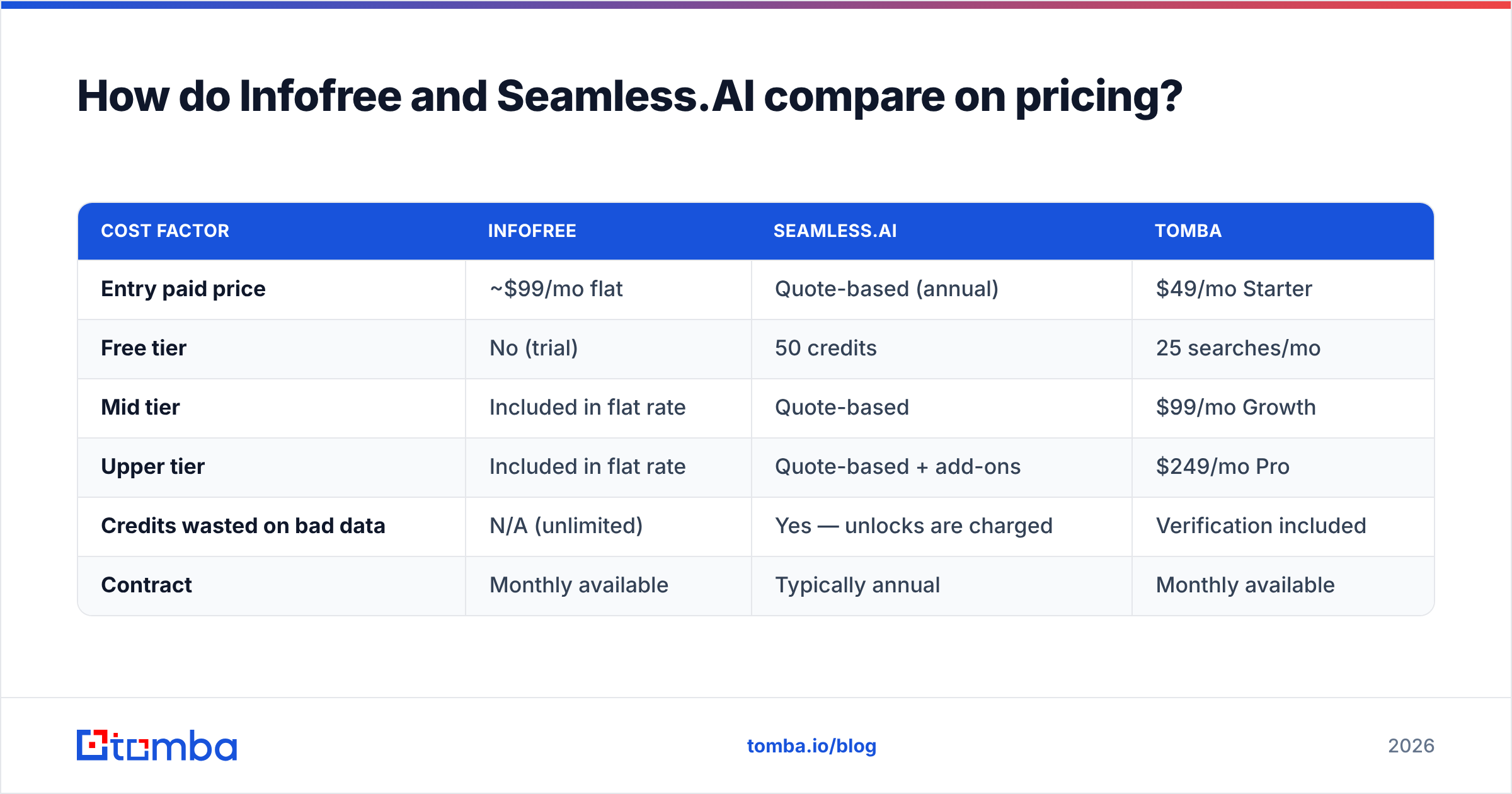
Conclusion first: Infofree is cheaper and easier to forecast. Seamless.AI costs more and is harder to predict. But if you only need a few hundred good records a month, its cost per usable B2B contact can still come out ahead.
Infofree publishes its tiers. The headline plan sits around $99/month for unlimited sales-lead downloads with the bundled CRM. Lighter plans exist below that for smaller record limits. You know your annual spend on day one.
Seamless.AI does not publish a price page. Paid seats are sold by quote, typically annual. Publicly reported entry seats have landed in the low-hundreds-per-user-per-month range, depending on credit volume and add-ons. Treat any number you read online — including this one — as a rumour until it is in your own quote. What is not rumour is the shape of the complaint pattern on G2 reviews: credits vanish faster than buyers expect, and renewal terms surprise people.
| Cost factor | Infofree | Seamless.AI | Tomba |
|---|---|---|---|
| Entry paid price | ~$99/mo flat | Quote-based (annual) | $49/mo Starter |
| Free tier | No (trial) | 50 credits | 25 searches/mo |
| Mid tier | Included in flat rate | Quote-based | $99/mo Growth |
| Upper tier | Included in flat rate | Quote-based + add-ons | $249/mo Pro |
| Credits wasted on bad data | N/A (unlimited) | Yes — unlocks are charged | Verification included |
| Contract | Monthly available | Typically annual | Monthly available |
The structural difference matters more than the sticker. With a flat rate you pay for volume you may not need. With credits you pay for attempts, not outcomes. An unlock that returns a dead mailbox costs the same as one that returns your next customer. See Tomba pricing for how a per-search model with verification folded in changes that arithmetic.
Infofree vs Seamless.AI: which platform has better data accuracy?#
Seamless.AI wins on B2B freshness. Infofree wins on nothing here, honestly — its strength is breadth and price, not per-record precision.
That said, "wins" is doing light work in that sentence. AI-assembled records are inferred, and inference produces two failure modes buyers consistently underestimate:
- Pattern-guessed emails. If a tool knows the company uses
first.last@, it can generatejane.doe@acme.comwithout ever proving that mailbox exists. Valid-looking is not valid. - Role drift. The person was VP Sales when the page was crawled. They are not now. Titles decay roughly 20–30% a year in high-churn segments.
Infofree's failure mode is different and older. Compiled business files skew toward the organisation — address, phone, SIC, revenue band — rather than the individual. You often get a company switchboard and an owner name, not a verified work inbox for the specific director you want to reach.

The practical takeaway: whichever you buy, budget for a verification layer. Run exports through an email verifier before they touch your sequencing tool. Catch-all domains need special handling. A plain SMTP ping returns "accept all" and tells you nothing, which is why a catch-all verifier exists as a separate step. Skip this and a "great list" turns into a 9% bounce rate and a burned sending domain.
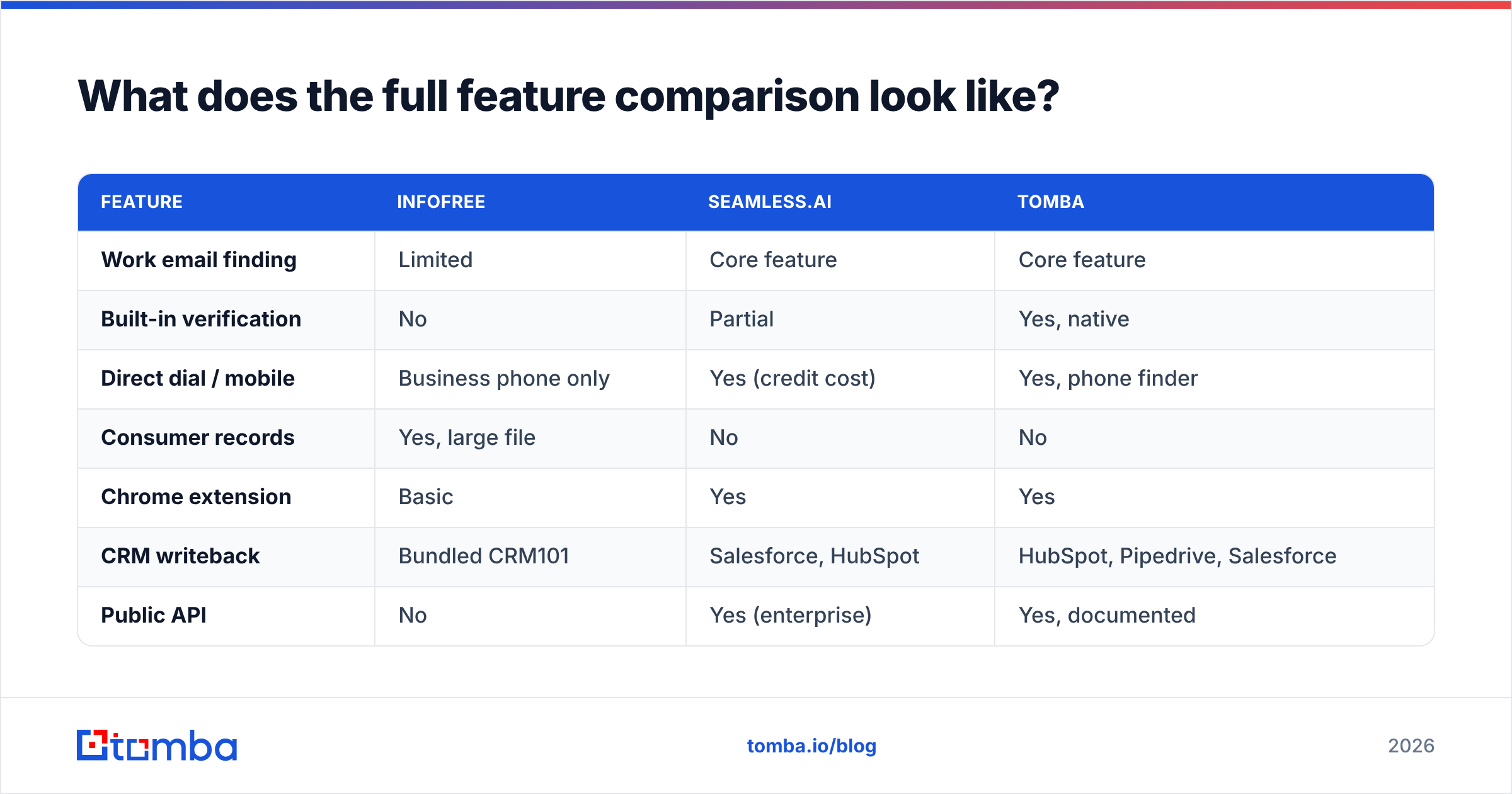
What does the full feature comparison look like?#
| Feature | Infofree | Seamless.AI | Tomba |
|---|---|---|---|
| Work email finding | Limited | Core feature | Core feature |
| Built-in verification | No | Partial | Yes, native |
| Direct dial / mobile | Business phone only | Yes (credit cost) | Yes, phone finder |
| Consumer records | Yes, large file | No | No |
| Chrome extension | Basic | Yes | Yes |
| CRM writeback | Bundled CRM101 | Salesforce, HubSpot | HubSpot, Pipedrive, Salesforce |
| Public API | No | Yes (enterprise) | Yes, documented |
| Bulk processing | Unlimited exports | Credit-metered | Bulk finder + verifier |
| Sheets / Excel add-on | CSV export | Limited | Yes, both |
| Intent data | No | Add-on | No |
| Transparent pricing | Yes | No | Yes |

Three rows carry most of the decision weight.
Verification. Seamless.AI does some validation, Infofree does effectively none, and both leave you responsible for the final check. If your team sends more than a few thousand emails a month, this is not a nice-to-have. It is the difference between inbox and spam folder. Our sender reputation primer covers why one bad send cycle takes weeks to recover from.
API access. Infofree has no meaningful developer story. If your RevOps team wants enrichment to fire when a form is submitted or a record goes stale, Infofree is a dead end, and you will export CSVs by hand forever. Seamless.AI offers API access at enterprise tiers. A documented email finder API available from paid self-serve plans is a genuinely different operating model.
Consumer data. This is Infofree's moat. If you sell to homeowners, local services, or run direct mail, Seamless.AI simply does not have the file. No amount of AI sourcing replaces a compiled consumer database.
Who should actually choose Infofree?#
Choose Infofree if three things are true:
- You sell locally or to SMBs. Pulling every HVAC contractor within 50 miles with 5–20 employees is exactly what a compiled file does well.
- Volume matters more than precision. Direct mail, cold calling from a switchboard list, and territory planning tolerate 70% accuracy. Cold email does not.
- You want one predictable invoice. No credit anxiety, no quarterly true-up conversation with a rep.
Skip it if you need verified work emails for named individuals at mid-market or enterprise accounts, if you sell outside the US, or if you need anything to happen programmatically.
Who should actually choose Seamless.AI?#
Choose Seamless.AI if:
- You run a seated SDR team that lives in LinkedIn and needs one-click push into Salesforce or HubSpot.
- You want intent signals bundled with contact data and are willing to pay the add-on premium rather than assemble a stack.
- Your ACV justifies the seat cost. At a five-figure deal size, a few hundred dollars a month per rep is noise. At $200 MRR deals, it is not.
Push back before you sign if the quote is annual-only, if credits do not roll over, or if the contract auto-renews without a written notice window. Those three terms are where most buyer regret in this category comes from. Ask for them in writing, and ask what happens to your exported data if you churn.
What are the hidden costs in both tools?#
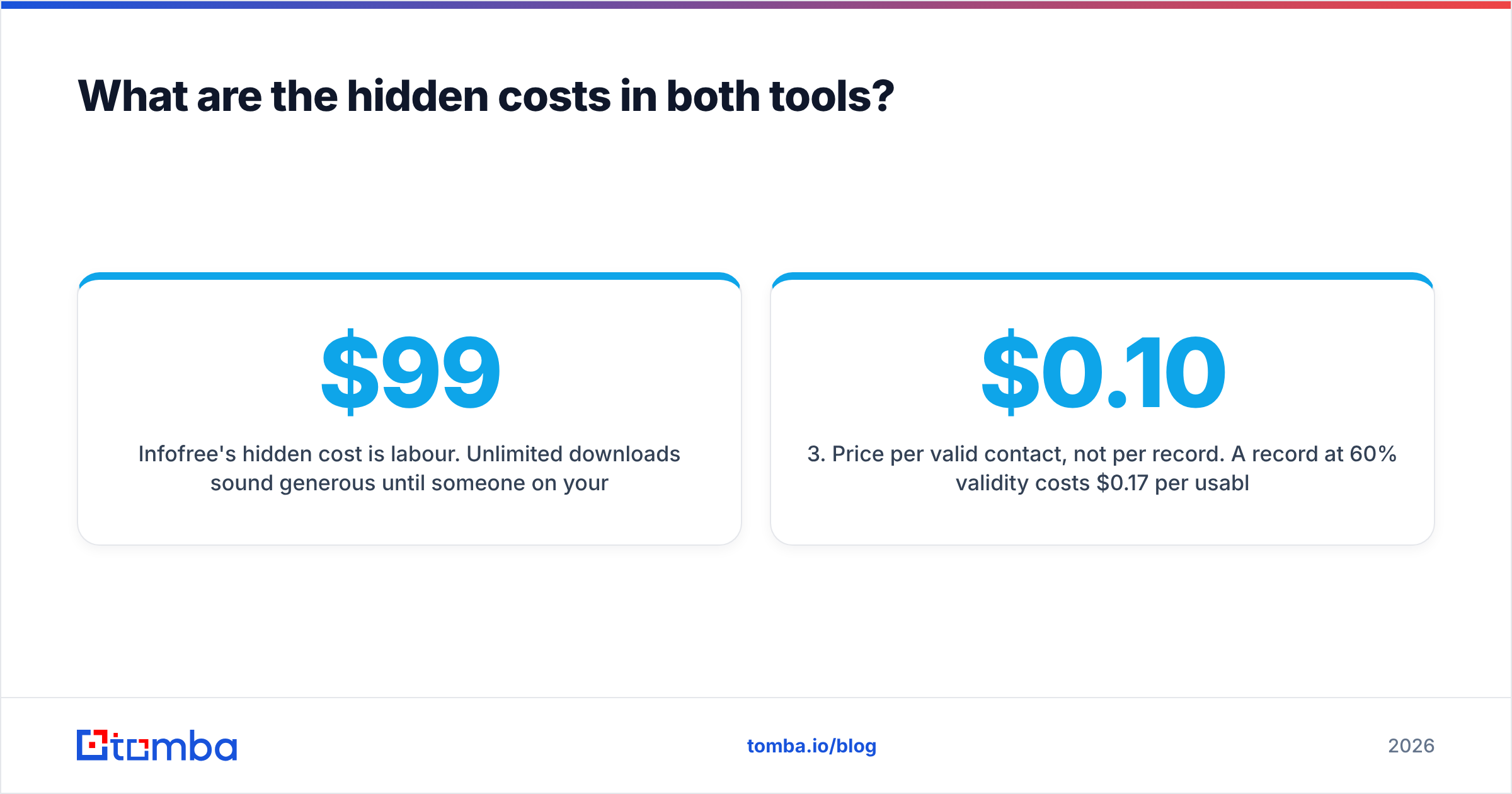
Infofree's hidden cost is labour. Unlimited downloads sound generous until someone on your team spends six hours a week de-duplicating exports, appending emails by hand, and reconciling a bundled CRM against your real one. Run the numbers at a loaded hourly rate and the "$99 plan" is rarely $99.
Seamless.AI's hidden cost is credit burn on records you throw away. Every unlock is billed whether the email bounces or the contact left in 2024. Teams routinely report consuming a month's credits in the first ten days, then either buying a top-up or going dark on prospecting for three weeks.
Both share a third cost: deliverability damage. Unverified sends raise bounce rates. Bounce rates degrade email deliverability, and weak deliverability suppresses replies on the good contacts you paid for. The bill arrives later, but it arrives.
A short pre-purchase checklist that has saved buyers real money:
- Sample before you sign. Ask for 50 records in your exact ICP, not a curated demo list.
- Verify the sample independently. Run it through a third-party verifier and count the valid, catch-all, and invalid buckets yourself.
- Price per valid contact, not per record. A $0.10 record at 60% validity costs $0.17 per usable contact.
- Test one non-US segment if you sell internationally. This is where AI-sourced data thins out fastest.
- Read the renewal clause before the pricing page.
Is there a better alternative for email-first outbound?#
If your workflow is "I know the companies, I need the right people and their verified work emails," neither of these is the tightest fit. That is a workflow fit statement, not a slight against either vendor.
A few honest options depending on what you actually need:
- BookYourData — pay-as-you-go verified B2B contacts with no subscription lock-in and a stated accuracy guarantee. Strong choice if you want to buy a list outright rather than rent a database, and it avoids the annual-contract problem entirely.
- Tomba — built around finding and verifying professional email addresses at named domains. Domain search returns every published address at a company with the detected email pattern. The email finder turns a first name, last name, and domain into a verified address, and data enrichment fills the rest of the record. Starter is $49/mo, verification is native rather than a separate SKU, and the free tier lets you test 25 searches before paying anything. The data sources page documents where records come from — worth reading for any vendor you evaluate, not just this one.
- Seamless.AI itself — genuinely the right answer if you need intent data and seated CRM workflows in one contract and have the budget.
There is no universally correct pick. There is a correct pick for your motion, your geography, and your average deal size.
How should you verify data from either tool?#
Whatever you buy, treat every export as untrusted input:
- Deduplicate first. Cheaper to clean 4,000 rows than to verify 6,000 with 2,000 duplicates.
- Syntax and domain check. Kill obvious junk and dead domains before spending any verification budget.
- SMTP-level verification. Confirm the mailbox accepts mail. Bulk-process it — a bulk email finder and verifier handles tens of thousands of rows without manual work.
- Isolate catch-alls. Do not treat "accept all" as valid. Segment those into a lower-priority sequence with a warmed secondary domain.
- Re-verify quarterly. B2B contact data decays roughly 2–3% per month. A list that was clean in January is measurably worse by April.
Teams that run this pipeline consistently see bounce rates under 2%. Teams that skip it see 8–15%, then spend a month wondering why their sender reputation collapsed.
The verdict#
The Infofree vs Seamless.AI verdict is split. Infofree wins on price predictability and consumer or local coverage. Seamless.AI wins on B2B freshness, CRM workflow, and intent signals. Neither wins on verified email accuracy, which is what most cold outbound runs on.
If you sell locally, mail physical pieces, or dial from lists, Infofree is defensible and cheap. If you run a seated SDR team on mid-market accounts with budget to match, Seamless.AI earns its seat — just negotiate the credit and renewal terms hard.
If your bottleneck is simply getting the right person's verified work email at companies you have already identified, stop paying for a database you browse. Start paying for answers you can send to. Start free with the Tomba Email Finder — 25 searches a month at no cost, $49/mo when you outgrow it, with verification built in rather than billed separately. Test it against whatever you use today on the same 50 accounts and let the bounce rate decide.
Related guides#
// get started
Find, verify and enrich your first contacts today
Start on the free plan with 25 searches a month, then scale when your team is ready.
Free plan · No credit card required · GDPR & CCPA
// about the author