Infofree vs SignalHire 2026: Which Lead Data Tool Wins?
Infofree sells flat-rate access to a US business database. SignalHire sells credits for real-time contact lookups. They solve different problems badly if you pick the wrong one — here's the honest breakdown.
Infofree vs SignalHire is a choice between two very different products. Infofree sells flat-rate access to a large US business file. SignalHire sells credits that reveal one person's contact details at a time. This guide compares price, data quality, and coverage, then says who each tool actually fits.
TL;DR
- Infofree is a flat-rate US business and consumer database (roughly $99/month for "unlimited" list downloads, subject to fair-use caps). You pay for access to a compiled file, not for individual lookups.
- SignalHire is a credit-based contact finder built around a Chrome extension. It reveals emails and phone numbers from LinkedIn and other public profiles, one person at a time or in bulk.
- They are not really competitors. Infofree wins on volume and cost predictability for US SMB territory lists. SignalHire wins on person-level precision, phone numbers, and non-US coverage.
- Neither one is a verification tool. Infofree's compiled records drift. SignalHire's credits get spent on results you still have to bounce-test before sending.
- The realistic 2026 stack is one source of targeting data plus a dedicated finder/verifier layer. That is where Tomba (free tier at 25 searches/month, Starter $49/month) tends to slot in.
What is Infofree and who is it built for?#
Infofree sells subscription access to a compiled US database. The file holds roughly 15 million business records and hundreds of millions of consumer records. The sources are public filings, phone directories, credit bureaus, and business registrations. You log in, set a filter (SIC code, revenue band, employee count, radius around a ZIP), and export the list.
The pitch is simplicity: one flat monthly fee, no credit math, no per-record charges. It comes from the same compiled-data tradition as Salesgenie. The buyer is the same too: insurance agents, local B2B services, franchise owners, and financial advisors working a geographic territory.
That model has one consequence you should understand before you buy. A compiled database is a snapshot, not a live query. The record for "Office Manager, ACME Plumbing, Tulsa" was true on some date. Whether it is true today depends on how recently that segment was refreshed. Compiled files also lean toward company-level data: main switchboard numbers, generic info@ addresses, owner names from the business registration. What you rarely get is the direct work email of the specific VP you want to reach.
Check infofree.com for current plan details. Flat-rate vendors change their fair-use limits more often than their headline price.
What is SignalHire and how does it work?#
SignalHire runs on the opposite model. It keeps a large profile index (the vendor claims hundreds of millions of professional profiles) and looks up contact details on request. You install the browser extension, open a LinkedIn profile or a search result page, and click reveal. SignalHire returns emails and, where available, direct or mobile phone numbers. Each reveal costs a credit.
Its center of gravity is recruiting. SignalHire ships an ATS-lite layer with candidate pipelines, team collaboration, bulk list processing, and an API. A large share of its users are sourcing people, not companies. That shapes the data. It is strong on individual professionals with a public presence. It is weak on the 12-person HVAC contractor with no LinkedIn footprint at all.
Credit pricing also means your cost scales with your ambition, not your results. Most credit systems only charge for successful reveals. But "successful" only means a value came back. It does not mean the inbox is live. Details and current tiers are on signalhire.com.

Infofree vs SignalHire: how do they compare head-to-head?#
Here is the practical comparison. It ignores marketing claims and sticks to what changes your workflow.
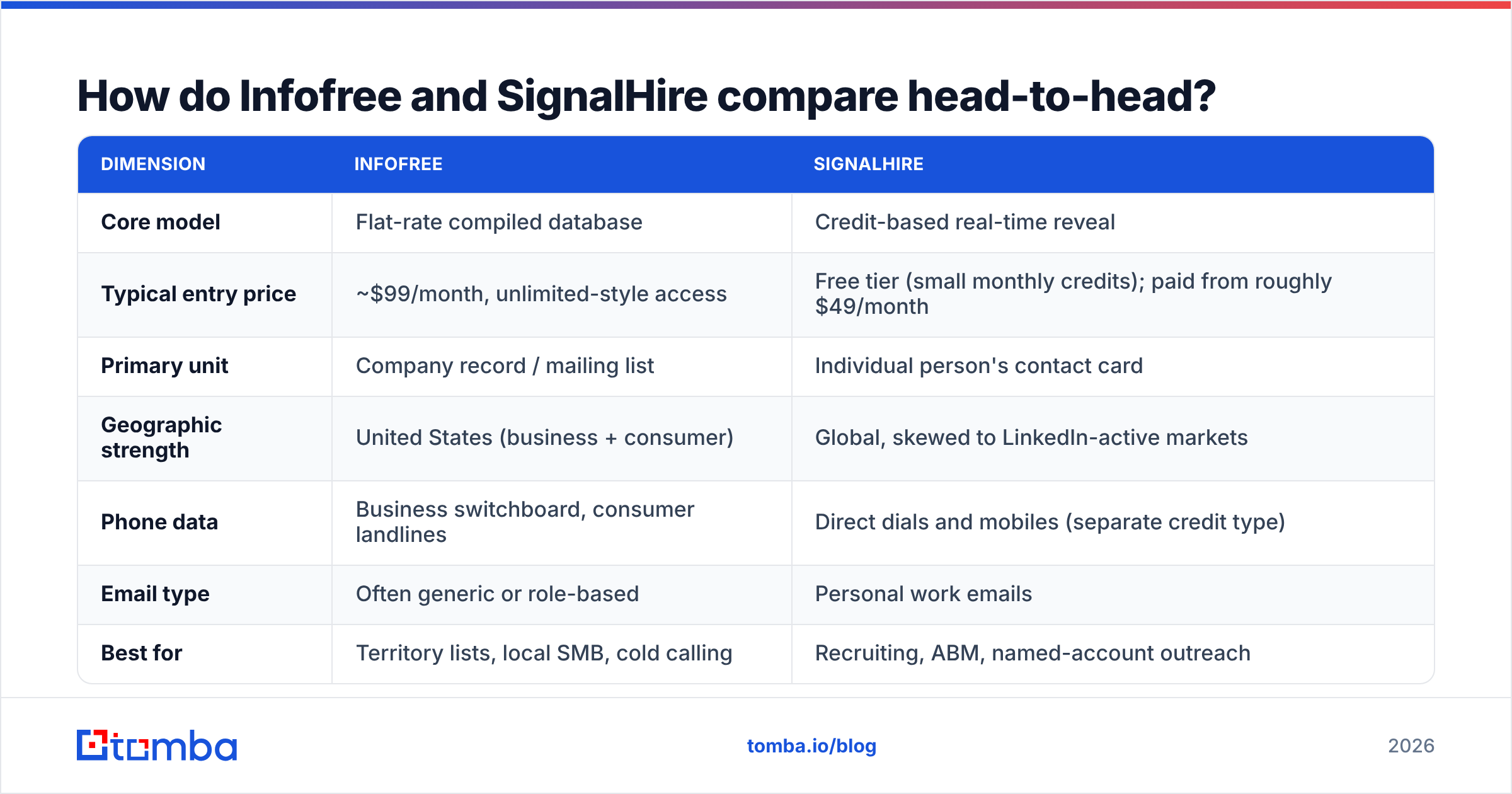
| Dimension | Infofree | SignalHire |
|---|---|---|
| Core model | Flat-rate compiled database | Credit-based real-time reveal |
| Typical entry price | ~$99/month, unlimited-style access | Free tier (small monthly credits); paid from roughly $49/month |
| Primary unit | Company record / mailing list | Individual person's contact card |
| Geographic strength | United States (business + consumer) | Global, skewed to LinkedIn-active markets |
| Phone data | Business switchboard, consumer landlines | Direct dials and mobiles (separate credit type) |
| Email type | Often generic or role-based | Personal work emails |
| Best for | Territory lists, local SMB, cold calling | Recruiting, ABM, named-account outreach |
| Browser extension | Limited | Core of the product |
| API access | Minimal | Yes |
| Built-in verification | No meaningful layer | Basic validity signal only |
| Data freshness | Periodic batch refresh | Resolved at request time |
The table makes the split obvious. Say your ICP is "every dental practice within 50 miles of Columbus." Infofree gets you 900 records for a fixed fee. SignalHire would burn hundreds of credits to assemble the same list badly. Now say your ICP is "Heads of RevOps at Series B SaaS companies in Germany." Infofree has almost nothing there, and SignalHire is the right tool.

How accurate is the data from each tool?#
Neither vendor publishes an audited accuracy figure. Treat any number on a pricing page as a marketing claim, not a measurement. What you can reason about is the failure mode of each model.
Infofree's failure mode is staleness. Compiled records decay at roughly 2-3% per month. People change jobs, businesses close, and phone lines get disconnected. A record refreshed nine months ago is not the same asset as one refreshed last week. Flat-rate vendors also have every reason to refresh in batches rather than continuously. Generic info@ addresses stay valid for years while routing straight to a gatekeeper. A "valid" email here is not the same as a reachable decision-maker.
SignalHire's failure mode is pattern inference. Real-time finders mix known-good records with guessed patterns (first.last@domain.com) and an SMTP check. On domains with a clean mail server, that works well. Catch-all domains are the problem, and they now cover a large slice of mid-market and enterprise mail. The server accepts every address, so the check returns "valid" for a mailbox that may not exist. That is why a separate catch-all verifier step exists as its own product category.
The honest summary: both tools produce usable data, and both produce bounce risk. Neither one removes your job of running the export through an email verifier before it touches a sending domain. A 6% bounce rate will damage your sender reputation no matter which logo was on the invoice.
Which one is actually cheaper for your volume?#
Flat-rate and credit pricing only compare if you normalize to cost-per-usable-contact. "Usable" means verified, personal, and matched to your ICP. A row in a CSV does not count.
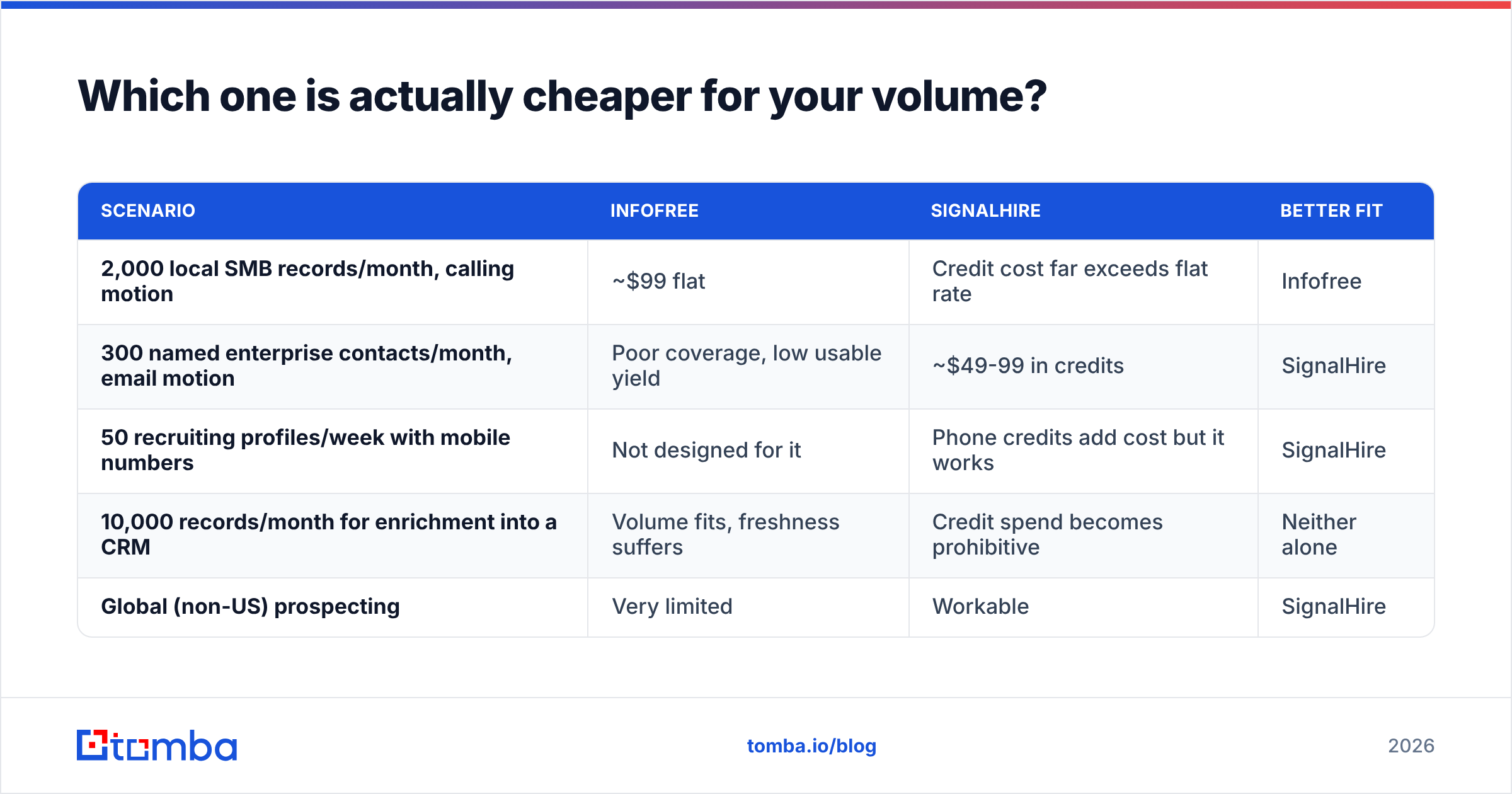
| Scenario | Infofree | SignalHire | Better fit |
|---|---|---|---|
| 2,000 local SMB records/month, calling motion | ~$99 flat | Credit cost far exceeds flat rate | Infofree |
| 300 named enterprise contacts/month, email motion | Poor coverage, low usable yield | ~$49-99 in credits | SignalHire |
| 50 recruiting profiles/week with mobile numbers | Not designed for it | Phone credits add cost but it works | SignalHire |
| 10,000 records/month for enrichment into a CRM | Volume fits, freshness suffers | Credit spend becomes prohibitive | Neither alone |
| Global (non-US) prospecting | Very limited | Workable | SignalHire |
That fourth row is where most teams get stuck. Bulk enrichment at real volume is a third category. It needs API-first pricing, not seat-and-credit pricing. You usually own the company list already. Running a bulk email finder against it costs less than paying either vendor to re-discover contacts you could resolve from a domain and a name.

What should you actually check before you commit?#
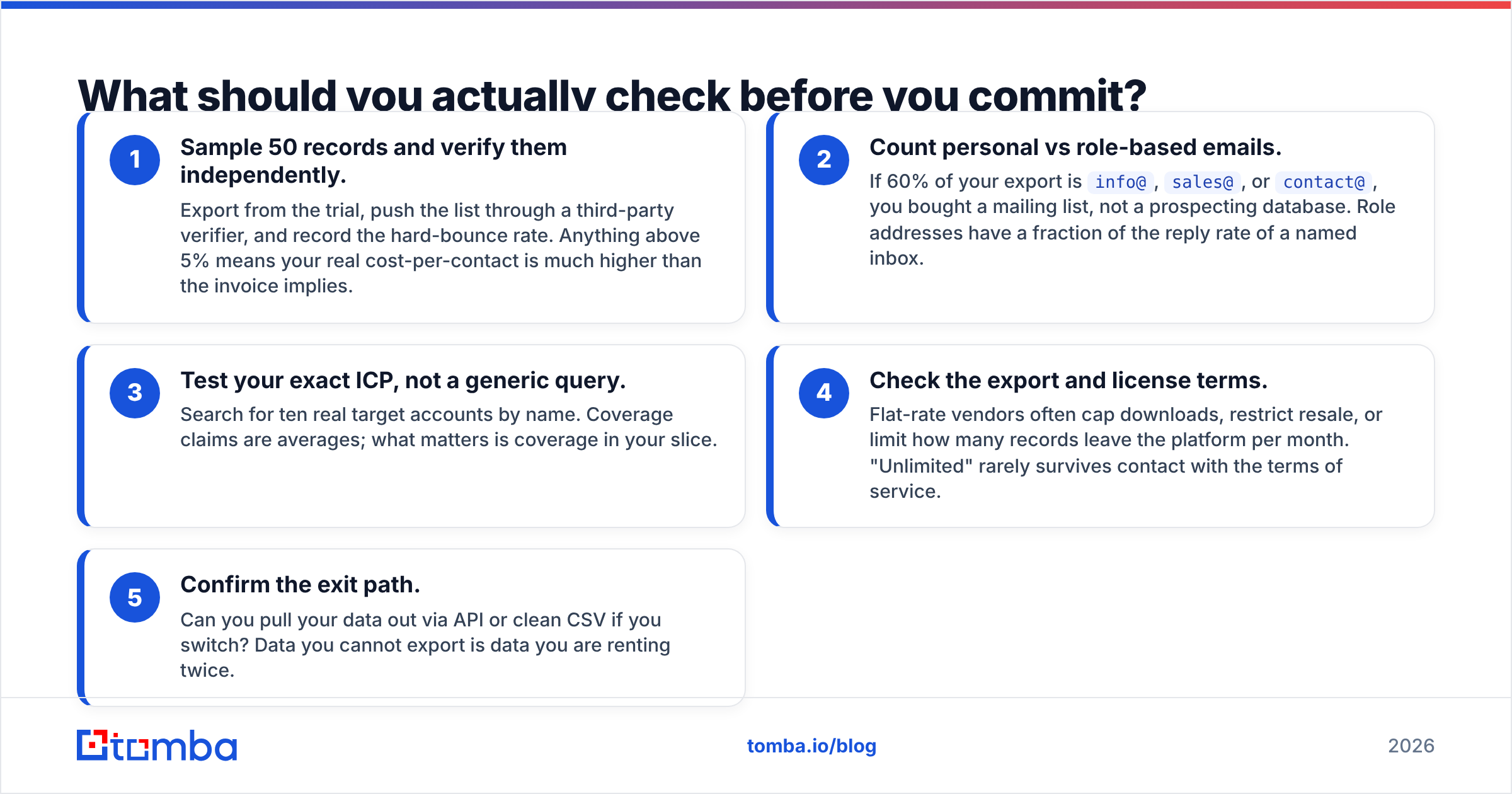
Run these five checks during the trial. They take under an hour. They also separate a good buy from a twelve-month regret.
Sample 50 records and verify them independently. Export from the trial and push the list through a third-party verifier. Record the hard-bounce rate. Anything above 5% means your real cost-per-contact is far higher than the invoice implies.
Count personal vs role-based emails. If 60% of your export is
info@,sales@, orcontact@, you bought a mailing list, not a prospecting database. Role addresses get a fraction of the replies a named inbox gets.Test your exact ICP, not a generic query. Search for ten real target accounts by name. Coverage claims are averages. What matters is coverage in your slice.
Check the export and license terms. Flat-rate vendors often cap downloads, restrict resale, or limit how many records leave the platform each month. "Unlimited" rarely survives contact with the terms of service.
Confirm the exit path. Can you pull your data out by API or clean CSV if you switch? Data you cannot export is data you rent twice.

Where does a dedicated email finder fit alongside these?#
Think of it like a kitchen. Infofree is the wholesale supplier: cheap, high volume, variable quality. SignalHire is the specialty grocer: precise, priced per item. Neither one is the chef. Neither one washes the produce.
The washing step is verification and pattern resolution. It is also the cheapest place to recover margin. Once you have a company list — from Infofree, from SignalHire, from a conference roster, from your CRM — resolving contacts from a domain and a name is a solved problem. Domain search returns the addresses attached to a company plus the format the company uses. You can then extrapolate with confidence instead of guessing. That flips your spend from "pay per discovery attempt" to "pay per resolved contact."
For teams doing this at scale, the practical build is:
- Targeting layer — whatever gets you the right account list. For US SMB territories, Infofree is genuinely cost-effective. For global tech, use SignalHire or LinkedIn Sales Navigator.
- Resolution layer — an email finder API that takes a name plus a domain and returns a scored address. Call it from your enrichment pipeline, not a browser extension.
- Verification layer — syntax, MX, SMTP, and catch-all handling before anything enters a sequence.
- Sending layer — your sequencer, with suppression lists wired back to the verification output.
Teams that collapse layers two and three into "whatever the data vendor says is valid" are the ones filing deliverability tickets six weeks later.
Which one should you choose?#
The Infofree vs SignalHire decision comes down to your motion and your geography.
Choose Infofree if you sell to US small businesses in a defined area. It fits a phone-first motion, a predictable monthly cost, and a tolerance for generic email quality. It is good value for territory-based SMB prospecting, and it is priced for a one-to-five-person shop.
Choose SignalHire if you need named individuals, mobile numbers, non-US coverage, or a recruiting workflow. The extension is fast and the bulk tooling is competent. Credits make sense when each contact is worth real money to you.
Choose neither as your only tool if you run outbound email at any serious volume. Both leave you holding unverified data. Unverified data is the single most common cause of a burned sending domain.
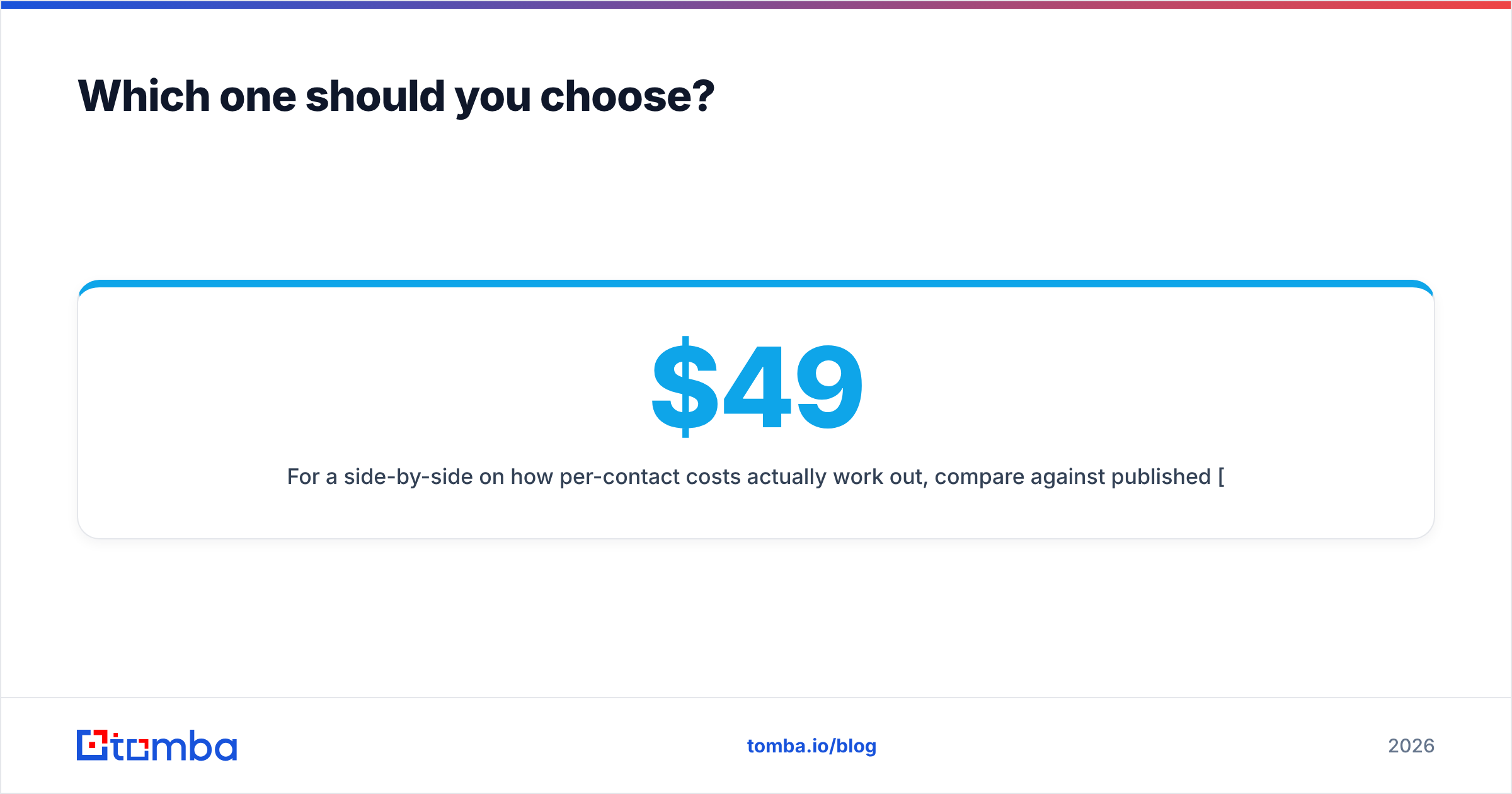
For a side-by-side on per-contact cost, compare against published Tomba pricing: Free at 25 searches/month, Starter at $49/month, Growth at $99/month, Pro at $249/month. Note too that user reviews on G2 are a better sanity check on any of these vendors than their own case studies.
Frequently asked questions#
Does Infofree have a free trial? It has historically offered a low-cost or free trial window rather than a permanent free tier. Verify the current offer before you assume.
Does SignalHire have a free plan? Yes. It is a small monthly credit allowance, and it is enough to test coverage on your ICP. That is exactly what you should use it for.
Can I use either for GDPR-covered outreach? Both surface data on EU individuals in some segments. You need your own lawful basis and suppression process. A vendor compliance page does not transfer liability to them.
Which has better phone data? SignalHire for direct dials and mobiles. Infofree for business switchboard numbers and consumer landlines. Different products, different use cases.
Stop paying twice for contacts you cannot send to. Whichever targeting source you land on, run the names and domains through the Tomba Email Finder before they reach your sequencer. You get verified, scored, personal work addresses with sources you can audit. It starts free at 25 searches per month and $49/month on Starter. Your bounce rate, and your sending domain, will notice the difference.
Related guides#
// get started
Find, verify and enrich your first contacts today
Start on the free plan with 25 searches a month, then scale when your team is ready.
Free plan · No credit card required · GDPR & CCPA
Get the Tomba newsletter
Product and data updates
// about the author