Informa TechTarget Alternatives: 10 Options Compared for 2026
Informa TechTarget bundles media, intent data and syndicated leads into one contract. Here are 10 alternatives that unbundle it, with data models, pricing reality and the trade-offs nobody puts in the deck.
TL;DR
- Informa TechTarget sells three different things in one contract: tech media reach, purchase-intent signals from its own editorial network, and syndicated leads. Most teams only need one of them.
- The best alternative depends on which piece you are actually replacing. Intent signal? Bombora, 6sense, Demandbase or G2. Syndicated leads? Madison Logic, DemandScience, Foundry. Contact data underneath it all? Tomba or BookYourData.
- Informa TechTarget pricing is not public and typically lands in the five-figure annual range with a minimum commitment. Several alternatives start under $100/month.
- The hidden cost is not the license, it is the rework: syndicated leads arrive with stale emails, and someone on your team has to verify and enrich them before a sequence can run.
- A practical 2026 stack for most mid-market teams: one intent source, one outbound sequencer, and a contact-data API that keeps the records deliverable.
What is Informa TechTarget, and what are you actually buying?#
Informa TechTarget is the entity formed when Informa Tech's digital businesses merged with TechTarget at the end of 2024. The combined company owns a large network of B2B technology publications, webinar platforms like BrightTALK, and the intent product most buyers know it for, Priority Engine.
The business model matters more than the feature list. Informa TechTarget is a media company that sells data as a by-product. Its intent signal comes from people reading its own articles, downloading its own whitepapers and attending its own webinars. That is first-party publisher data, and for enterprise IT categories it is genuinely strong: if a network engineer at a 4,000-person insurer is reading six articles about SASE, that is a real signal.
The trade-off is coverage. If your buyer does not live in enterprise technology media, the signal thins out fast. A RevOps leader buying a payroll tool, a clinic administrator buying scheduling software, or a manufacturer buying an MES system may never touch that content network.
So when people search for Informa TechTarget alternatives, they are usually trying to solve one of four separate problems. Sort out which one is yours before you take a single demo.
Why do teams look for Informa TechTarget alternatives?#
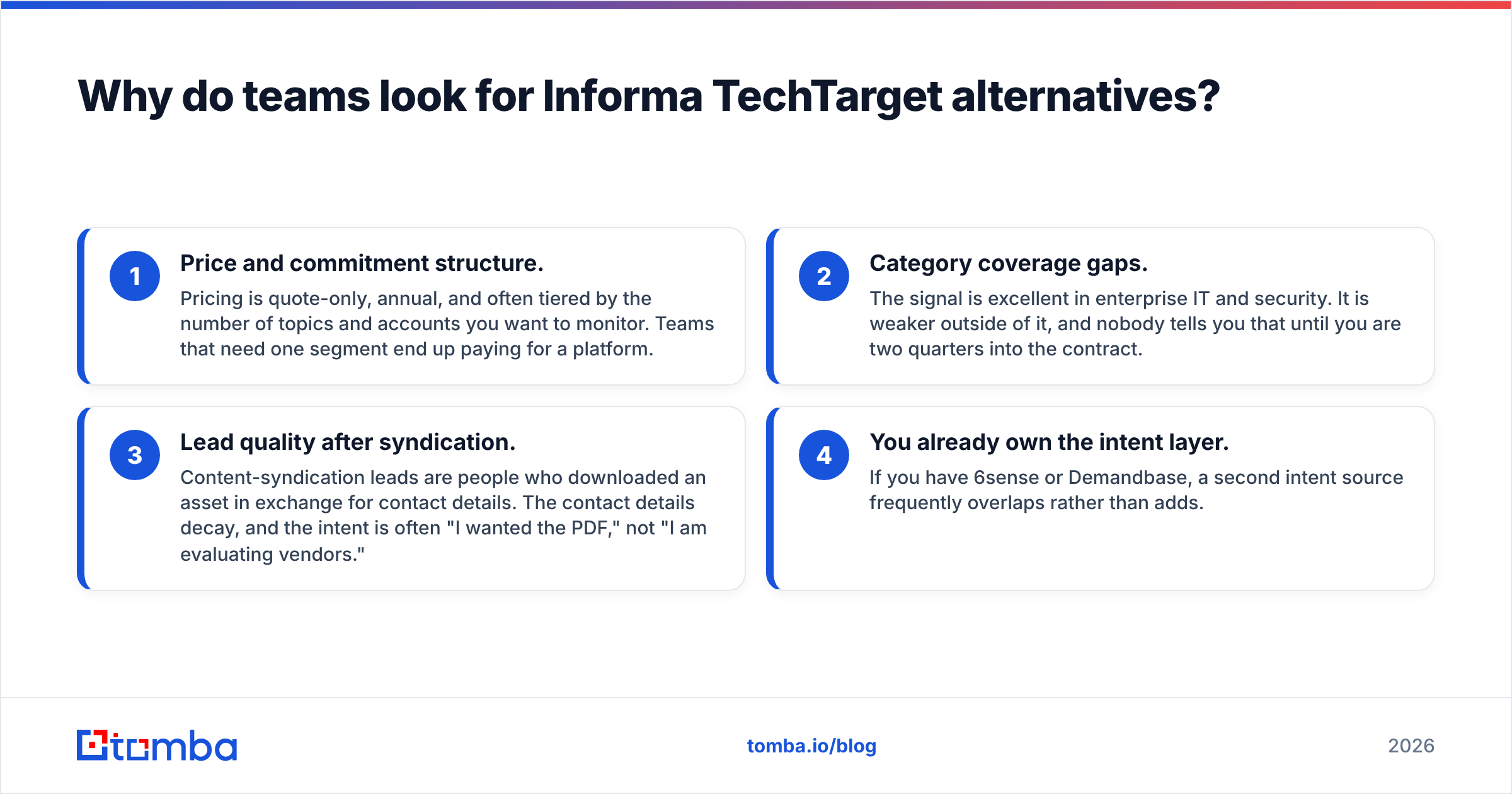
Four reasons come up over and over in procurement conversations and on review sites like G2:
- Price and commitment structure. Pricing is quote-only, annual, and often tiered by the number of topics and accounts you want to monitor. Teams that need one segment end up paying for a platform.
- Category coverage gaps. The signal is excellent in enterprise IT and security. It is weaker outside of it, and nobody tells you that until you are two quarters into the contract.
- Lead quality after syndication. Content-syndication leads are people who downloaded an asset in exchange for contact details. The contact details decay, and the intent is often "I wanted the PDF," not "I am evaluating vendors."
- You already own the intent layer. If you have 6sense or Demandbase, a second intent source frequently overlaps rather than adds.
What should a good Informa TechTarget alternative actually replace?#
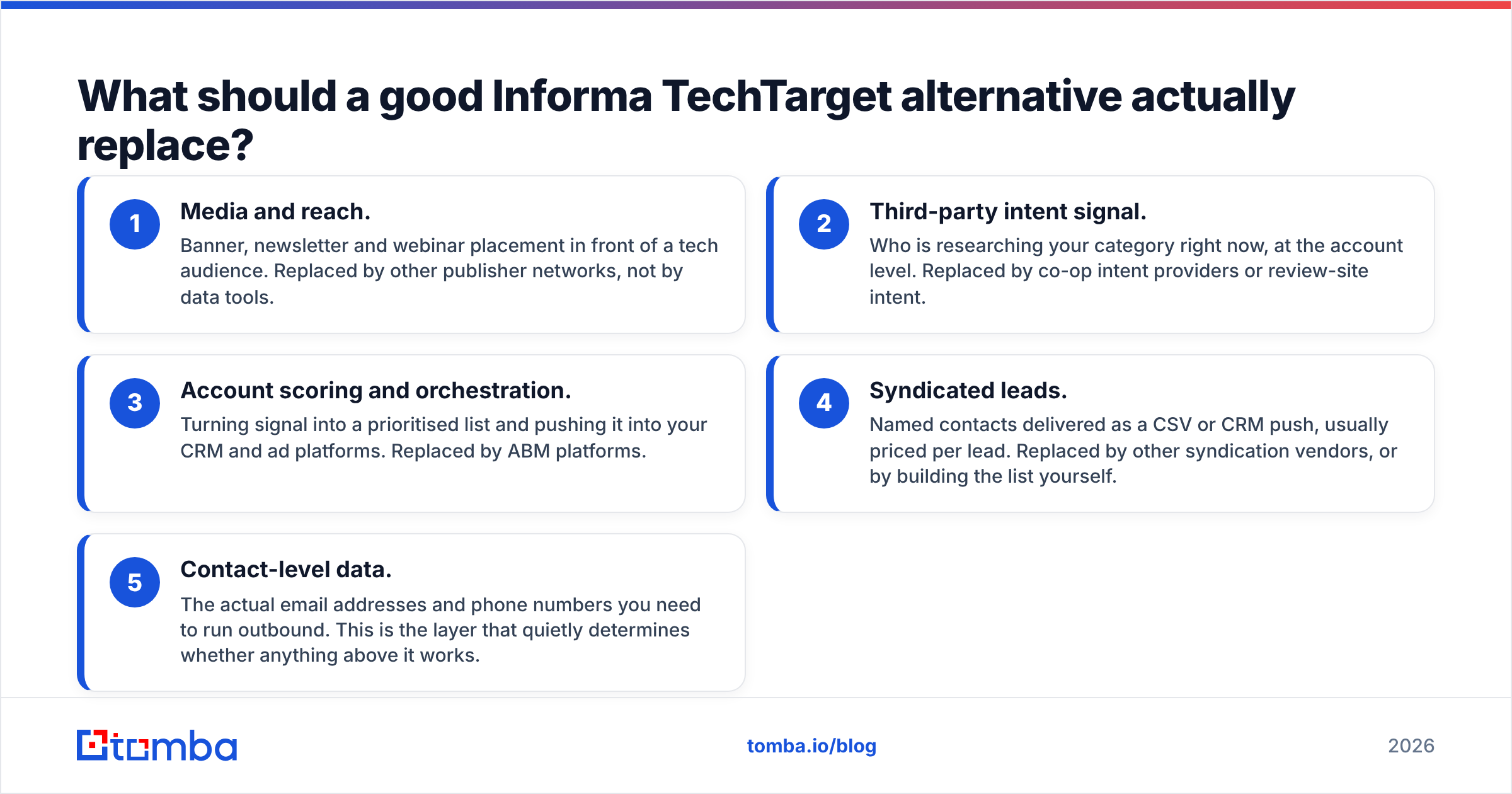
This is the part most comparison posts skip. Informa TechTarget is a bundle, and you should evaluate replacements by layer, not by brand name.
- Media and reach. Banner, newsletter and webinar placement in front of a tech audience. Replaced by other publisher networks, not by data tools.
- Third-party intent signal. Who is researching your category right now, at the account level. Replaced by co-op intent providers or review-site intent.
- Account scoring and orchestration. Turning signal into a prioritised list and pushing it into your CRM and ad platforms. Replaced by ABM platforms.
- Syndicated leads. Named contacts delivered as a CSV or CRM push, usually priced per lead. Replaced by other syndication vendors, or by building the list yourself.
- Contact-level data. The actual email addresses and phone numbers you need to run outbound. This is the layer that quietly determines whether anything above it works.
Layer five is where most budgets leak. You can buy perfect intent and still send to a mailbox that bounced six months ago. Any replacement plan needs an answer for how contact records get found, verified and refreshed.
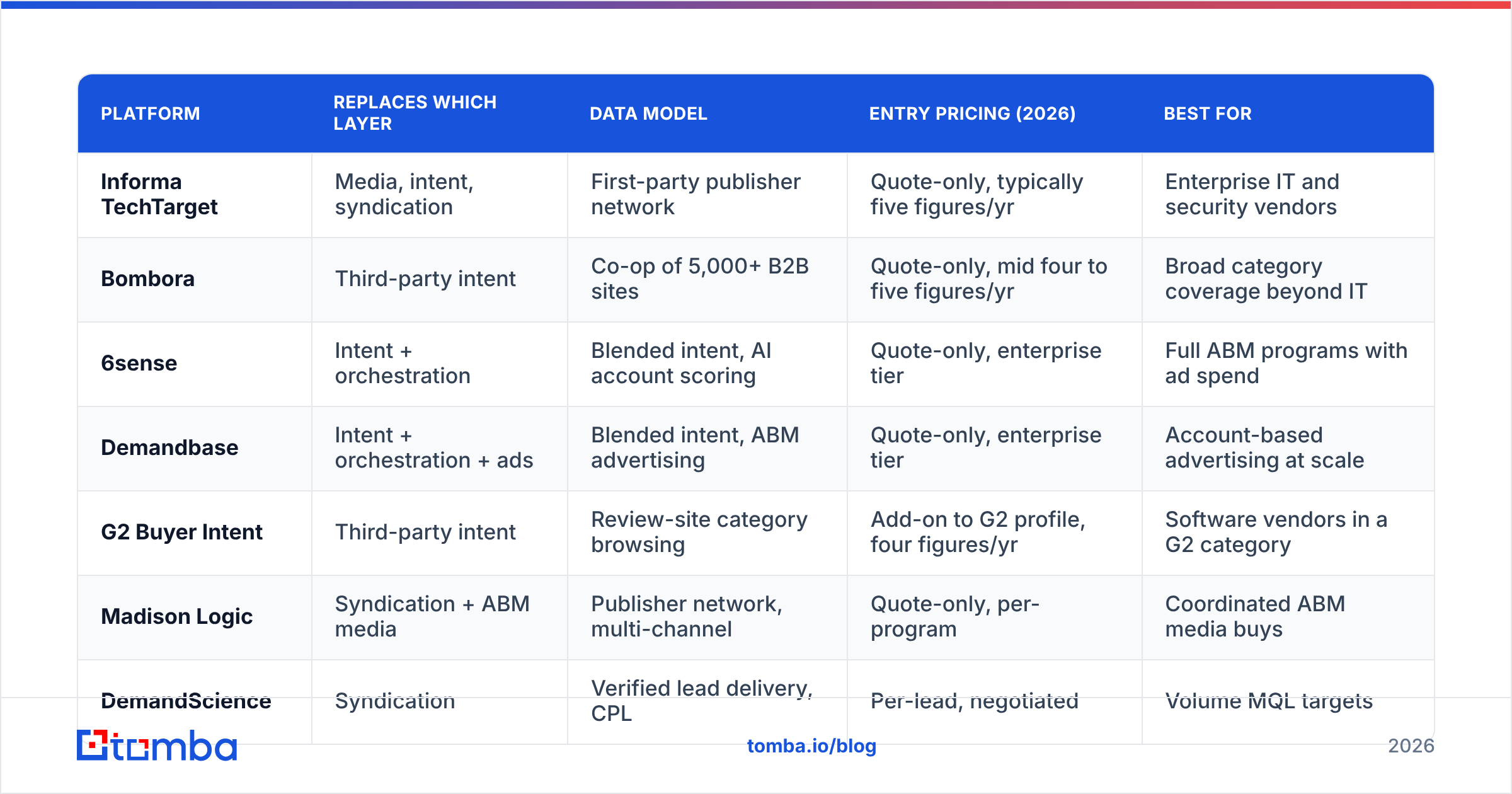
How do the main Informa TechTarget alternatives compare?#
| Platform | Replaces which layer | Data model | Entry pricing (2026) | Best for |
|---|---|---|---|---|
| Informa TechTarget | Media, intent, syndication | First-party publisher network | Quote-only, typically five figures/yr | Enterprise IT and security vendors |
| Bombora | Third-party intent | Co-op of 5,000+ B2B sites | Quote-only, mid four to five figures/yr | Broad category coverage beyond IT |
| 6sense | Intent + orchestration | Blended intent, AI account scoring | Quote-only, enterprise tier | Full ABM programs with ad spend |
| Demandbase | Intent + orchestration + ads | Blended intent, ABM advertising | Quote-only, enterprise tier | Account-based advertising at scale |
| G2 Buyer Intent | Third-party intent | Review-site category browsing | Add-on to G2 profile, four figures/yr | Software vendors in a G2 category |
| Madison Logic | Syndication + ABM media | Publisher network, multi-channel | Quote-only, per-program | Coordinated ABM media buys |
| DemandScience | Syndication | Verified lead delivery, CPL | Per-lead, negotiated | Volume MQL targets |
| Foundry (IDG) | Media, intent, syndication | Tech publisher network | Quote-only | The closest like-for-like swap |
| BookYourData | Contact data | Self-serve verified B2B lists | Pay-as-you-go credits | Buying a targeted list without a contract |
| Tomba | Contact data + verification | Domain search, finder, verifier, API | Free tier, then $49/mo Starter | Teams building their own lists in-house |
The table makes the key point visible: only three of these are genuinely trying to be Informa TechTarget. The rest are components you assemble.
Which alternative is best for third-party intent data?#
Bombora is the default swap for the intent layer alone. Its co-op model aggregates content consumption across thousands of B2B publisher sites, which gives it broader category reach than any single publisher network. Bombora Surge scores drop cleanly into most CRMs and ABM platforms, and many other vendors license Bombora underneath their own UI, so you may already be paying for it indirectly.
6sense and Demandbase are a different purchase. You are not buying a signal feed, you are buying an orchestration platform that blends intent with firmographics, web visits and ad delivery. If you have the headcount to run it, either can replace Informa TechTarget's prioritisation function and then some. If you do not, you will use 10% of the platform and feel every dollar. Demandbase leans harder into advertising; 6sense leans harder into predictive scoring.
G2 Buyer Intent is the cheapest useful intent signal for most software companies. The scope is narrow by design: you see accounts browsing your category and your competitors' profiles. That narrowness is a feature. A visit to a comparison page is a much later-stage signal than an article read.
If you run an ABM motion, add a website visitor reveal layer as well so you can see which of those in-market accounts already touched your site. That closes the loop between third-party signal and first-party behaviour.
Which alternative is best for content syndication and lead delivery?#
Foundry, formerly IDG Communications, is the nearest like-for-like competitor. Same shape of business, same tech-media audience, same mix of intent and syndicated leads. If you liked the model but not the account team or the price, Foundry is the obvious second quote to get.
Madison Logic wraps syndication inside a multi-channel ABM framework, coordinating content delivery with display and LinkedIn against the same target account list. It suits teams who want one partner running the account program rather than a CPL vendor.
DemandScience is the volume play, priced per lead against agreed filters. It works if your marketing team is measured on MQL count. It creates problems if sales is measured on meetings, because CPL vendors optimise for the metric in the contract.

Whichever you pick, budget for the cleanup step. Syndicated lead files routinely arrive with 10-25% undeliverable addresses because the download happened weeks earlier or the person changed jobs. Running the file through an email verifier before it touches your sending domain is not optional. One bad send to a 5,000-row list can cost you more in sender reputation than the leads were worth.
Can you replace syndicated leads by building the list yourself?#
For many mid-market teams, yes, and the maths is not close.
A syndicated lead typically costs somewhere between $40 and $120 depending on filters and whether it is single- or double-qualified. Building the equivalent list means three steps: define the account list, find the right people at those accounts, and verify the contact details.
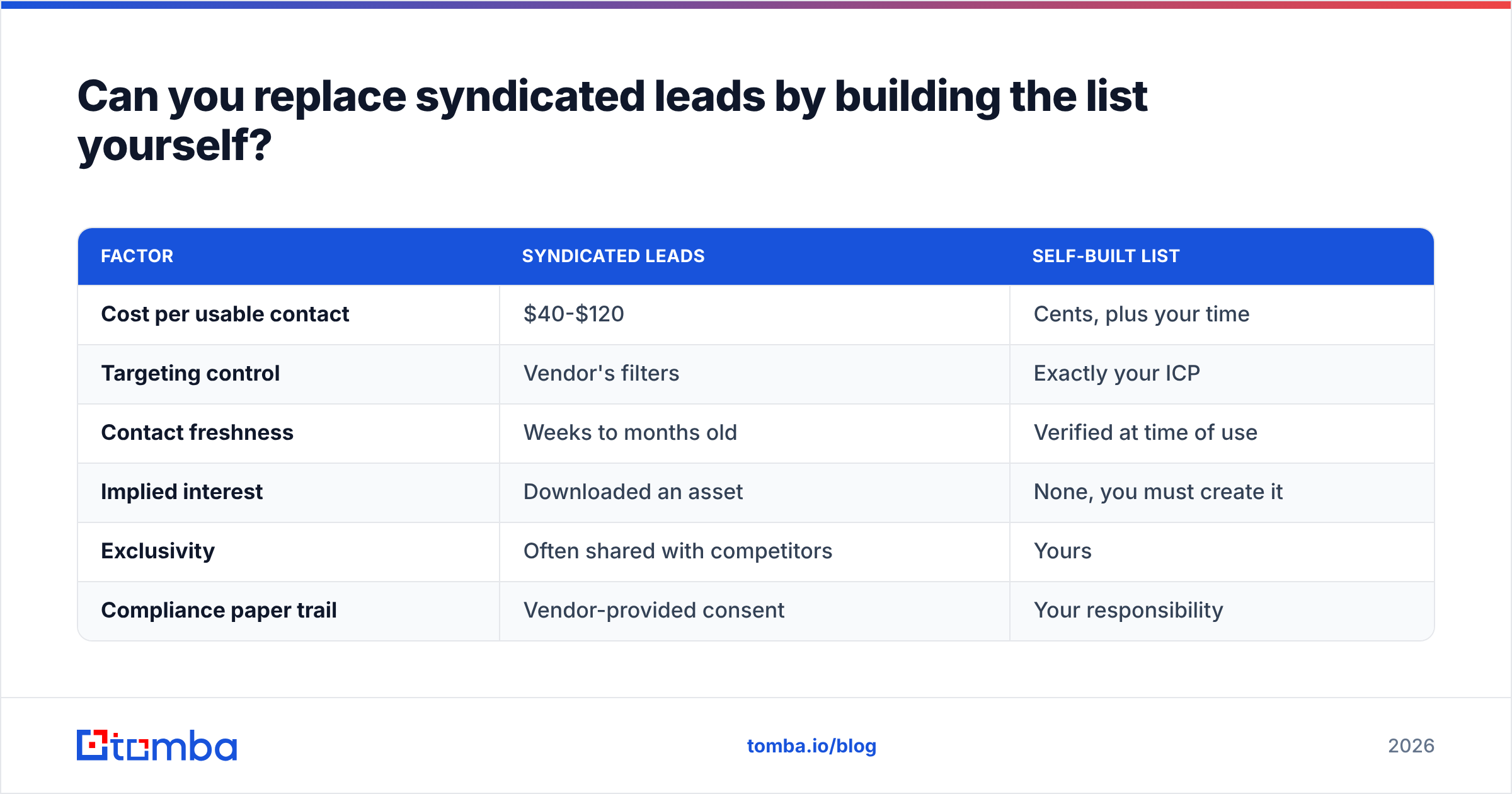
Here is how the two approaches compare on the things that actually matter:
| Factor | Syndicated leads | Self-built list |
|---|---|---|
| Cost per usable contact | $40-$120 | Cents, plus your time |
| Targeting control | Vendor's filters | Exactly your ICP |
| Contact freshness | Weeks to months old | Verified at time of use |
| Implied interest | Downloaded an asset | None, you must create it |
| Exclusivity | Often shared with competitors | Yours |
| Compliance paper trail | Vendor-provided consent | Your responsibility |
The honest trade-off: syndicated leads come with a consent record and a hook ("you downloaded our guide"). Self-built lists come with precision and cost control but require real cold outreach. Neither is universally right. Most teams that leave a bundled contract end up doing both, with a much smaller syndication spend pointed only at the segments where it converts.
If you go the self-built route, the workflow is mechanical: pull target accounts from your intent source, run domain search to map the people at each account, verify every address, then push the result into your sequencer. Tools like BookYourData work well when you want to buy a targeted, pre-verified list outright rather than assemble one, and they are pay-as-you-go rather than annual. Tomba fits the opposite case: you already know the accounts and want an API that returns verified contacts on demand, at pricing that starts free and moves to $49/mo Starter, $99/mo Growth and $249/mo Pro.
How do you evaluate any of these vendors before signing?#
Run the same four tests on every shortlisted vendor, including the incumbent.
- Coverage test. Give them 50 accounts from your actual pipeline, not their sample. Ask what percentage they have signal on. Anything under 60% means your category is outside their network.
- Recency test. Ask when the underlying data was last refreshed and how. "Continuously" is not an answer; ask for a date field in the export.
- Deliverability test. Take 200 contacts from their sample file and verify them independently. Bounce rate above 5% tells you what the rest of the file looks like.
- Exit test. Ask what you keep when the contract ends. Some intent platforms treat scores as licensed, not owned, which means your CRM enrichment evaporates on renewal day.
Do the deliverability test before the pricing negotiation, not after. It is the single strongest piece of leverage you will have, and it takes an afternoon with a data enrichment or verification API.
What does a sensible 2026 stack look like?#
For most B2B teams under 200 employees, the bundle is the wrong shape. A cheaper and more controllable stack looks like this:
- One intent source sized to your category. G2 Buyer Intent if you are a software vendor, Bombora if your buyers are outside tech media.
- One account list maintained in your CRM, not in a vendor's UI, so you own it at renewal.
- One contact-data layer with an API, so enrichment happens automatically when a record enters the CRM rather than in a quarterly batch project.
- One sending platform with proper warmup and domain separation.
- A verification step wired between three and four so nothing unverified ever reaches your sending domain.
That stack costs a fraction of a bundled media contract and, more importantly, each piece is independently replaceable. When the intent vendor underperforms, you swap one line item instead of renegotiating everything.
Ready to build the contact layer yourself?#
Intent data tells you which accounts to work. It does not give you a deliverable address for the person who signs the contract. That is the gap that quietly kills most account-based programs, bundled or unbundled.
Start with the Tomba Email Finder: search by domain, name or company, get verified professional addresses back, and wire the same logic into your CRM with the Tomba API so every new account is enriched on arrival. The free tier covers 25 searches a month, which is enough to run the deliverability test on any vendor file sitting in your inbox right now. Run it before you sign the renewal.
Related guides#
// get started
Find, verify and enrich your first contacts today
Start on the free plan with 25 searches a month, then scale when your team is ready.
Free plan · No credit card required · GDPR & CCPA
// about the author