Informa TechTarget Pricing 2026: Reviews, Pros and Cons
Informa TechTarget doesn't publish a price list, and that's deliberate. Here's what buyers actually report paying for Priority Engine, content syndication and QSOs — plus the honest pros, cons, and cheaper starting points.
TL;DR
- Informa TechTarget does not publish pricing. Every deal is a custom annual contract, and buyers consistently report entry points in the tens of thousands of dollars per year rather than a few hundred dollars per month.
- The three things you're actually buying are intent signals (Priority Engine), content syndication leads billed on a cost-per-lead basis, and analyst/media packages (ESG, BrightTALK). They are priced and negotiated separately.
- Reviews are genuinely split: buyers love the account-level intent depth in enterprise IT, and they complain about lead quality variance, rigid annual commitments, and contact records that go stale between refreshes.
- It's a strong fit if you sell enterprise technology to IT buyers with a six-figure ACV. It's a poor fit if you need per-contact email data, run outbound at SMB price points, or want to test before committing a year of budget.
- Most teams evaluating it are really solving two problems at once — finding in-market accounts, and finding valid contact details inside them. Only the first one needs a five-figure contract.
What is Informa TechTarget?#
Informa TechTarget is the company formed when Informa Tech's digital businesses merged with TechTarget at the end of 2024. The combined business sells B2B technology marketers three things that used to come from separate vendors: purchase-intent data derived from its own network of technology publications, lead generation through content syndication, and analyst research plus webinar media through Enterprise Strategy Group and BrightTALK.
The moat is first-party. Unlike intent vendors that license co-op bidstream data, TechTarget owns hundreds of editorial sites that IT buyers read when they're researching storage, security, cloud, networking, and enterprise software. When a director of infrastructure at a Fortune 1000 company reads four articles about hyperconverged infrastructure in a week, that behaviour happens on property Informa TechTarget controls. It knows the company, often the individual, and it can sell that signal to the vendors who want that deal.
That's a real asset, and it explains the pricing posture. You are not buying a database seat. You are buying privileged access to an audience nobody else can observe the same way.
What does Informa TechTarget actually sell?#
Before you can evaluate the price you need to separate the product lines, because sales reps will quote them as a bundle and the bundle is where budget disappears.
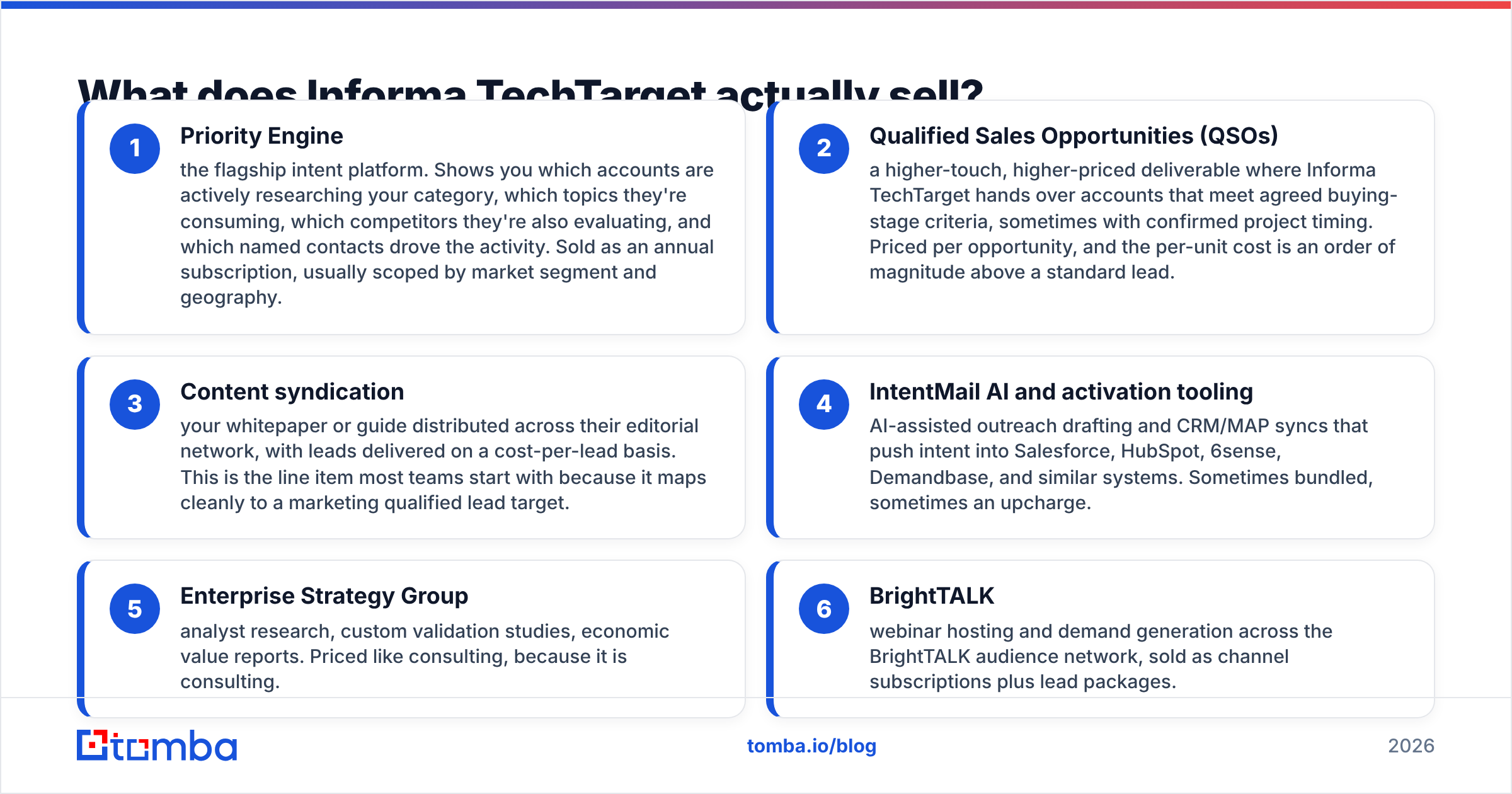
- Priority Engine — the flagship intent platform. Shows you which accounts are actively researching your category, which topics they're consuming, which competitors they're also evaluating, and which named contacts drove the activity. Sold as an annual subscription, usually scoped by market segment and geography.
- Qualified Sales Opportunities (QSOs) — a higher-touch, higher-priced deliverable where Informa TechTarget hands over accounts that meet agreed buying-stage criteria, sometimes with confirmed project timing. Priced per opportunity, and the per-unit cost is an order of magnitude above a standard lead.
- Content syndication — your whitepaper or guide distributed across their editorial network, with leads delivered on a cost-per-lead basis. This is the line item most teams start with because it maps cleanly to a marketing qualified lead target.
- IntentMail AI and activation tooling — AI-assisted outreach drafting and CRM/MAP syncs that push intent into Salesforce, HubSpot, 6sense, Demandbase, and similar systems. Sometimes bundled, sometimes an upcharge.
- Enterprise Strategy Group — analyst research, custom validation studies, economic value reports. Priced like consulting, because it is consulting.
- BrightTALK — webinar hosting and demand generation across the BrightTALK audience network, sold as channel subscriptions plus lead packages.
A common enterprise deal stitches together Priority Engine, a syndication commitment, and a BrightTALK channel. Each has its own pricing logic, and each is separately negotiable.

How much does Informa TechTarget pricing cost in 2026?#
Short answer: plan for a five-figure annual commitment minimum, and expect the sales cycle to include a discovery call before you see a number.
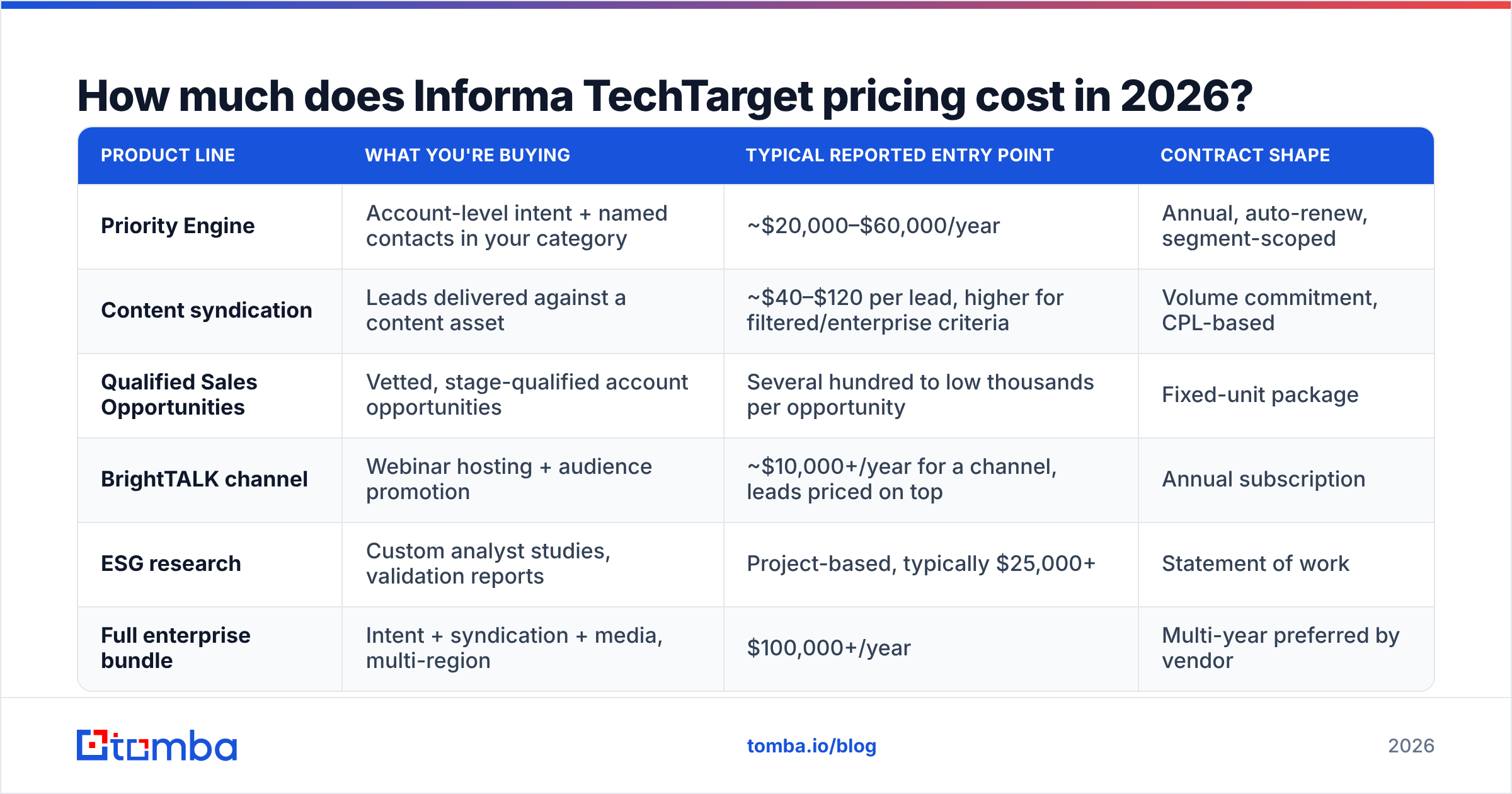
Informa TechTarget publishes no price list, no public tiers, and no self-serve checkout. That is normal for enterprise intent platforms and it is also the single most common complaint in buyer reviews. What follows are ranges that buyers, agencies, and procurement teams have reported publicly — treat them as directional planning figures, not quotes. Your actual number moves with market segment, geography, seat count, and how much of the bundle you take.
| Product line | What you're buying | Typical reported entry point | Contract shape |
|---|---|---|---|
| Priority Engine | Account-level intent + named contacts in your category | ~$20,000–$60,000/year | Annual, auto-renew, segment-scoped |
| Content syndication | Leads delivered against a content asset | ~$40–$120 per lead, higher for filtered/enterprise criteria | Volume commitment, CPL-based |
| Qualified Sales Opportunities | Vetted, stage-qualified account opportunities | Several hundred to low thousands per opportunity | Fixed-unit package |
| BrightTALK channel | Webinar hosting + audience promotion | ~$10,000+/year for a channel, leads priced on top | Annual subscription |
| ESG research | Custom analyst studies, validation reports | Project-based, typically $25,000+ | Statement of work |
| Full enterprise bundle | Intent + syndication + media, multi-region | $100,000+/year | Multi-year preferred by vendor |
Three pricing mechanics matter more than the headline number:
Scope drives the quote, not seats. Priority Engine pricing is largely a function of how many topic segments and regions you unlock. "Security, North America" costs meaningfully less than "Security + Cloud + Data Management, global." Reps will often lead with the broad scope. Ask for the narrow one first.
CPL is a floor, not a ceiling. Base cost-per-lead looks reasonable until you add filters. Restricting to specific job titles, company sizes, industries, or buying-stage criteria raises the effective CPL substantially — sometimes doubling it. Budget from the filtered number.
Renewal is where the leverage sits. Multiple buyers report that the best discounts come at renewal, when usage data is on the table, rather than in the first contract. If year one underdelivered, that's negotiating material.
What do reviews say about Informa TechTarget?#
Aggregate sentiment on review sites like G2 lands in the "good product, hard commercial relationship" zone. The pattern is consistent enough to be useful.
What reviewers consistently praise:
- Intent signal quality inside enterprise IT is genuinely differentiated. Because the data is first-party editorial behaviour, it has less noise than aggregated bidstream feeds.
- Topic granularity is deep. You can see the specific sub-category a buyer is researching, not just a broad category bucket.
- Named-contact visibility means you see which individuals drove account activity, which makes SDR prioritisation far less speculative.
- Customer success teams get repeat positive mentions for campaign strategy help.
What reviewers consistently criticise:
- Contact data decays between refreshes. Titles change, people leave, and emails bounce. Several reviewers describe cross-checking Priority Engine contacts against a separate verification tool before sequencing.
- Syndication lead quality varies by campaign. Some batches convert; others are described as people who downloaded a guide with no project attached.
- Pricing opacity makes internal budgeting painful, and annual auto-renew clauses catch teams that forget the notice window.
- The platform skews heavily to enterprise IT. If you sell HR software, fintech, or manufacturing services, coverage thins fast.
- Onboarding to first pipeline takes time. It is not a tool where you buy on Monday and book meetings on Wednesday.
The honest read: the intent layer earns its keep for the right buyer. The contact layer is the weak point, and that weakness is fixable cheaply.
How does Informa TechTarget compare to the alternatives?#
The comparison that matters depends on which job you're hiring a vendor for. Intent platforms, verified list providers, and email-finding tools solve adjacent but different problems, and buying the wrong category is the most expensive mistake in this evaluation.
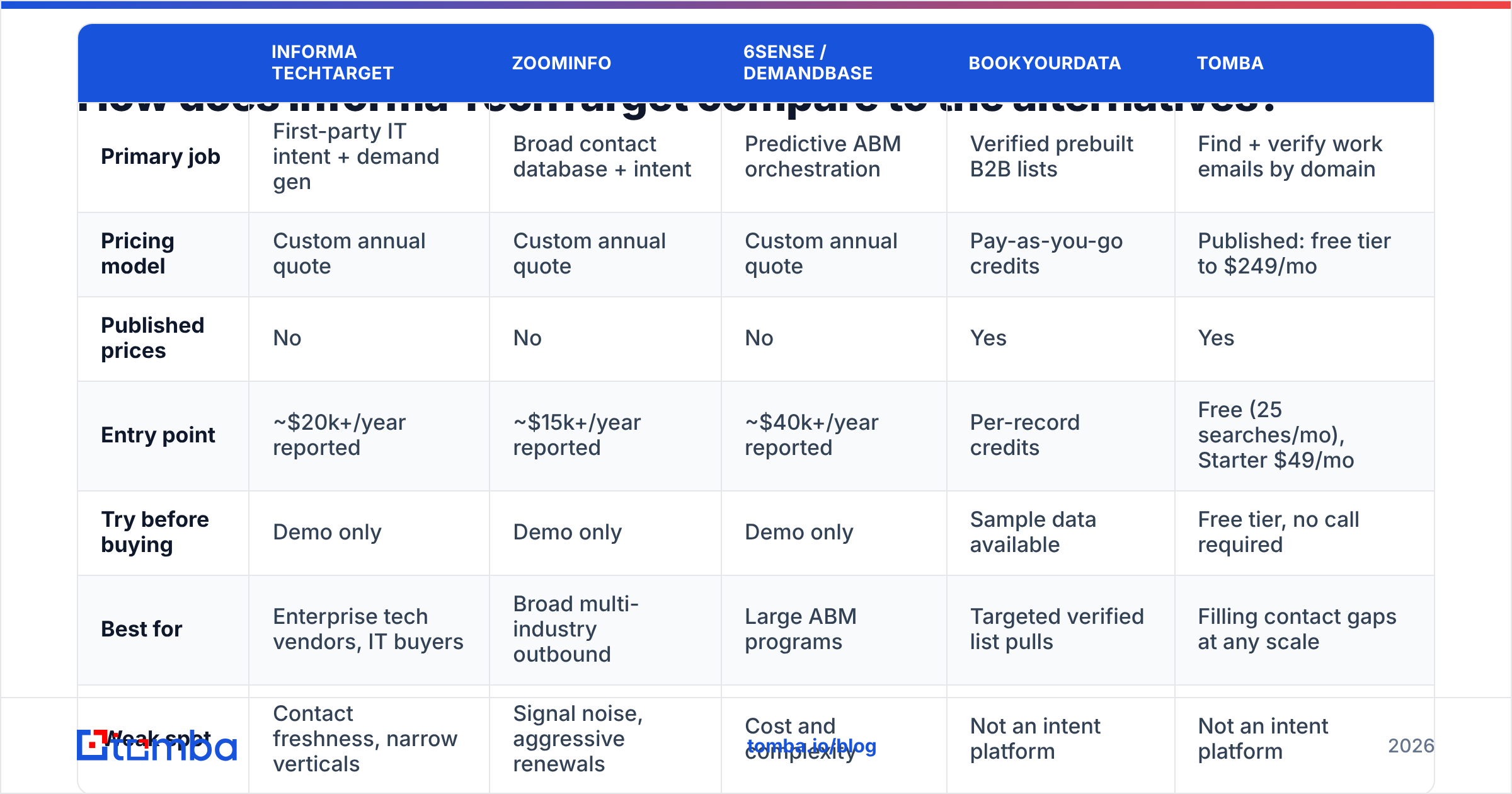
| Informa TechTarget | ZoomInfo | 6sense / Demandbase | BookYourData | Tomba | |
|---|---|---|---|---|---|
| Primary job | First-party IT intent + demand gen | Broad contact database + intent | Predictive ABM orchestration | Verified prebuilt B2B lists | Find + verify work emails by domain |
| Pricing model | Custom annual quote | Custom annual quote | Custom annual quote | Pay-as-you-go credits | Published: free tier to $249/mo |
| Published prices | No | No | No | Yes | Yes |
| Entry point | ~$20k+/year reported | ~$15k+/year reported | ~$40k+/year reported | Per-record credits | Free (25 searches/mo), Starter $49/mo |
| Try before buying | Demo only | Demo only | Demo only | Sample data available | Free tier, no call required |
| Best for | Enterprise tech vendors, IT buyers | Broad multi-industry outbound | Large ABM programs | Targeted verified list pulls | Filling contact gaps at any scale |
| Weak spot | Contact freshness, narrow verticals | Signal noise, aggressive renewals | Cost and complexity | Not an intent platform | Not an intent platform |
Two things fall out of that table.
First, if what you actually need is "tell me which accounts are in market for enterprise storage," nothing on this list substitutes for Informa TechTarget. That's the product.
Second, if what you need is "give me a valid email for the VP of Infrastructure at these 400 accounts," you should not be paying intent-platform prices for it. That's a per-contact problem with per-contact tooling. A domain search against a target account list, run through an email verifier before sequencing, costs a rounding error against a five-figure contract and produces fresher results than a quarterly database refresh.

Who should buy Informa TechTarget — and who shouldn't?#
Buy it if:
- You sell enterprise technology — infrastructure, security, cloud, data, networking — where TechTarget's editorial audience is your literal buyer.
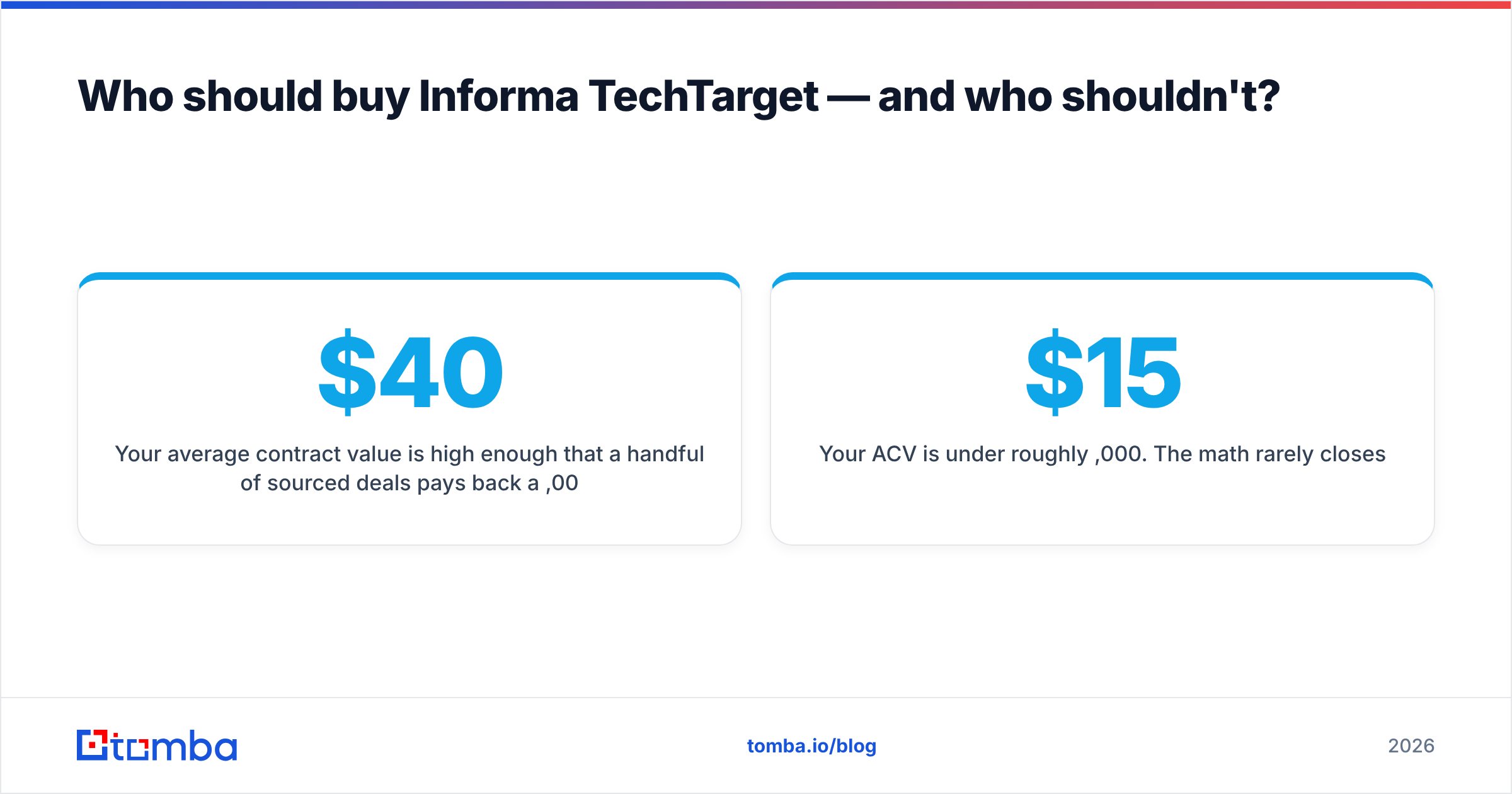
- Your average contract value is high enough that a handful of sourced deals pays back a $40,000 subscription. At a $150,000 ACV, two wins clear it.
- You have an SDR team or agency that can act on intent signals within days. Intent data decays. A signal you act on in week four is worth a fraction of one you act on in day two.
- You already have marketing ops capable of routing intent into your CRM and measuring influenced pipeline. Without attribution, renewal conversations become opinion contests.
Skip it if:
- Your ACV is under roughly $15,000. The math rarely closes.
- You sell outside enterprise IT. Coverage is the constraint, not quality.
- You need contact data more than account signals. This is the most common mis-purchase.
- You can't commit a year. There is no meaningful free tier or short pilot, and reviewers rarely report success negotiating one.
- You're a team of two doing founder-led outbound. Start with account research and data enrichment at a fraction of the cost, prove the motion, then buy signal.
How do you negotiate a better Informa TechTarget contract?#
Assume the first quote has room in it. Practical levers, roughly in order of effectiveness:
Narrow the scope deliberately. Ask for a single topic segment and a single region. You can expand mid-term, usually at a prorated rate, and expansion is an easier internal approval than a renewal increase.
Separate the bundle. Quote Priority Engine standalone, syndication standalone, and BrightTALK standalone before you look at the package. Bundles hide which line is underperforming, which makes year-two renegotiation harder.
Push for quality guarantees on syndication. Lead replacement terms for records that fail agreed criteria are negotiable. Get the rejection window and criteria in writing, and staff someone to actually use them.
Time the deal. Quarter-end and fiscal-year-end concessions are real at public companies. Informa TechTarget trades publicly, and its sellers carry quotas like everyone else.
Fix the auto-renew clause. Ask for a 30-day notice window instead of 60 or 90, and calendar it the day you sign.
Ask what happens to your data at churn. Confirm whether exported contacts remain usable after the contract ends. The answer affects how you plan a graceful exit.
What's the cheapest sane way to start?#
Run the account layer manually before you buy the signal layer.
Build a target account list from your closed-won patterns — industry, size, tech stack, geography. Then find the actual humans inside those accounts. Pull the contact roster per company with domain search, verify deliverability, and sequence. Track reply rate and meeting rate by segment for a quarter.
If a segment replies at 6% and books meetings, you've found a market you can scale — and that's the segment worth unlocking in Priority Engine. If nothing replies, intent data would have told you which accounts to email badly, not how to email them well. Fixing messaging is cheaper than fixing targeting with a subscription.
This sequencing also gives you a hard negotiating number. Walking into a renewal saying "we generate X meetings per 1,000 contacts today, show me what your signal adds" is a very different conversation from walking in with a blank slate.
The bottom line#
Informa TechTarget pricing is expensive, opaque, and — for enterprise technology vendors selling into IT — frequently justified. The first-party intent data is hard to replicate, and the reviews that criticise it almost never criticise the signal itself. They criticise contact freshness, lead variance, and the commercial terms.
Which means the right move for most teams isn't "buy it" or "don't." It's "buy the part only they can sell, and solve the contact layer somewhere cheaper."
That's where Tomba fits. Use the Tomba Email Finder to get verified, current work emails for the people inside your target accounts — whether those accounts came from an intent platform, a conference list, or your own research. The free tier gives you 25 searches a month with no sales call, Starter is $49/mo, and Tomba pricing is published on the page, which is more than you can say for most of this category. Start there, prove the motion, and let the five-figure contracts earn their place afterwards.
Related guides#
// get started
Find, verify and enrich your first contacts today
Start on the free plan with 25 searches a month, then scale when your team is ready.
Free plan · No credit card required · GDPR & CCPA
// about the author