What Is an Information Qualified Lead (IQL)? 2026 Guide
An information qualified lead gave you data in exchange for content — not a buying signal. Here's how to spot IQLs, enrich them, score them honestly, and stop handing half-baked contacts to your reps.
TL;DR
- An information qualified lead (IQL) is someone who traded contact details for content — an ebook, a benchmark report, a calculator — without expressing any intent to buy.
- IQLs sit at the very top of the funnel, before MQL. Treating them like MQLs is the single fastest way to torch your reps' trust in marketing.
- Most IQL records are incomplete on purpose: people type "gmail.com" addresses and skip the company field. Enrichment, not more forms, fixes that.
- The right play is a data-completion pass, a behavior-based scoring window, and a nurture track — not a call task.
- Measured correctly, IQL→MQL conversion is a leading indicator that tells you whether your content is attracting buyers or students.
What is an information qualified lead?#
An information qualified lead is a contact who has given you identifying information in exchange for something informational. They downloaded the guide. They joined the webinar. They used your free ROI calculator. What they did not do is ask about pricing, request a demo, or describe a problem they're trying to solve this quarter.
Think of it like a bookstore. Someone picking up a cookbook and flipping through it is engaged — but they haven't walked to the register. An IQL is the flip-through. An MQL is walking toward the register. An SQL is standing at it with a card out.
Technically, IQL is a stage label in a lifecycle model. It was popularized as the missing rung between "anonymous visitor" and "marketing qualified lead," because a lot of teams were dumping raw form fills straight into MQL and wondering why sales acceptance rates collapsed. The IQL stage gives you a legitimate place to park contacts who are real, reachable, and interested in a topic — but not in a purchase.
The defining traits:
- Voluntary identification. They gave you a name and email themselves. No cold list, no scrape.
- Informational intent only. The asset they consumed teaches something; it doesn't sell something.
- Sparse data. Short forms mean you usually get 2–4 fields, often including a personal email domain.
- Unknown fit. You don't yet know company size, industry, or role — so you can't say whether they're ICP.
- No timeline. Nothing in their behavior implies a buying window.
Where does an IQL sit relative to MQL, SQL, and PQL?#
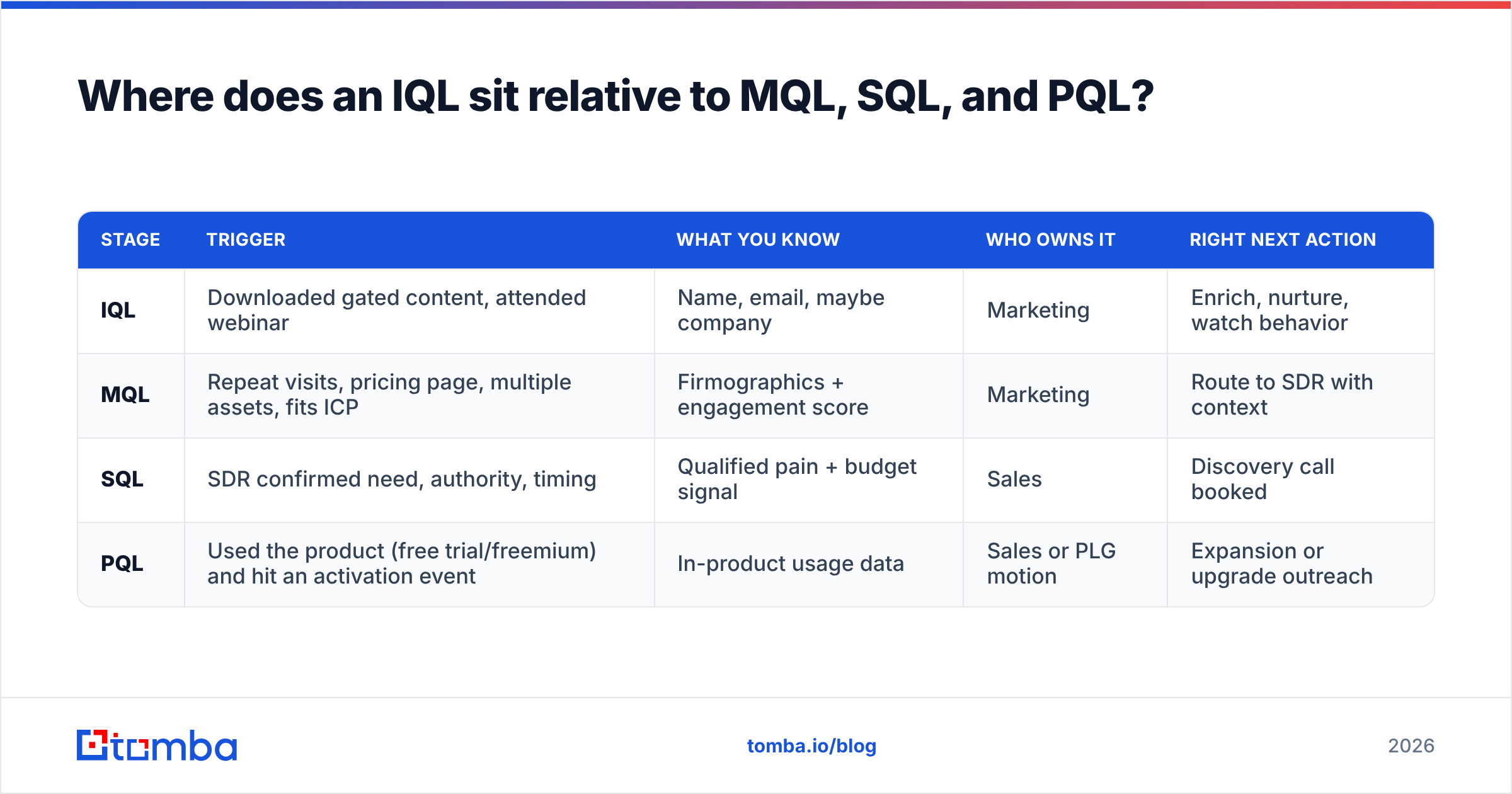
This is the part most teams blur, and the blur is expensive. Here's the practical breakdown.
| Stage | Trigger | What you know | Who owns it | Right next action |
|---|---|---|---|---|
| IQL | Downloaded gated content, attended webinar | Name, email, maybe company | Marketing | Enrich, nurture, watch behavior |
| MQL | Repeat visits, pricing page, multiple assets, fits ICP | Firmographics + engagement score | Marketing | Route to SDR with context |
| SQL | SDR confirmed need, authority, timing | Qualified pain + budget signal | Sales | Discovery call booked |
| PQL | Used the product (free trial/freemium) and hit an activation event | In-product usage data | Sales or PLG motion | Expansion or upgrade outreach |
The column that matters most is "Right next action." An IQL handed to an SDR as a call task produces the worst thirty seconds in B2B: "Hi, I saw you downloaded our guide…" followed by a click. That call isn't bad because the SDR is bad. It's bad because the contact never asked for it.
Lead scoring exists precisely to keep these stages separate, and HubSpot's lead qualification framework is a reasonable starting template if you're building the model from scratch.
Why do most teams get IQLs wrong?#
Three failure modes, in order of frequency.
They inflate the count. Someone decides the board deck needs a bigger "leads" number, so every form fill becomes an MQL. Sales acceptance rate drops from 60% to 18%, marketing gets blamed for "junk leads," and the real problem — a mislabeled stage — never gets discussed.
They lengthen the form instead of enriching. The instinct when data is thin is to add fields. Company size, job title, phone, budget. Every field you add cuts conversion, and the fields you add get filled with garbage anyway. "Job title: asdf" is not data. Pulling firmographics from the email domain after the fact gets you better data with a shorter form.
They nurture with the wrong asset. An IQL who downloaded "The 2026 Cold Email Benchmark Report" gets dropped into a sequence that opens with a case study and a demo CTA. The jump is too big. Nurture should move one rung at a time: report → template → comparison guide → demo.
There's a fourth failure worth naming: teams that delete IQLs entirely because "they never convert." Some of them do. Gartner's sales research has been consistent for years that B2B buying groups spend the majority of their cycle doing independent research before they ever contact a vendor. The IQL stage is literally where that research happens. Deleting it means you only ever meet buyers who are already shortlisting someone else.
How do you turn a thin IQL record into something usable?#
You run a completion pass before the contact ever touches a scoring model. Garbage in, garbage scored.
- Resolve the email domain to a company.
marc@acme.iotells you more than most form fields do. Domain-level lookup gives you the company name, size bracket, and tech stack. - Handle personal-domain signups. A gmail.com or outlook.com address isn't automatically junk — it's often a real buyer being cautious. Match on name plus stated company, or use a reverse email lookup to attach a person record.
- Append role and seniority. This is the field that decides whether the contact can ever become an MQL. A "Marketing Coordinator" and a "VP Demand Gen" at the same company deserve different tracks.
- Verify before you nurture. Sending a six-email sequence to a dead address is how you damage sender reputation for the addresses that are real. Run the list through an email verifier at intake, not at send time.
- Find the second contact. If the IQL is a practitioner at a fit account, the buyer is usually one level up. That's an enrichment job, not a nurture job.
- Stamp the source asset. Which piece of content produced this record is the highest-value field in the row. It determines the nurture branch and, later, your content attribution.
Bulk data enrichment makes steps 1–3 a batch operation rather than a per-record manual task. If you're processing a few thousand form fills a month, run them as a bulk email finder job on a schedule instead of one-off lookups.
IQL vs MQL: what actually changes in your process?#
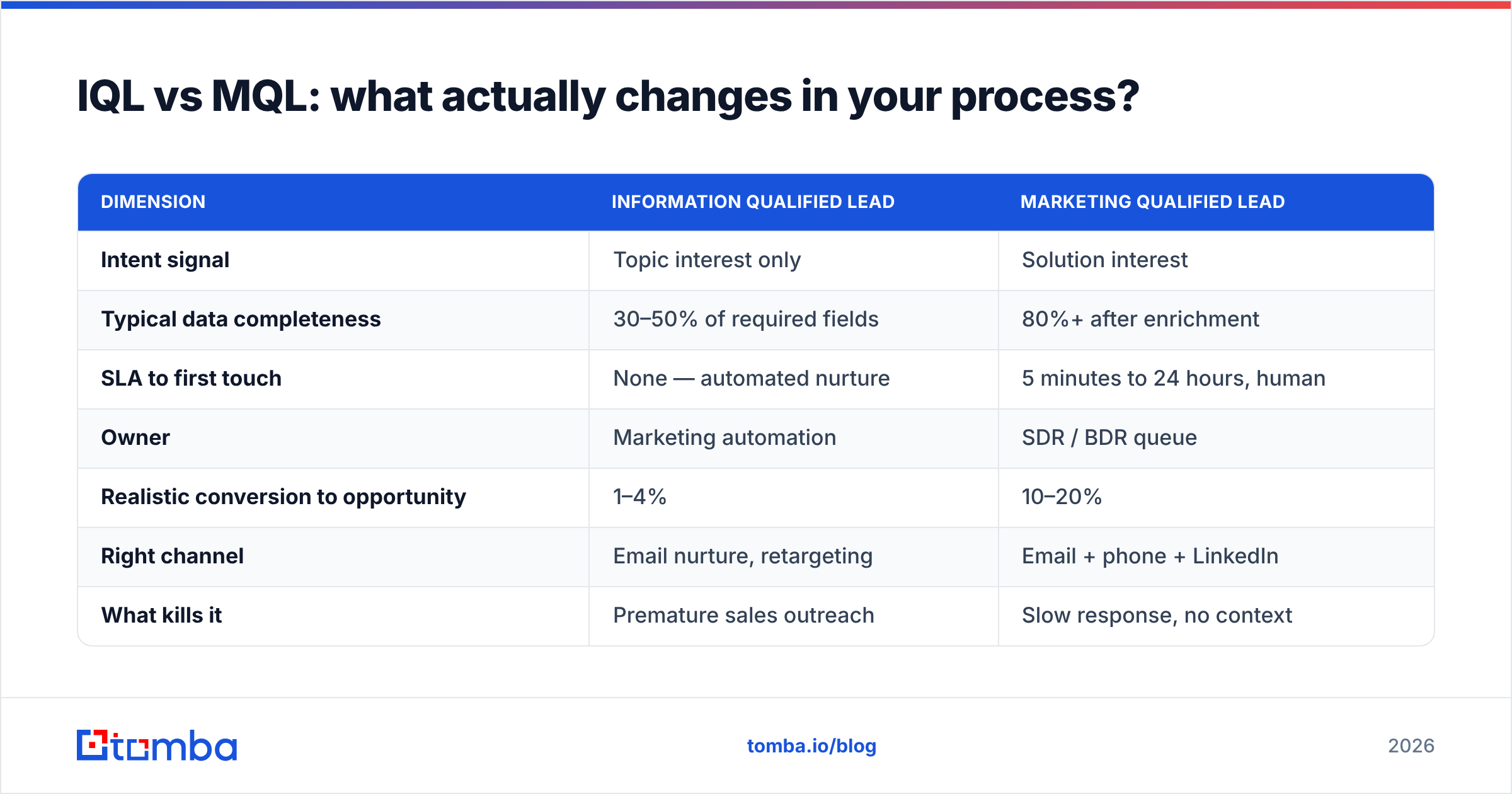
| Dimension | Information Qualified Lead | Marketing Qualified Lead |
|---|---|---|
| Intent signal | Topic interest only | Solution interest |
| Typical data completeness | 30–50% of required fields | 80%+ after enrichment |
| SLA to first touch | None — automated nurture | 5 minutes to 24 hours, human |
| Owner | Marketing automation | SDR / BDR queue |
| Realistic conversion to opportunity | 1–4% | 10–20% |
| Right channel | Email nurture, retargeting | Email + phone + LinkedIn |
| What kills it | Premature sales outreach | Slow response, no context |
The operational takeaway: IQLs get automation, MQLs get humans. The moment you spend SDR minutes on IQLs, your cost per opportunity goes up and your rep morale goes down. The moment you automate MQLs, you lose deals you'd already won.
How do you score an information qualified lead without inventing numbers?#
Scoring models fail when someone assigns point values in a meeting based on vibes. Build yours from two axes instead.
Fit (who they are). Derived entirely from enriched data: industry match, employee count band, geography, seniority, tech stack. Fit is static — it doesn't change based on what they did last Tuesday.
Engagement (what they did). Asset type weighted by depth. A webinar attended live beats a webinar registered-but-no-show. A pricing page visit beats a blog visit. Three assets in seven days beats three assets in seven months.
An IQL becomes an MQL when it clears thresholds on both axes. Not one. A VP at a perfect-fit account who read one blog post is not an MQL — she's a great IQL. A student who consumed nine assets is not an MQL either.
Two rules that save you from most scoring pathologies:
- Decay engagement points. Cut engagement score by half after 30 days of inactivity. Without decay, your MQL queue fills with contacts who were interested in Q1 2025.
- Cap single-asset scoring. If one contact downloads the same template four times, that's one signal, not four.
For the definitional boundaries of each stage, the MQL glossary entry is a useful reference to align marketing and sales on wording before you argue about point values.

What should an IQL nurture track look like?#
Keep it short and keep it topical. Five emails over three weeks, all tied to the asset they originally downloaded.
- Email 1 (immediate): Deliver the asset. One line offering a related resource. No CTA to book anything.
- Email 2 (day 3): The single best insight from the asset, expanded. Link to a tool or template.
- Email 3 (day 8): A comparison or "how teams like yours do X" piece. First soft product mention.
- Email 4 (day 15): A short customer story matched to their enriched industry.
- Email 5 (day 21): The ask. Demo, trial, or a 15-minute teardown offer.
If they engage with emails 3–5, engagement score crosses the threshold and the record promotes to MQL. If they don't, they move to a monthly newsletter cadence and stop consuming sequence slots. Either outcome is fine. What's not fine is leaving them in an eight-month drip that trains them to ignore your domain.
Personal-domain IQLs get one extra step: before the sequence starts, try to match them to a work address. A contact who signed up as jsmith88@gmail.com but works at a 400-person SaaS company is worth far more as j.smith@company.com — that's the address that maps to the account in your CRM.
Which tools actually help with IQL enrichment and routing?#
Different jobs, different tools. Here's an honest split.
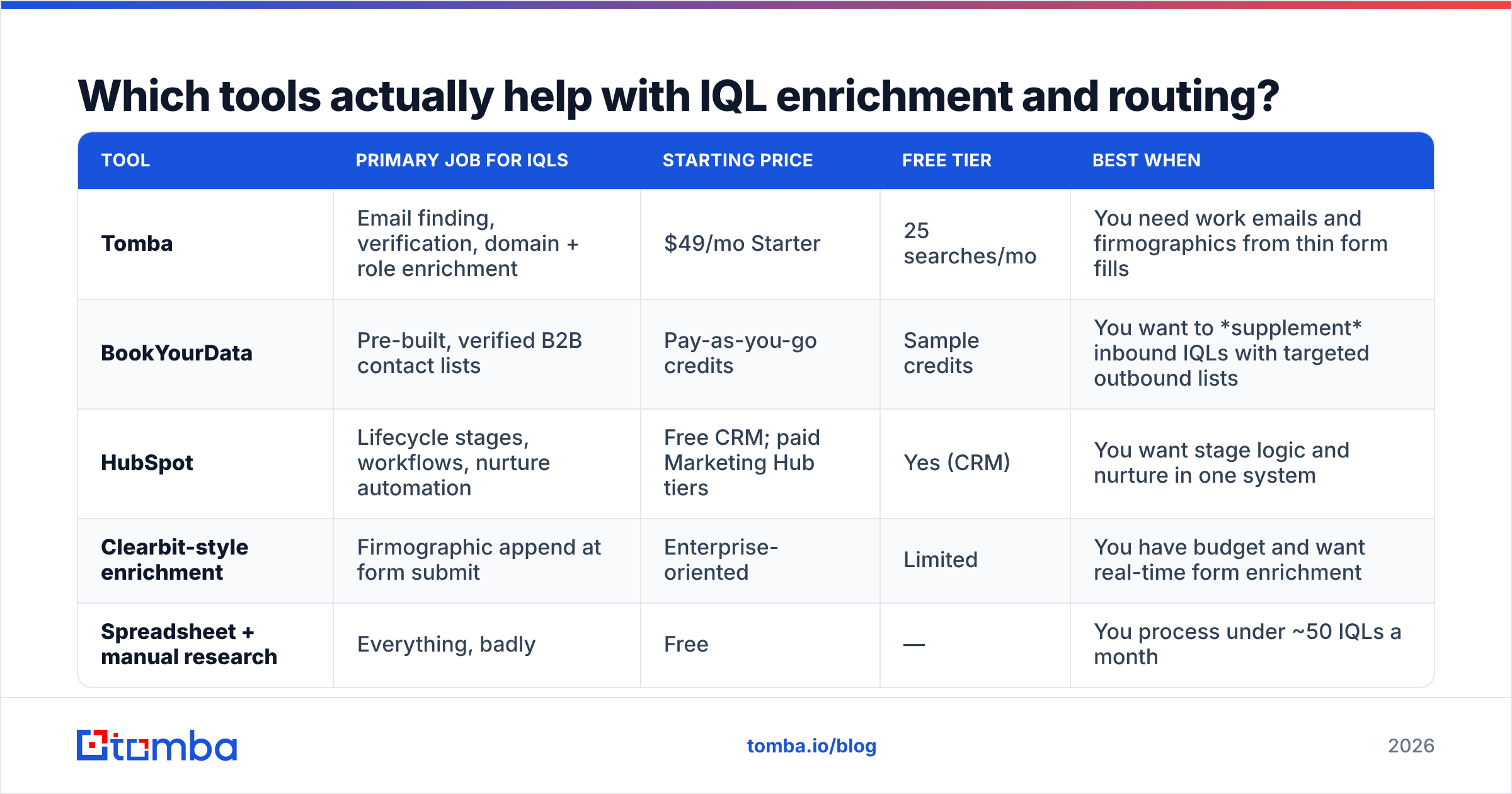
| Tool | Primary job for IQLs | Starting price | Free tier | Best when |
|---|---|---|---|---|
| Tomba | Email finding, verification, domain + role enrichment | $49/mo Starter | 25 searches/mo | You need work emails and firmographics from thin form fills |
| BookYourData | Pre-built, verified B2B contact lists | Pay-as-you-go credits | Sample credits | You want to supplement inbound IQLs with targeted outbound lists |
| HubSpot | Lifecycle stages, workflows, nurture automation | Free CRM; paid Marketing Hub tiers | Yes (CRM) | You want stage logic and nurture in one system |
| Clearbit-style enrichment | Firmographic append at form submit | Enterprise-oriented | Limited | You have budget and want real-time form enrichment |
| Spreadsheet + manual research | Everything, badly | Free | — | You process under ~50 IQLs a month |
A note on stacking: BookYourData and an enrichment tool solve adjacent problems, not the same one. One brings you contacts you didn't have; the other completes the ones who raised their hand. Teams running serious demand gen usually need both motions, and the data hygiene requirements are identical either way — verify before you send.
If you want to compare vendor claims independently, G2's category pages are reasonable for reading real deployment reviews rather than marketing copy. Check the review dates; this category changes fast.
Practical workflow for most mid-market teams:
- Form fill lands in the CRM as Lifecycle = IQL
- Nightly job runs domain + role enrichment via API
- Verification pass flags undeliverable and catch-all addresses
- Fit score calculates automatically from enriched fields
- Behavior triggers engagement score in the automation platform
- Combined threshold promotes to MQL and creates the SDR task
Everything before the last line is automation. That's the point.
What metrics prove your IQL program is working?#
Track four numbers and ignore the rest:
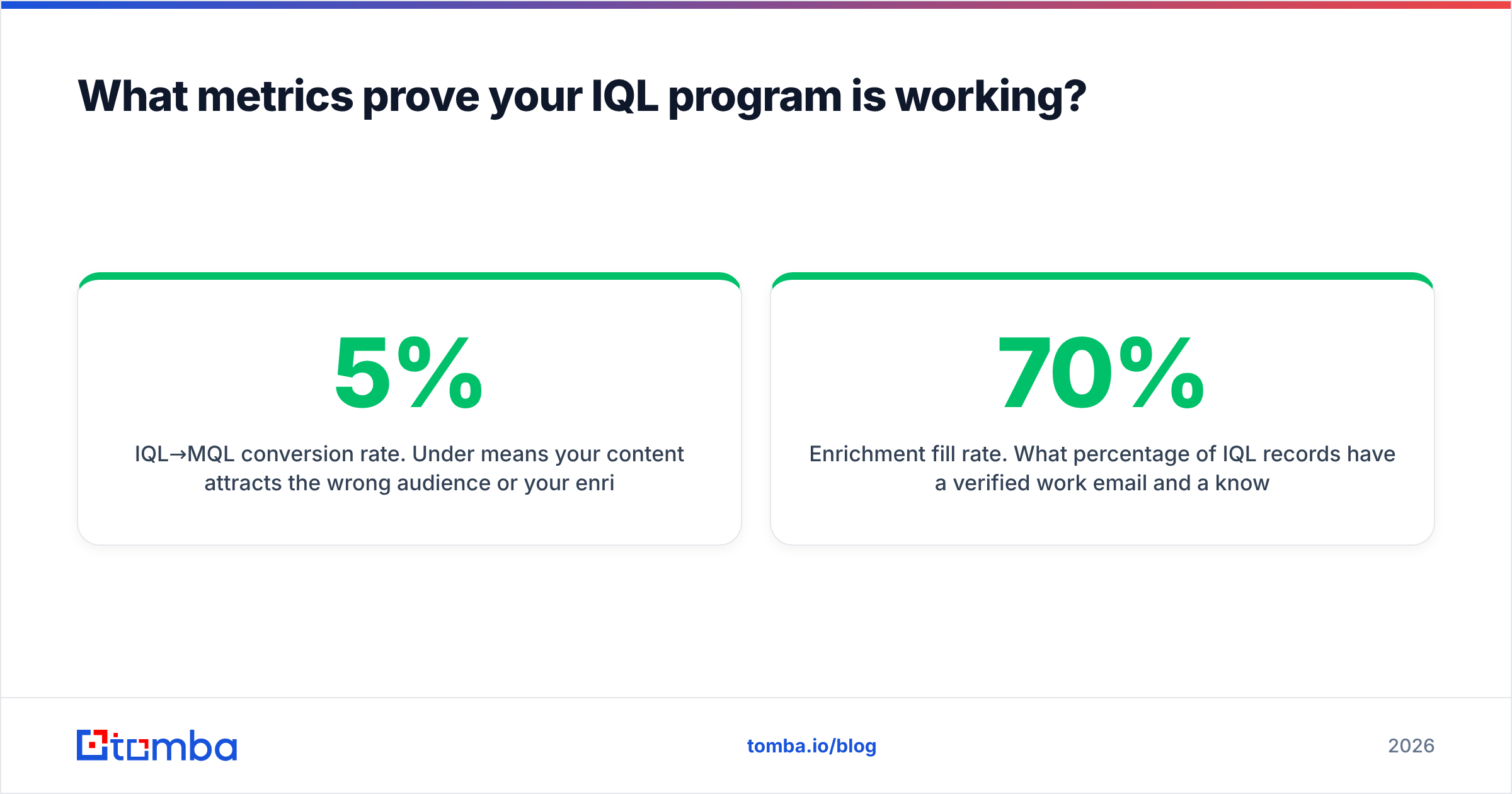
- IQL→MQL conversion rate. Under 5% means your content attracts the wrong audience or your enrichment is failing. Over 30% means your MQL bar is too low.
- Enrichment fill rate. What percentage of IQL records have a verified work email and a known company after the completion pass? Target 70%+.
- Time-to-enrichment. Hours, not days. A record enriched a week later has already gone cold.
- Content-to-opportunity attribution. Which source asset produces IQLs that eventually close? That's your content roadmap, handed to you.
The one number to stop reporting: raw lead volume. It goes up when you gate a listicle and tells you nothing about pipeline.
Where should you start this week?#
Pull the last 90 days of form fills. Count how many have a verified work email and a known company. If that number is under half — and for most teams it is — your IQL problem isn't scoring, nurture, or messaging. It's data completeness, and it's fixable in an afternoon.
Start by running that export through the Tomba Email Finder to convert personal-domain signups into work addresses and attach the company data your scoring model needs. The free tier covers 25 searches a month if you want to test the fill rate on a sample first; Starter is $49/mo when you're ready to run the whole backlog. Enrich first, score second, and let your reps talk only to the leads who earned the call.
Related guides#
// get started
Find, verify and enrich your first contacts today
Start on the free plan with 25 searches a month, then scale when your team is ready.
Free plan · No credit card required · GDPR & CCPA
// about the author