Inside Sales Closing Techniques That Work in 2026
Most closing advice is recycled 1980s field-sales theater. Here are the inside sales closing techniques that actually move remote deals forward — with scripts, timing, and the data hygiene that makes them work.
TL;DR
- The "always be closing" playbook was built for in-person deals with one decision maker. Inside sales in 2026 averages 6–10 buying-group members, so pressure closes now stall deals instead of accelerating them.
- The techniques that still work — summary close, mutual action plan close, negative-reverse, takeaway, alternative choice — all share one trait: they surface a blocker instead of manufacturing urgency.
- Your close rate is capped by your discovery. If you didn't get budget authority, a compelling event, and a named economic buyer, no verbal trick recovers that.
- Closing is a data problem too. Roughly a third of B2B contact records go stale every year; chasing a promoted champion is a lost deal that looks like a bad close.
- Run the close as a process: recap → confirm criteria → address the real objection → propose a dated next step → get it in writing.
What Are Inside Sales Closing Techniques, Really?#
An inside sales closing technique is a structured way to move a deal from "interested" to "signed" without being in the room. That last part changes everything.
Think of field sales closing like a dinner conversation — you read body language, you sense hesitation, you adjust in real time. Inside sales closing is more like a chess game played by mail. You get one move per exchange, you can't see your opponent's face, and if you send a bad move, you wait three days to find out.
Technically: inside sales closes are verbal or written frameworks executed over phone, video, or email that convert a qualified opportunity into a committed purchase decision. They work by removing friction, not by applying pressure.
The distinction matters because most closing content still teaches pressure. The "assumptive close," the "puppy dog close," the "Ben Franklin close" — these come from a era where the rep controlled the information. Your buyer now reads your G2 reviews, your pricing page, and two competitor comparison posts before they ever take your call. Gartner's B2B buying research has consistently found that buyers spend the minority of their journey talking to any vendor at all. You're not closing an uninformed prospect. You're helping an over-informed committee reach internal consensus.
Wait — that's the wrong syntax. Here it is properly:

Which Closing Techniques Still Work in 2026?#
Here are the nine that survive contact with a modern buying committee, ranked roughly by how often they're the right tool.
1. The Summary Close. You restate everything the buyer told you they needed, map each item to what you're proposing, then ask for the decision. It works because it proves you listened and it forces the buyer to either agree or name what's missing.
Script: "So to recap — you need SOC 2 by Q1, you need the Salesforce sync to be bidirectional, and you can't exceed $40K annual. The Growth tier covers all three and we've scoped the sync at two weeks. Is there anything on that list I've got wrong before we talk paperwork?"
2. The Mutual Action Plan (MAP) Close. Instead of asking for the signature, you co-build a dated timeline working backward from their go-live date. Legal review on the 14th, security questionnaire on the 18th, signature by the 24th. The close becomes a shared project plan.
This is the highest-leverage technique in complex inside sales, because it converts "I'll get back to you" into a specific person owing a specific thing on a specific day.
3. The Alternative Choice Close. You offer two viable paths rather than a yes/no. "Do you want to start with the 25-seat pilot in October, or go straight to the full 80-seat rollout in January?" Both answers are a purchase. The trap: if you use this before the buyer has actually decided to buy, it reads as manipulative and they'll say "neither."
4. The Negative-Reverse Close. Borrowed from Sandler. When a prospect is over-enthusiastic but not moving, you gently push the opposite direction: "Honestly, I'm not sure we're a fit — you mentioned your team is already stretched, and this needs about four hours of setup. Should we revisit in Q2?" Genuine buyers will argue for the deal. Non-buyers reveal themselves, and you reclaim the pipeline slot.
5. The Takeaway Close. You remove something — a discount, an onboarding perk, a tier feature — and let scarcity do the work. This only works when the scarcity is real. Fake deadlines are the fastest way to lose trust with a procurement team that has seen fifty vendors run the same play.
6. The Objection-Isolation Close. "If we solved the integration timeline, is there anything else standing between us and moving forward?" You're forcing every hidden objection to the surface at once instead of playing whack-a-mole over six weeks.
7. The Sharp Angle Close. The buyer asks for something ("Can you do 20% off?") and you trade for commitment ("If I can get that approved, can you sign by Friday?"). Powerful, but burns credibility if you use it on a request you were always going to grant.
8. The Urgency Close (Compelling Event). Not manufactured urgency — their urgency. Contract expiring, a compliance deadline, a new VP with a mandate. You anchor the close to an event that exists in their world, not yours.
9. The Soft Trial Close. Mid-call temperature checks: "How does that sound so far?" "On a scale of one to ten, where are you?" These aren't closes. They're instruments. Use them every call so the real close is never a surprise.
How Do These Closes Compare in Practice?#
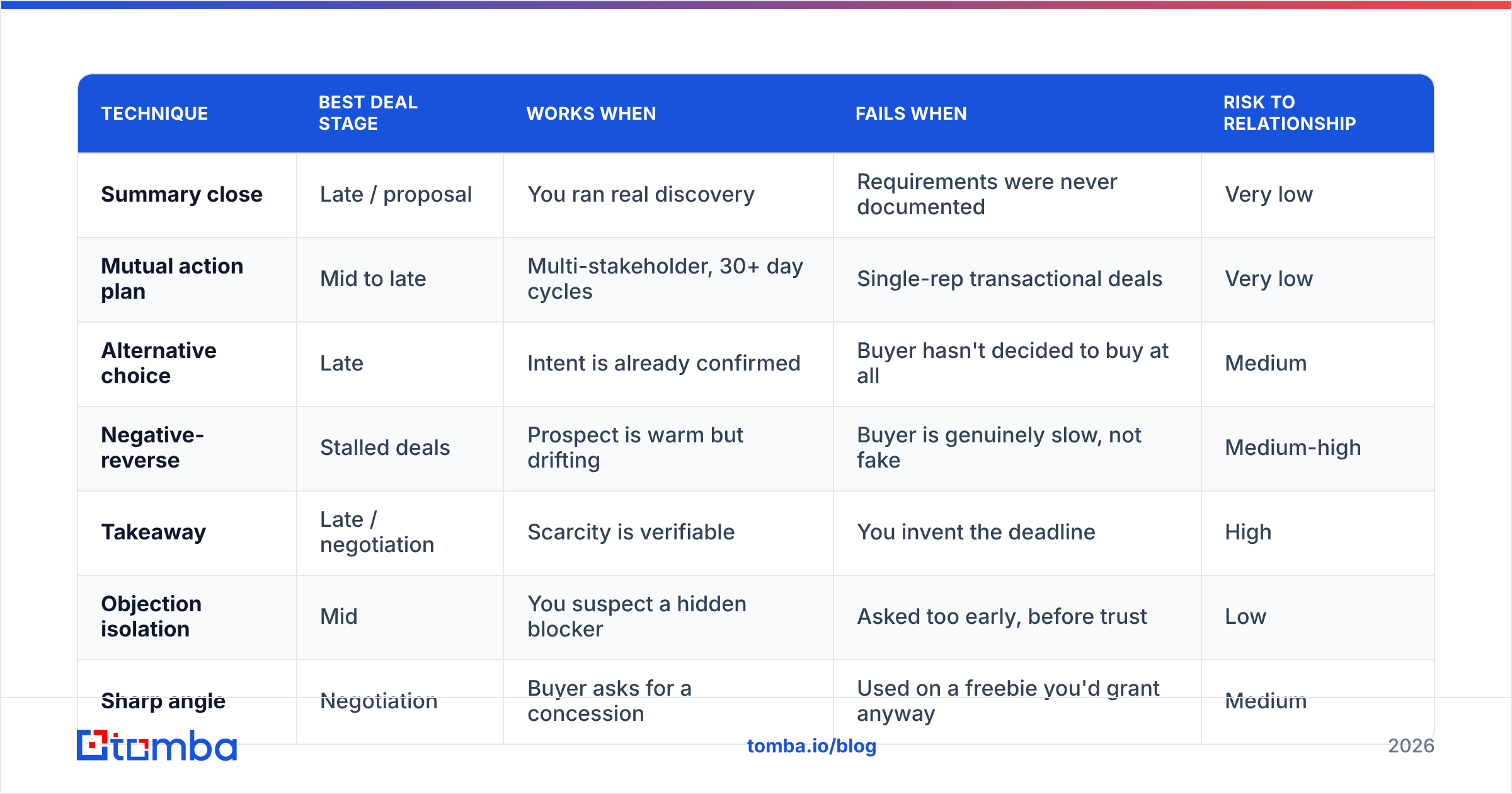
| Technique | Best deal stage | Works when | Fails when | Risk to relationship |
|---|---|---|---|---|
| Summary close | Late / proposal | You ran real discovery | Requirements were never documented | Very low |
| Mutual action plan | Mid to late | Multi-stakeholder, 30+ day cycles | Single-rep transactional deals | Very low |
| Alternative choice | Late | Intent is already confirmed | Buyer hasn't decided to buy at all | Medium |
| Negative-reverse | Stalled deals | Prospect is warm but drifting | Buyer is genuinely slow, not fake | Medium-high |
| Takeaway | Late / negotiation | Scarcity is verifiable | You invent the deadline | High |
| Objection isolation | Mid | You suspect a hidden blocker | Asked too early, before trust | Low |
| Sharp angle | Negotiation | Buyer asks for a concession | Used on a freebie you'd grant anyway | Medium |
| Compelling-event urgency | Any | A real deadline exists | You fabricate the event | Low (if real) |
| Soft trial close | Every call | Always | Never — but don't mistake it for a close | None |
Two patterns fall out of that table. First: every low-risk technique depends on information you gathered earlier. Second: every high-risk technique depends on scarcity, and scarcity is the one thing a modern buyer can fact-check in about ninety seconds.
Why Do Most Inside Sales Closes Fail Before the Close?#
Because the close isn't where deals die. Discovery is.
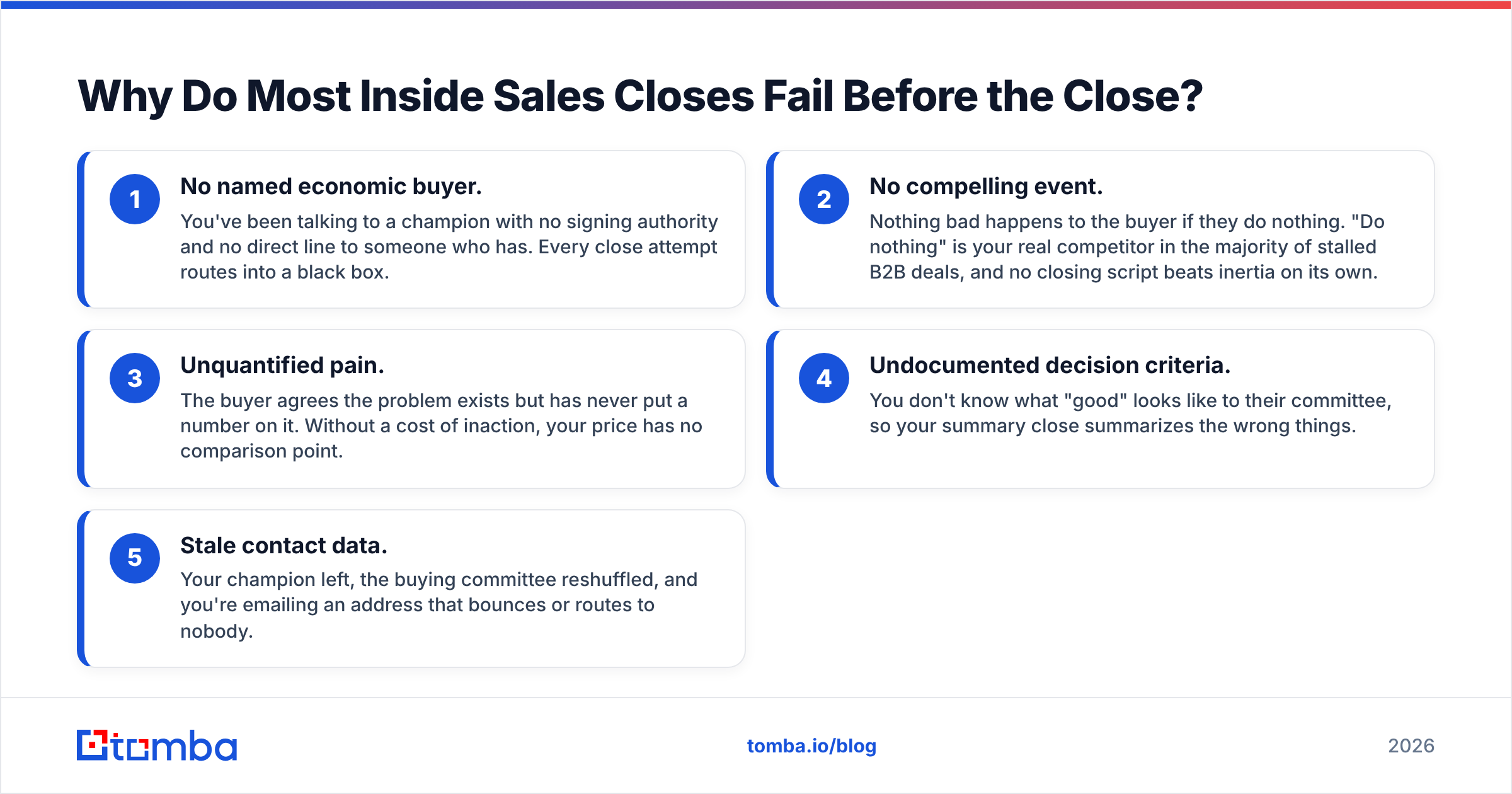
A deal that dies at the close almost always has one of five defects baked in from week one:
- No named economic buyer. You've been talking to a champion with no signing authority and no direct line to someone who has. Every close attempt routes into a black box.
- No compelling event. Nothing bad happens to the buyer if they do nothing. "Do nothing" is your real competitor in the majority of stalled B2B deals, and no closing script beats inertia on its own.
- Unquantified pain. The buyer agrees the problem exists but has never put a number on it. Without a cost of inaction, your price has no comparison point.
- Undocumented decision criteria. You don't know what "good" looks like to their committee, so your summary close summarizes the wrong things.
- Stale contact data. Your champion left, the buying committee reshuffled, and you're emailing an address that bounces or routes to nobody.
That last one gets dismissed as an ops issue, but it kills a startling number of late-stage deals. B2B contact data decays continuously as people change roles and companies; if your sequence is still hitting a champion who was promoted out of the department in March, your "close rate problem" is actually a data problem. Running your key accounts through an email verifier before a late-stage push, and re-enriching the account with a fresh domain search to catch the new stakeholder, costs minutes and saves deals that look — in the CRM — like closing failures.
What Does a Full Close Sequence Look Like?#
Here's a five-touch sequence for a stalled late-stage deal. Use it as a skeleton, not a script.
Touch 1 — Call (Day 0): Summary + objection isolation. Recap their stated criteria. Confirm nothing has changed. Then isolate: "Assuming the security review clears, is there anything else between us and a decision this quarter?"
Touch 2 — Email (Day 1): The written MAP. Send the mutual action plan as a plain table in the email body, not an attachment. Attachments don't get opened by legal. Assign each row an owner and a date.
Touch 3 — Email (Day 5): Cost-of-inaction nudge. One paragraph. Quantify what another quarter of the status quo costs them, using their number from discovery — not yours.
Touch 4 — Call or LinkedIn (Day 9): Multi-thread. If your champion has gone quiet, go around — politely and transparently. Copy the economic buyer on a short recap. Deals with three or more engaged contacts close materially more often than single-threaded ones, and HubSpot's sales research has repeatedly shown multi-threading correlates with higher win rates.
Touch 5 — Email (Day 14): Negative-reverse / clean break. "I don't want to keep landing in your inbox if the timing isn't right. Should I close this out and check back in Q2?" This email has the highest reply rate of any in the sequence, because it gives the buyer permission to be honest.
If you're building these sequences from scratch, start from proven structures rather than a blank page — our cold email templates library covers the late-stage nudge and break-up patterns specifically.
How Should You Handle the Four Classic Objections?#
"It's too expensive." Almost never about price. It's about unproven value or a budget that lives in another department. Response: "Compared to what?" Then re-anchor against the cost of inaction you quantified in discovery. If they genuinely have no budget, that's a qualification failure — reschedule for their next fiscal cycle rather than discounting your way into a bad-fit customer.
"Send me some information." A deflection nine times out of ten. Response: "Happy to — what specifically would be most useful, and who else on your team should see it?" The second half of that question is the real ask. If they can't name a recipient, there's no committee and no deal.
"We're already using [competitor]." Don't attack the incumbent; buyers defend past decisions. Ask what they'd change if they could. That answer is your entry point, and the switching conversation usually starts six to nine months later at renewal. Log the renewal date.
"I need to talk to my team." The most honest objection you'll get, and the one most reps fumble. Don't say "sure, let me know." Say: "Makes sense. What's the biggest question they'll have, and would it help if I joined that conversation for ten minutes?" You're trying to get in the room where the actual decision happens.
What Should You Measure?#
Closing improvement is invisible without instrumentation. Track these five:
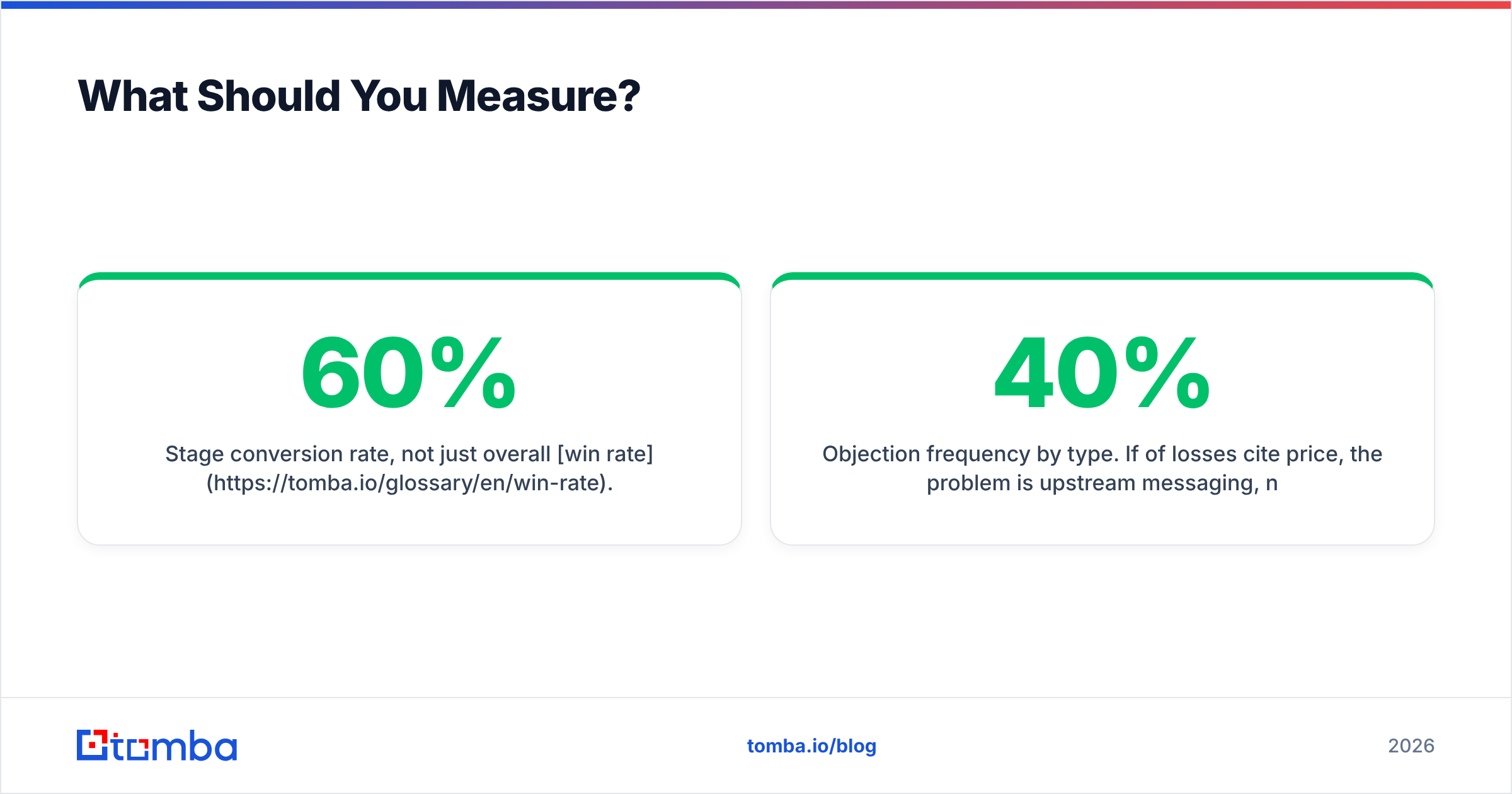
- Stage conversion rate, not just overall win rate. If proposal→closed-won is 60% but discovery→proposal is 12%, your closing is fine and your qualification is broken.
- Average stakeholders per closed-won deal versus closed-lost. If won deals average 4 contacts and lost deals average 1.3, multi-threading is your single highest-ROI change.
- Days in final stage. A deal sitting 45+ days past proposal is usually dead and inflating your forecast.
- Objection frequency by type. If 40% of losses cite price, the problem is upstream messaging, not your negotiation skill.
- Contact bounce rate on late-stage accounts. A rising bounce rate on deals you're actively working is an early warning that your buying committee has changed underneath you.
Most CRMs will give you the first four with a saved report. The fifth requires discipline about data hygiene — and it's the one that reliably surprises teams when they first measure it.
What's the Fastest Way to Improve Close Rates?#
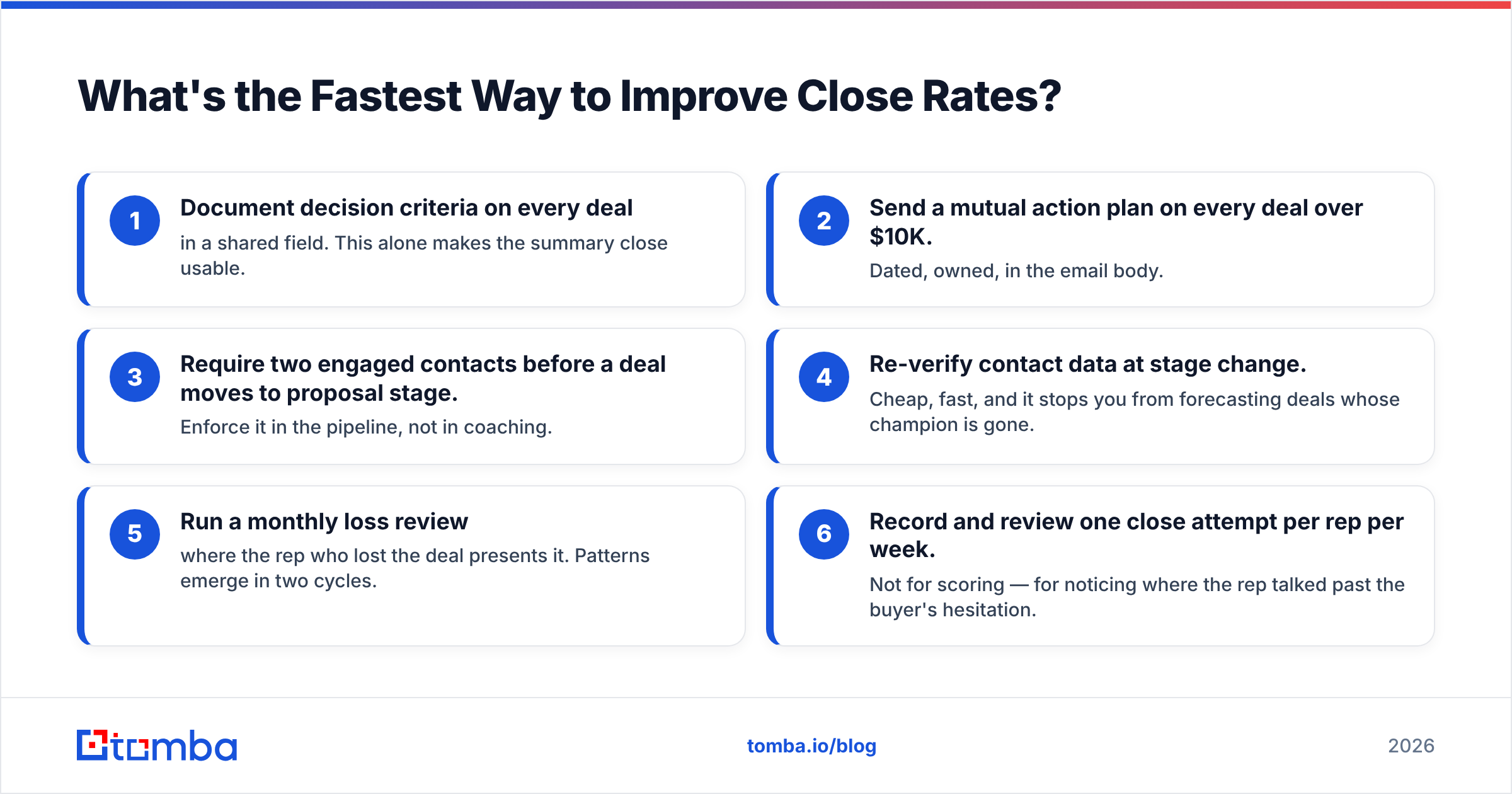
In order of impact-per-hour invested:
- Document decision criteria on every deal in a shared field. This alone makes the summary close usable.
- Send a mutual action plan on every deal over $10K. Dated, owned, in the email body.
- Require two engaged contacts before a deal moves to proposal stage. Enforce it in the pipeline, not in coaching.
- Re-verify contact data at stage change. Cheap, fast, and it stops you from forecasting deals whose champion is gone.
- Run a monthly loss review where the rep who lost the deal presents it. Patterns emerge in two cycles.
- Record and review one close attempt per rep per week. Not for scoring — for noticing where the rep talked past the buyer's hesitation.
Notice what's not on that list: new closing scripts. Script quality is rarely the binding constraint. Process and data quality almost always are.
Where Does Tooling Fit?#
Closing technique is human. But the inputs — who's on the committee, whether you can reach them, whether the second and third stakeholders are even in your CRM — are a tooling question.
When a deal stalls and your champion goes dark, the fastest recovery is to identify the two or three other people who own the outcome and get a credible message in front of them. That means finding a verified work address for a VP you've never spoken to, quickly, without a burned-out bounce rate. Tomba's email finder does exactly that — name plus company domain in, verified address out — and it's the difference between a single-threaded deal that dies quietly and a multi-threaded one you can actually close. The free tier covers 25 searches a month; paid plans start at $49/mo on Tomba pricing if you're running this across a full pipeline.
Pair it with a disciplined mutual action plan and honest qualification, and your close rate stops depending on which script you memorized.
Start here: grab a Tomba Email Finder free account, pull the missing stakeholders on your five largest open deals, and send each one a two-line recap with a dated next step. That's a better use of the next thirty minutes than reading another list of closing lines.
Related guides#
Ready to find emails that actually work?
Join 150,000+ professionals who stopped guessing and started sending. Free credits on signup — no credit card required.
Get the Tomba newsletter
Practical outbound tactics and product updates — once every two weeks.
About the author