The Inside Sales Process: A 7-Stage Playbook for 2026
Most inside sales teams don't lose deals at the close — they lose them at stage two, on bad data and vague discovery. Here's the 7-stage process that actually holds up, with the metrics to prove each stage works.
TL;DR
- The inside sales process is a repeatable, remote-first sequence that takes a lead from list to signature without anyone getting on a plane. Seven stages: list building, qualification, first touch, discovery, demo, objection handling, close and handoff.
- Most teams obsess over stages 5–7 (demo and close) while the real leakage happens at stages 1–2. If 22% of your contact data bounces, your reply rate is fiction and your pipeline math is broken.
- Inside sales wins on cost per interaction — roughly a sixth of the cost of a field visit — which is why it now handles most deals under $50K ACV.
- Track six numbers, not twenty: data accuracy, connect rate, meeting-held rate, stage conversion, sales cycle length, and win rate by source.
- The rollout is faster than people expect. Thirty days is enough to define stages, clean your data layer, and get a working scorecard.
What is the inside sales process, exactly?#
The inside sales process is the documented sequence of steps a remote sales rep follows to move a prospect from "name on a list" to "signed customer" — all conducted by phone, email, video call, and messaging, without field visits.
Think of it like a commercial kitchen versus a private chef. The private chef (outside sales) travels to one client, cooks one bespoke meal, and charges accordingly. The kitchen (inside sales) runs a line: prep, sauté, plate, pass. Every station has a standard, every ticket moves in a known order, and the throughput is the point. Technically, inside sales is a volume-and-velocity model where repeatability substitutes for physical presence.
That definition matters because the word "process" does real work here. A field rep can improvise their way to a deal on relationship capital. An inside rep running 60 touches a day cannot. The process is the product.
Three things define a mature inside sales process:
- Defined stages with exit criteria. A deal doesn't move to "Discovery" because it feels good. It moves because a specific, observable event occurred — a meeting was held, a pain was named, a budget owner was identified.
- A data layer that feeds it. Stages are useless if the contacts entering stage one are guesses. Verified email, verified phone, and correct company context are process inputs, not nice-to-haves.
- A measurement loop. Each stage has a conversion rate. When one stage drifts, you fix that stage — not the whole funnel.
Is inside sales better than outside sales for your deal size?#
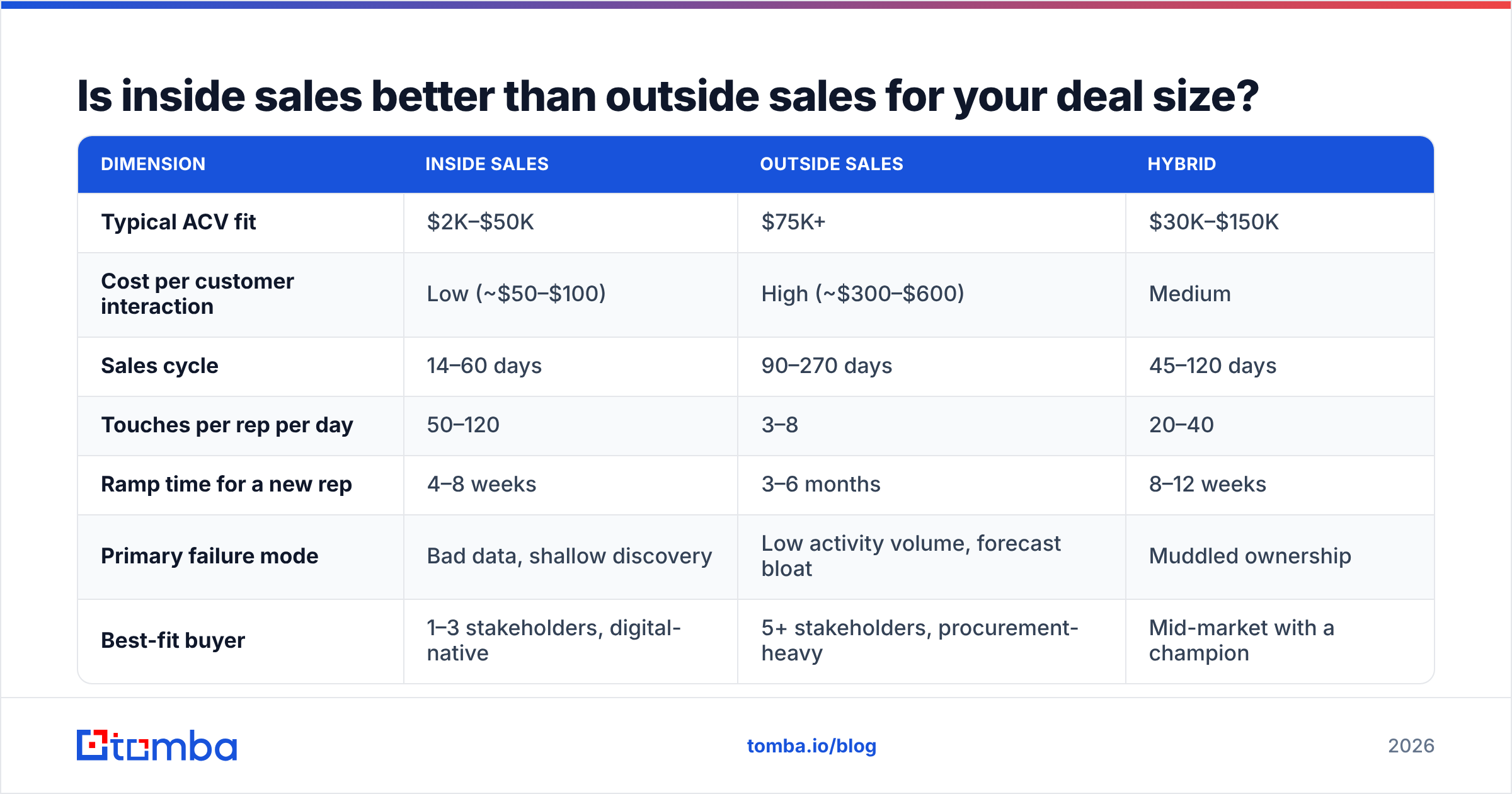
It depends almost entirely on average contract value and buying-committee complexity. Here's the honest comparison.
| Dimension | Inside sales | Outside sales | Hybrid |
|---|---|---|---|
| Typical ACV fit | $2K–$50K | $75K+ | $30K–$150K |
| Cost per customer interaction | Low (~$50–$100) | High (~$300–$600) | Medium |
| Sales cycle | 14–60 days | 90–270 days | 45–120 days |
| Touches per rep per day | 50–120 | 3–8 | 20–40 |
| Ramp time for a new rep | 4–8 weeks | 3–6 months | 8–12 weeks |
| Primary failure mode | Bad data, shallow discovery | Low activity volume, forecast bloat | Muddled ownership |
| Best-fit buyer | 1–3 stakeholders, digital-native | 5+ stakeholders, procurement-heavy | Mid-market with a champion |
The industry shifted hard toward inside sales after 2020 and never shifted back. Salesforce's sales research and HubSpot's sales blog both document the same pattern: buyers under $50K ACV actively prefer not to have a rep in the room. The video call isn't a downgrade anymore — it's the default.
Where outside sales still wins: enterprise deals where a procurement committee needs to be walked through a security review in person, and industries where relationships are the moat (construction, medical devices, industrial equipment).
What are the 7 stages of the inside sales process?#
Here's the sequence, with the exit criterion that actually justifies moving a deal forward.
- List building and targeting. You define the ICP, then source contacts that match it. Exit criterion: contact has a verified work email, a role that matches your buyer persona, and a company that matches your firmographic filters. Not "found on LinkedIn."
- Qualification and scoring. Score the account before a human spends time on it. Fit signals (headcount, tech stack, industry) plus intent signals (site visits, hiring posts, funding). Exit criterion: score above your threshold.
- First touch and sequencing. Multichannel: email, phone, LinkedIn, and sometimes a video message. Typically 8–12 touches across 18–21 days. Exit criterion: a reply, a connect, or a documented exhaustion of the sequence.
- Discovery call. Twenty-five to forty minutes. The rep talks less than 40% of the time. Exit criterion: a named business pain, a quantified cost of inaction, and an identified decision process.
- Demo or solution review. Tailored to the pain named in stage 4. Generic product tours belong in a recorded video, not a live call. Exit criterion: the prospect articulates, unprompted, how your product solves their stated problem.
- Objection handling and negotiation. Price, timing, incumbent, internal politics. Exit criterion: a mutual action plan with dates and named owners.
- Close and handoff. Signature, then a structured transfer to onboarding with the discovery notes attached. Exit criterion: onboarding kickoff booked before the rep celebrates.
Notice that four of the seven exit criteria are things the prospect does or says. That's deliberate. Stages that advance on rep optimism produce forecasts that miss.
Why does stage one decide whether the rest of the process works?#
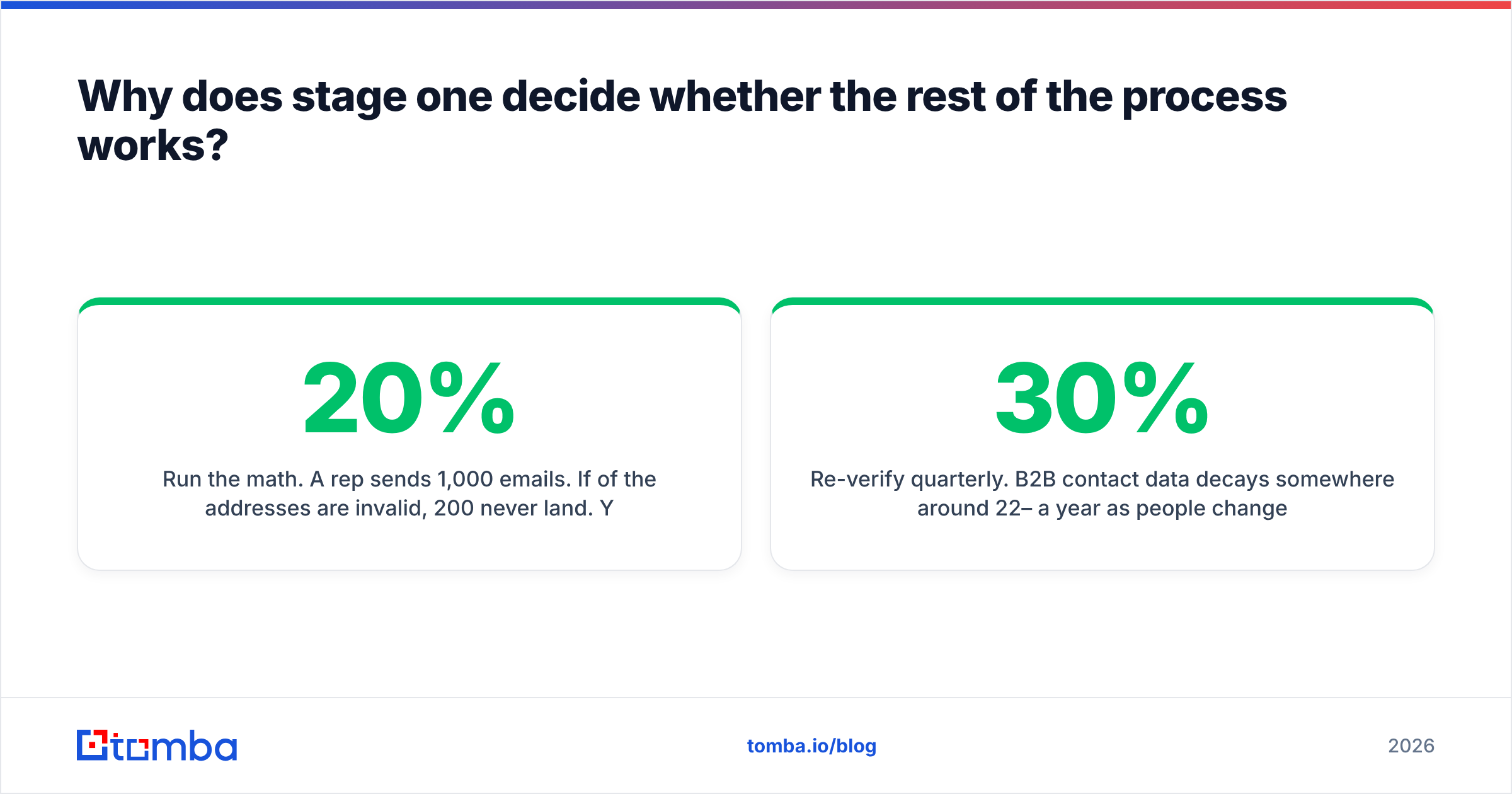
Because everything downstream is a percentage of what enters at the top, and bad data corrupts every number after it.
Run the math. A rep sends 1,000 emails. If 20% of the addresses are invalid, 200 never land. Your platform reports a 12% reply rate on delivered mail, which sounds fine — but you also just told mailbox providers that a fifth of your list is garbage, and your sender reputation absorbs the damage. Two weeks later your valid emails start landing in spam, and the reply rate drops for reasons no one can trace back to the list.
This is the least glamorous part of the inside sales process and the one with the highest leverage. Practical guardrails:
- Verify before you send, not after you bounce. Running a list through an email verifier costs a fraction of a cent per record and protects a domain you can't easily replace.
- Source from patterns, not guesses. Company email formats are predictable at scale. A proper email finder resolves first-name-last-name conventions against live SMTP signals instead of permutating and hoping.
- Handle catch-all domains explicitly. A catch-all accepts everything, which means "no bounce" tells you nothing. Segment those into a separate, lower-volume track.
- Re-verify quarterly. B2B contact data decays somewhere around 22–30% a year as people change jobs. A list you cleaned in January is measurably worse by June.
- Enrich with phone, not just email. Multichannel sequences outperform email-only ones consistently, and a phone finder turns a one-channel play into a three-channel one.
Teams that treat data as a stage in the process, with its own owner and its own metric, outperform teams that treat it as a procurement decision made once a year.
What does a discovery call look like when it's run properly?#
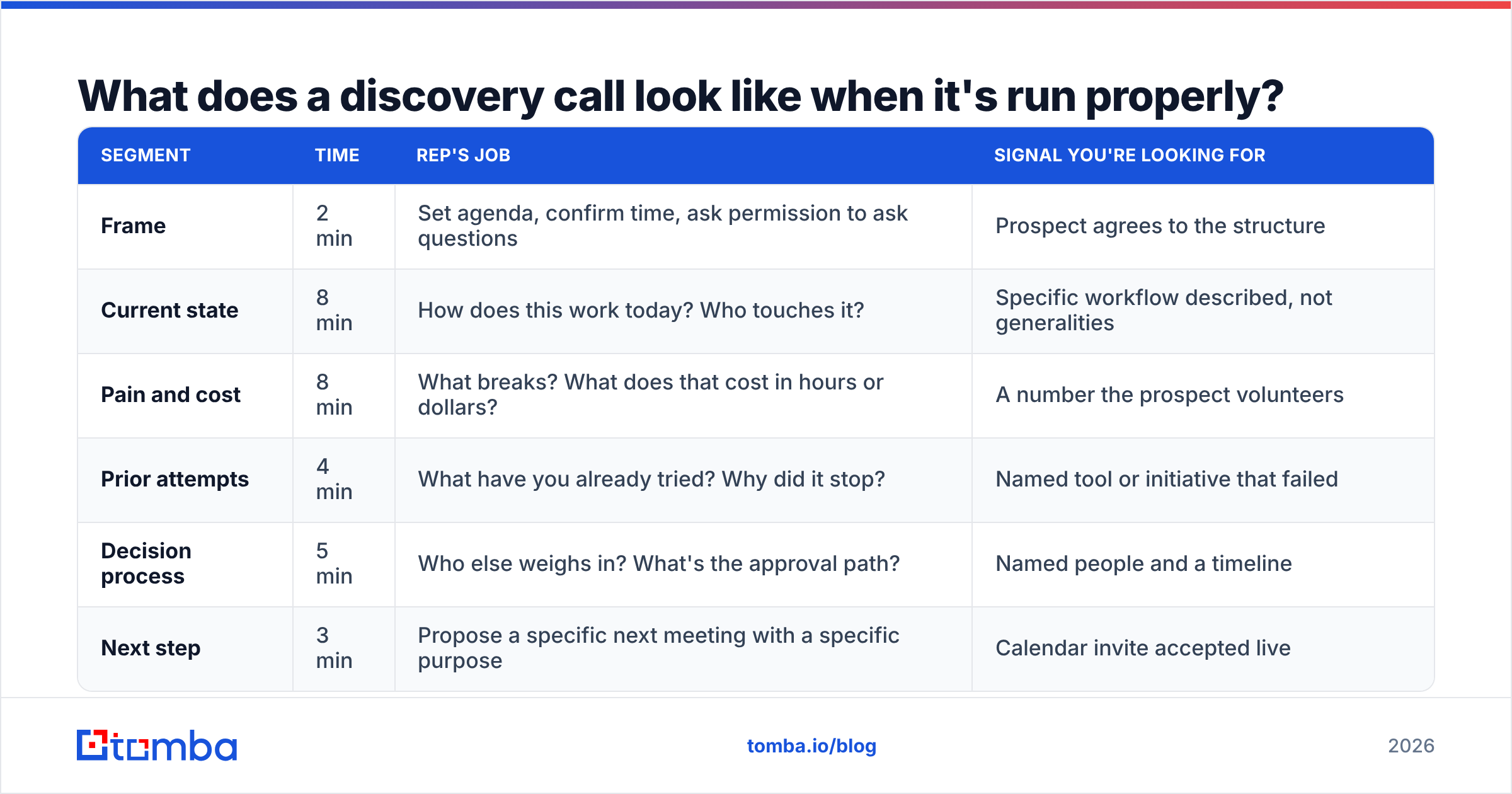
It looks like a diagnosis, not a pitch. The closest analogy is a good doctor's appointment: they ask about symptoms, duration, what you've already tried, and what happens if nothing changes — before mentioning a single treatment.
A workable 30-minute structure:
| Segment | Time | Rep's job | Signal you're looking for |
|---|---|---|---|
| Frame | 2 min | Set agenda, confirm time, ask permission to ask questions | Prospect agrees to the structure |
| Current state | 8 min | How does this work today? Who touches it? | Specific workflow described, not generalities |
| Pain and cost | 8 min | What breaks? What does that cost in hours or dollars? | A number the prospect volunteers |
| Prior attempts | 4 min | What have you already tried? Why did it stop? | Named tool or initiative that failed |
| Decision process | 5 min | Who else weighs in? What's the approval path? | Named people and a timeline |
| Next step | 3 min | Propose a specific next meeting with a specific purpose | Calendar invite accepted live |
The single highest-correlation behavior with closed-won: getting the prospect to state a quantified cost of inaction in their own words. "It's annoying" doesn't close. "We're burning about 15 hours a week on manual list cleanup, which is roughly a full headcount" closes.
Record calls and review them. Not for compliance theater — for the talk-ratio number. If your reps are speaking more than 45% of a discovery call, the deal quality of your pipeline is lower than your CRM thinks it is.
Which metrics actually tell you the inside sales process is working?#
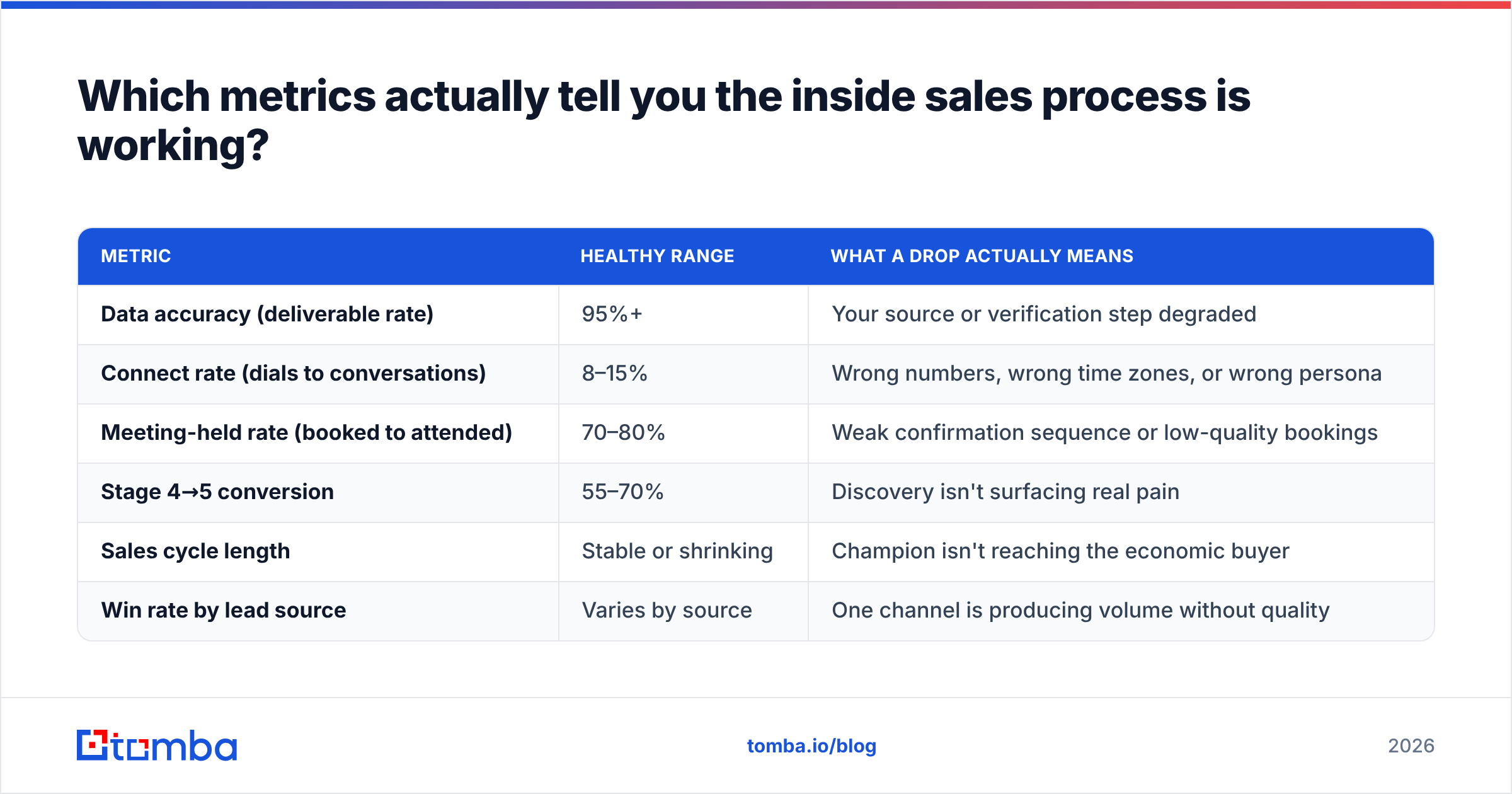
Six. More than that and nobody looks at any of them.
| Metric | Healthy range | What a drop actually means |
|---|---|---|
| Data accuracy (deliverable rate) | 95%+ | Your source or verification step degraded |
| Connect rate (dials to conversations) | 8–15% | Wrong numbers, wrong time zones, or wrong persona |
| Meeting-held rate (booked to attended) | 70–80% | Weak confirmation sequence or low-quality bookings |
| Stage 4→5 conversion | 55–70% | Discovery isn't surfacing real pain |
| Sales cycle length | Stable or shrinking | Champion isn't reaching the economic buyer |
| Win rate by lead source | Varies by source | One channel is producing volume without quality |
The trap is averaging. A blended 22% win rate hides the fact that inbound demo requests close at 41% and a scraped list closes at 4%. Segment by source or the number is decorative. Gartner's sales practice makes the same point repeatedly: aggregate funnel metrics conceal exactly the variance you need to act on.
Also worth tracking, but quarterly rather than weekly: pipeline coverage ratio (3x–4x of quota is the usual target) and average deal size drift.
Where do most inside sales processes break?#
Four places, in order of how often we see them.
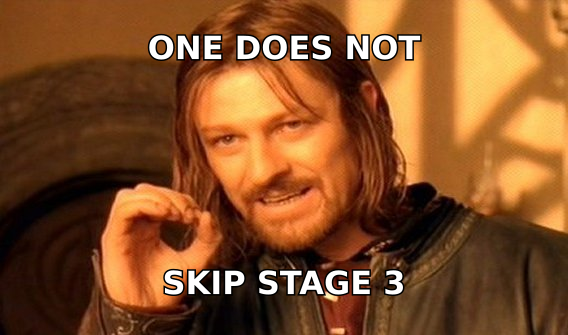
1. Stages that advance on hope. If any rep can drag a deal to "Negotiation" without a mutual action plan, your forecast is a wish list. Enforce exit criteria in the CRM with required fields, not in a training deck.
2. Data that's refreshed once and never again. The list that produced a 9% reply rate in Q1 produces 4% in Q3, and the team blames the copy. Set a re-verification cadence and make it someone's job.
3. Sequence fatigue. The same 11-step email cadence for 18 months, sent to a market that has now received it three times. Rotate messaging quarterly and retire sequences with declining reply rates instead of defending them.
4. The handoff cliff. The deal closes, the rep moves on, and onboarding starts from zero because discovery notes lived in the rep's head. Attach the stage-4 notes to the account record and make the kickoff call a closing requirement.
A useful diagnostic: pull your last 20 closed-lost deals and mark which stage they died in. If more than half died between stages 3 and 4 — first touch to discovery — your problem is targeting and data, not closing skill. Fixing the close when the leak is upstream is like re-tiling a bathroom to stop a roof leak.
How do you build the process in 30 days?#
- Week 1 — Map and define. Write the seven stages with exit criteria. Interview your two best reps and document what they actually do, not what the old playbook says. Configure the stages in your CRM with required fields.
- Week 2 — Fix the data layer. Rebuild the ICP filter, re-source a clean target list, verify it, and enrich with phone numbers. Connect your enrichment source directly to the CRM through an integration so records stay current without manual exports.
- Week 3 — Rebuild sequences and scripts. One sequence per persona, 8–12 touches, three channels. Write a discovery question bank organized by the segments in the table above. Record two role-play calls per rep.
- Week 4 — Instrument and review. Build the six-metric scorecard. Run the first pipeline review against exit criteria, not vibes. Expect a pipeline haircut — deals that never qualified will fall out, and that's the point.
If you want peer validation on tooling before you commit budget, G2's sales engagement category is a reasonable place to check whether a vendor's reviews match its marketing.
Where does your data layer come from?#
Every stage in this playbook depends on stage one being correct, and stage one depends on knowing who your buyer is and how to reach them. That's the part most teams outsource to a scraper and regret two quarters later when the domain reputation bill comes due.
Tomba's Email Finder is built for exactly this input step: find verified work emails by domain, name, or company, check them before they hit a send queue, and push them straight into your sequencer or CRM. The free tier covers 25 searches a month if you just want to test accuracy against a list you already trust, and paid plans start at $49/month with bulk and API access on the higher tiers — see Tomba pricing for the full breakdown.
Build the seven stages. Then feed them something real.
Related guides#
// get started
Find, verify and enrich your first contacts today
Start on the free plan with 25 searches a month, then scale when your team is ready.
Free plan · No credit card required · GDPR & CCPA
// about the author