Instantly vs Lemlist (2026): Which Cold Email Tool Wins?
Instantly and Lemlist solve the same problem from opposite ends: one optimizes for volume and inbox placement, the other for personalization and multichannel. Here is where each actually wins in 2026.
TL;DR
- Instantly wins on volume and infrastructure. Unlimited inbox connections on paid plans, a large warmup network, and a rotation engine built for teams sending thousands of emails a day.
- Lemlist wins on personalization and multichannel. Custom images, dynamic landing pages, LinkedIn steps, and calling sit inside the same sequence.
- Pricing is closer than the marketing suggests. Instantly splits sending and lead credits into separate line items; Lemlist bundles fewer contacts at a higher per-seat cost.
- Neither tool fixes bad data. Both sell lead databases as add-ons, and both will happily send to addresses that bounce. Verification is on you.
- Our pick: high-volume outbound teams take Instantly; founder-led or ABM-style outbound with under 500 target accounts takes Lemlist.
Choosing between these two is not really a feature-checklist exercise. Instantly and Lemlist have been converging for three years — both send sequences, both warm inboxes, both have a lead database bolted on. The real question is which philosophy matches how your team prospects. This breakdown covers what actually differs in 2026, what the pricing pages hide, and the data problem that sinks campaigns on either platform.
What are Instantly and Lemlist, exactly?#
Instantly launched as a deliverability-first sending tool. Its core promise: connect as many sending mailboxes as you want, let the platform rotate volume across them, and keep a warmup network running in the background so those mailboxes look established. Everything else — the CRM, the lead finder, the AI copy assistant — was built outward from that sending engine.
Lemlist started from the opposite end. Its original hook was the custom image: drop a prospect's logo onto a mockup, embed it in the email, and stand out in a crowded inbox. From there it grew into a multichannel sequencer where an email step, a LinkedIn visit, a LinkedIn message, and a call task all live in one campaign flow.
That origin story still shapes both products. Instantly feels like infrastructure with a UI on top. Lemlist feels like a creative outbound workspace that happens to send email.
How do Instantly and Lemlist compare at a glance?#
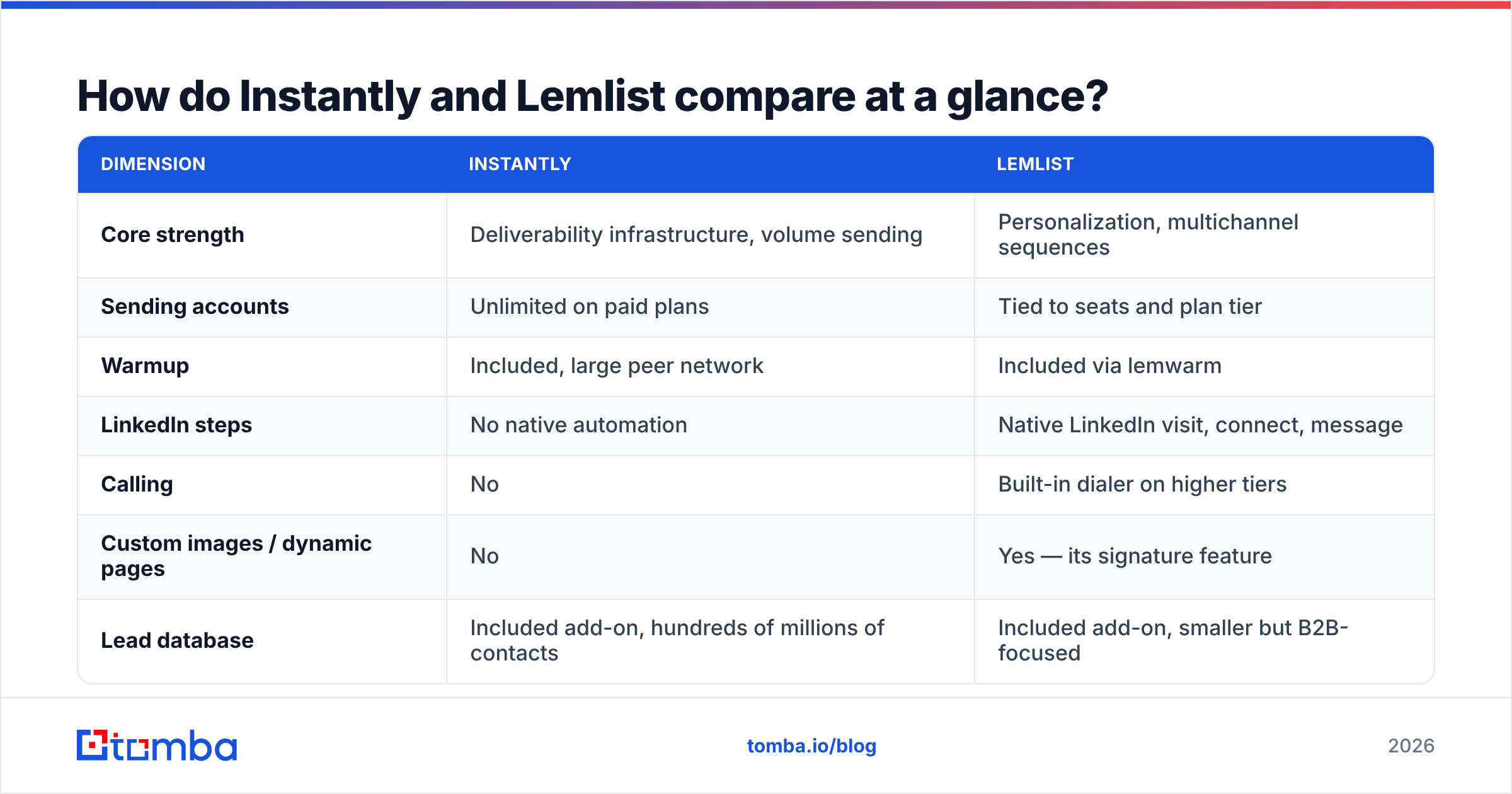
| Dimension | Instantly | Lemlist |
|---|---|---|
| Core strength | Deliverability infrastructure, volume sending | Personalization, multichannel sequences |
| Sending accounts | Unlimited on paid plans | Tied to seats and plan tier |
| Warmup | Included, large peer network | Included via lemwarm |
| LinkedIn steps | No native automation | Native LinkedIn visit, connect, message |
| Calling | No | Built-in dialer on higher tiers |
| Custom images / dynamic pages | No | Yes — its signature feature |
| Lead database | Included add-on, hundreds of millions of contacts | Included add-on, smaller but B2B-focused |
| Unibox / shared inbox | Yes, strong | Yes, lighter |
| CRM depth | Lightweight pipeline | Lightweight pipeline |
| Learning curve | Low — ship a campaign in 20 minutes | Moderate — more knobs, more steps |
| Best for | Agencies, SDR teams, high-volume outbound | Founders, ABM, niche or high-ACV targets |
| API access | Yes, on higher tiers | Yes |
If you only read one row, read the LinkedIn one. That single gap decides this comparison for a lot of teams. If your motion requires a connection request before the email lands, Lemlist keeps it in one sequence and Instantly does not.
Which one has better deliverability?#
Instantly, on raw infrastructure. But the gap is narrower than the reviews claim, and both are downstream of choices you make before you touch either tool.
Instantly's advantage is architectural. Because sending accounts are unlimited on paid plans, you can spread 1,000 daily sends across 25 mailboxes at 40 each instead of hammering five mailboxes at 200. Mailbox rotation, per-account daily caps, and automatic ramping are all first-class settings. Its warmup network is one of the larger ones in the market, which matters because warmup only works if real inboxes are opening, replying, and pulling your mail out of spam.
Lemwarm does the same job competently and gives you more granular control over ramp speed and warmup email content. What it doesn't give you is Instantly's economics at scale — adding another twenty mailboxes affects your bill differently.
Here is the part both vendors underplay: email deliverability in 2026 is gated by authentication and list hygiene far more than by warmup. Google and Microsoft both enforce bulk-sender requirements — SPF, DKIM, DMARC, one-click unsubscribe, and a spam complaint rate under 0.3%. Neither platform will fix a missing DMARC record for you, and neither will stop you from importing a list where a third of the addresses are dead.
A 30% bounce rate on a fresh domain will torch your sender reputation in about four days. No warmup network outruns that.

Run every import through an email verifier before it touches a sequence, and use a warmup calculator to set realistic ramp targets rather than guessing. Both steps happen outside Instantly and Lemlist, and both matter more than which of the two you pick.
Which one personalizes better?#
Lemlist, decisively, and it isn't close on the creative side.
Lemlist's personalization stack includes:
- Custom images — a prospect's website screenshot, logo, or name rendered into an image template at send time. Still the highest-signal "this is not a blast" cue available in cold email.
- Dynamic landing pages — a per-prospect page with their company name, your pitch, and a booking link, generated from the same variables as the email.
- Liquid syntax conditionals — full if/else logic in the body so one template serves five segments without five templates.
- Video personalization — native integrations that drop a thumbnail with the prospect's site in the background.
- AI variable generation — pull a first line from a prospect's LinkedIn or site copy across an entire list.
Instantly has AI-generated first lines and standard spintax plus merge tags. That covers most of what a volume team needs, and spintax genuinely helps with content fingerprinting across thousands of sends. But you cannot build a lemlist-style custom image inside Instantly, and if that's your differentiator, the comparison ends here.
The honest caveat: personalization has diminishing returns tied to deal size. At a $3,000 ACV, a dynamic landing page for every prospect is a losing trade on time. At $60,000, it's cheap. Match the tool to the math, not to the demo.
How does the pricing actually compare?#
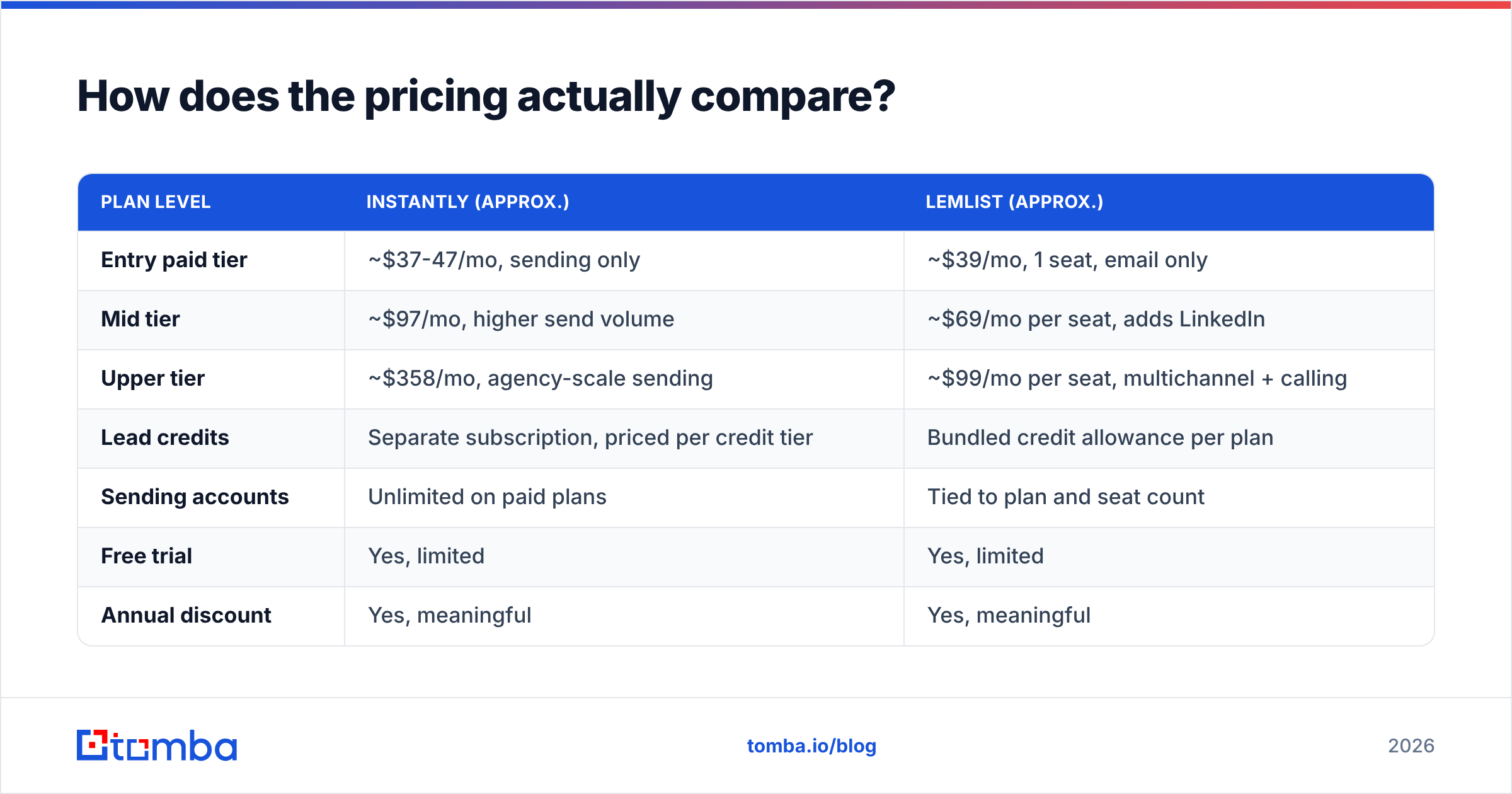
Both vendors restructure plans regularly, so treat these as directional and verify on their pricing pages before you buy. The shape of the pricing is what matters anyway.
| Plan level | Instantly (approx.) | Lemlist (approx.) |
|---|---|---|
| Entry paid tier | ~$37-47/mo, sending only | ~$39/mo, 1 seat, email only |
| Mid tier | ~$97/mo, higher send volume | ~$69/mo per seat, adds LinkedIn |
| Upper tier | ~$358/mo, agency-scale sending | ~$99/mo per seat, multichannel + calling |
| Lead credits | Separate subscription, priced per credit tier | Bundled credit allowance per plan |
| Sending accounts | Unlimited on paid plans | Tied to plan and seat count |
| Free trial | Yes, limited | Yes, limited |
| Annual discount | Yes, meaningful | Yes, meaningful |
Two traps show up in real invoices.
Instantly's split billing. Sending and lead data are separate subscriptions. Teams budget for the $97 sending plan, then discover that the lead database they actually wanted is another line item. If you are already sourcing contacts elsewhere, this is fine — you just buy sending. If you expected an all-in-one number, it stings.
Lemlist's per-seat math. Lemlist charges per seat, and the LinkedIn and calling features live on higher tiers. A five-person SDR team on the multichannel tier lands well north of what a comparable Instantly seat count costs, because Instantly's pricing scales on sending volume rather than headcount. Small teams do better on Lemlist; growing teams cross over.
Check current numbers on G2 alongside the vendor pages — buyer reviews there tend to surface the add-on costs faster than the pricing tables do.
Which tool fits which team?#
- Lead gen agencies running client campaigns. Instantly. Unlimited mailboxes, workspace separation, and volume economics are the whole job.
- Founder-led outbound, under 500 target accounts. Lemlist. You have time to personalize and the deal sizes to justify it.
- SDR teams with a defined ICP and a big TAM. Instantly. Volume, rotation, and a clean unibox beat creative flourish at this scale.
- ABM and enterprise motions. Lemlist. Multichannel sequencing with LinkedIn touches maps to how those buying committees actually get reached.
- Recruiters and talent teams. Lemlist, for the LinkedIn steps — most of your sourcing already lives there.
- Anyone sending from a brand-new domain. Either, but only after 3-4 weeks of warmup and strict authentication. The tool choice is the least important variable in month one.
What do neither Instantly nor Lemlist solve?#
Contact data quality. Both bundle a lead database, and both databases are fine for breadth and weak for freshness in narrow verticals.
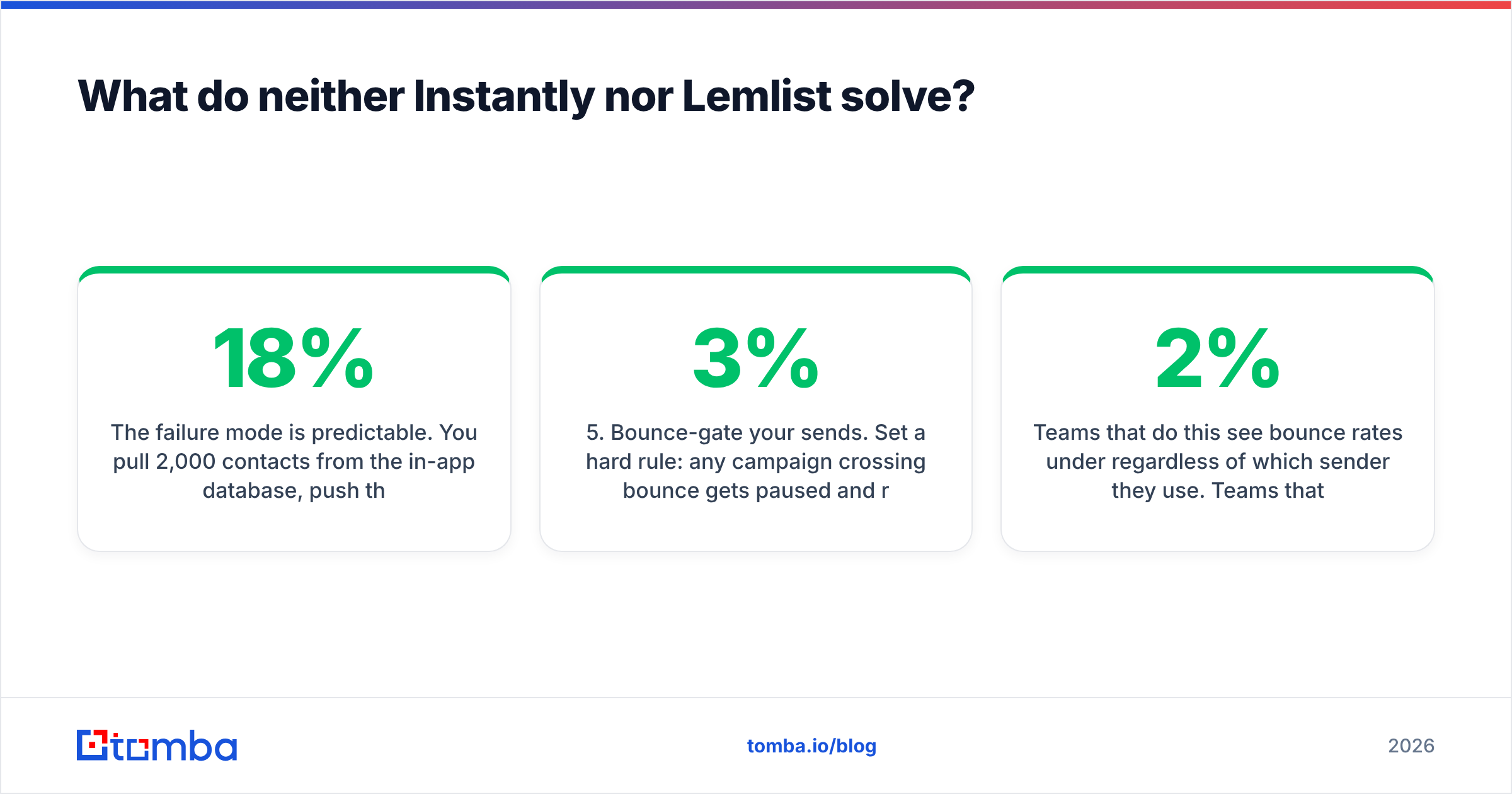
The failure mode is predictable. You pull 2,000 contacts from the in-app database, push them straight into a sequence because the friction to do so is one click, and watch a 12-18% bounce rate come back. Job changes are the usual culprit: B2B contact data decays at roughly 2-3% per month, which means a list built eighteen months ago is close to half wrong. Neither platform re-verifies at send time.

The fix is a data layer that sits in front of whichever sender you choose:
- Source by domain, not by list. Build target accounts first, then pull contacts per company with domain search so you know exactly who you're reaching and why.
- Verify every address before import. SMTP-level validation catches the dead mailboxes; catch-all handling decides what you do with the ambiguous ones.
- Enrich what you keep. Titles, seniority, and company attributes drive the segmentation that makes personalization work in either tool.
- Re-verify quarterly. Suppression lists rot. So do your best-performing segments.
- Bounce-gate your sends. Set a hard rule: any campaign crossing 3% bounce gets paused and re-cleaned, no exceptions.
Teams that do this see bounce rates under 2% regardless of which sender they use. Teams that skip it blame the platform for a data problem.
Can you use both Instantly and Lemlist together?#
Yes, and a surprising number of teams do — but only when the motions are genuinely separate.
The workable split: Lemlist runs the top 100-200 named accounts with heavy personalization and LinkedIn touches, while Instantly runs the broad, keyword-qualified volume list. One CRM is the source of truth, and a suppression sync between the two prevents the embarrassing scenario where a prospect gets a hand-crafted Lemlist sequence and a generic Instantly blast in the same week.
What does not work is running both on the same domain pool. Warmup networks, reply handling, and bounce accounting get messy fast, and you lose the ability to attribute a reputation drop to a specific campaign. Separate domains, separate mailboxes, separate lists.
If you are a team of under five people, skip this entirely. Running two sequencers is an operations tax most outbound teams cannot afford to pay.
Which should you pick?#
Pick Instantly if your constraint is volume, your list is large, and your deals close on a repeatable pitch. The unlimited mailbox model and the warmup network are worth more than anything Lemlist offers on the creative side, and the setup time is genuinely short.
Pick Lemlist if your constraint is attention, your target list is small and named, and LinkedIn is already part of how you reach people. The custom images and multichannel steps earn their premium at higher deal sizes.
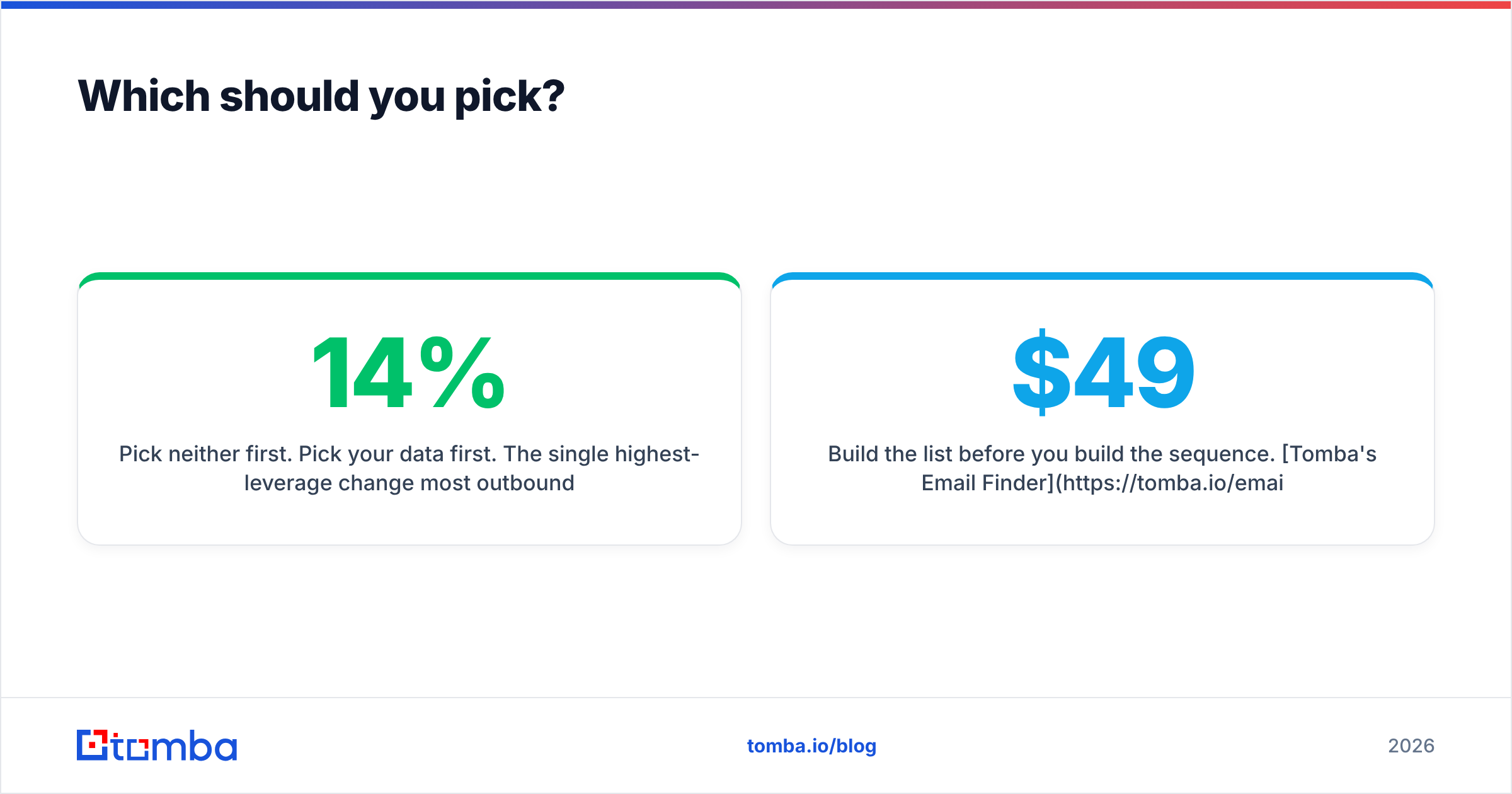
Pick neither first. Pick your data first. The single highest-leverage change most outbound teams can make in 2026 is not switching sequencers — it's cutting their bounce rate from 14% to 2% by verifying and enriching before import. That one change lifts inbox placement, reply rate, and domain longevity simultaneously, and it works no matter which platform sends the mail.
Build the list before you build the sequence. Tomba's Email Finder finds verified professional addresses by name, company, or domain — with source attribution on every result, so you know where the data came from. Start free with 25 searches a month; paid plans begin at $49/mo, and full Tomba pricing scales to Growth at $99/mo and Pro at $249/mo. Export clean, verified contacts straight into Instantly or Lemlist and let the sequencer do the one job it's good at.
Related guides#
// get started
Find, verify and enrich your first contacts today
Start on the free plan with 25 searches a month, then scale when your team is ready.
Free plan · No credit card required · GDPR & CCPA
Get the Tomba newsletter
Product and data updates
// about the author