9 Best Intentrack Alternatives in 2026 (Free and Paid)
Intent platforms promise to tell you who is in-market. Most just charge enterprise money for anonymous page views. Here are nine Intentrack alternatives that actually get a name, an email, and a reply.
TL;DR
- Most teams searching for Intentrack alternatives are not unhappy with the signal — they are unhappy that a signal without a verified contact is unactionable.
- Intent platforms split into three buckets: topic-level intent (Bombora, 6sense), account-level visitor ID (Dealfront, Albacross), and person-level reveal plus contact data (Tomba Reveal, RB2B, Warmly).
- Enterprise intent suites routinely land in the $30k–$100k/year range once seats and credits are counted. Mid-market tools start under $100/month.
- If your bottleneck is "I know the account, I can't reach the human," a contact-data layer costs less than a second intent subscription.
- Cheapest realistic replacement stack in 2026: one visitor-ID tool + one verified email finder + your existing sequencer.
What is Intentrack and what does it actually do?#
Intentrack sits in the buyer-intent category: software that watches for behavioral signals — content consumption, research spikes, repeat site visits, technology changes — and tells you which accounts are showing above-baseline interest in what you sell. The pitch is simple and genuinely good: stop cold-calling the whole TAM, call the 3% who are already looking.
The problem shows up at handoff. An intent platform hands your SDR a company name, a topic cluster, and a surge score. It rarely hands them a person, a verified email, or a direct dial. That gap is why "Intentrack alternatives" is a search anyone running outbound eventually types — not because the intent data is wrong, but because it stops one step short of an email you can actually send.
Before you shop, be precise about which of these three jobs you are buying:
- Third-party topic intent — aggregated publisher co-op data showing an account researching "warehouse management software" somewhere on the open web. Broad reach, low precision, no contact.
- First-party visitor identification — reverse IP or pixel-based resolution of your own anonymous traffic to a company (or a person). High precision, limited to traffic you already earn.
- Contact resolution and enrichment — turning a resolved company or LinkedIn profile into a name, role, verified email, and phone. This is the layer that makes the other two sellable to a rep.
Most vendors do one well and market all three. Pricing follows the same pattern: the suites that claim all three charge like a platform, not a tool.
Why do teams look for Intentrack alternatives?#
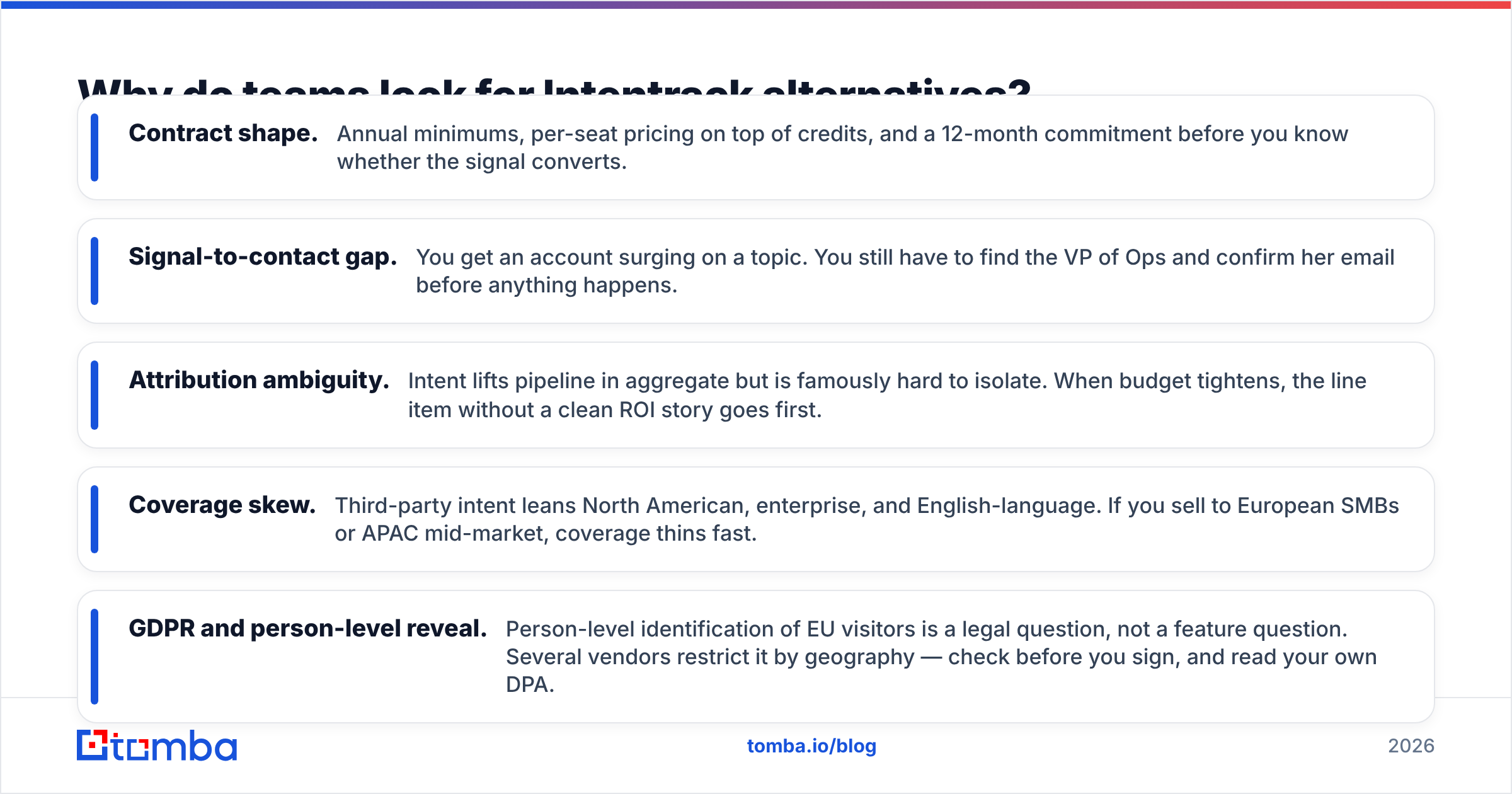
The five recurring reasons, in the order they usually come up in renewal conversations:
- Contract shape. Annual minimums, per-seat pricing on top of credits, and a 12-month commitment before you know whether the signal converts.
- Signal-to-contact gap. You get an account surging on a topic. You still have to find the VP of Ops and confirm her email before anything happens.
- Attribution ambiguity. Intent lifts pipeline in aggregate but is famously hard to isolate. When budget tightens, the line item without a clean ROI story goes first.
- Coverage skew. Third-party intent leans North American, enterprise, and English-language. If you sell to European SMBs or APAC mid-market, coverage thins fast.
- GDPR and person-level reveal. Person-level identification of EU visitors is a legal question, not a feature question. Several vendors restrict it by geography — check before you sign, and read your own DPA.
What are the best Intentrack alternatives in 2026?#
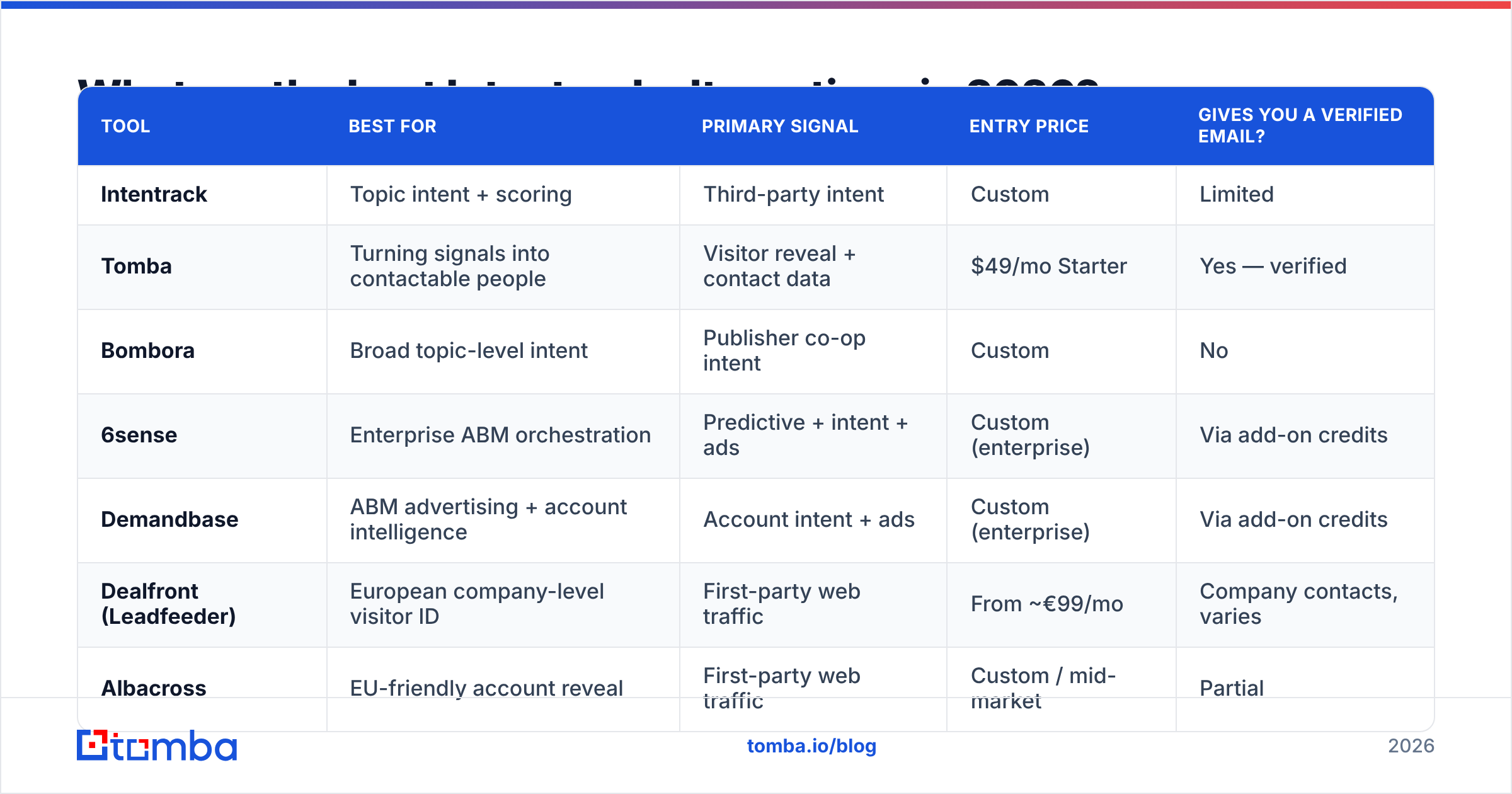
Nine options, grouped by what they actually deliver. Pricing below reflects publicly listed entry tiers where vendors publish them; enterprise intent suites are quote-only and change constantly — treat anything marked "Custom" as "expect five figures annually."
| Tool | Best for | Primary signal | Entry price | Gives you a verified email? |
|---|---|---|---|---|
| Intentrack | Topic intent + scoring | Third-party intent | Custom | Limited |
| Tomba | Turning signals into contactable people | Visitor reveal + contact data | $49/mo Starter | Yes — verified |
| Bombora | Broad topic-level intent | Publisher co-op intent | Custom | No |
| 6sense | Enterprise ABM orchestration | Predictive + intent + ads | Custom (enterprise) | Via add-on credits |
| Demandbase | ABM advertising + account intelligence | Account intent + ads | Custom (enterprise) | Via add-on credits |
| Dealfront (Leadfeeder) | European company-level visitor ID | First-party web traffic | From ~€99/mo | Company contacts, varies |
| Albacross | EU-friendly account reveal | First-party web traffic | Custom / mid-market | Partial |
| Warmly | Real-time warm outbound | Visitor ID + orchestration | Free tier, paid tiers | Partial |
| RB2B | US person-level website reveal | Person-level pixel | Free tier + paid | Work email, US-focused |
| BookYourData | Buying verified contact lists directly | Purchased B2B contact data | Pay-as-you-go | Yes — verified |
How do the three categories actually differ?#
| Capability | Topic intent (Bombora, 6sense) | Visitor ID (Dealfront, Albacross, RB2B) | Contact data (Tomba, BookYourData) |
|---|---|---|---|
| Finds accounts you've never touched | Yes | No | Partially (database search) |
| Works on your own traffic | No | Yes | Yes, as the enrichment layer |
| Returns a named person | Rarely | Sometimes | Yes |
| Returns a verified email | No | Sometimes | Yes |
| Typical annual cost | $20k–$100k | $1k–$15k | Under $1.2k at Growth tier |
| Time to first sent email | Days | Hours | Minutes |
The honest read: these are complements, not substitutes. Teams that "replace" an intent suite usually replace it with two cheaper tools — one that produces signal, one that produces contactability — and keep more budget than they lose in coverage.
Which Intentrack alternatives are worth a closer look?#
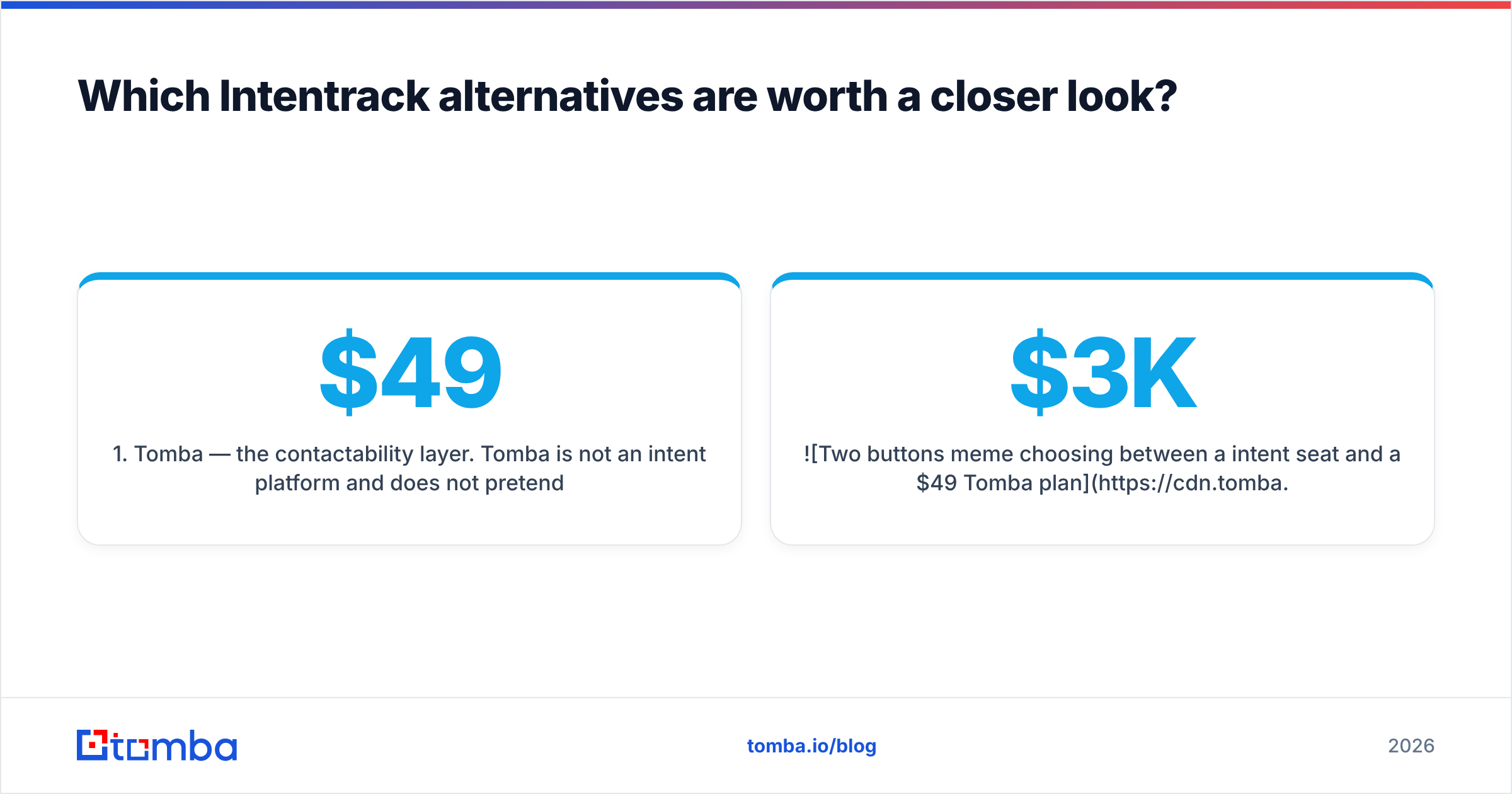
1. Tomba — the contactability layer. Tomba is not an intent platform and does not pretend to be. It is the piece that makes intent actionable: website visitor reveal to see which companies are on your site, domain search to pull the right roles at those companies, and a verification pass so the address you found survives contact with a mail server. Free tier is 25 searches/month; Starter is $49/mo, Growth $99/mo, Pro $249/mo. The Tomba API matters more than the UI for this use case — you pipe resolved accounts in, get verified contacts out, and never touch a dashboard.
Best for: teams that already have signal and need people. Weak spot: no predictive scoring, no ad orchestration.
2. Bombora — the reference data set. Bombora's co-op aggregates consumption data across thousands of B2B publishers and is the underlying intent source for a surprising number of "intent" products you already use. If your objection to Intentrack is coverage rather than concept, Bombora is the closest like-for-like. Weak spot: account-level only, quote-only pricing, and you still need a contact layer downstream.
3. 6sense — the full ABM suite. Predictive models, intent, advertising, and orchestration in one platform. It is the right answer when you have a marketing ops team to run it and a deal size that justifies enterprise pricing. It is the wrong answer for a five-person sales team. See the 6sense alternative breakdown if you want the narrower comparison.
4. Demandbase — advertising-led ABM. Strongest when paid media is a core channel and you want intent to drive ad spend, not just SDR lists. Compare with the Demandbase alternative view before committing to an annual.
5. Dealfront (Leadfeeder + Echobot) — Europe-first. If your ICP is DACH, Nordics, or Benelux, Dealfront's coverage and GDPR posture are meaningfully better than US-centric alternatives. Company-level, not person-level. Published tiers start around €99/month, which is a different universe from enterprise intent pricing.
6. Albacross — clean account reveal. European, straightforward, integrates well with common CRMs. Good at the one job; no pretense of predictive scoring. See the Albacross alternative comparison.
7. RB2B — person-level, US only. Identifies individual visitors (not just companies) on US traffic and pushes them to Slack. Genuinely useful for product-led motions. Deliberately does not operate person-level in the EU, which tells you something about the legal reality of that feature.
8. Warmly — signal orchestration. Bundles visitor ID, some intent, chat, and automated outreach triggers. Attractive when you want one vendor instead of a stack; less attractive when you want best-in-class at each layer.
9. BookYourData — buy the contacts directly. A respected option when the problem is not signal at all but list coverage: pay-as-you-go verified B2B contacts with no annual commitment, which makes it easy to pressure-test a new segment before you build a whole intent motion around it. Pairs naturally with an email verifier pass before you load anything into a sequencer.

Is intent data worth the price in 2026?#
Sometimes. The honest framing is a threshold test, not a yes/no.
Third-party intent earns its keep when three conditions hold: your ACV is high enough that a 10–20% lift in meeting quality pays a five-figure subscription, your TAM is large enough that prioritization is a real problem, and you have someone whose job includes acting on the data weekly. Miss any one of those and you are buying a dashboard.
Below that threshold — SMB ACVs, a TAM you could list in a spreadsheet, a two-rep team — first-party signal beats third-party intent on every dimension that matters. Someone reading your pricing page three times this week is a stronger buying signal than an anonymous topic surge, and you can resolve it for a fraction of the cost. G2's buyer intent category is useful for seeing which vendors mid-market buyers actually stick with versus which ones dominate analyst decks.
One more thing worth saying plainly: intent data decays. A surge from three weeks ago is close to worthless. Any evaluation should weight speed-to-contact heavily, because a platform that takes four days to move a signal into a rep's queue has already lost most of the value it generated.
How do you replace Intentrack without losing pipeline?#
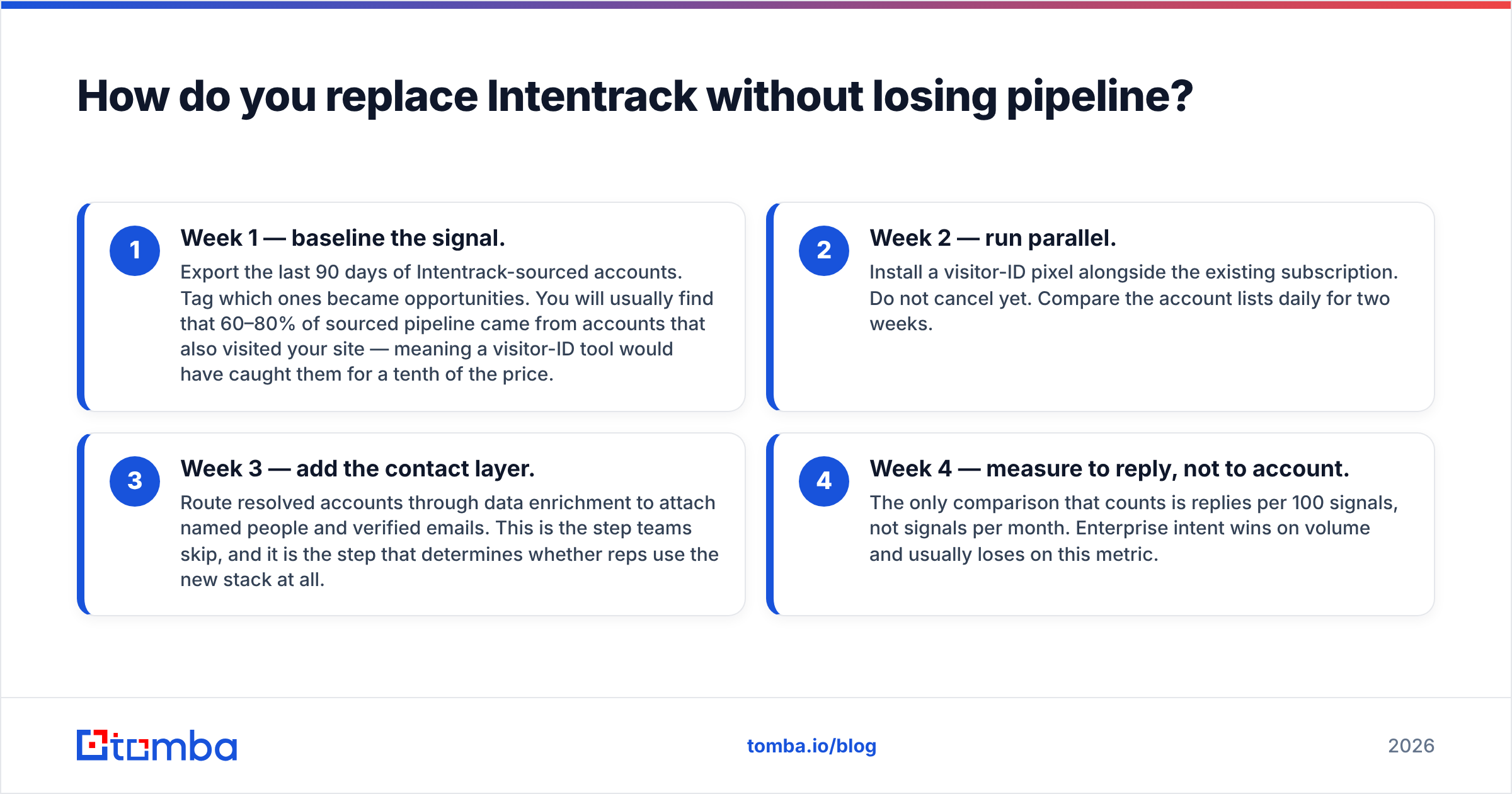
A four-week migration that does not create a gap:
- Week 1 — baseline the signal. Export the last 90 days of Intentrack-sourced accounts. Tag which ones became opportunities. You will usually find that 60–80% of sourced pipeline came from accounts that also visited your site — meaning a visitor-ID tool would have caught them for a tenth of the price.
- Week 2 — run parallel. Install a visitor-ID pixel alongside the existing subscription. Do not cancel yet. Compare the account lists daily for two weeks.
- Week 3 — add the contact layer. Route resolved accounts through data enrichment to attach named people and verified emails. This is the step teams skip, and it is the step that determines whether reps use the new stack at all.
- Week 4 — measure to reply, not to account. The only comparison that counts is replies per 100 signals, not signals per month. Enterprise intent wins on volume and usually loses on this metric.
If you cannot get replies out of the new stack, the problem is almost never the intent source — it is deliverability or contact quality. Check your email deliverability basics and bounce rate before blaming the signal.
Which alternative fits your team?#
- Under 10 reps, SMB/mid-market ACV: visitor ID (Dealfront or Albacross in Europe, RB2B in the US) + verified contact data. Budget: under $300/month combined.
- 10–50 reps, enterprise ACV, ABM motion: 6sense or Demandbase, with a contact-enrichment layer on top. Budget: five figures annually, plus ops headcount.
- Product-led, US-heavy traffic: RB2B or Warmly for person-level reveal, enrichment for anything they miss.
- Testing a brand-new segment: buy a small verified list (BookYourData is a solid pay-as-you-go route), sequence it, and only invest in intent after the segment proves out.
- API-first / building internally: skip the suites, wire Tomba's API into whatever signal source you already trust. Full Tomba pricing is public, so you can model cost per resolved contact before writing a line of code.
Frequently asked questions#
Do I need intent data and a visitor-ID tool? Not usually at the same time. Start with visitor ID — it is cheaper and the signal is stronger. Add third-party intent when you have exhausted your own traffic.
Is person-level visitor identification legal? In the US, broadly yes under current practice. In the EU and UK, person-level reveal without consent is contested and most reputable vendors restrict it. Company-level reveal is far safer ground. Get your own legal read; this is not it.
Will switching hurt deliverability? Only if the new contact source is worse. Verify every address before it enters a sequence — bounce rate above 2% damages sender reputation faster than any single intent decision.
Stop paying enterprise prices for anonymous page views. Whatever signal source you land on, the last mile is the same: a real person, a verified email, and a send that actually arrives. Start free with the Tomba Email Finder — 25 searches a month, no card — and see how many of the accounts your intent tool flagged last week you can put a named, verified contact against in the next ten minutes.
Related guides#
// get started
Find, verify and enrich your first contacts today
Start on the free plan with 25 searches a month, then scale when your team is ready.
Free plan · No credit card required · GDPR & CCPA
// about the author