9 Best Intentsify Alternatives in 2026: Intent Data Compared
Intentsify bundles intent signals with content syndication, but it is not the only way to spot in-market accounts. Here are nine alternatives compared on signal quality, contact data, and what they actually cost.
TL;DR
- Intentsify's real differentiator is not raw intent data — it is the bundled activation layer (content syndication, display, programmatic) that turns signals into leads. If you only want signals, you are overpaying.
- The strongest like-for-like swaps are Bombora (signal purity), 6sense and Demandbase (full ABM platforms), and G2 Buyer Intent (review-site signals that convert unusually well).
- If your bottleneck is actually "we have accounts but no one to email," an intent platform will not fix it. Contact-level data from a tool like Tomba or a list provider like BookYourData solves a different problem — usually the cheaper one.
- Budget reality: enterprise intent platforms in 2026 still cluster in the $30k–$100k+ annual range. Signal-only and contact-data tools start at double-digit monthly prices.
- Pick by what you can act on this quarter, not by dashboard screenshots. A weekly list of 40 warm accounts with verified contacts beats a heat map nobody works.
What is Intentsify, and what does it actually sell?#
Intentsify is an intent-based account intelligence platform. It ingests buyer intent signals from a mix of sources, scores accounts against your ideal customer profile, and then — this is the part people underrate — offers to act on those signals for you through content syndication, display advertising, and programmatic campaigns.
That bundle is the whole strategy. Intentsify sits between a pure data vendor (which hands you a feed and wishes you luck) and a full ABM suite (which wants to own your entire go-to-market stack). For marketing teams with demand-gen budget and no in-house activation muscle, that middle position is genuinely useful.
It also explains why people shop for alternatives. Three complaints come up repeatedly in buyer conversations and on G2:
- Cost versus attributable pipeline. Syndication-led programs generate MQLs that sales frequently disqualifies, and the annual commitment makes that hard to walk back mid-contract.
- Signal opacity. You are told an account is surging. Understanding exactly why, from which sources, and with what confidence, is harder than with a source-transparent vendor.
- No contact layer you can just use. Knowing that Acme Corp is researching your category is step one. Getting the VP of Ops at Acme into a sequence is step two, and intent platforms are consistently weaker at step two than at step one.
If any of those describe you, the good news is that the market in 2026 is unbundled enough to buy exactly the piece you need.
What should you compare in an Intentsify alternative?#
Do not start with feature lists. Start with these five dimensions, because they are what actually differ once you get past the demo:
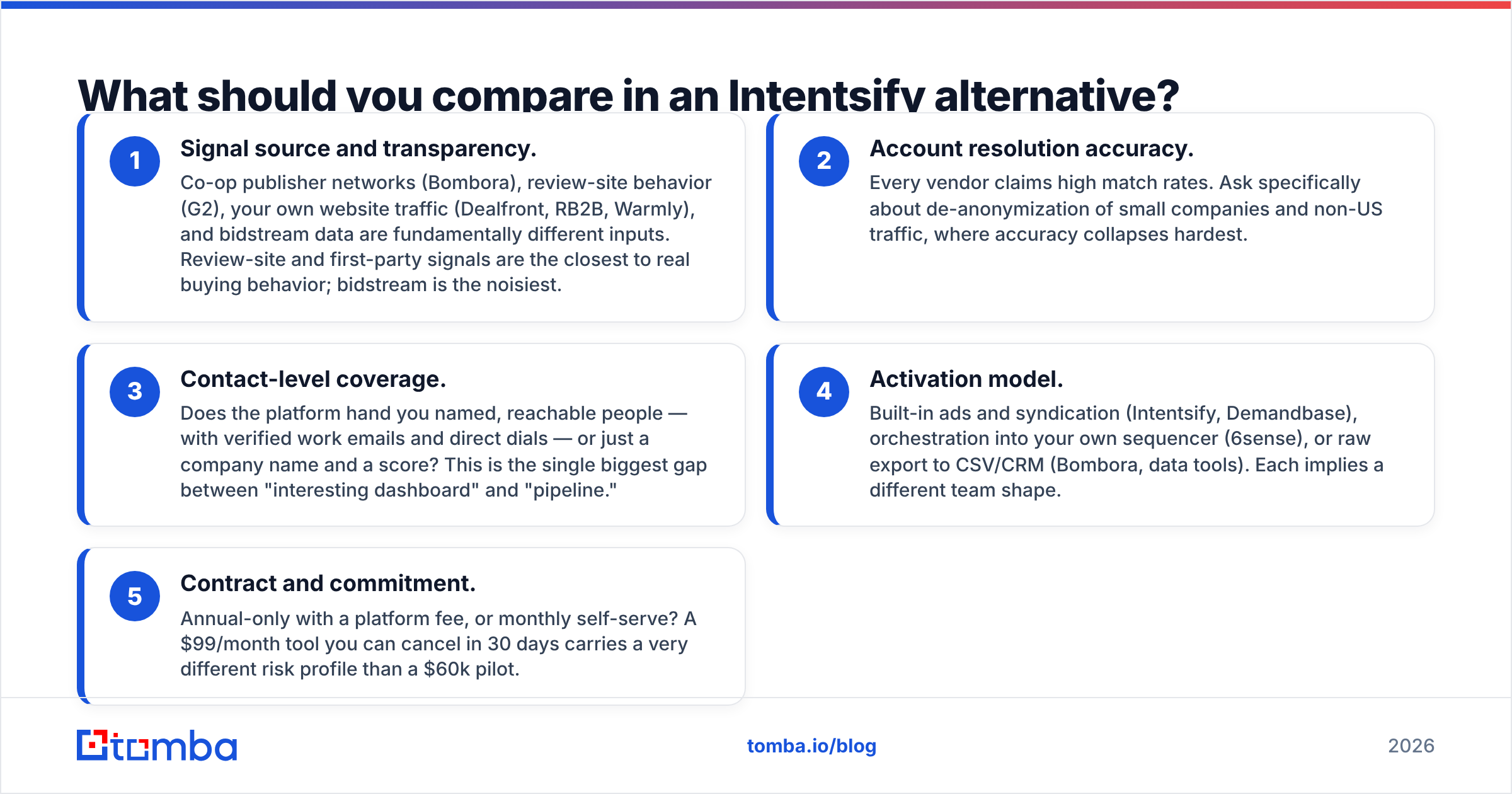
- Signal source and transparency. Co-op publisher networks (Bombora), review-site behavior (G2), your own website traffic (Dealfront, RB2B, Warmly), and bidstream data are fundamentally different inputs. Review-site and first-party signals are the closest to real buying behavior; bidstream is the noisiest.
- Account resolution accuracy. Every vendor claims high match rates. Ask specifically about de-anonymization of small companies and non-US traffic, where accuracy collapses hardest.
- Contact-level coverage. Does the platform hand you named, reachable people — with verified work emails and direct dials — or just a company name and a score? This is the single biggest gap between "interesting dashboard" and "pipeline."
- Activation model. Built-in ads and syndication (Intentsify, Demandbase), orchestration into your own sequencer (6sense), or raw export to CSV/CRM (Bombora, data tools). Each implies a different team shape.
- Contract and commitment. Annual-only with a platform fee, or monthly self-serve? A $99/month tool you can cancel in 30 days carries a very different risk profile than a $60k pilot.
What are the best Intentsify alternatives in 2026?#
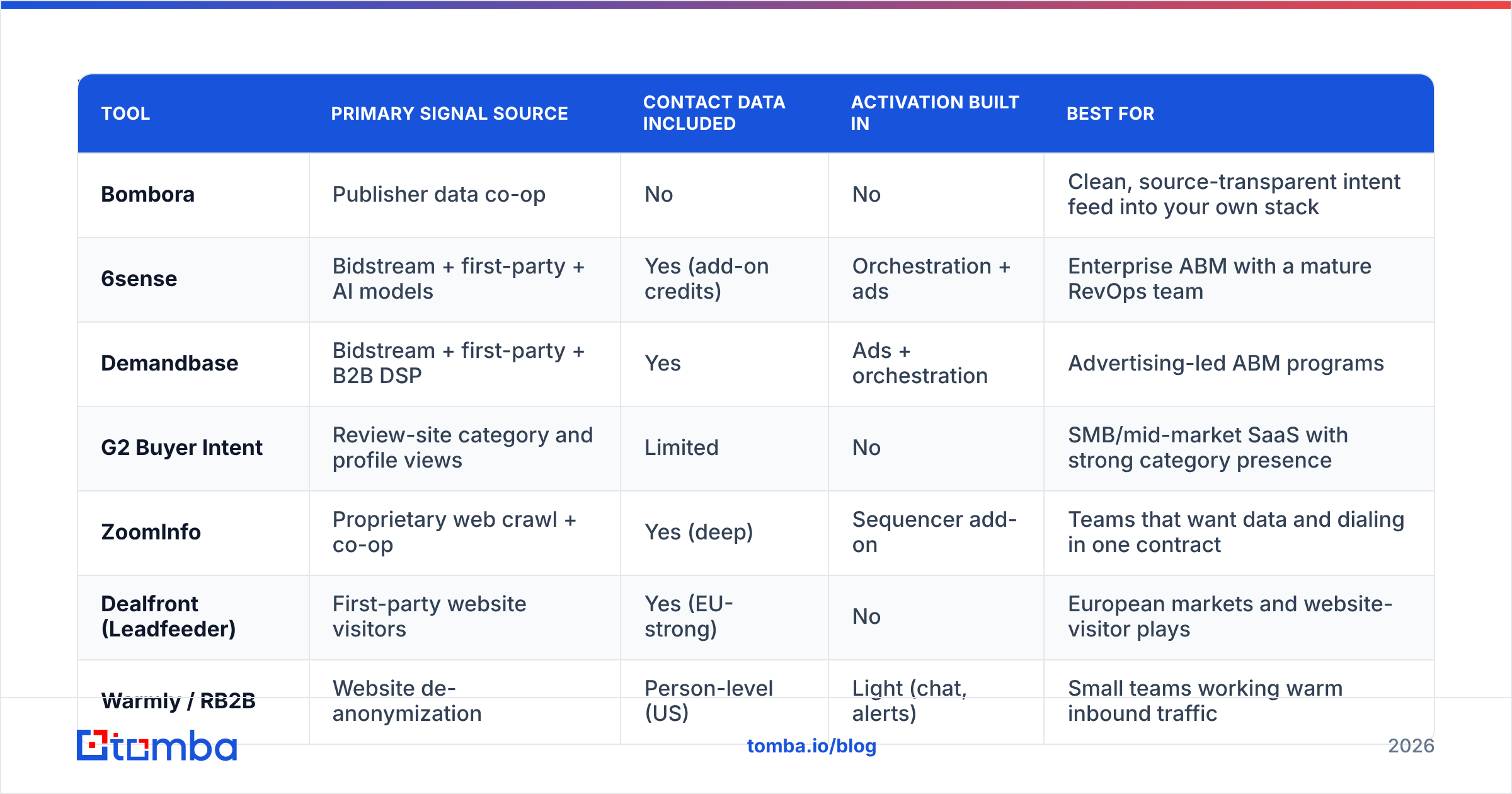
| Tool | Primary signal source | Contact data included | Activation built in | Best for |
|---|---|---|---|---|
| Bombora | Publisher data co-op | No | No | Clean, source-transparent intent feed into your own stack |
| 6sense | Bidstream + first-party + AI models | Yes (add-on credits) | Orchestration + ads | Enterprise ABM with a mature RevOps team |
| Demandbase | Bidstream + first-party + B2B DSP | Yes | Ads + orchestration | Advertising-led ABM programs |
| G2 Buyer Intent | Review-site category and profile views | Limited | No | SMB/mid-market SaaS with strong category presence |
| ZoomInfo | Proprietary web crawl + co-op | Yes (deep) | Sequencer add-on | Teams that want data and dialing in one contract |
| Dealfront (Leadfeeder) | First-party website visitors | Yes (EU-strong) | No | European markets and website-visitor plays |
| Warmly / RB2B | Website de-anonymization | Person-level (US) | Light (chat, alerts) | Small teams working warm inbound traffic |
| Tomba | Contact discovery and verification | Yes (core product) | No | Turning any account list into verified, sendable contacts |
| BookYourData | Curated, pay-as-you-go B2B lists | Yes | No | One-off list purchases without an annual contract |
Bombora — the signal purity option#
Bombora runs a co-op of B2B publishers and reports Company Surge scores based on content consumption across that network. It is the reference standard most other vendors either license from or benchmark against, and Bombora is unusually open about taxonomy and methodology.
What you give up: activation. Bombora is a feed, not a campaign engine. You need a CRM, a sequencer, and someone to own the workflow. What you gain: you can audit why an account is flagged, and you can pipe the same signal into six destinations instead of one walled garden.
6sense — the full-stack enterprise replacement#
6sense is the most complete replacement for what Intentsify does, plus considerably more: predictive account scoring, buying-stage prediction, orchestration, and its own advertising. If you have a RevOps function that can configure it and a marketing ops person to maintain it, it consolidates several line items.
The honest caveats are price and time-to-value. Six-figure contracts are common, and most teams describe a 60–90 day ramp before the model is producing trustworthy stage predictions. Buying 6sense to replace a mid-market intent subscription is usually a budget increase, not a swap.
Demandbase — when advertising is the main motion#
Demandbase leans harder into the B2B advertising side, with its own DSP and strong account identification. If your Intentsify usage is dominated by display and programmatic activation rather than sales alerts, Demandbase is the closest structural match. If your usage is dominated by content syndication leads, note that Demandbase does not replace that motion directly.
G2 Buyer Intent — the highest-conviction signal per dollar#
Someone comparing you against two named competitors on a review site is not vaguely curious. They are shortlisting. That makes G2 Buyer Intent one of the best signal-to-noise ratios available, and pricing is far more approachable than platform-tier ABM.
The constraint is coverage. You only see activity on your category and profile pages, which means the volume is small and skewed toward companies that use review sites. Treat it as a high-priority trigger layered on top of a broader source, not as your only input.
ZoomInfo — data depth over signal sophistication#

ZoomInfo's intent module is decent; its contact database is the real reason people buy it. If your team's complaint about Intentsify is "the accounts are fine but we cannot reach anyone," ZoomInfo solves that in one contract — at a price and contract length that many mid-market teams find punishing.
Dealfront, Warmly, and RB2B — first-party visitor plays#
This category answers a narrower question: who is already on my website? Dealfront is the strongest option for European markets and GDPR-conscious deployments. Warmly and RB2B focus on fast, person-level alerts on US traffic that route into Slack or your sequencer within minutes.
These are not Intentsify replacements in scope. They are frequently better than Intentsify at the specific job of converting existing traffic, and they cost a fraction as much. Many teams end up running one of these plus a cheap contact-data tool and killing the platform subscription entirely.
Tomba — the contact layer under every account list#
Tomba does not sell intent. It sells the step after intent: turning a company name into verified, deliverable contacts. Run an account list through domain search to pull the people at each company, filter by department and seniority, then push everything through the email verifier before it touches your sending domain.
Pricing is public and self-serve — Free at 25 searches/month, Starter $49/mo, Growth $99/mo, Pro $249/mo, Enterprise custom — and the Tomba API means you can wire enrichment directly into whatever intent source you end up choosing. For teams whose actual failure point is a thin contact layer rather than weak signals, this is the cheapest fix on the list.
BookYourData — when you just need the list#
BookYourData is a well-regarded pay-as-you-go B2B contact provider with strong accuracy guarantees and no annual lock-in. If your need is episodic — a conference follow-up list, a new vertical test, a one-market expansion — buying a clean list outright is often more sensible than provisioning a platform seat you will use for six weeks. It complements an intent tool rather than competing with one.
How do the pricing models actually compare?#
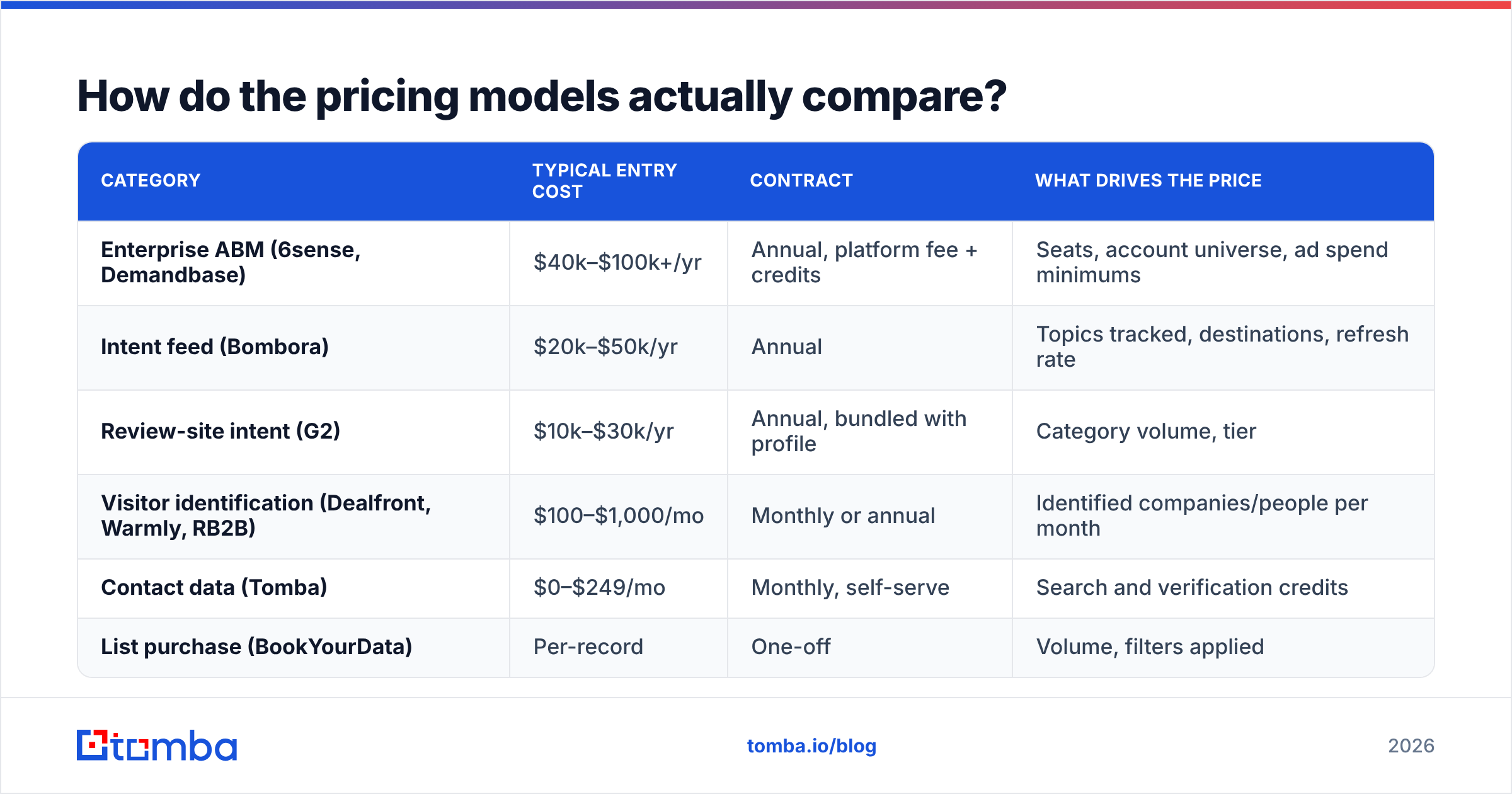
Published pricing in this category is rare, so treat these as buyer-reported ranges rather than rate cards. Always get your own quote.
| Category | Typical entry cost | Contract | What drives the price |
|---|---|---|---|
| Enterprise ABM (6sense, Demandbase) | $40k–$100k+/yr | Annual, platform fee + credits | Seats, account universe, ad spend minimums |
| Intent feed (Bombora) | $20k–$50k/yr | Annual | Topics tracked, destinations, refresh rate |
| Review-site intent (G2) | $10k–$30k/yr | Annual, bundled with profile | Category volume, tier |
| Visitor identification (Dealfront, Warmly, RB2B) | $100–$1,000/mo | Monthly or annual | Identified companies/people per month |
| Contact data (Tomba) | $0–$249/mo | Monthly, self-serve | Search and verification credits |
| List purchase (BookYourData) | Per-record | One-off | Volume, filters applied |
The spread is the point. A team can assemble visitor identification plus verified contact data plus a sequencer for under $500/month. That stack does not do predictive buying-stage modeling, and for a 6-person sales team it does not need to.
Is intent data worth it without a contact layer?#
No — and this is the most expensive lesson in the category.
Intent data tells you which door to knock on. It does not tell you who opens it. Most platforms surface a company, a topic cluster, and a score. Your rep still has to identify the four relevant stakeholders, find their addresses, confirm those addresses are live, and write something worth reading. If that pipeline is broken, better signals just mean more accounts you fail to contact.
Two practical consequences:
- Budget the contact layer before the signal layer. Verified contacts improve every campaign you run, including the ones that have nothing to do with intent. Signals only improve the campaigns you have the capacity to act on.
- Protect deliverability on the way in. Scraped or stale addresses produce bounces, and bounces damage sender reputation faster than any content problem. Verification is not optional hygiene, it is the thing keeping your domain out of spam folders. A bulk verify pass on any purchased or exported list should be automatic.
How should you choose between these Intentsify alternatives?#
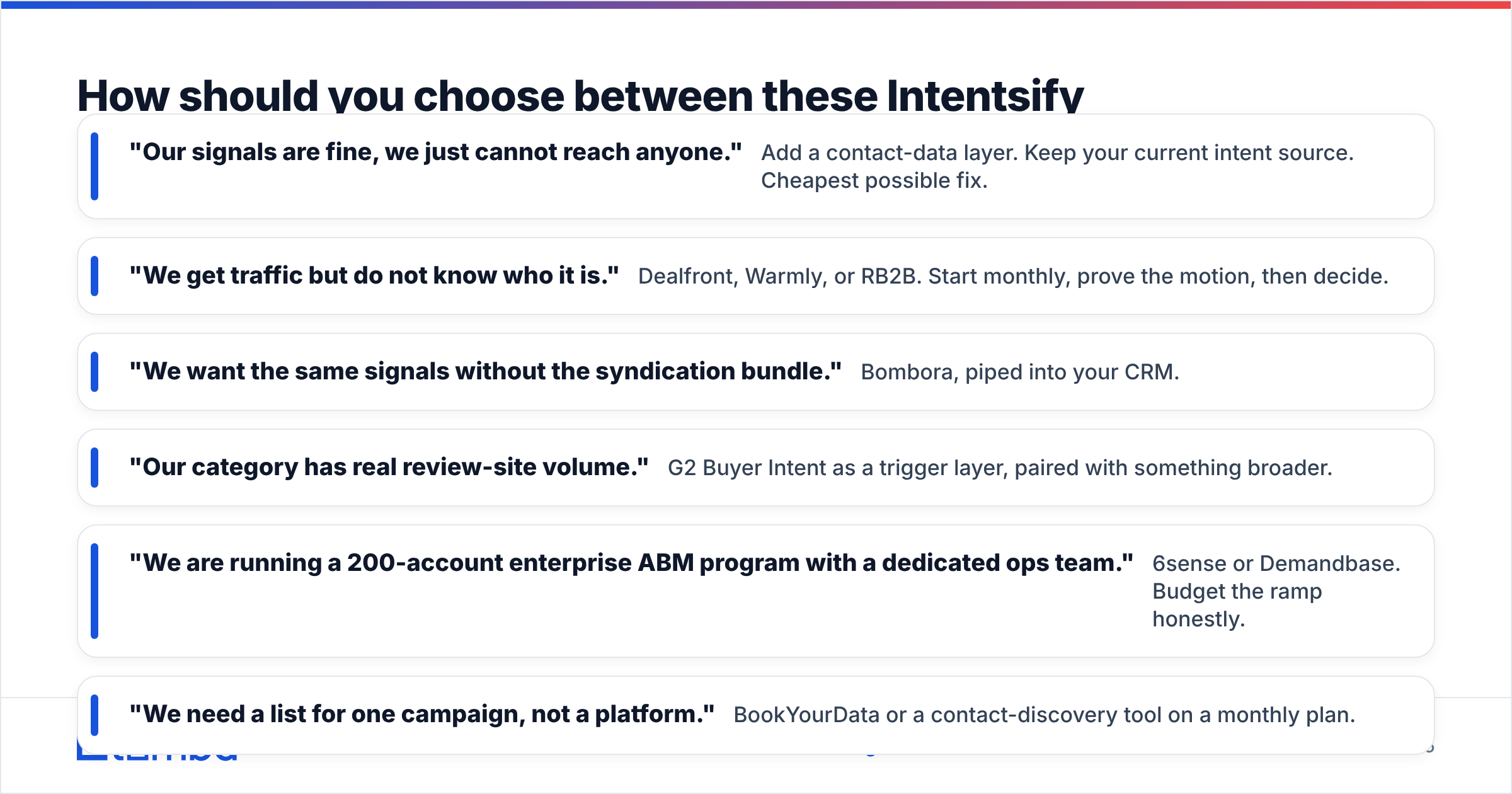
Match the tool to your actual constraint:
- "Our signals are fine, we just cannot reach anyone." Add a contact-data layer. Keep your current intent source. Cheapest possible fix.
- "We get traffic but do not know who it is." Dealfront, Warmly, or RB2B. Start monthly, prove the motion, then decide.
- "We want the same signals without the syndication bundle." Bombora, piped into your CRM.
- "Our category has real review-site volume." G2 Buyer Intent as a trigger layer, paired with something broader.
- "We are running a 200-account enterprise ABM program with a dedicated ops team." 6sense or Demandbase. Budget the ramp honestly.
- "We need a list for one campaign, not a platform." BookYourData or a contact-discovery tool on a monthly plan.
Run any new source as a 90-day test with a pre-agreed success metric — meetings booked from flagged accounts, not MQLs delivered. Intent platforms are very good at producing activity. Only some of them produce pipeline.
Ready to turn intent signals into contacts you can actually email?#
Whichever intent source you pick, the signal is worthless until someone replies. Tomba Email Finder takes the accounts your intent tool surfaces and returns verified, deliverable work emails for the exact roles you are targeting — with a free tier at 25 searches a month, $49/mo Starter plans, and an API that drops straight into the workflow you already have. Start with your current warm-account list, verify it, and see how much of your "intent problem" was really a contact problem.
Related guides#
// get started
Find, verify and enrich your first contacts today
Start on the free plan with 25 searches a month, then scale when your team is ready.
Free plan · No credit card required · GDPR & CCPA
// about the author