Interest Based Negotiation: The B2B Sales Playbook for 2026
Positional haggling caps your deal size and kills margin. Interest based negotiation digs past the stated demand to the real driver behind it — here's the framework, the scripts, and where it fails.
TL;DR
- Interest based negotiation means you trade on the why behind a demand, not the demand itself. "We need 30% off" is a position; "my CFO capped Q4 software spend at $40k" is an interest — and only one of those has more than one solution.
- The method comes from the Harvard Negotiation Project (Getting to Yes). Four moves: separate people from the problem, focus on interests, invent options for mutual gain, insist on objective criteria.
- It reliably outperforms positional bargaining on margin, contract length, and renewal rates — not necessarily on close speed. Transactional, one-shot, price-only deals are where it wastes your time.
- The hardest part isn't the negotiation. It's the discovery that precedes it: you cannot trade interests you never uncovered, and most reps discover exactly one (budget).
- Your prep checklist matters more than your table technique. Know their BATNA, your walk-away number, and at least four non-price variables you can move.
What is interest based negotiation?#
Interest based negotiation is a bargaining approach where both sides surface the underlying needs driving their demands, then build an agreement that satisfies as many of those needs as possible — instead of meeting in the middle on a single number.
Here's the everyday version. Two people want the last orange in the kitchen. Positional bargaining cuts it in half, and both walk away half-satisfied. Interest based negotiation asks why. One wants the juice; the other wants the peel for a cake. Cut it wrong and you destroyed half the value that was sitting there for free.
B2B deals are full of oranges. A prospect says "your price is too high." That single sentence could mean:
- Their budget cycle doesn't reset until January.
- They have an internal benchmark from a competitor's quote.
- Procurement measures them on discount-achieved, not on outcome.
- They genuinely cannot justify the ROI at your price with their current volume.
- They're testing whether you'll fold, because your last rep did.
Five different interests, five different solutions, and only one of them is actually solved by a discount. If you respond to the position with a number, you're guessing — and you're guessing with your own margin.
The framework was formalized by Roger Fisher and William Ury at the Harvard Program on Negotiation, whose work on principled negotiation remains the canonical text nearly five decades on. Sales adopted it late, and adopted it badly — most "value selling" training is interest based negotiation with the discovery step removed.
How does it differ from positional bargaining?#
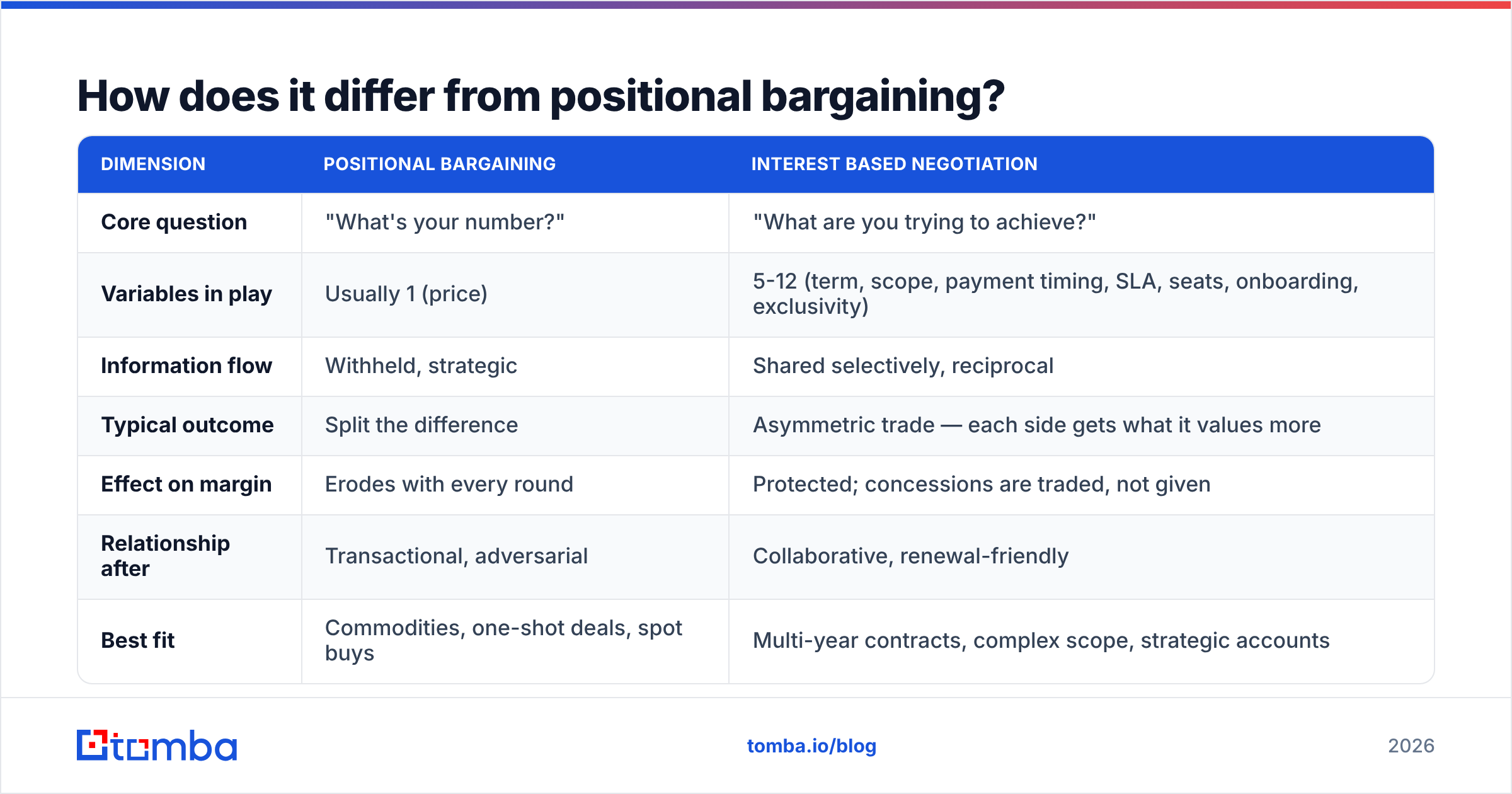
Positional bargaining is a tug of war over one variable. Interest based negotiation turns the rope into a table with many things on it.
| Dimension | Positional bargaining | Interest based negotiation |
|---|---|---|
| Core question | "What's your number?" | "What are you trying to achieve?" |
| Variables in play | Usually 1 (price) | 5-12 (term, scope, payment timing, SLA, seats, onboarding, exclusivity) |
| Information flow | Withheld, strategic | Shared selectively, reciprocal |
| Typical outcome | Split the difference | Asymmetric trade — each side gets what it values more |
| Effect on margin | Erodes with every round | Protected; concessions are traded, not given |
| Relationship after | Transactional, adversarial | Collaborative, renewal-friendly |
| Best fit | Commodities, one-shot deals, spot buys | Multi-year contracts, complex scope, strategic accounts |
| Failure mode | Deadlock or margin collapse | Over-disclosure to a hard bargainer |
| Prep time required | Low | High — discovery is the whole game |
Notice the failure mode row. Interest based negotiation is not universally superior. Against a trained procurement professional running a pure hard-bargaining playbook, over-sharing your interests hands them a map of your pressure points. The counter isn't to abandon the method — it's to insist on objective criteria before you disclose anything soft.

What are the four principles, concretely?#
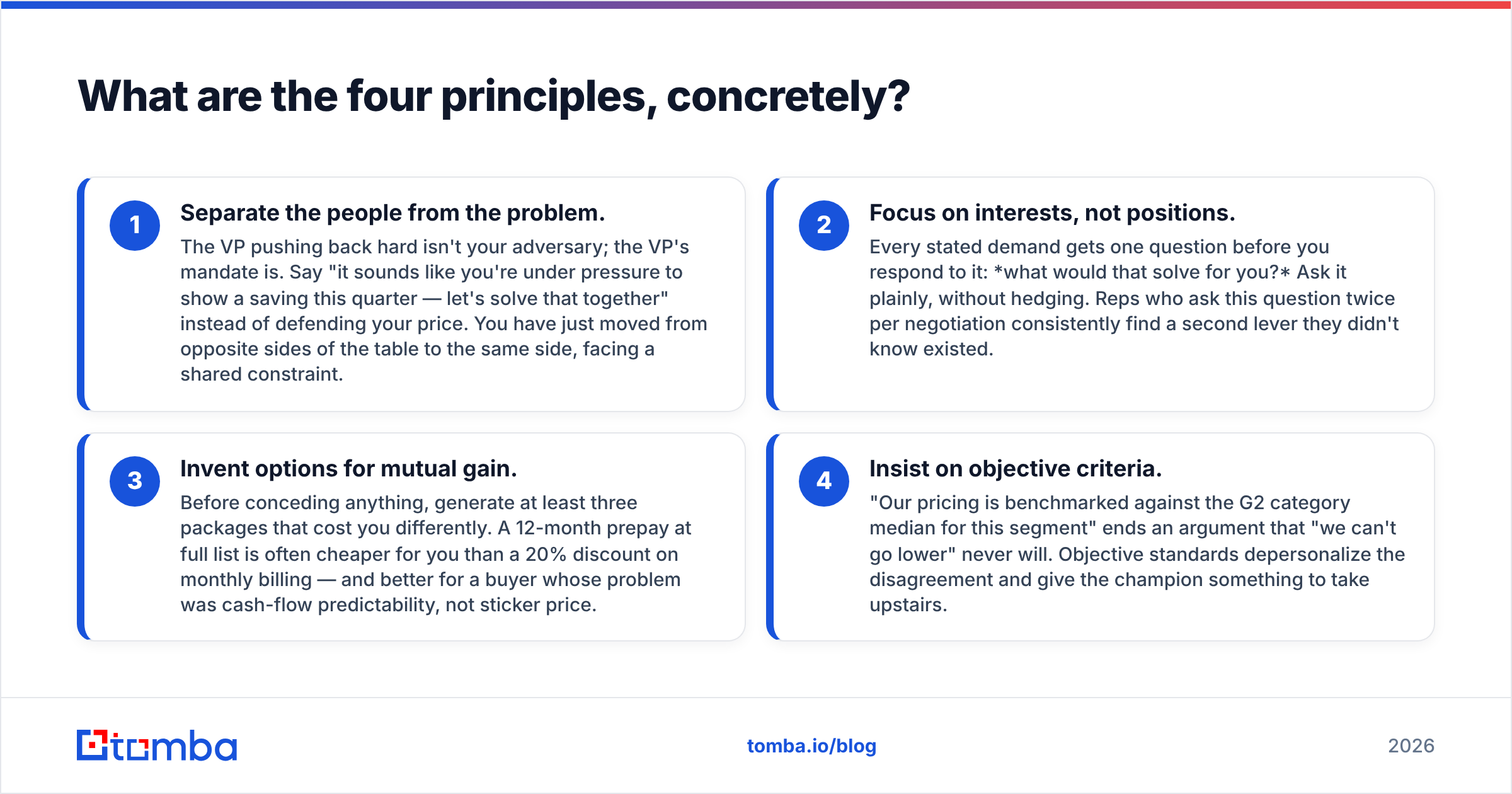
Fisher and Ury's four principles are usually taught as abstractions. Here's what each one looks like on a Tuesday afternoon call.
Separate the people from the problem. The VP pushing back hard isn't your adversary; the VP's mandate is. Say "it sounds like you're under pressure to show a saving this quarter — let's solve that together" instead of defending your price. You have just moved from opposite sides of the table to the same side, facing a shared constraint.
Focus on interests, not positions. Every stated demand gets one question before you respond to it: what would that solve for you? Ask it plainly, without hedging. Reps who ask this question twice per negotiation consistently find a second lever they didn't know existed.
Invent options for mutual gain. Before conceding anything, generate at least three packages that cost you differently. A 12-month prepay at full list is often cheaper for you than a 20% discount on monthly billing — and better for a buyer whose problem was cash-flow predictability, not sticker price.
Insist on objective criteria. "Our pricing is benchmarked against the G2 category median for this segment" ends an argument that "we can't go lower" never will. Objective standards depersonalize the disagreement and give the champion something to take upstairs.
The fifth principle — the one Ury added later and the one most sales teams skip — is know your BATNA: your Best Alternative To a Negotiated Agreement. If your pipeline is thin, every buyer can smell it. The most powerful move in interest based negotiation happens weeks before the call, when you built enough pipeline that walking away is genuinely survivable.
Where does discovery actually come from?#
You cannot trade on interests you never found. This is the practical bottleneck, and it's upstream of every negotiation technique in this post.
Most reps enter a negotiation knowing one interest: budget. They know it because the buyer volunteered it. Everything else — the competing internal initiative, the champion's promotion timeline, the renewal date on the incumbent contract, the compliance deadline forcing a decision — has to be built before the call.
That means:
- Multi-threading. A single contact gives you a single set of interests, usually the least strategic ones. The economic buyer, the technical evaluator, and the end user each want different things, and those differences are your trading material. Getting to three contacts inside an account starts with finding them — a domain search across the company returns the org's email patterns and the people attached to them in one pass.
- Pre-call research on the buyer's constraints. Earnings calls, job postings, and press releases telegraph interests. A company hiring six security engineers has a compliance interest it will not mention on a discovery call.
- Knowing the incumbent. If you don't know what they're paying today, you're negotiating blind against a number the buyer knows and you don't.
- Verified contact data. Multi-threading dies quietly when your emails bounce. Bounced outreach to a second stakeholder doesn't just fail — it dents your sender reputation for every other thread in that account. Run new contacts through an email verifier before you send.
Discovery isn't a stage that ends. In interest based negotiation, you're still discovering in the final call — because a new interest surfaced under pressure is often the one that closes the deal.
What does an interest based script sound like?#
Three moments where the method changes what you say.
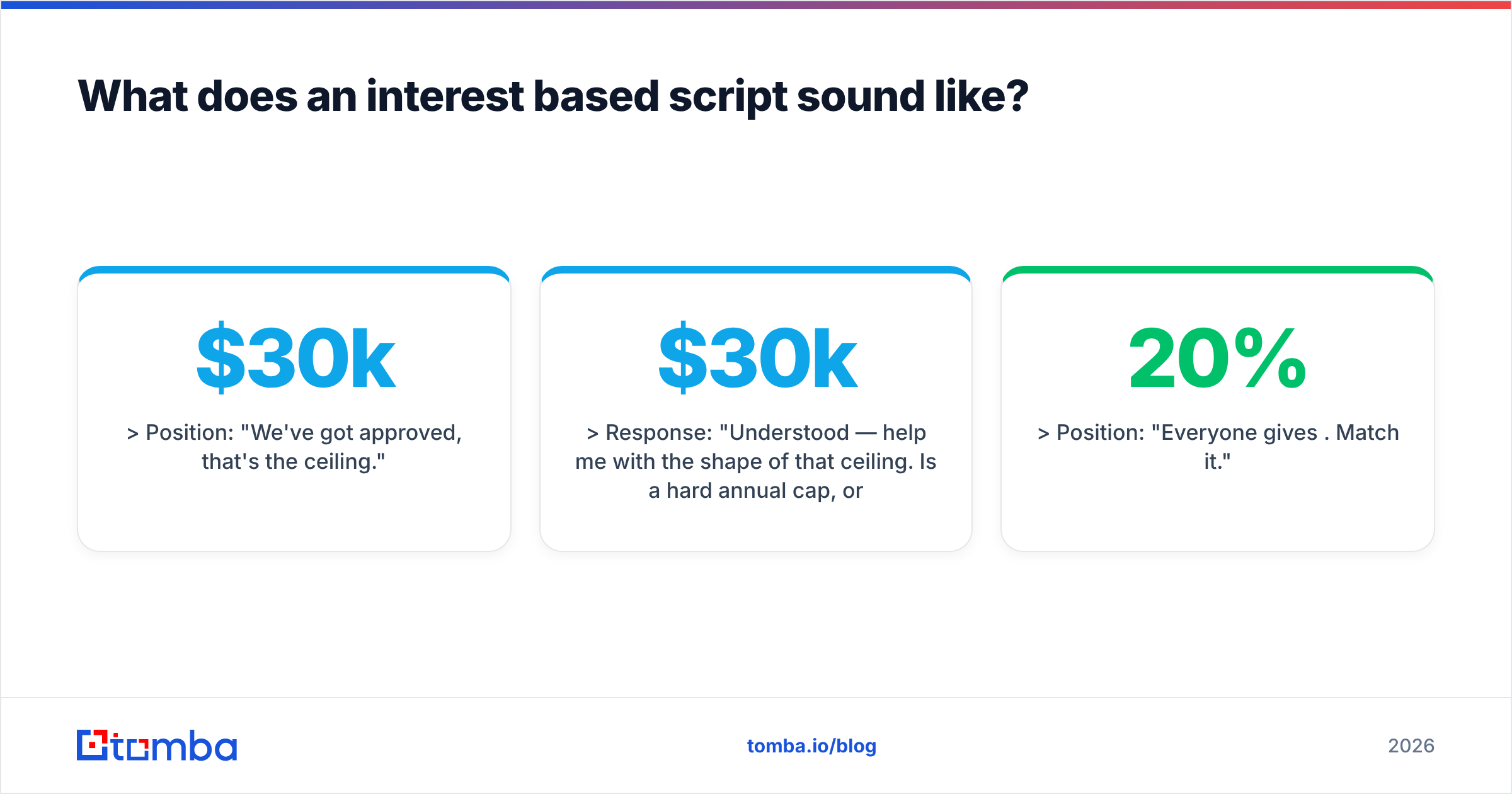
When they anchor low.
Position: "We've got $30k approved, that's the ceiling."
Response: "Understood — help me with the shape of that ceiling. Is $30k a hard annual cap, or a Q4 cap that resets? Because if it resets, there's a version of this that starts smaller now and expands in January, and you'd get the full deployment you actually need."
When they demand a discount they don't need.
Position: "Everyone gives 20%. Match it."
Response: "I can't move list price without changing what you're buying — that's how our pricing works, and it's the same for every customer. What I can do is move term, payment timing, or onboarding scope. Which of those three is worth the most to you?"
Notice what happened: you refused the position, held an objective criterion, and immediately offered three alternative currencies. The negotiation continues, but it's no longer about the number.
When you hit apparent deadlock.
Position: "We just can't get there."
Response: "Let's assume for a minute we don't do a deal. What happens on your side in six months?" — Their answer is their BATNA. It is the single most valuable piece of information in the room, and buyers give it up surprisingly often because it feels like venting rather than disclosure.

When should you NOT use interest based negotiation?#
Honest answer: more often than the framework's evangelists admit.
Skip it when the deal is genuinely transactional. A $200/month self-serve upgrade doesn't warrant a two-hour interest-mapping exercise. The discovery cost exceeds the deal value. Publish your price, hold it, move on.
Skip it when there's no relationship after. Interest based negotiation pays off across the relationship's lifetime — renewals, expansions, referrals. A one-shot deal with a buyer you will never see again removes most of that payoff, and a purely distributive approach is rational.
Be careful when the other side is trained to exploit disclosure. Enterprise procurement teams at large organizations are frequently trained in exactly this asymmetry: extract your interests, disclose none of their own. The defense is reciprocity — disclose one interest, then wait. If they don't reciprocate, stop disclosing and move to objective criteria only. Research from Forrester on B2B buying complexity has consistently found more stakeholders in enterprise decisions, which cuts both ways: more interests to trade, more people who benefit from your transparency without returning it.
Be careful in a weak-BATNA quarter. The method assumes you can walk. If you can't, you're not negotiating on interests — you're performing collaboration while conceding. Buyers notice.
What does a prep sheet look like?#
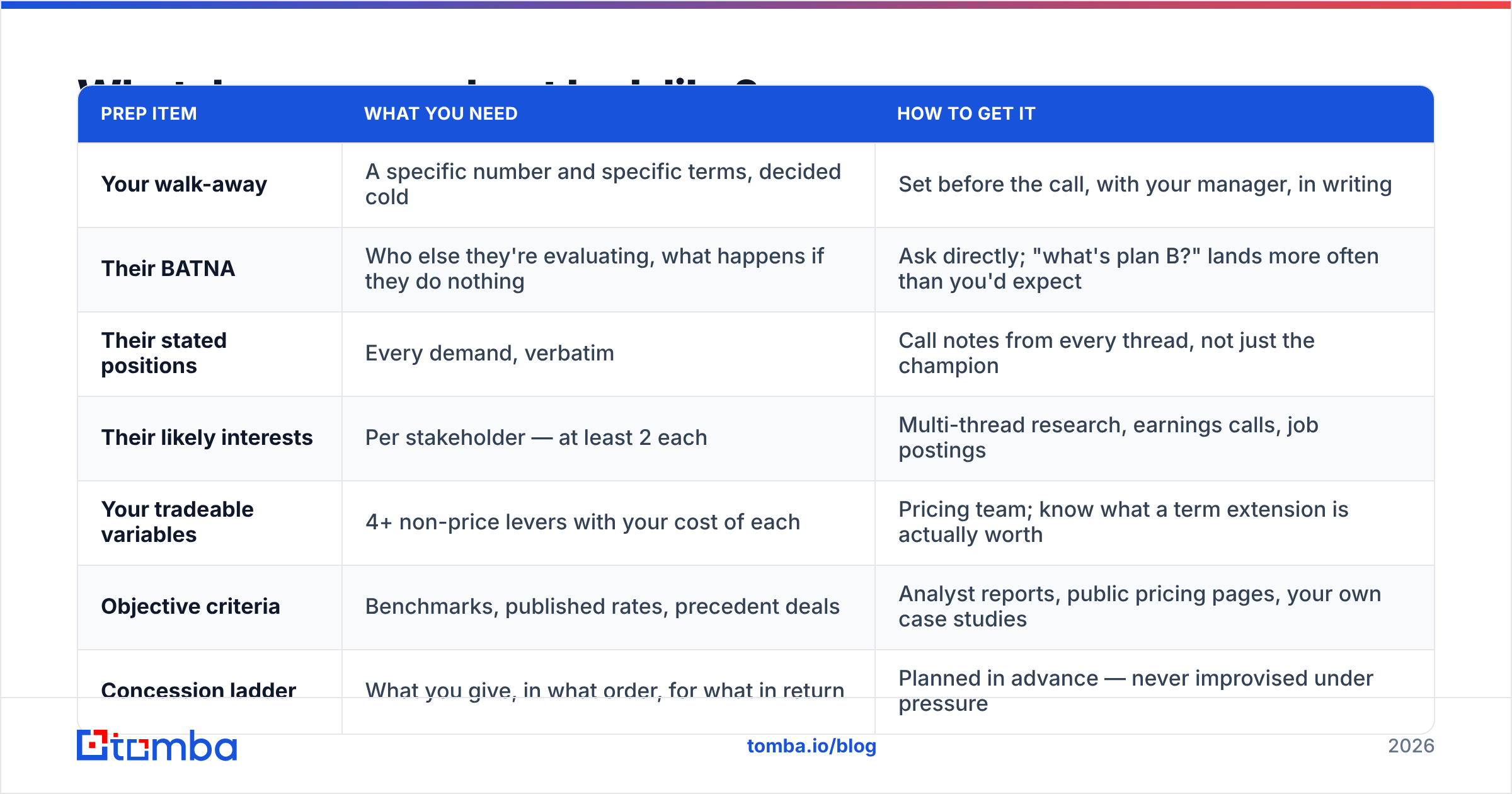
Fill this out before every negotiation above your average deal size. Fifteen minutes, and it beats any table technique.
| Prep item | What you need | How to get it |
|---|---|---|
| Your walk-away | A specific number and specific terms, decided cold | Set before the call, with your manager, in writing |
| Their BATNA | Who else they're evaluating, what happens if they do nothing | Ask directly; "what's plan B?" lands more often than you'd expect |
| Their stated positions | Every demand, verbatim | Call notes from every thread, not just the champion |
| Their likely interests | Per stakeholder — at least 2 each | Multi-thread research, earnings calls, job postings |
| Your tradeable variables | 4+ non-price levers with your cost of each | Pricing team; know what a term extension is actually worth |
| Objective criteria | Benchmarks, published rates, precedent deals | Analyst reports, public pricing pages, your own case studies |
| Concession ladder | What you give, in what order, for what in return | Planned in advance — never improvised under pressure |
The "cost of each variable" row is the one teams skip and the one that generates the most money. If you don't know that a 24-month term is worth 9% of contract value to your business, you can't tell whether trading it for a 12% discount was smart or stupid. Most reps guess, and most guess wrong in the buyer's favor.
How do you scale this across a team?#
Individual skill doesn't compound. Process does.
Standardize the trade menu. Publish an internal list of every non-price concession, its cost to the business, and its typical value to a buyer. Reps stop inventing and start selecting.
Require the prep sheet above a threshold. Any deal over your median ACV doesn't get a negotiation call without one. Enforce it in the CRM as a required field, not as a suggestion.
Review deals on trades, not outcomes. In your deal reviews, stop asking "did we win?" and start asking "what did we get for the discount we gave?" A won deal with three unreciprocated concessions is a training failure that happened to close. This is a sales process discipline more than a negotiation one.
Fix the top of the funnel first. Interest based negotiation requires a credible BATNA, and a credible BATNA requires pipeline. A team negotiating from scarcity will revert to discounting under quarter-end pressure no matter how much Fisher and Ury they've read. Pipeline volume is a negotiation tool. Teams building multi-threaded coverage at scale usually run bulk lead generation against a target account list, then verify before sequencing — the boring part that makes the sophisticated part possible.
Record and review the "why would that help?" moment. It's the single highest-leverage question in the method. Pull the call recordings, find where reps asked it, and find where they didn't. The gap is your coaching plan.
What's the realistic payoff?#
Set expectations honestly. Interest based negotiation is not a magic close rate.
What it consistently improves: realized price (fewer reflexive discounts), contract term (because term is a tradeable variable and buyers often don't value it much), stakeholder buy-in (more people got something they wanted), and renewal likelihood (the deal was built on their actual needs rather than a number they were talked into).
What it doesn't reliably improve: cycle time. Interest discovery takes calls. Multi-threading takes weeks. If your compensation and forecast pressure reward speed above all else, the method will lose to "just give them 15%" every single quarter, and no amount of training will fix an incentive problem.
What it requires: discovery infrastructure. You need to reach more than one person per account, reach them reliably, and know something about them before the first call. That is a data problem before it's a skills problem.
Build the pipeline that lets you negotiate from strength. Interest based negotiation collapses the moment you can't walk away from a deal — and walking away requires enough accounts in play that one loss doesn't break the quarter. Tomba's Email Finder gets you verified contacts for every stakeholder in an account, not just the one who replied to your first email, so you can multi-thread properly and surface interests before you're at the table. Start free with 25 searches a month, or check Tomba pricing — Starter runs $49/mo and scales with the account coverage your negotiation strategy actually needs.
Related guides#
// get started
Find, verify and enrich your first contacts today
Start on the free plan with 25 searches a month, then scale when your team is ready.
Free plan · No credit card required · GDPR & CCPA
// about the author