Interseller vs LeadEngineAI: Which Outreach Tool Wins in 2026?
Interseller built its name on recruiter sequencing with contact finding attached. LeadEngineAI sells AI-first lead generation. Here is how the two actually differ on data quality, pricing model, and workflow fit — plus when neither is the right buy.
TL;DR
- Interseller is a sequencing platform first, a contact-finding tool second. It was built for recruiters, acquired by Greenhouse, and its gravity is in ATS/CRM sync and multi-step email sequences — not in raw data coverage.
- LeadEngineAI is an AI-first lead generation tool. It leans on list building, intent signals, and AI-written copy. The workflow is "describe your ICP, get a list," which is faster to start and harder to audit.
- Neither one is a data vendor. Both resell or blend third-party contact data, which is why teams running high-volume outbound usually bolt a dedicated finder and verifier onto whichever platform they pick.
- Pricing models differ more than prices do. Interseller-style tools charge per seat; AI lead engines lean toward credit bundles. Per-seat pricing punishes teams; credits punish volume.
- If your bottleneck is deliverable addresses, not sequencing, a $49/mo API-first finder plus your existing sender does the job for a fraction of either platform.
What are Interseller and LeadEngineAI?#
They solve adjacent problems that look identical on a landing page.
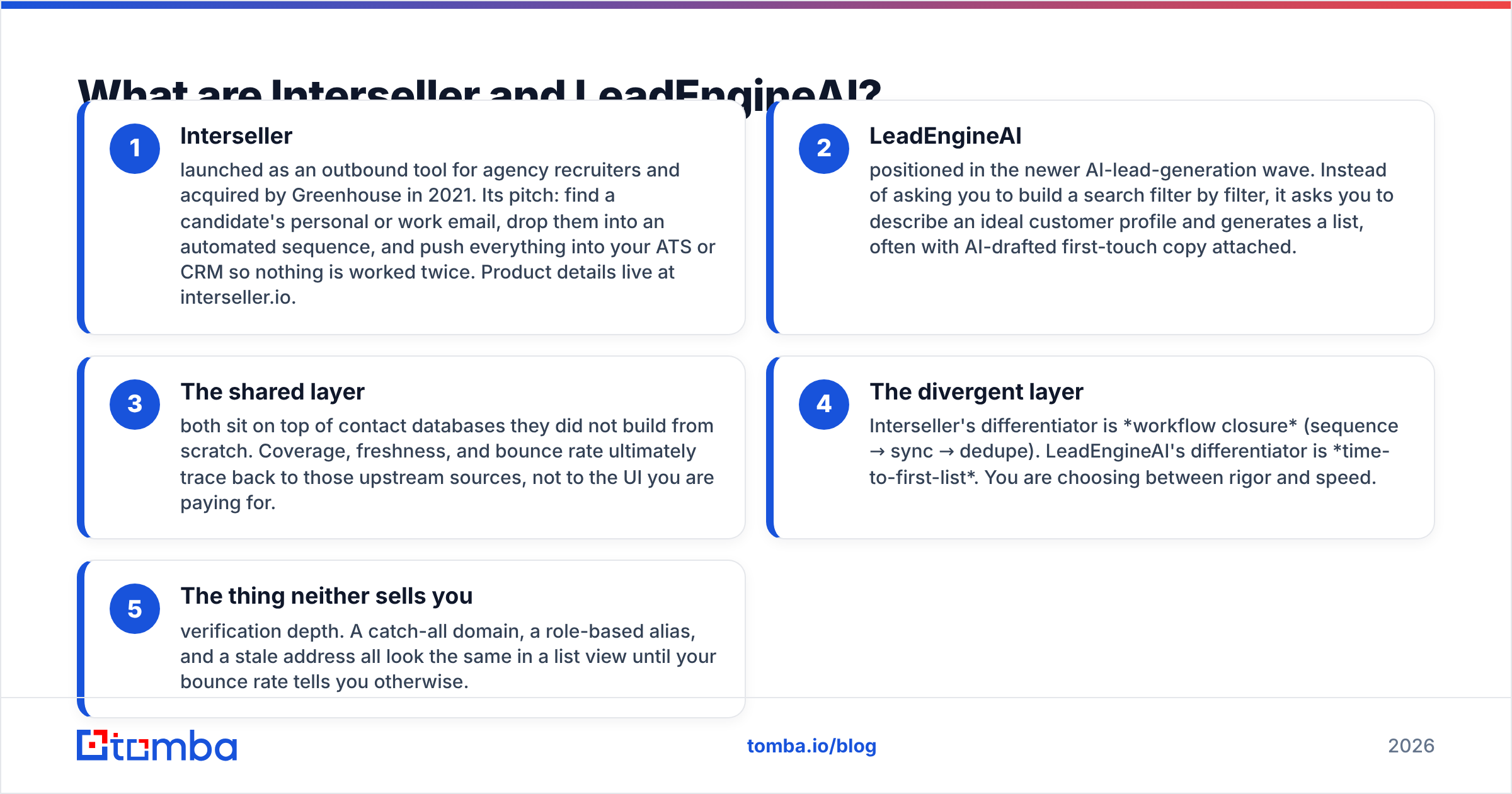
- Interseller — launched as an outbound tool for agency recruiters and acquired by Greenhouse in 2021. Its pitch: find a candidate's personal or work email, drop them into an automated sequence, and push everything into your ATS or CRM so nothing is worked twice. Product details live at interseller.io.
- LeadEngineAI — positioned in the newer AI-lead-generation wave. Instead of asking you to build a search filter by filter, it asks you to describe an ideal customer profile and generates a list, often with AI-drafted first-touch copy attached.
- The shared layer — both sit on top of contact databases they did not build from scratch. Coverage, freshness, and bounce rate ultimately trace back to those upstream sources, not to the UI you are paying for.
- The divergent layer — Interseller's differentiator is workflow closure (sequence → sync → dedupe). LeadEngineAI's differentiator is time-to-first-list. You are choosing between rigor and speed.
- The thing neither sells you — verification depth. A catch-all domain, a role-based alias, and a stale address all look the same in a list view until your bounce rate tells you otherwise.
That last point matters more than any feature checkbox. Outbound math is unforgiving: a 6% bounce rate on a 5,000-send month is 300 hard failures that your ESP reads as sloppy list hygiene, and your sender reputation absorbs the damage for weeks.

How do Interseller and LeadEngineAI compare head-to-head?#
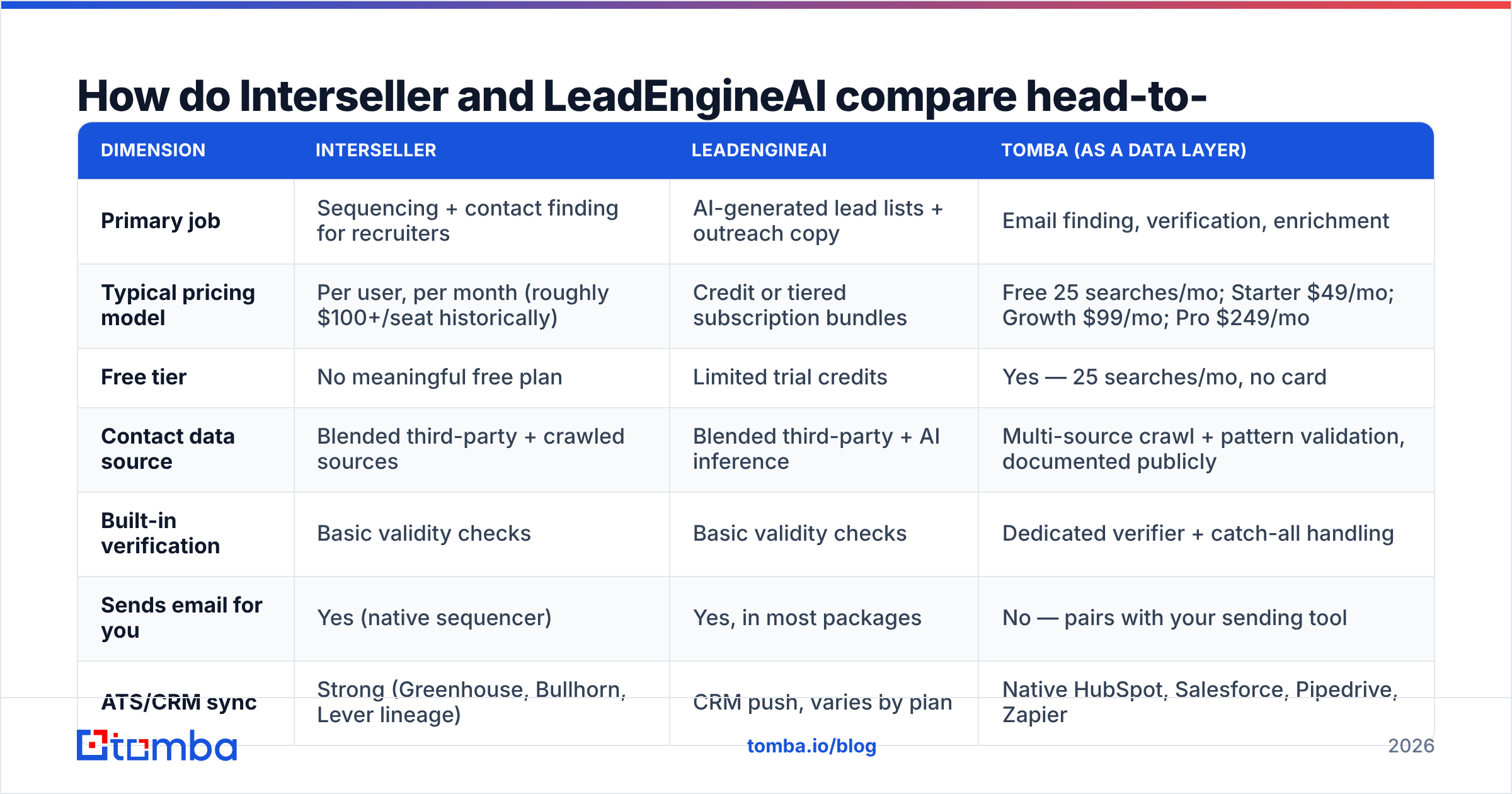
Here is the honest side-by-side. Treat pricing as directional — both vendors have repackaged plans more than once, so confirm on their own pages before you sign.
| Dimension | Interseller | LeadEngineAI | Tomba (as a data layer) |
|---|---|---|---|
| Primary job | Sequencing + contact finding for recruiters | AI-generated lead lists + outreach copy | Email finding, verification, enrichment |
| Typical pricing model | Per user, per month (roughly $100+/seat historically) | Credit or tiered subscription bundles | Free 25 searches/mo; Starter $49/mo; Growth $99/mo; Pro $249/mo |
| Free tier | No meaningful free plan | Limited trial credits | Yes — 25 searches/mo, no card |
| Contact data source | Blended third-party + crawled sources | Blended third-party + AI inference | Multi-source crawl + pattern validation, documented publicly |
| Built-in verification | Basic validity checks | Basic validity checks | Dedicated verifier + catch-all handling |
| Sends email for you | Yes (native sequencer) | Yes, in most packages | No — pairs with your sending tool |
| ATS/CRM sync | Strong (Greenhouse, Bullhorn, Lever lineage) | CRM push, varies by plan | Native HubSpot, Salesforce, Pipedrive, Zapier |
| API access | Limited | Plan-dependent | Full REST API on every paid plan |
| Best fit | Agency recruiting teams | Small teams wanting fast lists | Teams that need accurate addresses at volume |
| Worst fit | Large SDR teams (seat cost compounds) | Regulated or high-ACV outbound needing audit trails | Teams wanting an all-in-one sender |

Which one has better contact data accuracy?#
Neither publishes a bounce-rate SLA you can hold them to, which is itself the answer.
Interseller's accuracy reputation is strongest in recruiting-adjacent data — personal emails for candidates, where it historically outperformed generic B2B databases. On corporate sales personas at mid-market and enterprise accounts, it is average. LeadEngineAI's accuracy varies with how tightly you constrain the ICP prompt: broad prompts return broad, thinner data; narrow prompts return fewer, better rows. That is the tradeoff baked into AI list generation — inference fills gaps that a crawler would have left empty, and inferred rows bounce.
Three tests to run during any trial, on your own accounts, not the vendor's demo list:
- The 100-row bounce test. Pull 100 contacts at your real ICP, verify them through an independent email verifier, and compare the verdicts to what the platform claimed. Anything under 90% agreement is a red flag.
- The catch-all test. Find 20 contacts at domains you know are catch-all. A tool that marks every one "valid" is guessing. A catch-all verifier that returns a confidence tier is telling you the truth.
- The staleness test. Pick 15 people you know changed jobs in the last six months. Count how many still show the old employer.
Run those three and the marketing copy stops mattering. Independent user reviews on G2 are useful for directional sentiment, but nobody's review reflects your specific ICP, and ICP is 80% of the variance in data quality.
Is Interseller better than LeadEngineAI for recruiting?#
Yes, and it is not close — if you are an agency recruiter with an ATS.
Interseller's whole design assumes a candidate pipeline: personal email discovery, a sequencer tuned for long nurture cadences, and deduplication against records already in your ATS so two recruiters don't hit the same person in the same week. That last feature sounds mundane and saves agencies real revenue. LeadEngineAI is not built for candidate work; its ICP logic thinks in firmographics — company size, industry, tech stack — not in skills, seniority, and availability.
Flip it for B2B sales and the verdict softens. For a four-person SDR team doing net-new outbound into SaaS accounts, LeadEngineAI's faster list assembly is a genuine advantage, and Interseller's recruiting-shaped workflow becomes overhead you pay per seat for.
What does each actually cost at real team sizes?#
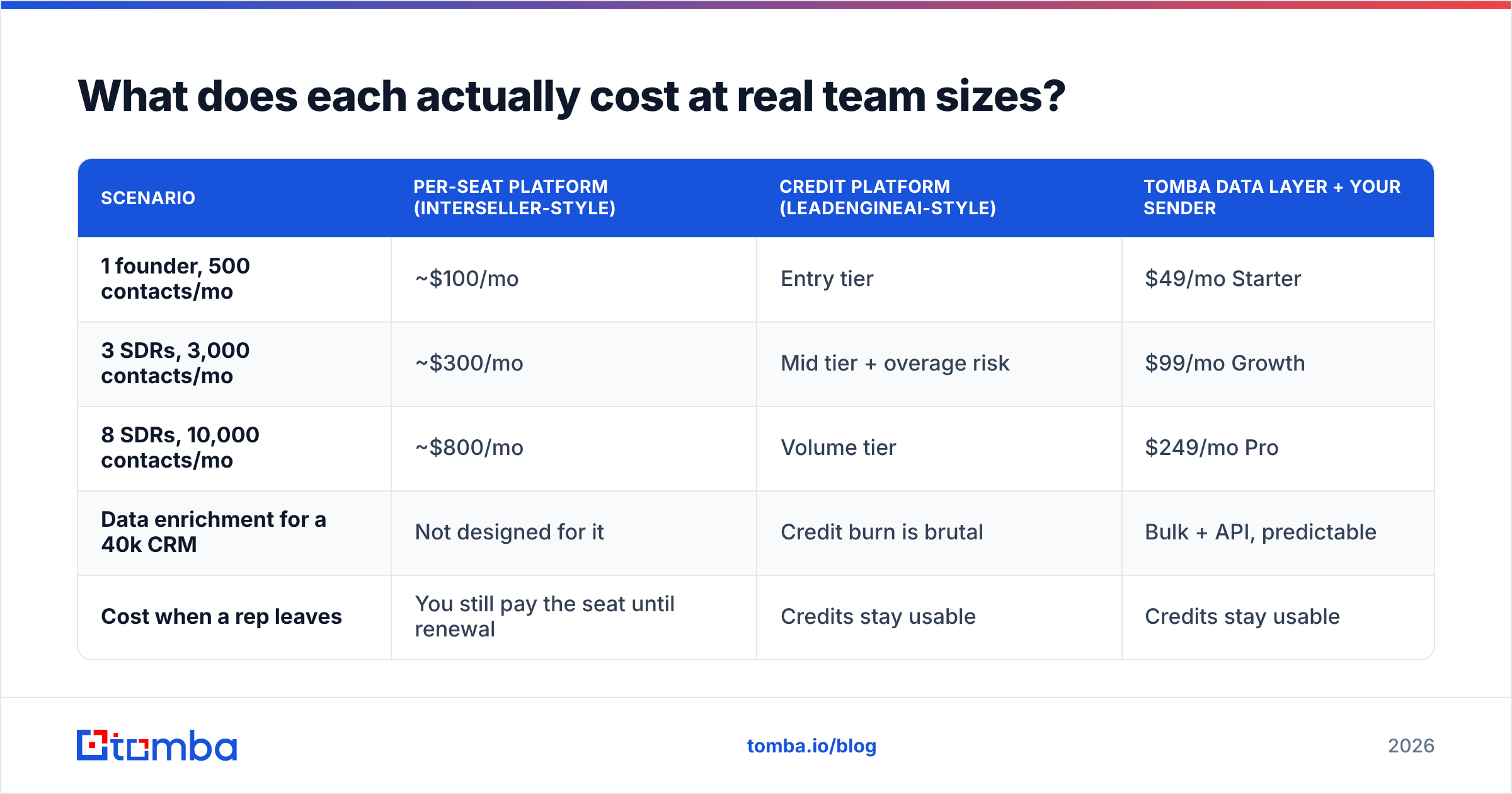
Model the three-year cost, not the monthly sticker. Seat-based tools scale with headcount; credit-based tools scale with volume. These are wildly different curves.
| Scenario | Per-seat platform (Interseller-style) | Credit platform (LeadEngineAI-style) | Tomba data layer + your sender |
|---|---|---|---|
| 1 founder, 500 contacts/mo | ~$100/mo | Entry tier | $49/mo Starter |
| 3 SDRs, 3,000 contacts/mo | ~$300/mo | Mid tier + overage risk | $99/mo Growth |
| 8 SDRs, 10,000 contacts/mo | ~$800/mo | Volume tier | $249/mo Pro |
| Data enrichment for a 40k CRM | Not designed for it | Credit burn is brutal | Bulk + API, predictable |
| Cost when a rep leaves | You still pay the seat until renewal | Credits stay usable | Credits stay usable |
The last row is the one finance teams notice. Seat licenses convert headcount churn into stranded spend. Credit pools do not. Full Tomba pricing is public, which is worth something on its own — any vendor that hides tiers behind a demo call is pricing you by how desperate you sound.

Where do both platforms fall short?#
Four failure modes show up repeatedly in teams that outgrow either tool.
- The all-in-one tax. You pay platform rates for a sequencer you may already own in HubSpot, Outreach, or Instantly, plus data you could source more cheaply. Bundling is convenient at five users and expensive at twenty-five.
- Opaque verification. Both flag addresses as valid or risky without exposing why. When your email deliverability dips, you cannot trace which list segment caused it.
- Thin API surface. If your RevOps team wants to enrich inbound signups in real time, a UI-first platform is the wrong shape. You need an email finder API with per-request latency you can measure.
- Vendor lock on the sending domain. Once your sequences, snippets, and reply routing live inside one platform, migrating is a quarter-long project. Keep the data layer separate from the sending layer and that switch costs an afternoon.
It is also fair to name the competitive field honestly. Neither Interseller nor LeadEngineAI is the only option: providers like BookYourData take a pay-as-you-go database approach that suits teams wanting to own a static list outright, and dedicated finders take the API-first route. The right architecture depends on whether your constraint is finding people, reaching them, or tracking them.
Should you unbundle and use a dedicated email finder instead?#
For most B2B sales teams in 2026 — yes, at least partially.
The unbundled stack looks like this: a dedicated finder and verifier for data, your existing sequencer for sending, your CRM for tracking. Each layer is replaceable. You stop paying a platform premium on the two layers you already own.
What that looks like concretely with Tomba:
- Prospecting a target account list. Run domain search on each company to pull every discoverable address plus the company's email pattern, then filter by department.
- Working from LinkedIn. Use the LinkedIn finder or the Tomba Chrome extension so reps stay in the tab they already live in.
- Cleaning an inherited list. Push the CSV through bulk verify before it ever touches your sender. This single step is usually worth more than any copy change you will make this quarter.
- Enriching inbound. Call the API on form submit so a free-email signup resolves to a company, headcount, and tech stack before routing.
- Filling phone gaps. Add B2B phone numbers for the accounts worth a call, rather than paying a second platform for dialer-grade data.
The tradeoff is real: you manage three vendors instead of one, and you own the integration glue. For teams under three people, that overhead may not be worth it — buy the bundle, move fast. Past roughly five reps, the math and the flexibility both favor unbundling.
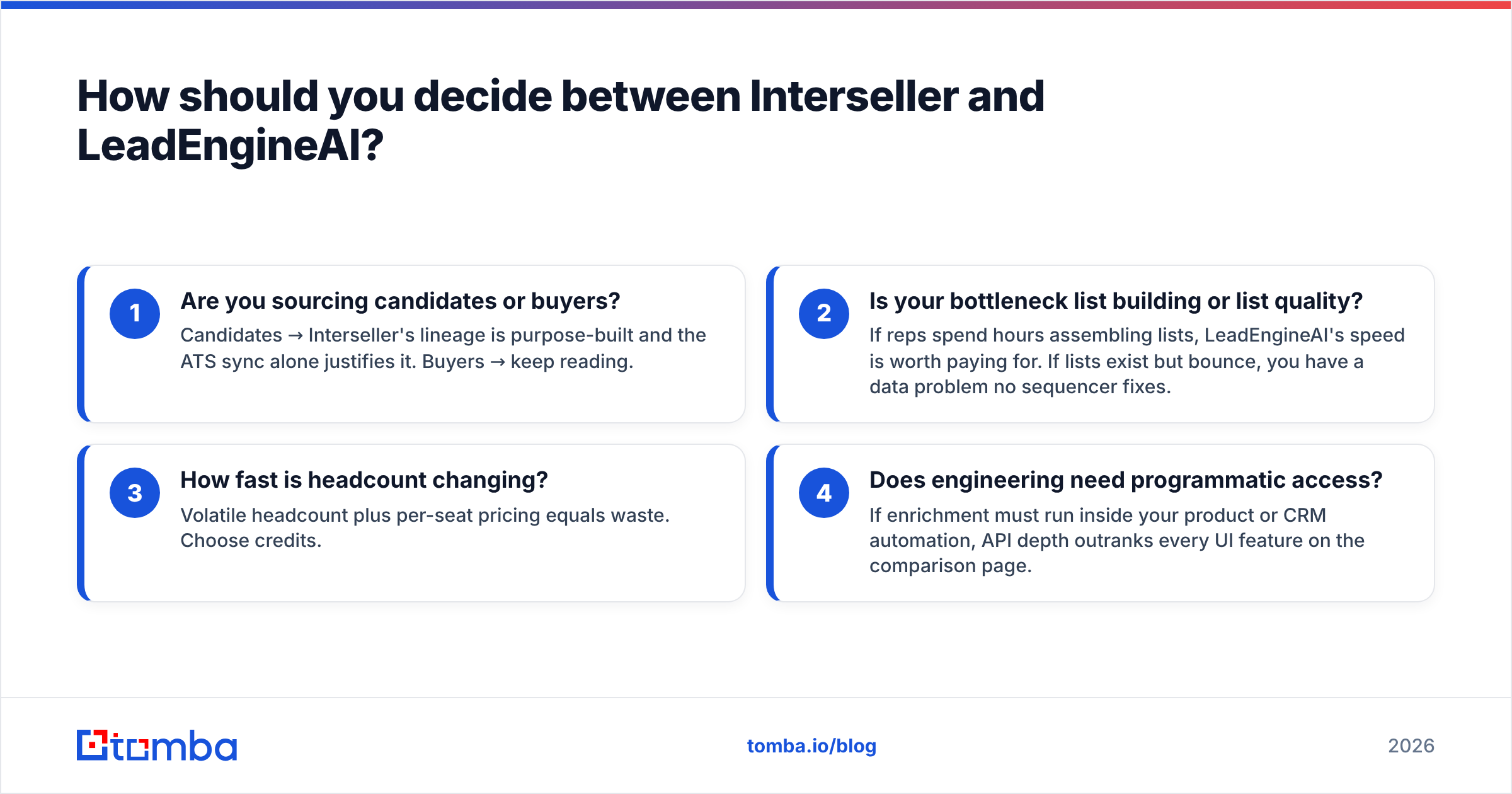
How should you decide between Interseller and LeadEngineAI?#
Answer four questions honestly and the choice makes itself.
- Are you sourcing candidates or buyers? Candidates → Interseller's lineage is purpose-built and the ATS sync alone justifies it. Buyers → keep reading.
- Is your bottleneck list building or list quality? If reps spend hours assembling lists, LeadEngineAI's speed is worth paying for. If lists exist but bounce, you have a data problem no sequencer fixes.
- How fast is headcount changing? Volatile headcount plus per-seat pricing equals waste. Choose credits.
- Does engineering need programmatic access? If enrichment must run inside your product or CRM automation, API depth outranks every UI feature on the comparison page.
Most teams that run this exercise land in a hybrid: keep a sequencer they already trust, drop the bundled data layer, and spend the difference on accuracy. That is the least glamorous and most defensible outcome.

Start with the data layer, not the platform#
Before you commit to a per-seat contract, test whether data quality is actually your constraint. Pull 100 contacts at your real ICP with the Tomba Email Finder — the free tier gives you 25 searches with no card, and Starter is $49/mo if you want to run the full test. Compare the bounce rate against whatever you are using now. If the gap is meaningful, you have found your bottleneck, and you can fix it for less than one seat of either platform costs.
Related guides#
// get started
Find, verify and enrich your first contacts today
Start on the free plan with 25 searches a month, then scale when your team is ready.
Free plan · No credit card required · GDPR & CCPA
Get the Tomba newsletter
Product and data updates
// about the author