Interseller vs SMARTe (2026): Which Sourcing Tool Wins?
Interseller sequences your outreach. SMARTe feeds you contact data. They solve different halves of the same problem — and picking wrong costs you a year of seat fees. Here's the honest breakdown, plus what to do if you only need the emails.
TL;DR
- Interseller is a sequencer with sourcing attached. It finds an email, then sends the multi-step campaign for you and syncs activity back to your ATS or CRM. Since the Greenhouse acquisition it is sold primarily to recruiting teams.
- SMARTe is a data provider, not an outreach tool. It supplies verified work emails and mobile numbers with GDPR/CCPA compliance documentation, then pushes them into whatever sequencer you already run.
- They barely overlap. If you compare them feature-for-feature you will pick the wrong one. Compare them by which half of your stack is broken.
- Both are seat-priced and sales-gated at the top end. Interseller has historically sat near $100 per seat per month; SMARTe runs a limited free tier and quotes paid plans. Neither is cheap once you add users.
- If you already own a sequencer, you are buying data, not software. A pure email finder at $49/mo does that job for a fraction of a seat license.
What are Interseller and SMARTe, exactly?#
Interseller started life as a recruiter's shortcut: paste a LinkedIn profile, get a personal or work email, drop the contact into an automated email sequence, and let the tool stop sending the moment someone replies. Greenhouse acquired it in 2021, and the product has since been absorbed into the Greenhouse sourcing automation story. The DNA is still visible — Interseller's centre of gravity is the campaign, not the database. Its ATS sync (Greenhouse, Lever, Bullhorn and friends) is the feature most teams actually pay for, because it kills duplicate outreach to candidates already in the pipeline.
SMARTe comes at the same problem from the opposite end. It is a B2B contact and company intelligence platform: search by title, geography, industry, headcount and technology, then export verified work emails and — the part SMARTe pushes hardest — direct mobile numbers. There is a Chrome extension for LinkedIn, a bulk export flow, and integrations into Salesforce, HubSpot, Outreach and Salesloft. SMARTe sends nothing. It fills the top of a funnel somebody else runs.
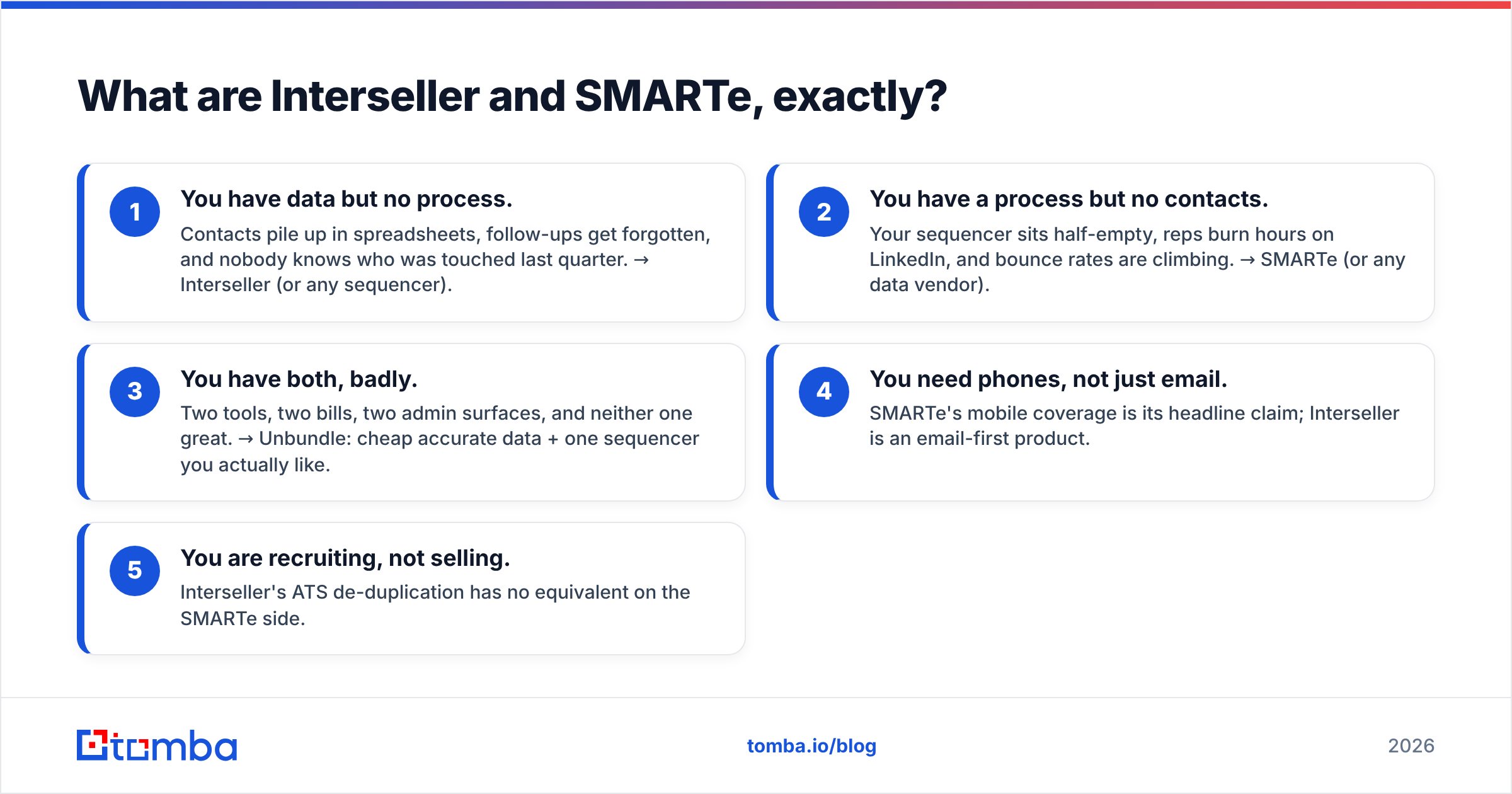
So the real question behind "Interseller vs SMARTe" is not which tool is better. It is which layer of your stack is the bottleneck:
- You have data but no process. Contacts pile up in spreadsheets, follow-ups get forgotten, and nobody knows who was touched last quarter. → Interseller (or any sequencer).
- You have a process but no contacts. Your sequencer sits half-empty, reps burn hours on LinkedIn, and bounce rates are climbing. → SMARTe (or any data vendor).
- You have both, badly. Two tools, two bills, two admin surfaces, and neither one great. → Unbundle: cheap accurate data + one sequencer you actually like.
- You need phones, not just email. SMARTe's mobile coverage is its headline claim; Interseller is an email-first product.
- You are recruiting, not selling. Interseller's ATS de-duplication has no equivalent on the SMARTe side.
How do Interseller and SMARTe compare head-to-head?#
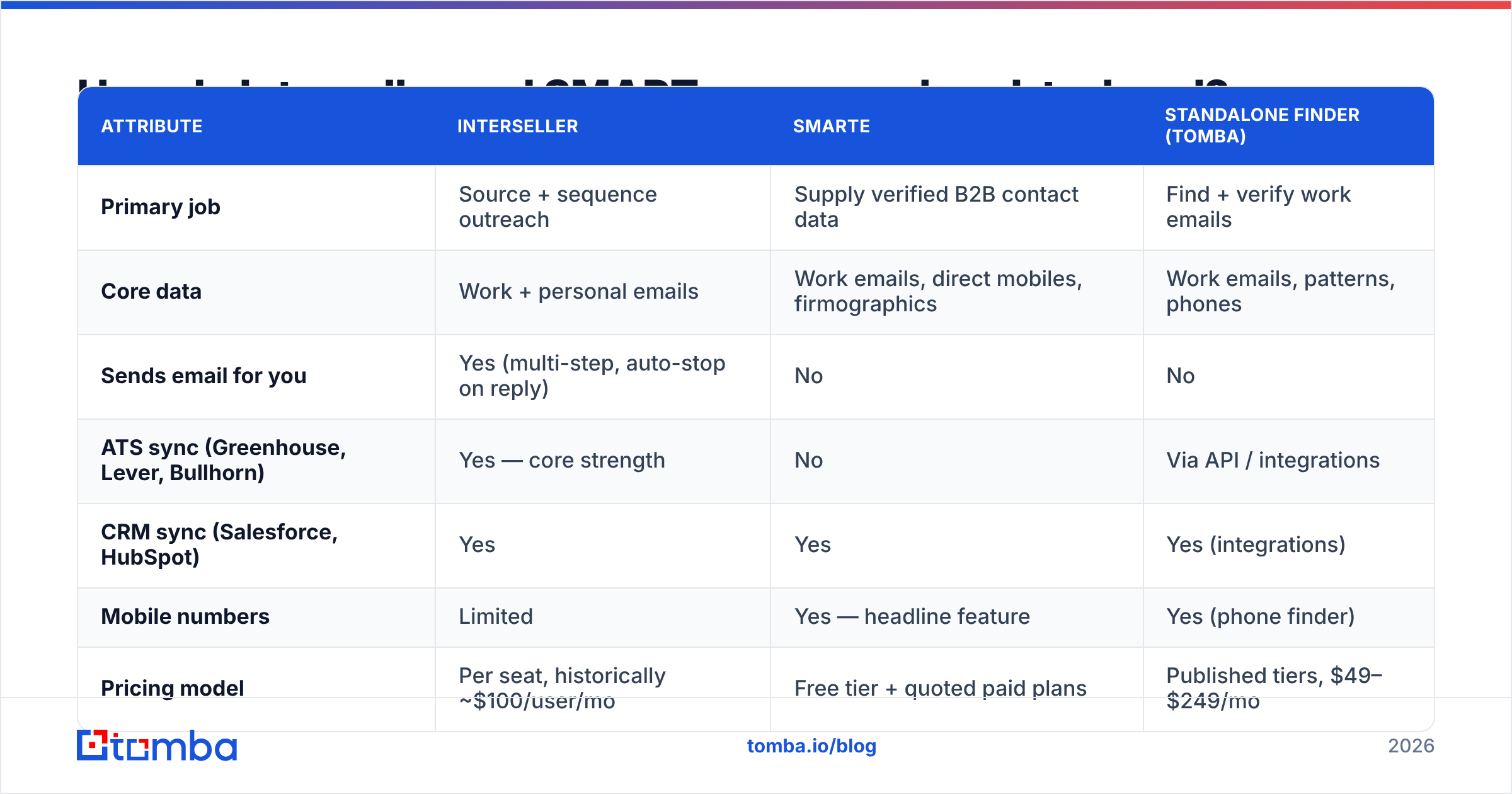
Here is the honest side-by-side, with a standalone email-finder column so you can see what each bundle is actually charging you for.
| Attribute | Interseller | SMARTe | Standalone finder (Tomba) |
|---|---|---|---|
| Primary job | Source + sequence outreach | Supply verified B2B contact data | Find + verify work emails |
| Core data | Work + personal emails | Work emails, direct mobiles, firmographics | Work emails, patterns, phones |
| Sends email for you | Yes (multi-step, auto-stop on reply) | No | No |
| ATS sync (Greenhouse, Lever, Bullhorn) | Yes — core strength | No | Via API / integrations |
| CRM sync (Salesforce, HubSpot) | Yes | Yes | Yes (integrations) |
| Mobile numbers | Limited | Yes — headline feature | Yes (phone finder) |
| Pricing model | Per seat, historically ~$100/user/mo | Free tier + quoted paid plans | Published tiers, $49–$249/mo |
| Free tier | Trial only | Yes, limited credits | Yes, 25 searches/mo |
| Public API | Limited | Available on request | Yes, documented |
| Best for | Agency + in-house recruiters | Sales teams needing phones in NAM/EMEA | Anyone who just needs the address |
Two things fall out of that table immediately.
First, you are paying twice for overlap you will not use. Buy Interseller and you are paying for a sequencer; if your SDRs already live in Outreach or Instantly, that budget is dead weight. Buy SMARTe and you are paying for firmographic search; if your ICP list already exists in your CRM, you are buying a database to look up 40 names.
Second, the pricing transparency gap is real. Interseller has historically published a seat price you can plan around. SMARTe routes serious volume through a sales conversation, which means your cost depends on your negotiating position and renewal timing. Neither model is wrong, but they make budgeting very different exercises. Check both vendors' current pages before you commit — published pricing on this category moves every few quarters.
Which one gives you better contact data?#
Neither vendor will lose this on paper, because both publish accuracy figures measured against their own methodology. The number that matters is the one your mail server reports back.
Three practical differences show up in real testing:
- Email type. Interseller has historically been willing to return personal addresses (Gmail, Outlook) — genuinely useful for recruiting passive candidates who ignore work email, and genuinely risky for B2B sales, where a personal address in a cold sequence reads as a privacy violation in the EU.
- Phone depth. SMARTe's differentiator is direct dials and mobiles, with coverage strongest in North America and decent in EMEA and APAC. If your motion is cold calling, this is the whole argument.
- Verification freshness. Both cache. Cached data decays roughly 2–2.5% per month as people change jobs, which means a record found in January and sent in June is meaningfully riskier than one verified at send time.
That last point is where most teams lose deliverability. It does not matter whose database is 95% accurate on the day of the crawl — it matters whether the address is re-checked before it enters a sequence. Run every list through an email verifier immediately before send, regardless of which vendor sourced it, and treat catch-all domains as a separate bucket rather than a pass/fail.

For context on how the wider finder market benchmarks out, the chart above is a useful sanity check: the spread between the best and worst tools on the same test list is large enough to change your bounce rate by several points, which is the difference between a healthy sending domain and a throttled one.
Which is better for recruiters?#
Interseller, clearly — and it is not close.
Recruiting has one requirement no sales tool models properly: you must not email a candidate who is already in your pipeline, already placed, or already rejected by the hiring manager last month. Interseller's ATS integration reads that state and suppresses the send. Doing this manually across Greenhouse and a separate sequencer is a weekly export-and-cross-reference ritual that someone will eventually skip.
Add the auto-stop-on-reply behaviour, the personal-email sourcing, and templates built for candidate messaging rather than SaaS pitches, and the case is straightforward. If you run agency or in-house recruiting at any volume, SMARTe is not really competing for this budget.
The caveat: Interseller's roadmap now lives inside Greenhouse's priorities. If you are not a Greenhouse customer, ask pointed questions about standalone product investment before signing a multi-year deal.
Which is better for sales teams?#
SMARTe, if you need phones. Otherwise, neither.
For an outbound sales org, Interseller's sequencing is thinner than the tools SDRs already use — Outreach, Salesloft, Instantly, Reply.io, Smartlead all do more, with better reporting, better inbox rotation, and better deliverability tooling. Buying Interseller for sales usually means downgrading your sequencer to get a mediocre data layer bundled in.
SMARTe makes more sense here because it slots in beside your existing stack instead of replacing part of it. The Chrome extension works where reps already work, exports go straight into the CRM, and the compliance documentation (GDPR, CCPA) is more thorough than most mid-market data vendors bother with — which matters if legal reviews your vendors.
But notice what you are actually buying: a list. If your ICP is well-defined and your reps are working named accounts rather than running broad searches, the "intelligence" half of the platform goes unused and you are paying platform prices for lookups. That is the moment to price out a focused domain search workflow instead.
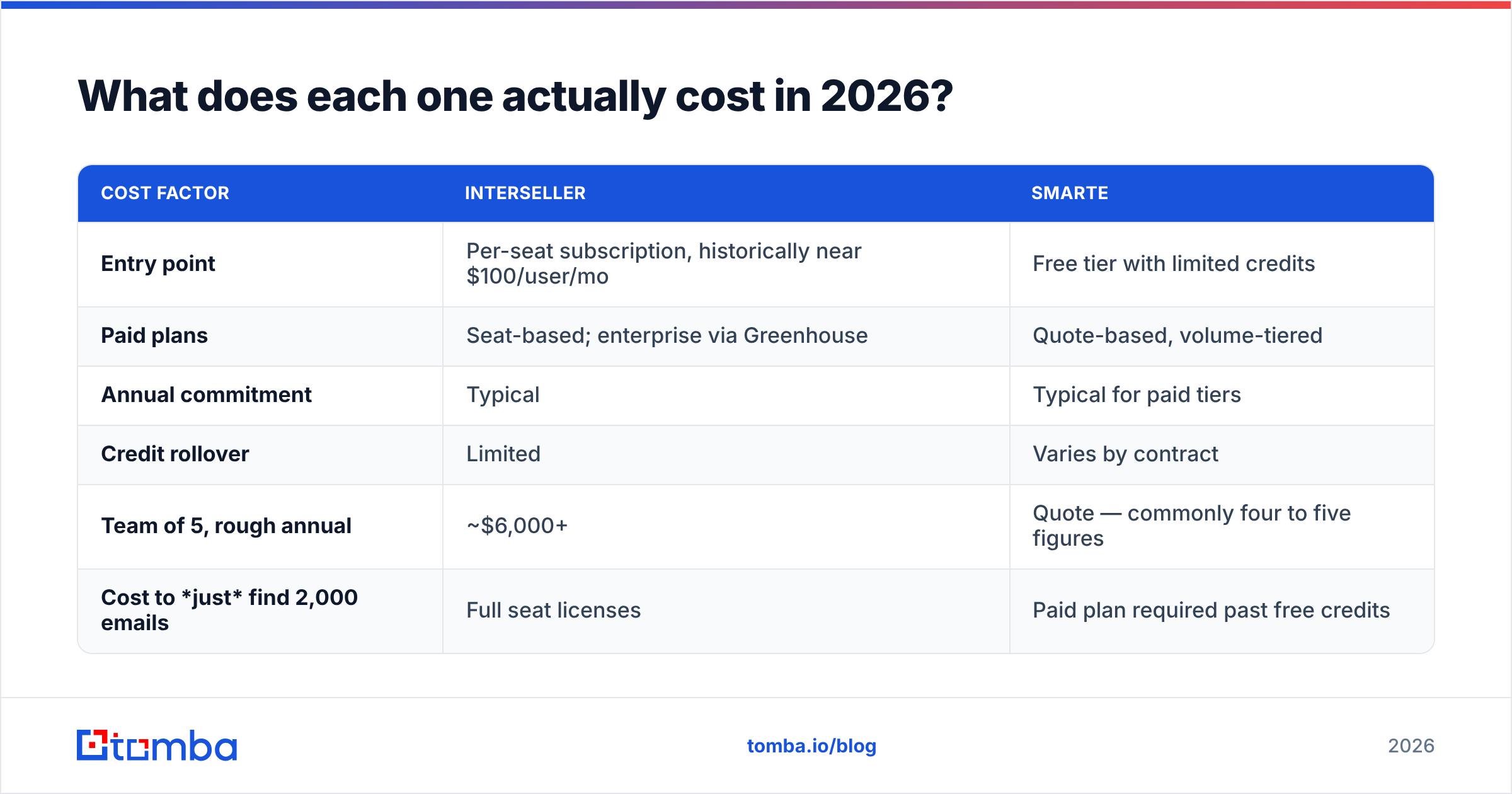
What does each one actually cost in 2026?#
| Cost factor | Interseller | SMARTe |
|---|---|---|
| Entry point | Per-seat subscription, historically near $100/user/mo | Free tier with limited credits |
| Paid plans | Seat-based; enterprise via Greenhouse | Quote-based, volume-tiered |
| Annual commitment | Typical | Typical for paid tiers |
| Credit rollover | Limited | Varies by contract |
| Team of 5, rough annual | ~$6,000+ | Quote — commonly four to five figures |
| Cost to just find 2,000 emails | Full seat licenses | Paid plan required past free credits |
That last row is the uncomfortable one. A five-person team paying seat licenses for a sourcing platform is spending roughly $6,000 a year before a single email is sent. If what you needed was 2,000 verified addresses a month, the same outcome costs a fraction of that from a dedicated finder — Tomba pricing starts at $49/mo for Starter, $99/mo for Growth, with a free tier at 25 searches per month for testing the data before you spend anything.
What are the real limitations of each?#
Interseller's weak points:
- Sequencing depth is basic next to purpose-built sales engagement platforms — limited A/B testing, limited multichannel.
- Product direction is now tied to Greenhouse's roadmap.
- Email-first: weak if your motion depends on dialing.
- Per-seat pricing punishes teams where only two people actually source.
SMARTe's weak points:
- No sending, no sequencing, no campaign reporting — it is one layer, and you still need the rest.
- Quote-based pricing makes cost comparison hard and renewals unpredictable.
- Coverage is strongest in North America; verify your specific geography and vertical during the trial, not after.
- Free tier is small enough that meaningful evaluation usually requires a sales call.
Shared weak point: neither tool solves deliverability. Both will happily hand you addresses that technically resolve and still land in spam because your domain reputation is poor, your SPF record is misconfigured, or you are sending 300 cold emails a day from a single mailbox. Data quality is necessary and not sufficient.
Should you unbundle instead?#
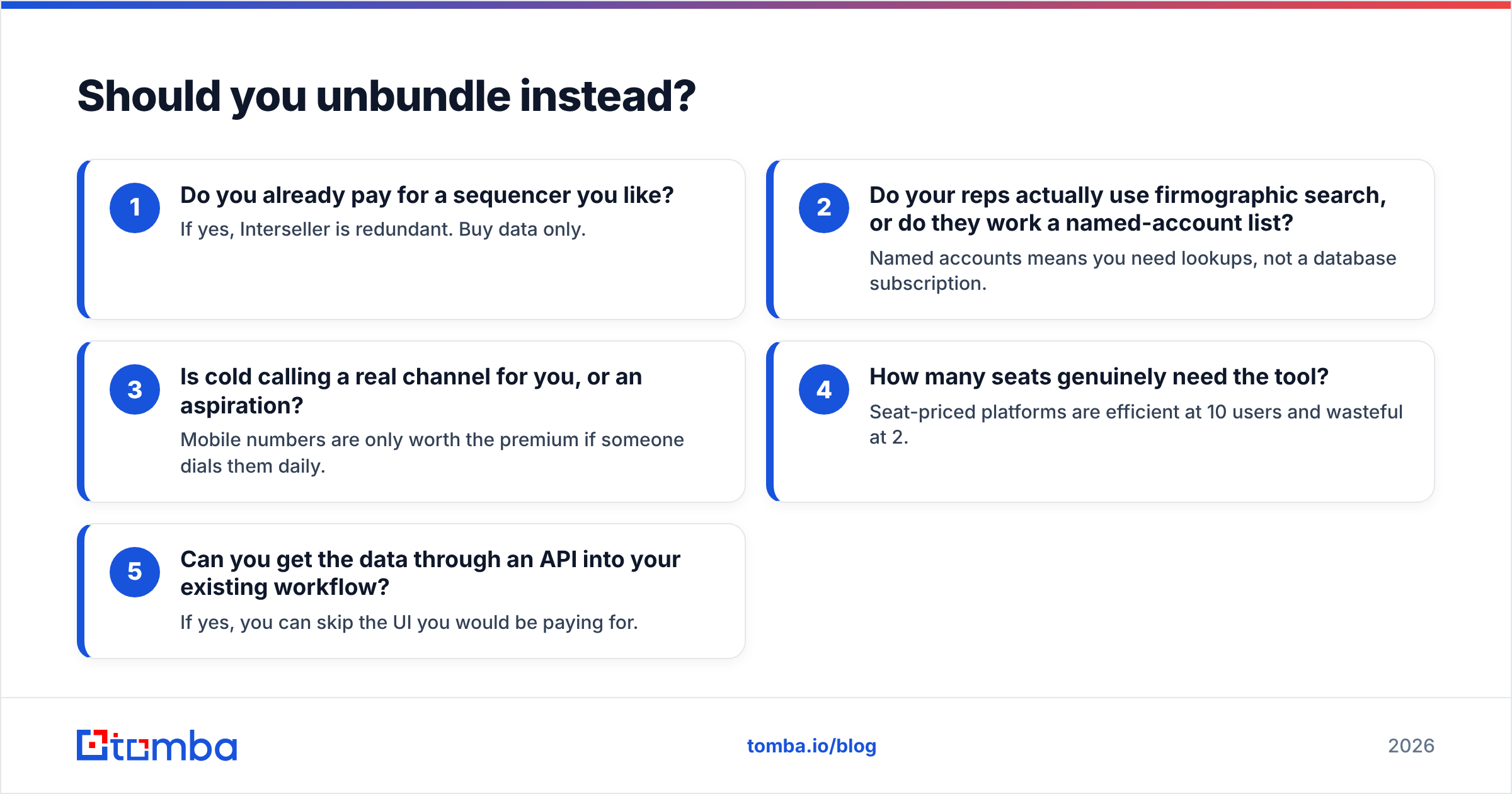
Run this test before you sign either contract. Answer honestly:
- Do you already pay for a sequencer you like? If yes, Interseller is redundant. Buy data only.
- Do your reps actually use firmographic search, or do they work a named-account list? Named accounts means you need lookups, not a database subscription.
- Is cold calling a real channel for you, or an aspiration? Mobile numbers are only worth the premium if someone dials them daily.
- How many seats genuinely need the tool? Seat-priced platforms are efficient at 10 users and wasteful at 2.
- Can you get the data through an API into your existing workflow? If yes, you can skip the UI you would be paying for.
If three or more of those point toward "I just need accurate contacts," unbundling wins on cost and flexibility. A documented Tomba API, a bulk finder, and your existing sequencer covers the same ground as either platform for a fraction of the spend — and swapping one component later costs you nothing.

Cross-reference what reviewers report on G2 before you decide; the gap between marketing claims and mid-market customer experience is usually visible in the one-star reviews, not the five-star ones.
So which should you pick?#
- Recruiting team, Greenhouse or Lever in the stack: Interseller. The ATS de-duplication alone justifies the seat cost.
- Sales team where cold calling is a real channel: SMARTe. Test mobile coverage in your exact territory during the trial.
- Sales team running email-only outbound with an existing sequencer: neither. You are buying software you already own. Buy data at data prices.
- Small team, tight budget, need volume: unbundle. Finder + verifier + your sequencer.
- Enterprise with legal review: SMARTe's compliance documentation is the stronger starting point.
The failure mode to avoid is buying a platform to solve a data problem. Platforms are priced on everything they can do; you get billed for the sequencer, the search UI, and the integrations whether or not you touch them. If the thing that is actually broken is "we cannot reliably get the right email address," fix that directly and keep the rest of your stack intact.
Start with the free tier of Tomba Email Finder — 25 searches a month, no sales call, no annual commitment. Run it against 50 contacts you already know are correct, check the hit rate and the bounce rate yourself, and then decide whether either platform is worth a seat license on top.
Related guides#
// get started
Find, verify and enrich your first contacts today
Start on the free plan with 25 searches a month, then scale when your team is ready.
Free plan · No credit card required · GDPR & CCPA
Get the Tomba newsletter
Product and data updates
// about the author