Interseller vs ZoomInfo (2026): Which Contact Data Wins?
Interseller is a sourcing sequencer with a contact finder bolted on. ZoomInfo is a database with everything bolted on. Here is how they actually compare on data, pricing, contracts, and fit — plus when neither is the right buy.
TL;DR — here is the short answer on Interseller vs ZoomInfo.
- Interseller (now part of Greenhouse) is a sourcing tool. You find a contact, drop them into an email sequence, and sync to your ATS. It is built for recruiters, not for sales reps.
- ZoomInfo is a data platform. You get a huge B2B database, plus intent data, dialers, and a Copilot layer. It is built for large revenue teams with budget.
- Price is the headline. Interseller sat near $100 per seat per month. ZoomInfo deals often land between $15,000 and $40,000 a year.
- Neither is a pure email finder. If you just want verified work emails, both are heavy and costly for that job.
- Best fit: Interseller for recruiters on Greenhouse. ZoomInfo for big teams that need intent data. A focused finder for everyone else.
What are Interseller and ZoomInfo?#
The Interseller vs ZoomInfo debate starts with a simple fact. These tools solve two different problems. Both just happen to end with an email address.
Interseller began as a sourcing tool for recruiters. You install the Chrome extension. You open a profile on LinkedIn or GitHub. Interseller finds a work or personal email. Then it drops that person into an email sequence that stops when they reply. Greenhouse acquired Interseller in 2021, and the tool now sits inside the Greenhouse sourcing stack. That deal matters more than any feature. The roadmap is a hiring roadmap now, not a sales one.
ZoomInfo is the other shape. It is a database business. You start with filters: industry, headcount, job title, tech stack, buying intent. Then you pull lists of companies and people. Sequencing, dialers, call review, and visitor tracking were bought and bolted on later. Look at the product pages and you see a suite, not a tool.
So the real question behind interseller vs zoominfo is short. Do you need a workflow tool or a data set?
How do Interseller and ZoomInfo compare at a glance?#
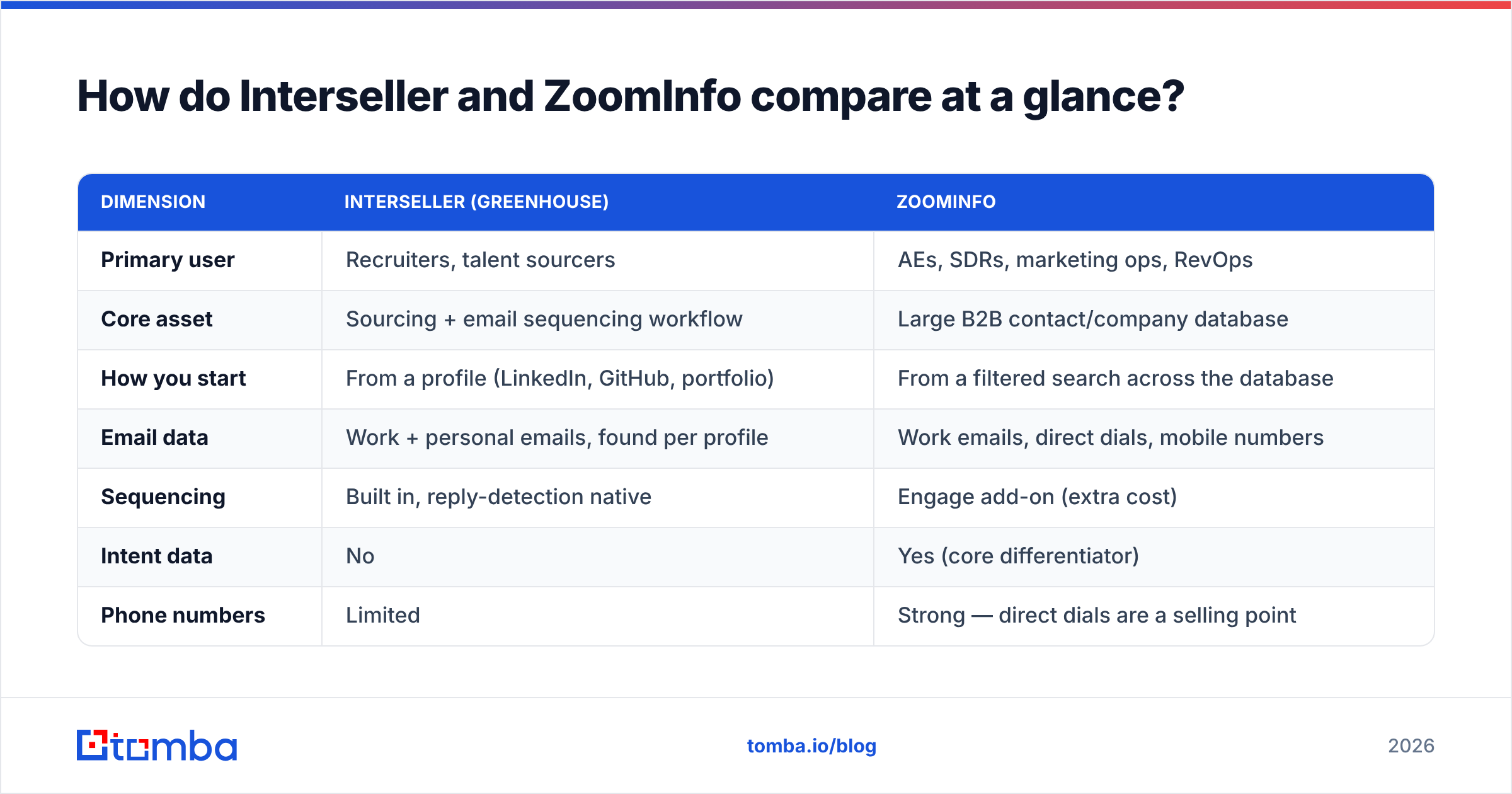
Here is the Interseller vs ZoomInfo comparison in one table.
| Dimension | Interseller (Greenhouse) | ZoomInfo |
|---|---|---|
| Primary user | Recruiters, talent sourcers | AEs, SDRs, marketing ops, RevOps |
| Core asset | Sourcing + email sequencing workflow | Large B2B contact/company database |
| How you start | From a profile (LinkedIn, GitHub, portfolio) | From a filtered search across the database |
| Email data | Work + personal emails, found per profile | Work emails, direct dials, mobile numbers |
| Sequencing | Built in, reply-detection native | Engage add-on (extra cost) |
| Intent data | No | Yes (core differentiator) |
| Phone numbers | Limited | Strong — direct dials are a selling point |
| CRM/ATS sync | Greenhouse, Lever, Bullhorn, SmartRecruiters | Salesforce, HubSpot, Dynamics, Outreach, Salesloft |
| Typical entry price | ~$100/user/month (historically) | $15,000+/year, annual contract |
| Free tier | No | No (free trial/limited lookups only) |
| Contract | Monthly available historically | Annual, seat minimums, credit caps |
| Best for | 1–20 seat recruiting teams | 20+ seat enterprise GTM orgs |
Two things jump out. First, the price gap is not 2x. It is closer to 10x once you add seat minimums. Second, these tools barely compete. Interseller does not sell intent data. ZoomInfo does not sell recruiter-grade personal emails.

Which platform has better data accuracy?#
Accuracy is the sharpest test in any Interseller vs ZoomInfo review. The two hold different data. So "better" depends on who you chase.
Three things drive the result:
- Coverage — how many rows on your list get any result. ZoomInfo wins on US sales titles at mid-size and large firms. Interseller wins on job candidates, such as engineers with a GitHub page.
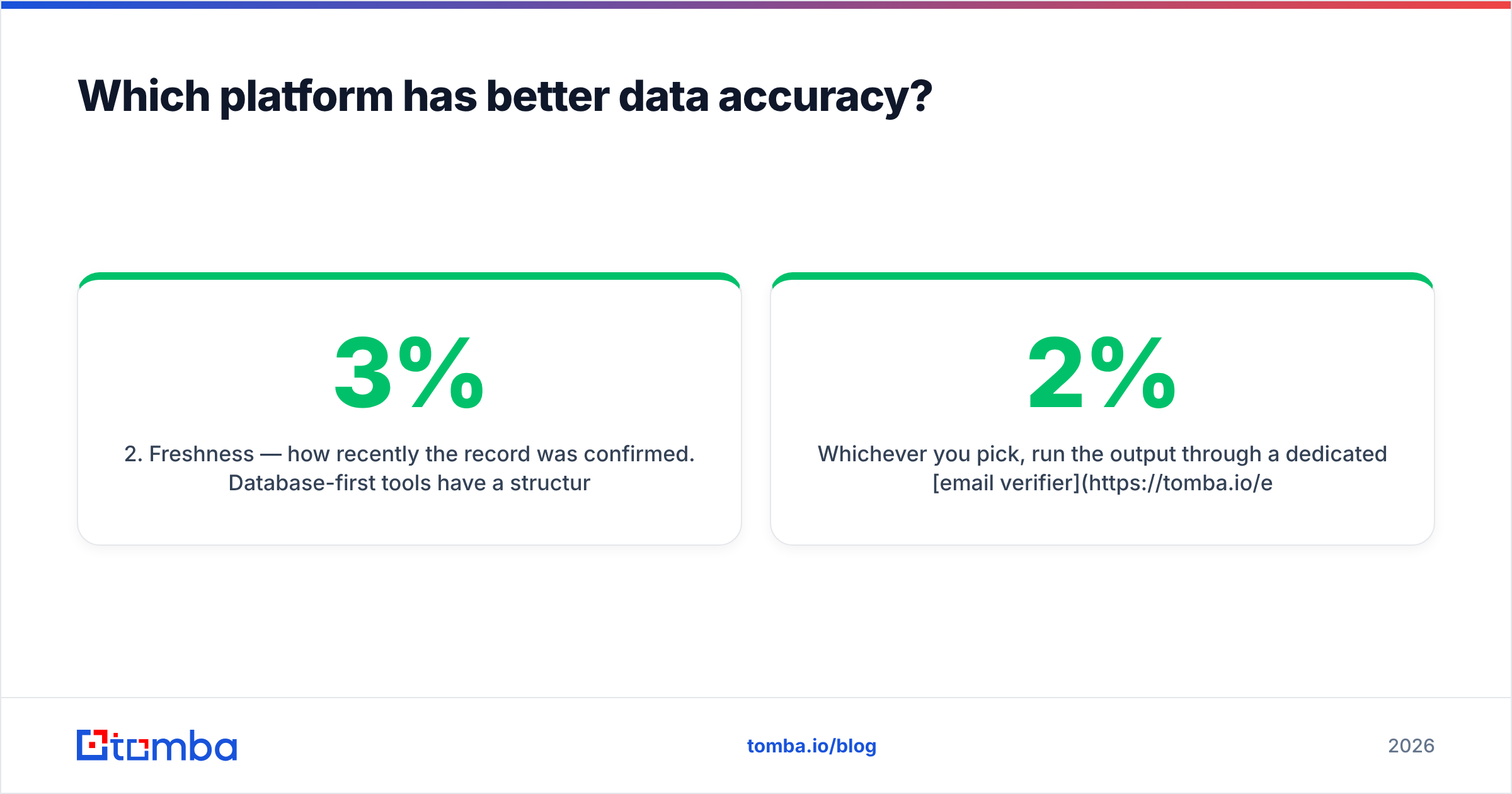
- Freshness — how recently the record was checked. A stored record rots by 2–3% each month as people move jobs. Tools that search on demand stay fresher by design.
- Proof — whether the email was tested, guessed from a pattern, or copied from a third party. An email that was never tested is a bounce in waiting.
Two more factors decide your bounce rate:
- Catch-all domains — many B2B domains accept all mail, so the usual check tells you nothing. Most tools mark these "unknown" and hand you the risk.
- Bounce promise — what the vendor puts in writing. Read the fine print. Most promises refund credits, not your sender name.

Teams who run both tools report the same pattern. ZoomInfo phone data is strong and hard to copy. Its email records go stale faster than the screen suggests. Interseller emails are fresher per lookup, but the ceiling is low. It is not built to make a 20,000-row list.
Either way, run the output through a real email verifier before you send. Trusting a vendor's "valid" flag is how inboxes stop trusting you. Say much of your list sits on accept-all domains. Then a good catch-all verifier is the gap between a 2% bounce rate and a 12% one.
How does pricing really compare?#
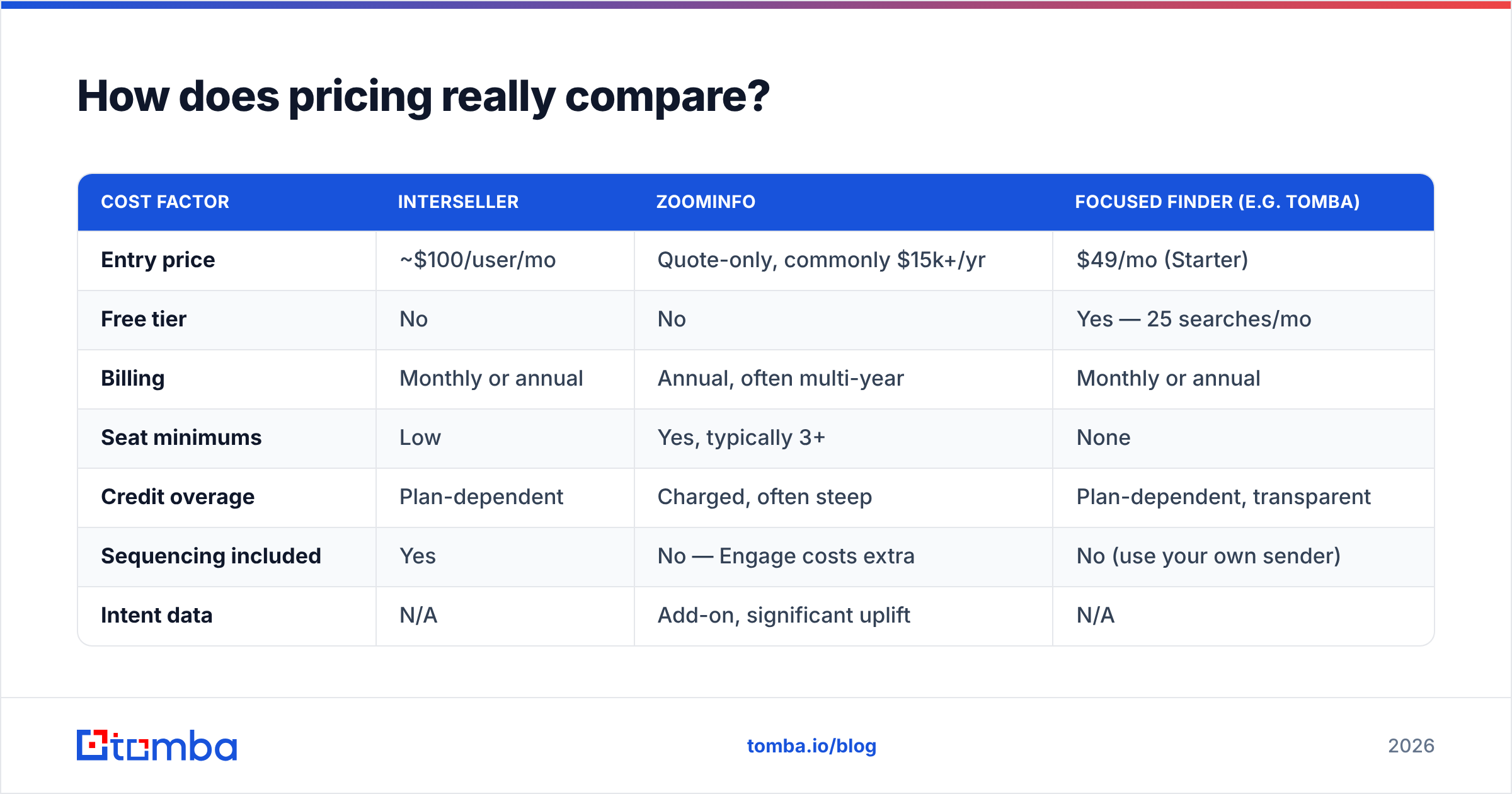
Money is the clearest split in Interseller vs ZoomInfo.
| Cost factor | Interseller | ZoomInfo | Focused finder (e.g. Tomba) |
|---|---|---|---|
| Entry price | ~$100/user/mo | Quote-only, commonly $15k+/yr | $49/mo (Starter) |
| Free tier | No | No | Yes — 25 searches/mo |
| Billing | Monthly or annual | Annual, often multi-year | Monthly or annual |
| Seat minimums | Low | Yes, typically 3+ | None |
| Credit overage | Plan-dependent | Charged, often steep | Plan-dependent, transparent |
| Sequencing included | Yes | No — Engage costs extra | No (use your own sender) |
| Intent data | N/A | Add-on, significant uplift | N/A |
| Phone/mobile data | Limited | Included on higher tiers | Add-on via phone finder |
| API access | Limited | Enterprise tiers | All paid plans |
| Time to first value | Same day | 2–6 weeks (procurement, onboarding) | Minutes |
ZoomInfo publishes no prices at all. Every deal is a quote. Reviews on G2 and buyer forums put entry deals in the mid five figures. The number climbs fast once you add Engage, intent topics, or extra credits. Plan for renewal hikes too. Multi-year bumps are normal.
Interseller pricing is harder to pin down since the Greenhouse deal. It is now folded into Greenhouse Sourcing Automation more than sold alone. If you do not run Greenhouse, that bundle is a real barrier.
Say your need is simply "find emails at volume." Then weigh both against Tomba pricing: Free (25 searches a month), Starter $49, Growth $99, Pro $249, and custom plans above that. This is not a like-for-like match on features. That is the point. You pay for the one job you do every day.

Who should choose Interseller?#
Interseller vs ZoomInfo has a clear answer for one group. Pick Interseller if three or more of these fit you:
- You hire, you do not sell. You source engineers, designers, or nurses. Personal email beats work email for those roles.
- You already run Greenhouse. The ATS sync is the moat. Outside it, the value drops fast.
- Your volume is small. A few hundred touches per recruiter each month, not tens of thousands.
- You want one tool, not a stack. Find, send, and sync in one window. Replies pause the sequence for you.
- You need speed. No buying cycle, no legal review, live in the same week.
Where it falls short: no intent data, thin company filters, and weak bulk list building. The roadmap now serves recruiters. If you sell for a living, Interseller will feel borrowed from another team. It is.
Who should choose ZoomInfo?#
The other side of Interseller vs ZoomInfo is narrow but real. ZoomInfo earns its price in these cases:
- You need intent signals. Knowing which accounts shop your category is hard to get elsewhere at that scale.
- You need direct dials. Mobile numbers are the strongest asset here. For a phone-led team, that counts. Our notes on phone finder workflows help you benchmark.
- You run true account-based marketing. Org charts, reporting lines, and turf planning across thousands of accounts.
- You have an ops team. ZoomInfo rewards teams who build with it. Without that, most of the license sits idle.
- Buying is not a blocker. You can absorb a 4–6 week cycle and a yearly lock-in.
Where it falls short: cost, rigid contracts, credit anxiety, and a data set that leans US-heavy. Coverage in Europe and Asia is thinner than the marketing hints. Privacy-minded buyers have had a bumpy ride. If any of that bites, an Apollo alternative or a focused finder gives you more per dollar.
What if neither one fits?#
Here is the honest answer for many teams weighing Interseller vs ZoomInfo. You are judging two big suites when you need one job done well.
Run this test. List the five things you did with prospect data last month. Say four of them were "take a name and a company, return a verified work email." Then you do not need a database license or a hiring tool. You need a finder with a good API and a verifier that handles catch-alls.
These belong on the shortlist:
- Tomba — email finder, verifier, domain search, and enrichment. Prices start at $49 a month, and a free tier lets you test accuracy first.
- BookYourData — good when you want ready-made, pay-as-you-go lists instead of one lookup at a time. An accuracy promise comes with it.
- Your current sequencer — Instantly, Smartlead, Outreach, or Salesloft already send mail. Paying for Engage on top is double spend.
- CRM tools you own — HubSpot and Salesforce both ship basic enrichment. Check what you own first. HubSpot's docs are clearer than most.
The unbundled stack costs under $200 a month for a small team. That is about one ZoomInfo seat, spread across a whole year, with no contract.
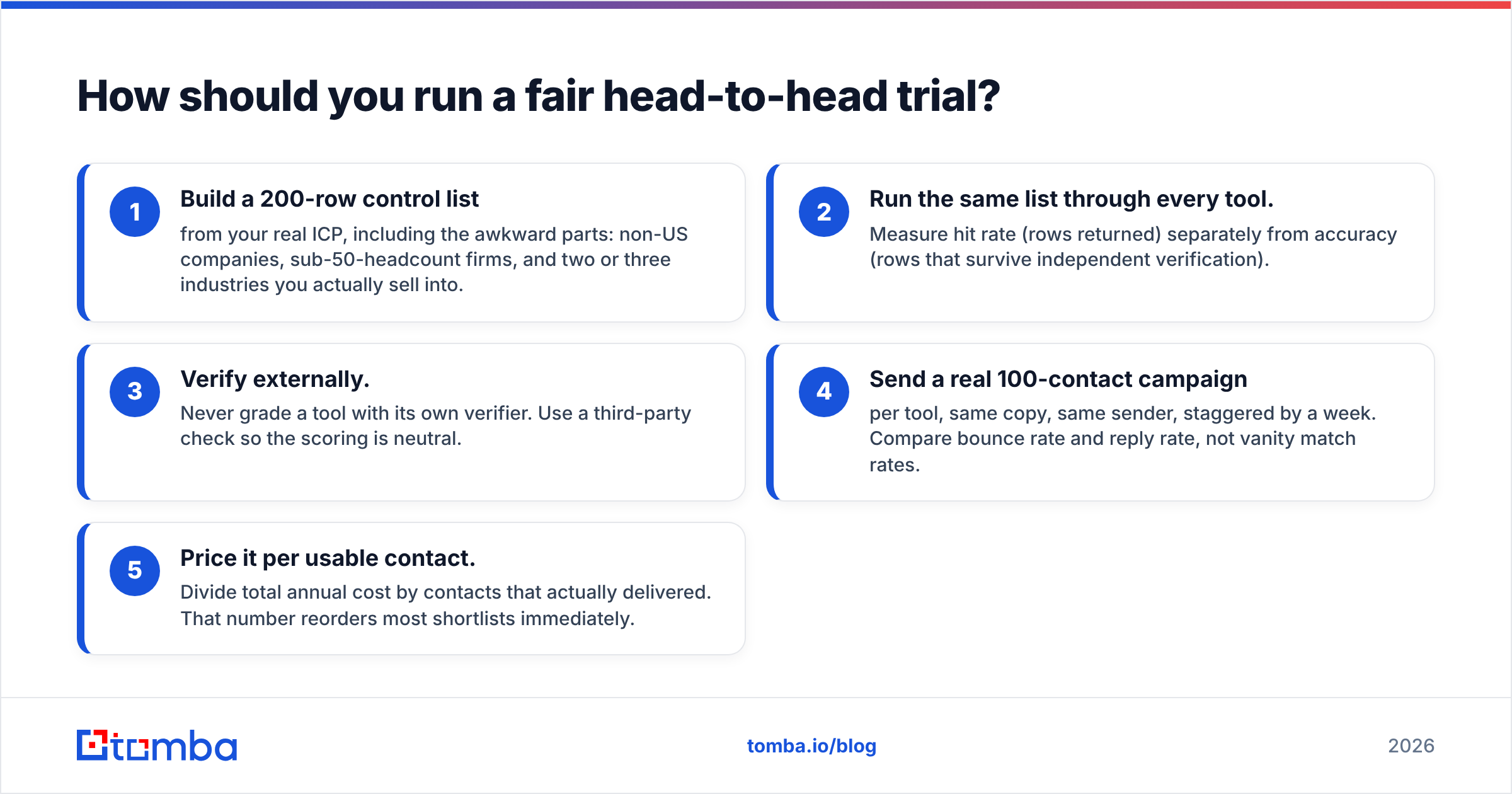
How should you run a fair head-to-head trial?#
Do not judge on demo data. Vendors demo the accounts they cover best. Here is a fair Interseller vs ZoomInfo test.
- Build a 200-row control list from your real target market. Include the awkward parts: firms outside the US, teams under 50 people, and two or three sectors you sell into.
- Run the same list through every tool. Track hit rate and accuracy as two separate numbers.
- Check the results elsewhere. Never grade a tool with its own verifier. Use a third party so the score stays neutral.
- Send a real 100-contact campaign per tool. Same copy, same sender, one week apart. Compare bounce and reply rates, not match rates.
- Price it per usable contact. Divide the yearly cost by contacts that actually landed. That number reorders most shortlists.
Need to process the control list fast? A bulk email finder or a direct email finder API call returns the same output in minutes. No sales calls needed.

So what's the verdict on Interseller vs ZoomInfo?#
They are not real rivals. The Interseller vs ZoomInfo question usually shows that the buyer has a third problem.
Choose Interseller if you hire inside Greenhouse and want sourcing and sending in one window. Choose ZoomInfo if you run a large sales org where intent data and mobile numbers pay for a five-figure deal. Choose neither if your day is finding and checking contact data. In that case you are buying a suite to use one part of it.
Before you sign anything with a seat minimum, run the 200-row test. Start with the Tomba Email Finder free tier. You get 25 searches a month, no card, and no sales call. See what your real list resolves at. If the hit rate holds up against the quotes in your inbox, you just saved a year of spend.
Related guides#
// get started
Find, verify and enrich your first contacts today
Start on the free plan with 25 searches a month, then scale when your team is ready.
Free plan · No credit card required · GDPR & CCPA
// about the author