Introducing a Colleague to a Client Email: Templates That Work
A colleague introduction email is a trust transfer, not an announcement. Here are the six parts every version needs, five copy-paste templates for real handoff situations, and the mistakes that quietly cost you the account.
TL;DR
- An introducing a colleague to a client email is a trust transfer, not an org-chart announcement. The client cares about one thing: does this new person know my account?
- The six-part structure — context, credential, continuity, ownership, next step, sign-off — works for every handoff type, from a full account transfer to adding a specialist for one project.
- Send it before the colleague ever emails the client directly. A cold email from an unknown name at a familiar company is the fastest way to get filtered.
- Handoffs fail on logistics more than wording: wrong address, an alias that no longer routes, or a client contact who left three months ago.
- Verify the client's address and check whether your contact is still at the company before you write a single line.
What is an introducing a colleague to a client email?#
It is the message you send when someone new on your side starts working with an existing client — a new account manager, an implementation specialist, a CSM taking over post-sale, or a cover during parental leave.
Think of it like handing someone the keys to your car. You do not just drop the keys in their hand and walk away. You tell them where the spare tire is, you tell the passenger who is driving now, and you stay reachable for a week in case something rattles. The email does all three jobs at once.
What it is not: a status update, a CC on an internal thread, or a three-line note that says "Sarah will take it from here." Those versions read as abandonment. The client hears "you have been downgraded," and the relationship you spent eight months building resets to zero.
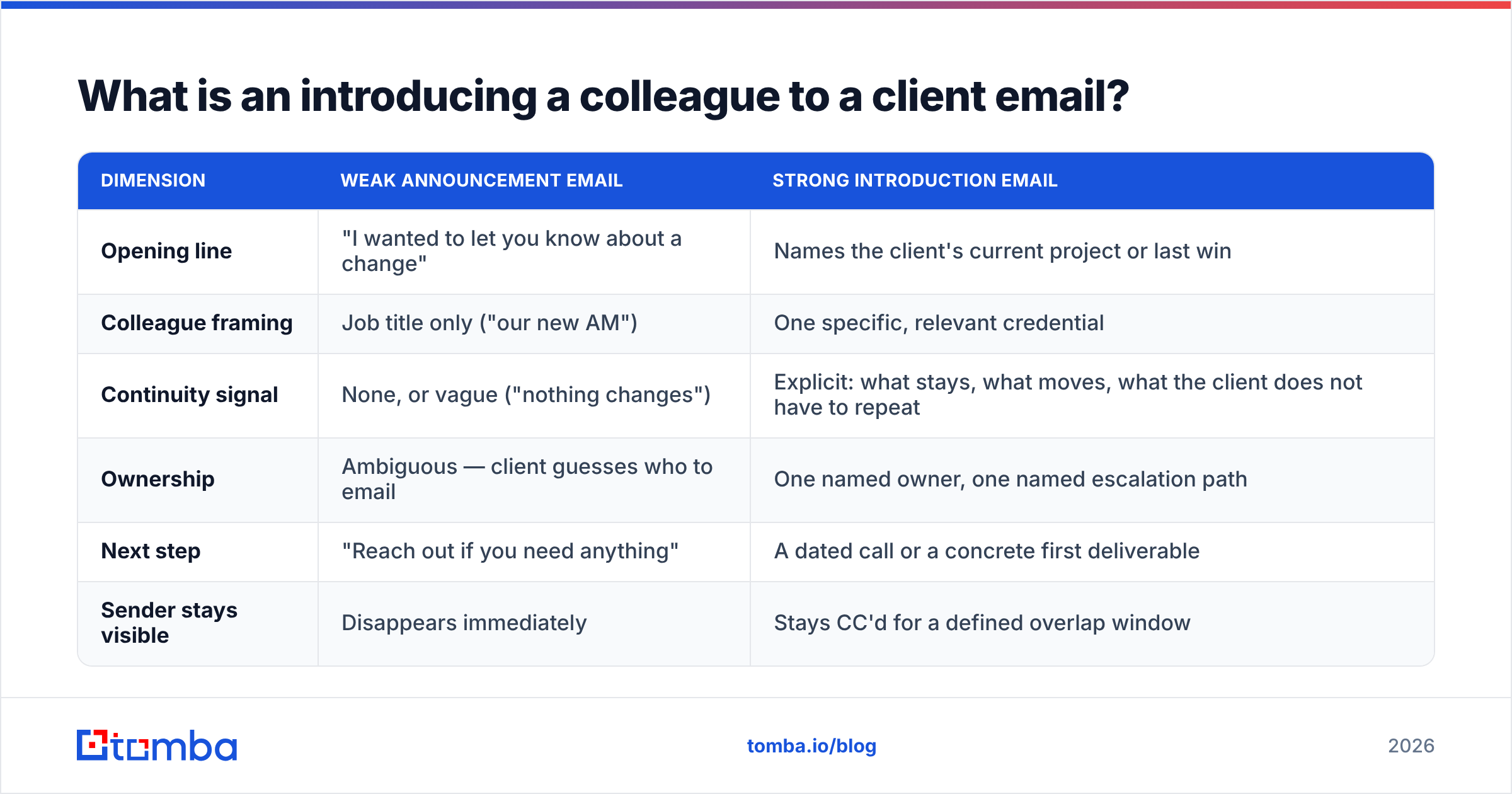
Here is what separates the two, side by side:
| Dimension | Weak announcement email | Strong introduction email |
|---|---|---|
| Opening line | "I wanted to let you know about a change" | Names the client's current project or last win |
| Colleague framing | Job title only ("our new AM") | One specific, relevant credential |
| Continuity signal | None, or vague ("nothing changes") | Explicit: what stays, what moves, what the client does not have to repeat |
| Ownership | Ambiguous — client guesses who to email | One named owner, one named escalation path |
| Next step | "Reach out if you need anything" | A dated call or a concrete first deliverable |
| Sender stays visible | Disappears immediately | Stays CC'd for a defined overlap window |
The right-hand column takes maybe ninety extra seconds to write. The left-hand column is why renewal conversations get awkward in Q4.
When should you send the colleague introduction email?#
Before the colleague sends anything themselves. That is the single rule that matters most, and it is the one most teams break.
Timing beyond that depends on the handoff type:
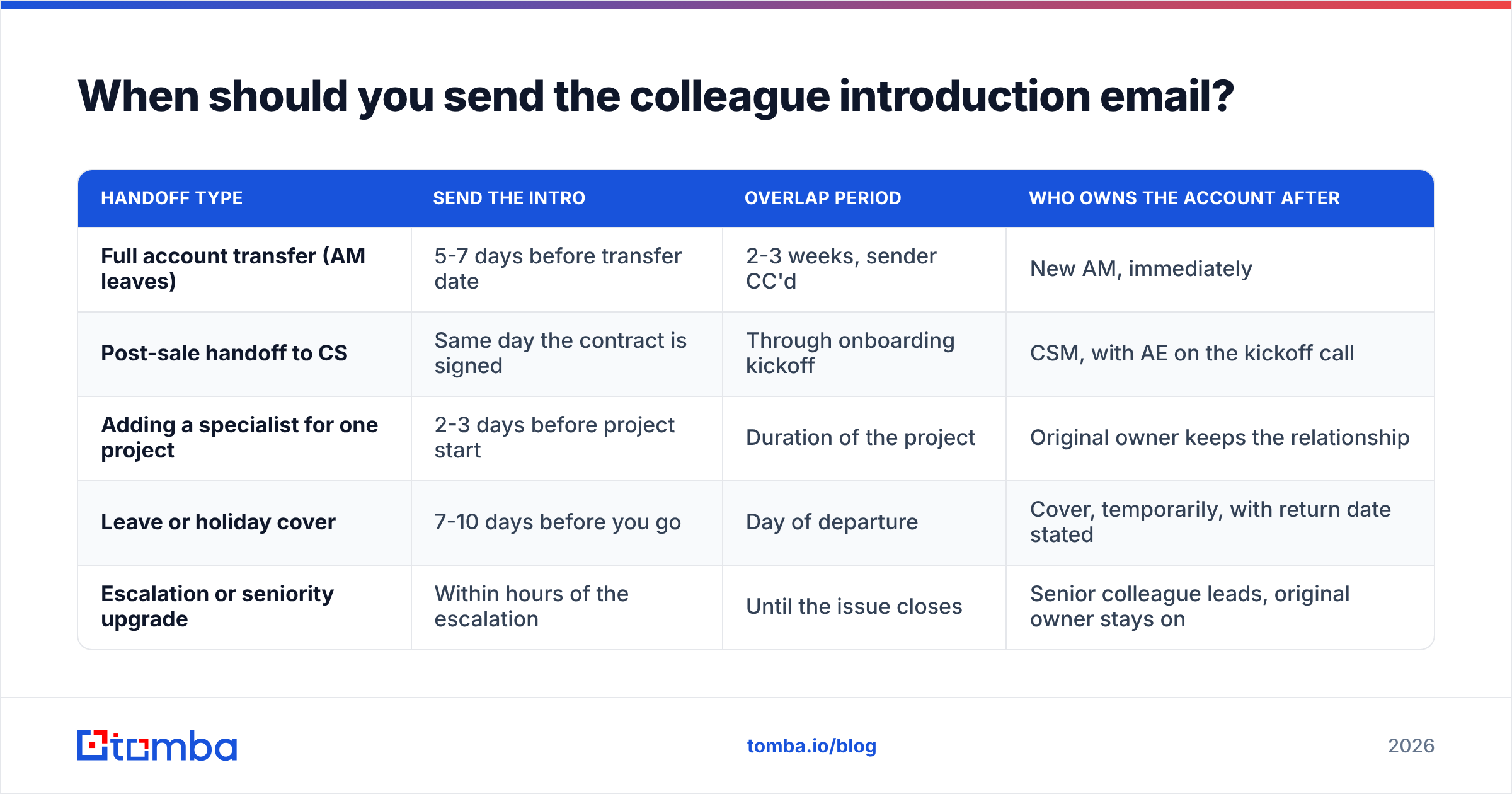
| Handoff type | Send the intro | Overlap period | Who owns the account after |
|---|---|---|---|
| Full account transfer (AM leaves) | 5-7 days before transfer date | 2-3 weeks, sender CC'd | New AM, immediately |
| Post-sale handoff to CS | Same day the contract is signed | Through onboarding kickoff | CSM, with AE on the kickoff call |
| Adding a specialist for one project | 2-3 days before project start | Duration of the project | Original owner keeps the relationship |
| Leave or holiday cover | 7-10 days before you go | Day of departure | Cover, temporarily, with return date stated |
| Escalation or seniority upgrade | Within hours of the escalation | Until the issue closes | Senior colleague leads, original owner stays on |
The overlap window is the part people skip. If you vanish the moment you hit send, you have not introduced anyone — you have resigned from the account in public. Two weeks of visible CC is what makes the transfer feel like continuity instead of churn.

What are the six parts of a colleague introduction email?#
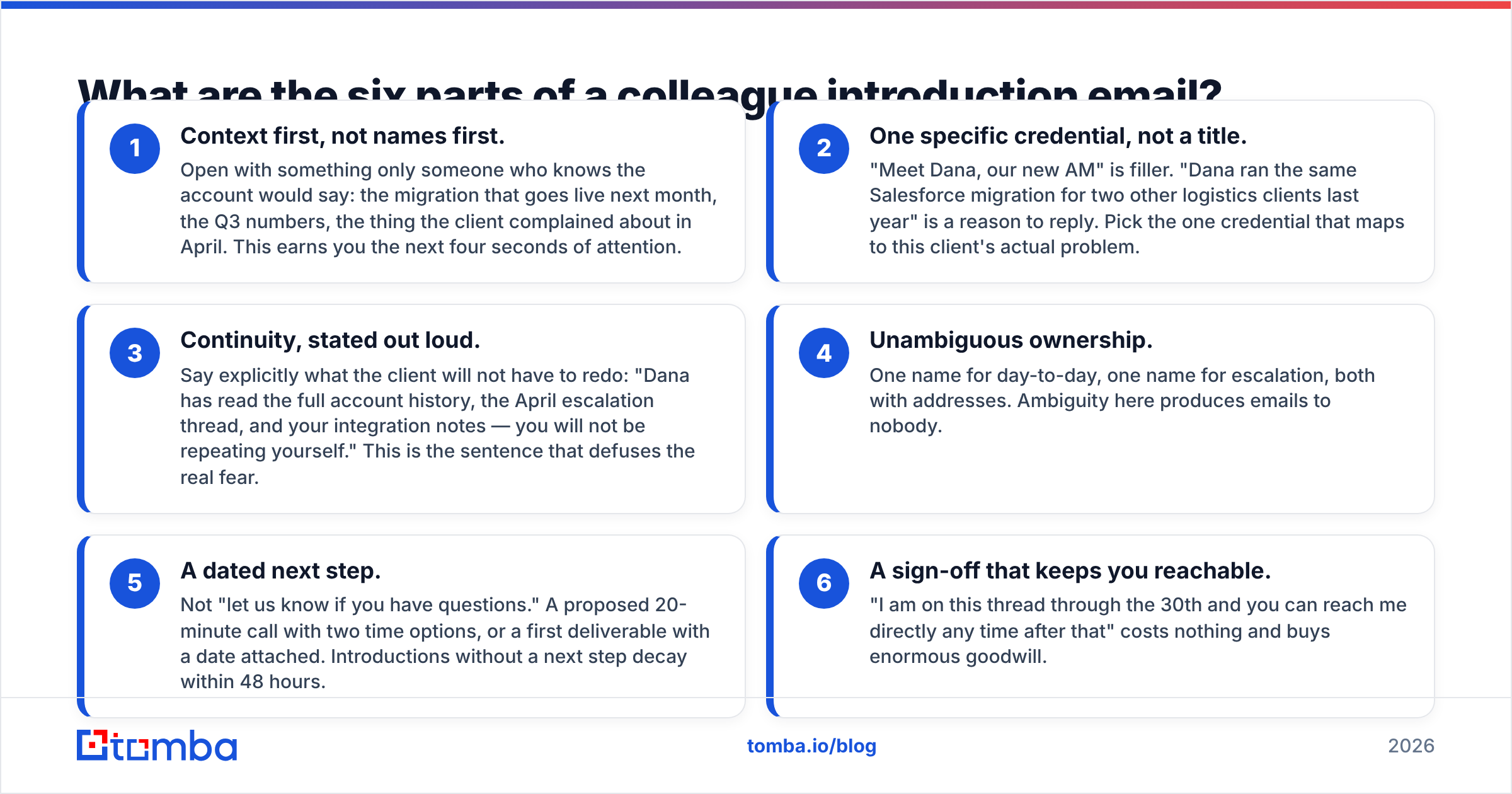
Every version of this email — whether it is four lines or fourteen — is built from the same six moves. Use them in order.
- Context first, not names first. Open with something only someone who knows the account would say: the migration that goes live next month, the Q3 numbers, the thing the client complained about in April. This earns you the next four seconds of attention.
- One specific credential, not a title. "Meet Dana, our new AM" is filler. "Dana ran the same Salesforce migration for two other logistics clients last year" is a reason to reply. Pick the one credential that maps to this client's actual problem.
- Continuity, stated out loud. Say explicitly what the client will not have to redo: "Dana has read the full account history, the April escalation thread, and your integration notes — you will not be repeating yourself." This is the sentence that defuses the real fear.
- Unambiguous ownership. One name for day-to-day, one name for escalation, both with addresses. Ambiguity here produces emails to nobody.
- A dated next step. Not "let us know if you have questions." A proposed 20-minute call with two time options, or a first deliverable with a date attached. Introductions without a next step decay within 48 hours.
- A sign-off that keeps you reachable. "I am on this thread through the 30th and you can reach me directly any time after that" costs nothing and buys enormous goodwill.
If you want to pressure-test your draft, read it back and ask: could this email have been written by someone who had never worked on the account? If yes, it is not an introduction — it is a form letter.
Which template fits your situation?#
Five real scenarios, five templates. Adapt the specifics; keep the structure.
1. Full account transfer
Subject: Dana is taking over your account (and already knows the Q3 plan)

Hi Marcus,

Before the September rollout kicks off, one change worth 30 seconds of your time.

Dana Okoye is taking over as your account manager starting the 22nd. She ran the
same multi-warehouse rollout for two logistics clients last year, and she has already
read through your integration notes and the April routing escalation — you will not
be re-explaining any of it.

Day to day: Dana (dana@ourcompany.com).
Anything urgent or contractual: Priya, our director (priya@ourcompany.com).

Dana will send two times for a 20-minute intro call this week. I am staying on this
thread through the end of the month, so reply to me directly if anything feels off.

It has been genuinely good working with you.
Nathan
2. Post-sale handoff to customer success
Subject: Your onboarding starts Monday — meet Leah

Hi Rachel,

Contract is signed, so here is what happens next.

Leah Ferris runs onboarding for our mid-market accounts and will own your rollout
from Monday through go-live. She sat in on our scoping call in August, so she has
the full picture of the three-region requirement and the November deadline.

She will send the kickoff agenda tomorrow. I will be on the kickoff call, then I
step back to your commercial contact for renewals and expansion.

Nothing you told me during the evaluation needs to be repeated.
Tom
3. Adding a specialist to an existing project
Subject: Bringing in Sam for the API piece

Hi Elena,

The webhook latency issue you flagged last Thursday is genuinely a deep one, so I
am bringing in reinforcement rather than guessing at it.

Sam Whitaker is our integrations engineer — he wrote the retry logic in the version
you are running. He will join our Thursday sync and own the diagnosis from there.

I am still your point of contact for everything else. Sam is on the technical thread
only, so you do not have to track two relationships.

Thursday, 2pm as usual?
Priya
4. Leave or holiday cover
Subject: Who to contact while I am out (Oct 6 - Nov 17)

Hi David,

I am out on parental leave from October 6 and back November 17.

Jonas Kelly is covering my accounts. He has your renewal timeline, the discount
structure we agreed in June, and the open ticket on the SSO config. Reach him at
jonas@ourcompany.com.

The renewal conversation is scheduled for the first week of November — Jonas will
run it with the same terms we discussed, no renegotiation.

I will pick everything back up on the 17th.
Amara
5. Escalation upgrade
Subject: Bringing our VP into the routing issue

Hi Marcus,

Yesterday's outage was not acceptable and I am not going to handle it alone.

Priya Raman, our VP of Delivery, is now on this thread and owns the resolution
plan. She has the full incident timeline and authority to make commercial calls
without checking with anyone.

You will have a written root-cause summary by Friday 5pm. I stay on every message.
Nathan
Notice what none of these do: apologize for existing, pile on adjectives, or use the phrase "I wanted to reach out." If you need a starting point for other scenarios, the cold email templates library covers adjacent formats, and running a draft through a subject line tester will tell you fast whether your subject reads as news or as noise.
What mistakes kill a colleague introduction email?#
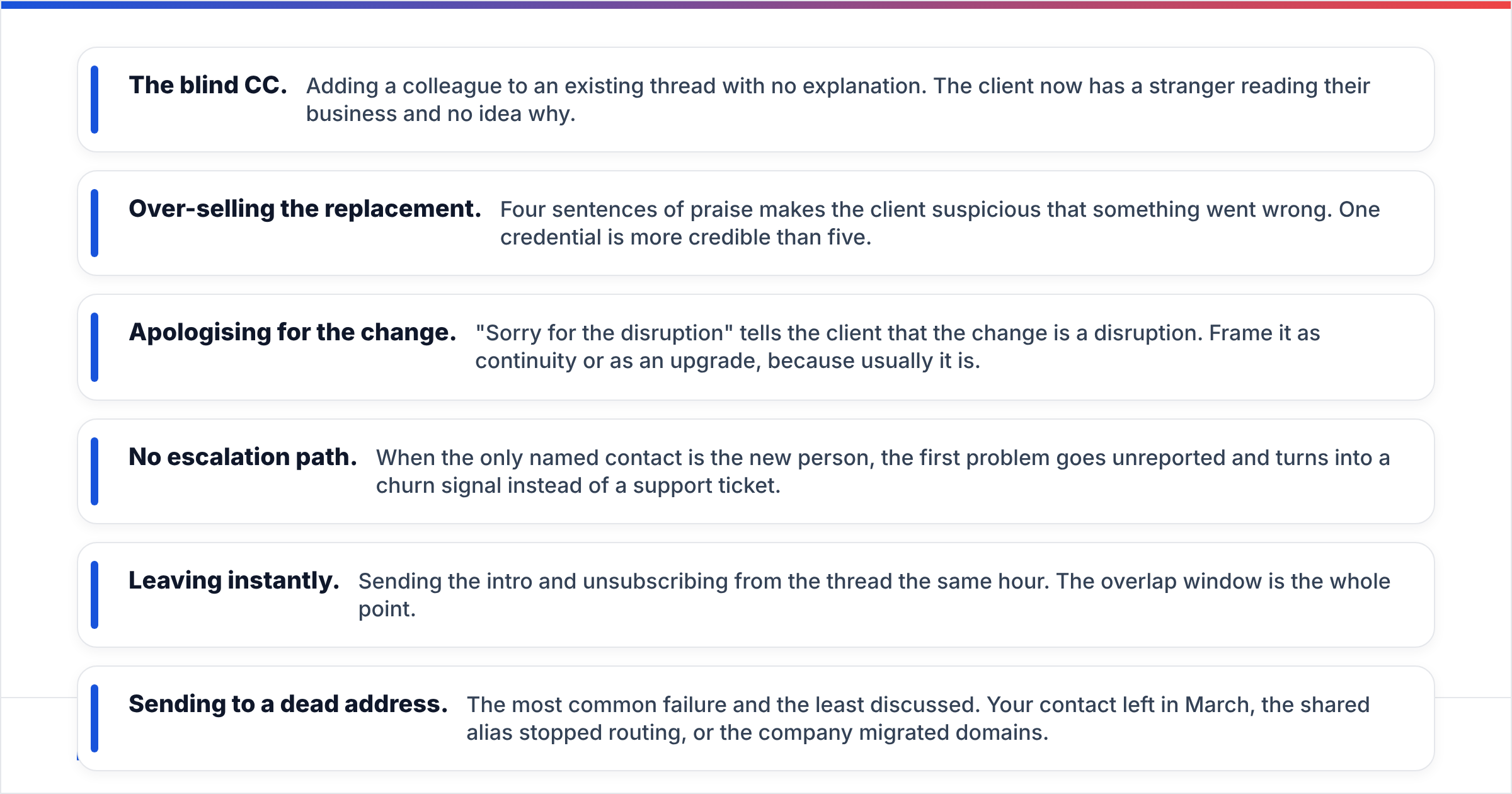
- The blind CC. Adding a colleague to an existing thread with no explanation. The client now has a stranger reading their business and no idea why.
- Over-selling the replacement. Four sentences of praise makes the client suspicious that something went wrong. One credential is more credible than five.
- Apologising for the change. "Sorry for the disruption" tells the client that the change is a disruption. Frame it as continuity or as an upgrade, because usually it is.
- No escalation path. When the only named contact is the new person, the first problem goes unreported and turns into a churn signal instead of a support ticket.
- Leaving instantly. Sending the intro and unsubscribing from the thread the same hour. The overlap window is the whole point.
- Sending to a dead address. The most common failure and the least discussed. Your contact left in March, the shared alias stopped routing, or the company migrated domains.

That last one deserves its own section, because no amount of good copy survives a bounce.
How do you make sure the introduction actually lands?#
Check three things before you write, not after you send.
Is the contact still there? B2B contact data decays roughly 25-30% a year through job changes alone, and account handoffs tend to happen at exactly the moment when the client side is also reshuffling. A reverse email lookup on the address you have tells you whether the person behind it still matches the role you think they hold.
Does the address still resolve? Aliases like procurement@ and ops@ get retired quietly. Run the address through an email verifier before a handoff email, not after — a bounce on an introduction email means your colleague starts the relationship invisible.
Who else should be on the thread? Buying committees grow after the sale. If the client's team has added a technical lead or a new ops manager since your last conversation, a domain search surfaces the current roster at that company so your introduction reaches everyone who will actually work with your colleague, not just the person who signed.
For the writing side itself, the fundamentals of professional email etiquette described in Netiquette still hold, and both the HubSpot sales blog and the Salesforce blog publish useful ongoing research on account transitions and customer retention if you want to go deeper on the relationship-management side.
What does a good handoff look like two weeks later?#
The client has emailed your colleague directly without CC'ing you. They did not re-explain their setup. The first call happened on the date you proposed. Nobody asked "who is my contact again?"
If all four are true, the email worked. If the client is still routing everything through you three weeks in, the introduction did not transfer trust — it just added a name to the thread. Send a short follow-up that hands off one specific, live item to your colleague in public, and let them solve it visibly. Competence closes the gap faster than another introduction ever will.
Get the address right before you write the email#
The best-written introduction in the world is worthless if it lands in a mailbox nobody reads. Before your next handoff, confirm you have a live, current address for every person who should be on the thread — including the ones who joined the client's team after you closed the deal.
Tomba Email Finder finds and confirms professional addresses by name and domain, so your colleague's first impression is a reply instead of a bounce. The free tier covers 25 searches a month, and paid plans start at $49/mo — full Tomba pricing is on the site. Check the address, then send the email.
Related guides#
// get started
Find, verify and enrich your first contacts today
Start on the free plan with 25 searches a month, then scale when your team is ready.
Free plan · No credit card required · GDPR & CCPA
// about the author