Introducing Mail to Buyer: Templates That Get Replies in 2026
A first email to a buyer gets about eight seconds of attention. Here is the structure, the templates, and the verification step that decide whether yours gets a reply or a delete.
TL;DR
- An introducing mail to buyer is a first-contact email whose only job is to earn a reply, not to close a deal. One ask, one proof point, one line about the buyer.
- The three formats that work are the referral intro, the trigger-event intro, and the supplier/capability intro. Pick based on what you actually know about the buyer.
- Subject lines under 50 characters, bodies under 125 words, and a single low-friction ask outperform long "company overview" emails by a wide margin.
- Bad contact data kills more intro emails than bad copy. Verify the address before you send; a bounced first email damages your sending domain for every buyer after it.
- Follow up three to four times over two to three weeks, each time with a new angle. Most replies to cold intros arrive after the first message, not on it.
What Is an Introducing Mail to Buyer?#
An introducing mail to buyer is the first email you send to a purchasing decision-maker who has never heard of you: a procurement manager, a category buyer at a retailer, a head of sourcing at a manufacturer, or the department lead who controls the budget for what you sell.
Think of it like knocking on a stranger's door at a trade show booth. You get roughly one sentence before they decide whether to keep listening or look past your shoulder. The email version is the same, except the buyer's inbox has 180 other doors being knocked on that morning.
The mistake almost everyone makes is treating this email as a brochure. Sellers stuff in the founding year, the factory size, the certifications, the full product catalogue, and three different calls to action. Buyers read none of it. The email that works does something narrower: it proves you understand what this specific buyer sources, offers one concrete reason you might be relevant, and asks a question that costs ten seconds to answer.
What Does a Buyer Actually Read in the First Eight Seconds?#
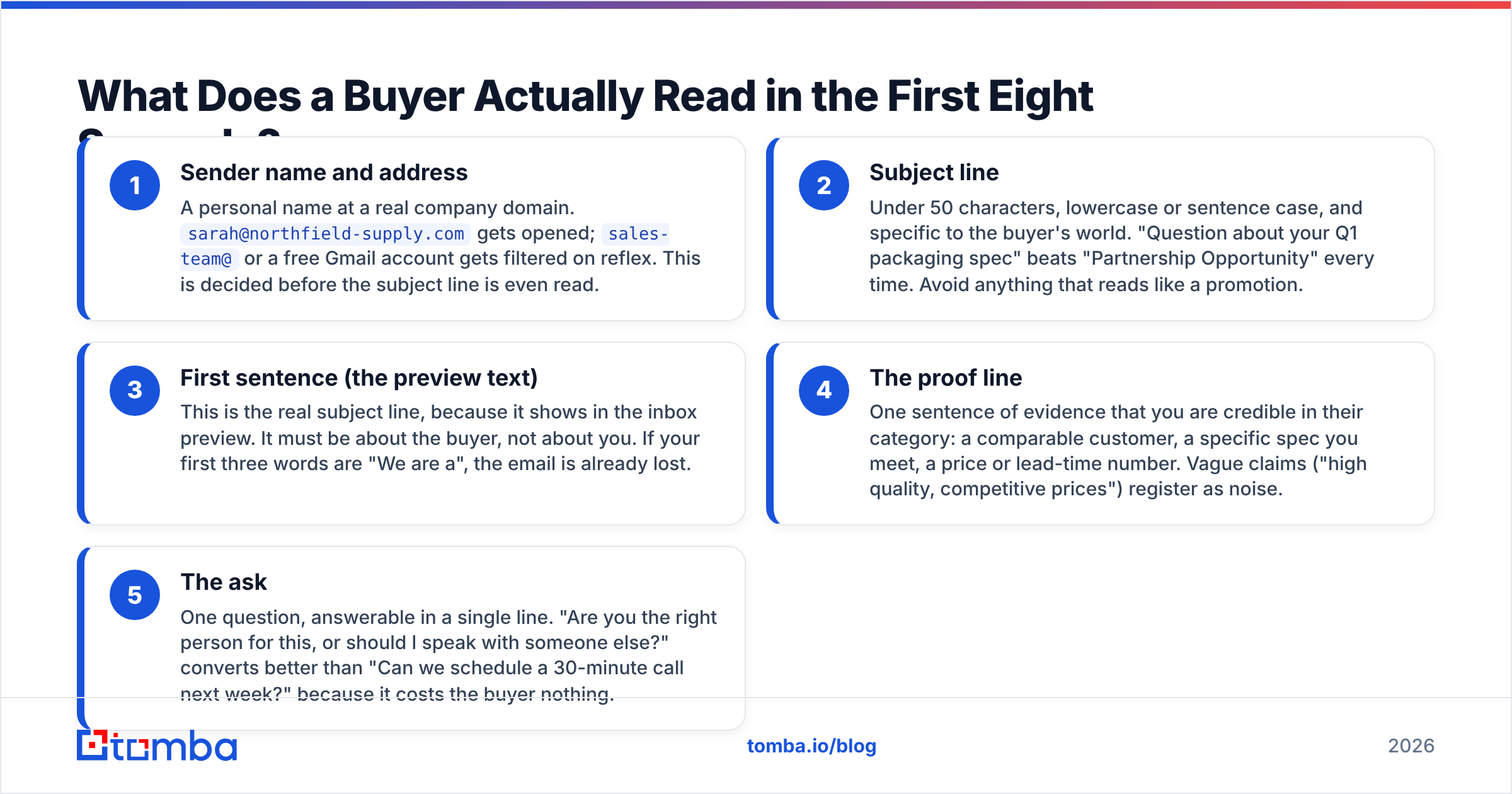
Buyers triage. They scan in a fixed order and drop out the moment something reads like a mass mailing. Here is the sequence, and what each element has to accomplish:
- Sender name and address — A personal name at a real company domain.
sarah@northfield-supply.comgets opened;sales-team@or a free Gmail account gets filtered on reflex. This is decided before the subject line is even read. - Subject line — Under 50 characters, lowercase or sentence case, and specific to the buyer's world. "Question about your Q1 packaging spec" beats "Partnership Opportunity" every time. Avoid anything that reads like a promotion.
- First sentence (the preview text) — This is the real subject line, because it shows in the inbox preview. It must be about the buyer, not about you. If your first three words are "We are a", the email is already lost.
- The proof line — One sentence of evidence that you are credible in their category: a comparable customer, a specific spec you meet, a price or lead-time number. Vague claims ("high quality, competitive prices") register as noise.
- The ask — One question, answerable in a single line. "Are you the right person for this, or should I speak with someone else?" converts better than "Can we schedule a 30-minute call next week?" because it costs the buyer nothing.
Everything else — company history, catalogue links, certifications, your team photo — belongs in the second email, after the buyer has signalled interest.
Why Do Most Buyer Introduction Emails Get Deleted?#
Three failure modes account for most of it.
The email is about you. Count the pronouns in your draft. If "we," "our," and "I" outnumber "you" and "your," the buyer reads it as a broadcast. Buyers do not care about your twelve years in the industry until they care about the problem you solve.
The ask is too expensive. Asking a stranger for 30 minutes on a first email is asking for a commitment worth hundreds of dollars of their time. Ask for information instead: a yes/no, a redirect to the right person, a one-word confirmation of who handles the category.
The email never arrives. This is the invisible failure. If your list has a 12% invalid rate and you blast 500 intro emails, roughly 60 bounce. Mailbox providers read that bounce rate as a spam signal, and the next batch lands in junk regardless of how good the copy is. Sending reputation is cumulative, so one sloppy campaign degrades results for months. Google's own guidance for bulk senders puts hard-bounce and complaint thresholds at the centre of inbox placement, which is why list hygiene is a copywriting problem, not just an ops problem.
If you want the broader mechanics behind that, email deliverability is worth understanding before you scale any outbound program.
Which Introduction Email Format Should You Use?#
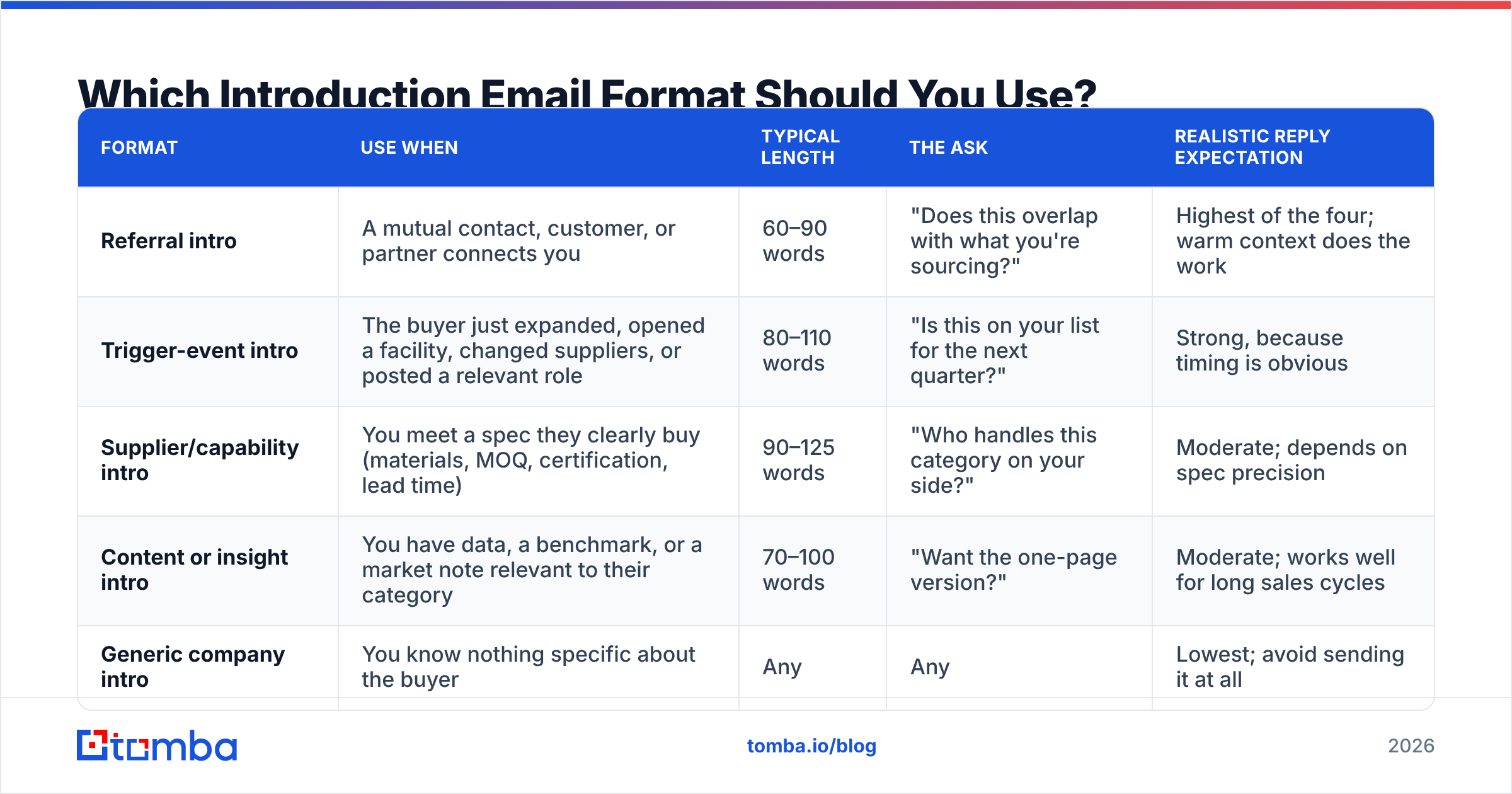
There is no single best template. The right format depends entirely on what you know about the buyer before you write. Pick from these four:
| Format | Use when | Typical length | The ask | Realistic reply expectation |
|---|---|---|---|---|
| Referral intro | A mutual contact, customer, or partner connects you | 60–90 words | "Does this overlap with what you're sourcing?" | Highest of the four; warm context does the work |
| Trigger-event intro | The buyer just expanded, opened a facility, changed suppliers, or posted a relevant role | 80–110 words | "Is this on your list for the next quarter?" | Strong, because timing is obvious |
| Supplier/capability intro | You meet a spec they clearly buy (materials, MOQ, certification, lead time) | 90–125 words | "Who handles this category on your side?" | Moderate; depends on spec precision |
| Content or insight intro | You have data, a benchmark, or a market note relevant to their category | 70–100 words | "Want the one-page version?" | Moderate; works well for long sales cycles |
| Generic company intro | You know nothing specific about the buyer | Any | Any | Lowest; avoid sending it at all |
The bottom row is the honest one. If you cannot fill in a single buyer-specific detail, the problem is research, not writing. Spend the ten minutes on their website, their LinkedIn posts, or their recent press before you draft anything.
What Does a Working Introducing Mail to Buyer Look Like?#
Three templates you can adapt. Keep the structure; replace every bracket with something real.
Template 1 — Trigger-event intro
Subject: your new [Rotterdam] site

Hi [First name],

Saw [Company] is bringing the [Rotterdam] facility online this
quarter. Usually that means re-sourcing [category] on a tighter
lead time.

We supply [comparable buyer] with [specific spec] at [lead time],
EU-warehoused, so there's no customs delay on reorders.

Is [category] sourcing something you're handling, or should I
speak to someone else on the team?

[Your name]
[Title, Company]
Template 2 — Supplier/capability intro
Subject: [MOQ 500] on [product category]

Hi [First name],

Quick one. You currently list [product] at [spec] — we run the
same spec at MOQ 500 with a 21-day lead time from [origin].

Two of your category peers moved to us last year, mostly to cut
the reorder window.

Worth a spec sheet, or is your supplier list closed for the year?

[Your name]
Template 3 — Referral intro
Subject: [Mutual contact] suggested I reach out

Hi [First name],

[Mutual contact] at [Company] mentioned you're the person to
talk to about [category].

We handle [specific thing] for them — [one concrete result,
e.g. "cut their landed cost 9% on the same spec"].

Does that overlap with anything you're looking at right now?

[Your name]
Notice what is missing from all three: no attachments, no catalogue links, no "we are a leading manufacturer," no 30-minute meeting request. The entire goal is a one-line reply. Everything else happens after that.
For subject-line variants, run a few through a subject line tester before committing a batch. Small changes in phrasing move open rates more than most people expect, and sales teams at scale treat this as a standing A/B test — a practice documented extensively in HubSpot's sales resources.
How Do You Find the Right Buyer's Email Address?#
Copy is the easier half. Reaching the actual buyer is where most outbound programs quietly fail.
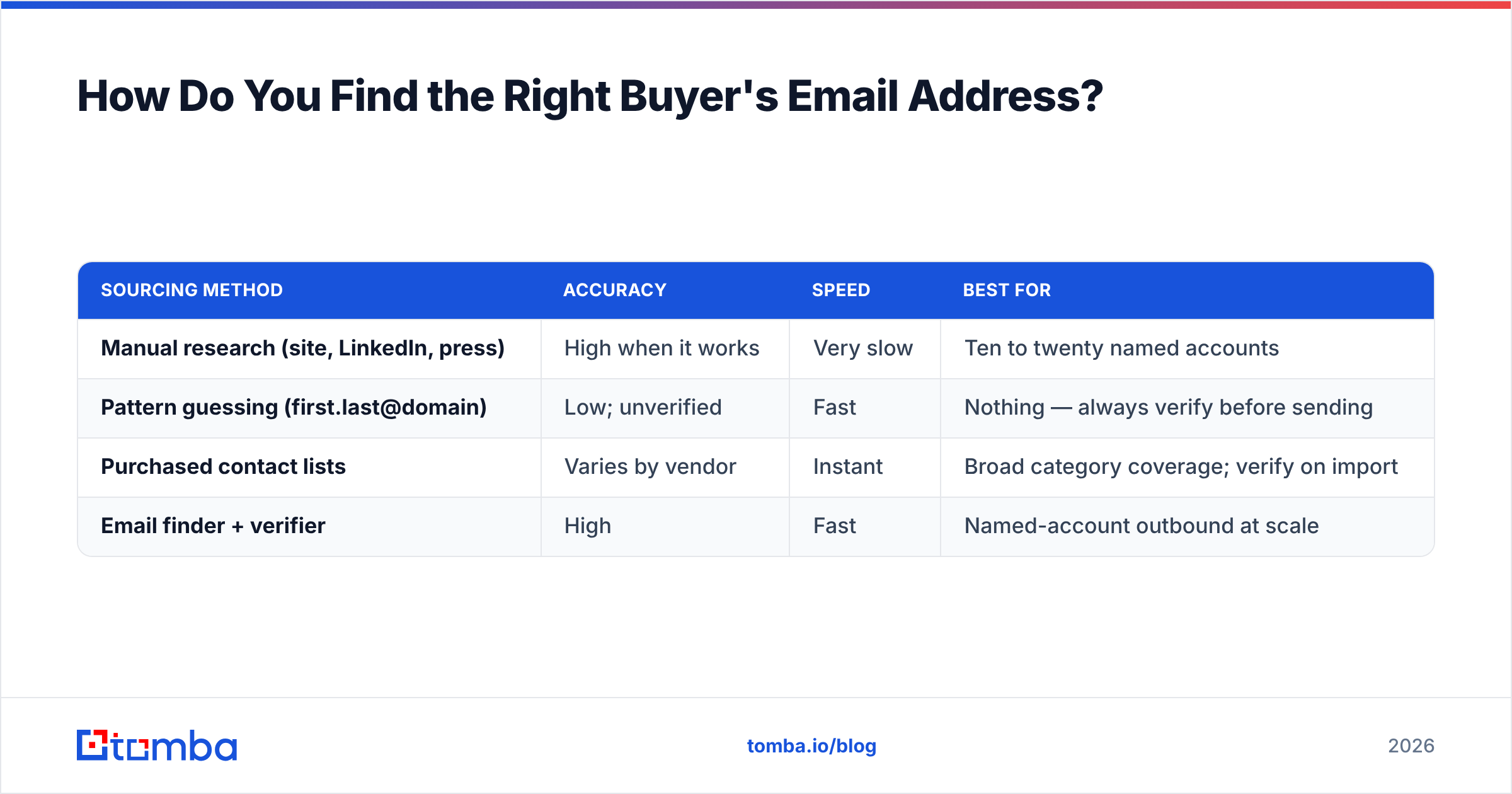
You need two things: the correct person, and a deliverable address for that person. Getting the company's generic info@ address and hoping it forwards to procurement is not a strategy — those inboxes are triaged by people with no purchasing authority.
| Sourcing method | Accuracy | Speed | Best for |
|---|---|---|---|
| Manual research (site, LinkedIn, press) | High when it works | Very slow | Ten to twenty named accounts |
| Pattern guessing (first.last@domain) | Low; unverified | Fast | Nothing — always verify before sending |
| Purchased contact lists | Varies by vendor | Instant | Broad category coverage; verify on import |
| Email finder + verifier | High | Fast | Named-account outbound at scale |
A practical workflow: pull the buyer's company domain, run a domain search to see which departments are represented and what the company's email pattern is, then use the email finder on the specific name you identified. Finally, run the result through an email verifier so you are not spending sender reputation on a guess.
Reputable list vendors such as BookYourData are a reasonable shortcut when you need breadth in a category you have never sold into — just treat any purchased file the same way you treat a scraped one, and verify it on import rather than assuming freshness. The same applies to records already sitting in your CRM; B2B contact data decays fast as people change roles.
Tomba's own plans make the verify-first habit cheap to build: the free tier covers 25 searches a month, Starter runs $49/mo, Growth $99/mo, and Pro $249/mo, with bulk processing available if you are working a list rather than named accounts. Full Tomba pricing is on the site.
How Many Follow-Ups Should You Send?#
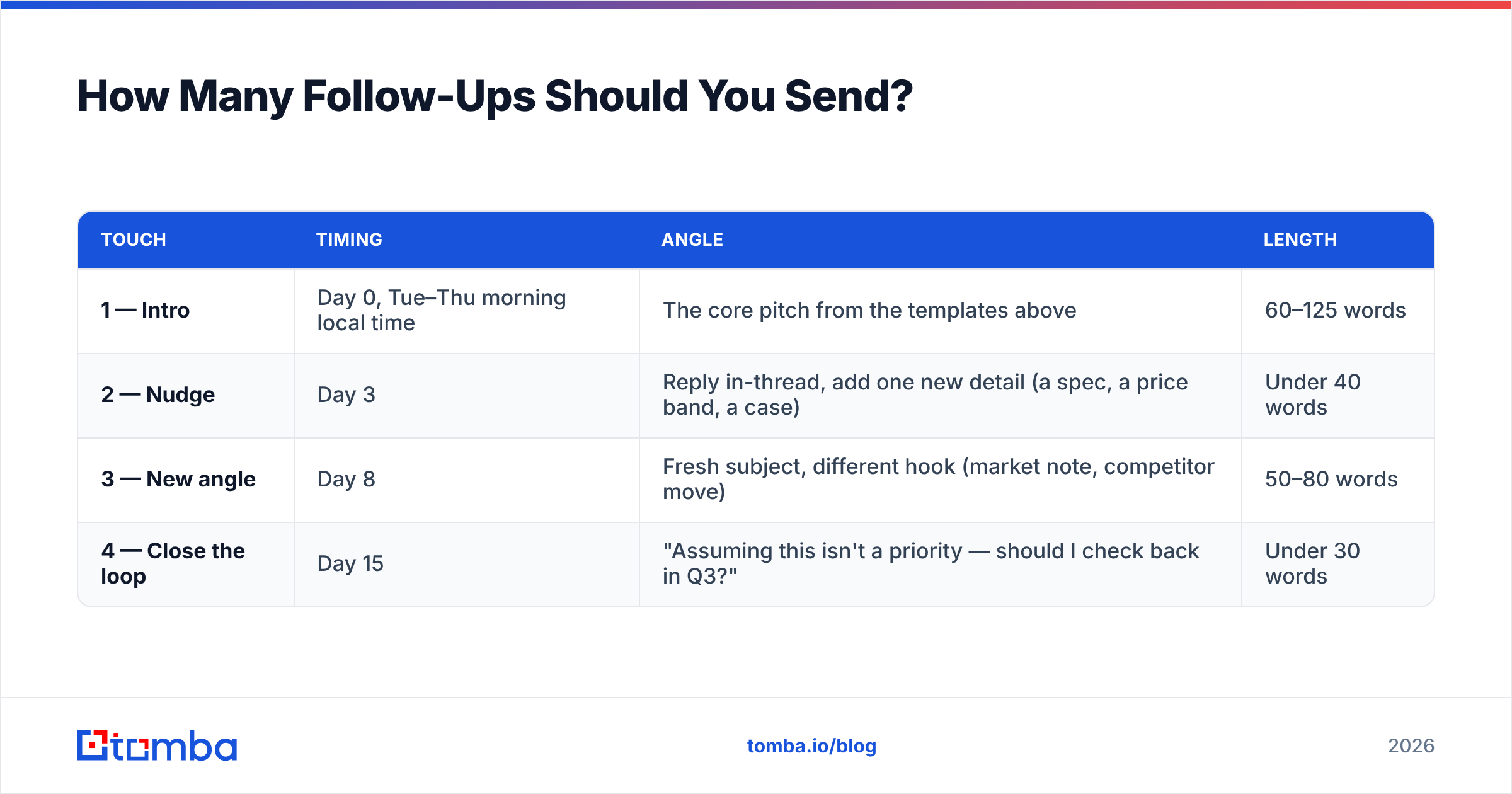
Most replies to a cold introducing mail to buyer do not come from the first email. Buyers are busy, your email arrived during a fire drill, and the thread sank. A follow-up is not nagging; it is a second chance at good timing.
| Touch | Timing | Angle | Length |
|---|---|---|---|
| 1 — Intro | Day 0, Tue–Thu morning local time | The core pitch from the templates above | 60–125 words |
| 2 — Nudge | Day 3 | Reply in-thread, add one new detail (a spec, a price band, a case) | Under 40 words |
| 3 — New angle | Day 8 | Fresh subject, different hook (market note, competitor move) | 50–80 words |
| 4 — Close the loop | Day 15 | "Assuming this isn't a priority — should I check back in Q3?" | Under 30 words |
That last one pulls a surprising number of replies, because it gives the buyer an easy, face-saving exit. "Yes, check back in Q3" is a qualified lead with a date attached.
Two rules for follow-ups. Never send a bare "just bumping this to the top of your inbox" — it adds nothing and signals automation. And never send touch two if touch one hard-bounced; fix the address instead.
If you run this across a large account list, a sequencing tool becomes necessary. The sales engagement category on G2 is a reasonable place to compare options, but the sequencer is downstream of data quality. A perfect cadence on a bad list still lands in spam.
What Kills Reply Rates Fastest?#
- Attachments on a first email. PDFs and price lists trip spam filters and get stripped by corporate gateways. Send them after the reply.
- Multiple links. One link maximum. Zero is often better on the first touch.
- Buzzword openers. "I hope this email finds you well" and "I wanted to reach out" are delete triggers. Start with the buyer.
- Wrong trade terms. If you sell internationally and misuse Incoterms in the first email, an experienced buyer stops reading. Precision signals competence.
- Unverified sends at volume. Bounces compound. One 500-email blast with a 12% invalid rate can suppress inbox placement for weeks.
- No clear sender identity. No title, no company, no reply-to that matches the sending domain. Buyers will not engage with an email they cannot trace.
How Do You Know It's Actually Working?#
Track four numbers per campaign, in this order: delivery rate, open rate, reply rate, and qualified-reply rate. Most teams only watch the last one, which means they cannot tell the difference between weak copy and a broken list.
If delivery is below 95%, stop writing and fix the data. If delivery is healthy but opens are low, the subject line and sender name are the problem. If opens are strong but replies are not, your ask is too expensive or your proof line is generic. If replies come in but none are qualified, your targeting is wrong — you are reaching people who do not buy your category.
Fix in that order. Rewriting copy when the real issue is a 14% bounce rate is the most common wasted week in outbound.
Where to Start#
Pick twenty buyers you genuinely want. Research each one for ten minutes. Write one of the three templates above with real details filled in, verify every address before it leaves your outbox, and run the four-touch cadence. Twenty well-built intro emails will beat two thousand generic ones on every metric that matters, including the one your finance team looks at.
When you are ready to scale past manual research, start with the Tomba Email Finder. Give it a buyer's name and company domain and you get a verified, deliverable address back — so your introducing mail to buyer reaches an actual human instead of a bounce log. The free tier covers 25 searches a month, which is enough to build the habit before you commit to a plan.
Related guides#
// get started
Find, verify and enrich your first contacts today
Start on the free plan with 25 searches a month, then scale when your team is ready.
Free plan · No credit card required · GDPR & CCPA
Get the Tomba newsletter
Product and data updates
// about the author