How to Write an Introduction Email to a CEO That Gets Replies
CEOs read email on a phone, between meetings, with a delete finger ready. Here is the structure, subject-line logic, and follow-up cadence that actually earns a reply from the corner office.
TL;DR
- A CEO gives your email roughly three seconds on a phone screen. Everything past the first 12 words is a bonus you have to earn.
- The winning structure is fixed: proof you know their business, one specific insight or observation, one small ask. Target 70–110 words total.
- Never open with "I hope this email finds you well," your company boilerplate, or a calendar link. All three are instant deletes at the executive level.
- Deliverability is half the battle. An unverified guess at a CEO address bounces, and bounces at a small company often land in the CEO's own inbox as a failure notice — the worst possible first impression.
- Follow up three times over 12 days, then stop. CEOs respond to persistence, not pestering.
What is an introduction email to a CEO, and when is it worth sending?#
An introduction email to a CEO is a short, cold or semi-cold message sent directly to a chief executive with one goal: earn permission for a longer conversation. It is not a pitch. It is a credibility test you have to pass in under 15 seconds.
Think of it like handing someone a business card at a conference while they are already walking toward another conversation. You get one sentence. If that sentence is about you, they keep walking. If it is about them, they stop.
Going straight to the CEO is worth it in three situations:
- Small and mid-market companies (under ~200 employees). The CEO is still the buyer, the budget holder, and often the person with the pain. There is no VP layer to route through.
- A genuinely strategic proposal. Partnerships, M&A conversations, board introductions, category-defining product bets. These die in middle management because nobody below the CEO is paid to say yes.
- You have a real, verifiable connection. Shared investor, shared alma mater, you were quoted in the same article, you used to work at their biggest customer.
It is a bad idea when you are selling a $400/month tool to a 4,000-person enterprise. Gartner's research on the B2B buying journey shows buying groups of six to ten people for enterprise purchases — the CEO is not one of them for a departmental tool, and forwarding your email to the actual owner costs them social capital they will not spend on a stranger.
Why do most CEO introduction emails get ignored?#
Because they are written for the sender's comfort, not the reader's attention. Here are the five failure modes, in order of how often they show up:
- The email never arrives. You guessed
firstname@company.com, it bounced, and your domain took a reputation hit. At companies under 50 people, that bounce notification sometimes routes to a shared inbox the CEO reads. - The first line is about you. "I'm Alex, founder of Acme, and we help companies like yours..." A CEO has no reason to care who you are yet. You have not earned the introduction.
- It is too long. Anything over 150 words on a phone requires a scroll. A scroll requires a decision. The default decision is archive.
- The ask is too big. "Do you have 30 minutes next Tuesday?" is a request for 30 minutes of the most expensive calendar in the company from someone who has given nothing yet.
- It is obviously templated.
{{first_name}}, mismatched company names, or a "personalized" first line that is clearly generated from a LinkedIn headline. Executives see hundreds of these. They pattern-match in one glance.

What structure actually works for an introduction email to a CEO?#
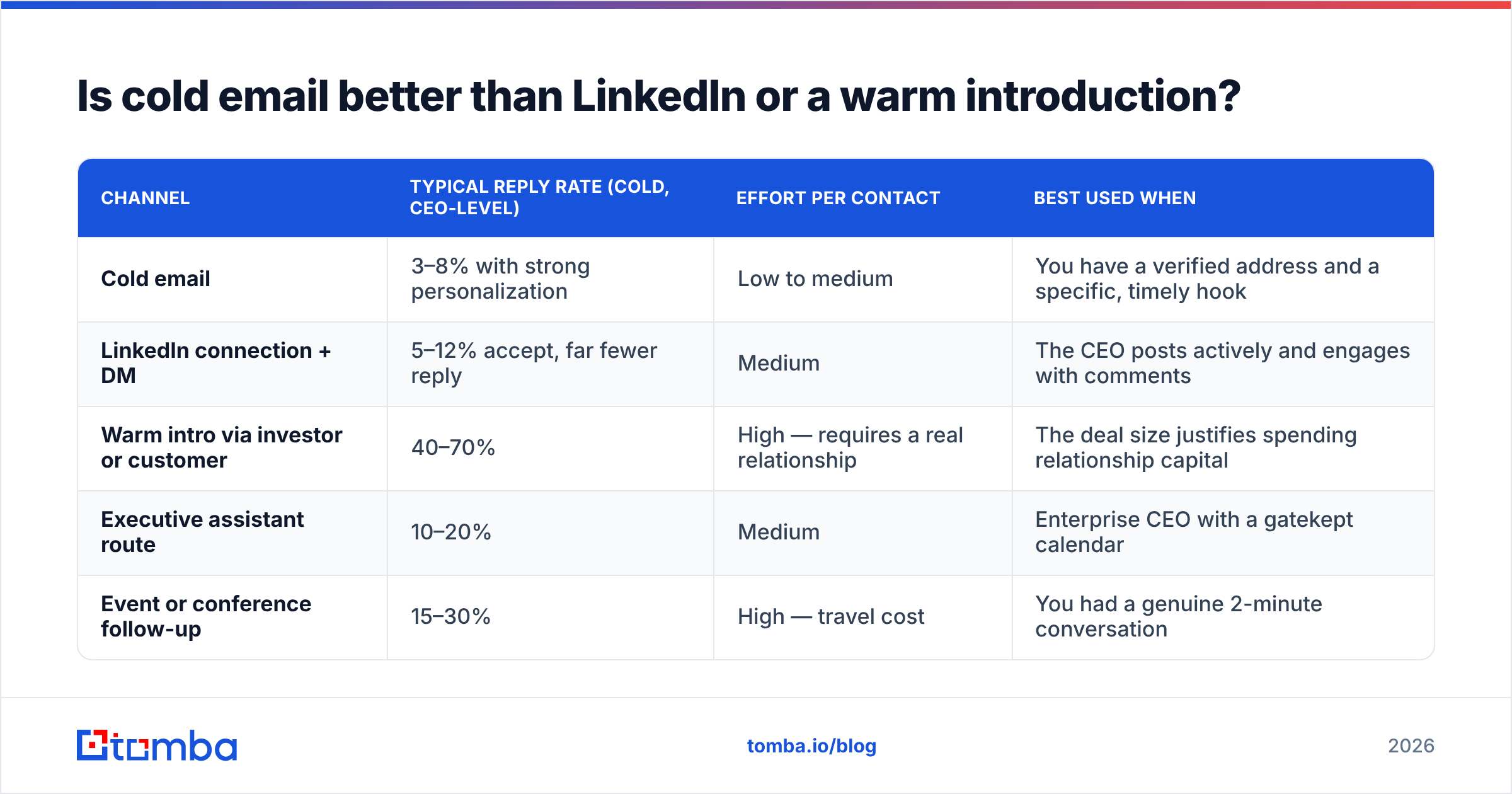
Use a fixed four-part skeleton. Every sentence has a job, and if a sentence has no job, cut it.
| Part | Its job | Word budget | Example |
|---|---|---|---|
| Subject line | Survive the preview pane | 3–6 words | Question about your Series B hiring plan |
| Opening line | Prove you did real homework | 15–25 words | Saw you're hiring four AEs in Austin before the Series B closes — congrats on the round. |
| The insight | Give value before asking | 25–40 words | Teams scaling from 2 to 6 reps usually lose 30% of pipeline to territory overlap in the first quarter. Two of your competitors hit this last year. |
| The ask | Make saying yes cheap | 10–20 words | Worth a 10-minute call, or should I send this to your VP Sales instead? |
Total: 70–110 words. That is the whole email. No signature block with six social icons, no attached one-pager, no calendar embed.
The last line matters more than people think. "Or should I send this to your VP Sales instead?" gives the CEO an easy, face-saving exit that still moves you forward. Half the time you get a forwarded intro to the right person — which is a better outcome than a CEO call anyway.
What should the subject line look like?#
Executive subject lines follow different rules than marketing subject lines. No curiosity gaps, no emoji, no ALL CAPS urgency.
- Specific and plain beats clever.
Austin AE hiringoutperformsA quick idea for you 🚀by a wide margin. - 3 to 6 words. Mobile clients truncate around 35 characters.
- Reference something only an insider would know. A funding round, a job posting, a recent podcast appearance, a product changelog entry.
- Never use "Quick question" alone. It is the single most-used cold subject line in B2B and executives have banned it mentally.
- Avoid anything that reads like an invoice or a security alert. Tricking someone into opening is a guaranteed one-way relationship.
If you want to sanity-check variations before you send, run them through a subject line tester rather than guessing at what sounds punchy.
Is cold email better than LinkedIn or a warm introduction?#
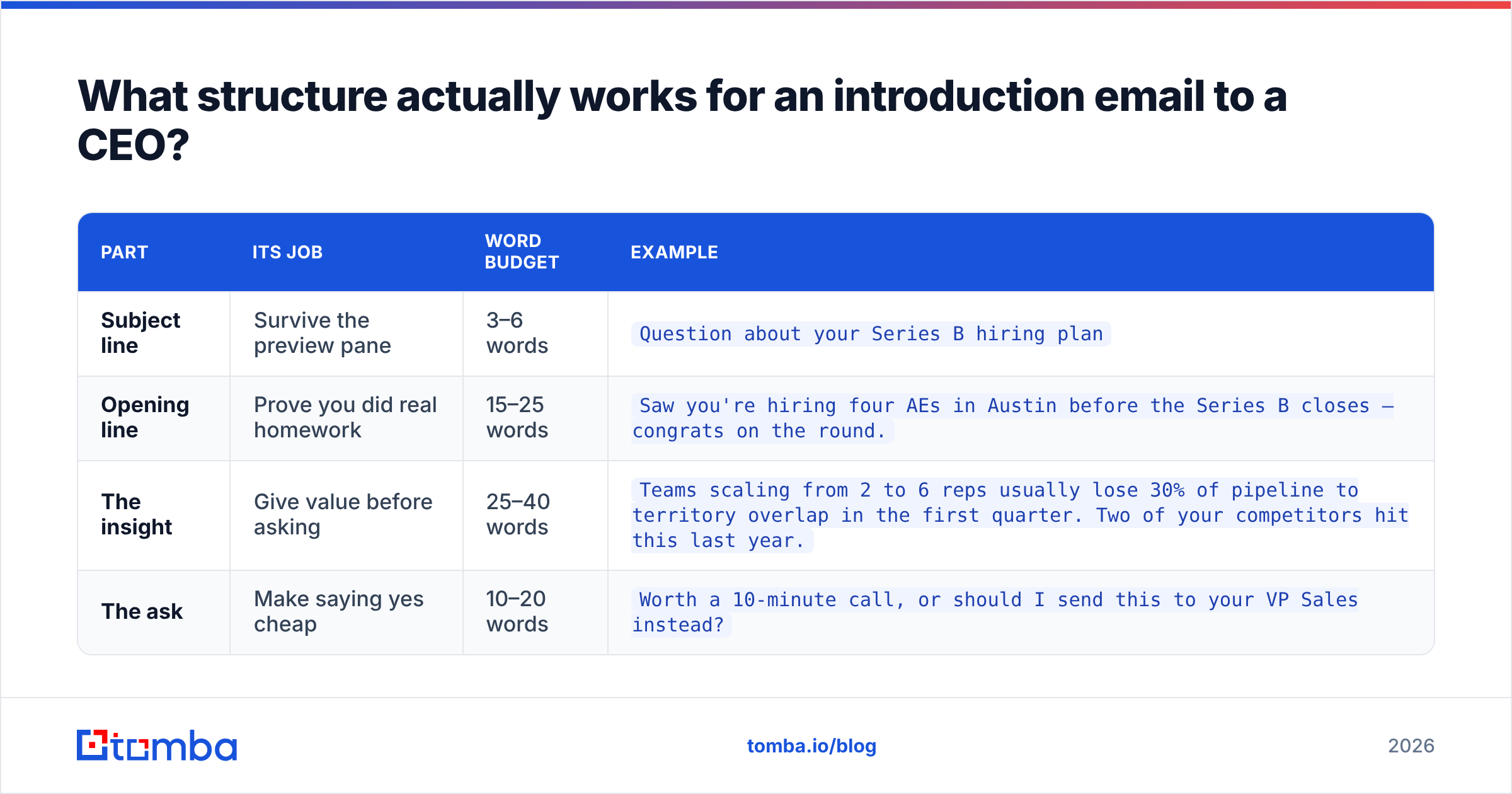
Email wins on reach and control. Warm intros win on conversion. LinkedIn sits awkwardly in the middle for CEOs specifically, because most executive LinkedIn inboxes are unread or managed by someone else.
| Channel | Typical reply rate (cold, CEO-level) | Effort per contact | Best used when |
|---|---|---|---|
| Cold email | 3–8% with strong personalization | Low to medium | You have a verified address and a specific, timely hook |
| LinkedIn connection + DM | 5–12% accept, far fewer reply | Medium | The CEO posts actively and engages with comments |
| Warm intro via investor or customer | 40–70% | High — requires a real relationship | The deal size justifies spending relationship capital |
| Executive assistant route | 10–20% | Medium | Enterprise CEO with a gatekept calendar |
| Event or conference follow-up | 15–30% | High — travel cost | You had a genuine 2-minute conversation |
The practical answer for most teams: email as the primary channel, LinkedIn engagement as the warm-up layer, and a warm intro whenever you can find one. HubSpot's sales blog has extensive benchmark data on multi-channel sequencing if you want to go deeper on cadence design.
A note on tooling: the sales engagement category on G2 has dozens of platforms that will sequence all of this for you. None of them fix a bad first sentence. Sequence software multiplies whatever quality you already have — including zero.
What are three templates that actually work?#
Template 1: The observation open (best for founder-to-founder)#
Subject: Your pricing page change
Noticed you moved the free tier behind a waitlist last month — we did the same thing in 2024 and support tickets dropped 40% while trial-to-paid stayed flat.
We built the routing layer that made that work. Happy to share the exact setup, no strings.
Want the write-up, or is this better pointed at your head of growth?
— Sam
Why it works: it opens with something only a person who actually visited the site would know, offers an asset instead of a meeting, and hands over an easy redirect.
Template 2: The mutual connection (best for semi-warm outreach)#
Subject: Priya Raman suggested I reach out
Priya mentioned you're rebuilding the RevOps stack after the Northstar acquisition.
We ran the same migration at Cobalt last year — 11 systems into 3, six weeks, no data loss. The part everyone underestimates is contact deduplication across the two CRMs.
Worth 10 minutes, or should I just send the migration checklist?
— Sam
Why it works: the name in the subject line buys you the open. The specific detail ("contact deduplication") buys you the read.
Template 3: The strategic proposal (best for partnerships)#
Subject: Distribution partnership — Acme x Northwind
We send about 2,000 qualified developers a month to tooling partners. Three of them have asked us specifically for what Northwind does.
No integration work required on your side for a pilot — we'd route traffic and split revenue 70/30 your way for the first quarter.
Interested enough for a 15-minute call, or should I send the one-page terms first?
— Sam
Why it works: it leads with the asset the other side wants, removes the implementation objection before it forms, and quantifies the offer.

How do you find and verify a CEO's email address?#
This is where most outreach quietly fails. You can write the best 90 words of your career and it means nothing if the address is wrong.
CEO addresses are harder to source than rep addresses for three reasons: they are frequently unlisted, they often use a different pattern than the rest of the company (sarah@ instead of sarah.chen@), and executive addresses get scraped and sold constantly, so public databases are full of stale entries from two jobs ago.
A workable process:
- Establish the company pattern first. Run a domain search to pull the addresses the company actually publishes and see whether they use
first.last,flast, orfirst. Pattern beats guessing every time. - Search the specific person. Feed the name and domain into an email finder and check the confidence score plus the cited sources. A result with three public sources is very different from a pattern-generated guess.
- Verify before you send. Always run the result through an email verifier. Executive addresses on catch-all domains need extra care — a catch-all accepts everything, so "valid" means less than it does elsewhere.
- Sanity-check the human. Does the LinkedIn still list this company? Did they announce a move on X last month? Twenty seconds of checking saves a very awkward email.
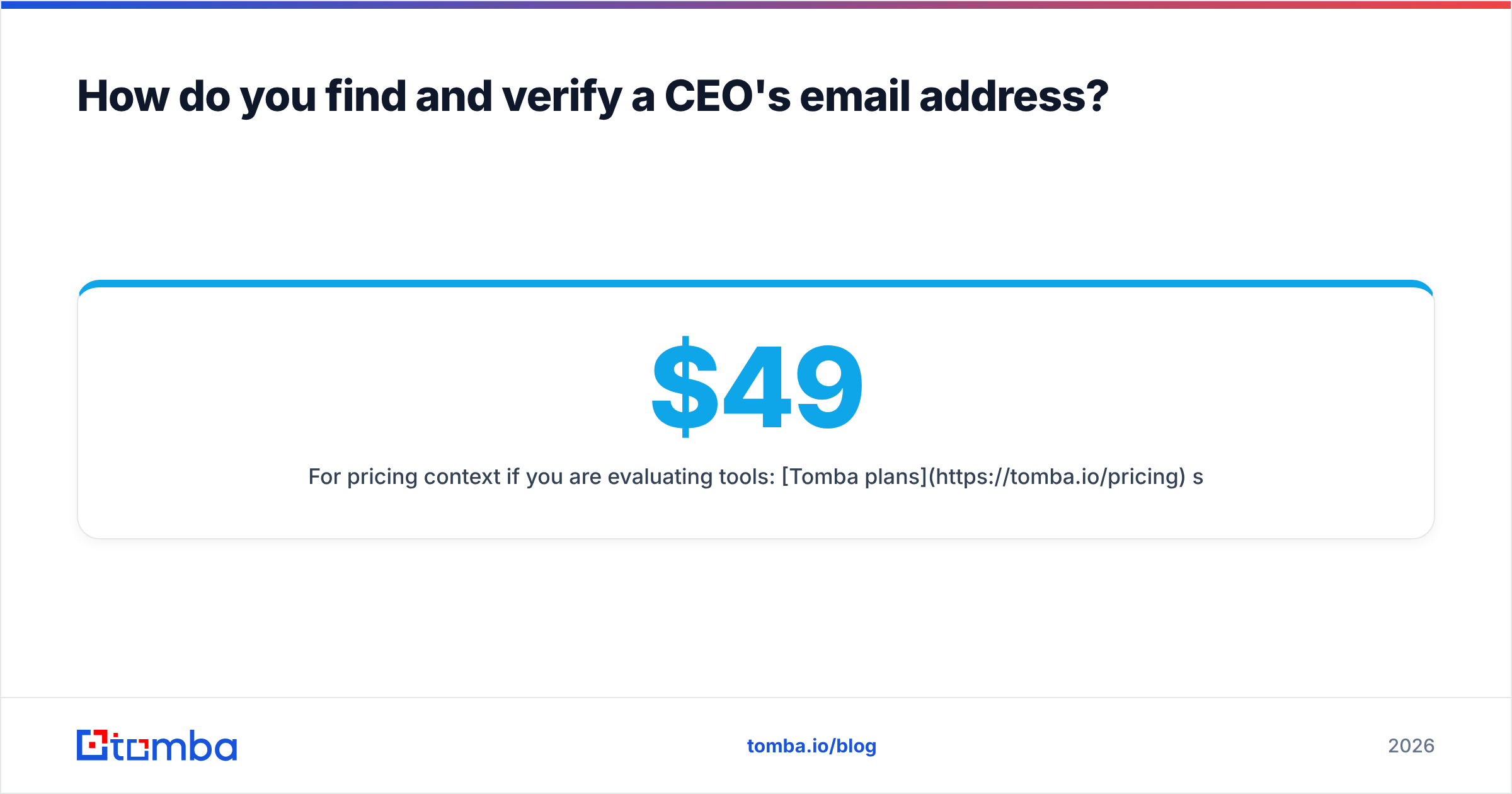
For pricing context if you are evaluating tools: Tomba plans start with a free tier at 25 searches per month, Starter at $49/mo, Growth at $99/mo, and Pro at $249/mo. Most teams doing executive outreach need far fewer searches than volume prospecting — you are sending 40 highly researched emails a month, not 4,000 sprayed ones.
If you are also assembling lists at scale, BookYourData is a solid option for pre-built, verified B2B contact lists when you want to buy records rather than find them one at a time. The two approaches complement each other: purchase for breadth, find-and-verify for the named accounts you actually care about.
How many times should you follow up with a CEO?#
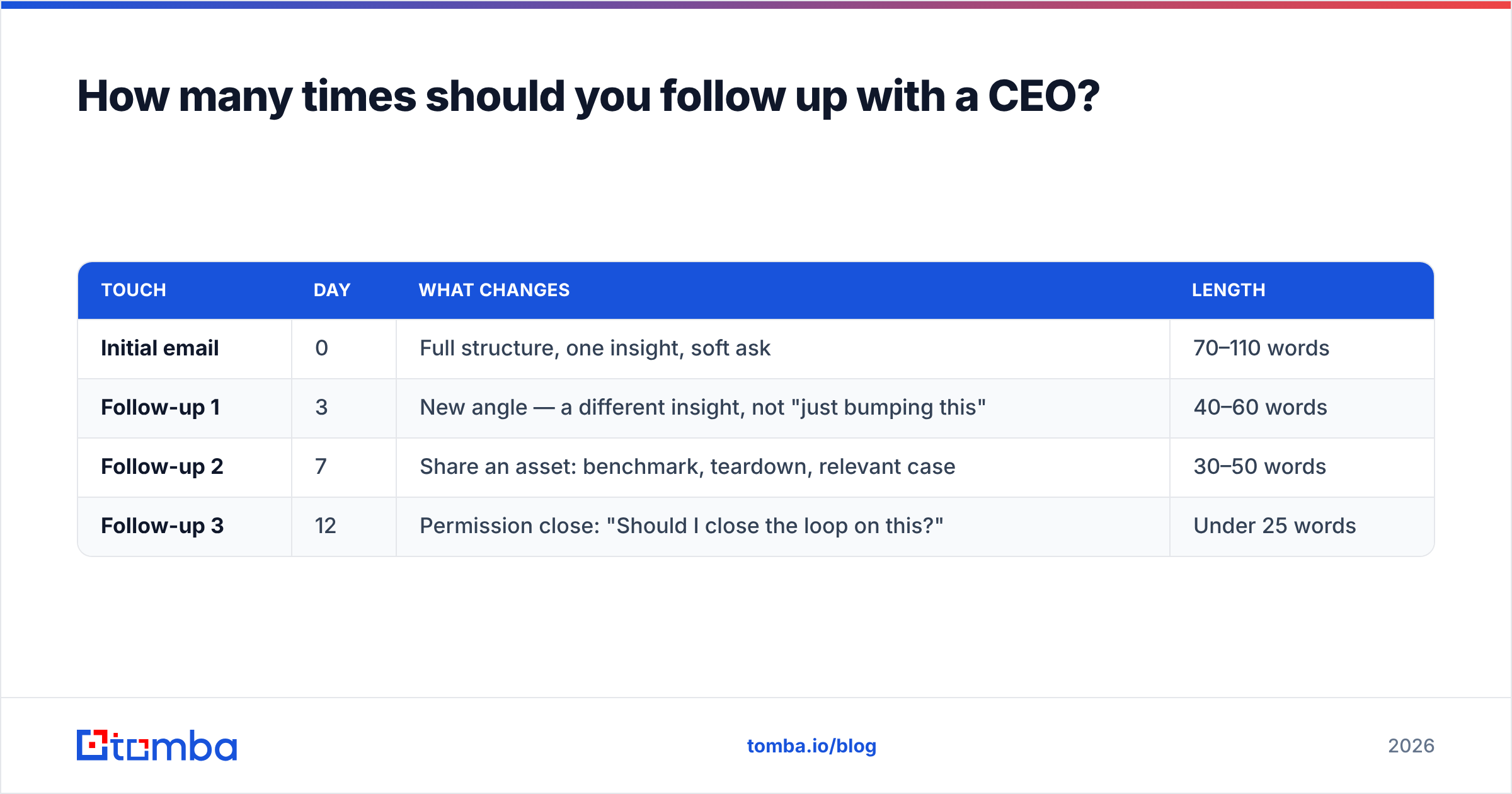
Three follow-ups over 12 days, then stop and move the contact to a quarterly touch list.
| Touch | Day | What changes | Length |
|---|---|---|---|
| Initial email | 0 | Full structure, one insight, soft ask | 70–110 words |
| Follow-up 1 | 3 | New angle — a different insight, not "just bumping this" | 40–60 words |
| Follow-up 2 | 7 | Share an asset: benchmark, teardown, relevant case | 30–50 words |
| Follow-up 3 | 12 | Permission close: "Should I close the loop on this?" | Under 25 words |
Two rules that matter more than the cadence itself. First, never reply to your own thread with "Bumping this to the top of your inbox" — it adds zero information and signals that your time is worth less than theirs. Second, the breakup email should genuinely close the loop. "I'll assume the timing isn't right and stop here — happy to reconnect after your Q1 planning" gets replies precisely because it is not a trick.
Reply rates at executive level are volatile enough that you should track them properly. If you are not measuring response rate per template and per follow-up position, you are optimizing blind.
What mistakes kill an otherwise good email?#
- Attachments on a first touch. Unopened at best, spam-filtered at worst.
- A calendar link before consent. It reads as "my time is scheduled, yours is available."
- Flattery that isn't specific. "I've long admired your leadership" means you read the About page.
- Mentioning their competitor by name in the first line. It puts them on the defensive instantly.
- Sending Monday 8am or Friday 4pm. Tuesday through Thursday, 7–8am local, tends to land when the CEO is triaging on their own rather than reacting to the team.
- Three questions in one email. One question. A CEO answering two questions takes twice as long, so they answer neither.
Start with an address that actually works#
You can rewrite your opening line fifty times, but a CEO who never receives the email cannot reply to it. Before your next executive outreach batch, confirm the pattern, find the address, and verify it — in that order.
Tomba Email Finder does all three from one workflow, with source citations so you can see where each address came from instead of trusting a black-box confidence score. Start on the free tier at 25 searches a month, which is roughly one month of serious, hand-researched CEO outreach — and exactly the volume at which this approach works best.
Related guides#
// get started
Find, verify and enrich your first contacts today
Start on the free plan with 25 searches a month, then scale when your team is ready.
Free plan · No credit card required · GDPR & CCPA
Get the Tomba newsletter
Product and data updates
// about the author