Introduction Email to Connect Two People: Templates and Rules
Most intro emails fail before they're sent: no permission, no context, no ask. Here's the double opt-in workflow, the five-line format that actually gets replies, and five templates you can paste today.
TL;DR
- An introduction email to connect two people is a permission-based handoff, not a favor you do for one side. Ask both parties first — that single step is the difference between a warm intro and an ambush.
- The double opt-in workflow (ask A, ask B, then connect) protects your reputation, and it costs you two short messages.
- The intro itself should be five lines: why now, who A is, who B is, the specific overlap, and a clear handoff. Anything longer gets skimmed.
- Forward-style intros, BCC intros, and group threads solve different problems. Pick based on whether either side needs an easy out.
- Getting the address wrong ruins a good intro. Verify the recipient before you hit send, especially if you pulled it from a signature, a CRM record, or a conference list.
What is an introduction email to connect two people?#
An introduction email to connect two people is a short message where you — the mutual contact — put two parties in the same thread and explain, in plain language, why they should talk. That's it. You are a bridge, not a salesperson for either side.
Think of it like introducing two friends at a party. You don't deliver a résumé. You say "Sam, this is Dana — she ran the same migration you're about to start," then step back and let them talk. The bad version is dragging someone across the room to meet a person who wants to sell them something. Everyone remembers who did the dragging.
That reputational math is the whole game. Every intro you make spends a small amount of credibility with both people. A good one earns interest. A bad one — wrong context, no permission, obvious agenda — is withdrawn from an account you can't easily refill. Most people make intros carelessly because the cost is deferred: you don't see the person who quietly stopped replying to your emails six months later.
Why does the double opt-in matter more than the intro itself?#
Because consent is the variable that predicts whether the thread goes anywhere. The double opt-in — popularized in the venture and startup world, and a close cousin of the permission logic behind opt-in email in marketing — means you get a yes from both sides before you connect them.
The workflow is three steps:
- Ask the requester for a forwardable blurb. Whoever wants the intro writes 3-4 sentences you can paste directly into an email — who they are, what they want, why this specific person. If they can't write it, they aren't ready for the intro.
- Ask the receiving party privately. Send the blurb with one question: "Worth an intro, or should I pass?" Give them an explicit, no-cost way to decline.
- Only then, connect. If you get a yes, send the intro email with both parties on the thread and hand over control.
Skipping step two is the most common failure. You save yourself 60 seconds and you hand a busy person an obligation they never agreed to. They now have to either take a meeting they don't want or say no in front of a third party. Both outcomes cost you.
The counter-argument you'll hear is that double opt-in is slow and kills momentum. In practice it adds about a day and raises the acceptance rate dramatically, because the receiving party arrives at the thread already interested instead of already defensive. If the intro is genuinely urgent and low-stakes — two colleagues who need to coordinate a deadline — skip the ceremony. Ceremony scales with stakes.
What are the five parts of a good intro email?#
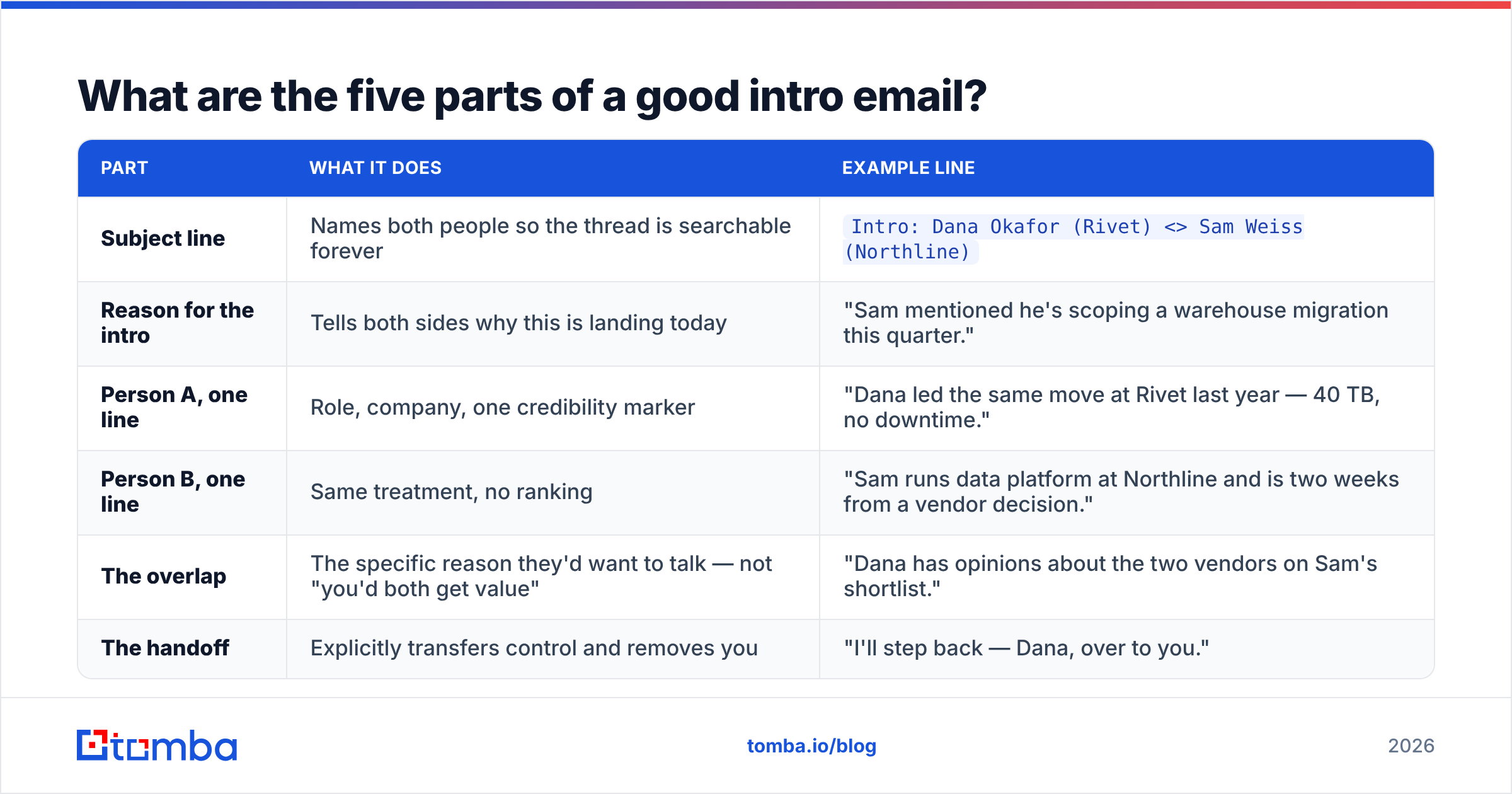
Here's the anatomy. Keep each part to one or two sentences; the whole email should fit on a phone screen without scrolling.
| Part | What it does | Example line |
|---|---|---|
| Subject line | Names both people so the thread is searchable forever | Intro: Dana Okafor (Rivet) <> Sam Weiss (Northline) |
| Reason for the intro | Tells both sides why this is landing today | "Sam mentioned he's scoping a warehouse migration this quarter." |
| Person A, one line | Role, company, one credibility marker | "Dana led the same move at Rivet last year — 40 TB, no downtime." |
| Person B, one line | Same treatment, no ranking | "Sam runs data platform at Northline and is two weeks from a vendor decision." |
| The overlap | The specific reason they'd want to talk — not "you'd both get value" | "Dana has opinions about the two vendors on Sam's shortlist." |
| The handoff | Explicitly transfers control and removes you | "I'll step back — Dana, over to you." |
Two details people skip. First, use the <> convention in the subject (Name A <> Name B) — it's instantly recognizable and makes the thread searchable in Gmail or Outlook years later. Second, write both bios at the same length. If one person gets three sentences and the other gets four words, you've told the short-bio person exactly where they rank.
Which format should you use: forward, BCC, or group thread?#
Three formats dominate, and they are not interchangeable. The choice comes down to how much of an exit you want to give each side.
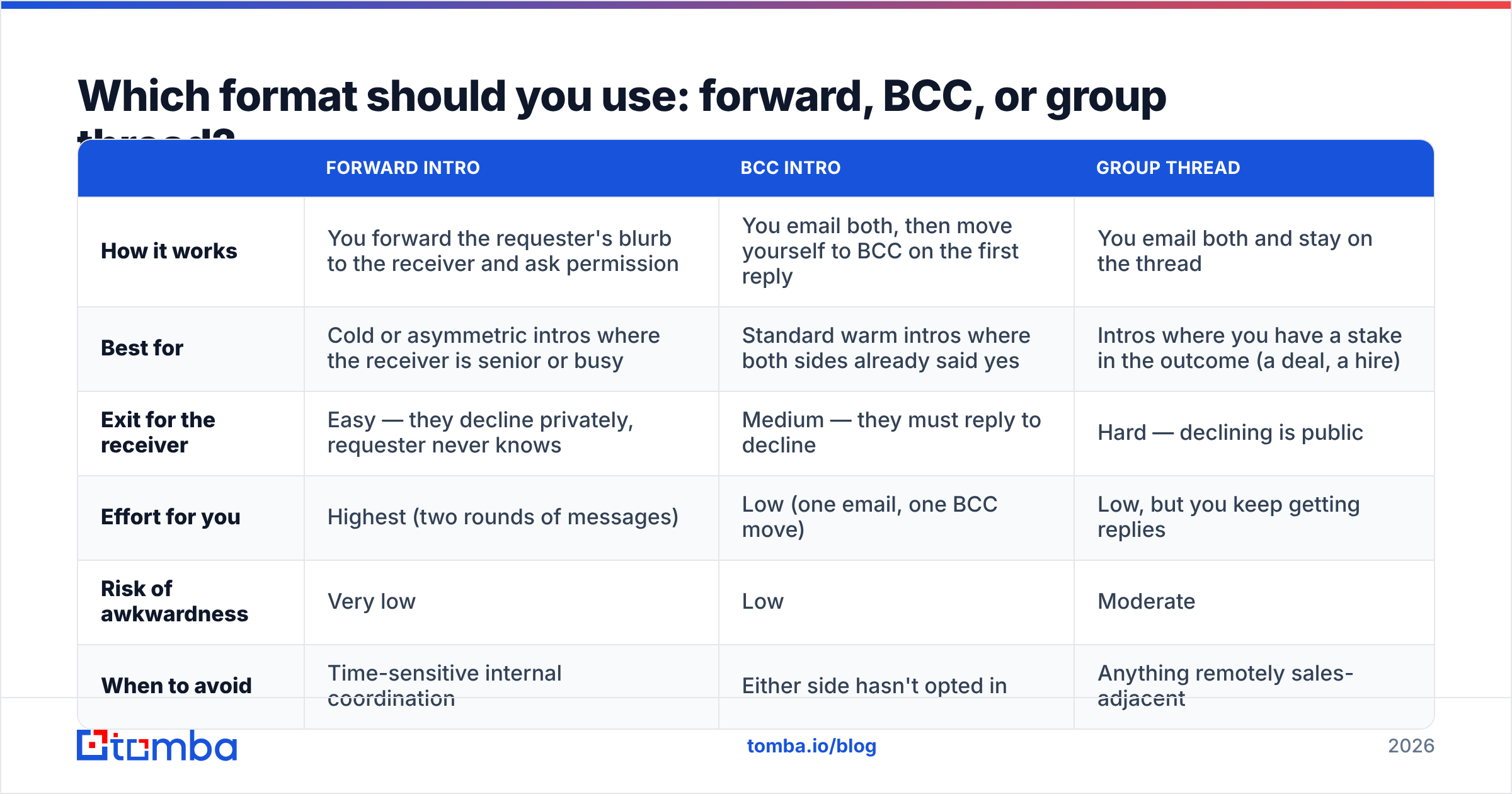
| Forward intro | BCC intro | Group thread | |
|---|---|---|---|
| How it works | You forward the requester's blurb to the receiver and ask permission | You email both, then move yourself to BCC on the first reply | You email both and stay on the thread |
| Best for | Cold or asymmetric intros where the receiver is senior or busy | Standard warm intros where both sides already said yes | Intros where you have a stake in the outcome (a deal, a hire) |
| Exit for the receiver | Easy — they decline privately, requester never knows | Medium — they must reply to decline | Hard — declining is public |
| Effort for you | Highest (two rounds of messages) | Low (one email, one BCC move) | Low, but you keep getting replies |
| Risk of awkwardness | Very low | Low | Moderate |
| When to avoid | Time-sensitive internal coordination | Either side hasn't opted in | Anything remotely sales-adjacent |
Default to the BCC intro once both parties have opted in. It's the cleanest: you write one email, the recipients see each other's addresses, and your "moving myself to BCC" line signals that the thread is now theirs. Reserve the group thread for cases where you'll actually contribute — a candidate referral you'll be asked about, or a partnership where you're a stakeholder.
What does a real intro email look like?#
Five templates. Change the names, keep the structure.
1. The standard warm intro (after double opt-in)
Subject: Intro: Dana Okafor (Rivet) <> Sam Weiss (Northline)
Dana, Sam — connecting you both as promised.
Sam, Dana led Rivet's warehouse migration last year, 40 TB with no customer-facing downtime. She's been through the exact vendor shortlist you're looking at.
Dana, Sam runs the data platform at Northline and is about two weeks out from a decision. He asked for a sanity check from someone who's done it.
I'll move myself to BCC — you two take it from here.
2. The candidate-to-hiring-manager intro
Subject: Intro: Priya Raman <> Marcus Hall (eng hiring, Loftwork)
Marcus, Priya — connecting you.
Marcus, Priya is a backend engineer who spent four years on billing systems at Corvid. She's early in a search and specifically wanted to talk to teams working on payments infrastructure.
Priya, Marcus leads the platform team at Loftwork and is hiring two senior backend roles this quarter.
Priya, Marcus knows you're talking to other teams — no pressure either way. Moving to BCC.
3. The vendor or service-provider intro (highest risk — be careful)
Subject: Intro: Ella Tran (Kestrel Design) <> Tom Beckett
Tom, Ella — as discussed on Tuesday.
Tom, Ella's studio did the rebrand for two companies in your space. You mentioned you were unhappy with the last agency's turnaround times; hers is the opposite problem, in a good way.
Ella, Tom is scoping a full site refresh for Q1 and has a real budget approved.
Both of you have my honest read on the other. Over to you — I'm out.
Note what's missing: no adjectives like "amazing," "rockstar," or "best in class." Specific facts do the work that adjectives can't.
4. The "I can't make this intro" decline
Hi Jordan — I got your note about an intro to Alicia. I'm going to pass on this one. I've only met her twice and I don't know her work well enough to vouch, which is what an intro from me implies. What I can do is point you to her team's engineering blog — she posts there regularly and a thoughtful cold note referencing a specific post would land better than a thin intro from me anyway.
Declining well is a skill. Say no clearly, give a reason that isn't about them, and offer a smaller alternative. Never ghost an intro request — silence reads as a judgment about the person.
5. The reconnect intro (people who've met before)
Subject: Re-intro: Kim Salas <> Ravi Patel
You two met at SaaStr in 2024 — reconnecting you because the timing finally makes sense.
Ravi, Kim just took over lifecycle marketing at Halden and is rebuilding their onboarding sequence from scratch. Kim, Ravi's team shipped the onboarding rework you told me you admired.
Moving to BCC.
If you want more starting points for adjacent scenarios, our library of cold email templates covers the outreach that happens before you have a mutual contact to ask.
What kills an intro email?#
The failure modes are predictable. Here are the ones that show up most often in real inboxes:
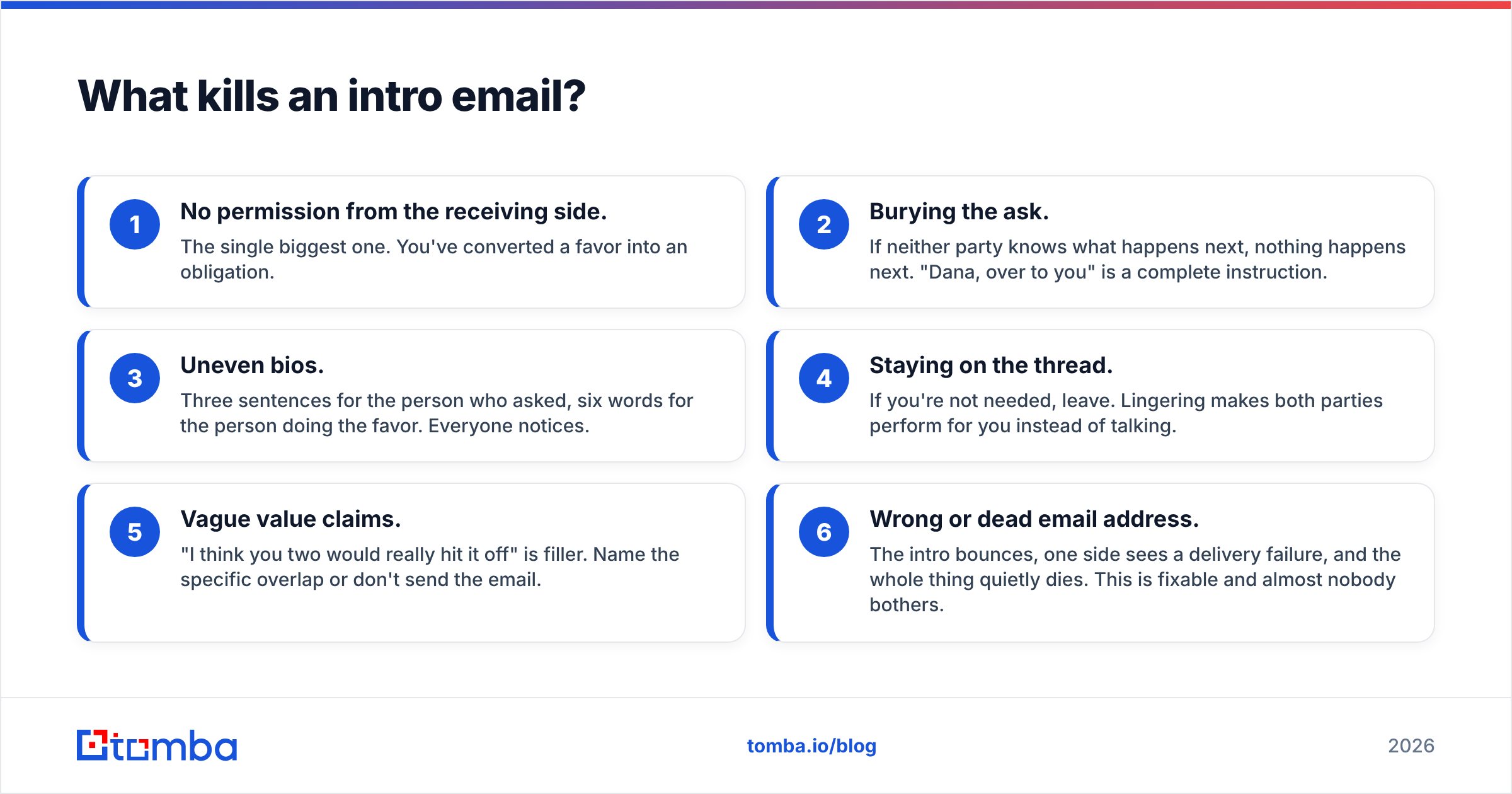
- No permission from the receiving side. The single biggest one. You've converted a favor into an obligation.
- Burying the ask. If neither party knows what happens next, nothing happens next. "Dana, over to you" is a complete instruction.
- Uneven bios. Three sentences for the person who asked, six words for the person doing the favor. Everyone notices.
- Staying on the thread. If you're not needed, leave. Lingering makes both parties perform for you instead of talking.
- Vague value claims. "I think you two would really hit it off" is filler. Name the specific overlap or don't send the email.
- Wrong or dead email address. The intro bounces, one side sees a delivery failure, and the whole thing quietly dies. This is fixable and almost nobody bothers.
That last one deserves more attention than it gets. Intro emails frequently go to addresses you scraped from memory, a two-year-old CRM record, or a conference attendee list. People change jobs constantly — G2 and other review platforms track B2B tooling churn that mirrors the same turnover in contact data. A bounced intro doesn't just fail; it makes you look sloppy to the person who did receive it.
How do you make sure the intro actually reaches both inboxes?#
Check the address before you send, not after it bounces. Three quick steps:
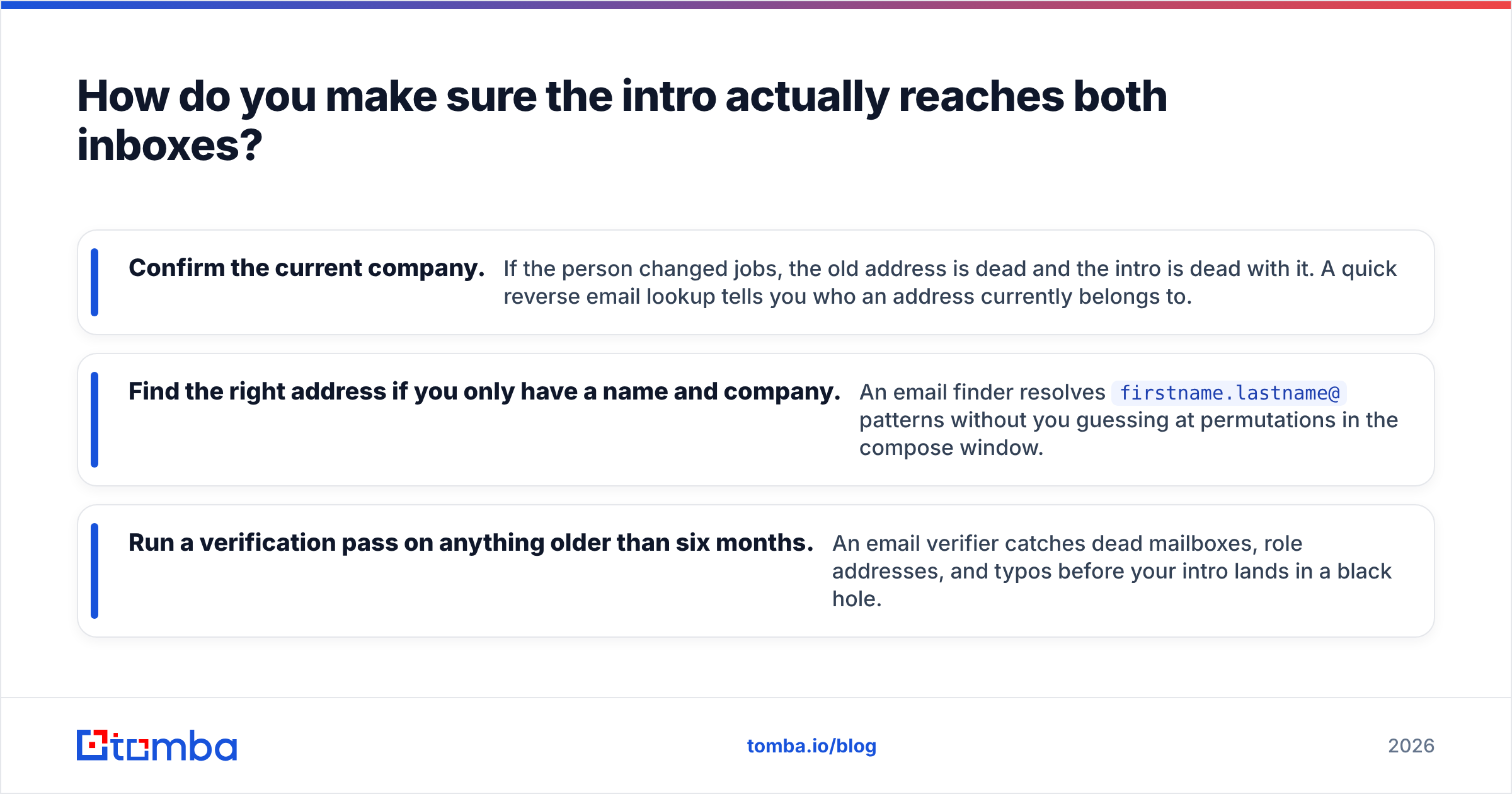
- Confirm the current company. If the person changed jobs, the old address is dead and the intro is dead with it. A quick reverse email lookup tells you who an address currently belongs to.
- Find the right address if you only have a name and company. An email finder resolves
firstname.lastname@patterns without you guessing at permutations in the compose window. - Run a verification pass on anything older than six months. An email verifier catches dead mailboxes, role addresses, and typos before your intro lands in a black hole.
This matters most for the reconnect intro and for any intro involving someone you haven't emailed in a year. For deliverability fundamentals beyond address accuracy — SPF, DKIM, sender reputation — HubSpot's blog has solid primers, though for a one-off intro from your normal work account, address accuracy is 90% of the risk.
How do you handle the reply-all handoff?#
The receiving party replies. Now what?
If you used a group thread and want out, the convention is a single line at the top of your reply: "Moving myself to BCC — you two have it from here." Then actually move yourself. Some clients make this awkward; just delete yourself from the recipient list on your final reply, which achieves the same thing.
If you're the person who received an intro, reply within 24 hours even if the answer is no. The mutual contact spent credibility on you. A same-day "thanks for connecting us, Dana — I'll send over some times" is the minimum. If you're not interested, say so directly to the other party and thank the connector separately.
And if you're the person who asked for the intro: your first reply sets the tone. Lead with a specific reference to what the connector said, propose a concrete next step with two time options, and keep it under 100 words. The worst first reply is a calendar link with no message attached.
What about intros at scale?#
Short answer: you can't scale a personal introduction, and trying to is how people burn networks. What you can systematize is the infrastructure around it — keeping contact records current, knowing who moved companies, and confirming addresses before you send.
If you find yourself needing dozens of new contacts rather than intros to specific people, that's a prospecting problem, not an introduction problem. Those are different motions with different rules, and conflating them is how a well-meaning connector turns into someone whose emails get filtered.
Before you send your next intro, make sure it lands. Tomba's Email Finder resolves a name plus a company domain into a verified, current work address — so your carefully written five-line intro reaches an inbox instead of a bounce queue. The free tier covers 25 searches a month, and paid plans start at $49/mo; see Tomba pricing for the full breakdown. Write the intro well, verify the address, then get out of the thread.
Related guides#
Ready to find emails that actually work?
Join 150,000+ professionals who stopped guessing and started sending. Free credits on signup — no credit card required.
Get the Tomba newsletter
Practical outbound tactics and product updates — once every two weeks.
About the author