The 9 Best Introhive Alternatives in 2026, Compared
Introhive owns relationship intelligence for professional services firms, but the annual contract is heavy. Here are nine Introhive alternatives, from full relationship-mapping platforms to cheap contact-data APIs, with honest pricing notes.
TL;DR
- Introhive is a relationship intelligence and CRM data automation platform aimed at large professional services firms (accounting, legal, consulting). It is quote-only, seat-based, and usually sold on annual or multi-year contracts.
- Most teams searching for Introhive alternatives are not looking for a cheaper Introhive. They want one of three narrower things: relationship mapping, CRM hygiene, or net-new contact data.
- If you need relationship graphs across a partner network, look at Affinity, Nexl, or 4Degrees. If you need net-new contacts and enrichment at API prices, look at Tomba, Cognism, or BookYourData.
- Pricing gap is the real story: Introhive-class platforms land in five figures a year; contact-data tools start under $100/month.
- Before you migrate, export your relationship history. Contact graphs built from years of email and calendar metadata are the one asset you cannot re-buy.
What does Introhive actually do?#
Introhive sits in a category most sales tools do not touch: it reads the exhaust of your firm's inboxes and calendars, then turns it into a map of who knows whom. Think of it as a company-wide Rolodex that rebuilds itself every night without anyone typing into Salesforce.
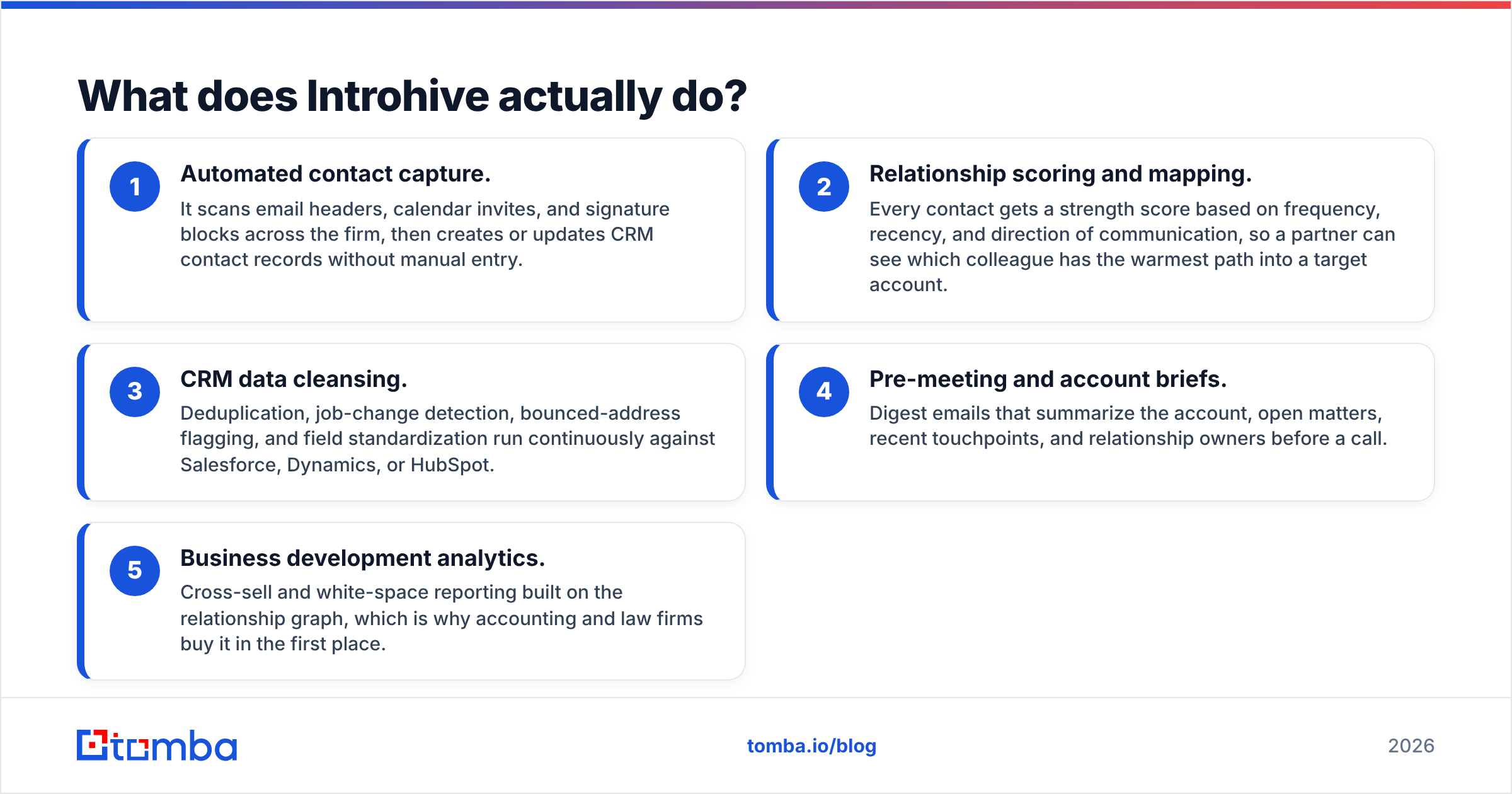
The platform bundles five distinct jobs, and understanding which one you actually need is the whole point of shopping for Introhive alternatives:
- Automated contact capture. It scans email headers, calendar invites, and signature blocks across the firm, then creates or updates CRM contact records without manual entry.
- Relationship scoring and mapping. Every contact gets a strength score based on frequency, recency, and direction of communication, so a partner can see which colleague has the warmest path into a target account.
- CRM data cleansing. Deduplication, job-change detection, bounced-address flagging, and field standardization run continuously against Salesforce, Dynamics, or HubSpot.
- Pre-meeting and account briefs. Digest emails that summarize the account, open matters, recent touchpoints, and relationship owners before a call.
- Business development analytics. Cross-sell and white-space reporting built on the relationship graph, which is why accounting and law firms buy it in the first place.
That bundle is genuinely hard to replicate with one cheap tool. It is also why the contract is expensive, and why half the firms evaluating it only need parts three and five.
Why do teams look for Introhive alternatives?#
Four complaints show up consistently in buyer reviews on G2 and in renewal conversations.
Price and contract structure. Introhive does not publish pricing. It is quoted per seat, usually with an annual minimum and frequently a multi-year term. For a 300-person firm that is a real line item, and it scales with headcount rather than with usage. A five-person BD team that only wants clean contact data is paying for a firm-wide deployment model.
Implementation weight. Contact capture requires mail-server level access (Exchange or Google Workspace admin consent), IT security review, and a data-privacy conversation with anyone whose inbox is being scanned. Rollouts measured in months are normal, not exceptional.
Privacy pushback. In EU and UK offices, scanning employee mailboxes to build a corporate contact graph triggers a legitimate-interest assessment and, often, a works-council conversation. Some firms decide the compliance overhead is not worth it.
It does not find net-new contacts. This is the big one. Introhive tells you who your firm already knows. It does not hand you the email address of a CFO nobody in the firm has ever met. If your pipeline problem is coverage rather than activation, a relationship intelligence platform solves the wrong half of the problem, and you end up buying a prospecting tool anyway.
Which Introhive alternatives should you compare in 2026?#
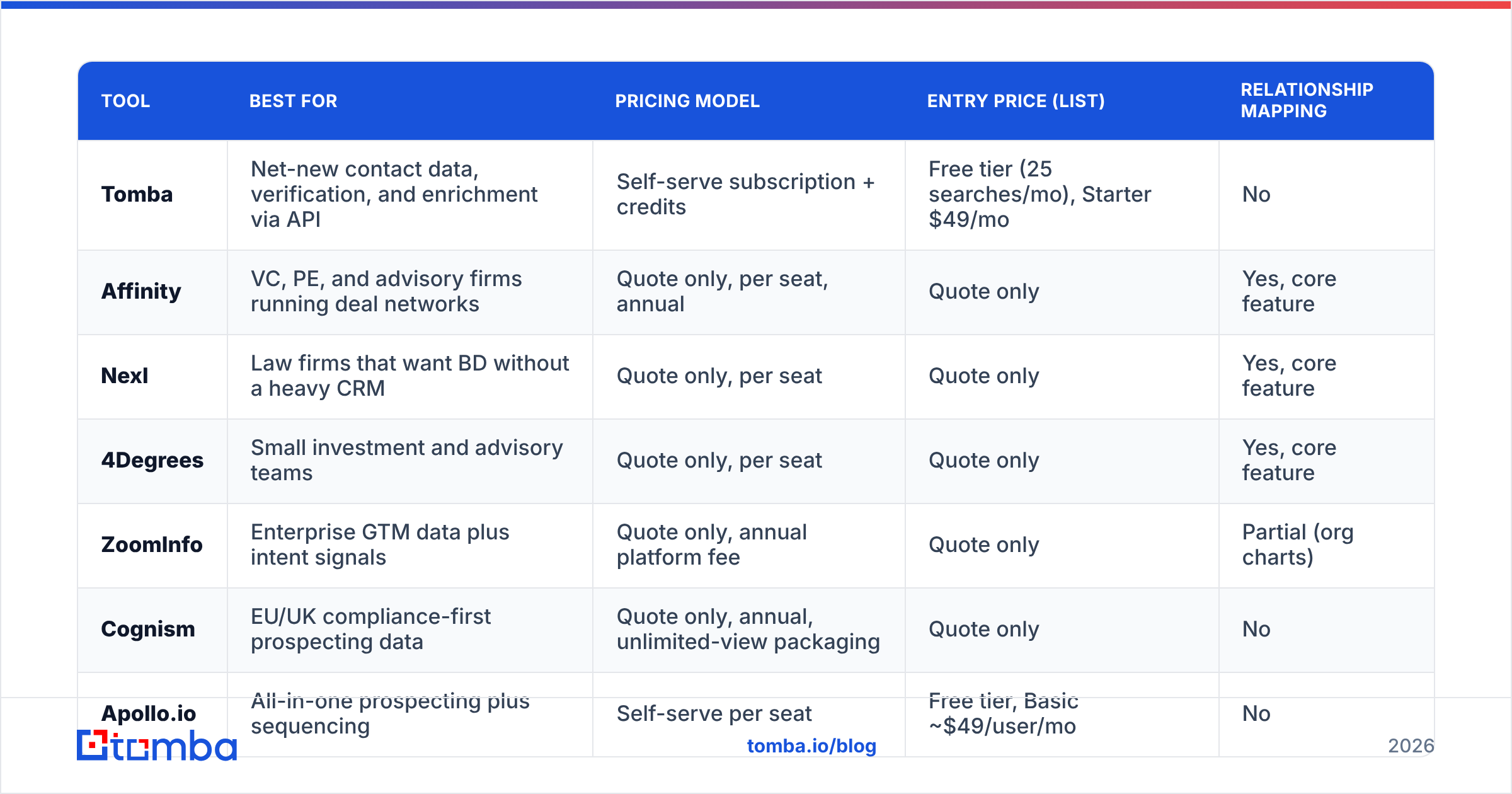
Here is the honest landscape. Prices are list prices published by each vendor at the time of writing; verify before you sign, because every vendor in the "quote only" column negotiates.
| Tool | Best for | Pricing model | Entry price (list) | Relationship mapping |
|---|---|---|---|---|
| Tomba | Net-new contact data, verification, and enrichment via API | Self-serve subscription + credits | Free tier (25 searches/mo), Starter $49/mo | No |
| Affinity | VC, PE, and advisory firms running deal networks | Quote only, per seat, annual | Quote only | Yes, core feature |
| Nexl | Law firms that want BD without a heavy CRM | Quote only, per seat | Quote only | Yes, core feature |
| 4Degrees | Small investment and advisory teams | Quote only, per seat | Quote only | Yes, core feature |
| ZoomInfo | Enterprise GTM data plus intent signals | Quote only, annual platform fee | Quote only | Partial (org charts) |
| Cognism | EU/UK compliance-first prospecting data | Quote only, annual, unlimited-view packaging | Quote only | No |
| Apollo.io | All-in-one prospecting plus sequencing | Self-serve per seat | Free tier, Basic ~$49/user/mo | No |
| BookYourData | Pay-as-you-go verified B2B lists, no subscription | Credit packs, no contract required | Pay-as-you-go credits | No |
| HubSpot Breeze Intelligence (ex-Clearbit) | Enrichment for teams already on HubSpot | Credit add-on to HubSpot | Credit packs on top of Hub subscription | No |
Tomba#
Tomba is the right alternative when your gap is net-new contact data rather than internal relationship history. It gives you an email finder, an email verifier, domain search, catch-all handling, phone lookup, and data enrichment behind a single API, so a RevOps engineer can wire enrichment into the CRM in an afternoon instead of a quarter.
The commercial model is the clearest contrast with Introhive: a free tier at 25 searches a month, Starter at $49/mo, Growth at $99/mo, Pro at $249/mo, and custom enterprise terms. You pay for lookups, not for every employee who has an inbox. Full Tomba pricing is public, which alone eliminates a procurement cycle.
What it does not do: it will not tell you that your Munich partner had dinner with the target's CFO in 2023. If that signal is the reason you bought Introhive, keep reading.
Affinity#
Affinity is the closest philosophical match to Introhive outside professional services. It ingests email and calendar data to build a relationship graph, then wraps a deal CRM around it. The design centre of gravity is venture capital, private equity, and investment banking, where the network is the product.
Strengths: genuinely good automatic data capture, strong deal-flow pipelines, and an interface that dealmakers actually open. Weaknesses: pricing is quote-only and lands in enterprise territory, and it is less suited to an accounting firm's cross-sell reporting than Introhive's purpose-built analytics. See affinity.co for current positioning.
Nexl#
Nexl targets law firms specifically. It captures relationships from Outlook, maps them to matters and clients, and layers BD workflows on top without demanding that lawyers log activities. For firms whose main Introhive use case is "which partner owns this client relationship," Nexl covers the same ground with a lighter footprint and a narrower feature surface.
4Degrees#

4Degrees is the small-team version of the Affinity idea: relationship intelligence plus a light CRM for investment, M&A advisory, and commercial real estate teams. It is a sensible landing spot if Introhive's enterprise deployment model is overkill for a 20-person shop but you still want the "who knows whom" graph.
ZoomInfo#

ZoomInfo replaces a different part of the stack. It is a data platform, not a relationship platform: firmographics, technographics, org charts, intent signals, and contact records at enormous scale. Buyers often run ZoomInfo and something like Introhive, because one supplies coverage and the other supplies warmth.
Be clear-eyed about the commercial model. Annual platform fees, credit caps, seat minimums, and auto-renewal clauses are standard. If you are leaving Introhive because of contract weight, ZoomInfo is not the lighter option.
Cognism#
Cognism's differentiator is compliance posture: notified DNC screening across European markets, GDPR-aligned sourcing, and mobile-number coverage that European teams rate highly. Packaging is typically unlimited-view within a seat count rather than a credit meter, which suits high-volume SDR teams. Pricing is quote-only and annual.
Apollo.io#
Apollo bundles a contact database with sequencing, dialer, and basic CRM functions at a self-serve price point. For a small BD team that wants contacts and the outbound machinery in one subscription, it is the pragmatic pick. Data accuracy on mobile numbers and smaller-market companies is the usual complaint, so pair it with independent verification before large sends. If you are cross-shopping, our Apollo alternative breakdown covers the accuracy trade-offs in detail.
BookYourData#
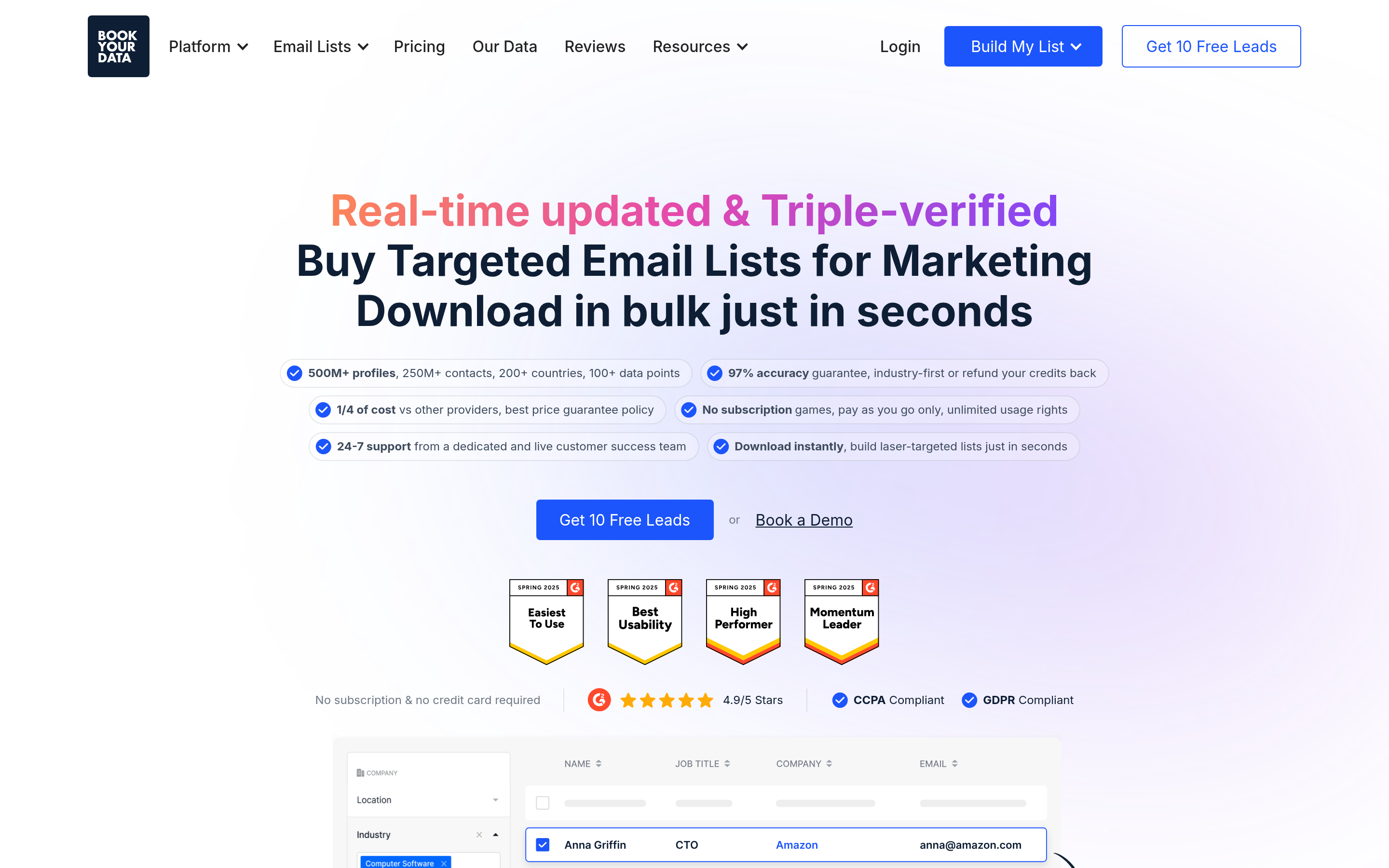
BookYourData takes a different commercial angle: build a targeted list with filters, pay per contact with credits that do not expire, and skip the subscription entirely. For firms that need a one-off list for a conference push or a new-market test rather than an always-on data feed, the pay-as-you-go model removes the exact contract friction that drives people away from Introhive in the first place. It is a list-building tool, not a relationship graph, so treat it as a complement to CRM hygiene work rather than a replacement for it.
HubSpot Breeze Intelligence (formerly Clearbit)#
If your CRM is HubSpot, the old Clearbit enrichment now ships as Breeze Intelligence credits inside the platform. Form shortening, company enrichment, and buyer-intent data land natively without an integration project. Coverage skews toward tech companies with strong web presence, and credits are consumed fast on high-traffic sites. Details live on hubspot.com.
Is relationship intelligence or a contact-data API the better buy?#
Start with the question your pipeline is actually failing on.
Buy relationship intelligence if: your firm has hundreds of employees with decades of accumulated contacts, your growth model is cross-selling existing clients into new service lines, and partners currently answer "do we know anyone at X?" by sending a firm-wide email. The value is activation of dormant network equity, and no amount of purchased data replaces it.
Buy contact data and enrichment if: your named-account list includes companies nobody in the firm has ever touched, your CRM records go stale because people change jobs, or your problem is that 30% of your outbound bounces. The value is coverage and hygiene, and a Tomba API call costs a fraction of a seat license.
Buy both if you are a large firm with an outbound motion, which is the configuration most enterprise accounting and consulting firms end up in. Just size each purchase to the job rather than letting one vendor sell you the whole bundle.
One more consideration that buyers routinely skip: data decay. Roughly a quarter of B2B contact records go stale each year through job changes alone. A relationship graph built from historical email does not fix that, because it records who your colleague emailed in 2022, not where that person works today. Verification and re-enrichment are separate line items no matter which platform you pick.
How do you migrate off Introhive without losing the relationship graph?#
Treat this as a data project, not a procurement one. The sequence that works:
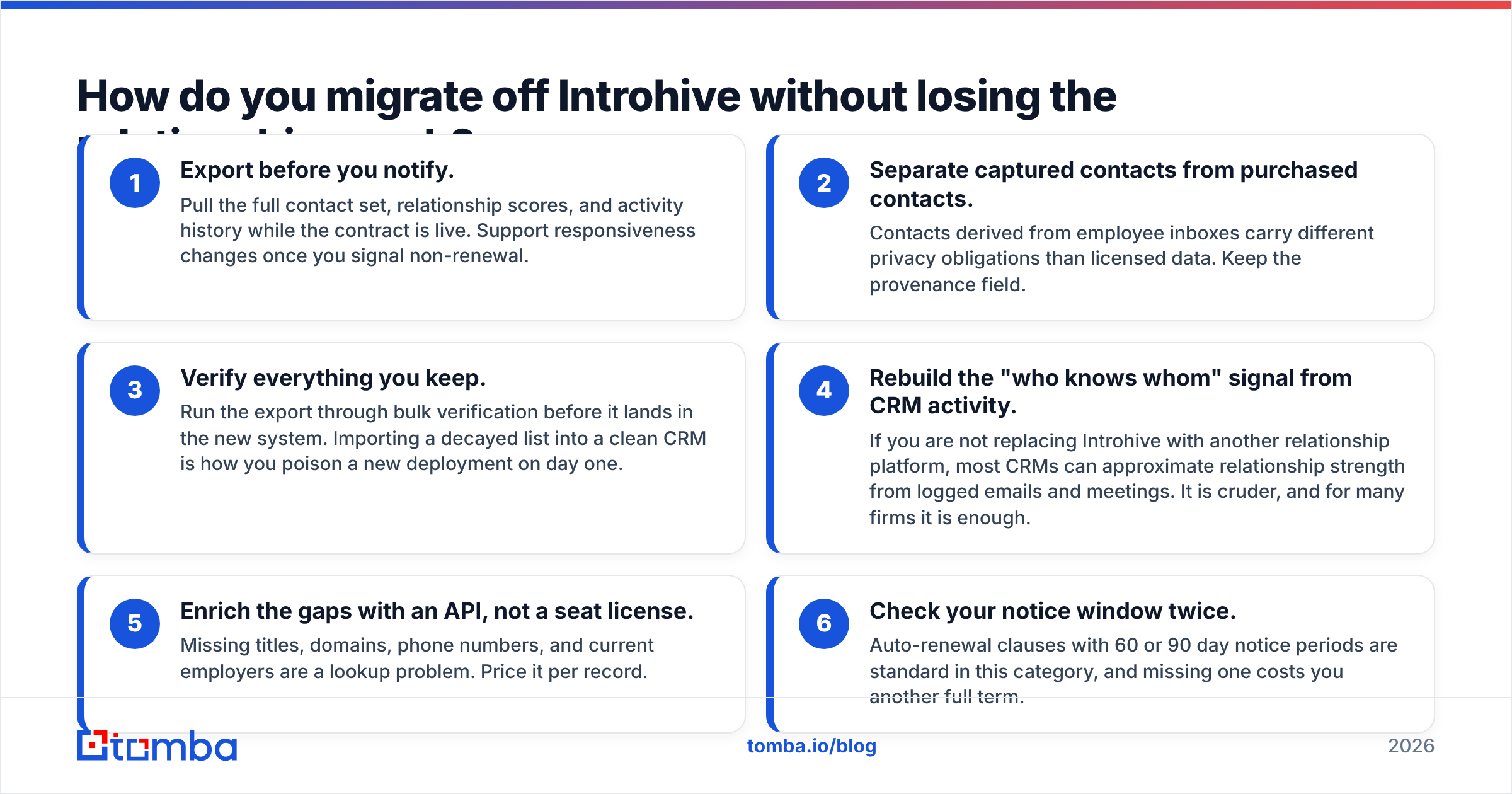
- Export before you notify. Pull the full contact set, relationship scores, and activity history while the contract is live. Support responsiveness changes once you signal non-renewal.
- Separate captured contacts from purchased contacts. Contacts derived from employee inboxes carry different privacy obligations than licensed data. Keep the provenance field.
- Verify everything you keep. Run the export through bulk verification before it lands in the new system. Importing a decayed list into a clean CRM is how you poison a new deployment on day one.
- Rebuild the "who knows whom" signal from CRM activity. If you are not replacing Introhive with another relationship platform, most CRMs can approximate relationship strength from logged emails and meetings. It is cruder, and for many firms it is enough.
- Enrich the gaps with an API, not a seat license. Missing titles, domains, phone numbers, and current employers are a lookup problem. Price it per record.
- Check your notice window twice. Auto-renewal clauses with 60 or 90 day notice periods are standard in this category, and missing one costs you another full term.
What should you actually do next?#
Decide whether you are solving for warmth or for coverage. Introhive and its direct peers (Affinity, Nexl, 4Degrees) solve for warmth, and they are worth their price only if your firm has a large dormant network to activate. Everything else on this list solves for coverage and hygiene at a fraction of the annual commitment.
If the honest answer is that your team needs verified, current contact data rather than a map of who met whom in 2019, start at the cheap end and stay there. Run a test list through the Tomba Email Finder on the free tier, compare the bounce rate against your current enriched records, and upgrade to Starter at $49/mo only once the numbers justify it. No quote call, no security review, no three-year term.
Related guides#
// get started
Find, verify and enrich your first contacts today
Start on the free plan with 25 searches a month, then scale when your team is ready.
Free plan · No credit card required · GDPR & CCPA
// about the author