Intuned Pricing in 2026: Reviews, Pros, and Cons Compared
Intuned sells browser automation infrastructure, not a contact database. Here is how its usage-based pricing actually behaves, what reviewers praise and complain about, and when buying a maintained data API costs less than building one.
TL;DR
- Intuned is browser-automation infrastructure for developers — you write Playwright-style extraction code, Intuned runs, schedules, and monitors it. It is not an off-the-shelf B2B contact database.
- Intuned pricing is usage-based and largely quote-driven: you pay for browser runtime, run volume, proxy traffic, and seats rather than a flat per-record fee. Public numbers move, so treat any figure you see in a blog post (including this one) as directional and confirm on the vendor's own page.
- The strongest reviews come from teams extracting data that no vendor sells — niche marketplaces, government portals, logged-in dashboards. The weakest reviews come from teams who wanted contacts and ended up maintaining selectors.
- The real cost is rarely the invoice. It is engineering time: an average scraping pipeline breaks every few weeks, and someone on payroll fixes it.
- If your end goal is verified work emails, phones, and firmographics, a maintained data API is almost always cheaper than building the same thing on automation infrastructure.
What is Intuned, and who is it actually for?#
Intuned is a platform for building and operating browser automations at scale. You describe what to extract from a page, it generates and runs the automation in managed cloud browsers, and it handles the boring production layer: scheduling, retries, proxy rotation, logging, versioning, and API endpoints so other systems can call your extractor. Under the hood it sits in the Playwright ecosystem, which matters — your team's existing browser-automation knowledge transfers directly, and so does the debugging model.
That positioning explains almost everything about how buyers react to it. Intuned is infrastructure. It gives you a reliable way to run your logic against your target sites. It does not hand you a pre-built dataset, and it makes no promise about the quality of what lives on the page you point it at.
Three buyer profiles show up repeatedly:
- Product teams shipping a data feature. You need live pricing from 40 retailer sites inside your own app, and that data is not for sale in a usable form.
- Ops teams automating a portal. A logged-in supplier dashboard, a permit database, an insurance carrier back office — anything with a login and no API.
- GTM teams trying to build a lead list. This is the group most likely to churn, because the job they actually have is buying data, not building extractors.
If you are in group three, read the cost section below before you write a line of code. The build-versus-buy math is usually not close.

How does Intuned pricing actually work?#
Intuned prices like infrastructure, not like a SaaS seat. That means your bill is a function of consumption, and the meters that matter are these:
- Browser runtime. The dominant cost driver. A headless browser session that loads a heavy SPA, waits for lazy content, scrolls, and clicks pagination can burn 20–60 seconds per page. Multiply by page count, not by record count.
- Run volume and concurrency. Higher concurrency finishes a crawl faster but raises your peak spend. Teams that need a nightly full refresh pay materially more than teams that can run incremental deltas.
- Proxy and residential traffic. Many targets require rotating or residential IPs. This is frequently metered separately, in gigabytes, and it is the line item that surprises people most.
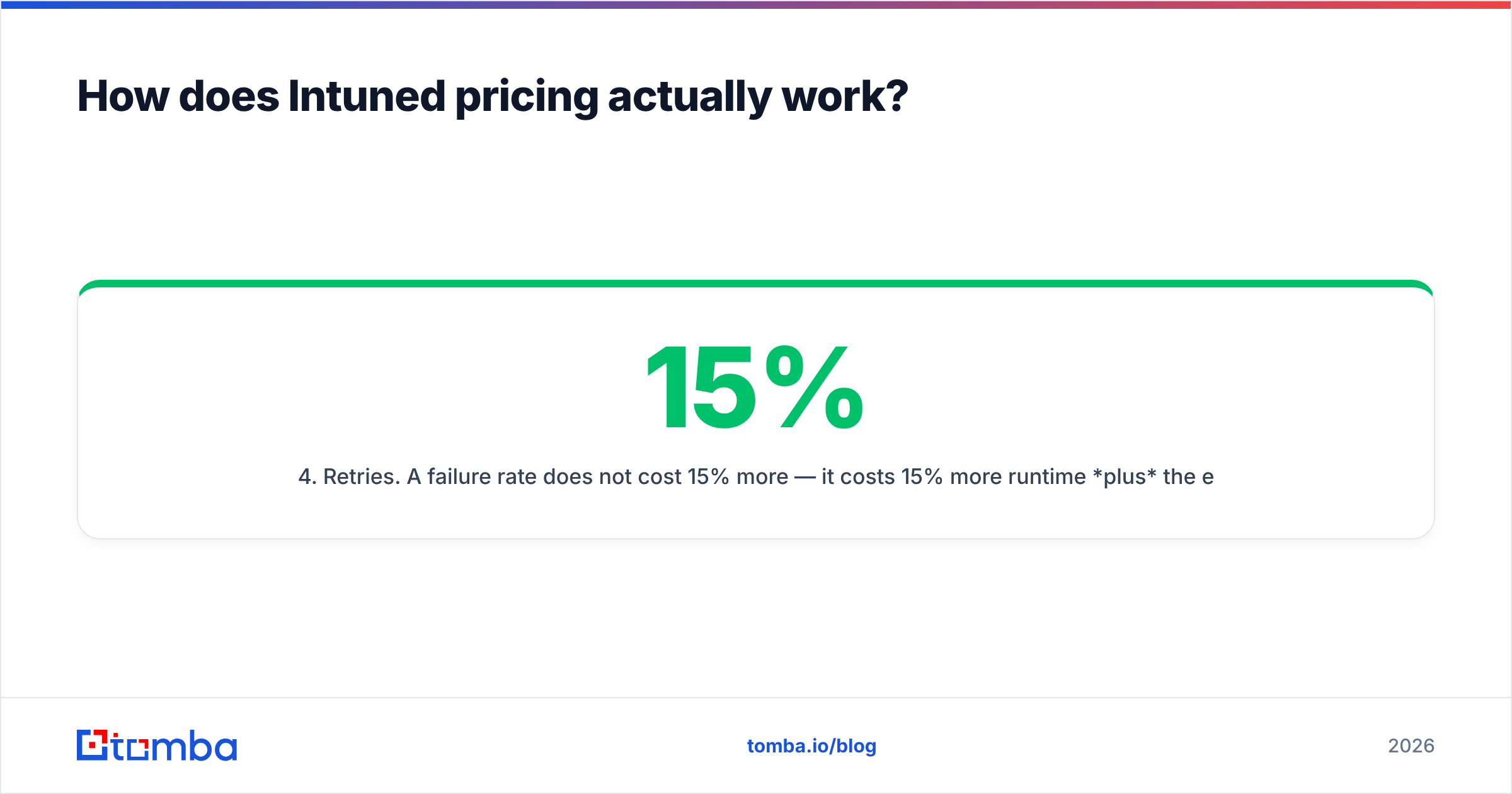
- Retries. A 15% failure rate does not cost 15% more — it costs 15% more runtime plus the engineering hours to figure out why.
- Seats and environments. Team access, staging versus production projects, and enterprise controls (SSO, audit logs, private networking) typically sit on higher tiers.
- Support and SLA. Response-time commitments and managed maintenance are a commercial conversation, not a checkbox.
The practical consequence: two companies on the same plan can pay wildly different amounts. A team extracting 5,000 static pages a month and a team extracting 500,000 JavaScript-heavy pages behind logins are not comparable customers, even if the logo on the invoice matches.
Check the current tiers on intuned.io before you budget. Usage-priced developer tools revise their packaging often, and any hard number reproduced in a third-party article ages badly within a quarter.
What should you model before signing?#
Build a spreadsheet with four inputs: pages per run, seconds per page, runs per month, and expected retry rate. Multiply them out into browser-minutes, then add proxy gigabytes. That single calculation predicts your Intuned bill better than any pricing page, and it also tells you whether the project is viable at all. If the answer is "we need 180,000 browser-minutes a month to build a contact list," stop — you are re-engineering a product that already exists for a fraction of the price.
What do Intuned reviews say?#
Public review volume for Intuned is thinner than for mass-market sales tools; it is a developer platform with a technical buyer, so feedback concentrates in engineering channels rather than on G2. Reading across what is available, the sentiment splits cleanly along the "is this the right job for the tool" line.
What reviewers consistently praise:
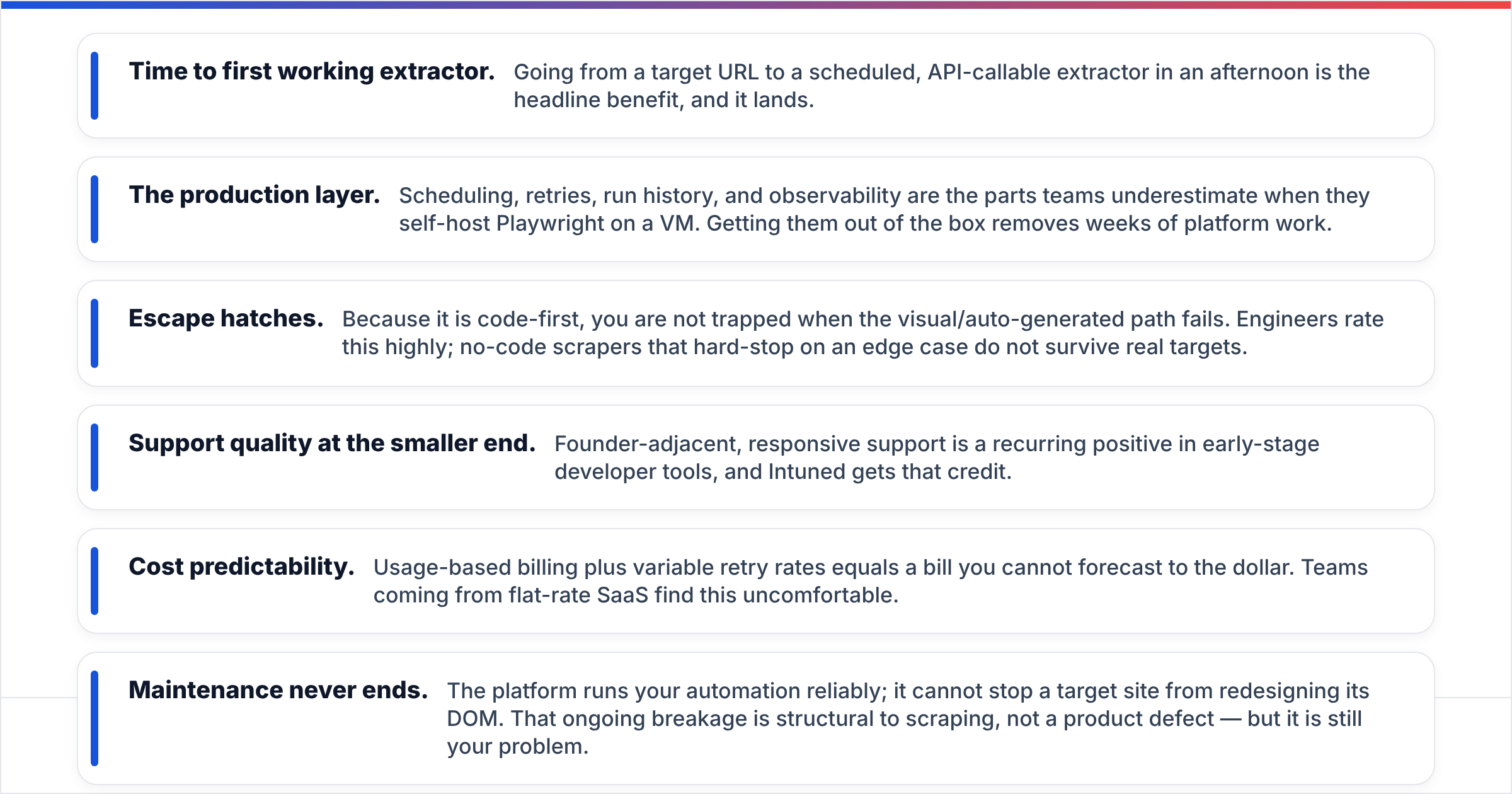
- Time to first working extractor. Going from a target URL to a scheduled, API-callable extractor in an afternoon is the headline benefit, and it lands.
- The production layer. Scheduling, retries, run history, and observability are the parts teams underestimate when they self-host Playwright on a VM. Getting them out of the box removes weeks of platform work.
- Escape hatches. Because it is code-first, you are not trapped when the visual/auto-generated path fails. Engineers rate this highly; no-code scrapers that hard-stop on an edge case do not survive real targets.
- Support quality at the smaller end. Founder-adjacent, responsive support is a recurring positive in early-stage developer tools, and Intuned gets that credit.
What reviewers consistently criticize:
- Cost predictability. Usage-based billing plus variable retry rates equals a bill you cannot forecast to the dollar. Teams coming from flat-rate SaaS find this uncomfortable.
- Maintenance never ends. The platform runs your automation reliably; it cannot stop a target site from redesigning its DOM. That ongoing breakage is structural to scraping, not a product defect — but it is still your problem.
- Wrong-tool mismatches. Reviewers who wanted contact data describe a lot of effort for a result they could have bought. This is the single most common source of disappointment.
- Learning curve for non-engineers. If nobody on the team is comfortable with selectors, async flows, and CI, the platform will sit unused.
Is Intuned worth it compared to the alternatives?#
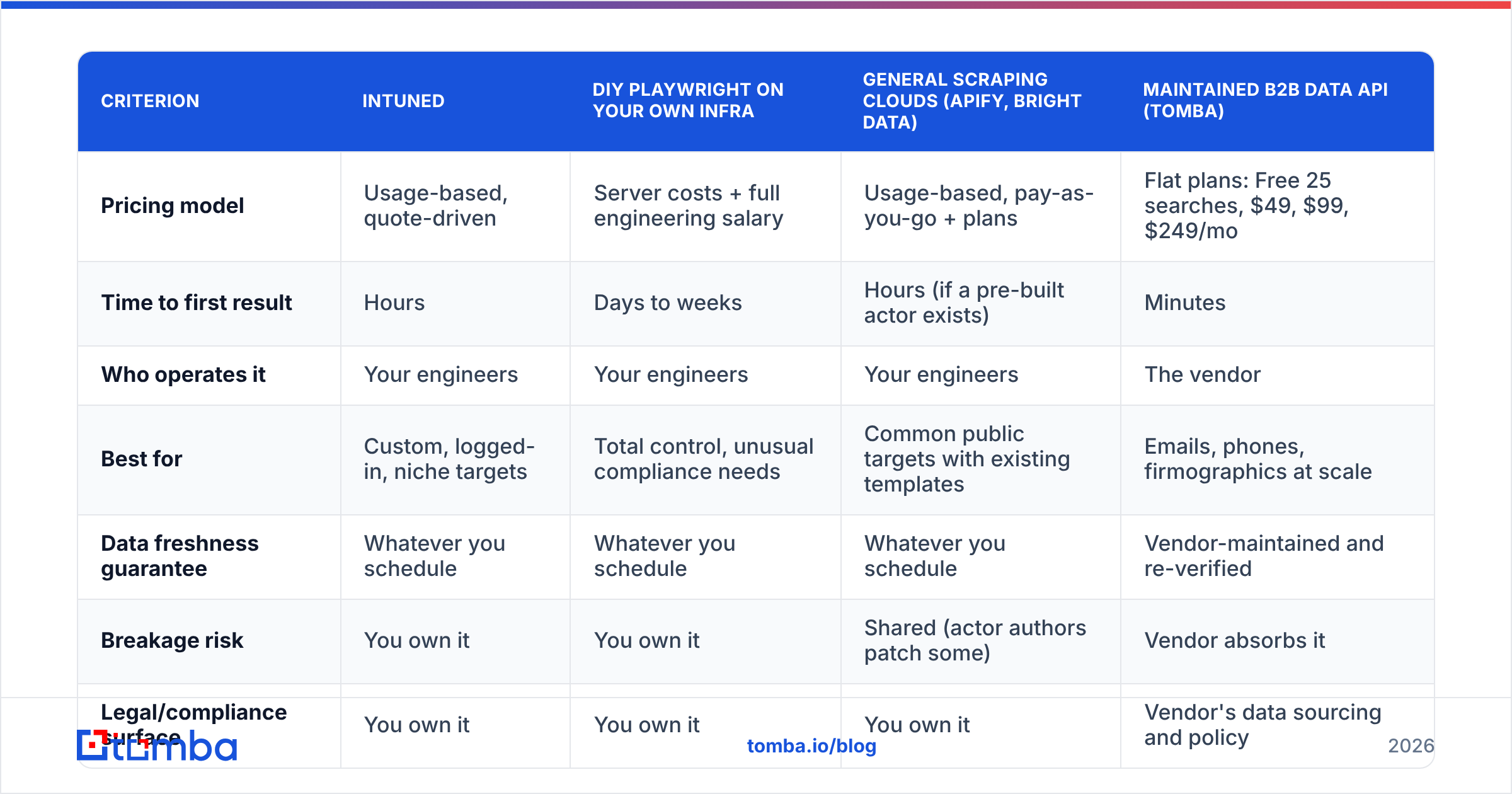
Depends entirely on what you are extracting. Here is how the categories separate:
| Criterion | Intuned | DIY Playwright on your own infra | General scraping clouds (Apify, Bright Data) | Maintained B2B data API (Tomba) |
|---|---|---|---|---|
| Pricing model | Usage-based, quote-driven | Server costs + full engineering salary | Usage-based, pay-as-you-go + plans | Flat plans: Free 25 searches, $49, $99, $249/mo |
| Time to first result | Hours | Days to weeks | Hours (if a pre-built actor exists) | Minutes |
| Who operates it | Your engineers | Your engineers | Your engineers | The vendor |
| Best for | Custom, logged-in, niche targets | Total control, unusual compliance needs | Common public targets with existing templates | Emails, phones, firmographics at scale |
| Data freshness guarantee | Whatever you schedule | Whatever you schedule | Whatever you schedule | Vendor-maintained and re-verified |
| Breakage risk | You own it | You own it | Shared (actor authors patch some) | Vendor absorbs it |
| Legal/compliance surface | You own it | You own it | You own it | Vendor's data sourcing and policy |
| Marginal cost of a new source | One new extractor to build | One new extractor to build | One new actor to build or buy | Usually zero — already covered |
The bottom row is the one that decides most deals. On automation infrastructure, every new data source is a new engineering project with its own maintenance tail. On a maintained data API, adding a new company domain to your pipeline costs one more call.

What are the hidden costs of a build-it-yourself data pipeline?#
The invoice is the small number. Model the rest honestly:
- Engineering maintenance. Assume each extractor needs 1–3 hours of attention per month across breakage, site redesigns, and anti-bot changes. Ten sources is a part-time job. Fifty sources is a headcount.
- Data quality work. Raw scraped output is messy: duplicate rows, inconsistent name casing, role accounts, dead mailboxes. Cleanup and normalization are real projects. This is where an email verifier stops being optional — sending to unverified scraped addresses is how domains get burned.
- Proxy spend. Often billed separately and often underestimated by an order of magnitude on residential traffic.
- Opportunity cost. Every sprint spent on extraction plumbing is a sprint not spent on the product your customers pay for.
- Compliance exposure. When you scrape, you own the sourcing decisions, the terms-of-service questions, and the data-subject obligations. Buying from a vendor with documented data sources moves part of that burden off your desk.
A blunt test: if the data you want is already sold as a product with published accuracy claims, building it yourself is a hobby, not a strategy. If it is genuinely unavailable — a regional marketplace, a licensing registry, a partner portal you have credentials for — then infrastructure like Intuned earns its price.
Who should buy Intuned, and who should not?#
Buy it if:
- You have engineers, and browser automation is a durable part of your product or operations.
- Your targets are custom, gated, or too niche for any data vendor to cover.
- You already self-host Playwright and are tired of babysitting schedulers, retries, and proxy pools.
- You can tolerate a variable monthly bill and have someone who will actually watch the usage dashboard.
Skip it if:
- Your goal is contact data. Emails, direct dials, job titles, and company firmographics are commodity products in 2026. Building them is a worse version of buying them.
- You have no engineering capacity. The platform removes infrastructure work, not development work.
- You need a fixed, boardroom-friendly line item every month.
- You need coverage across thousands of companies from day one. Per-source extractors do not scale that way; a database does.
For GTM teams specifically, the honest sequencing is: buy the commodity layer first — verified emails, phones, enrichment — and reserve custom extraction for the genuinely proprietary signal that gives you an edge. A domain search call returns the contact structure of a company in under a second; an extractor that does the same thing takes a week to write and breaks in a month.
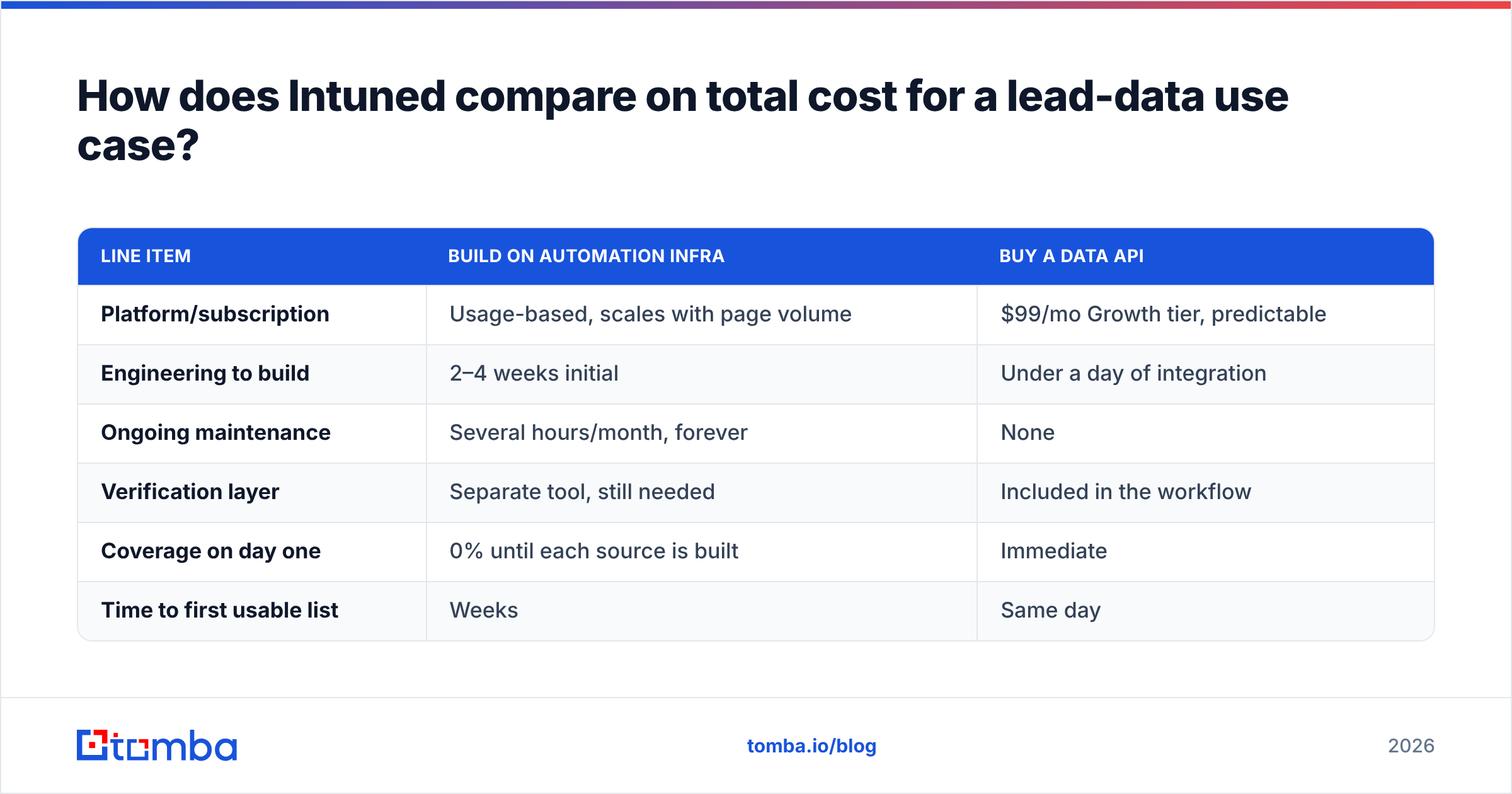
How does Intuned compare on total cost for a lead-data use case?#
Run the numbers on one concrete scenario: you want verified work emails for decision-makers at 5,000 companies, refreshed quarterly.
| Line item | Build on automation infra | Buy a data API |
|---|---|---|
| Platform/subscription | Usage-based, scales with page volume | $99/mo Growth tier, predictable |
| Engineering to build | 2–4 weeks initial | Under a day of integration |
| Ongoing maintenance | Several hours/month, forever | None |
| Verification layer | Separate tool, still needed | Included in the workflow |
| Coverage on day one | 0% until each source is built | Immediate |
| Time to first usable list | Weeks | Same day |
Even on generous assumptions, the build path loses on this specific job — and it loses worse the more companies you add. That is not a knock on Intuned. It is a knock on using infrastructure to recreate a finished product. Compare the tiers yourself on the Tomba pricing page and plug your own volumes into the model above.
Where the table flips: if the data is unsellable — behind your own credentials, specific to your vertical, regenerated hourly — the build path is the only path, and paying for managed browsers beats paying for a platform team.
What is the verdict on Intuned pricing in 2026?#
Intuned is fairly priced for what it is: managed browser-automation infrastructure with a genuinely fast path from target page to production endpoint. The usage-based model is standard for the category and rewards teams that run lean, incremental jobs. The pros — speed to first extractor, real production tooling, code-first escape hatches — are concrete. The cons — unpredictable bills, permanent maintenance, and a steep mismatch penalty if you picked the wrong job — are equally concrete and are largely inherent to scraping rather than unique to this vendor.
Judge it on one question: is the data I need for sale anywhere? If no, Intuned belongs on your shortlist and you should get a quote with your real page volumes attached. If yes, buy the data and spend your engineering budget on something a competitor cannot buy.
If what you actually need is verified, deliverable work email addresses — not a scraping stack — start with the Tomba Email Finder. It returns professional emails by name, domain, or company with confidence scoring and source attribution, works through a REST API, Sheets, Excel, or a browser extension, and costs a flat $49/mo on Starter with a free tier of 25 searches to test coverage on your own target accounts first. No selectors to maintain, no proxy bill, no 2 a.m. Slack alert when a site redesigns its header.
Related guides#
Ready to find emails that actually work?
Join 150,000+ professionals who stopped guessing and started sending. Free credits on signup — no credit card required.
Get the Tomba newsletter
Practical outbound tactics and product updates — once every two weeks.
About the author