8 Best InvestGlass Alternatives for 2026: Honest Comparison
InvestGlass is a solid Swiss-hosted CRM for regulated finance teams — but it is not the only option, and for many teams it is not the cheapest or the best-integrated one. Here are eight alternatives compared on price, compliance, and data quality.
TL;DR
- InvestGlass is a Swiss-hosted CRM for banks, wealth managers, and advisors. Its edge is data residency plus built-in KYC steps, not raw sales speed.
- Teams shop for InvestGlass alternatives for three reasons. They want more integrations, a lower seat price, or they are not a regulated firm at all.
- The right pick depends on your rules. Salesforce Financial Services Cloud and Practifi suit large firms. Wealthbox and Redtail suit US advisors. HubSpot and Pipedrive suit plain B2B sales teams.
Two more points to weigh before you shop:
- No CRM fills its own pipeline. You still need a verified contact-data layer behind it. That is a separate line item, and it is the cheaper half of the stack.
- Budget the switch, not just the plan. A CRM move takes 4–12 weeks of migration, data cleanup, and retraining.
What is InvestGlass, and who actually uses it?#
InvestGlass is a CRM and client-lifecycle platform hosted in Switzerland. It aims at regulated finance firms: private banks, external asset managers, advisors, insurance brokers, and fintechs. The draw is Swiss or EU data residency.
The feature set covers four areas:
- CRM core — contacts, companies, pipelines, activity logs, reports, and role-based access.
- Digital onboarding — KYC and AML forms, e-signature, and ID checks that leave an audit trail.
- Portfolio and suitability tools — risk profiles, suitability checks, and portfolio views built for advisors.
- Automation — rule-based sequences, approval flows, and a no-code form builder for client intake.
That mix is hard to find in one product. Say you are a Swiss asset manager under FINMA rules. You need client data to stay in Switzerland. InvestGlass is then on a very short list. The real question is whether you belong on that list. Many buyers pick a finance platform to do plain B2B sales.
Why do teams look for InvestGlass alternatives?#
Migration talks and public reviews on G2 and Capterra surface the same five gripes.
- Integration depth. Big CRMs have thousands of native connectors. Niche tools have dozens. If you run a marketing tool, a dialer, a BI layer, and billing, you will pay engineers to glue them together.
- Seat cost at scale. A niche CRM looks cheap at five seats. At fifty seats it does not, once onboarding and portfolio modules are added.
- Hiring and training. You can hire a Salesforce admin in any city. Admins for niche tools are rarer and cost more.
- You are not regulated. Some teams find InvestGlass in a Swiss software search. Then they pay for KYC steps they never open.
- Reporting limits. Advisors want AUM and suitability reports. Sales leaders want win rates, deal speed, and forecasts. Those are two different report sets.
None of this makes InvestGlass a bad product. It makes it a narrow one. That is why buyers shortlist InvestGlass alternatives in the first place. The mistake is to line it up against Salesforce feature by feature. Ask instead which limits you actually live under.
What are the best InvestGlass alternatives in 2026?#
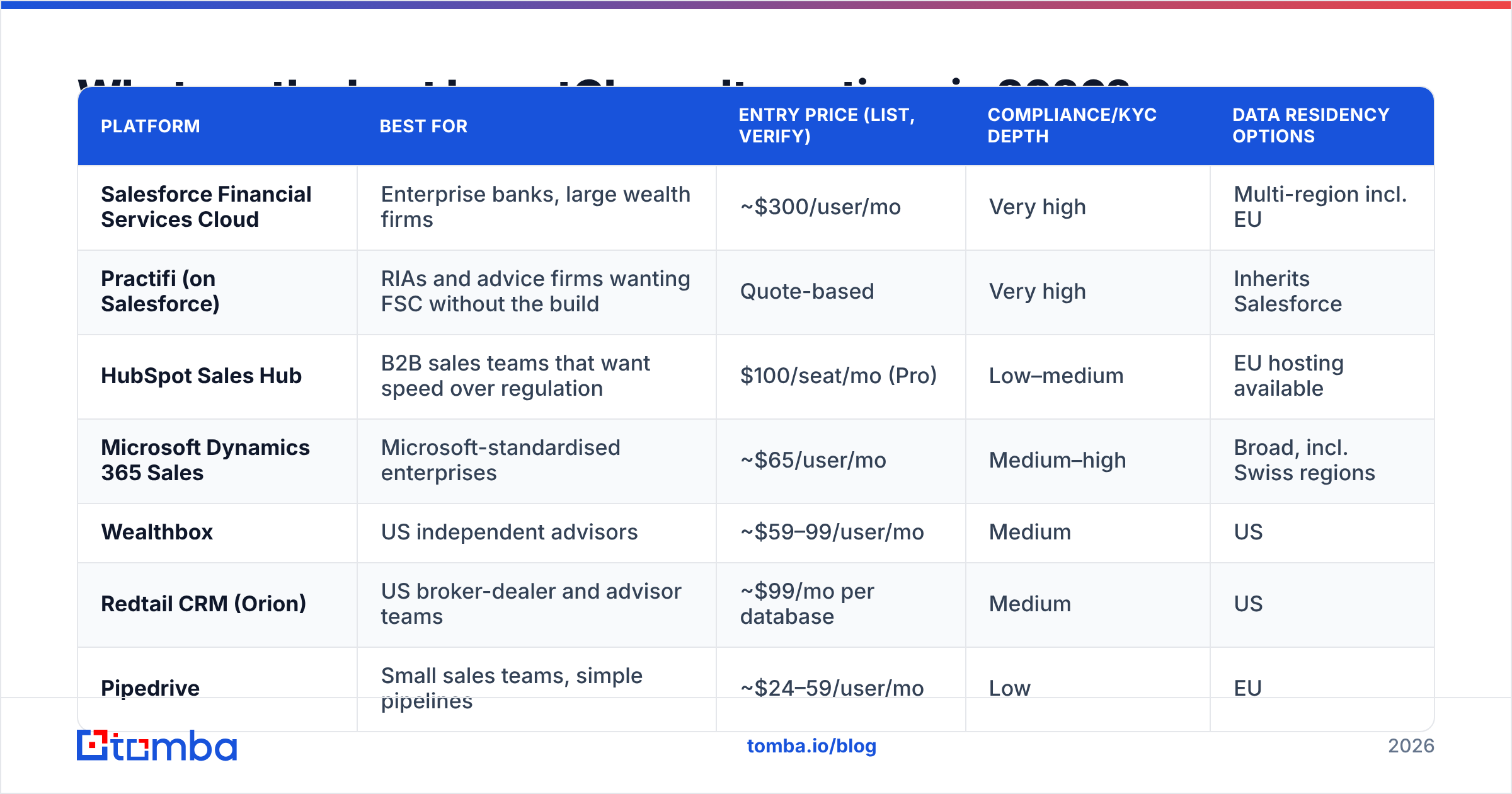
Here is the short list of InvestGlass alternatives, grouped by who each tool fits.
| Platform | Best for | Entry price (list, verify) | Compliance/KYC depth | Data residency options |
|---|---|---|---|---|
| Salesforce Financial Services Cloud | Enterprise banks, large wealth firms | ~$300/user/mo | Very high | Multi-region incl. EU |
| Practifi (on Salesforce) | RIAs and advice firms wanting FSC without the build | Quote-based | Very high | Inherits Salesforce |
| HubSpot Sales Hub | B2B sales teams that want speed over regulation | $100/seat/mo (Pro) | Low–medium | EU hosting available |
| Microsoft Dynamics 365 Sales | Microsoft-standardised enterprises | ~$65/user/mo | Medium–high | Broad, incl. Swiss regions |
| Wealthbox | US independent advisors | ~$59–99/user/mo | Medium | US |
| Redtail CRM (Orion) | US broker-dealer and advisor teams | ~$99/mo per database | Medium | US |
| Pipedrive | Small sales teams, simple pipelines | ~$24–59/user/mo | Low | EU |
| Zoho CRM | Cost-sensitive teams wanting breadth | ~$14–52/user/mo | Low–medium | Multi-region incl. EU |
Prices are list rates at the time of writing, and they change often. Check the vendor's own pricing page before you build a case.
Salesforce Financial Services Cloud#
This is the default answer for big firms. Salesforce FSC adds a finance data model on top of Sales Cloud: households, financial accounts, relationships, and referrals. You also get Einstein forecasting, a huge AppExchange, and a deep pool of certified admins.
The trade-offs are fair ones. It costs a lot. It needs an admin or a partner. A rollout takes months. Under 15 seats, it is far more tool than you need.
Practifi#
Practifi runs on the Salesforce platform. It ships advice-firm workflows out of the box: service steps, compliance tasks, and household views. So you skip most of the setup project. You keep Salesforce security and integrations, with a UI built for advisors. Pricing is quote-based and sits above generic CRM tiers.
HubSpot Sales Hub#
Running B2B sales rather than regulated advice? HubSpot is the practical pick. You get sequences, meeting links, deal automation, and tight marketing alignment. A free tier lets you pilot before you commit. Sales Hub Professional lists at $100 per seat per month. Starter costs far less for small teams.
What it will not do is KYC. There is no suitability engine, no AML form builder, and no audit trail for regulated onboarding. Third-party apps can cover some of it. But then you are assembling, not buying.
Microsoft Dynamics 365 Sales#
This is the best fit when your team already lives in Microsoft 365, Azure, and Power BI. Dynamics plugs straight into Outlook and Teams. You can shape the data model and pick your Azure region. That covers most European data rules without a niche vendor. The cost shows up in setup work, not in the sticker price.
Wealthbox and Redtail CRM#
Both serve US independent advisors, and both do the job well. You get household views, custodian links, workflow templates, and a UI advisors will actually use. Wealthbox has the cleaner, newer look. Redtail, now part of Orion, has the longer integration list. Neither aims at European rules. So they replace InvestGlass only if your compliance work is US-based.
Pipedrive and Zoho CRM#
Some teams just want a pipeline they can see, and a CRM reps will update. These two are the value picks. Pipedrive has the clearest pipeline UI on the market. Zoho gives you the most features per dollar, plus its own marketing, desk, and analytics apps. Neither offers real compliance tooling. If you never needed it, that is a plus, not a gap.
How do these InvestGlass alternatives compare on what breaks deals?#
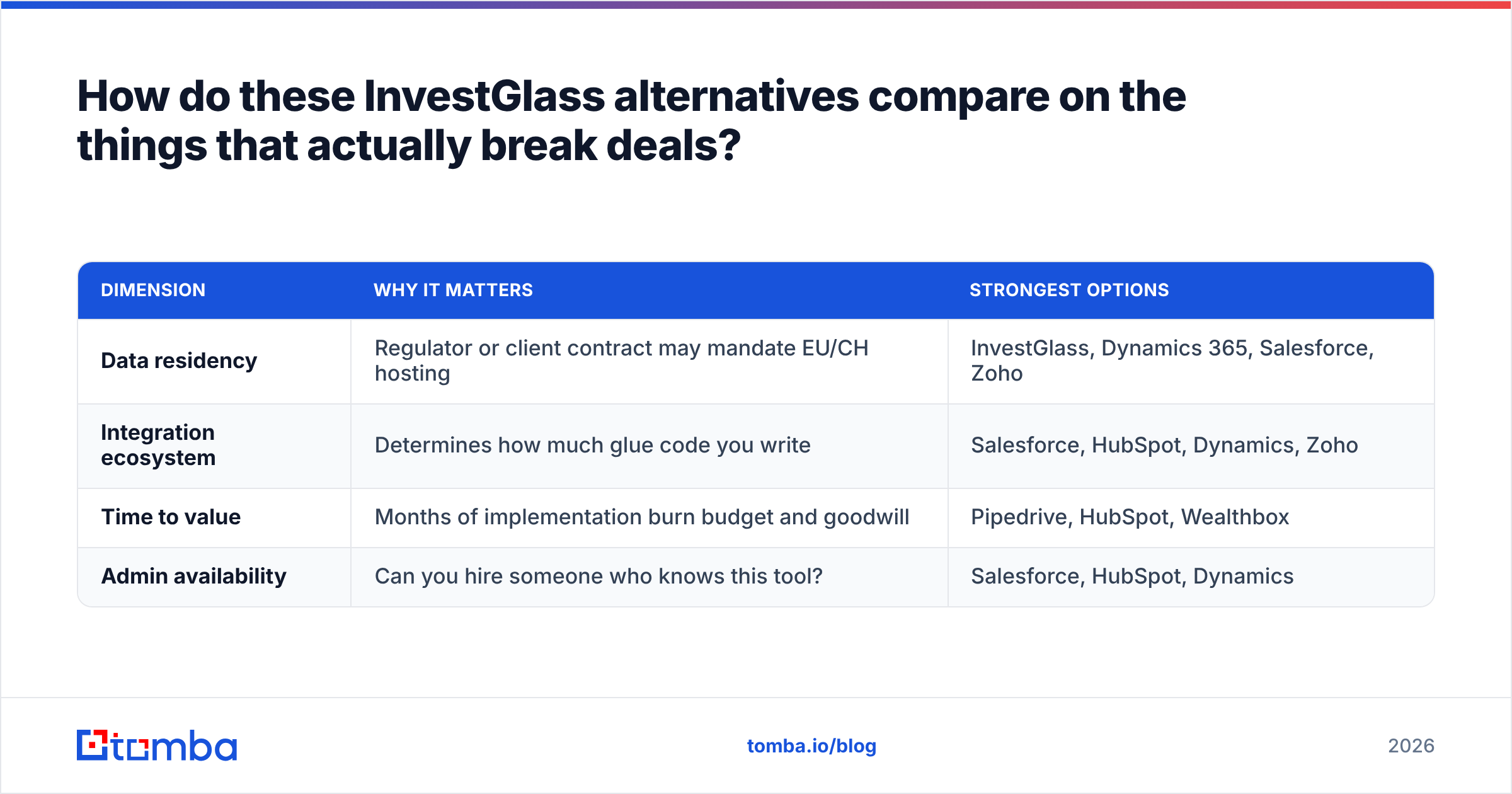
Feature grids flatter every vendor. Four things decide whether a move sticks:
| Dimension | Why it matters | Strongest options |
|---|---|---|
| Data residency | Regulator or client contract may mandate EU/CH hosting | InvestGlass, Dynamics 365, Salesforce, Zoho |
| Integration ecosystem | Determines how much glue code you write | Salesforce, HubSpot, Dynamics, Zoho |
| Time to value | Months of implementation burn budget and goodwill | Pipedrive, HubSpot, Wealthbox |
| Admin availability | Can you hire someone who knows this tool? | Salesforce, HubSpot, Dynamics |
Run your short list of InvestGlass alternatives through those four first. Then look at feature checkboxes. A tool that wins on features but has no admin pool turns into shelfware within two years.
Is a CRM alone enough, or do you need a data layer?#
Here is the part most alternatives posts skip. A new CRM does not fix a weak pipeline. A CRM is a filing cabinet with reports. It sorts the contacts you already have. It does not find new ones. It does not tell you when the old ones go stale.
B2B contact data decays by roughly 22–30% a year. People change jobs and firms reorganise. So a CRM move is the best moment to clean and re-enrich your database. You are touching every record anyway.
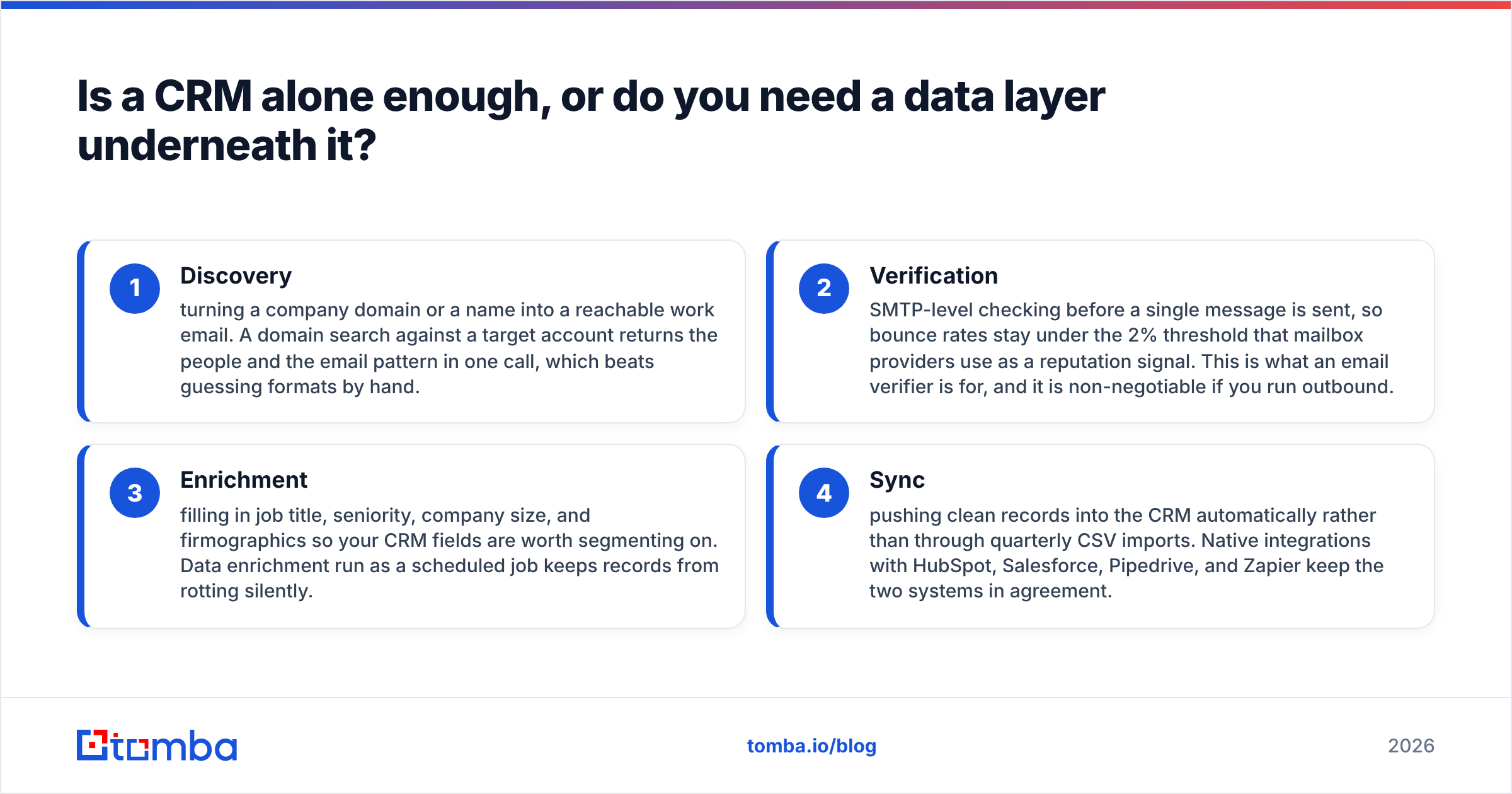
A data layer sits next to whichever CRM you pick. It handles four jobs:
- Discovery — turn a domain or a name into a work email. A domain search on a target account returns the people and the email pattern in one call. That beats guessing formats by hand.
- Verification — check each address at the SMTP level before you send. Keep bounces under 2%, the line mailbox providers watch. That is the job of an email verifier.
- Enrichment — fill in job title, seniority, company size, and firmographics. Run data enrichment on a schedule so records do not rot.
- Sync — push clean records into the CRM on their own, not by quarterly CSV import. Native integrations with HubSpot, Salesforce, Pipedrive, and Zapier keep both sides in step.

Prefer buying static lists to live search? BookYourData is a solid option in that lane. It pairs fine with any CRM here. It trades live lookup for pre-built volume.
The point is structure. Keep the system of record, the CRM, apart from the source of truth for contact data. Then your next CRM move costs a connector rewrite, not a data rebuild.
How should you choose between these InvestGlass alternatives?#
Work through five questions in order. The first hard limit you hit settles most of the short list.
- Are you regulated? If a regulator can audit your onboarding records, you need FSC, Practifi, or InvestGlass itself. If not, skip the compliance features and save the money.
- Where must the data live? Swiss hosting narrows the field fast. EU hosting is easy to find. If neither is in a contract, ignore this one.
- How many seats in 24 months? Price the plan you will be on then, not today. Seat tools that look cheap at eight seats can double your bill at forty.
Two more questions are about your team, not the tool:
- What is already in your stack? A Microsoft shop should lean to Dynamics. A marketing-led team should lean to HubSpot. Fighting your own stack is the priciest way to shop.
- Who owns the admin work? If the answer is "nobody yet," pick the simplest tool that clears the bar — Pipedrive or HubSpot — not the strongest one.
Here is a quick sanity check. Write down the three reports your leaders read each month. If a tool cannot produce all three without custom code, it is not a real candidate.
What does a realistic migration look like?#
Budget 4–12 weeks, based on data volume and integration count. First, get the data right:
- Week 1–2: Export and audit. Pull everything out of InvestGlass, custom fields and files included. Count duplicates, blanks, and records with no activity in 12 months. You will delete more than you think.
- Week 2–3: Clean and enrich. Dedupe, then re-verify every email before import. Dirty data in a clean CRM just moves the problem. A bulk verify pass handles the whole export in one job.
Then go live:
- Week 3–6: Configure and map. Build pipelines, fields, and permissions. Map old fields to new ones by hand. Do not let the importer guess.
- Week 5–8: Integrate. Reconnect email, calendar, marketing, and data sources. Niche tools cost you time here. Big ones do not.
- Week 7–10: Parallel run. Keep InvestGlass read-only while the team works in the new tool. Two weeks of overlap catches what a test import hides.
- Week 10–12: Cut over and train. CRM projects fail on adoption, not setup. Budget real training hours.
Which InvestGlass alternative should you pick?#
Most InvestGlass alternatives on this list win on one axis only. Match that axis to yours:
- Regulated European wealth firm that needs Swiss hosting: stay on InvestGlass, unless a clear gap is costing you money. It is the right tool for that job.
- Large financial institution: Salesforce Financial Services Cloud, or Practifi if you want the vertical pre-built.
- US independent advisor: Wealthbox for the newer UI, Redtail for the wider integration list.
- Microsoft-standard enterprise: Dynamics 365 Sales.
- B2B sales team with no regulator: HubSpot for power, Pipedrive for simplicity, Zoho for features per dollar.
Whichever way you go, the CRM is only half the decision. The other half is what feeds it.
Ready to fill whichever CRM you choose?#
A CRM is only as good as the contacts inside it. Tomba's Email Finder turns a domain, a company name, or a LinkedIn profile into a verified work email. It then pushes that email into HubSpot, Salesforce, Pipedrive, or your own stack through the Tomba API. Every result is checked before it reaches you. So your bounce rate and sender score stay intact through the move and after it.
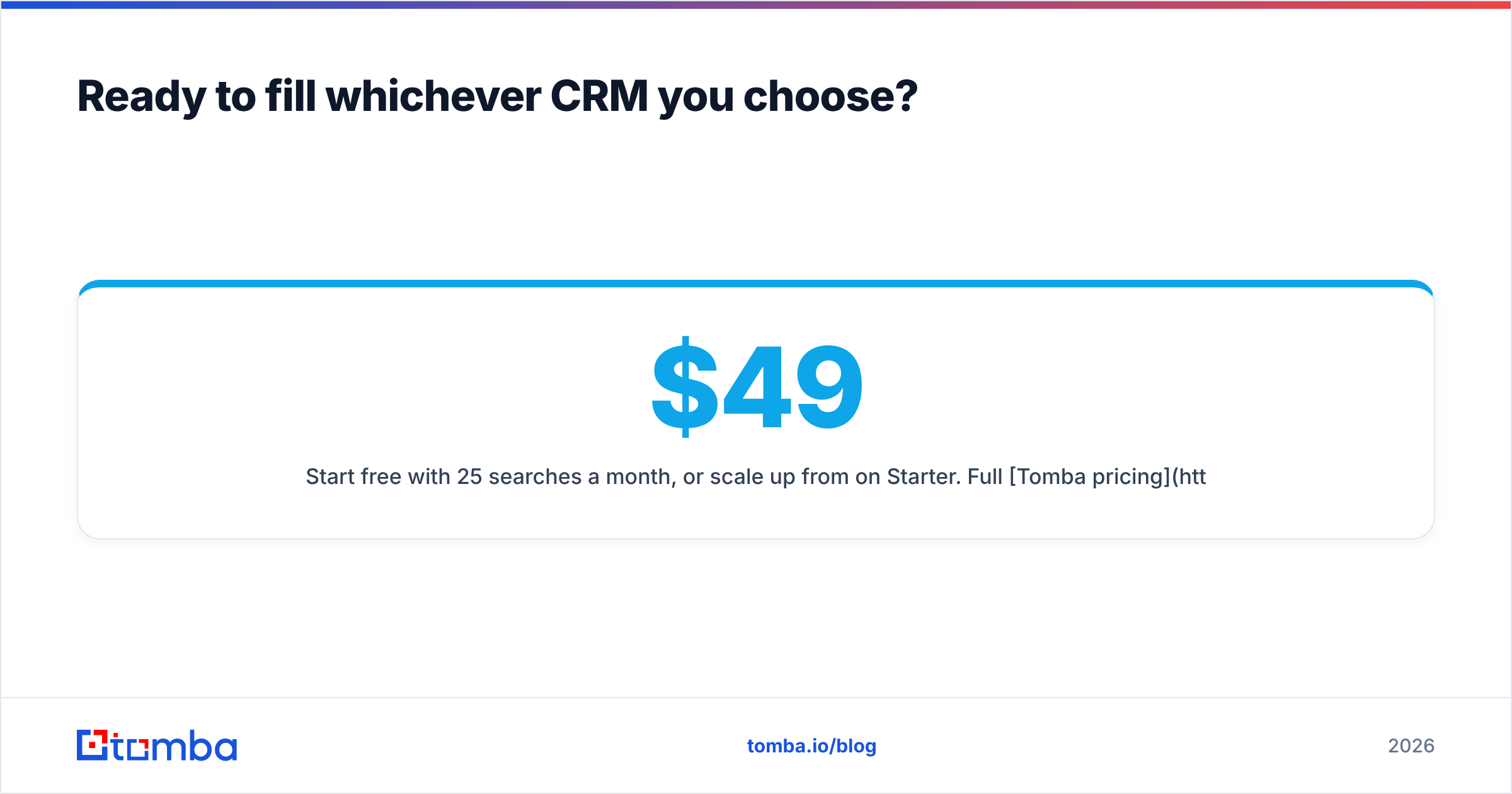
Start free with 25 searches a month. Paid plans start at $49 a month on Starter. Full Tomba pricing is public, with Growth at $99 a month and Pro at $249 a month for high volume. Move the CRM once. Keep the data layer for good.
Related guides#
// get started
Find, verify and enrich your first contacts today
Start on the free plan with 25 searches a month, then scale when your team is ready.
Free plan · No credit card required · GDPR & CCPA
// about the author