9 Best Invoca Alternatives for Call Tracking in 2026
Invoca is strong software with an enterprise price tag and an enterprise sales cycle. Here are nine Invoca alternatives compared on pricing, conversation AI, attribution depth, and who each one actually fits.
TL;DR
- Invoca is a high-end call tracking and conversation intelligence platform. It is built for large advertisers with contact centers. Most teams shopping for Invoca alternatives like the product. They just cannot live with the quote or the annual contract.
- Need number pools, source data, and CRM sync? The budget Invoca alternatives cover 80% of the job for a fraction of the price: CallRail, CallTrackingMetrics, WhatConverts, and Nimbata.
- Need AI call scoring across thousands of calls? Your real shortlist is short. Invoca, Convirza, Marchex, and Gong (for sales calls, not marketing calls).
- Run pay-per-call or affiliate traffic? Ringba and Retreaver are built for that job. No general call tracker matches them.
- Call tracking only measures demand you already have. If outbound is part of your pipeline, your limit is contact data, not call analytics. No Invoca alternatives fix that. It is a different budget line.
What does Invoca actually do, and why do teams look for alternatives?#
Invoca joins two things that used to be separate tools. The first is call tracking: which number, which ad, and which keyword drove the call. The second is conversation intelligence: what was said, and whether the call turned into a sale.
The product transcribes each call and scores it against your own signals. It then sends those signals to Google Ads and Meta as conversions. Outcomes land in Salesforce or your contact center. Say you run a hospital group, a car dealer group, a telecom, or an insurer. If you spend seven figures on paid search, that loop pays for itself. You stop chasing call volume and start chasing calls that book an appointment.
Teams rarely leave over a missing feature. Invoca does the job well. Buyers look for Invoca alternatives because of four frictions:
Price and packaging. Invoca does not publish list prices. Deals are annual and negotiated. Most land in the mid-five to six figures per year. At 2,000 calls a month, that math is hard to defend.
Procurement drag. Demo, scoping call, security review, legal. Teams that need a tracking number live this week will not wait two months.
Overkill for the job. Many buyers only need dynamic number insertion, session-level data, and a Google Ads link. Paying for an AI engine you never set up is waste.
Mid-market economics. The platform fee assumes a level of ad spend most firms never reach. Below roughly $100K a month in paid media, the extra tuning rarely covers the license. That is when Invoca alternatives start to look sensible.
None of this makes Invoca a bad product. It makes it a specific product for a specific buyer. The question is whether you are that buyer.
What should you look for in Invoca alternatives?#
Most Invoca alternatives look alike on a feature grid. Pick the two dimensions that actually gate your choice, then score only those. Here are the six that matter.
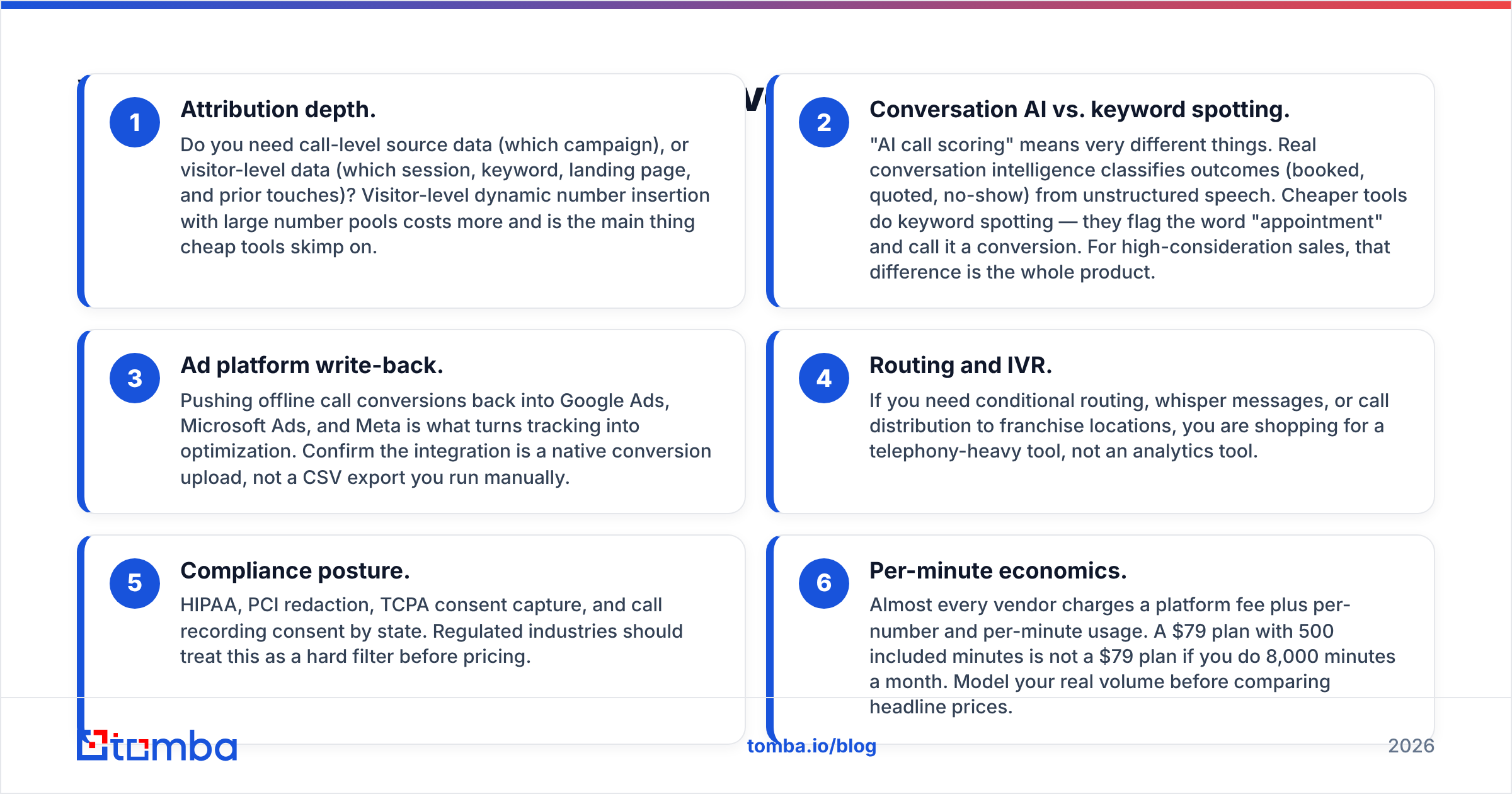
- Attribution depth. Do you need call-level data (which campaign) or visitor-level data (which session, keyword, and landing page)? Visitor-level tracking needs big number pools. It costs more, and cheap tools skimp on it.
- Conversation AI vs. keyword spotting. "AI call scoring" means two different things. Real AI reads the outcome — booked, quoted, no-show — from plain speech. Cheap tools just flag the word "appointment" and count it as a win. For big-ticket sales, that gap is the whole product.
- Ad platform write-back. Sending call conversions back to Google Ads, Microsoft Ads, and Meta is what turns tracking into better ad buying. Check that it is a native upload, not a CSV you export by hand.
- Routing and IVR. Need call routing, whisper messages, or calls split across branch locations? Then you want a phone tool, not an analytics tool.
- Compliance. HIPAA, PCI redaction, TCPA consent, and state call-recording rules. In regulated fields, treat this as a hard filter before you talk price.
- Per-minute cost. Almost every vendor bills a base fee plus numbers plus minutes. A $79 plan with 500 minutes is not a $79 plan at 8,000 minutes. Model your real volume first.
Which Invoca alternatives are worth shortlisting in 2026?#
Here is the practical landscape. Prices are list prices at the time of writing, and they change often. Check each vendor's pricing page before you build a business case.
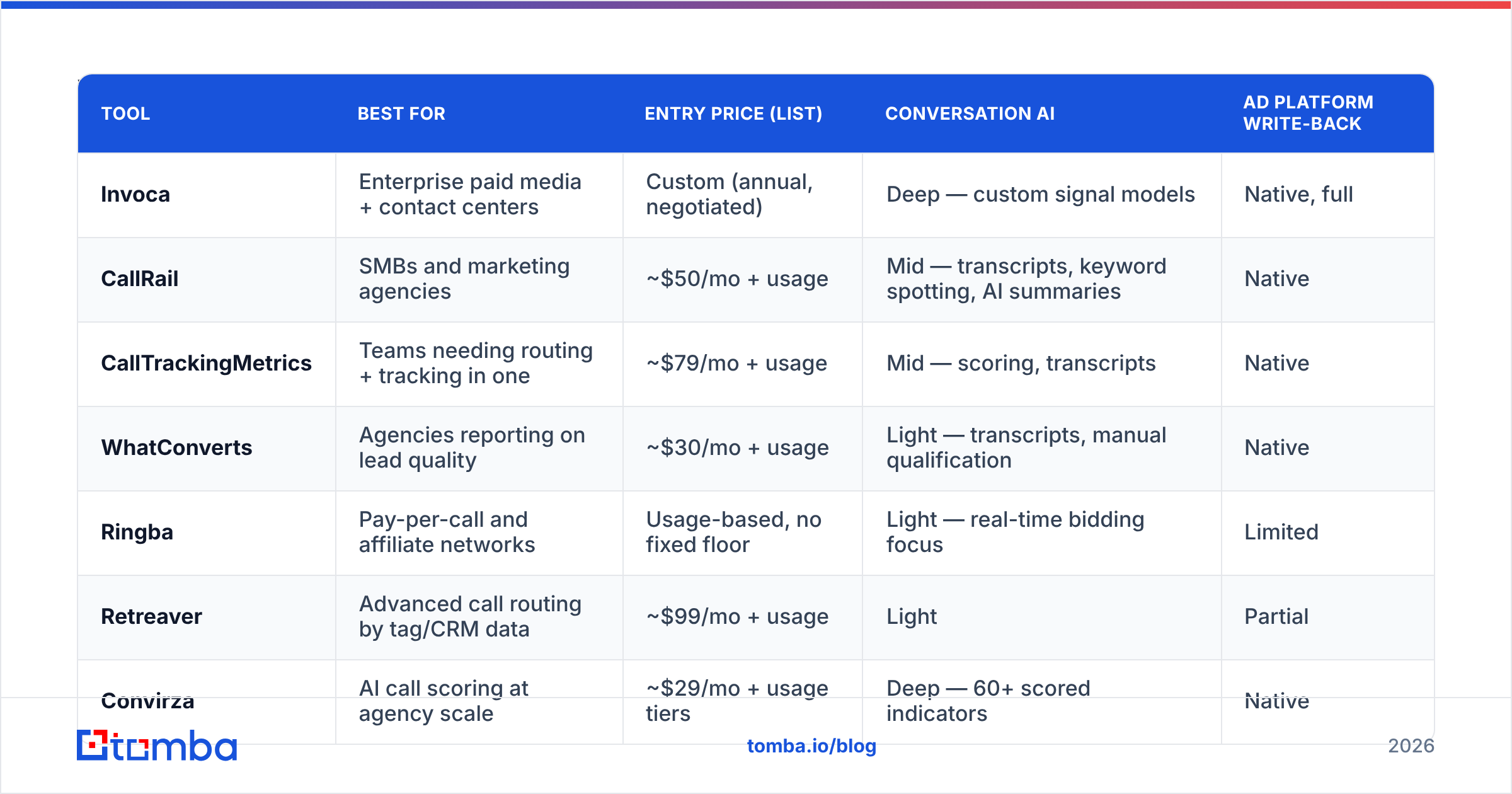
| Tool | Best for | Entry price (list) | Conversation AI | Ad platform write-back |
|---|---|---|---|---|
| Invoca | Enterprise paid media + contact centers | Custom (annual, negotiated) | Deep — custom signal models | Native, full |
| CallRail | SMBs and marketing agencies | ~$50/mo + usage | Mid — transcripts, keyword spotting, AI summaries | Native |
| CallTrackingMetrics | Teams needing routing + tracking in one | ~$79/mo + usage | Mid — scoring, transcripts | Native |
| WhatConverts | Agencies reporting on lead quality | ~$30/mo + usage | Light — transcripts, manual qualification | Native |
| Ringba | Pay-per-call and affiliate networks | Usage-based, no fixed floor | Light — real-time bidding focus | Limited |
| Retreaver | Advanced call routing by tag/CRM data | ~$99/mo + usage | Light | Partial |
| Convirza | AI call scoring at agency scale | ~$29/mo + usage tiers | Deep — 60+ scored indicators | Native |
| Marchex | Enterprise call analytics, auto/home services | Custom | Deep — outcome classification | Native |
| Infinity | Enterprise attribution, strong in UK/EU | Custom | Mid–deep | Native |
| Gong | Sales conversations, not marketing attribution | Custom (per seat, annual) | Deep — but for reps, not campaigns | N/A |
CallRail — the default mid-market swap#
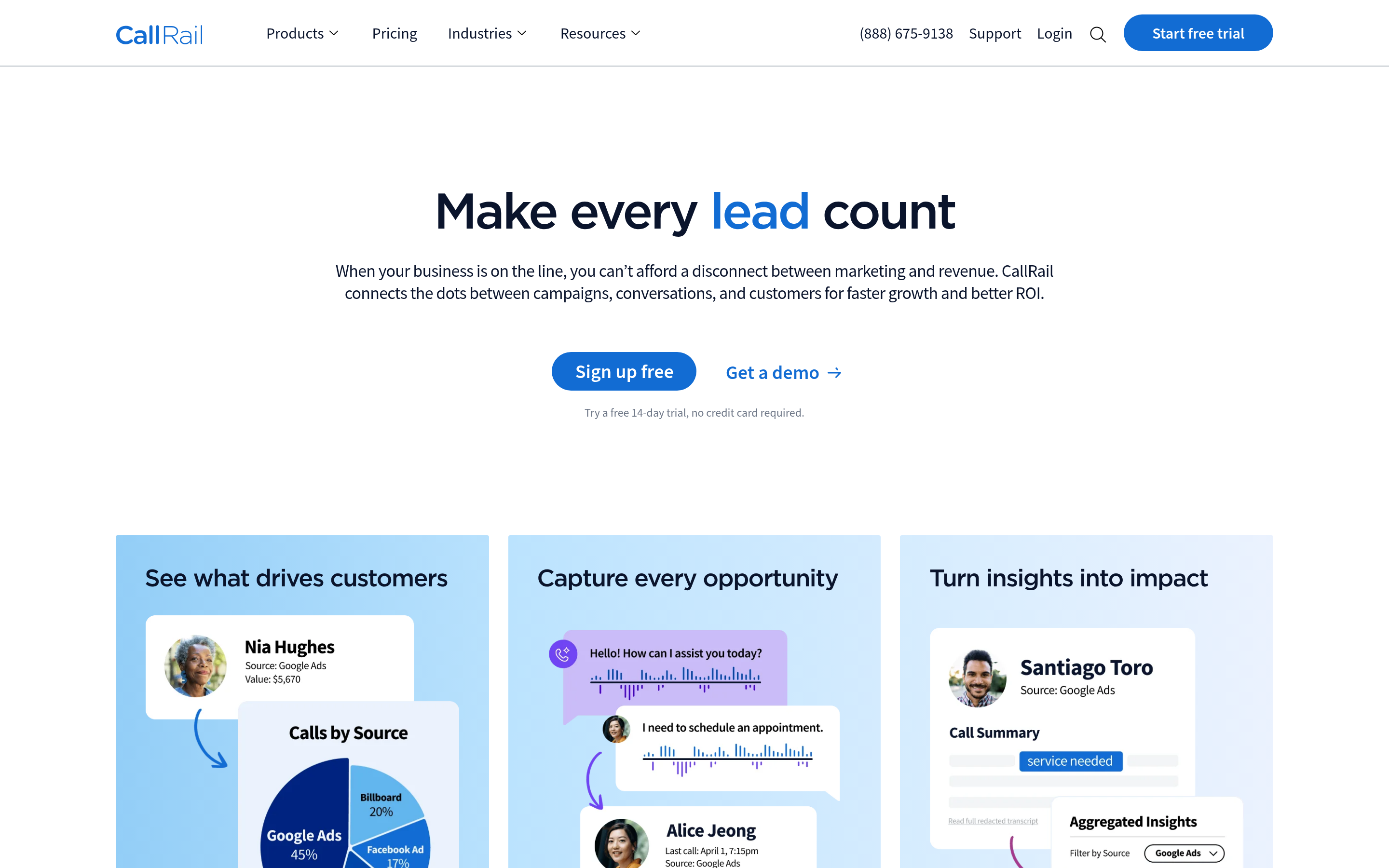
CallRail tops most Invoca alternatives lists, and for good reason. Dynamic number insertion works properly. The Google Ads and HubSpot links are clean. Agency tooling — sub-accounts and white-label reports — is mature. The AI layer gives you transcripts, summaries, and rule-based lead sorting. What you give up is Invoca's custom signal models. CallRail will tell you a call mentioned "financing." It will not tell you the call had a 73% chance of closing. For a service business spending $20–80K a month on paid search, that trade is usually right.
CallTrackingMetrics — when routing matters as much as reporting#
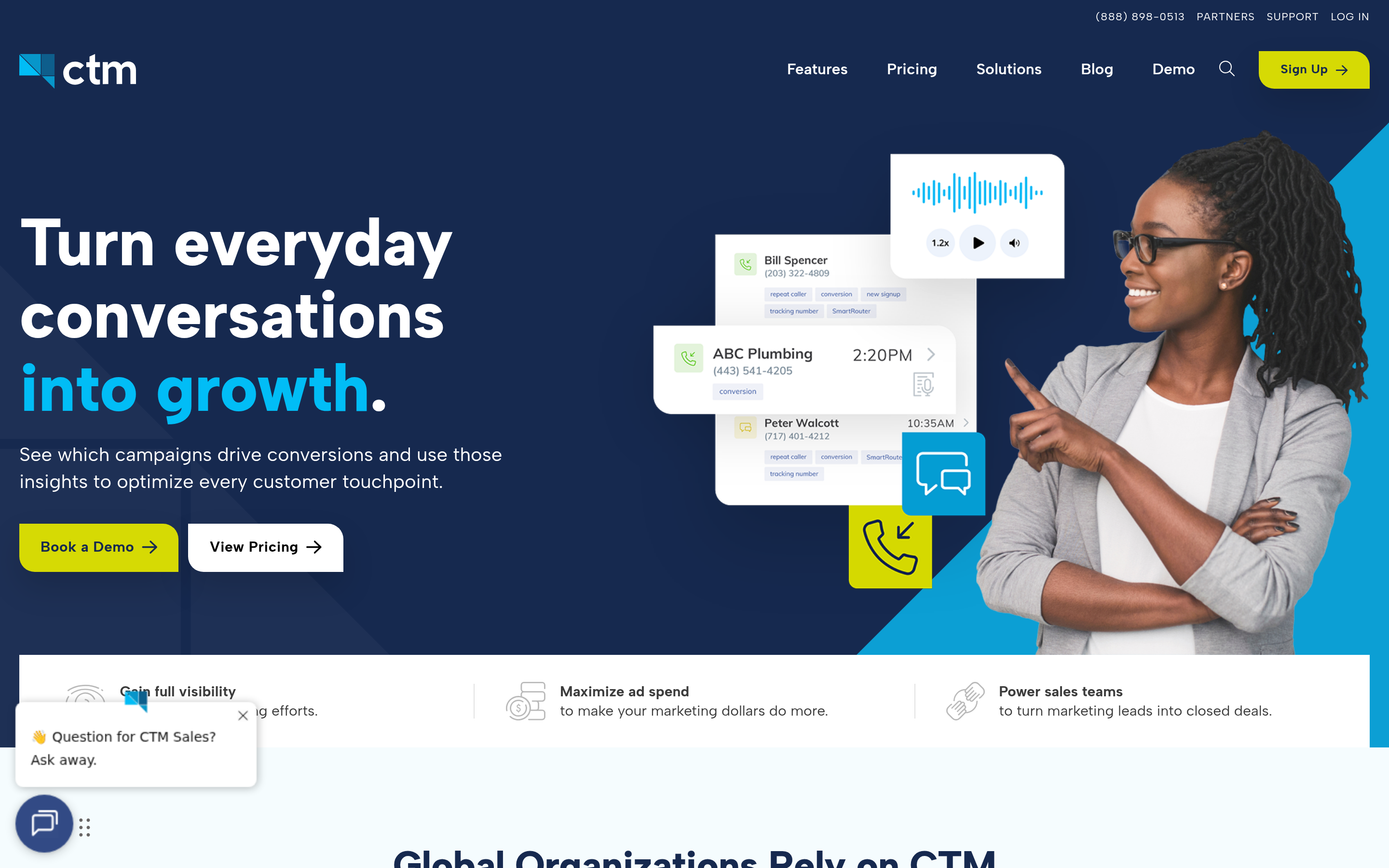
CTM fits when your phone system and your reporting should be one product. It ships a real softphone, IVR, smart routing, agent queues, and texting next to the tracking. Were you about to buy a call tracker and a small contact center? CTM merges the two line items. The interface feels more dated than CallRail's, and per-minute costs add up. Still, you get a lot of features per dollar.
WhatConverts — the lead-quality reporting play#
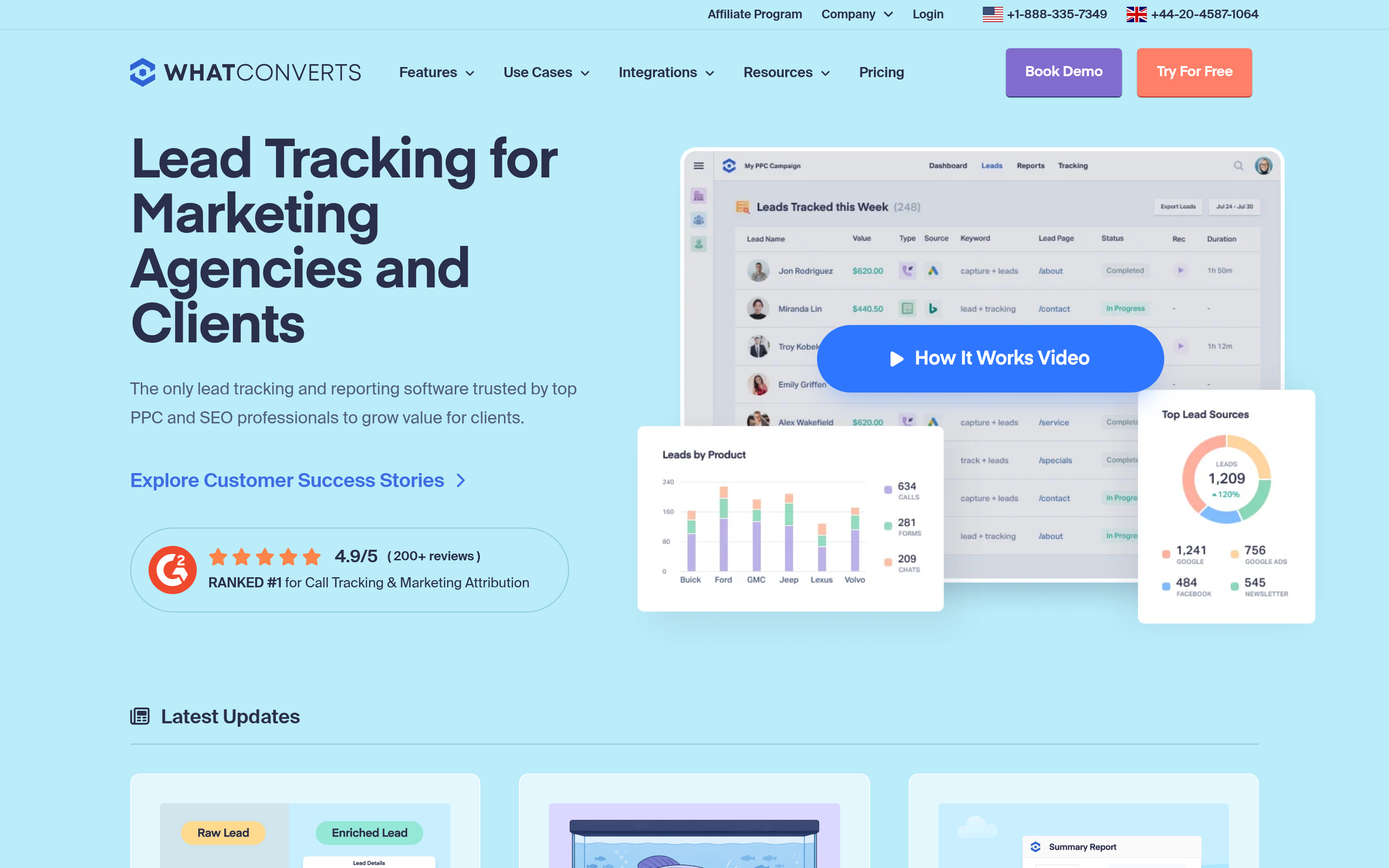
WhatConverts is narrower on purpose. It pulls calls, forms, chats, and orders into one lead record. Then it asks you to mark each lead as good or bad. That manual step sounds like a step back until you see the reports. You get revenue by keyword, by campaign, and by landing page, with people judging quality instead of an algorithm. Agencies that sell on lead quality love it. If you need scoring across 50,000 calls, it is too much hand work.
Ringba and Retreaver — pay-per-call specialists#
Do you buy or sell calls as inventory? Then general call trackers are the wrong shape, and these are the Invoca alternatives to look at. Ringba runs live bidding on inbound calls, with ping-tree logic, buyer caps, and revenue reconciliation built in. Retreaver stands out for tag-based routing. It attaches CRM data to a call in flight and routes on it. Neither is a marketing attribution suite. Both beat Invoca at one job: moving a live call to the buyer who pays the most.
Convirza and Marchex — the AI-scoring competitors#
These two are the Invoca alternatives that compete on capability, not just price. Convirza scores calls against dozens of markers. Did the agent ask for the appointment? Was the caller a real lead? Was the call a missed chance? It does that at a price mid-market teams can carry. Marchex is heavier, with strong models for auto, home services, and healthcare. Leaving Invoca over price rather than power? Start with these two before you drop to a tracking-only tool. You lose less.
Gong — different problem, frequently confused#
Gong shows up on every Invoca alternatives list, and it is almost always the wrong match. Gong reads outbound and sales calls to coach reps and forecast deals. Invoca reads inbound marketing calls to steer ad spend. If your pain is "I don't know which campaign drove the call," Gong solves nothing. If your pain is "my reps handle inbound leads badly," Gong is great and Invoca is not the tool. Read the category pages on G2 before you mix them up.

How do the pricing models actually compare?#
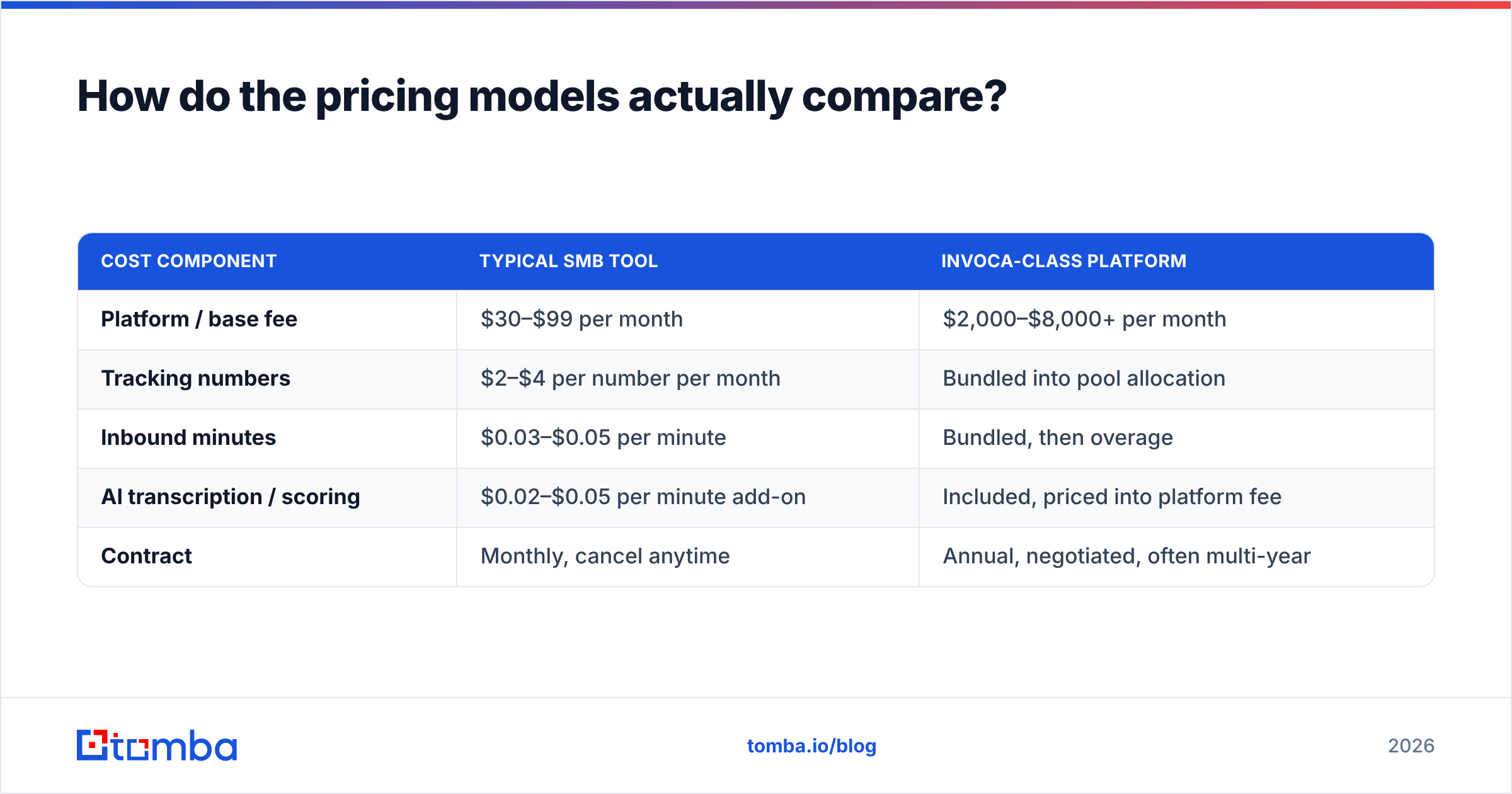
Headline prices mislead. Every vendor here bills on three axes, so model all three. Most Invoca alternatives look cheap until you add numbers and minutes.
| Cost component | Typical SMB tool | Invoca-class platform |
|---|---|---|
| Platform / base fee | $30–$99 per month | $2,000–$8,000+ per month |
| Tracking numbers | $2–$4 per number per month | Bundled into pool allocation |
| Inbound minutes | $0.03–$0.05 per minute | Bundled, then overage |
| AI transcription / scoring | $0.02–$0.05 per minute add-on | Included, priced into platform fee |
| Contract | Monthly, cancel anytime | Annual, negotiated, often multi-year |
Take a team with 1,500 calls a month at four minutes each. That is 6,000 minutes. On a mid-market tool, expect roughly $250–$450 a month once numbers and minutes are counted. The same volume on an enterprise platform does not buy 10x better data. It buys the same data with better models on top. Whether that is worth 20x depends on how much ad spend it steers. Rough rule: if a 1% lift in paid-media efficiency does not cover the license, buy the cheaper tool.
Is call tracking the right budget line for your pipeline at all?#
Here is the question most Invoca alternatives comparisons skip. Call tracking measures demand that already exists. It tells you which ad drove the phone call. It does not create a single new conversation.
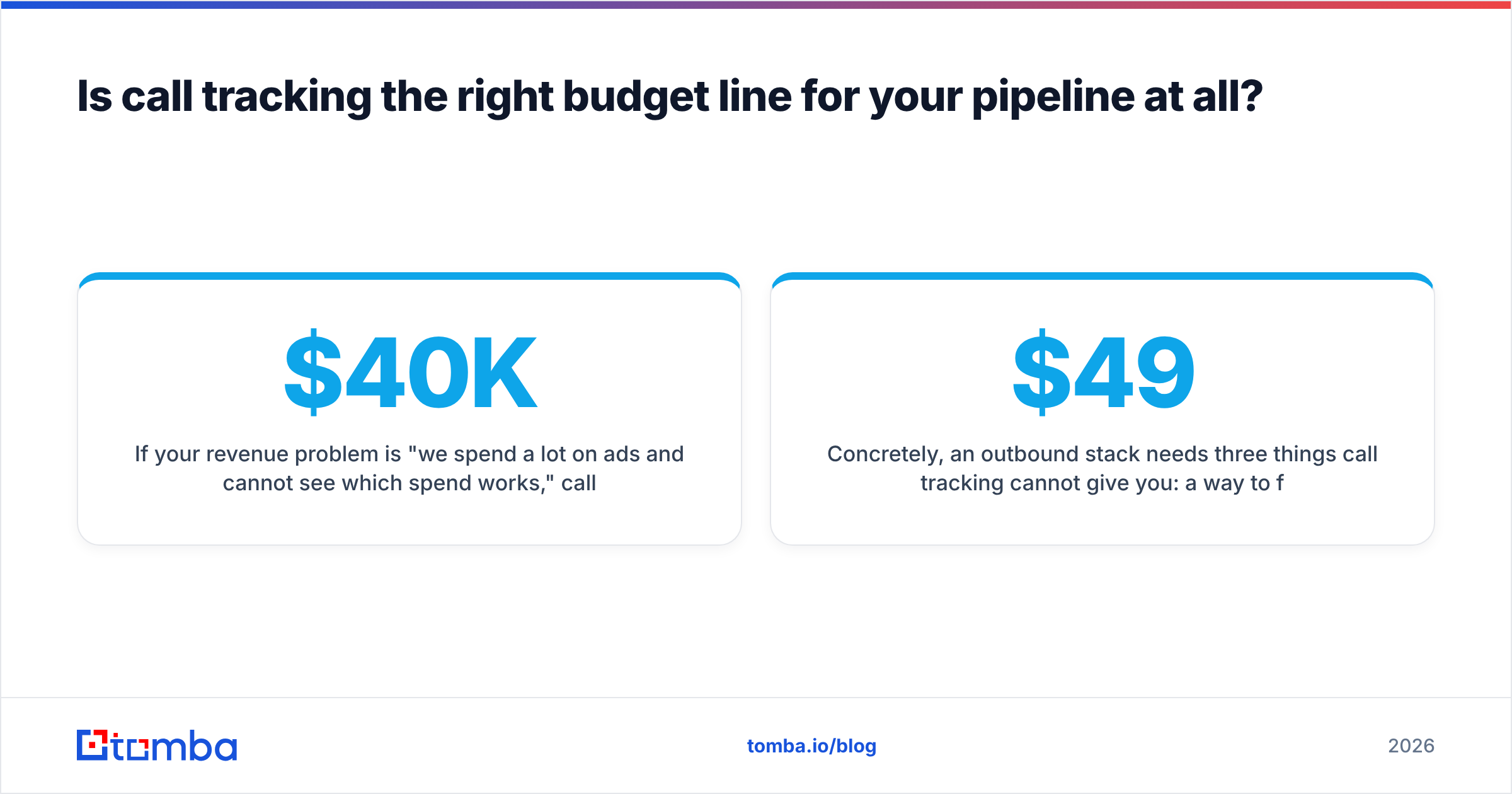
Is your problem "we spend a lot on ads and cannot see what works"? Then call tracking is the right buy, and this comparison matters. Is your problem "not enough good conversations happen in the first place"? Then a $40K conversation AI contract buys very precise reports about a pipeline that is too small.
Teams running both motions usually split the budget. One tool reports on inbound. A contact data layer feeds outbound. The second one costs an order of magnitude less. It is also where most mid-market teams see faster movement. That means verified direct dials and work emails for the accounts you already picked — a data enrichment job, not an analytics job.
An outbound stack needs three things call tracking cannot give you. First, a way to find decision-maker contact details from a company domain. Second, a way to confirm those details are live before a rep burns a dial or a send. Third, a way to keep CRM records current as people change jobs. Tomba's phone finder and phone validator handle the first two for phone. The email finder and verifier do the same on the email side. Tomba pricing starts free with 25 searches a month, then $49/mo on Starter and $99/mo on Growth. That is a rounding error on an enterprise call analytics invoice.
Which Invoca alternative should you actually pick?#
Most Invoca alternatives fit one of these constraints. Match the tool to the one that binds you:
- You want Invoca's power at a lower price: Convirza first, Marchex second. Same category, different economics.
- You want attribution and CRM sync, nothing fancier: CallRail. It is the safest default and the easiest to leave.
- You want routing, IVR, and tracking in one system: CallTrackingMetrics.
- You are an agency reporting lead quality to clients: WhatConverts.
- You buy or sell calls as inventory: Ringba, or Retreaver if routing logic comes first.
- You work in the UK or EU with enterprise governance needs: Infinity.
- Your problem is rep performance, not campaign attribution: Gong — and keep a cheap call tracker underneath it for source data.
- Your problem is pipeline volume, not measurement: skip this category and fix your contact data.
One process note. Run any shortlist as a 30-day parallel test, not a demo-based decision. Move a small number pool to the challenger and keep Invoca live on the rest. Then compare attributed conversions against closed-won records in your CRM. Vendor dashboards always agree with themselves. Your CRM is the referee.
Ready to fix the top of the funnel, not just the reporting?#
Call tracking tells you what happened to demand you already had. Want to create more of it? Start where every outbound conversation starts: a real person, a real inbox, a real direct dial. Tomba Email Finder finds verified work email addresses by domain, name, or company. The free tier gives you 25 searches a month, and Starter is $49/mo. No annual contract, no procurement cycle, and an API if you want it wired into the same CRM your call data lands in. Test it on 50 target accounts this week. See how many you can reach before your Invoca renewal date lands.
Related guides#
// get started
Find, verify and enrich your first contacts today
Start on the free plan with 25 searches a month, then scale when your team is ready.
Free plan · No credit card required · GDPR & CCPA
// about the author