7 Best Involve.me Alternatives in 2026 (Free and Paid)
involve.me is a capable interactive funnel builder, but it is not the cheapest or the most flexible option. Here are 7 alternatives compared on pricing, lead capture, integrations, and export limits.

TL;DR
- involve.me is a strong no-code builder for quizzes, calculators, and multi-step lead funnels, but pricing scales on submissions, and the cheapest plans strip out branding removal, webhooks, and most integrations.
- If you mainly need forms, Tally and Jotform are dramatically cheaper. If you need scored quizzes that qualify leads, ScoreApp and Outgrow are more specialised. If you need conversion-optimised funnel flows, Heyflow is the closest like-for-like swap.
- Typeform wins on brand polish and integrations; it loses on price per response, which is the single most expensive line item in this category.
- The tool is rarely the bottleneck. Most teams capture a first name and a work email, then discover 20-40% of those emails bounce or belong to a personal inbox.
- Pair whichever builder you pick with verification and enrichment so the leads that land in your CRM are actually reachable.
What does involve.me actually do?#
involve.me is an interactive content platform. You drag together a multi-step flow — a quiz, a price calculator, a survey, a product finder, a payment form — publish it on a subdomain or embed it on your site, and route the responses into your CRM or email tool. The official product positions it as a funnel builder rather than a form builder, and that distinction matters: the logic engine, the scoring, and the outcome pages are the reasons people pick it over a plain form.
The strengths are real:
- Conditional logic and answer-based branching without touching code.
- Calculators and scoring that produce a personalised result page.
- Built-in payment steps (Stripe, PayPal) inside a flow.
- A reasonable template library, so you are not designing from a blank canvas.
- AI-assisted flow generation that gets a first draft on screen in a minute.
The weaknesses are just as real, and they are the reason you are reading a list of involve.me alternatives:
- Submission-based pricing. A viral quiz is a billing event. Costs are predictable only if your traffic is.
- Feature gating on lower tiers. Removing branding, unlocking webhooks, and connecting most native integrations tends to sit above the entry plan.
- Design ceiling. You can make it look good; you cannot make it look bespoke without heavy CSS.
- Analytics depth. Drop-off by step is there, but attribution back to campaigns usually needs an external tool.
- Data quality. Like every self-serve form on the internet, it captures whatever the visitor types, including
asdf@gmail.com.
What should you look for in an involve.me alternative?#
Before you compare logos, write down which of these five you actually need. Most switching regret comes from optimising the wrong variable.
- Pricing model, not headline price. Per-submission, per-seat, per-form, and per-workspace models produce wildly different bills at 5,000 responses/month. A $29 plan capped at 100 submissions is more expensive than a $59 plan with 10,000.
- Logic depth. Branching is table stakes. Scoring, weighted answers, calculated fields, and hidden URL parameters are not. If you are building a qualification quiz, this is the make-or-break feature.
- Where the data goes. Native CRM objects beat Zapier steps. Check whether the tool writes to HubSpot/Salesforce natively, fires raw webhooks on the plan you are buying, and lets you export historic responses without an upgrade.
- Compliance and hosting. GDPR posture, EU data residency, and a signable DPA matter more than a template gallery if you sell into Europe or handle health/finance data.
- Design control. Custom domain, full CSS, and removable branding decide whether the funnel feels like your product or like a third-party pop-up.

Which involve.me alternatives are worth testing in 2026?#
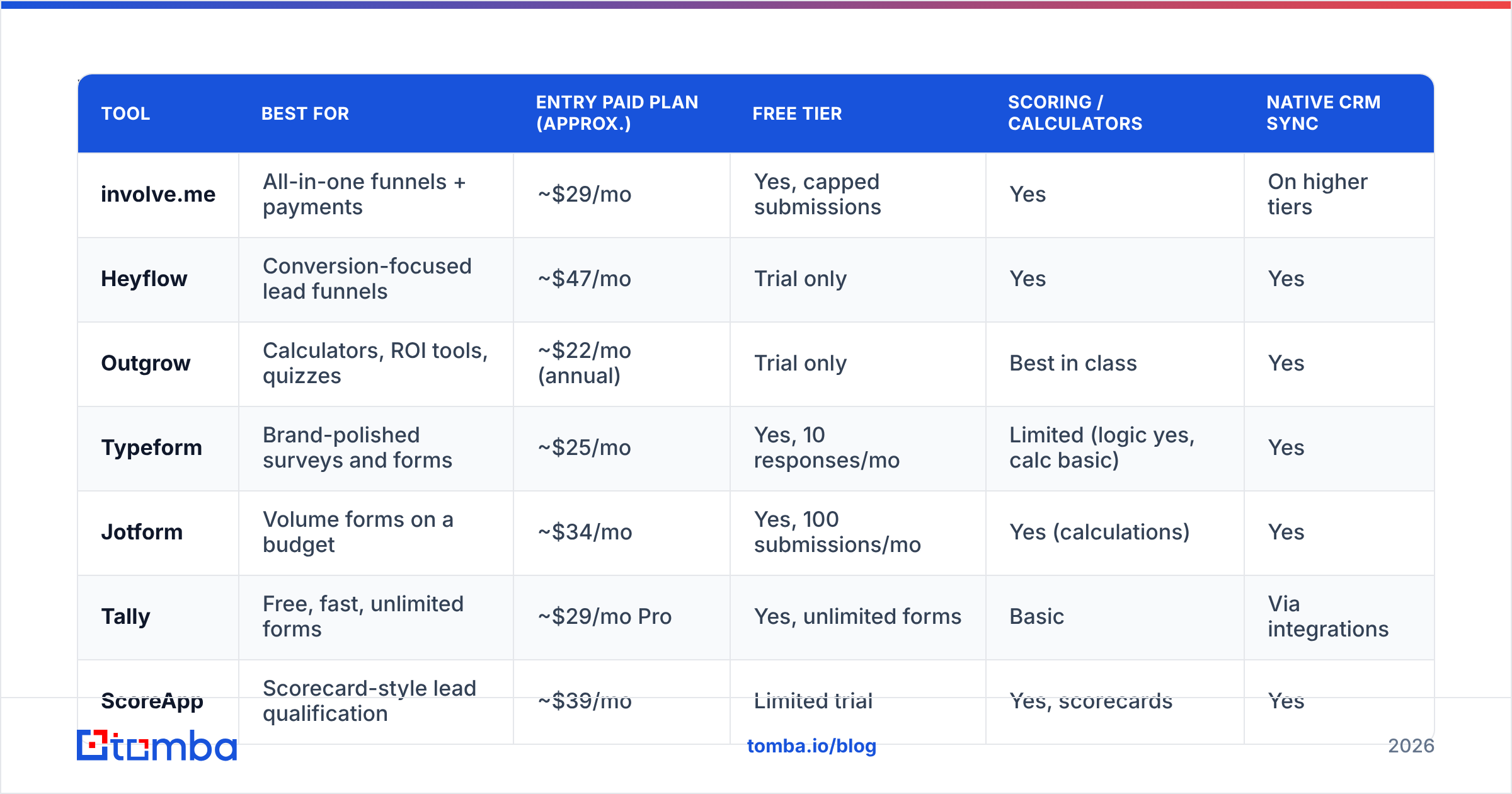
Seven tools cover almost every reason people leave. Prices below are public list prices at the time of writing, usually billed monthly; annual billing typically cuts 20-30%. Verify on the vendor's own pricing page before you commit.
| Tool | Best for | Entry paid plan (approx.) | Free tier | Scoring / calculators | Native CRM sync |
|---|---|---|---|---|---|
| involve.me | All-in-one funnels + payments | ~$29/mo | Yes, capped submissions | Yes | On higher tiers |
| Heyflow | Conversion-focused lead funnels | ~$47/mo | Trial only | Yes | Yes |
| Outgrow | Calculators, ROI tools, quizzes | ~$22/mo (annual) | Trial only | Best in class | Yes |
| Typeform | Brand-polished surveys and forms | ~$25/mo | Yes, 10 responses/mo | Limited (logic yes, calc basic) | Yes |
| Jotform | Volume forms on a budget | ~$34/mo | Yes, 100 submissions/mo | Yes (calculations) | Yes |
| Tally | Free, fast, unlimited forms | ~$29/mo Pro | Yes, unlimited forms | Basic | Via integrations |
| ScoreApp | Scorecard-style lead qualification | ~$39/mo | Limited trial | Yes, scorecards | Yes |
| Paperform | Forms with payments and bookings | ~$29/mo | Trial only | Yes | Yes |
Heyflow — the closest like-for-like swap#
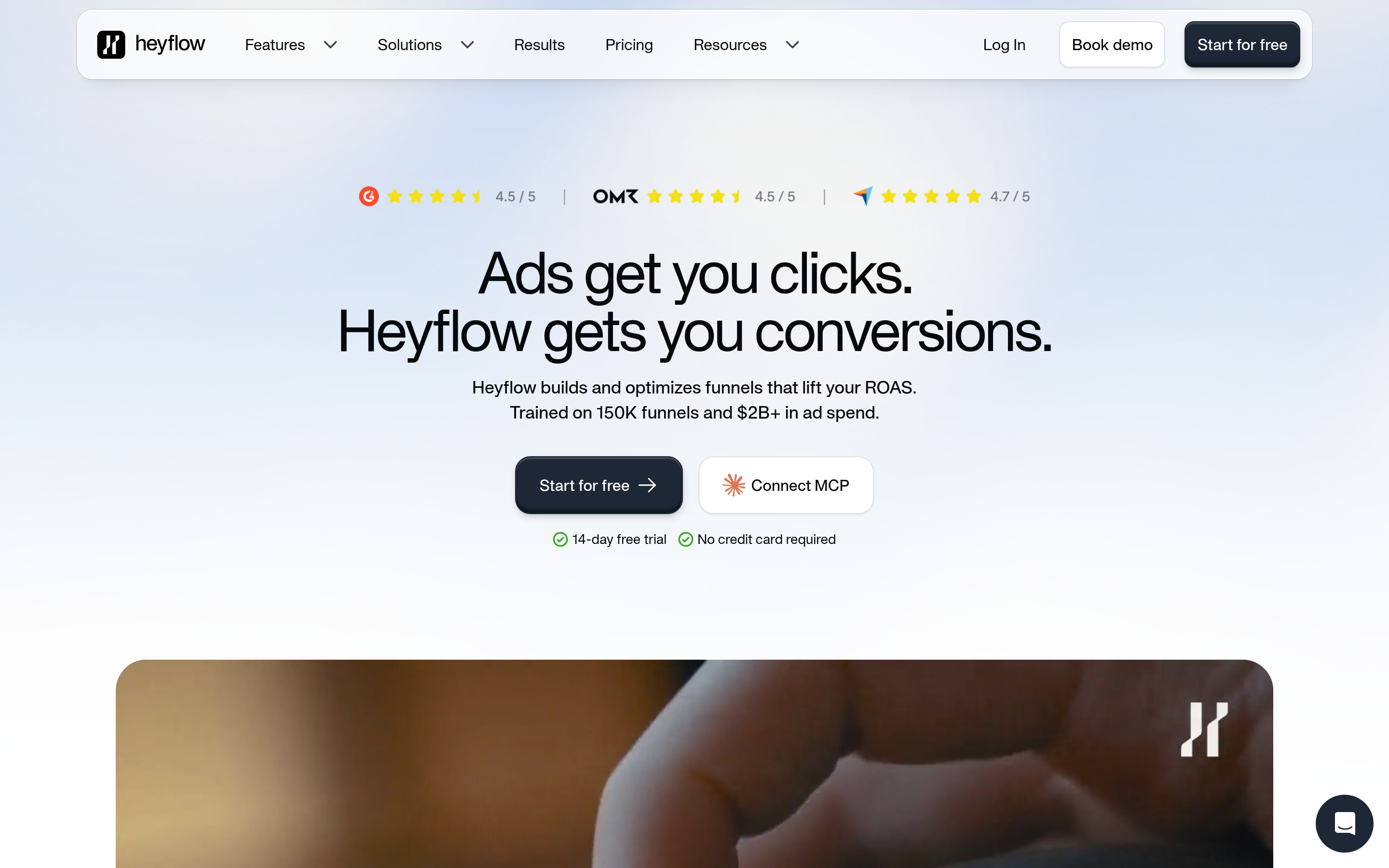
Heyflow builds the same thing involve.me builds: multi-step, mobile-first lead funnels with branching. It leans harder into conversion mechanics — sticky progress, click-to-advance cards, native A/B testing — and it is popular with insurance, solar, and financial-services teams in Europe. It is not cheap, and there is no meaningful free tier, but if your funnel is your acquisition channel, the per-lead economics usually work out.
Pick it if: paid traffic hits the funnel and every percentage point of completion is worth money.
Outgrow — when the interactive content is the offer#
Outgrow is the specialist for calculators, ROI tools, assessments, and recommendation engines. The formula builder handles genuinely complex maths, and result pages can be conditioned on dozens of variables. The trade-off is a steeper learning curve and a pricing ladder that climbs fast once you want white-labelling and unlimited leads.
Pick it if: you are building a "How much could you save?" calculator that will earn backlinks for three years.
Typeform — the brand-safe default#

Typeform still owns the category on feel. One question at a time, excellent mobile behaviour, a huge integration catalogue, and the kind of polish that makes a form feel like part of your product. The catch is the response cap: Basic plans run out quickly, and the jump to higher tiers is steep. Check the current review spread on G2 before you assume the cheapest tier fits your volume.
Pick it if: design quality and integration breadth matter more than cost per response.
Jotform — the volume workhorse#
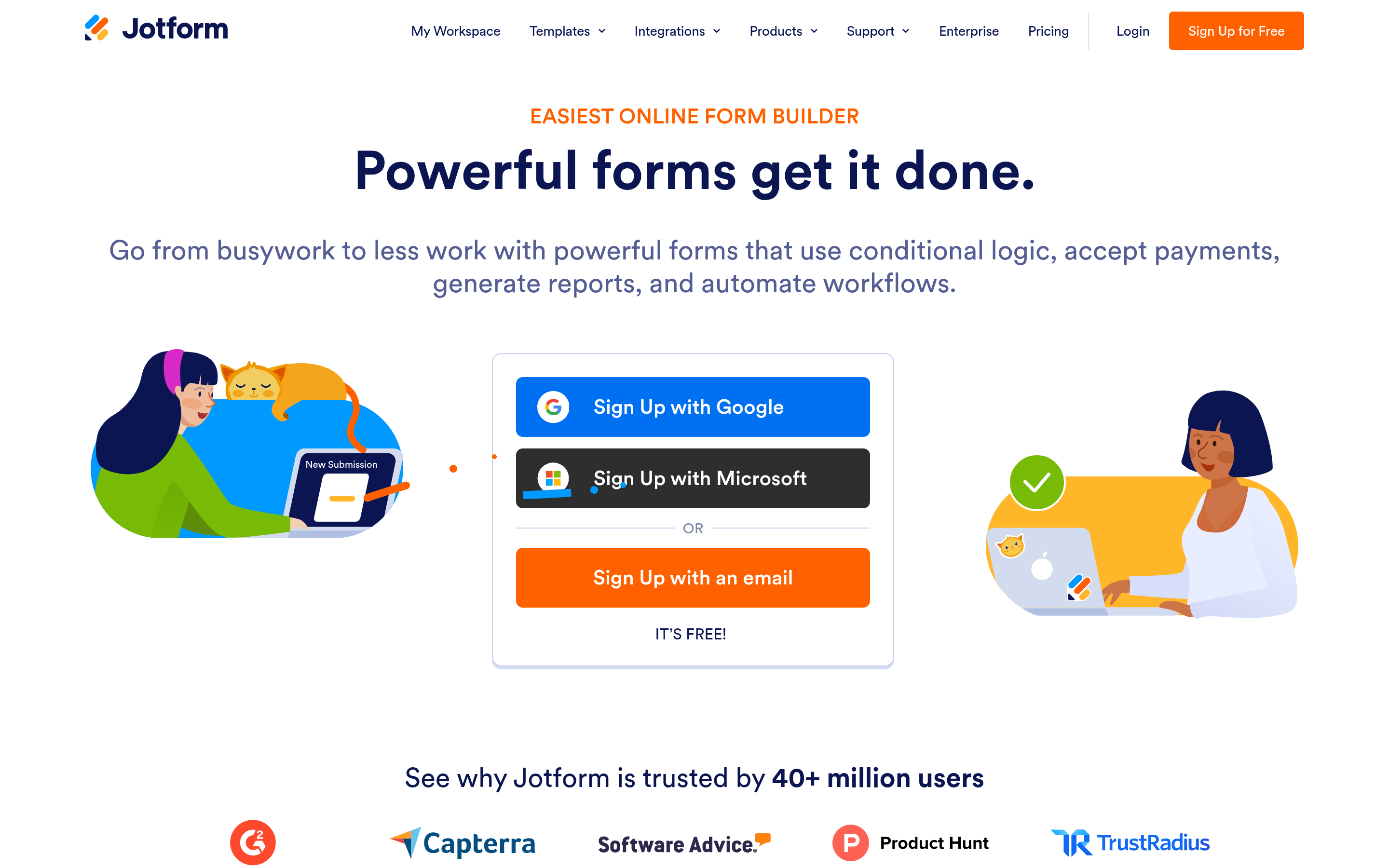
Jotform is unglamorous and enormously capable: conditional logic, calculations, e-signatures, HIPAA-eligible plans, approvals, and a template library in the tens of thousands. Submissions per dollar is the best on this list once you are past the free tier.
Pick it if: you need many forms, many submissions, and no design awards.
Tally — the free-tier outlier#
Tally gives away unlimited forms and unlimited submissions on its free plan, with a Notion-style editor that is genuinely pleasant. Logic and calculations exist; funnel analytics and deep branding control do not. For a lead magnet, a waitlist, or an internal request form, it is hard to justify paying anyone else.
Pick it if: budget is zero and you need something live this afternoon.
ScoreApp — quizzes that qualify#
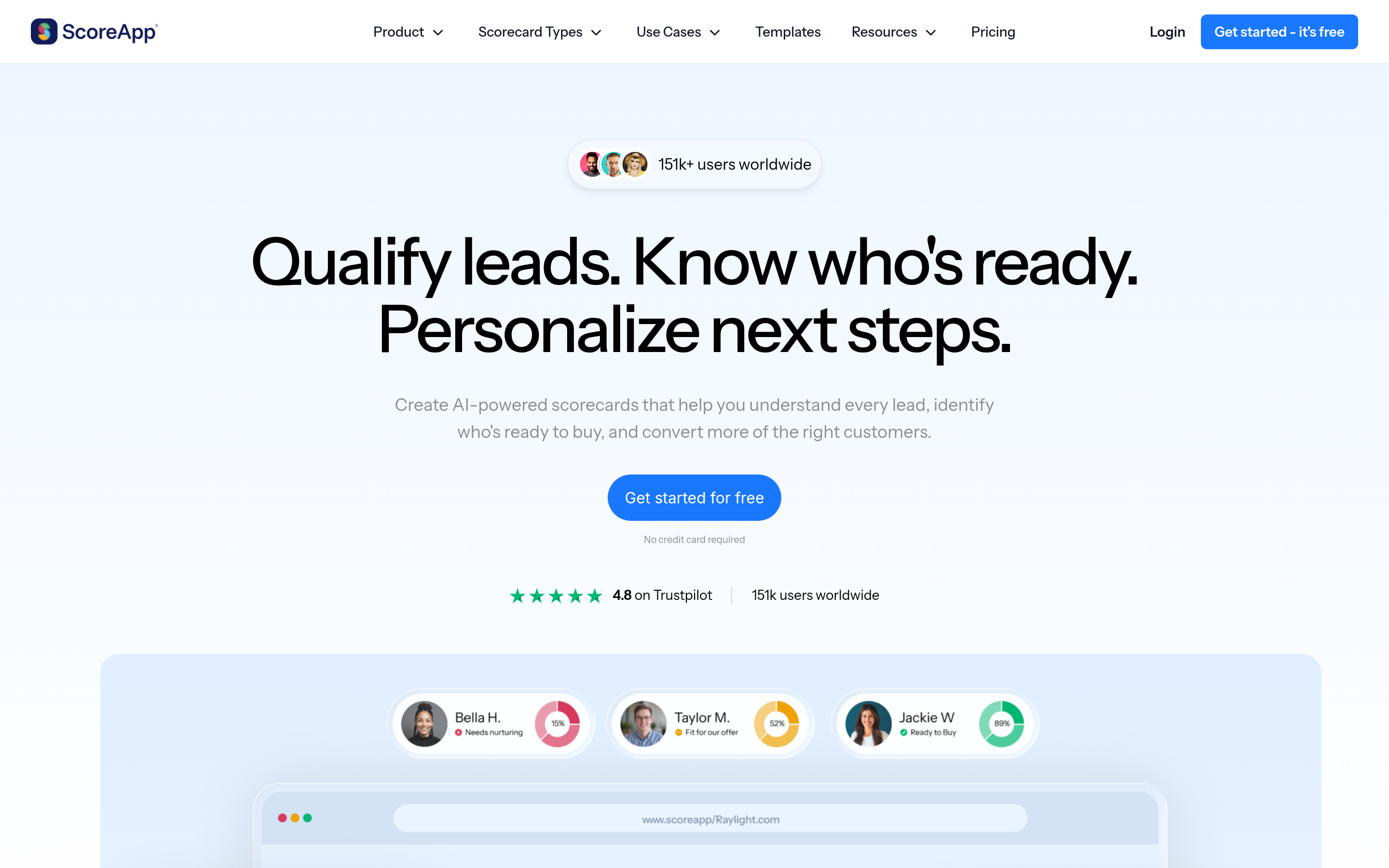
ScoreApp is built around one idea: a scorecard that assesses the prospect, returns a personalised report, and hands you a ranked lead. It ships with question banks, report templates, and follow-up email logic. It is narrower than involve.me and priced accordingly.
Pick it if: you sell consulting, coaching, or a service where "diagnose then prescribe" is the sales motion.
Paperform — forms with commerce attached#
Paperform sits between a form builder and a lightweight checkout. Products, coupons, bookings, and recurring payments are first-class, and the editor is a document you type into. If the reason you chose involve.me was its payment step, Paperform does that part better.
Pick it if: the form collects money, not just answers.
Is Typeform better than involve.me?#
Better at different jobs. Typeform is a superior form; involve.me is a superior funnel.
Typeform wins on perceived quality, respondent completion on simple flows, integration count, and the maturity of its API. involve.me wins when the flow needs to calculate something, score something, or end on a genuinely personalised outcome page, and when you want payments inside the same flow without a second tool.
The practical test: write down the last screen your visitor sees. If it is "Thanks, we'll be in touch," Typeform or Tally is enough. If it is "Based on your answers, your estimated annual saving is $14,200 — here is your plan," you want involve.me, Outgrow, or Heyflow.
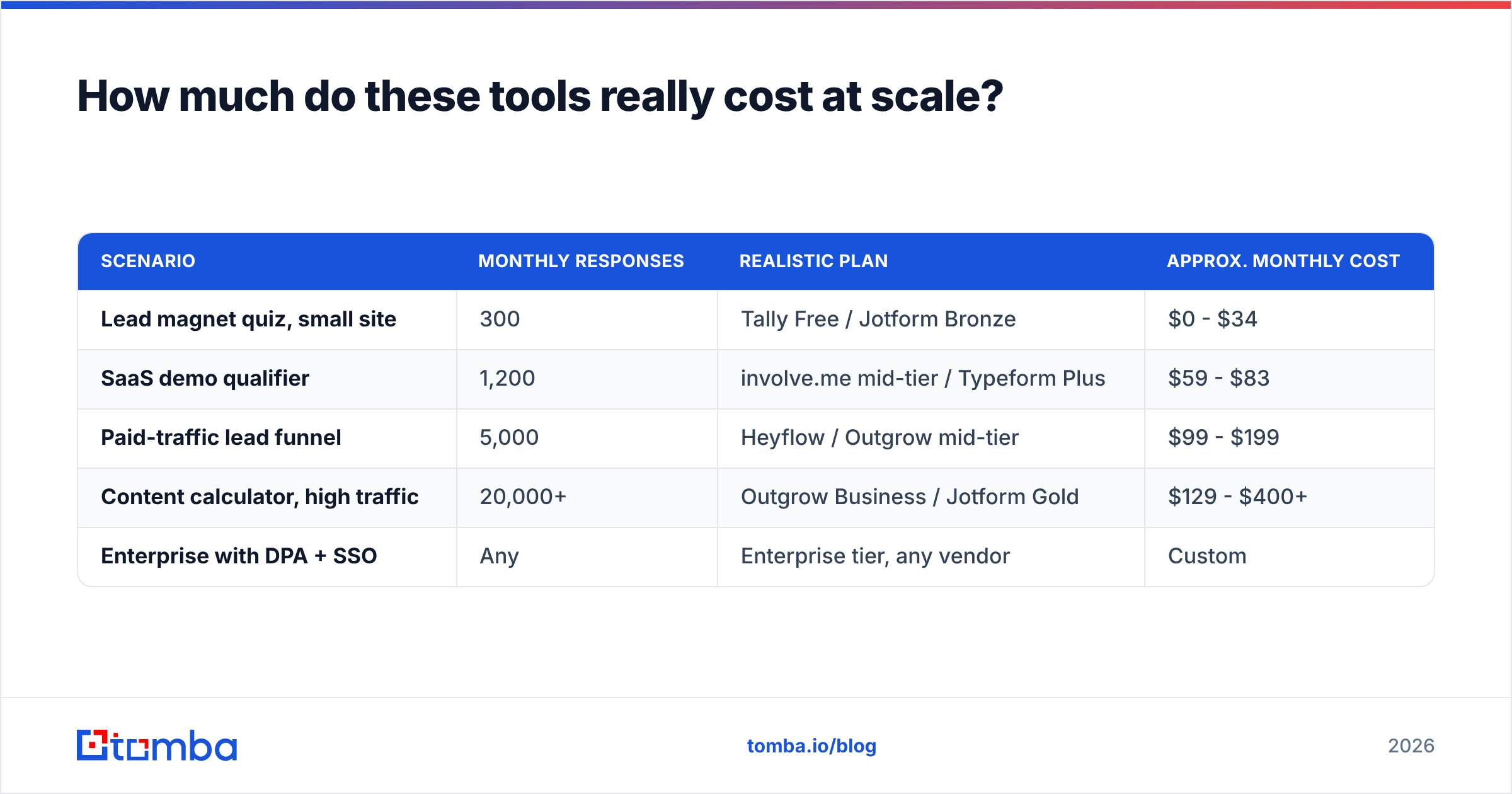
How much do these tools really cost at scale?#
Headline price is the wrong number. Model your actual volume.
| Scenario | Monthly responses | Realistic plan | Approx. monthly cost |
|---|---|---|---|
| Lead magnet quiz, small site | 300 | Tally Free / Jotform Bronze | $0 - $34 |
| SaaS demo qualifier | 1,200 | involve.me mid-tier / Typeform Plus | $59 - $83 |
| Paid-traffic lead funnel | 5,000 | Heyflow / Outgrow mid-tier | $99 - $199 |
| Content calculator, high traffic | 20,000+ | Outgrow Business / Jotform Gold | $129 - $400+ |
| Enterprise with DPA + SSO | Any | Enterprise tier, any vendor | Custom |
Two cost traps show up repeatedly. First, partial submissions: some vendors count an abandoned step as a response, some do not, and that difference can double your bill on a five-step funnel. Second, historic data export — check that you can pull every response you have ever collected as CSV on the plan you are buying, not the plan above it.
Does the builder actually fix your lead quality problem?#
No, and this is the part most comparison posts skip.
Every tool on this list is a collection mechanism. None of them validate that j.smith@acme.co exists, that it is not a role account, that the domain is not a catch-all swallowing everything, or that the person typed their work address rather than a burner. Industry-wide, a meaningful share of self-reported form emails are unusable, and a bounced-heavy list quietly degrades email deliverability for every campaign you send afterwards.
A pragmatic post-capture stack looks like this:
- Validate on submit. Run the submitted address through an email verifier via webhook before it reaches your CRM. Reject hard bounces at the door instead of after your first send.
- Fill the gaps. When someone gives you a company name but a personal Gmail, use an email finder to resolve the real work address at that domain.
- Enrich the record. Job title, seniority, company size, and tech stack turn a raw row into something your routing rules can act on. That is what data enrichment is for, and it is the difference between round-robin assignment and real territory routing.
- Catch the ones who never filled anything in. Most of your funnel traffic leaves without converting. Website visitor reveal identifies the companies behind that anonymous traffic so your quiz is not your only signal.
Every one of these steps is a webhook or API call, which is exactly why "does my plan include webhooks?" belongs on your evaluation checklist next to "how many submissions do I get?"
Which involve.me alternative should you choose?#
Match the tool to the job, not to the feature matrix:
- You want to spend nothing: Tally. Unlimited forms, live in ten minutes.
- You want the most submissions per dollar: Jotform.
- You want the best-looking form your brand can ship: Typeform.
- You want a calculator that ranks and earns links: Outgrow.
- You want a paid-traffic lead funnel that converts: Heyflow.
- You want to qualify service buyers with a scorecard: ScoreApp.
- You want to take payment inside the form: Paperform.
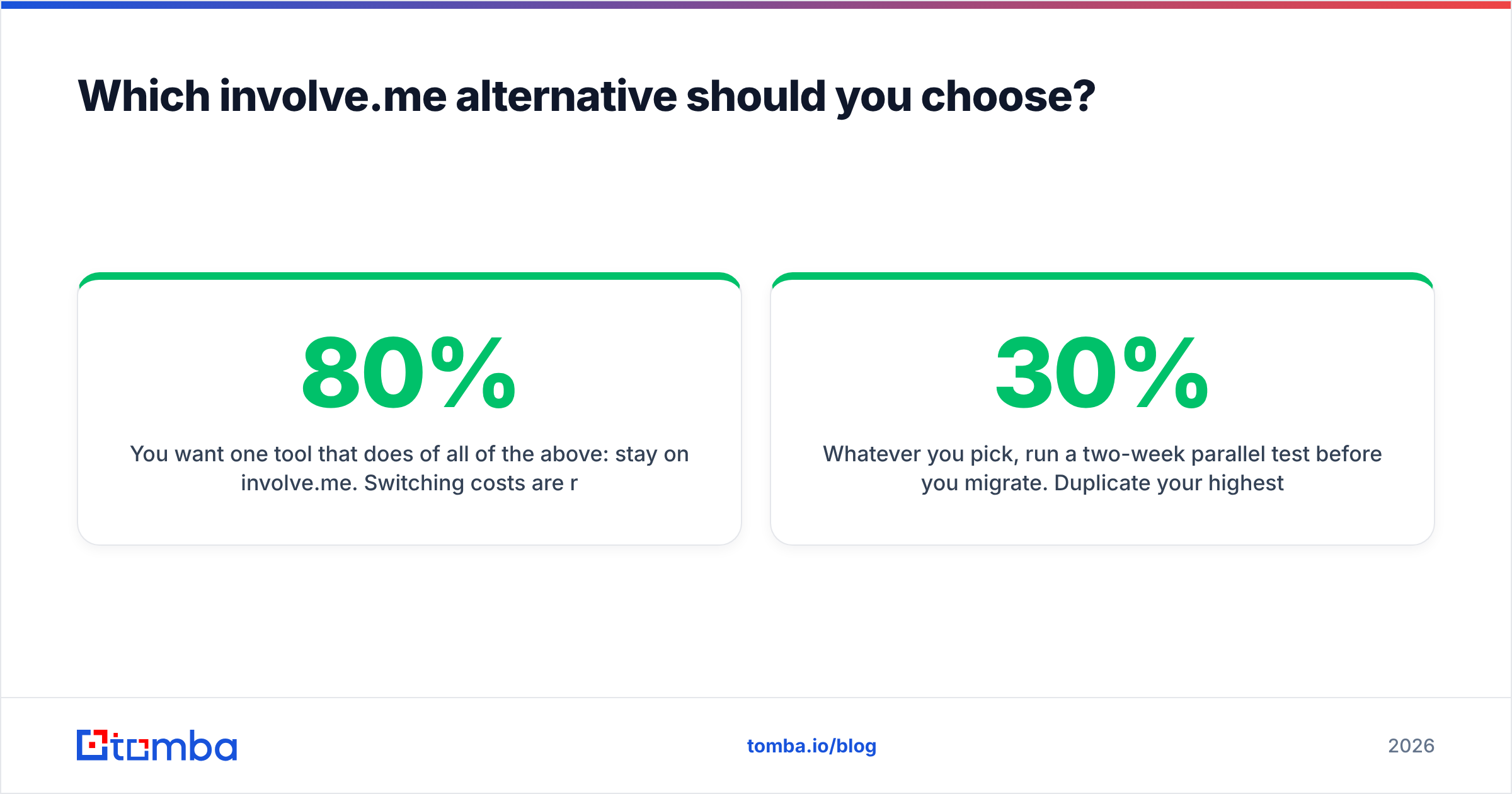
- You want one tool that does 80% of all of the above: stay on involve.me. Switching costs are real, and "good enough at everything" is a legitimate answer.
Whatever you pick, run a two-week parallel test before you migrate. Duplicate your highest-traffic flow in the new tool, split traffic 50/50, and compare completion rate and qualified leads — not raw submissions. A tool that collects 30% more responses and 15% fewer real buyers is a downgrade with good-looking dashboards.
Ready to turn form fills into reachable contacts?#
Pick the builder that fits your funnel, then make sure the contacts it captures are real. Tomba Email Finder resolves work email addresses from a name and company domain, verifies them before they hit your sequence, and plugs into any of these tools through a webhook or the API. Start on the free tier with 25 searches a month, or check Tomba pricing — Starter is $49/mo, Growth $99/mo, Pro $249/mo — and stop paying for leads you can never reach.
Related guides#
// get started
Find, verify and enrich your first contacts today
Start on the free plan with 25 searches a month, then scale when your team is ready.
Free plan · No credit card required · GDPR & CCPA
Get the Tomba newsletter
Product and data updates
// about the author