iPlum vs Line2 2026: Which Business Phone App Wins?
iPlum and Line2 both give you a second business line on the phone you already own. But they are built for different buyers. Here is the honest breakdown on price, compliance, call quality, texting, and which one your sales team should actually pay for.
TL;DR
- iPlum wins on compliance and price. Entry plans start in the $8–$9/month range, and it is the only one of the two that sells a HIPAA-compliant tier with a signed BAA, encrypted texting, and call recording archives.
- Line2 wins on simplicity. It has been around since 2008, the app is lighter, and unlimited US/Canada calling and texting is bundled into every tier with no add-on math.
- Neither is a real sales dialer. If you need power dialing, local presence, call dispositions, or CRM logging, both will frustrate you inside a quarter. They are second-line apps, not sales engagement platforms.
- Porting is the switching cost. Both support number porting, but the port window (7–14 business days typical) and the carrier paperwork are where most migrations stall.
- The phone app is the cheap part. A $9/month line that dials wrong numbers costs more than a $30/month line that dials verified decision-makers. Data quality beats app choice every time.
What are iPlum and Line2?#
Both products solve the same annoying problem: you do not want to hand out your personal mobile number to prospects, patients, tenants, or clients, and you do not want to carry two phones.
iPlum is a mobile-first business line built by a US company with an unusual focus on regulated industries. Healthcare practices, insurance agents, financial advisors, and legal teams are its core audience. That focus shapes everything: encrypted messaging, a signed Business Associate Agreement on higher tiers, call recording with retention, text archiving, and an admin portal for managing a team of lines.
Line2 is one of the original second-number apps. It predates most of the category and has changed hands a few times, and it sells a simpler promise: a second number with unlimited calling and texting across the US and Canada, plus light business features like an auto-attendant and business hours routing.
The short version: iPlum is a compliance-flavored business line. Line2 is a no-fuss second number. Everything else is detail.
How do iPlum and Line2 compare on price and features?#
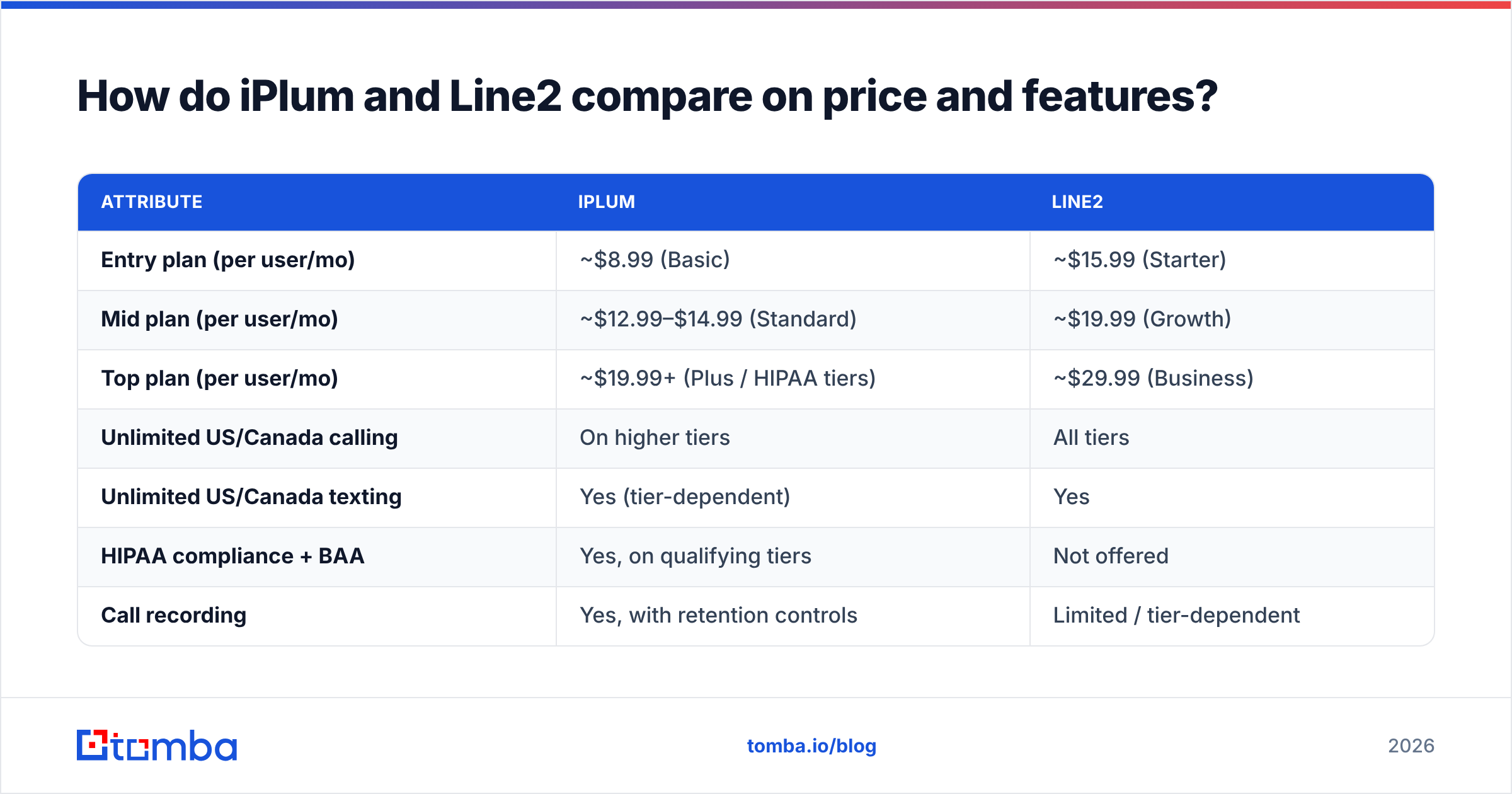
Pricing on both platforms shifts, and both run promotions, so treat the numbers below as directional and confirm on the vendor pages before you buy. As of early 2026, this is the shape of the market:
| Attribute | iPlum | Line2 |
|---|---|---|
| Entry plan (per user/mo) | ~$8.99 (Basic) | ~$15.99 (Starter) |
| Mid plan (per user/mo) | ~$12.99–$14.99 (Standard) | ~$19.99 (Growth) |
| Top plan (per user/mo) | ~$19.99+ (Plus / HIPAA tiers) | ~$29.99 (Business) |
| Unlimited US/Canada calling | On higher tiers | All tiers |
| Unlimited US/Canada texting | Yes (tier-dependent) | Yes |
| HIPAA compliance + BAA | Yes, on qualifying tiers | Not offered |
| Call recording | Yes, with retention controls | Limited / tier-dependent |
| Auto-attendant / IVR | Yes | Yes, on higher tiers |
| Team admin portal | Yes | Yes |
| International calling | Paid add-on credits | Paid add-on credits |
| Number porting | Supported | Supported |
| Free trial | Limited trial | 7-day trial typical |
| Best fit | Regulated solo pros and small teams | Freelancers, real estate, small biz |
Two things jump out of that table.
First, iPlum's floor is roughly half of Line2's floor. If you are a solo operator who just needs a professional second number and a voicemail greeting, iPlum is the cheaper entry point by a meaningful margin over a year — call it $100+ in savings for a single line.
Second, Line2 bundles more at the bottom. Unlimited calling and texting on the cheapest plan means you are not reading fine print about minute pools. Some buyers will pay the premium purely to stop thinking about it.

Which one has better call quality?#
Neither has a structural advantage, and anyone who tells you otherwise is selling something.
Both are VoIP. Both route calls over your data connection or fall back to a cellular bridge depending on plan and settings. That means call quality is mostly a function of three things you control:
- Your network. A weak 4G signal in a parking garage will wreck either app. Wi-Fi calling on a stable connection beats both.
- Codec and bandwidth headroom. VoIP needs maybe 100 kbps per call, which sounds trivial until you are on a shared office connection with a video call running.
- Cellular fallback availability. iPlum's cellular-minute routing option is genuinely useful in low-data areas. Line2 leans more heavily on data. If you sell from a car in rural territory, that difference is real.
Public review data from G2 and similar sites shows the same pattern for both products: solid ratings overall, with a recurring minority of one-star reviews about dropped calls and delayed message delivery. That is the VoIP category tax, not a specific failing of either vendor.
Practical test: run a 7-day pilot on both with your actual dialing pattern — same territory, same times of day, same devices. Fifty real calls will tell you more than five hundred reviews.
Does iPlum's HIPAA compliance actually matter for you?#
If you are in healthcare, this is not a feature comparison — it is a disqualifier. Line2 does not sell a HIPAA tier or sign a BAA, so for a medical practice the comparison ends there.
But "HIPAA-compliant" gets thrown around loosely, so know what iPlum is actually giving you:
- A signed Business Associate Agreement. This is the legal instrument. Without it, no app is HIPAA-compliant for your use, regardless of how encrypted the marketing page claims it is.
- Encrypted texting between iPlum users, plus secure messaging flows for patient communication.
- Audit-friendly call recording and text archiving with retention settings, so you can produce records if you are ever asked.
- Admin controls for provisioning and deprovisioning lines when staff turn over, which is a quietly important part of any compliance posture.
- Phone tree and business-hours routing so after-hours patient calls land somewhere defensible instead of a personal voicemail.
If you sell software, run an agency, or do real estate, none of this matters and you should not pay a premium for it. If you handle PHI, it is the whole ballgame.
What about texting, auto-attendant, and team features?#
Here the two products converge more than the marketing suggests. Both offer a business auto-attendant ("press 1 for sales"), business hours with after-hours routing, voicemail transcription, and team-level admin.
The differences are at the edges:
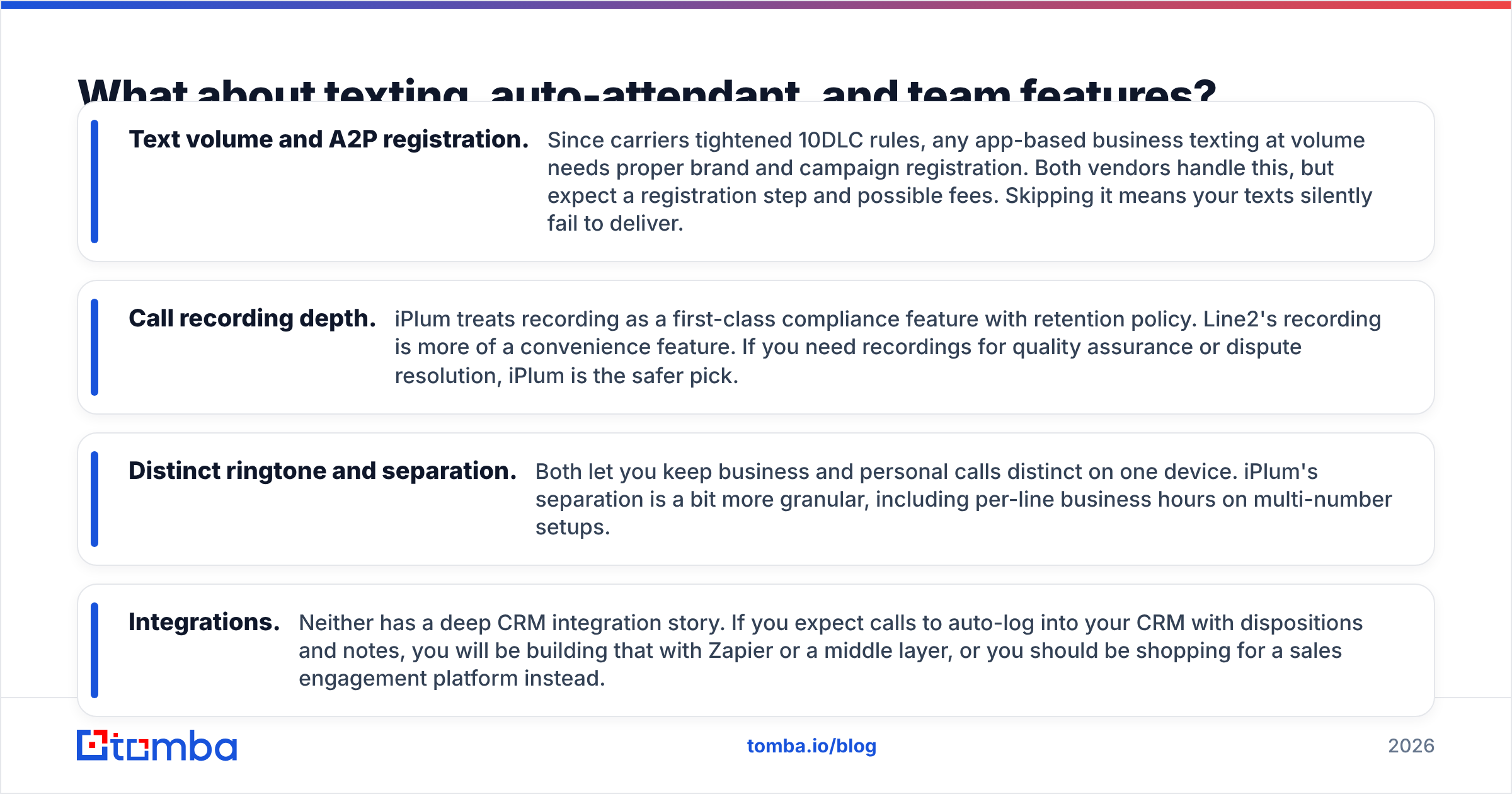
- Text volume and A2P registration. Since carriers tightened 10DLC rules, any app-based business texting at volume needs proper brand and campaign registration. Both vendors handle this, but expect a registration step and possible fees. Skipping it means your texts silently fail to deliver.
- Call recording depth. iPlum treats recording as a first-class compliance feature with retention policy. Line2's recording is more of a convenience feature. If you need recordings for quality assurance or dispute resolution, iPlum is the safer pick.
- Distinct ringtone and separation. Both let you keep business and personal calls distinct on one device. iPlum's separation is a bit more granular, including per-line business hours on multi-number setups.
- Integrations. Neither has a deep CRM integration story. If you expect calls to auto-log into your CRM with dispositions and notes, you will be building that with Zapier or a middle layer, or you should be shopping for a sales engagement platform instead.
That last bullet is the one that catches sales teams by surprise. A second-line app is a phone number, not a workflow.
Which is better for outbound sales teams?#
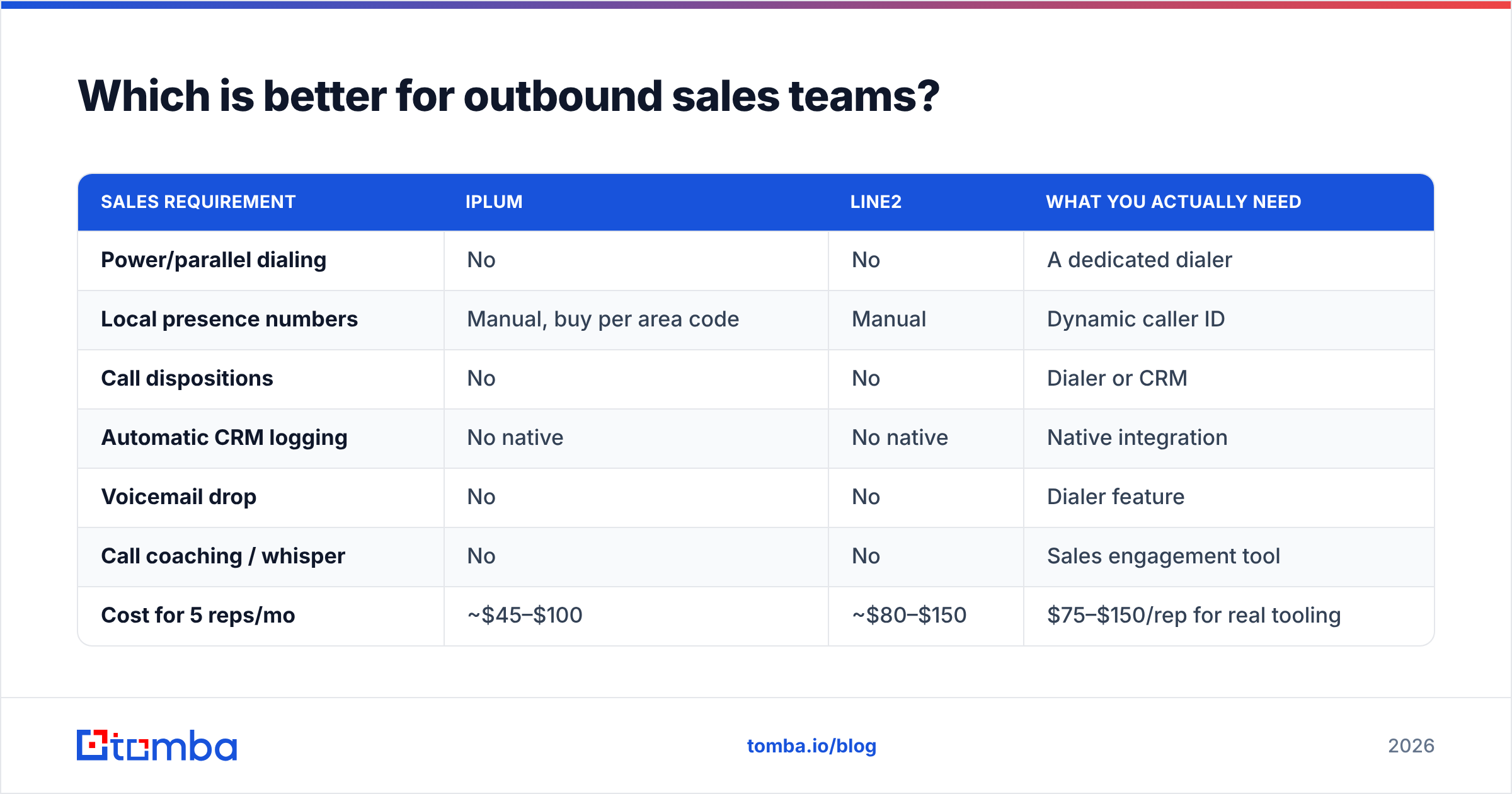
Honest answer: neither, if outbound calling is your primary motion.
Both products are optimized for receiving and returning calls under a professional identity. Outbound sales at volume needs things neither one delivers:
| Sales requirement | iPlum | Line2 | What you actually need |
|---|---|---|---|
| Power/parallel dialing | No | No | A dedicated dialer |
| Local presence numbers | Manual, buy per area code | Manual | Dynamic caller ID |
| Call dispositions | No | No | Dialer or CRM |
| Automatic CRM logging | No native | No native | Native integration |
| Voicemail drop | No | No | Dialer feature |
| Call coaching / whisper | No | No | Sales engagement tool |
| Cost for 5 reps/mo | ~$45–$100 | ~$80–$150 | $75–$150/rep for real tooling |
Where they do fit a sales org: as the second line for founders, account managers, and field reps who take inbound calls and do relationship follow-up. A founder running 15 conversations a week does not need a power dialer — they need a number that is not their personal cell. For that job, iPlum at $9–$13 a month is excellent value, and Line2 at $16–$20 is fine if you prefer its interface.
If you are building a genuine outbound motion, budget for the phone app and the data layer separately. The app is a rounding error; the data is where the leverage is.

Why the number you dial matters more than the app you dial from#
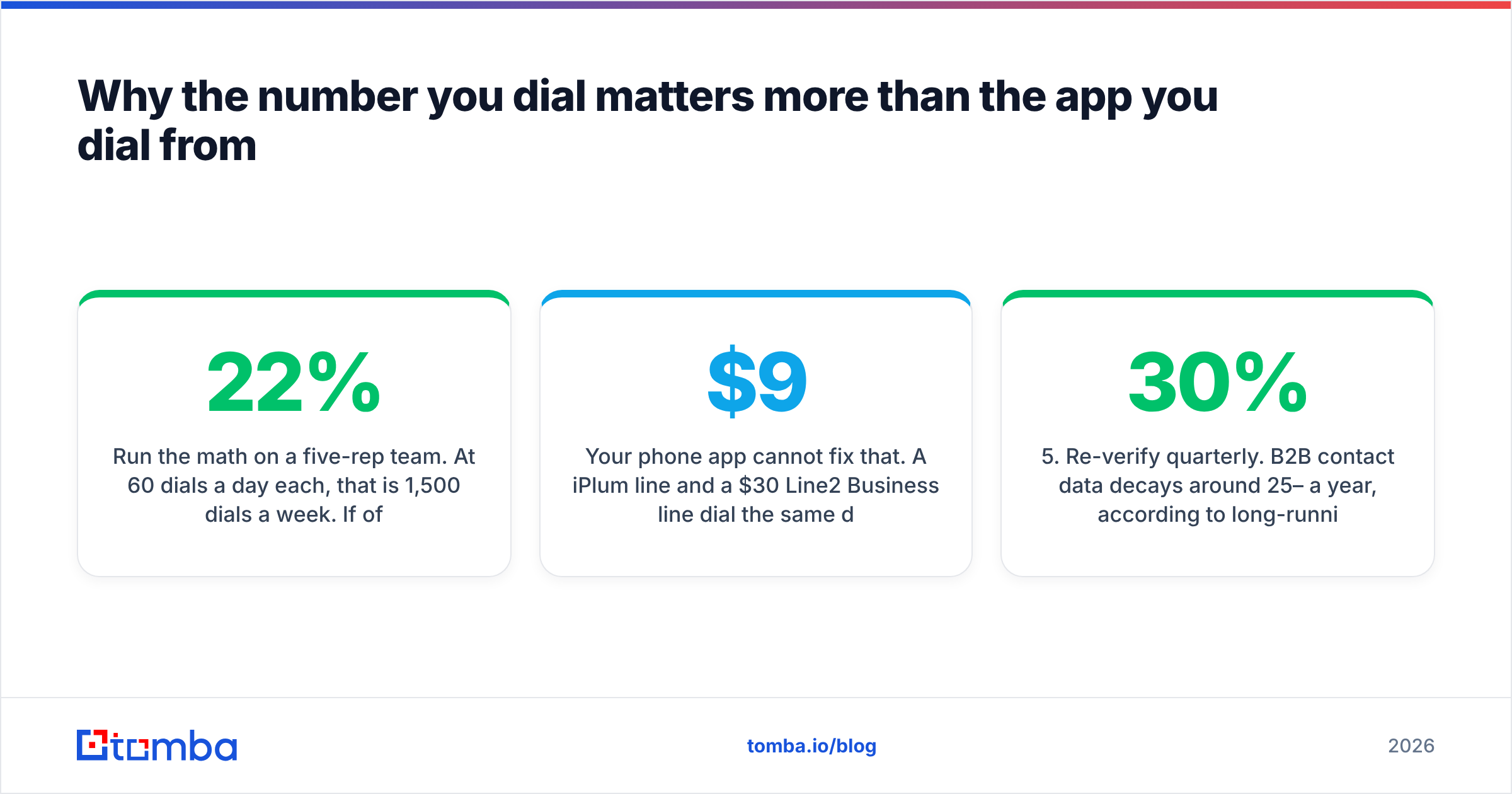
Run the math on a five-rep team. At 60 dials a day each, that is 1,500 dials a week. If 22% of your numbers are wrong — which is roughly what happens to a contact list that has aged 18 months without maintenance — you just burned 330 dials a week on disconnected lines, wrong departments, and people who left the company two roles ago.
Your phone app cannot fix that. A $9/month iPlum line and a $30/month Line2 Business line dial the same dead number with equal efficiency.
This is why serious teams treat contact data as infrastructure:
- Source the contact, not just the company. Company switchboards route you to a gatekeeper. Direct dials and verified work emails route you to a human. A phone finder that returns direct B2B numbers changes your connect rate more than any dialer setting.
- Validate before you dial. Running numbers through a phone validator strips out disconnected lines, invalid formats, and landline-vs-mobile mismatches before a rep wastes a second on them.
- Enrich so the call has a reason. Title, headcount, tech stack, and funding stage turn "just checking in" into a call with a premise. Data enrichment is what separates a dial from a conversation.
- Pair the call with the email. The multithreaded pattern — email, call, LinkedIn, call — still outperforms any single channel. Which means your call list and your email finder output should be the same list, not two different spreadsheets.
- Re-verify quarterly. B2B contact data decays around 25–30% a year, according to long-running research from vendors and analysts including HubSpot. Treat your list like produce, not furniture.
How do you port your existing number to iPlum or Line2?#
Both support porting, and the process is nearly identical because both go through the same underlying carrier plumbing.
- Get your account details from the losing carrier first. Account number, PIN or passcode, and the exact service address on file. Ninety percent of failed ports are a mismatch on one of these three fields.
- Do not cancel your old service. A cancelled number cannot be ported. Cancel only after the port completes.
- Expect 7–14 business days for a standard US wireless or landline port. Toll-free and some business lines can take longer.
- Budget for a one-time port fee on either platform, typically in the $10–$25 range per number.
- Test inbound and outbound immediately after cutover, including SMS delivery, since texting sometimes lags voice by a day.
The port is the real switching cost. Once your number lives inside a platform, moving again is a two-week project, so choose with a 24-month horizon rather than a 2-month one.
iPlum vs Line2: which should you choose?#
Choose iPlum if: you are in healthcare, insurance, law, or finance; you need a signed BAA; you want call recording with retention; you want the lowest entry price for a professional second line; or you work in areas with unreliable data coverage and want cellular-minute fallback.
Choose Line2 if: you want unlimited calling and texting bundled with zero fine print; you value a simpler, older, well-worn app; you are a freelancer, agent, or small-business owner outside a regulated industry; and the extra $6–$8 a month is not a decision factor.
Choose neither if: you are building an outbound sales team. Buy a real dialer, connect it to your CRM, and spend the difference on contact data that is actually correct.
One more decision filter: check whether your team is already paying for a phone system inside another tool. Plenty of companies discover they are buying a second-line app on top of a VoIP seat they already own. Audit before you add.
Make the calls land: start with better contacts#
The gap between a good quarter and a bad one is almost never the phone app. It is whether your reps are calling and emailing people who exist, hold the title you think they hold, and work at a company that has the problem you solve.
That is the part worth investing in. Tomba Email Finder gives you verified professional email addresses by name, domain, or company, with verification built in so you are not shipping bounces into a cold sequence — and it pairs directly with direct-dial data so your call list and your email list stop being two separate, equally stale spreadsheets. There is a free tier with 25 searches a month to test the accuracy on your own accounts, and paid plans start at $49/month; full details are on the Tomba pricing page.
Pick the phone app that fits your compliance needs and your budget. Then go fix the list.
Related guides#
// get started
Find, verify and enrich your first contacts today
Start on the free plan with 25 searches a month, then scale when your team is ready.
Free plan · No credit card required · GDPR & CCPA
// about the author