IPWAY Alternatives: 7 Proxy Providers Compared for 2026
IPWAY sells dedicated ISP and datacenter IPv4 proxies. Here is how seven alternatives compare on price per GB, pool type, trials and support — and when a B2B data API removes the need for proxies entirely.
TL;DR
- IPWAY sells dedicated IPv4 proxies: ISP (static residential) and datacenter. It also sells rotating ISP traffic from about $0.98/GB, with a trial allowance.
- The best IPWAY alternatives fall into three tiers. Enterprise: Bright Data, Oxylabs. Mid-market: Decodo, NetNut, SOAX. Budget: IPRoyal, Webshare.
- Price per GB is the loudest number. It is also the least useful one. Pool type, session control and ban rate on your targets matter more.
- Scraping contact data through proxies means you pay twice. Once for IPs, once for the parsers you keep fixing.
- Pick by workload, not by logo. Static ISP fits account work. Rotating residential fits scale. An API fits contact data.
What is IPWAY, and why do teams look for alternatives?#
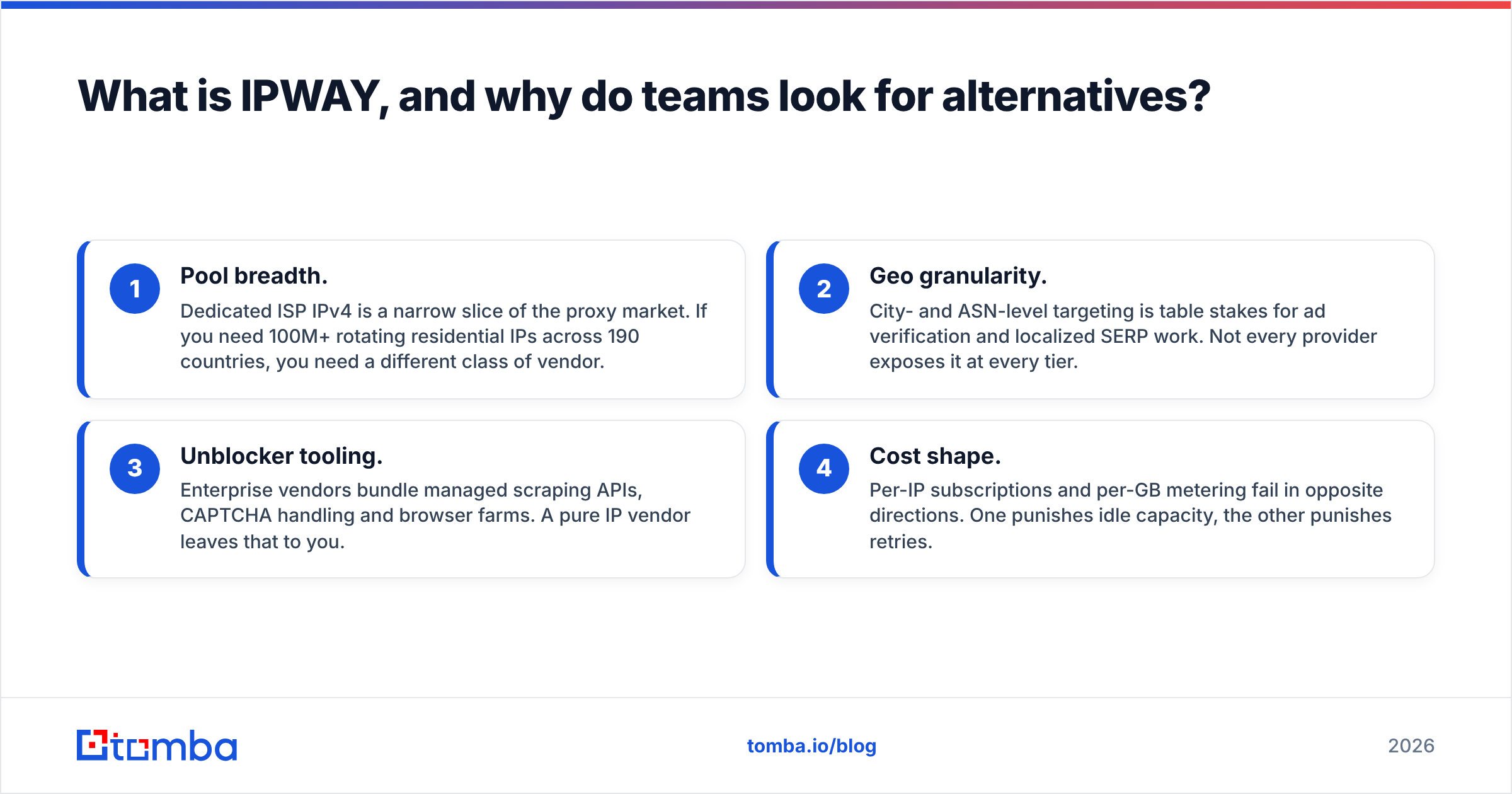
IPWAY is a proxy infrastructure provider. Its pitch is control. You hand-pick dedicated IPv4 proxies, either ISP-grade residential or datacenter. Then you manage usage, subusers and spend in one dashboard. It also sells rotating ISP residential traffic for teams that need churn instead of stability. Compliance is part of the pitch too: opt-in sourcing, GDPR and CCPA. You can see the current lineup on the IPWAY site.
That fits one job very well. Think multi-account work, ad checks, social tools, and any flow that breaks when an IP changes mid-session. A dedicated static IP behaves like a real home line. That is what you want when a platform fingerprints sessions.
So why do buyers shop for IPWAY alternatives? Four reasons show up again and again in review threads and buying calls:
- Pool breadth. Dedicated ISP IPv4 is a thin slice of the market. Some jobs need 100M+ rotating residential IPs across 190 countries. That is a different class of vendor.
- Geo detail. Ad checks and local SERP work need city and ASN targeting. Not every plan exposes it.
- Unblocker tooling. Big vendors bundle scraping APIs, CAPTCHA handling and browser farms. A pure IP vendor leaves that to you.
- Cost shape. Per-IP plans punish idle capacity. Per-GB plans punish retries. Both can bite.
None of this is a knock on IPWAY. These are simply the edges of what an IP platform does. The IPWAY alternatives below start where those edges are.
What should you compare in IPWAY alternatives?#
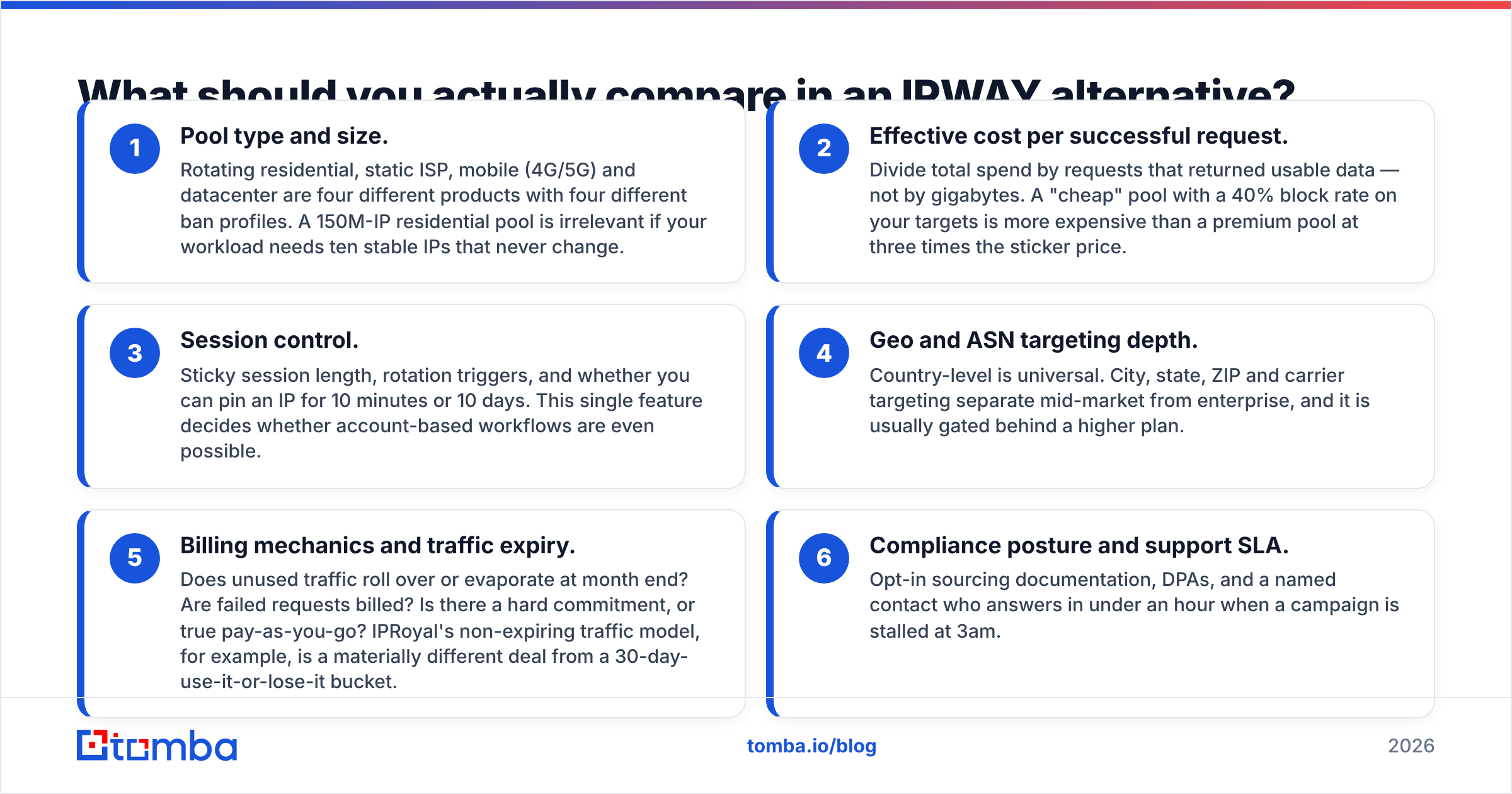
Price per GB is the number every vendor page shouts. It is also the worst guide to your final bill. Score IPWAY alternatives on six things instead.
Start with the three that decide whether the proxies work at all:
- Pool type and size. Rotating residential, static ISP, mobile and datacenter are four products. Each has its own ban profile. A 150M-IP pool is useless if you need ten IPs that never change.
- Cost per successful request. Divide spend by requests that returned usable data. Do not divide by gigabytes. A cheap pool with a 40% block rate costs more than a premium pool at triple the sticker price.
- Session control. Look at sticky session length and rotation triggers. Can you pin an IP for 10 minutes? For 10 days? This one feature decides if account work is even possible.
Then check the three that decide what you pay:
- Geo and ASN depth. Country-level targeting is universal. City, state, ZIP and carrier targeting are not. They usually sit behind a higher plan.
- Billing and traffic expiry. Does unused traffic roll over, or die at month end? Are failed requests billed? Is there a hard commit? IPRoyal keeps traffic alive until you use it. A 30-day bucket is a very different deal.
- Compliance and support. Ask for sourcing docs and a DPA. Ask who answers at 3am when a job stalls.
Write those six into a scorecard before your first sales call. Vendors will steer you to the axis they win on.
Which IPWAY alternatives are worth shortlisting in 2026?#
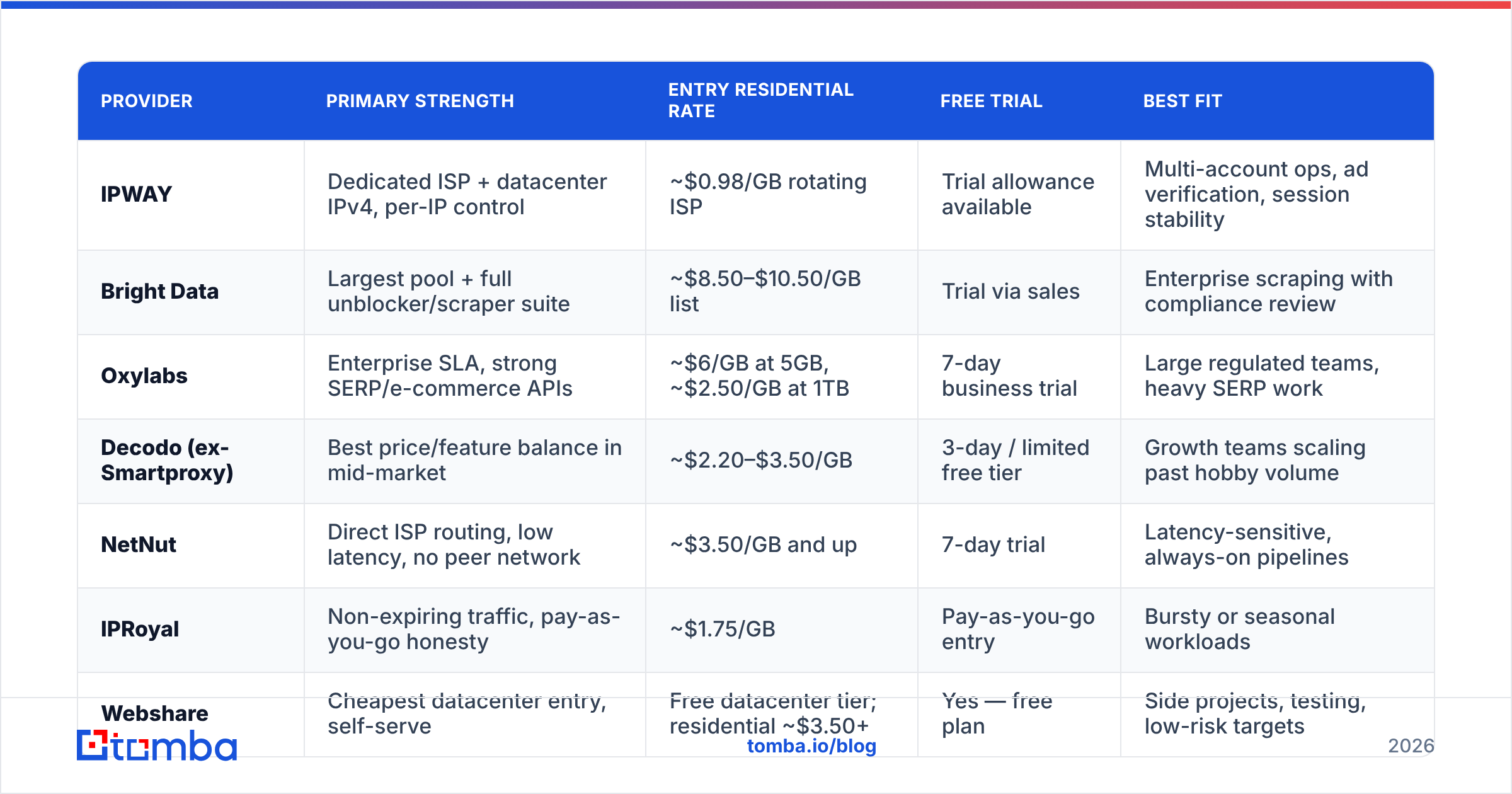
Prices below are public entry rates at the time of writing. They move often. Treat them as a bracket, not a quote. Volume deals routinely cut them by 50–75%.
| Provider | Primary strength | Entry residential rate | Free trial | Best fit |
|---|---|---|---|---|
| IPWAY | Dedicated ISP + datacenter IPv4, per-IP control | ~$0.98/GB rotating ISP | Trial allowance available | Multi-account ops, ad verification, session stability |
| Bright Data | Largest pool + full unblocker/scraper suite | ~$8.50–$10.50/GB list | Trial via sales | Enterprise scraping with compliance review |
| Oxylabs | Enterprise SLA, strong SERP/e-commerce APIs | ~$6/GB at 5GB, ~$2.50/GB at 1TB | 7-day business trial | Large regulated teams, heavy SERP work |
| Decodo (ex-Smartproxy) | Best price/feature balance in mid-market | ~$2.20–$3.50/GB | 3-day / limited free tier | Growth teams scaling past hobby volume |
| NetNut | Direct ISP routing, low latency, no peer network | ~$3.50/GB and up | 7-day trial | Latency-sensitive, always-on pipelines |
| IPRoyal | Non-expiring traffic, pay-as-you-go honesty | ~$1.75/GB | Pay-as-you-go entry | Bursty or seasonal workloads |
| Webshare | Cheapest datacenter entry, self-serve | Free datacenter tier; residential ~$3.50+ | Yes — free plan | Side projects, testing, low-risk targets |
| ScraperAPI / Scrape.do | Managed scraping, proxies abstracted away | Request-based pricing | Free request credits | Teams that want HTML, not IP plumbing |
Bright Data — the enterprise default#
Bright Data is the benchmark that other IPWAY alternatives get measured against. It has the biggest pool, the deepest geo targeting, a Web Unlocker, and a legal team that will clear your review. It is also the priciest and the hardest to set up. Is scraping a core revenue system with a named owner? Then the premium buys real uptime. Are you one engineer with a side pipeline? You will drown in the dashboard.
Oxylabs — enterprise with better onboarding#
Oxylabs sits in the same tier. The sales motion is friendlier, and the SERP and e-commerce APIs are genuinely good. Its residential pricing rewards commitment hard. The rate at 1TB is a fraction of the 5GB rate. That is great if you can forecast volume, and rough if you cannot.
Decodo — the mid-market sweet spot#
Decodo used to be Smartproxy. It is where most teams land after Bright Data sends a quote and they flinch. You get sub-$3/GB residential, solid sticky sessions, city-level targeting and a dashboard you can actually use. For serious but not enormous volume, it is the default pick among IPWAY alternatives.
NetNut — latency and stability#
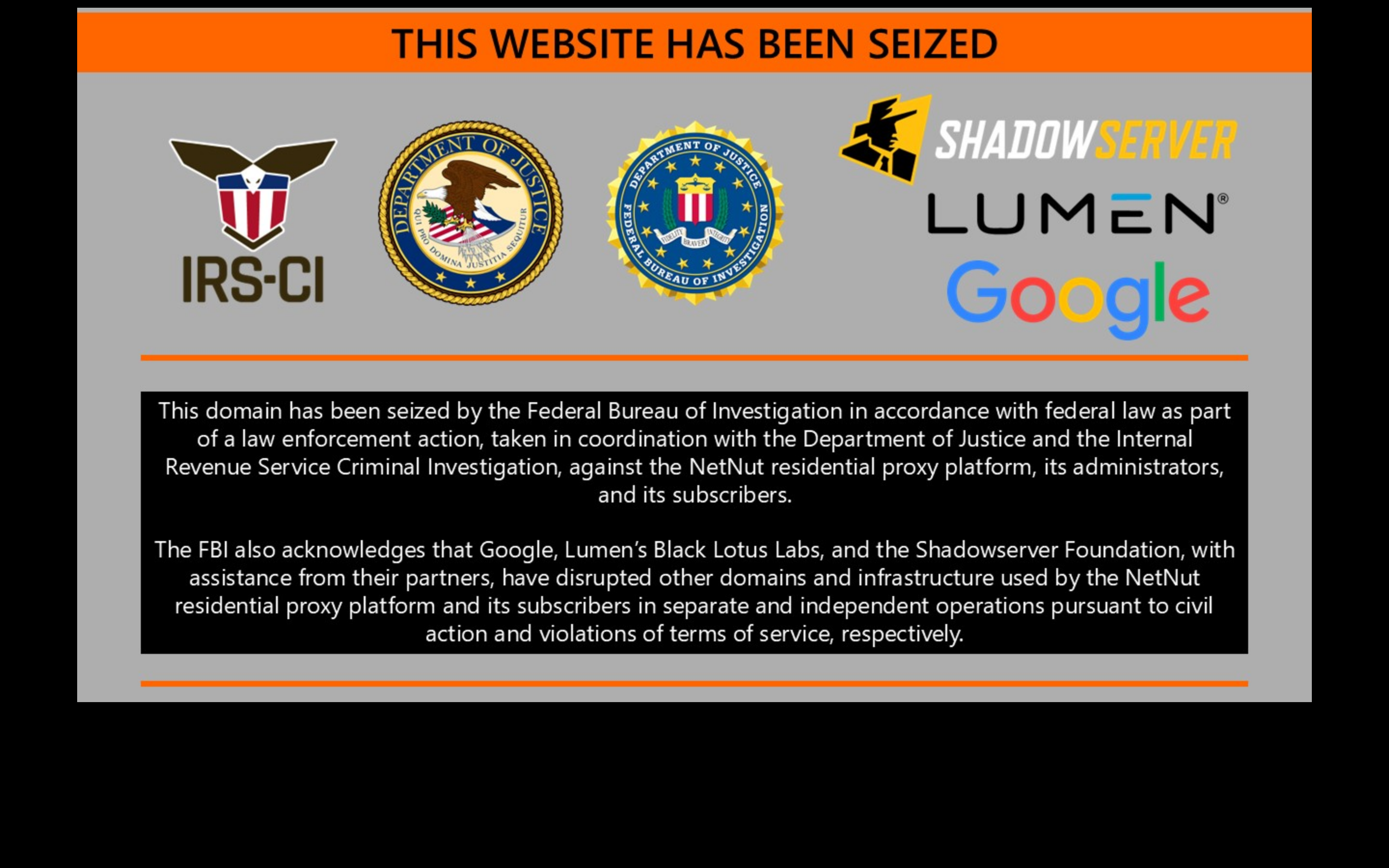
NetNut routes through ISP partners instead of a peer-to-peer network. Latency is lower. IP provenance holds fewer surprises. That suits always-on monitoring jobs, where a 6-second p95 kills the SLA.
IPRoyal and Webshare — the budget end#
These are the cheapest IPWAY alternatives on the list. IPRoyal traffic does not expire. Buy 50GB, use it over six months, lose nothing. That feature is badly underrated. Webshare has a free datacenter tier, so you can prototype before you spend a cent. Neither will pass an enterprise compliance review. Geo depth is thinner on both.
Managed scraping APIs — skipping the IP layer#
ScraperAPI, Scrape.do and similar tools sell you successful responses, not gigabytes. You send a URL. They handle rotation, retries, rendering and CAPTCHAs. You give up control and pay a margin. In return, the proxy problem stops being yours. If your real goal is data, that trade is usually the right one.
Is a proxy stack even the right tool for B2B contact data?#
Ask one question before you renew anything. What data are you actually trying to produce?
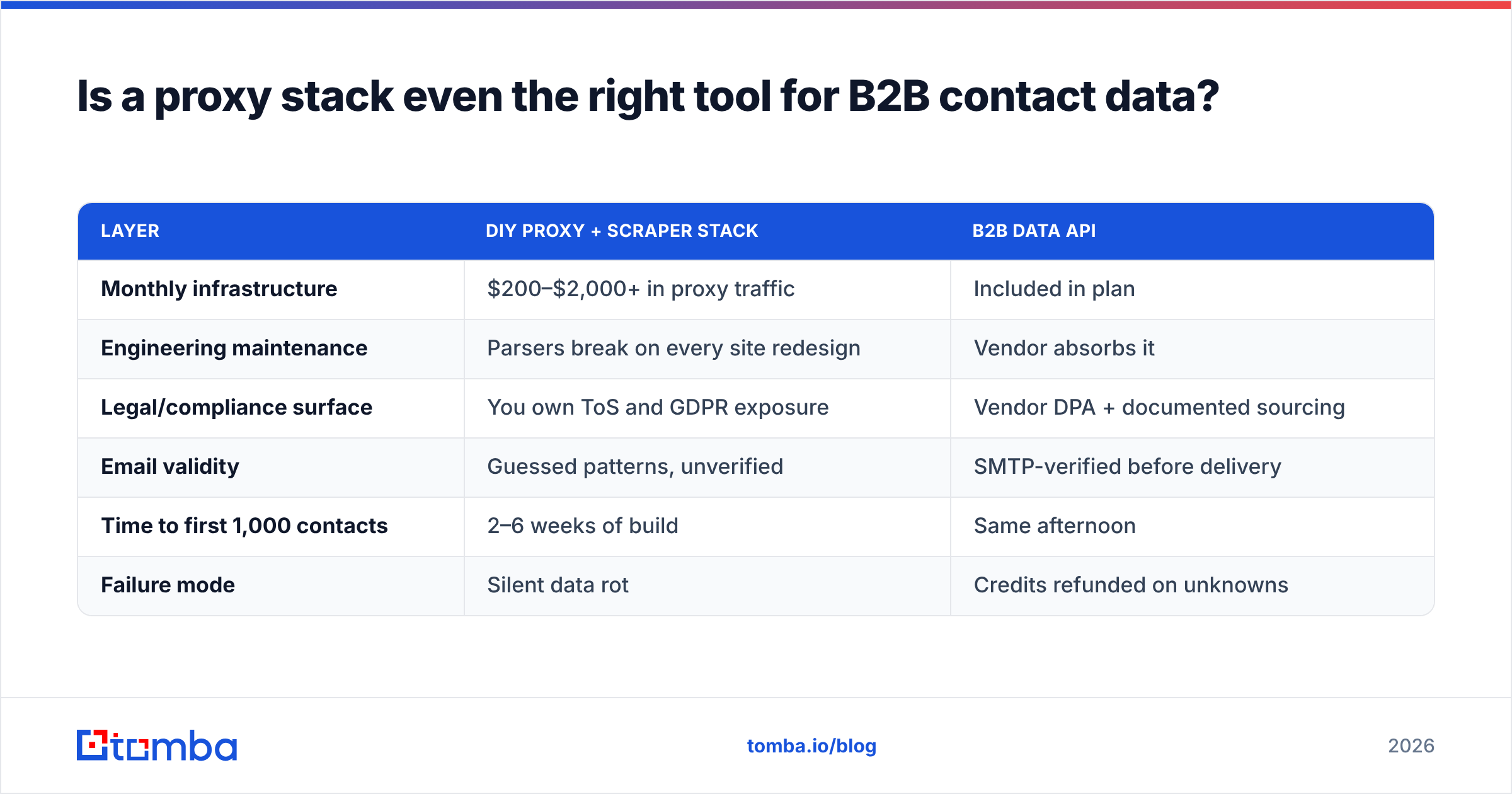
A lot of proxy spend in go-to-market teams goes to scraping sites, directories and profiles. The goal is a name, a job title, a work email and a phone number. That job already has its own product category. Running it through proxies means you own four brittle layers instead of one.
| Layer | DIY proxy + scraper stack | B2B data API |
|---|---|---|
| Monthly infrastructure | $200–$2,000+ in proxy traffic | Included in plan |
| Engineering maintenance | Parsers break on every site redesign | Vendor absorbs it |
| Legal/compliance surface | You own ToS and GDPR exposure | Vendor DPA + documented sourcing |
| Email validity | Guessed patterns, unverified | SMTP-verified before delivery |
| Time to first 1,000 contacts | 2–6 weeks of build | Same afternoon |
| Failure mode | Silent data rot | Credits refunded on unknowns |
Tomba sits on the API side of that table. The email finder turns a name and a domain into a verified work address. Domain search returns every public address at a company, with confidence scores and sources. Data enrichment fills in title, seniority, location and social profiles. Every result carries a citation trail. You can see where the address was found, as the data sources page explains. No IP rotation. No CAPTCHA budget. No parser on call.

Be clear about the boundary. This does not replace proxies. Price monitoring across 40 retailers still needs IPs. So does ad verification in 12 countries, or QA against geo-gated apps. For that work you want IPWAY or one of the IPWAY alternatives above. The point here is narrower. If your pipeline ends in a contact record, the proxy layer is cost, not value.
How should you test IPWAY alternatives before you switch?#
Run a two-week bake-off first. Never sign an annual deal cold. The method matters more than the vendor:
- Pick 3 candidates, not 6. More than three and no vendor gets enough volume to judge.
- Test on your real targets. Vendor benchmarks use easy endpoints. Only your own traffic shows the truth.
- Measure cost per successful record. Log failures, retries and partial responses on their own.
- Read the invoice, not the pricing page. Overage rates, minimum commits and traffic expiry hide the real delta.
- Stress the support channel once. File a real ticket during the trial. Time the reply. That number predicts your worst month.
Expect the winner to be 20–40% cheaper on effective cost, not on sticker price. If the gap is smaller, the migration is not worth the engineering.
Which of these IPWAY alternatives should you choose?#
Short version, by job to be done:
- Stable identity, multi-account work — stay on dedicated ISP. IPWAY already fits here. NetNut and Decodo's ISP tier are the closest swaps.
- Maximum scale, regulated industry — Bright Data or Oxylabs. You are paying for the paperwork and the SLA.
- Balanced growth team — Decodo. Best features per dollar in the middle of the market.
- Bursty, hard-to-predict volume — IPRoyal, for traffic that does not expire.
- Prototypes and low-risk targets — Webshare's free tier.
- You just want the data — a managed scraping API. Or skip scraping, if the output is contact records.
Where does Tomba fit?#
Maybe "IPWAY alternatives" is in your search history because scraping contact data got expensive. Then the cheapest fix is not another proxy vendor. It is deleting the scraping layer. Tomba's email finder returns verified work emails from a name and a domain. Every record carries confidence scoring and source citations. You can wire up the Tomba API in an afternoon. The free tier gives you 25 searches a month, so you can test accuracy on your own list. Paid plans start at $49/month for Starter and $99/month for Growth. Full details sit on the Tomba pricing page. Bring your hardest 100 contacts, check the hit rate, and decide from there. No proxy pool required.
Related guides#
// get started
Find, verify and enrich your first contacts today
Start on the free plan with 25 searches a month, then scale when your team is ready.
Free plan · No credit card required · GDPR & CCPA
// about the author