IQL vs MQL vs SQL: The 2026 Lead Qualification Guide
IQL, MQL, and SQL are three different promises about a lead — and most teams collapse them into one. Here is what each stage means, the handoff rules that stop leaks, and the data you need to make it hold.
TL;DR — the IQL MQL SQL funnel in five lines.
- IQL (information-qualified lead) is a name and an email attached to curiosity. MQL is curiosity plus fit plus repeated behavior. SQL is a lead a rep has accepted and agreed to work.
- Most B2B funnels do not leak at the top. They leak at the two handoffs: IQL→MQL and MQL→SQL.
- Stage names mean nothing on their own. You also need a written SLA and a shared data layer: verified email, real title, real company.
- Fit data beats behavior data at the MQL gate. A VP of Engineering who downloaded one PDF outranks an intern who downloaded five.
- Track MQL→SQL acceptance rate. Below 25% your scoring model is broken. Above 80% your bar is too low, and sales is just working the raw list.
IQL MQL SQL: what does each stage actually mean?#
The IQL MQL SQL funnel is three stages and three different promises.
An IQL — information-qualified lead — has traded contact details for something useful. A checklist, a benchmark report, a calculator. They wanted the thing, not your product. You know almost nothing except that they exist and a topic mattered to them for four minutes.
An MQL — marketing-qualified lead — has cleared a bar you defined in advance. That bar is a combination of who they are (fit) and what they did (behavior). A marketing qualified lead is marketing saying: based on our model, this person is worth a rep's time.
An SQL — sales-qualified lead — is the part most teams get wrong. An SQL is not a lead marketing sent to sales. It is a lead sales accepted. The acceptance is the qualification. Say a rep opens the record, decides the company is too small, and kicks it back. It was never an SQL. It was a rejected MQL, and that rejection is the most useful signal in your whole funnel.
Each stage has a different owner and a different failure mode. IQLs fail because you never nurtured them. MQLs fail because your scoring rewards clicks over fit. SQLs fail because the handoff took three days and the buyer already talked to someone else.
IQL MQL SQL compared: how the three stages differ#
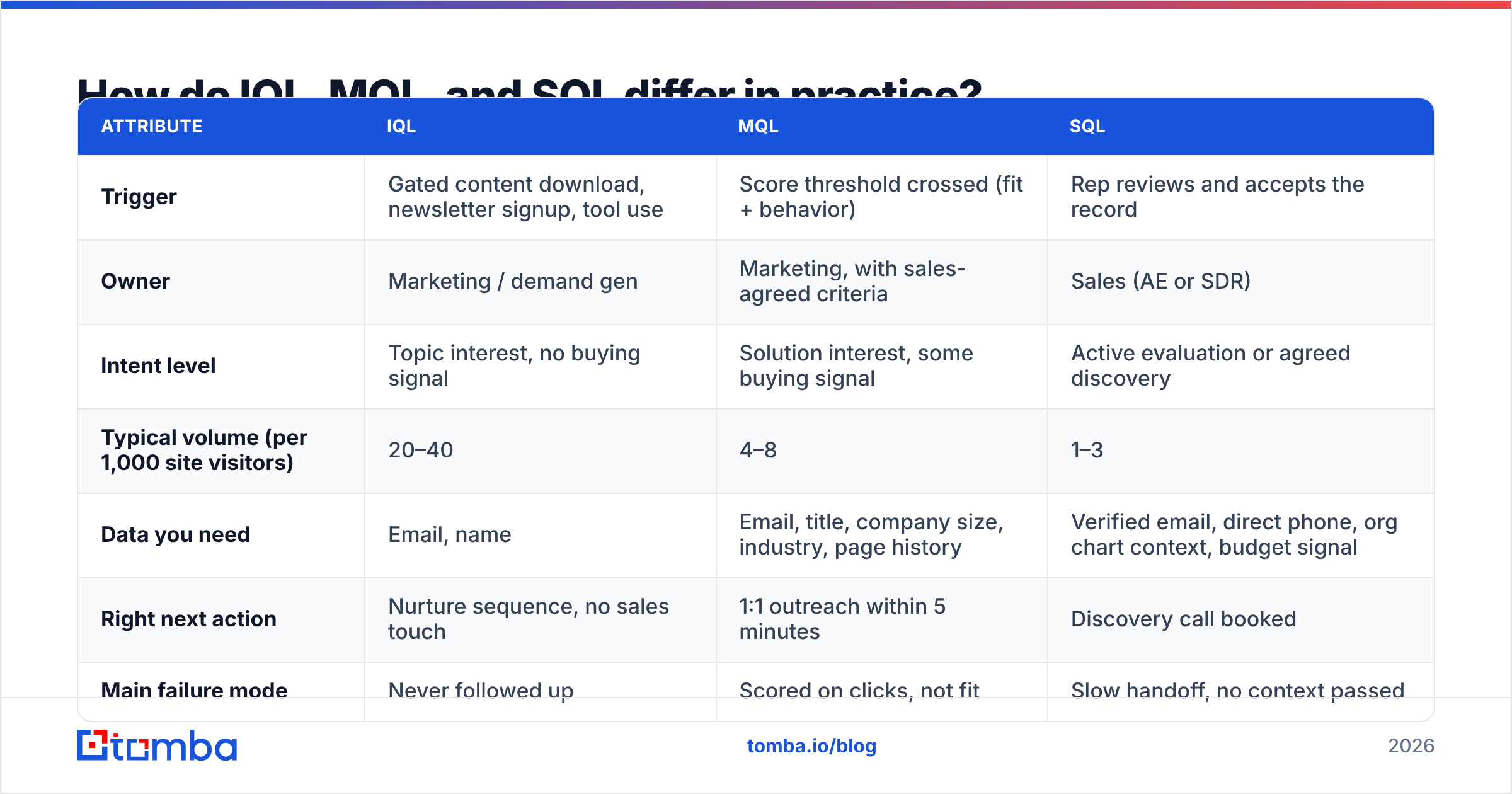
| Attribute | IQL | MQL | SQL |
|---|---|---|---|
| Trigger | Gated content download, newsletter signup, tool use | Score threshold crossed (fit + behavior) | Rep reviews and accepts the record |
| Owner | Marketing / demand gen | Marketing, with sales-agreed criteria | Sales (AE or SDR) |
| Intent level | Topic interest, no buying signal | Solution interest, some buying signal | Active evaluation or agreed discovery |
| Typical volume (per 1,000 site visitors) | 20–40 | 4–8 | 1–3 |
| Data you need | Email, name | Email, title, company size, industry, page history | Verified email, direct phone, org chart context, budget signal |
| Right next action | Nurture sequence, no sales touch | 1:1 outreach within 5 minutes | Discovery call booked |
| Main failure mode | Never followed up | Scored on clicks, not fit | Slow handoff, no context passed |
| Honest conversion rate to next stage | 10–25% | 25–45% | 15–30% to opportunity |
Those IQL MQL SQL volume and conversion ranges are directional, not gospel. A $400/year self-serve product and a $400,000 enterprise platform will not share a funnel shape. Use the ranges to notice when your numbers are wildly off, not to benchmark a decimal point.
What is an IQL, and why do most teams skip it?#
Most teams skip the first stage of the IQL MQL SQL funnel because it feels like admitting failure. You spent $8,000 on a report and got 600 emails — calling them "information-qualified" sounds like a euphemism for "not qualified."
It isn't. It is the only honest label for that list, and the honesty is what makes it useful.
Mark those 600 as IQLs instead of dumping them into the MQL bucket, and three good things happen. Sales stops complaining about lead quality, because nobody promised quality. Marketing gets a clean pool to nurture without skewing the MQL number the board looks at. And you get a measurable IQL→MQL rate. That one number tells you whether your nurture works or whether you are just sending newsletters into a void.
The practical rule: an IQL gets automation, never a rep. No SDR call, no personalized sequence, no LinkedIn connection request. Automation until they do something that clears the MQL bar.
When does an IQL become an MQL?#
When fit and behavior both clear a threshold — not either one alone. This is the first gate in the IQL MQL SQL funnel, and it is the one most teams set by feel.
It is also where most scoring models break. They are built entirely on behavior, because behavior is easy to instrument. Email open: +2. Pricing page view: +10. Webinar attendance: +15. Hit 50 points, become an MQL. It looks rigorous. It produces a pipeline full of students, consultants, and competitors doing research.
Fit is the harder half, and it is the half that predicts revenue. HubSpot's lead scoring guidance makes the same point from a different direction: your scoring model should start from the attributes your closed-won customers actually share, not from a list of trackable events.
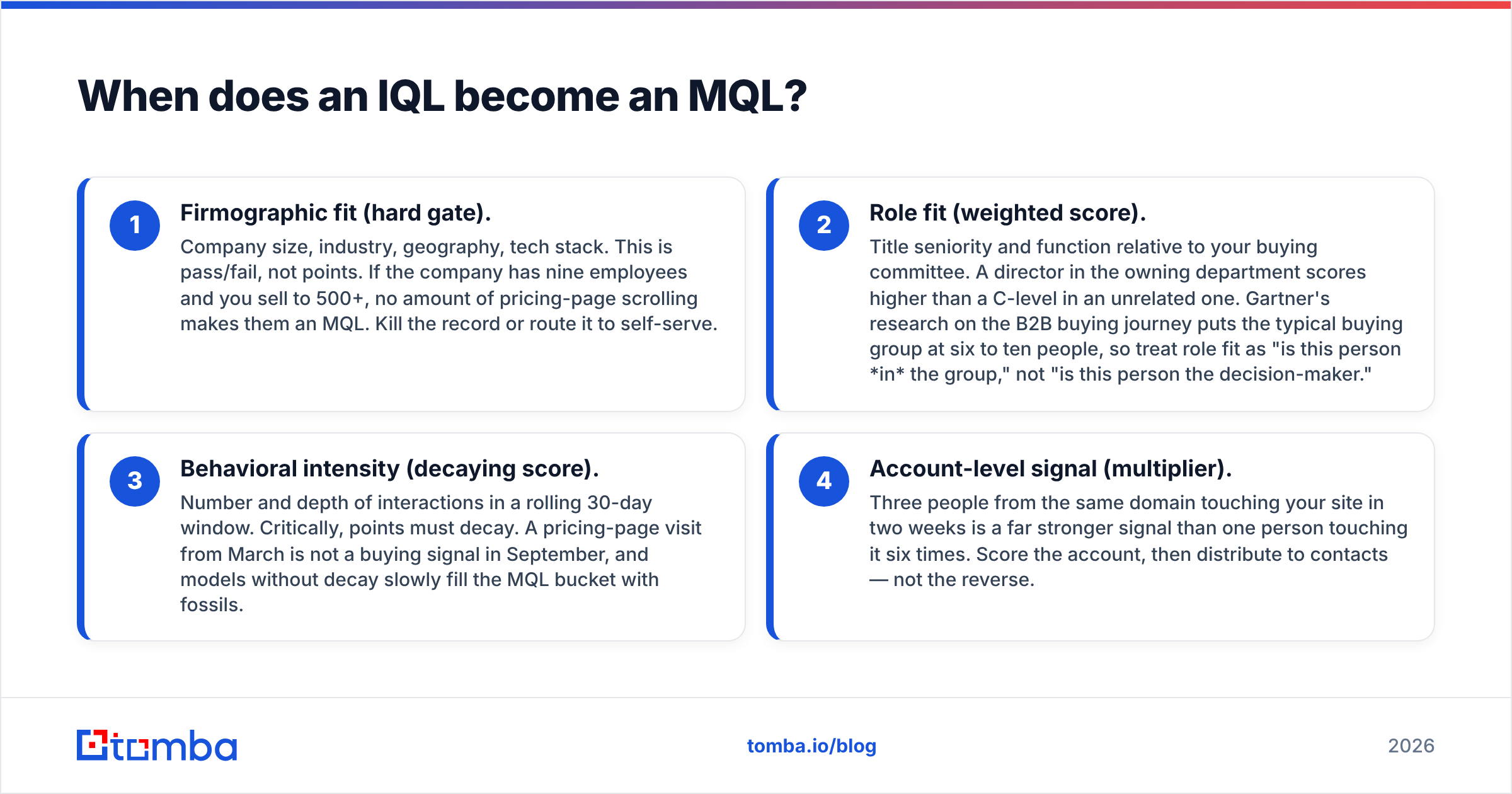
A workable MQL gate has four components:
- Firmographic fit (hard gate). Company size, industry, geography, tech stack. This is pass/fail, not points. If the company has nine employees and you sell to 500+, no amount of pricing-page scrolling makes them an MQL. Kill the record or route it to self-serve.
- Role fit (weighted score). Title seniority and function, judged against your buying committee. A director in the owning department scores higher than a C-level in an unrelated one.
- Behavioral intensity (decaying score). Number and depth of interactions in a rolling 30-day window. Points must decay. A pricing-page visit from March is not a buying signal in September, and models without decay fill the MQL bucket with fossils.
- Account-level signal (multiplier). Three people from one domain touching your site in two weeks beats one person touching it six times. Score the account, then push the score down to contacts — not the reverse.
Gartner's research on the B2B buying journey puts the typical buying group at six to ten people. So treat role fit as "is this person in the group," not "is this person the decision-maker."
Then set the threshold so that your MQL volume matches what sales can actually work. If two SDRs can handle 150 leads a month, calibrate the bar to produce roughly 150 — not 900 that get triaged into silence.
What makes a lead sales-qualified?#
Acceptance plus a booked next step. This is the last gate in the IQL MQL SQL funnel, and the only one sales owns outright.
The cleanest working definition of an SQL has three conditions, all of which must be true:
- A named rep has reviewed the record and explicitly accepted it (a status change, not a silent assignment).
- The rep has confirmed at least one qualification criterion beyond the model — a real pain, a real timeline, or a real budget conversation.
- There is a scheduled next interaction on a calendar.
If your CRM turns MQLs into SQLs automatically after a task is created, you do not have an SQL stage. You have a renamed MQL stage, and your reporting is lying to you about where deals die.
The rejection path matters as much as the acceptance path. Every rejected MQL should carry a reason code — wrong size, wrong role, no budget, competitor, bad data, already a customer. Six codes, no free text. Review them monthly. If 40% of rejections are "bad data," you do not have a scoring problem. You have a contact-data problem, and no amount of model tuning will fix it.
How fast does the handoff have to be?#
Faster than you think, and the curve is brutal.
One finding gets quoted endlessly: leads contacted within five minutes convert at many multiples of leads contacted in an hour. It has held up across a decade of replications by Forrester, InsideSales, and others. The exact multiplier varies by study and market. The shape does not. Qualification decays by the minute.
Which means your MQL→SQL SLA is an infrastructure problem, not a discipline problem. Writing "reps must respond in 5 minutes" in a Notion doc changes nothing. What changes things:
- Routing runs on write, not on a schedule. No hourly sync jobs between marketing automation and CRM.
- The record arrives complete. Verified email, direct line, title, company size, and the three pages they viewed — all in the assignment notification, not buried in a related object.
- There is a fallback owner. If the assigned rep does not accept within 15 minutes, it reassigns. Silence is not a decision.
- Rejection is one click. If kicking a lead back takes four fields, reps will sit on bad leads instead, and you lose the signal.
Where does the IQL MQL SQL funnel leak most?#
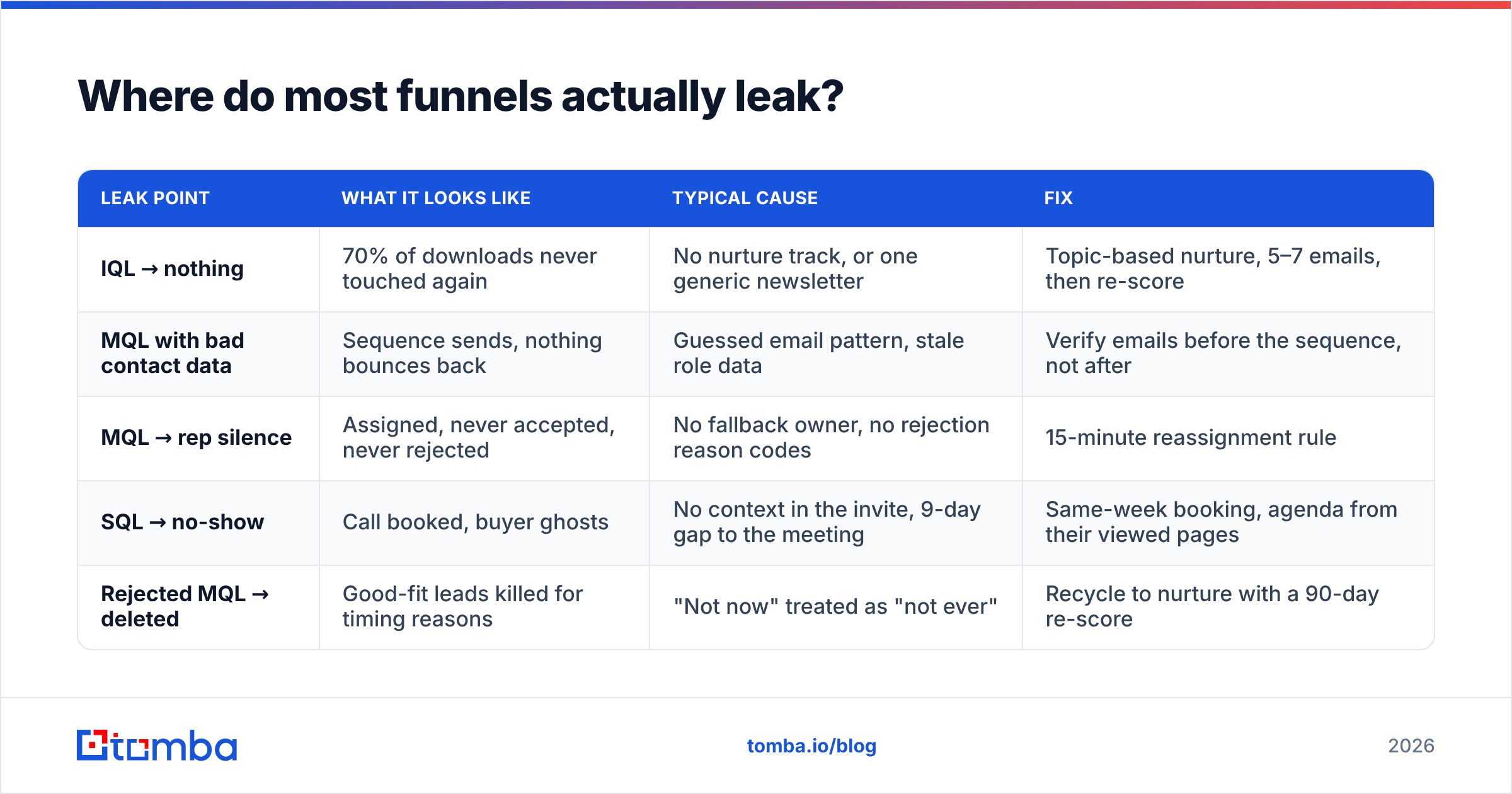
Between the stages, not inside them. Here is where the volume goes, in order of how much revenue it costs.
| Leak point | What it looks like | Typical cause | Fix |
|---|---|---|---|
| IQL → nothing | 70% of downloads never touched again | No nurture track, or one generic newsletter | Topic-based nurture, 5–7 emails, then re-score |
| MQL with bad contact data | Sequence sends, nothing bounces back | Guessed email pattern, stale role data | Verify emails before the sequence, not after |
| MQL → rep silence | Assigned, never accepted, never rejected | No fallback owner, no rejection reason codes | 15-minute reassignment rule |
| SQL → no-show | Call booked, buyer ghosts | No context in the invite, 9-day gap to the meeting | Same-week booking, agenda from their viewed pages |
| Rejected MQL → deleted | Good-fit leads killed for timing reasons | "Not now" treated as "not ever" | Recycle to nurture with a 90-day re-score |
The second row is the quiet one. A scoring model can be perfect and still produce nothing if the email address on the record is a guess. Pattern-generated addresses like first.last@company.com are right often enough to feel safe. They are also wrong often enough to wreck sender reputation across the whole domain. Verify before you send, and treat catch-all domains as their own bucket rather than as valid.
What data do you need at each IQL MQL SQL stage?#
Each stage needs a different depth of data. Buying maximum depth for every IQL is how data budgets get burned.
- IQL stage — minimum viable. Email and a name. Add a domain-to-company lookup if you want to segment nurture by industry. Do not buy phone numbers for people who downloaded a checklist.
- MQL stage — fit data. Title, seniority, department, company size, industry, and tech stack. This is where contact enrichment earns its cost, because it is the data your hard gate runs on. Enrich when the lead crosses the threshold, not at form fill.
- SQL stage — reachability and context. A verified direct email, a phone number, the buying-group map, and recent company events. Depth is justified here, because a rep is about to spend an hour.
- Recycled leads — refresh. B2B contact data decays at roughly 2–3% per month through job changes alone. Re-enrich any lead that has sat in nurture for 90 days.
Where the data comes from matters less than whether it is verified. Waterfall providers, database vendors like BookYourData, and API-first finders all have a place in a stack. BookYourData fits when you want a pre-built list by filters. An API-driven approach fits better when enrichment has to fire inside a workflow. What you should not do is pipe any of them into sequences unverified. Run a domain search to establish the company's real email pattern, then validate each address one by one.
How do you know the model is working?#
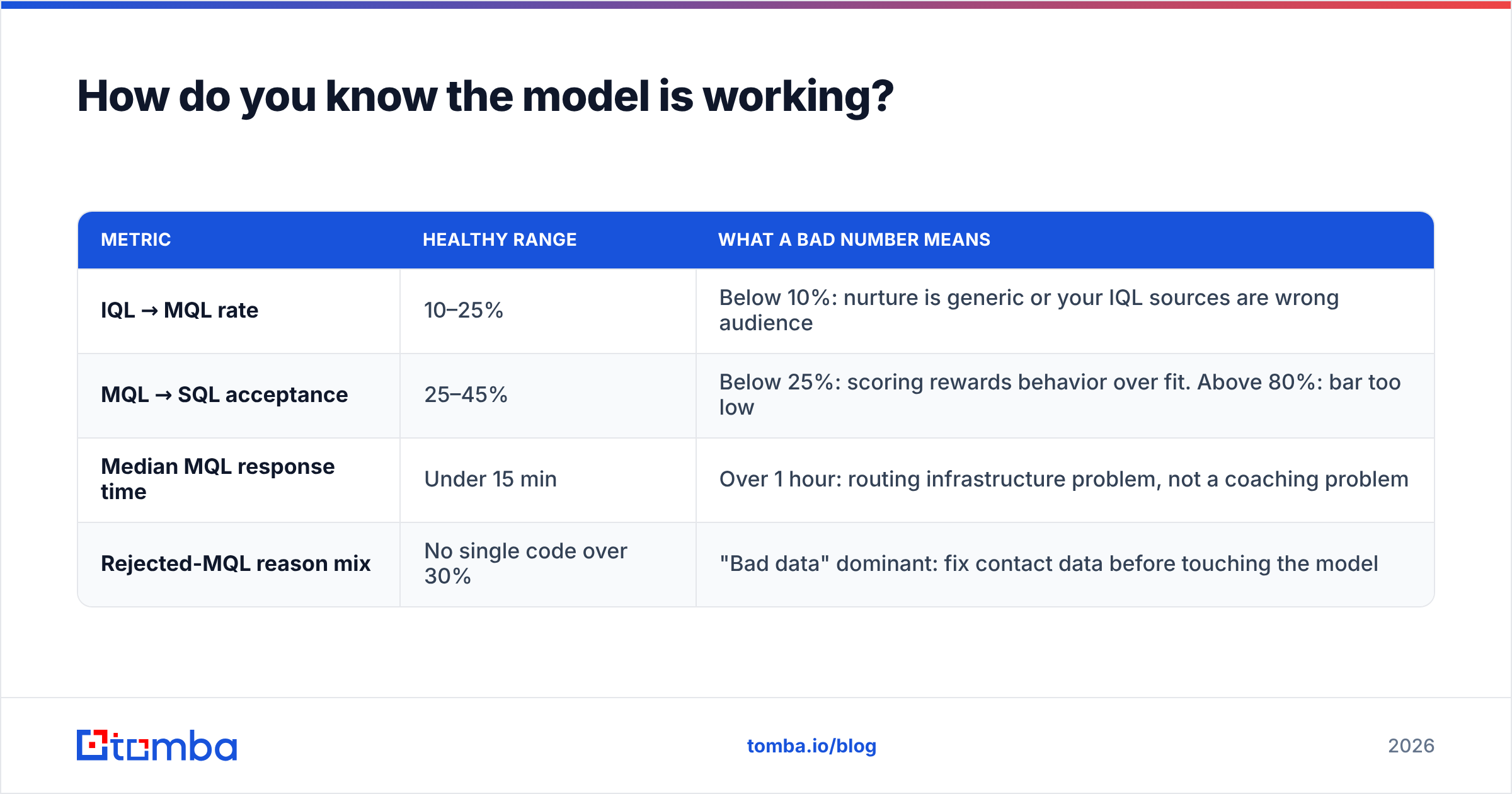
Four numbers, reviewed monthly. Not a dashboard with 30 tiles.
| Metric | Healthy range | What a bad number means |
|---|---|---|
| IQL → MQL rate | 10–25% | Below 10%: nurture is generic or your IQL sources are wrong audience |
| MQL → SQL acceptance | 25–45% | Below 25%: scoring rewards behavior over fit. Above 80%: bar too low |
| Median MQL response time | Under 15 min | Over 1 hour: routing infrastructure problem, not a coaching problem |
| Rejected-MQL reason mix | No single code over 30% | "Bad data" dominant: fix contact data before touching the model |
Add one qualitative check that no dashboard gives you. Sit with an SDR for thirty minutes while they work a fresh MQL queue, and watch what they skip. The leads they skip without opening tell you more about your scoring bar than a quarter of conversion analytics.
Do you still need the MQL stage in 2026?#
Yes — but as a routing mechanism, not as a marketing scoreboard.
The "MQLs are dead" argument has real substance behind it. Scoring a single contact misses the six-person buying committee. Dark social, podcasts, and communities generate demand that never shows up as a form fill. Teams that compensate marketing on MQL volume reliably get more MQLs and not more revenue.
All of that is an argument against MQLs as a target, not against MQLs as a stage. You still need a clear line between "nurture this automatically" and "put a human on this," because rep hours are your most expensive input. Keep the stage, move the account to the center of scoring, and pay marketing on pipeline accepted by sales rather than on leads generated.
The teams that run the IQL MQL SQL funnel well are boring about it: clear definitions, a written SLA, reason-coded rejections, and clean contact data underneath it all. No clever model survives a bad email address.
Where to start#
Pick the leak that costs you most and fix it first. For most teams that is not the scoring model. It is the contact record the model runs on.
If your reps reject MQLs for "bad data," or your sequences bounce against guessed addresses, start there. The Tomba Email Finder returns verified professional emails by name and domain with a confidence score. The record that reaches a rep is one they can act on, and an API call slots it into the exact moment a lead crosses your MQL threshold. The free tier gives you 25 searches a month. Run 25 of last month's rejected leads through it and see how many were real people behind bad addresses.
Fix the data under your IQL MQL SQL funnel first, then fix the model. In that order.
Related guides#
// get started
Find, verify and enrich your first contacts today
Start on the free plan with 25 searches a month, then scale when your team is ready.
Free plan · No credit card required · GDPR & CCPA
// about the author