Isometrik AI Pricing, Reviews, Pros and Cons (2026)
Isometrik AI sells agentic commerce and support automation on quote-only contracts. Here is how the pricing model actually works, what buyers report, where it wins, where it hurts, and how it stacks up against cheaper alternatives.
TL;DR
- Isometrik AI pricing is quote-only. There is no price list and no tiers. What you pay turns on chat volume, agent count, hosting, and how hard you push back.
- Plan for a five-figure yearly spend at mid-market size. Big rollouts cost more once setup and support land on the bill.
- Strong points: deep AI agents for shops and support, one bot across every channel, and a team that will build around your stack.
- Weak points: hidden prices, a slow sales cycle, few public reviews next to Zendesk or Salesforce, and real setup work before you see a payoff.
- If your real problem is finding and checking work emails, a $49/mo tool fixes it. You do not need a six-week buying cycle.
What is Isometrik AI?#
Isometrik AI is an AI agent platform for shops, retail brands, and support teams. The agents do real work. They do not just answer FAQs.
Think of a chatbot as a phone menu. Isometrik is closer to a contractor. It wires up your store, your catalog, your order system, and your chat apps. Then one agent can walk a buyer all the way to checkout.
That gap shapes the price. A chatbot is a per-seat SaaS tool. An AI agent build is a platform plus a services deal. Vendors price it that way. Visit the official Isometrik site and you will see claims about sales lift, GMV, and ticket deflection. You will not see plans or tiers. When a vendor sells outcomes and hides tiers, the price is set deal by deal.
The platform covers four jobs:
- Shop agents that help buyers search, pick, add to cart, and check out in chat.
- Support agents that handle "where is my order?", returns, and account fixes with no ticket.
- One agent across channels — web chat, WhatsApp, and in-app chat — so the bot keeps one voice.
- Tuning and analytics, where you read chat logs, spot what broke, and fix the flow.
None of this is rare in 2026. The leaders win on depth. They take on the messy middle for you: catalog sync, user look-ups, and hand-off rules.
How does Isometrik AI pricing work?#
Short answer: there is no public price, and you should not expect one. Isometrik AI pricing is sales-led. You book a demo. You scope your use case. You get a quote.
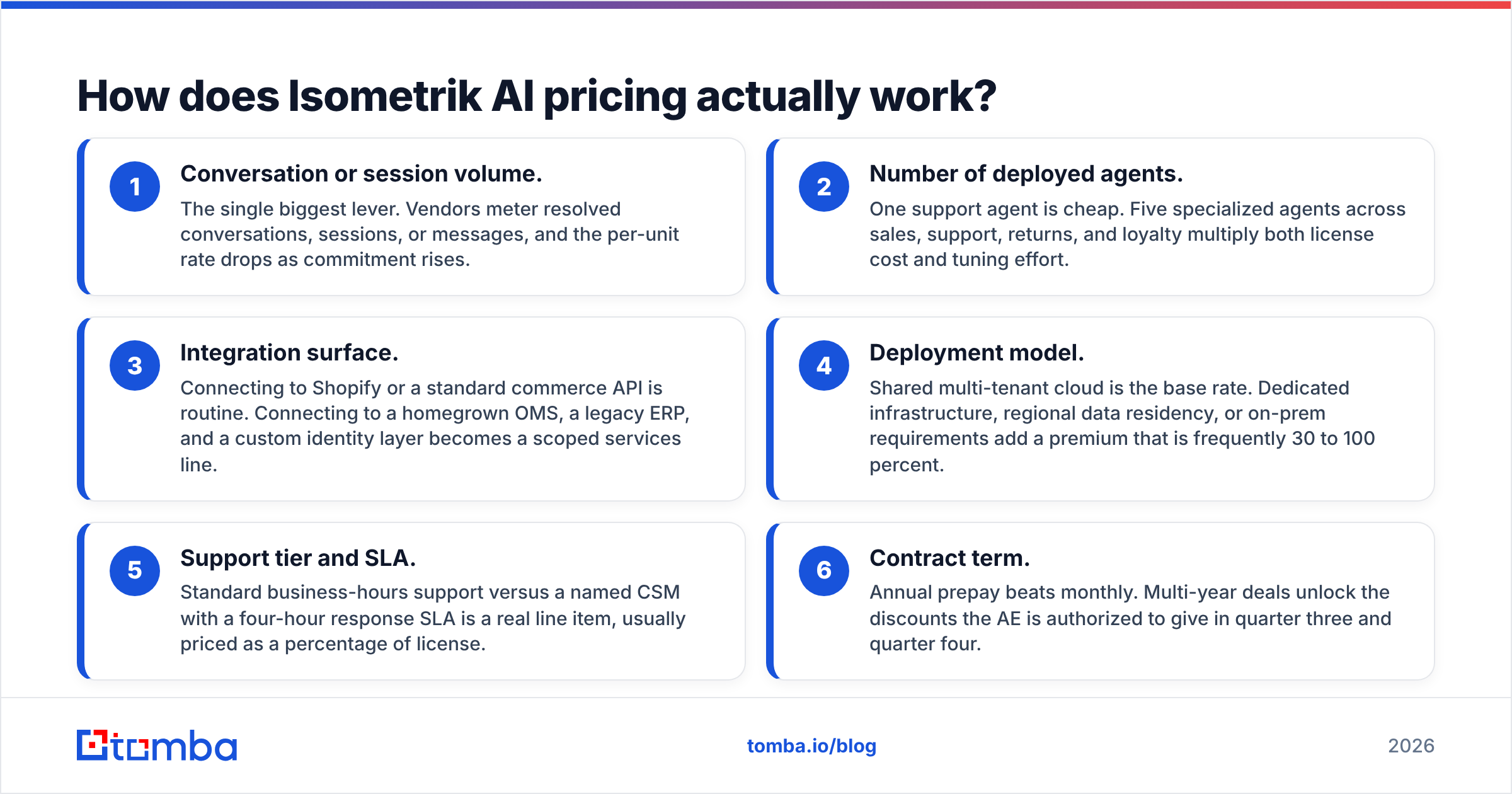
Four things shape the number you are quoted:
- Chat volume. This is the biggest lever by far. Vendors bill per chat, per session, or per message. The unit rate drops as your commit goes up.
- Agent count. One support agent is cheap. Five agents across sales, support, returns, and loyalty cost more to license and more to tune.
- Setup work. A Shopify hook-up is routine. A home-grown order system, an old ERP, or a custom log-in layer is not. Each one adds a services line.
- Where it runs. Shared cloud is the base rate. A private stack, EU-only data, or on-prem can add 30 to 100 percent.
Two more levers show up late in the deal:
- Support tier. Office-hours help is one price. A named rep with a four-hour reply clock is another. It is often billed as a share of the license.
- Contract length. Yearly up front beats monthly. Multi-year deals unlock the deepest discount a rep can sign off on.

Because none of it is public, the advice is blunt. Get three quotes before you take one. Vendors here price against rivals, not against a rate card. Buyers who name two live options get better terms. Buyers who show up sole-sourced do not.
Ask one more question early. Is the quote license-only, or license plus setup? Plenty of AI agent deals look cheap until a second contract lands. That one carries a 6-to-12-week onboarding fee.
What does Isometrik AI pricing cost in year one?#
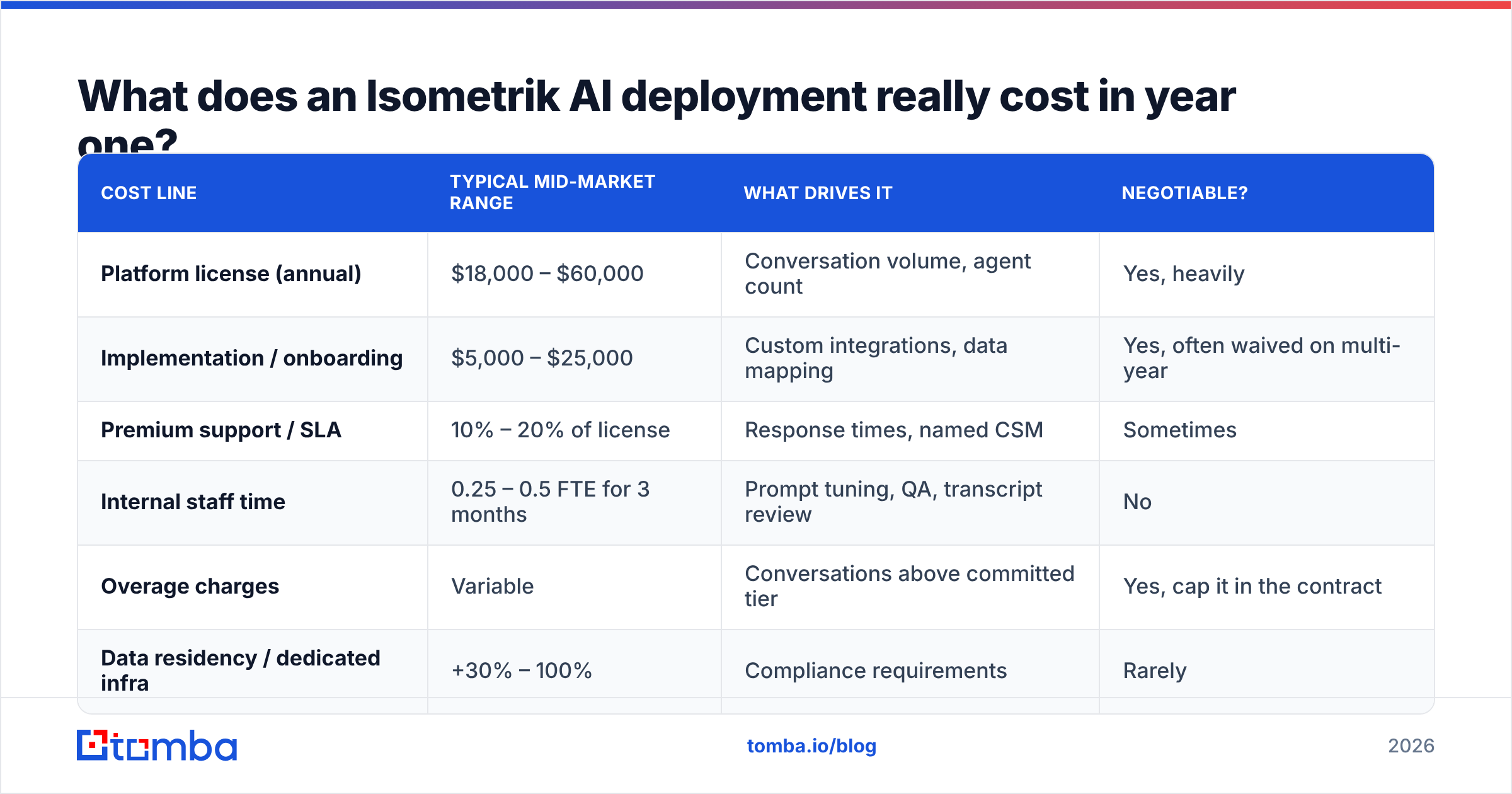
The license is rarely the whole bill. Below is a year-one model for a mid-market retail build. Treat these as planning ranges for this class of tool. They are not quoted numbers, since Isometrik AI pricing is never published.
| Cost line | Typical mid-market range | What drives it | Negotiable? |
|---|---|---|---|
| Platform license (annual) | $18,000 – $60,000 | Conversation volume, agent count | Yes, heavily |
| Implementation / onboarding | $5,000 – $25,000 | Custom integrations, data mapping | Yes, often waived on multi-year |
| Premium support / SLA | 10% – 20% of license | Response times, named CSM | Sometimes |
| Internal staff time | 0.25 – 0.5 FTE for 3 months | Prompt tuning, QA, transcript review | No |
| Overage charges | Variable | Conversations above committed tier | Yes, cap it in the contract |
| Data residency / dedicated infra | +30% – 100% | Compliance requirements | Rarely |
The line most teams forget is staff time. An AI agent is not a set-and-forget buy. Someone on your side has to read chat logs. They spot the ten ways people ask "where is my refund". Then they fix the flow.
Budget a quarter of a person for the first three months. Skip that step and the build will miss its mark. You will then blame the vendor for a gap you left open.
One more clause to fight for: cap your overage in writing. Usage-based AI pricing with no ceiling is how a $2,000 month turns into a $9,000 month on Black Friday.
What do Isometrik AI reviews say?#
Isometrik has fewer public reviews than the big CX suites. That is normal for a niche vendor. Check live listings and buyer counts on G2 and Capterra before you trust any summary, this one included.
Here are the themes buyers in this market bring up.
What reviewers praise:
- Fast, hands-on support. Small vendors ship fixes faster than big ones do. Buyers of niche AI tools say this is the main reason they pick a challenger.
- Depth on shop workflows. Cart recovery, catalog-aware picks, and order look-ups work out of the box. You do not build them from scratch.
- They will build for you. Need an odd hook-up? A challenger will code it. A giant will park it on a roadmap.
What reviewers flag:
- Hidden prices. This is the top gripe with quote-only AI vendors, and Isometrik AI pricing sits in that camp. Buyers hate that they cannot check their own budget first.
- Slow first value. These builds take weeks, not hours. Teams hoping to launch the same day walk away let down.
- Thin docs. Niche vendors ship code faster than they ship docs. Expect to lean on your rep.
A fair read: the tool does what it claims for teams that fit the mould. The friction sits in the buying and the upkeep, not in the tech. That is a very different risk from "the AI does not work".
Is Isometrik AI better than the other options?#
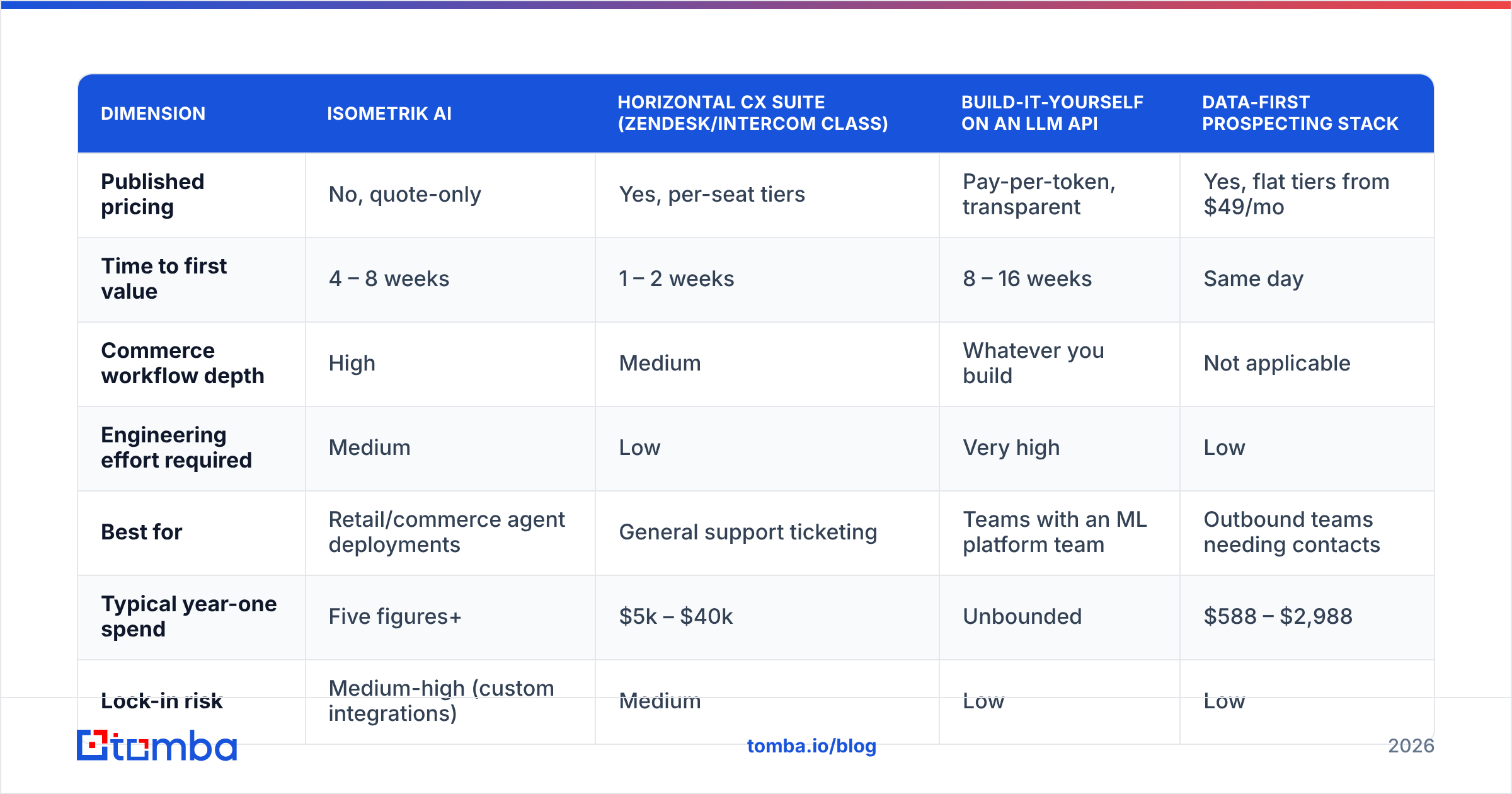
It depends on the job you hire the tool for. Here is the honest split across four options buyers mix up.
| Dimension | Isometrik AI | Horizontal CX suite (Zendesk/Intercom class) | Build-it-yourself on an LLM API | Data-first prospecting stack |
|---|---|---|---|---|
| Published pricing | No, quote-only | Yes, per-seat tiers | Pay-per-token, transparent | Yes, flat tiers from $49/mo |
| Time to first value | 4 – 8 weeks | 1 – 2 weeks | 8 – 16 weeks | Same day |
| Commerce workflow depth | High | Medium | Whatever you build | Not applicable |
| Engineering effort required | Medium | Low | Very high | Low |
| Best for | Retail/commerce agent deployments | General support ticketing | Teams with an ML platform team | Outbound teams needing contacts |
| Typical year-one spend | Five figures+ | $5k – $40k | Unbounded | $588 – $2,988 |
| Lock-in risk | Medium-high (custom integrations) | Medium | Low | Low |
The last column is the one that trips people up. Plenty of teams shopping for AI agents have a pipeline problem, not a chat problem. They do not have enough good leads to talk to. So they buy a tool that talks better to the few they have. That fixes the wrong thing.
Does your funnel get traffic and chats, but close too few? Then AI agents are the right buy. Is the top of your funnel dry? Then you need contact data, not agents. An email finder plus a checking step costs a sliver of Isometrik AI pricing and fixes the real gap.

What are the real pros of Isometrik AI?#
1. It takes on the hard part. Catalog know-how, order-system hook-ups, and user look-ups are hard to build. Paying a niche vendor that has solved them is a fair use of budget.
2. Custom work is on the table. Challengers trade scale for reach. If your stack is odd, that trade is worth real money. A market leader will not make it.
3. You can shape the deal. The sale is hands-on, so you can push for terms tied to metrics you care about: fix rate, ticket deflection, assisted sales. Try getting a per-seat SaaS vendor to sign up to that.
4. One setup, every channel. Running a separate bot per channel is a known tax. Cutting that tax is a real gain, and it grows as you add channels.
What are the real cons of Isometrik AI?#
1. You cannot check your own budget. Isometrik AI pricing is quote-only, so you burn time before you know if the tool is in reach. Three calls to learn you cannot afford it is a real cost for a lean team.
2. The buying cycle drags. Expect a security review, a data deal, and a pilot. In most firms that runs two to three months. Gartner's work on AI platform adoption keeps finding the same thing: what slows AI down is the buying cycle, not the tech.
3. Custom hook-ups lock you in. They are an asset while you stay. They are a liability the day you want out. Ask what happens to them when the deal ends. Get that answer in writing.
4. It does not fill the funnel. Agents improve what happens after a buyer shows up. They do not make buyers show up. Mix the two up and you get a slick chat flow with too little traffic.
5. Small public footprint. Fewer reviews, fewer forum answers, fewer outside experts. You will lean on the vendor more than you would with a giant.
Who should buy Isometrik AI, and who should not?#
Buy it if: you run a shop or retail team with real chat volume, you have an owner who can tune agents each week, your budget can take a five-figure year, and your bottleneck is sales rate or support cost.
Skip it if: you are pre-launch, your chat volume is under a few thousand a month, no one owns agent quality, or too few buyers know you exist.
For that last group, the order of work is clear. Build a repeatable outbound motion first. Use domain search to map the firms in your ICP. Run each address through an email verifier so your sender score holds up. Then enrich the records that close. Once your team cannot keep up with the volume, then weigh Isometrik AI pricing. You will bargain with real numbers in hand.
How do you run a fair test?#
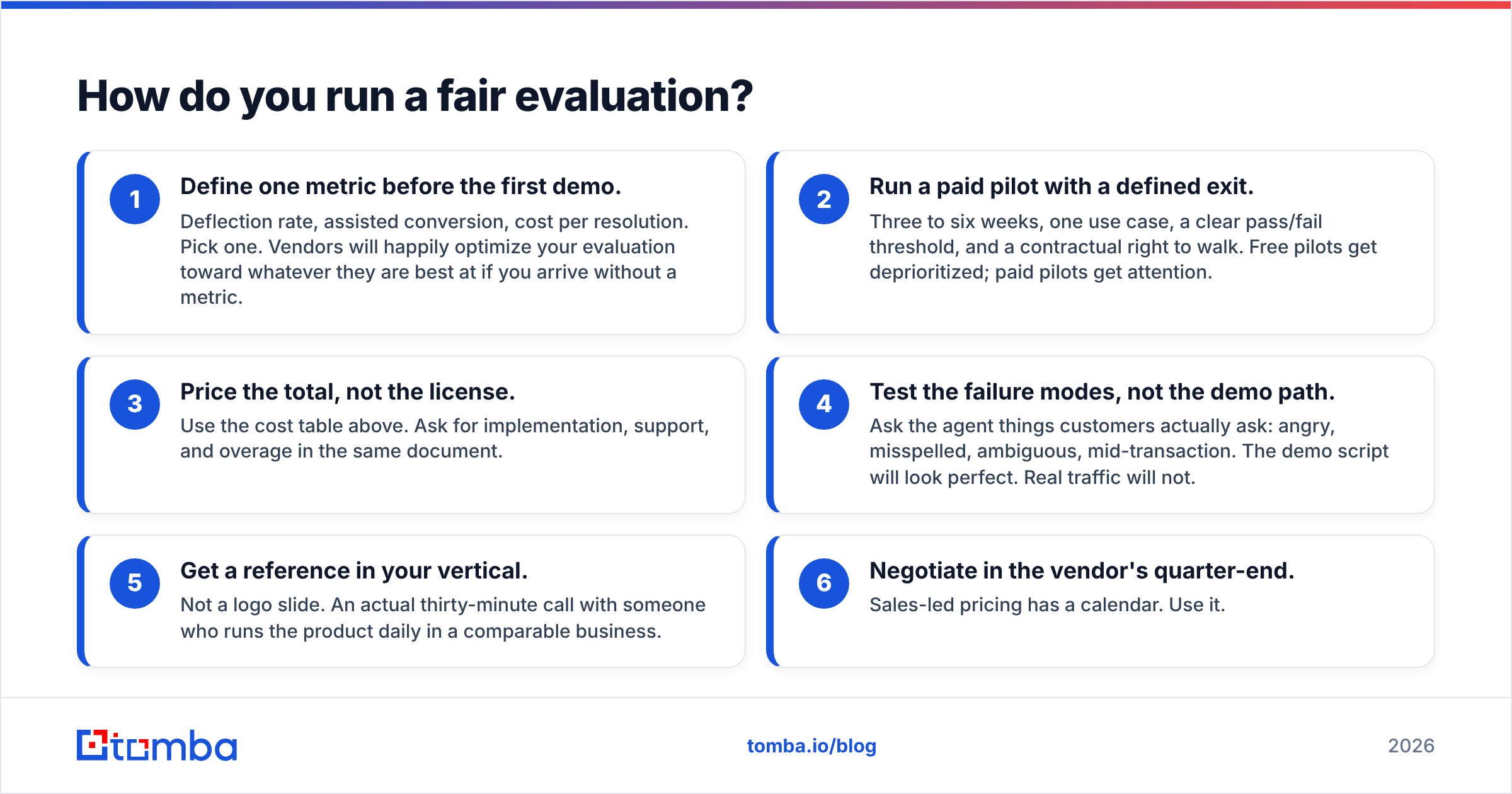
- Pick one metric before the first demo. Ticket deflection, assisted sales, or cost per fix. Pick one. Vendors will steer a loose test toward what they do best.
- Run a paid pilot with a clear exit. Three to six weeks. One use case. A pass/fail bar, and the right to walk. Free pilots get ignored. Paid pilots get staffed.
- Price the whole thing, not the license. Use the cost table above. Ask for setup, support, and overage in one document.
Then push on the parts a demo will never show you.
- Test what breaks, not the happy path. Ask what real buyers ask: angry, misspelled, half-typed, mid-order. The demo script looks perfect. Live traffic will not.
- Get a reference in your market. Not a logo slide. A thirty-minute call with someone who runs the tool each day.
- Buy at the vendor's quarter end. Sales-led pricing runs on a calendar. Use it.
Weigh the quote against the full cost of the other path. Include open options like Tomba's published pricing so your board sees a range, not one number. A public benchmark beats any feature list in a budget meeting. It also gives you a floor to hold Isometrik AI pricing against.
Ready to fix the top of your funnel first?#
AI agents pay off when you have more chats than you can handle. Most teams are not there yet. They have a contact-data problem in an AI costume.
Start with the Tomba Email Finder. The free tier gives you 25 searches a month. Test it on your own target accounts before you spend a cent. Starter is $49/mo. Growth is $99/mo. No quote-only mystery, and no six-week buying cycle. Find the buyers, check the addresses, fill the pipeline. Then go weigh Isometrik AI pricing with real volume numbers in hand.
Related guides#
// get started
Find, verify and enrich your first contacts today
Start on the free plan with 25 searches a month, then scale when your team is ready.
Free plan · No credit card required · GDPR & CCPA
Get the Tomba newsletter
Product and data updates
// about the author