Istari.ai Alternatives: 8 Better B2B Data Tools for 2026
Istari.ai turns company websites into structured firmographic data — but it won't hand you a verified contact. Here are 8 alternatives compared on coverage, pricing, API access, and what each one is actually good at.
Most people hunting for Istari.ai alternatives want one of two things: a better way to find target companies, or the emails of the people who work there. Istari.ai does the first job well. It does not do the second one at all.
TL;DR
- Istari.ai is a web-mining engine, not a prospecting database. It reads company websites at scale and turns them into company and tech profiles. That helps with research, screening, and segmentation.
- It does not give you a person's email. For outbound, you need a contact layer on top, or a tool that does both jobs.
- Pricing is quote-based. There is no public self-serve plan today, so small teams cannot just swipe a card and start.
- The best Istari.ai alternatives depend on the job. Company discovery: Ocean.io, Vainu, Crunchbase. Enrichment: Breeze, Tomba. All-in-one outbound: Apollo. Bought lists: BookYourData.
- If your real blocker is "I have the company, I need the person," an email finder with an API is cheaper and faster than a web-mining contract.
What does Istari.ai actually do?#
Istari.ai crawls company websites and reads them. It then turns that free text into structured fields: what the firm sells, which tech it mentions, and signals like AI use or green claims. The company spun out of academic research in Germany, and it shows. The output looks like a market-research dataset, not a sales list. You can see the positioning on istari.ai directly.
That design has real strengths. Old-school data vendors lean on registry records, self-reported labels, and stale SIC codes. Web mining reads what a firm says about itself today. Want to know how many German mid-market makers mention industrial IoT? Classic databases are useless here. Web mining is very good at it.
The design also has a hard ceiling. A website tells you what a company does. It rarely tells you who runs demand gen there. It almost never gives you their email. That gap is why most teams weighing Istari.ai alternatives are really weighing two product types at once.
Why do teams look for Istari.ai alternatives?#
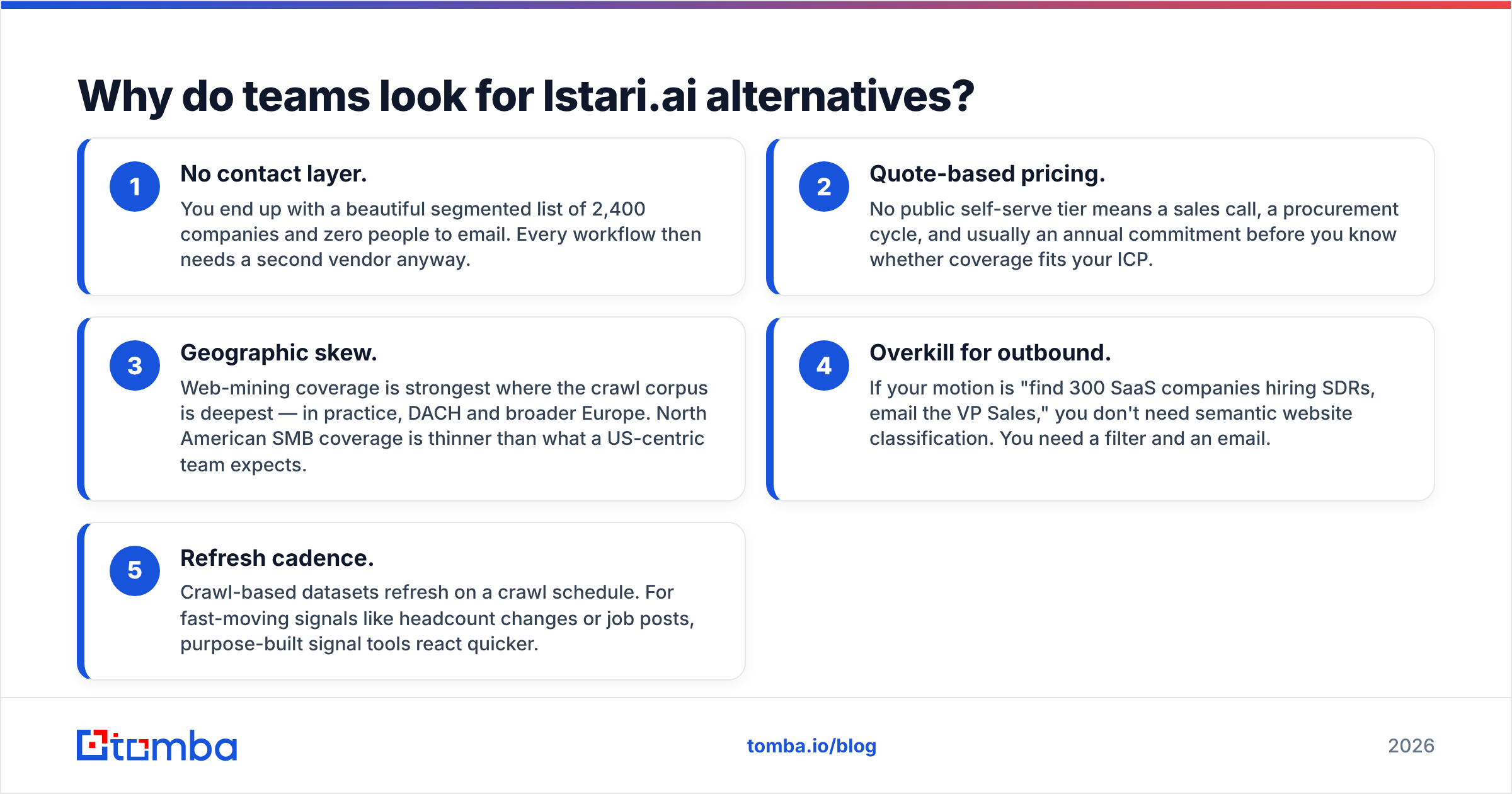
Five reasons come up again and again.
- No contact layer. You get a clean list of 2,400 firms and zero people to email. Every workflow then needs a second vendor.
- Quote-based pricing. No public plan means a sales call and often a yearly deal, before you know if coverage fits your ICP.
- Geographic skew. Crawl depth drives coverage. In practice that means DACH and wider Europe. US small-business data is thinner.
- Overkill for outbound. "Find 300 SaaS firms hiring SDRs, email the VP Sales" needs a filter and an email, not website classification.
- Refresh speed. Crawl data updates on a crawl schedule. Job posts and new hires move faster than that.
None of this makes Istari.ai a bad product. It makes it a specific one. The question is whether your job matches its shape.
How should you evaluate any Istari.ai alternative?#
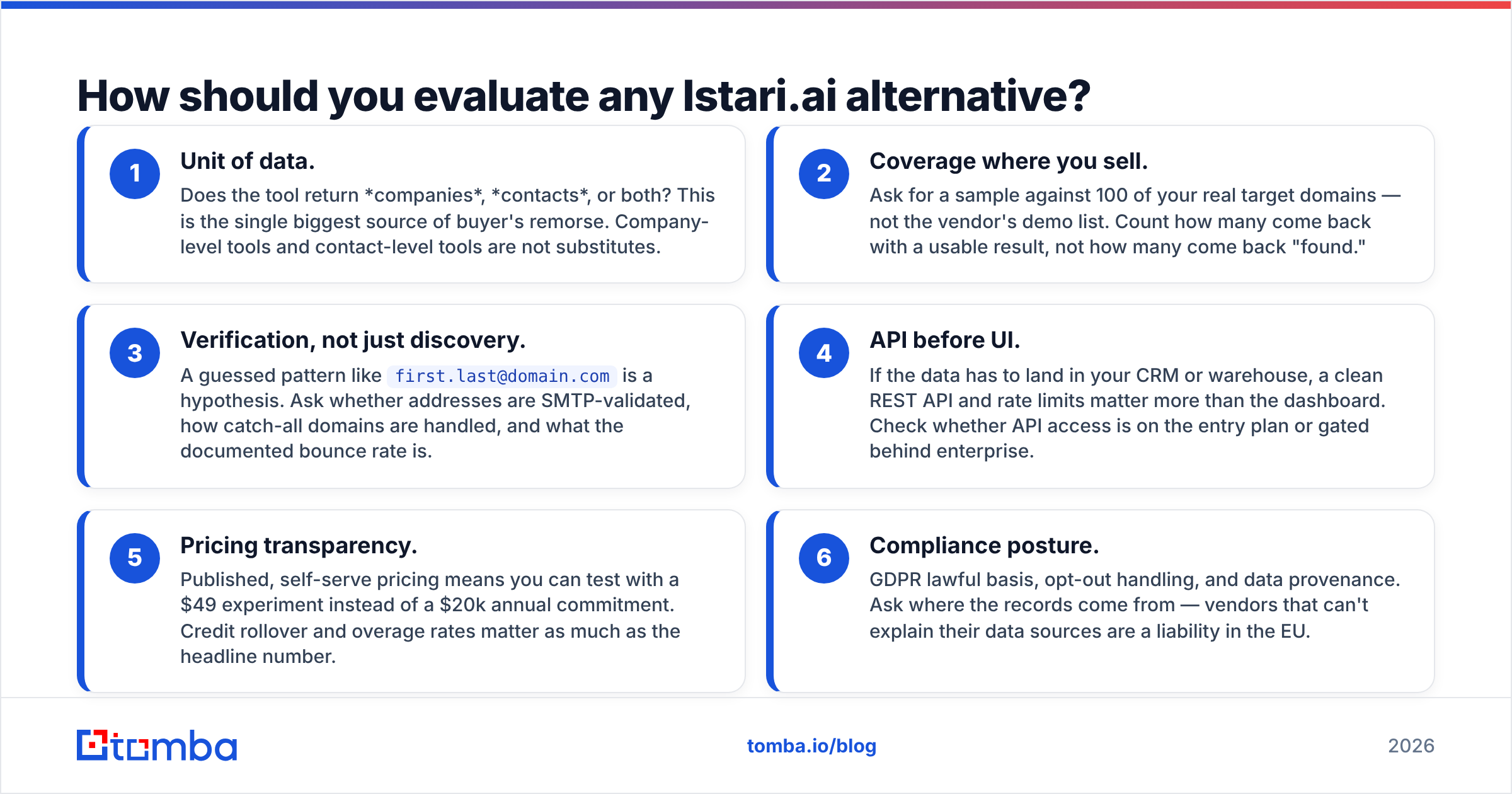
Score each option on these six points before you look at price.
- Unit of data. Does the tool return companies, contacts, or both? This is the top source of buyer's remorse. The two types are not swaps for each other.
- Coverage where you sell. Ask for a test run on 100 of your own target domains, not the demo list. Count usable results, not "found" results.
- Verification, not guessing. A pattern like
first.last@domain.comis a guess. Ask if addresses are SMTP-checked and how catch-all domains are handled. - API before UI. If the data must land in your CRM, a clean REST API matters more than the dashboard. Check if the API is on the entry plan.
- Clear pricing. Public self-serve pricing lets you test for $49 instead of $20k. Credit rollover and overage rates matter too.
- Compliance. Ask about GDPR basis, opt-out handling, and record provenance. Vendors that dodge the data sources question are a risk in the EU.
Good Istari.ai alternatives score well on the unit of data you actually need. The rest is detail.
Which are the best Istari.ai alternatives in 2026?#
Here is the honest landscape. Each tool is grouped by the job it does best.
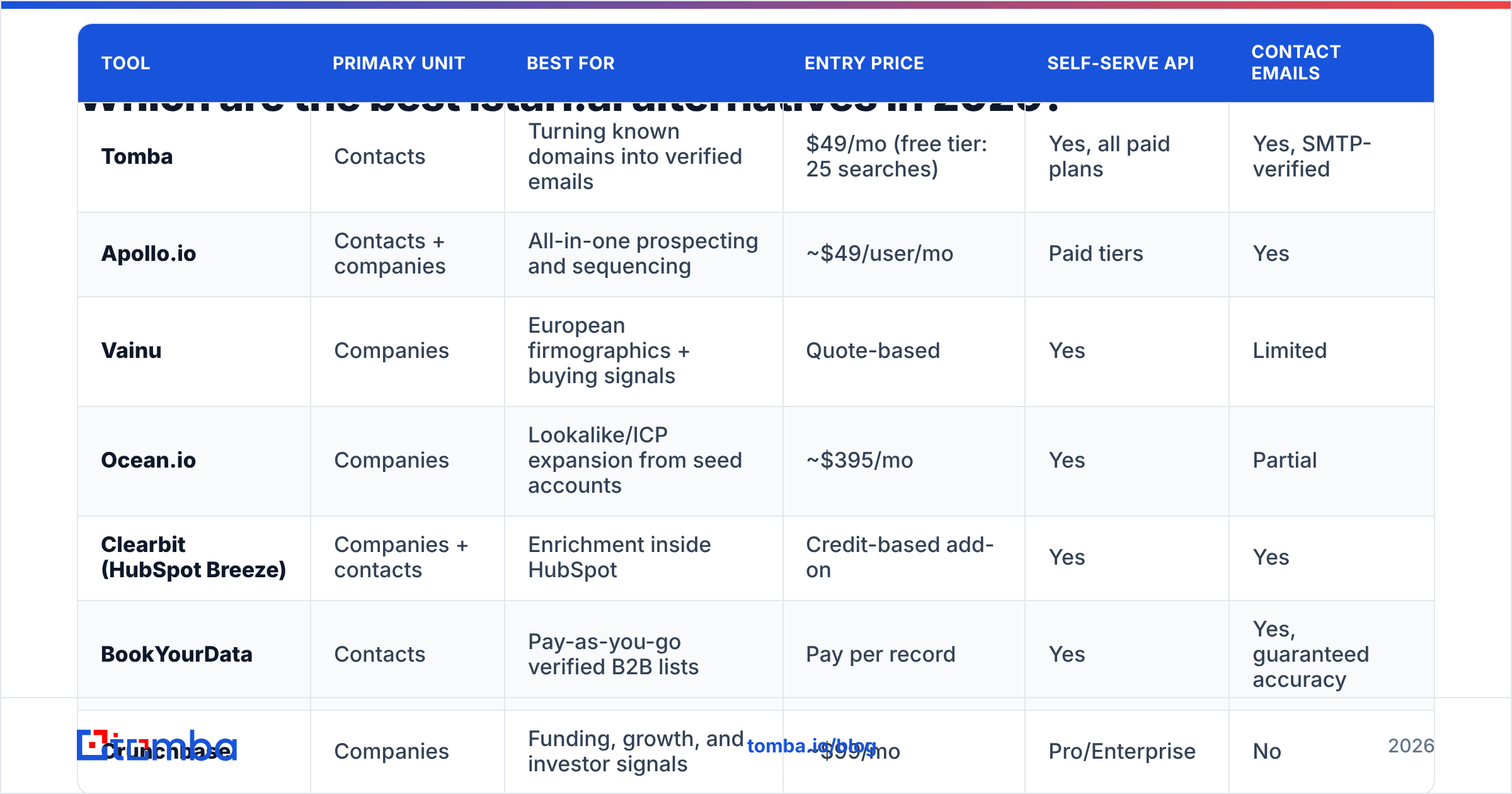
| Tool | Primary unit | Best for | Entry price | Self-serve API | Contact emails |
|---|---|---|---|---|---|
| Tomba | Contacts | Turning known domains into verified emails | $49/mo (free tier: 25 searches) | Yes, all paid plans | Yes, SMTP-verified |
| Apollo.io | Contacts + companies | All-in-one prospecting and sequencing | ~$49/user/mo | Paid tiers | Yes |
| Vainu | Companies | European firmographics + buying signals | Quote-based | Yes | Limited |
| Ocean.io | Companies | Lookalike/ICP expansion from seed accounts | ~$395/mo | Yes | Partial |
| Clearbit (HubSpot Breeze) | Companies + contacts | Enrichment inside HubSpot | Credit-based add-on | Yes | Yes |
| BookYourData | Contacts | Pay-as-you-go verified B2B lists | Pay per record | Yes | Yes, guaranteed accuracy |
| Crunchbase | Companies | Funding, growth, and investor signals | ~$99/mo | Pro/Enterprise | No |
| 6sense | Accounts | Enterprise intent and ABM orchestration | Enterprise quote | Yes | Yes |
Tomba — best when you already know the companies#
Tomba solves the half of the job Istari.ai leaves open. Give it a domain and it returns the people: names, roles, and verified emails. The email finder works from a domain plus a name. Domain search returns every address it can find at a company. The verifier runs SMTP checks, including catch-all handling, before anything reaches your sequencer.
Most teams use a simple pattern. Keep a company source, even a scraped list or a Crunchbase export. Then push those domains through the Tomba API to attach contacts and data enrichment. Pricing is public: free at 25 searches a month, then $49/mo Starter, $99/mo Growth, and $249/mo Pro. You can test your own ICP for the cost of lunch. Full Tomba pricing is listed on the site.
Where it isn't the answer: Tomba will not build a target list from a description of a market. It is a contact and enrichment layer, not a market map.
Apollo.io — best all-in-one for outbound teams#
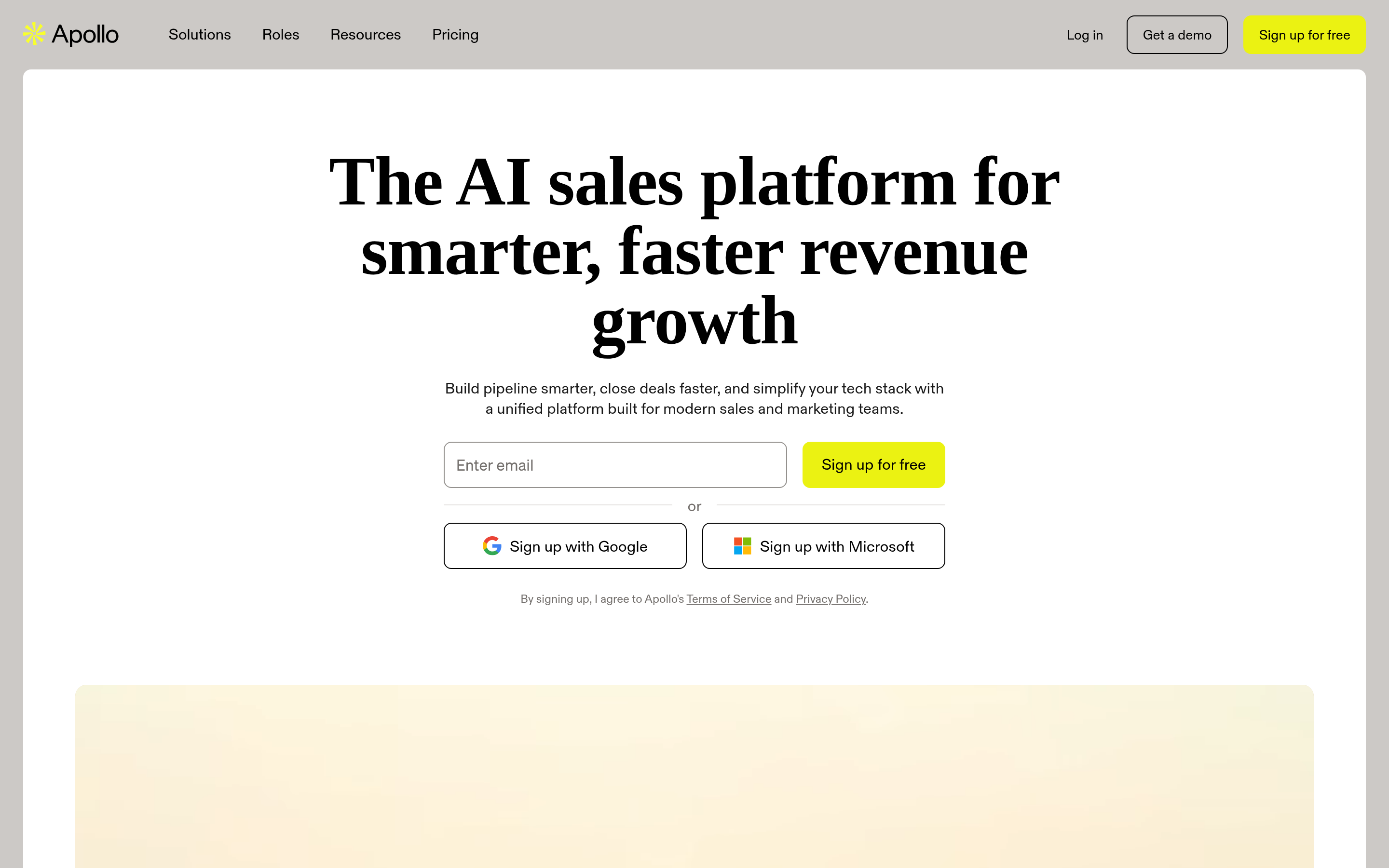
Apollo bundles a big contact database, filters, sequences, and a dialer. If you want one seat that goes from "pick an ICP" to "email sent," it is the least messy option. The trade-off is data quality. Apollo records are crowd-sourced at scale, so you should verify before you send. Many teams pair Apollo for discovery with a separate verifier.
Vainu — the closest philosophical match#
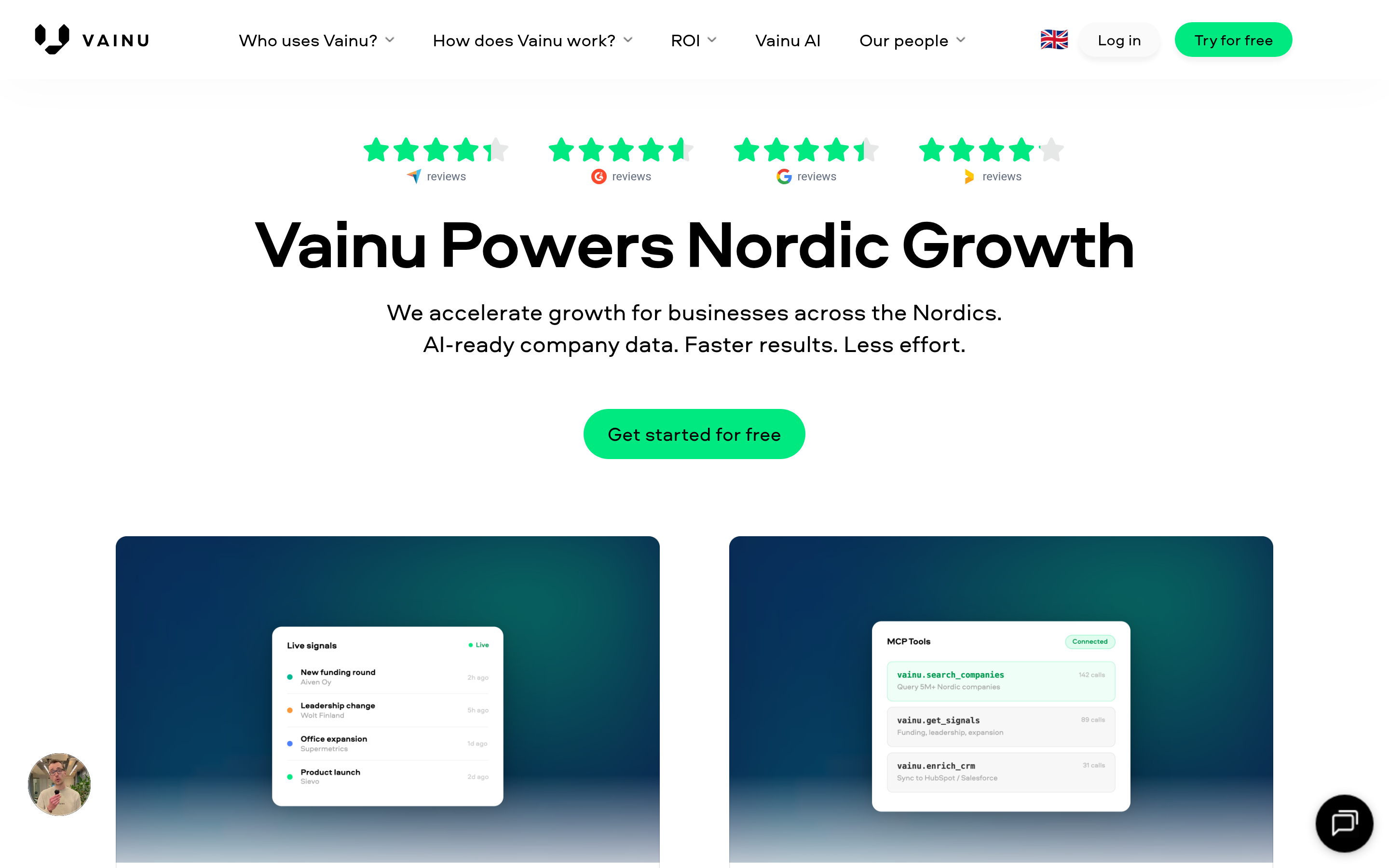
Vainu is the nearest match to Istari.ai on this list. It blends company data with web-derived buying signals. It is strongest in the Nordics and wider Europe, and it plugs into CRMs well. If you liked the Istari.ai approach but want a more sales-native UI, book this demo first. Pricing is quote-based, so expect the same procurement friction.
Ocean.io — best for ICP lookalikes#
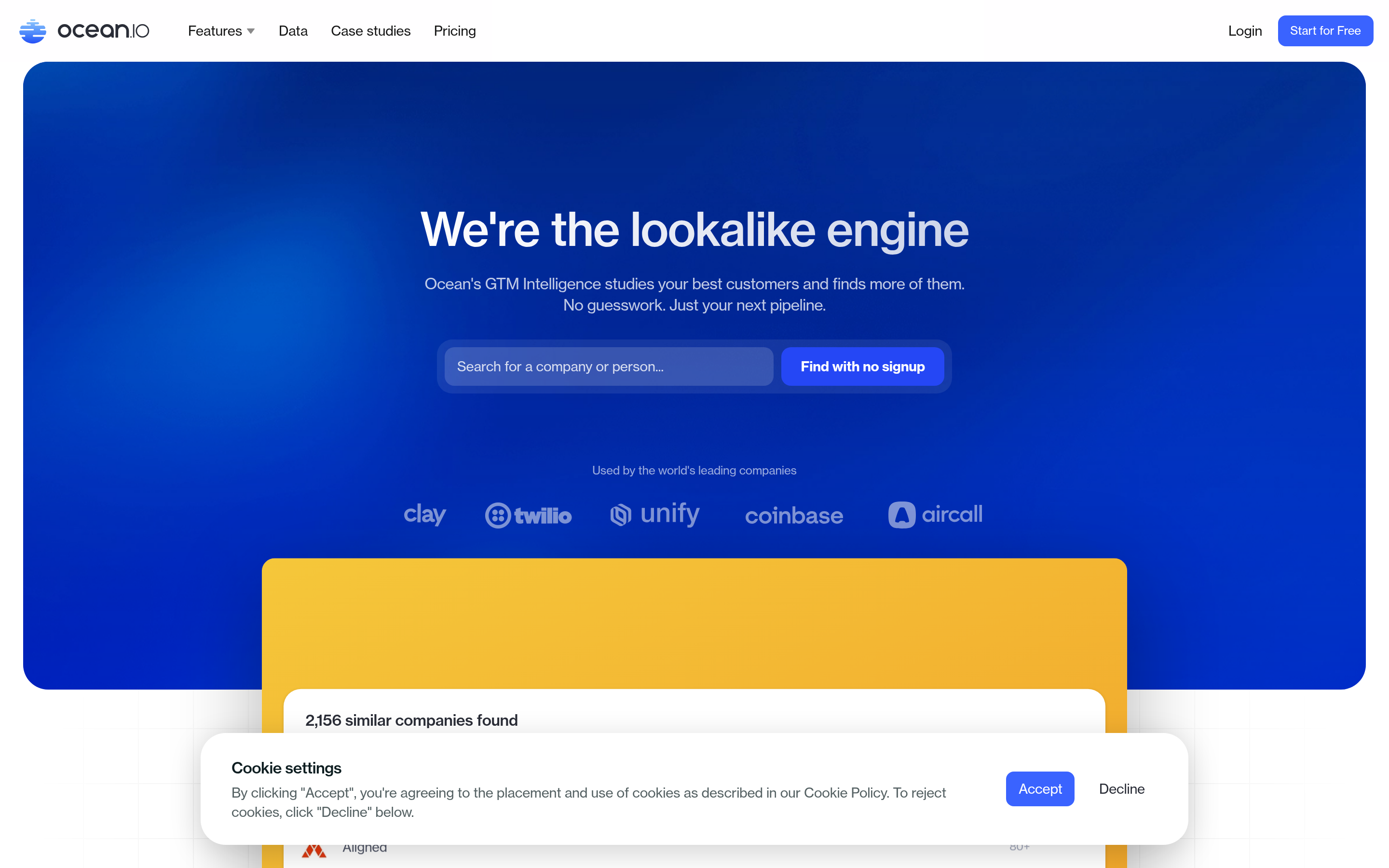
Ocean.io does one trick well: "give me 50 companies that look like these 10." If you need market expansion rather than market description, that fits better than website classification. It works at company level, so you still need a contact source.
Clearbit / HubSpot Breeze Intelligence — best if you live in HubSpot#
Clearbit is now part of HubSpot and ships as Breeze Intelligence. If your CRM is HubSpot, native enrichment on form fill is hard to beat. If your CRM is something else, the stand-alone story is weaker than before. Read the current HubSpot product docs before you assume old Clearbit behavior still applies. Teams who want the old flexibility often land on a Clearbit alternative with a plain API.
BookYourData — best for pay-as-you-go verified lists#
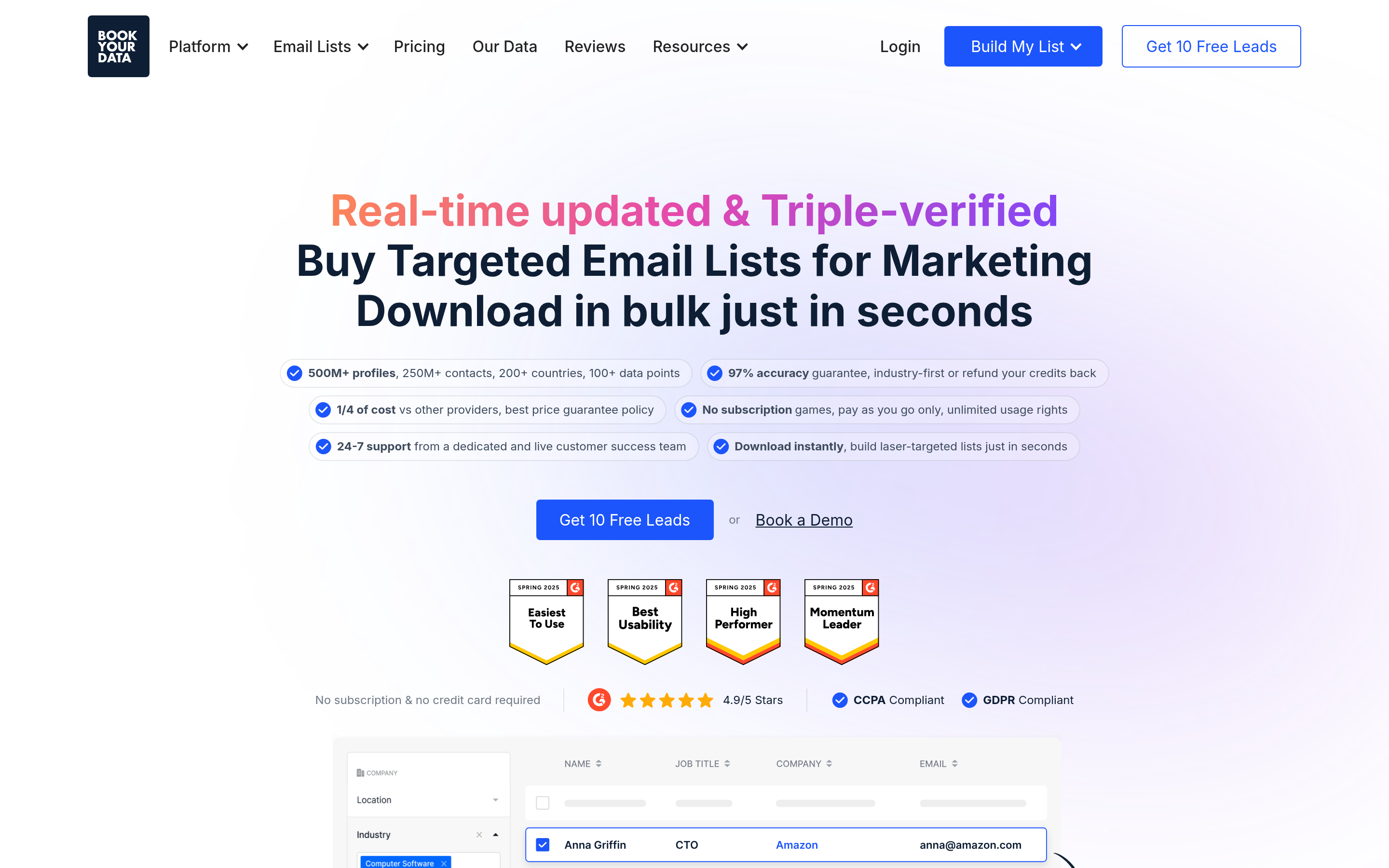
BookYourData flips the model. You filter, you see the count, you buy the records, and you own them. There is no seat fee and no credit expiry. The platform also backs its records with an accuracy guarantee. For one defined campaign against one defined segment, buying a clean list outright is often cheaper. For always-on prospecting, a subscription usually wins.
Crunchbase — best for funding and growth signals#
If your trigger is "raised a Series A in the last 90 days," Crunchbase is the source. No amount of website mining copies it. It is company-only and holds no emails, so treat it as an input. Check current plans on crunchbase.com before you budget, since tiers have shifted.
6sense — best for enterprise ABM#
6sense covers intent data, account scoring, and orchestration. It suits teams with a real ABM program and the staff to run it. Pricing is enterprise and rollout takes quarters. It only makes your shortlist of Istari.ai alternatives if you are replacing a whole GTM stack.

Is a web-mining platform worth it versus a contact database?#
Run the math on your own funnel, not on a vendor deck.
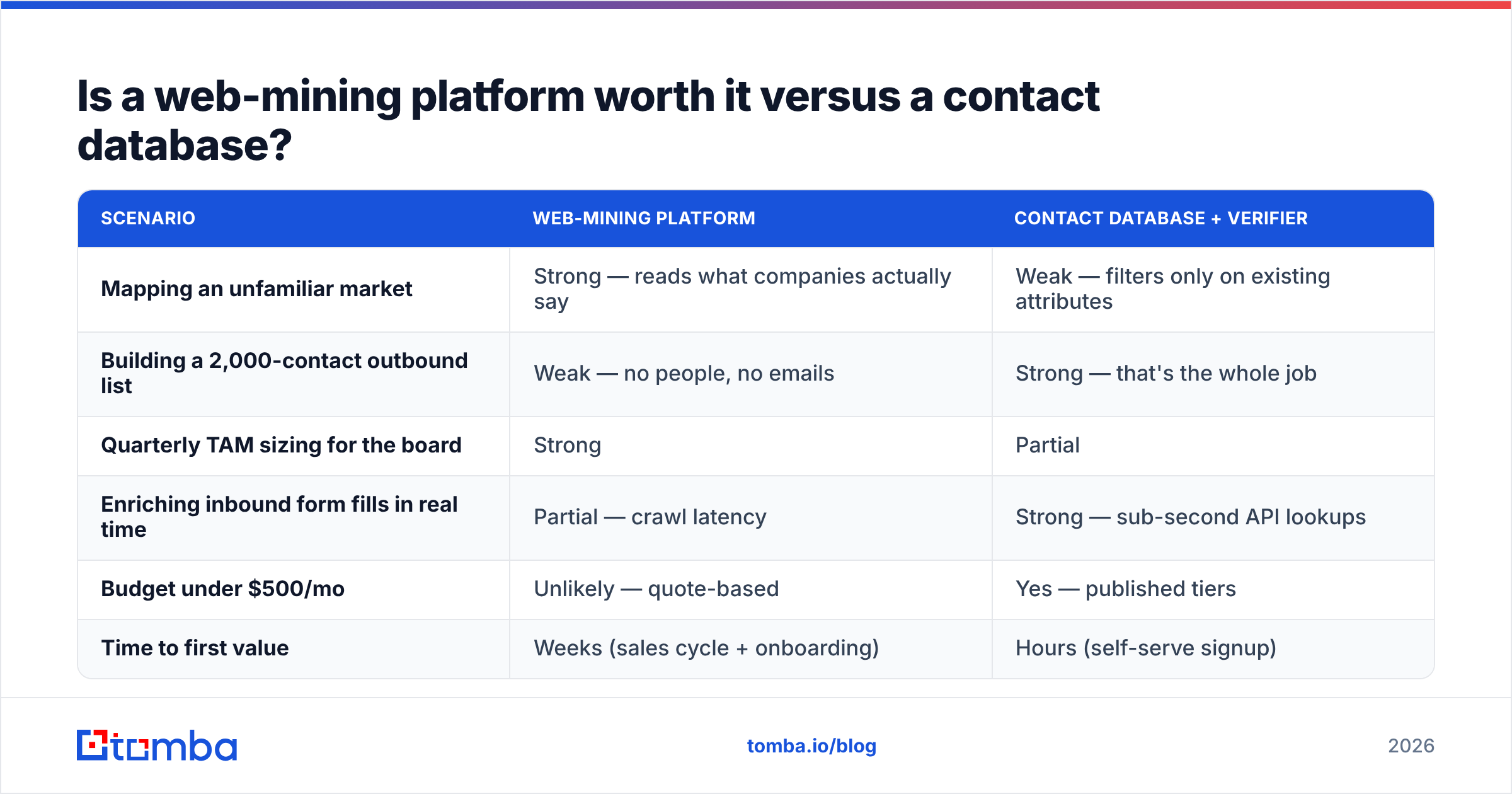
| Scenario | Web-mining platform | Contact database + verifier |
|---|---|---|
| Mapping an unfamiliar market | Strong — reads what companies actually say | Weak — filters only on existing attributes |
| Building a 2,000-contact outbound list | Weak — no people, no emails | Strong — that's the whole job |
| Quarterly TAM sizing for the board | Strong | Partial |
| Enriching inbound form fills in real time | Partial — crawl latency | Strong — sub-second API lookups |
| Budget under $500/mo | Unlikely — quote-based | Yes — published tiers |
| Time to first value | Weeks (sales cycle + onboarding) | Hours (self-serve signup) |
The pattern is clear. Web mining wins at understanding a market. Contact data wins at acting on one. Most Istari.ai alternatives sit firmly in one camp or the other. Teams that drop a web-mining contract usually bought a research tool to fix a pipeline problem.
Want buyer signal instead of vendor claims? Filter reviews by company size on G2. The gap between enterprise and SMB scores is where the truth usually sits.
What should you do next?#
Pick by the bottleneck you actually have.
- "I don't know who to target." Ocean.io or Vainu. Crunchbase if funding is your trigger.
- "I know the accounts, I need the people." An email finder with a public API and built-in checks.
- "I want one tool and one bill." Apollo, plus a verify step before each send.
- "I need 5,000 clean records once, not a subscription." BookYourData's pay-as-you-go model.
- "Everything lives in HubSpot." Breeze Intelligence.
Most evaluations of Istari.ai alternatives land on the second case. Start with Tomba's Email Finder. Drop in a domain and a name, and get a verified address back. Then wire the same call into your CRM through the API. The free tier gives you 25 searches, which is enough to see real coverage before you sign anything.
Related guides#
// get started
Find, verify and enrich your first contacts today
Start on the free plan with 25 searches a month, then scale when your team is ready.
Free plan · No credit card required · GDPR & CCPA
// about the author