Istari AI vs LeadMine: Which B2B Data Tool Wins in 2026?
Istari AI sells company intelligence scraped from the open web. LeadMine sells contact records you can email today. They are not the same product — and picking wrong costs you a quarter of pipeline.
Istari AI vs LeadMine is a fair question built on a shaky premise. The two tools barely compete. Istari AI picks the companies. LeadMine finds the people. Here is how they differ, what they cost, and which half of the job each one does.
TL;DR
- Istari AI vs LeadMine is not a like-for-like fight. Istari AI is web-derived company intelligence — it tells you which firms match a profile.
- LeadMine is a contact database and email finder — it tells you who to email inside those firms.
- Stuck on "we don't know which 400 companies to target"? Istari AI is the closer fit.
- Stuck on "we have the account list but no working addresses"? LeadMine is.
- Pricing is not comparable. Istari AI is quote-based, sold like a data subscription. LeadMine sells self-serve credits.
- Neither tool replaces a verification layer. Company data goes stale each quarter. Contact data goes stale each month.
- Most teams that ran this comparison bought both kinds of tool. Budget for two line items, not one.
Istari AI vs LeadMine: what does each tool do?#
Start with the category confusion. It is the single biggest reason teams waste a trial.
Istari AI is a German data company. It reads company websites at scale and turns that text into firmographic and technographic signals.
The pitch is simple. A company's own website is the freshest, least gamed description of what it does. So instead of stale SIC codes or self-reported CRM fields, you derive industry, activity, tech adoption, and digital maturity from crawled text. The output describes organizations, not individuals, as a dataset or an API feed. It has leaned toward market research, economic analysis, and enterprise account selection rather than daily SDR work.
LeadMine sits at the other end of the funnel. It is a B2B contact database with a search interface, a Chrome extension, and an email finder.
You filter by job title, company, location, and industry. It returns named people, business email addresses, and an internal confidence score. It is the kind of tool a two-person outbound team buys on a credit card on a Tuesday.
So Istari AI vs LeadMine is less a head-to-head and more a fork in the road. Are you buying targeting or reachability?
Why the account-vs-contact split matters so much#
Because the failure modes differ, and so does the cost of guessing wrong.
Buy contact data without good account selection and your campaign lands fast, cheap, and in the wrong inboxes. Open rates look fine. Reply rates look fine. Pipeline is zero. Nothing in the tooling tells you it broke.
Buy company intelligence with no contact layer and you get a pretty account list nobody can work. SDRs burn forty minutes per account hunting one VP's email. The list rots before it is half-worked.
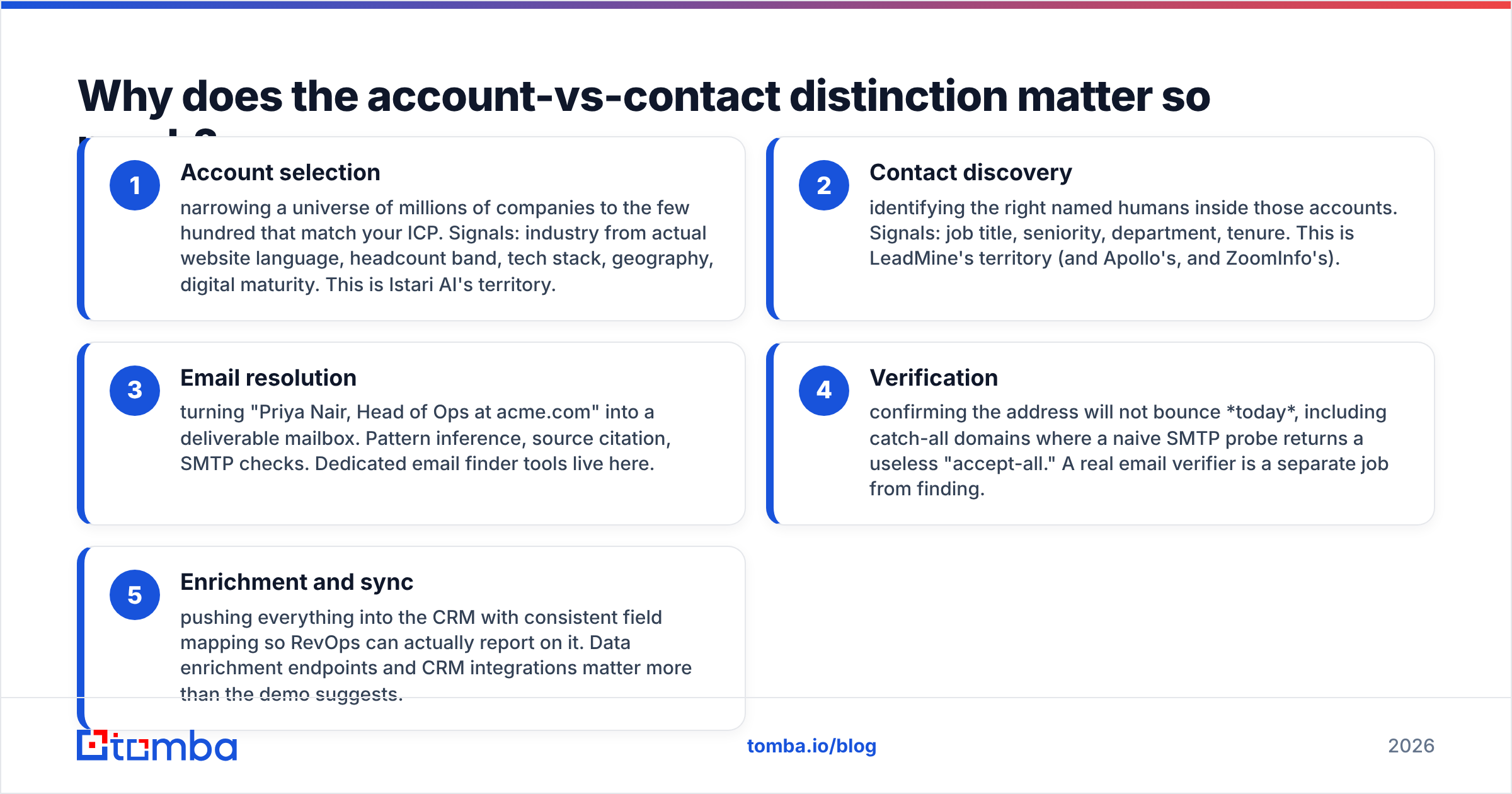
Here is the practical division of labour:
- Account selection — cut millions of companies down to the few hundred that fit your ICP. Signals: industry from real website language, headcount band, tech stack, geography, digital maturity. This is Istari AI's territory.
- Contact discovery — find the right named humans inside those accounts. Signals: title, seniority, department, tenure. This is LeadMine's territory (and Apollo's, and ZoomInfo's).
- Email resolution — turn "Priya Nair, Head of Ops at acme.com" into a real mailbox. Pattern inference, source citation, SMTP checks. Email finder tools live here.
- Verification — confirm the address will not bounce today. Catch-all domains make that harder than it looks. A real email verifier is a separate job from finding.
- Enrichment and sync — push it all into the CRM with clean field mapping, so RevOps can report on it. Data enrichment endpoints and CRM integrations matter more than the demo suggests.
Vendors blur these five steps in their marketing. Your procurement process should not.

Istari AI vs LeadMine: the head-to-head table#
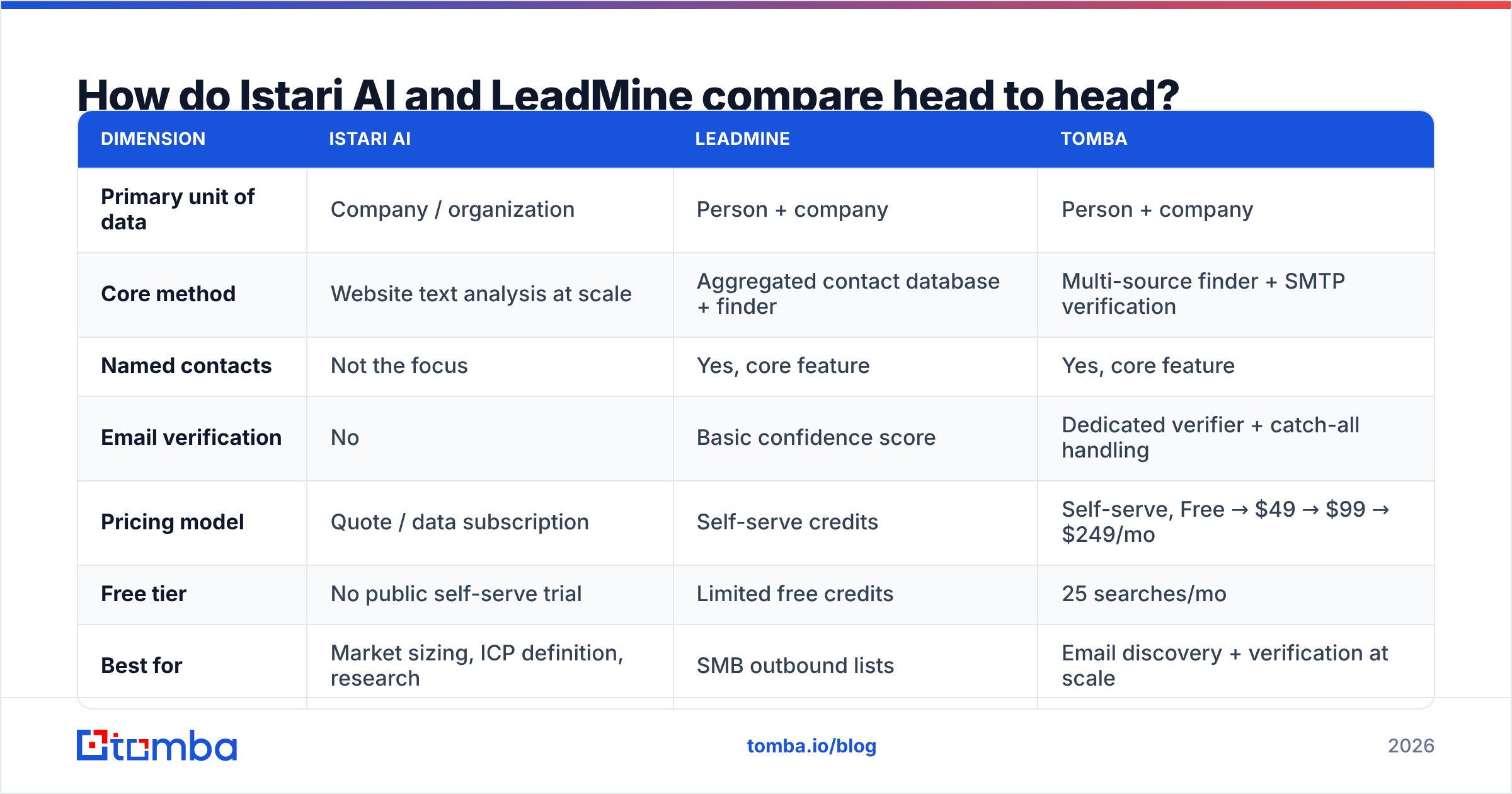
Read this as a shape-of-the-market view, not a spec sheet. Both vendors change packaging. Istari AI publishes no self-serve price card, so any cost figure is directional until you get a quote.
| Dimension | Istari AI | LeadMine | Tomba |
|---|---|---|---|
| Primary unit of data | Company / organization | Person + company | Person + company |
| Core method | Website text analysis at scale | Aggregated contact database + finder | Multi-source finder + SMTP verification |
| Named contacts | Not the focus | Yes, core feature | Yes, core feature |
| Email verification | No | Basic confidence score | Dedicated verifier + catch-all handling |
| Pricing model | Quote / data subscription | Self-serve credits | Self-serve, Free → $49 → $99 → $249/mo |
| Free tier | No public self-serve trial | Limited free credits | 25 searches/mo |
| Best for | Market sizing, ICP definition, research | SMB outbound lists | Email discovery + verification at scale |
| API access | Yes, data feeds | Yes | Yes, plus CLI, Sheets, Excel |
| Typical buyer | Analyst, RevOps, strategy | Founder, SDR, agency | Growth, RevOps, developers |
Two things jump out of the Istari AI vs LeadMine table.
First, the overlap is narrow. You are not picking between two versions of one product. You are picking which half of the problem a vendor solves for you.
Second, the buying motion differs. Istari AI's quote model implies a scoping call, a defined universe of companies, and a contract term. LeadMine's credit model means you can test it this afternoon. If you need lists next week, that gap decides for you.

Which one has better data accuracy?#
Wrong question, slightly. They are accurate about different things, and they decay at different speeds.
Istari AI's accuracy rests on source freshness. A company updates its own website, so a label drawn from it beats a code assigned at registration and never revisited.
It still fails in known ways. Thin or outdated sites. Holding companies whose domain describes the parent, not the operating unit. Non-English markets, where crawl-and-classify gets harder. Industry and tech stack move slowly, so a quarterly refresh is fine.
Contact data is a different animal. B2B records decay roughly 2–3% per month through job changes, restructures, and domain moves. Reviews on G2 show the steady gap between advertised accuracy and real bounce rates.
A database-first tool like LeadMine is only as good as its last refresh on the record you pulled. A confidence score is a useful hint. It is not proof that the mailbox accepts mail today.
So the Istari AI vs LeadMine accuracy debate ends in the same place every time. Whatever the source, verify before you send. Verification costs a fraction of a cent per record. A 12% bounce rate costs domain reputation that takes weeks to rebuild.

Two accuracy traps worth naming:
- Catch-all domains. Many mid-market domains accept mail for any address, so a naive check marks
asdfgh@company.comas valid. Tools that skip catch-all handling quietly inflate their pass rates. A dedicated catch-all verifier is the difference between a real number and a flattering one. - Pattern guessing sold as discovery. Guessing
first.last@domain.comis fine, but only if the tool tests it and says it was inferred. Ask every vendor whether results carry a source citation. The good ones say yes at once.
Istari AI vs LeadMine pricing: how do credits compare?#
Here is where the two products stop being comparable in any clean way.
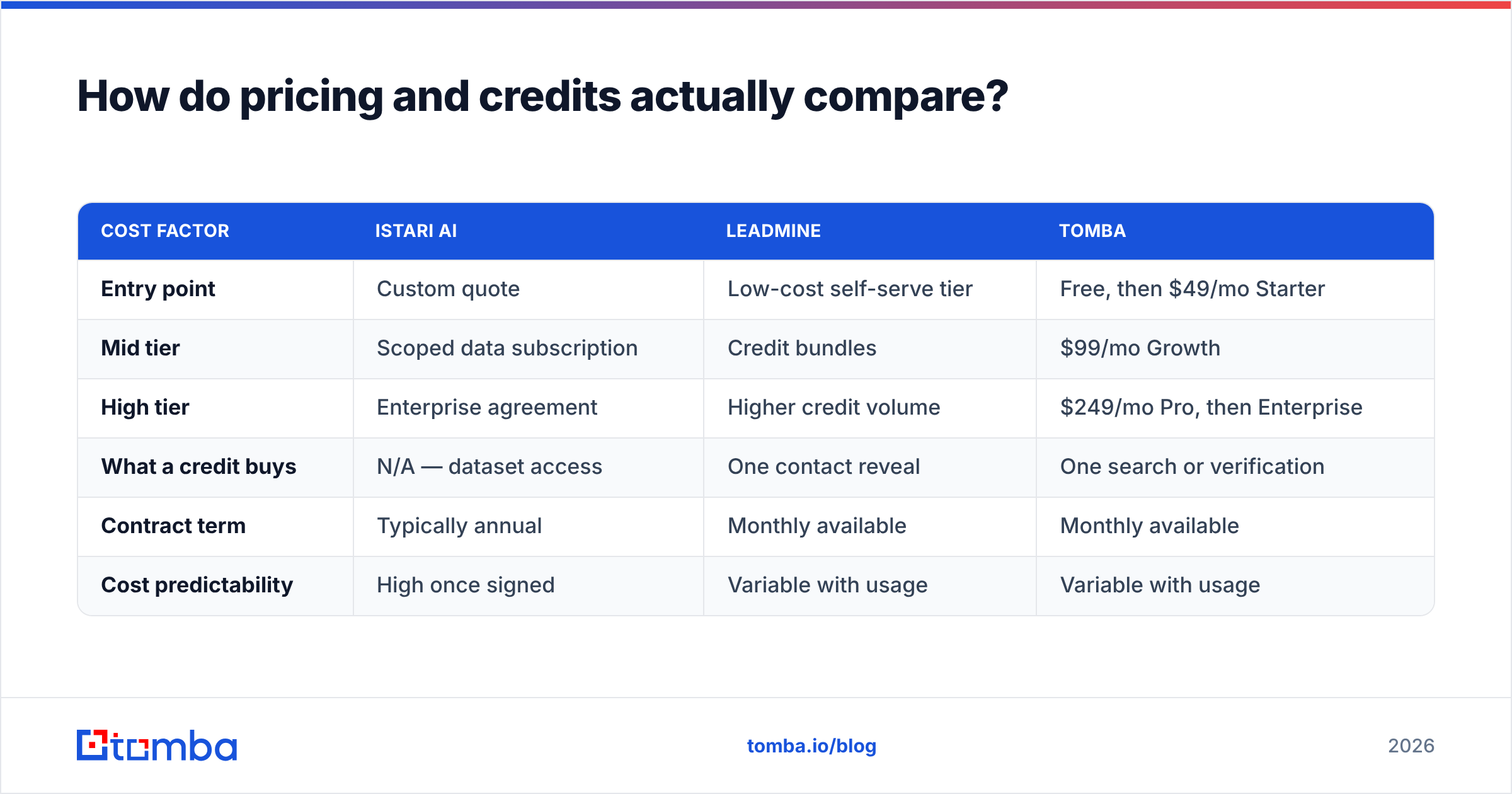
| Cost factor | Istari AI | LeadMine | Tomba |
|---|---|---|---|
| Entry point | Custom quote | Low-cost self-serve tier | Free, then $49/mo Starter |
| Mid tier | Scoped data subscription | Credit bundles | $99/mo Growth |
| High tier | Enterprise agreement | Higher credit volume | $249/mo Pro, then Enterprise |
| What a credit buys | N/A — dataset access | One contact reveal | One search or verification |
| Contract term | Typically annual | Monthly available | Monthly available |
| Cost predictability | High once signed | Variable with usage | Variable with usage |
The honest read: Istari AI is budgeted like a data subscription, LeadMine like a utility. Seed-stage teams will find the quote model out of reach and out of proportion. A research function at a larger company will find per-credit pricing flimsy and hard to govern.
For a reference point, Tomba pricing runs Free (25 searches a month), Starter at $49, Growth at $99, and Pro at $249 a month, with Enterprise quoted. That is roughly the 2026 market band for self-serve finder-plus-verifier tooling. Use it as a sanity check when a vendor's number lands far outside it.
Which should you pick for your use case?#
Match the tool to the real bottleneck, not to the demo you liked most.
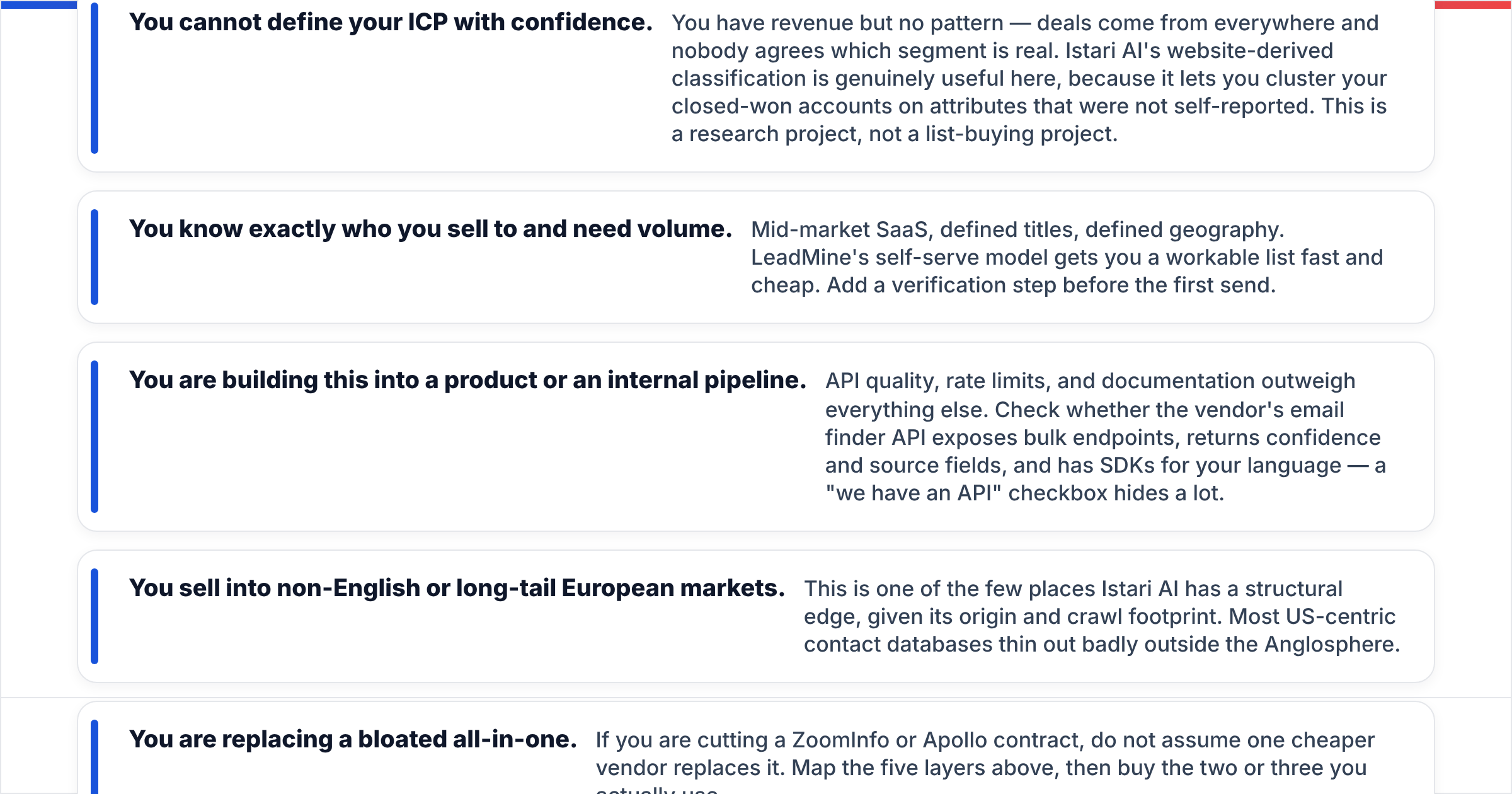
You cannot define your ICP. Deals come from everywhere and nobody agrees which segment is real. Istari AI helps here. Its website-derived labels let you cluster closed-won accounts on traits nobody self-reported. Treat it as a research project, not a list purchase.
You know your buyer and need volume. Mid-market SaaS, set titles, set geography. LeadMine gets you a workable list fast and cheap. Add a verification step before the first send.
You are building a product or an internal pipeline. API quality, rate limits, and docs outweigh everything else. Check whether the email finder API exposes bulk endpoints, returns confidence and source fields, and ships an SDK for your language.
You sell outside the Anglosphere. This is one of the few spots where Istari AI has a structural edge, given its origin and crawl footprint. Most US-centric contact databases thin out badly in long-tail European markets.
You are cutting a bloated all-in-one. Do not assume one cheaper vendor replaces ZoomInfo or Apollo. Map the five layers above, then buy the two or three you actually use.
Do you need both — and what does the stack look like?#
Most Istari AI vs LeadMine evaluations end with a stack, not a winner. Though not always with these two vendors.
A workable 2026 stack has four parts. One source for account selection (Istari AI, another market-intelligence feed, or intent data). One for contact discovery and email resolution. One for verification. Your CRM as the system of record. The classic mistake is buying two tools for layer two and none for layer four.
A sequence that avoids over-buying:
- Run one quarter with a self-serve contact tool and manual account picking. Measure reply rate by segment.
- Steady reply rates across segments? Targeting is fine. Spend on volume and verification, not on intelligence.
- Wild swings you cannot explain? Targeting is the bottleneck. That is when a company-intelligence subscription earns its price.
- Only then negotiate an annual data contract, with the segment hypothesis already written down.
Order matters. Company intelligence is easy to buy and hard to operationalize. Teams that buy it first often end up with a dashboard nobody opens.
What about deliverability once you have the data?#
Good data is necessary, not sufficient. Three things decide whether a list converts.
- Bounce rate under 2%. Above that, mailbox providers throttle you no matter how good the copy is. That is a verification problem, not a writing problem.
- Authentication in order. SPF, DKIM, and DMARC aligned on the sending domain. Clean data cannot rescue an unauthenticated domain. HubSpot's deliverability guidance covers the baseline well.
- Sane volume. A 4,000-contact list should not go out in one batch from a domain that sent 40 emails last month.
Pulling from a database-first tool like LeadMine? Run the export through verification before it reaches your sequencer. Working from an Istari AI account list? You still have to find and verify each address. The account list is the input, not the output.
The bottom line on Istari AI vs LeadMine#
Istari AI wins when the question is which companies. LeadMine wins when the question is which people, cheaply, today. They compete less than the search query suggests. Teams that force an either/or usually end up with half a workflow.
Either way, the contact layer is where money leaks. Want addresses that are sourced rather than guessed, and verified rather than scored? Start with the Tomba Email Finder. The free tier gives you 25 searches a month. That is enough to benchmark it against any list you are thinking of buying.
Related guides#
Ready to find emails that actually work?
Join 150,000+ professionals who stopped guessing and started sending. Free credits on signup — no credit card required.
Get the Tomba newsletter
Practical outbound tactics and product updates — once every two weeks.
About the author