Istari.ai vs LeadRocks: Which B2B Data Tool Wins in 2026?
Istari.ai maps markets with web-based AI. LeadRocks hands you LinkedIn-sourced contacts. They are not substitutes — here is which one fits your GTM motion, and where both leave gaps you still have to fill.
Istari.ai vs LeadRocks is the wrong fight. One tool picks your accounts. The other finds your contacts. Here is how to tell which one you need.
TL;DR
- Istari.ai vs LeadRocks is not a real matchup. Istari.ai is web-AI market intelligence. It scores companies. LeadRocks is a contact database. It hands you people, with emails and phone numbers.
- Pick Istari.ai if your problem is "which 3,000 companies should we even talk to?" Think TAM sizing, market maps, tech screening, deep firm data.
- Pick LeadRocks if your problem is "we know the accounts, we need the inboxes." It gives SDR-ready contacts at a low price, with a LinkedIn workflow.
- Neither one fixes contact accuracy. Bulk B2B databases decay 25–30% a year. Any list you export still needs a check before it touches your sending domain.
- Most teams end up with a stack, not a winner. You need an account layer, a contact layer, and a verify layer. Tomba is the verify layer.
What are Istari.ai and LeadRocks, exactly?#
"Istari.ai vs LeadRocks" is a confusing search for one reason. Both tools get filed under "B2B data." Yet they sit at opposite ends of the funnel.
Istari.ai is a German company-intelligence platform. It runs on what it calls Web-AI. It crawls millions of company websites and reads them. Language models then sort each company by what it actually does: industry, tech use, product focus, and signs of new work. The output is firm-level data — screening lists, market maps, ecosystem reports. Buyers tend to be economic agencies, consultants, investors, strategy teams, and GTM leads. They need proof behind their segments, not a CSV of names.
LeadRocks is a plain B2B contact database. It claims 100M+ profiles with work emails, personal emails, and phone numbers. Most of that data is LinkedIn-style. You search by job title, company, location, industry, or headcount. Then you export the matches. You can also pull contacts from a LinkedIn search page with its Chrome extension. Buyers tend to be founders, agencies, and small sales teams. They want volume without an enterprise contract.
Put it bluntly. Istari.ai answers who is worth targeting. LeadRocks answers who do I email. Mix the two up and you pay for the wrong layer, then blame the data.
Which layer of the GTM stack does each tool sit in?#
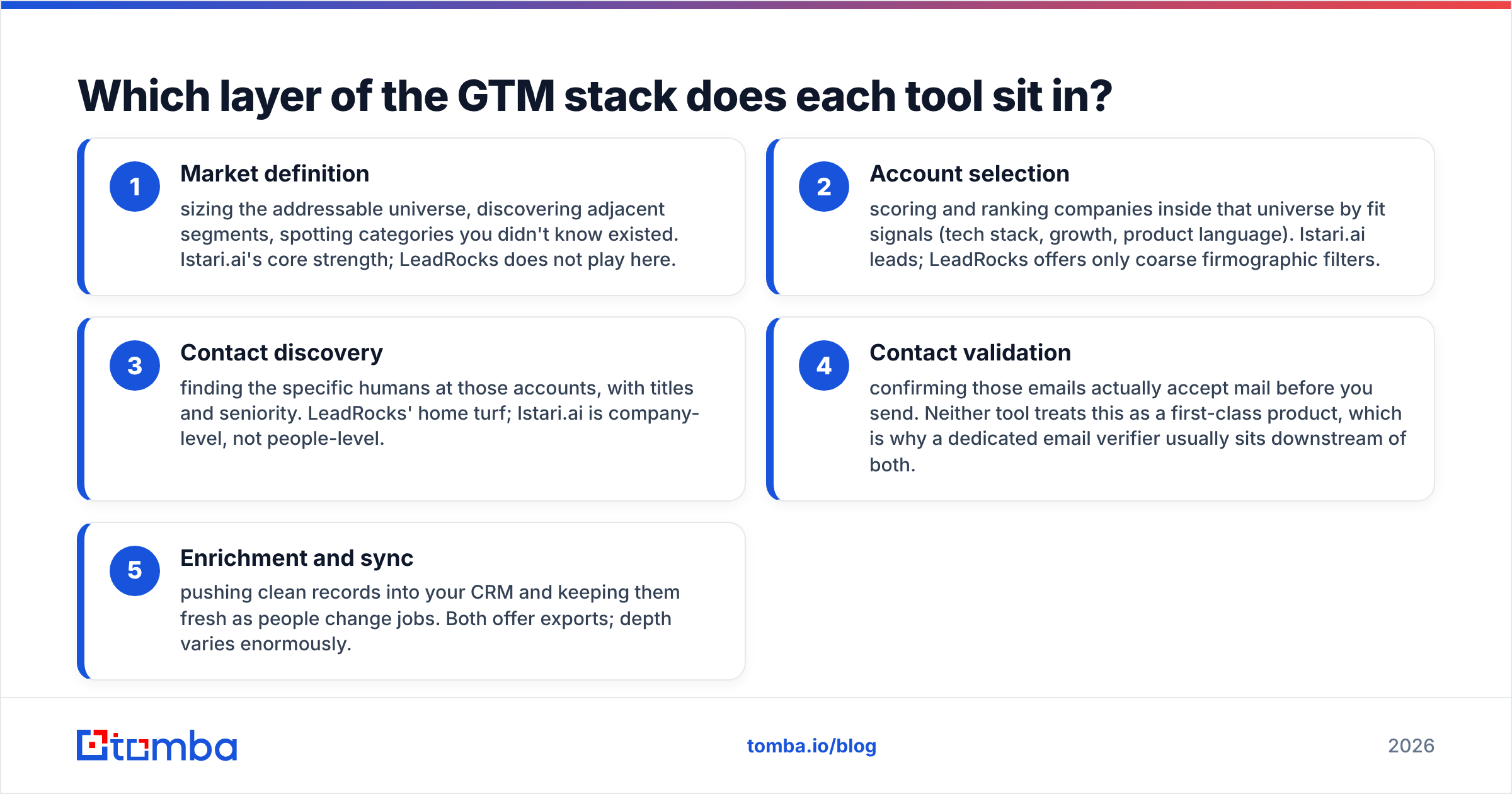
Map the stack first. Almost every B2B data problem is one of these five jobs. No single vendor does all five well.
- Market definition — sizing the market, finding new segments, spotting groups you did not know existed. This is Istari.ai's core strength. LeadRocks does not play here.
- Account selection — ranking companies by fit signals, such as tech stack, growth, or product language. Istari.ai leads. LeadRocks offers only rough firm filters.
- Contact discovery — finding the people at those accounts, with titles and seniority. This is LeadRocks' home turf. Istari.ai stops at the company level.
- Contact validation — proving those emails accept mail before you send. Neither tool treats this as a real product. That is why a dedicated email verifier sits downstream of both.
- Enrichment and sync — pushing clean records into your CRM and keeping them fresh as people move jobs. Both offer exports. Depth varies a lot.
Name the one job that blocks you. The buying choice then takes about ten minutes.
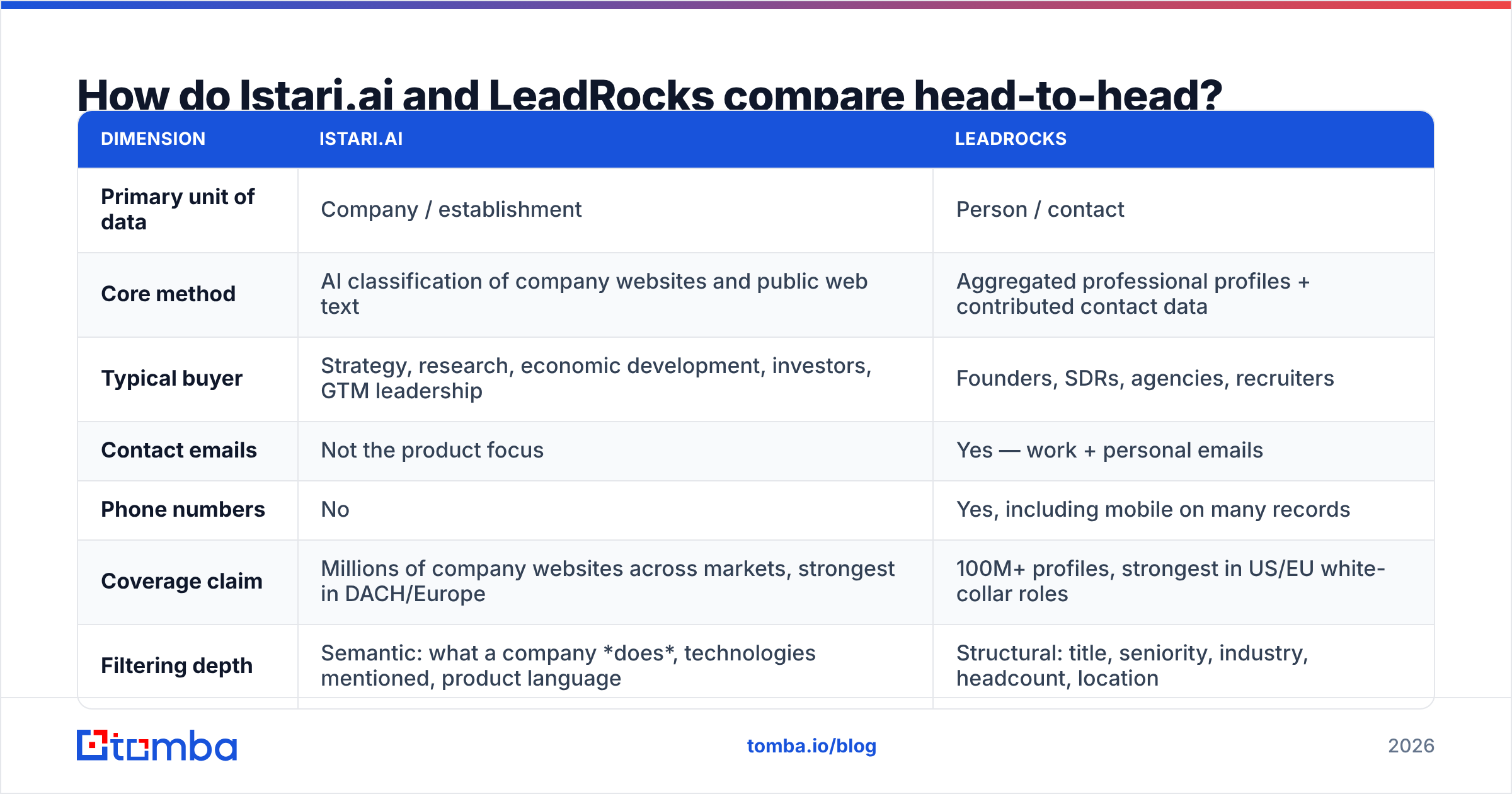
Istari.ai vs LeadRocks: how do they compare head-to-head?#
| Dimension | Istari.ai | LeadRocks |
|---|---|---|
| Primary unit of data | Company / establishment | Person / contact |
| Core method | AI classification of company websites and public web text | Aggregated professional profiles + contributed contact data |
| Typical buyer | Strategy, research, economic development, investors, GTM leadership | Founders, SDRs, agencies, recruiters |
| Contact emails | Not the product focus | Yes — work + personal emails |
| Phone numbers | No | Yes, including mobile on many records |
| Coverage claim | Millions of company websites across markets, strongest in DACH/Europe | 100M+ profiles, strongest in US/EU white-collar roles |
| Filtering depth | Semantic: what a company does, technologies mentioned, product language | Structural: title, seniority, industry, headcount, location |
| Browser extension | No | Yes — LinkedIn / Sales Navigator capture |
| Self-serve signup | No public self-serve tier | Yes, instant |
| Pricing model | Quote-based, project or annual licence | Monthly/annual credit tiers, frequent lifetime deals |
| Output format | Reports, screening lists, API/data delivery | CSV export, CRM push, in-app lists |
| Best at | Deciding which accounts deserve attention | Getting contacts into a sequence fast |
| Weakest at | Contact-level execution | Explaining why an account is a good fit |
Istari.ai vs LeadRocks is not a feature race. The two tools barely overlap. Neither can "beat" the other on a checklist. They win on use case.
Is Istari.ai worth it for a sales team?#
It depends on one thing. Is your segmentation already solved?
Istari.ai earns its keep when standard firm filters fail. SIC and NAICS codes are blunt. A company filed under "manufacturing" could be a sheet-metal shop or an industrial IoT vendor. No headcount filter tells you which. Istari.ai reads the company's own website and infers what it does from the words on the page. That is far better at this split. Do you sell a technical product into a narrow niche? Then this is the class of tool that stops you wasting a quarter on the wrong list.
It is the wrong buy in one case. You already know your ICP. You have a named-account list from your VP. You just need people to email. Buying a market-intelligence platform to solve that is slow and costly. You get a lovely market map and still zero emails.
Weigh the sales motion too. There is no public self-serve tier. Expect a scoping call, a quote, and a yearly or project licence. That is normal for research-grade data. It also means procurement, not a credit card. Budget for it. Do not expect to trial it on a Tuesday afternoon.
Is LeadRocks good enough for serious outbound?#
LeadRocks is good at what it claims to be good at. It is cheap, fast, self-serve contact volume. For a two-person startup sending 500 emails a week, that is often the right call. The LinkedIn extension matches how most SDRs work: search, capture profiles, reveal contacts. The price is a fraction of enterprise sales-intelligence tools.
The honest caveats apply to every pooled contact database:
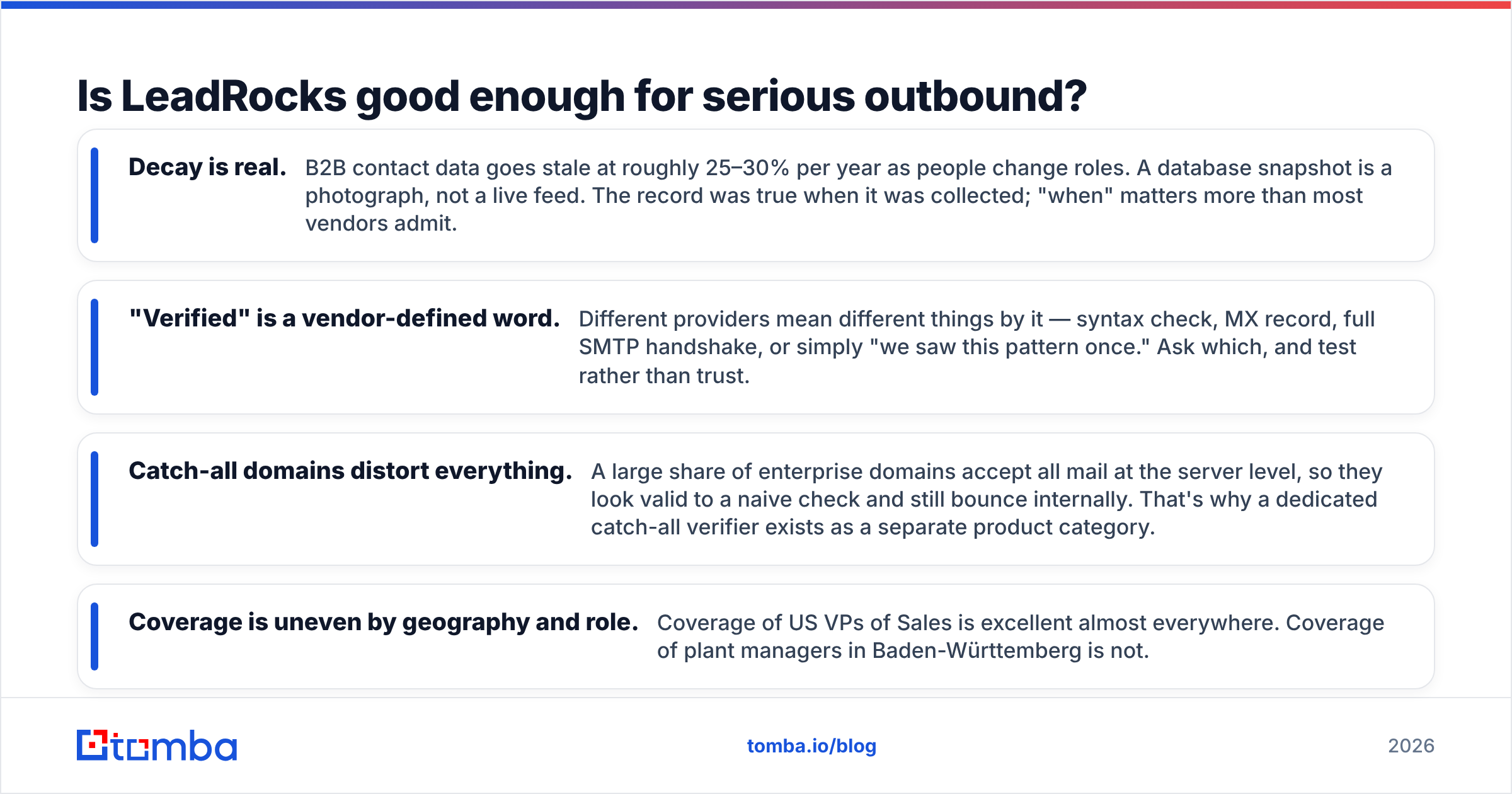
- Decay is real. B2B contact data goes stale at 25–30% a year as people move jobs. A database is a photo, not a live feed. The record was true when it was taken. "When" matters more than most vendors admit.
- "Verified" means whatever the vendor wants. It can mean a syntax check, an MX record, a full SMTP handshake, or "we saw this pattern once." Ask which. Then test it rather than trust it.
- Catch-all domains skew everything. Many company domains accept all mail at the server. They look valid to a simple check and still bounce inside. That is why a catch-all verifier is its own product category.
- Coverage is uneven by region and role. US VPs of Sales are covered well almost anywhere. Plant managers in Baden-Württemberg are not.
None of this makes LeadRocks a bad tool. It makes it a source. Sources need a quality gate after them. Check any vendor's standing on G2's sales intelligence category before you sign a year. Reviews on coverage and refunds age faster than feature pages do.
What does each one actually cost?#
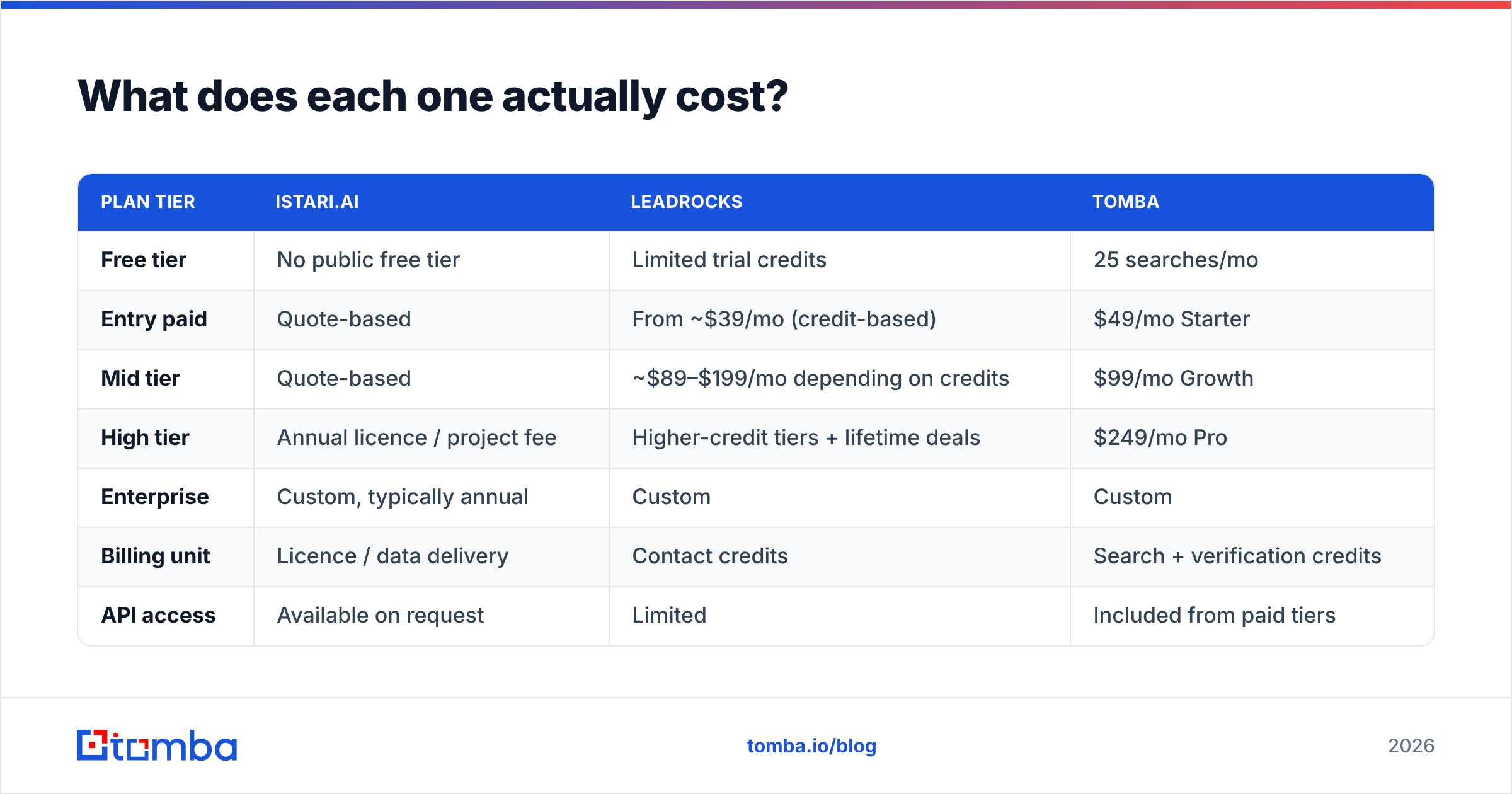
| Plan tier | Istari.ai | LeadRocks | Tomba |
|---|---|---|---|
| Free tier | No public free tier | Limited trial credits | 25 searches/mo |
| Entry paid | Quote-based | From ~$39/mo (credit-based) | $49/mo Starter |
| Mid tier | Quote-based | ~$89–$199/mo depending on credits | $99/mo Growth |
| High tier | Annual licence / project fee | Higher-credit tiers + lifetime deals | $249/mo Pro |
| Enterprise | Custom, typically annual | Custom | Custom |
| Billing unit | Licence / data delivery | Contact credits | Search + verification credits |
| API access | Available on request | Limited | Included from paid tiers |
One note on precision. LeadRocks has run lifetime deals and changed its tiers more than once. Istari.ai does not publish rate cards at all. Treat the numbers above as a rough guide. Confirm on each vendor's own pricing page before you buy. Tomba's numbers are exact — see Tomba pricing for the current breakdown.
The shape of the price matters more than the headline figure. Istari.ai is a fixed-cost licence. You pay once for a market view and use it all year. LeadRocks is pay per use. Every contact you reveal burns a credit, even if that person left the company. Pay-per-use punishes bad targeting twice: once in wasted credits, once in wasted sends.
Istari.ai vs LeadRocks: where do both tools leave a gap?#
Right at the handoff. You chose the account. Now you need to reach a person.
Istari.ai will tell you that 412 mid-size industrial automation firms in Europe mention edge computing on their sites. Great targeting. It will not give you the Head of Operations' email. LeadRocks will hand you 40,000 contacts that match "Head of Operations, manufacturing, DACH." Great volume. It will not say who still works there. It will not flag the domains that bounce you into a spam trap.
That gap is where deliverability dies. Bounce rates above 2–3% drag sender reputation down. Repair takes far longer than the damage took. One bad 5,000-record export can cost you a sending domain.
The fix is a verify-and-find layer that works on demand, not on a snapshot:
- Run every imported list through verification before the first send, not after the first bounce report.
- Find emails at send time by domain and name. Do not trust a record collected 14 months ago. That is what a live email finder does that an export cannot.
- Handle catch-all domains on purpose. Do not let them quietly poison your numbers.
- Automate it with an email finder API. Enrich when a record enters your CRM, not in a yearly clean-up project.

Can you use Istari.ai and LeadRocks together?#
Yes. For some teams that is the strongest setup. Most Istari.ai vs LeadRocks debates end right here.
The pattern is simple. Istari.ai defines and scores the account universe. You get a ranked list of companies and a reason for each one. Then you need people at those exact domains. That is a domain-first job, not a filter-first one. A database like LeadRocks or a live domain search takes over: give it the domain, get the people. Last, verify everything before it enters a sequence.
Avoid the reverse order. Do not start from the cheapest contacts and work backwards to an ICP. That is how teams end up with 60,000 contacts, a 1.4% reply rate, and a burned domain.
Istari.ai vs LeadRocks: which should you choose in 2026?#
Short version:
- Choose Istari.ai if your real question is strategic: market entry, segments, ecosystem maps, tech screening. You also need budget for a quoted licence. It is a research tool, not a prospecting tool, and it is strongest in Europe.
- Choose LeadRocks if your real question is day-to-day: you need contacts this week, self-serve, at startup prices, inside LinkedIn. Budget for verification on top. Check coverage in your own region during the trial.
- Choose neither, yet, if your bounce rate is already above 3%. No new data source fixes bad hygiene. It only speeds up the damage.
The Istari.ai vs LeadRocks choice only settles the first two layers. The contact layer is the one that touches your sending reputation, so be fussy about it. Tomba's email finder resolves addresses live against the domain instead of replaying an old snapshot. Verification and catch-all handling sit in the same flow. The free tier gives 25 searches a month, Starter is $49/mo, and the API is there when you want to automate. Run your Istari.ai account list or your LeadRocks export through it before the next campaign. Then compare the bounce rate yourself. That one test tells you more than any vendor comparison page, including this one.
Related guides#
Ready to find emails that actually work?
Join 150,000+ professionals who stopped guessing and started sending. Free credits on signup — no credit card required.
Get the Tomba newsletter
Practical outbound tactics and product updates — once every two weeks.
About the author