Istariai vs Leadsforge (2026): Which Lead Tool Wins?
Istariai and Leadsforge both promise clean B2B contact data, but they solve different halves of the problem. Here is how they compare on coverage, accuracy, pricing, and bounce risk in 2026.
Istariai vs Leadsforge is not really a contest between two rivals. One tool picks your targets. The other builds your list. Neither one hands you a verified work email. Here is the short version.
TL;DR
- Istariai vs Leadsforge in one line: Istariai scores accounts, Leadsforge assembles lists, and both stop short of a deliverable email.
- Neither vendor publishes audited accuracy numbers. Treat every "98% accurate" claim from either side as unproven until you run your own bounce test.
- Both price per seat plus credits. That model punishes teams with spiky prospecting volume. You either overbuy or run dry mid-quarter.
- If your real gap is "I have names but no verified work emails," a dedicated email finder costs less and bounces less than either platform.
- Run a 200-contact head-to-head before you sign anything annual. Track valid rate, catch-all rate, and hard bounces. That one test beats every G2 badge on both sites.
What are Istariai and Leadsforge?#
Short version: Istariai is an AI company-intelligence layer. Leadsforge is an AI lead-list builder. They overlap in the middle, because both end with a spreadsheet of people to email. They just get there from opposite directions.
Think of it like building a house. Istariai is the surveyor: it tells you which plots are worth building on, what's already there, and how the neighborhood is trending. Leadsforge is the framing crew: it takes your brief and puts up a structure fast. You need both jobs done, and neither tool does the other's job especially well.
Here is what separates a company-intelligence tool from a list-builder. This is the part most buyers get wrong.
- Signal source. Intelligence platforms crawl web presence, job posts, tech stacks, and filings. They infer what a company is doing right now. List-builders resolve a query against a stored contact database.
- Unit of output. Intelligence tools return accounts and scores. List-builders return rows with names and emails. Buy the wrong one and you spend weeks converting between the two formats.
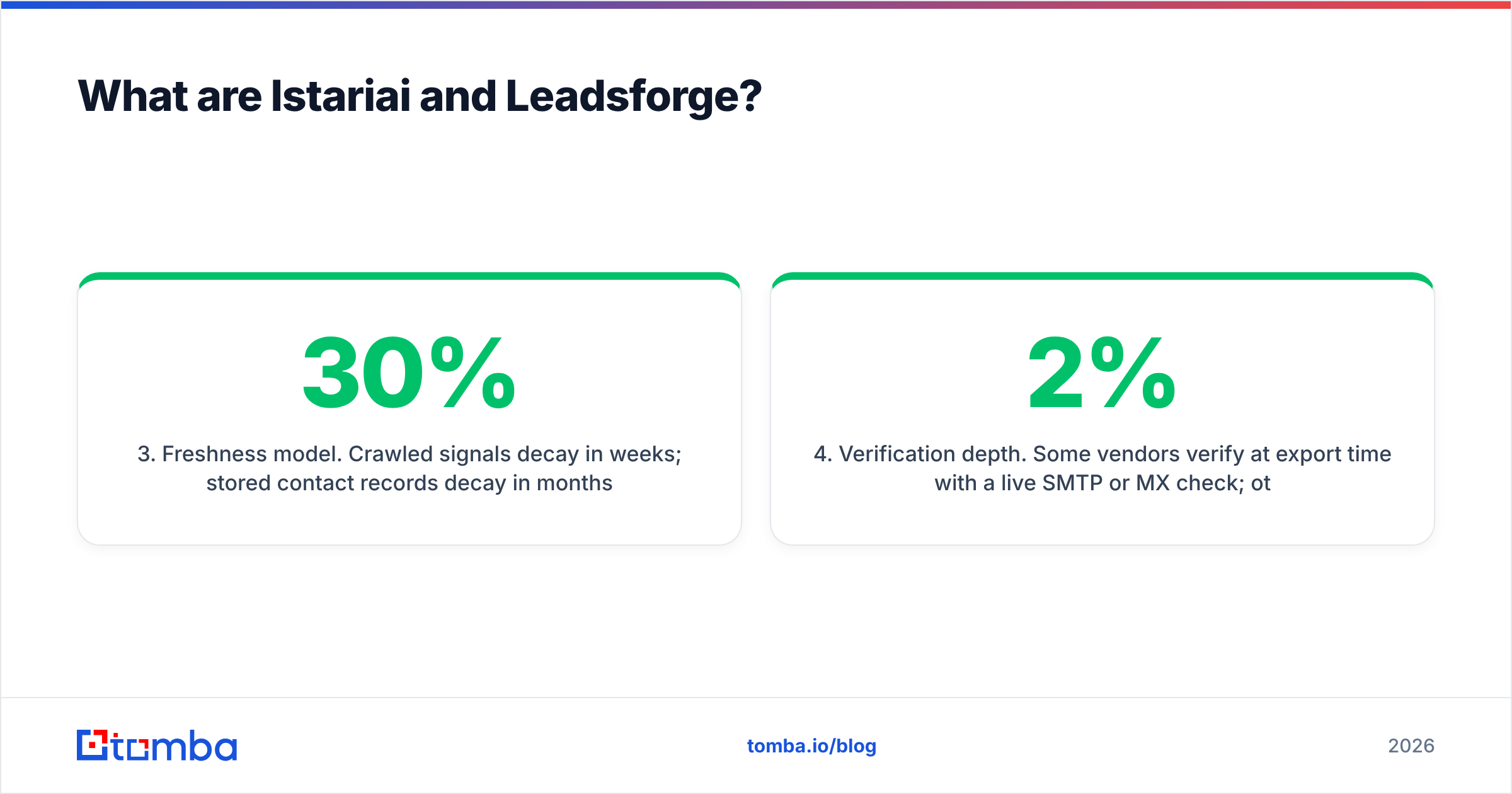
- Freshness model. Crawled signals decay in weeks. Stored contact records decay in months. At a 30% annual job-change rate, any static database is wrong about one contact in three.
The last two differences are the ones that set your bounce rate.
- Verification depth. Some vendors run a live SMTP or MX check at export time. Others hand you whatever the database held. That single choice explains most of the gap between a 2% bounce rate and a 12% one.
- Where it ends. Intelligence tools stop at "here's who to target." List-builders stop at "here's the CSV." Neither one replaces a sequencer, a CRM, or a verifier. Budget for those separately.
If you can't name which of those five is your real bottleneck, you are not ready to choose between Istariai and Leadsforge yet.
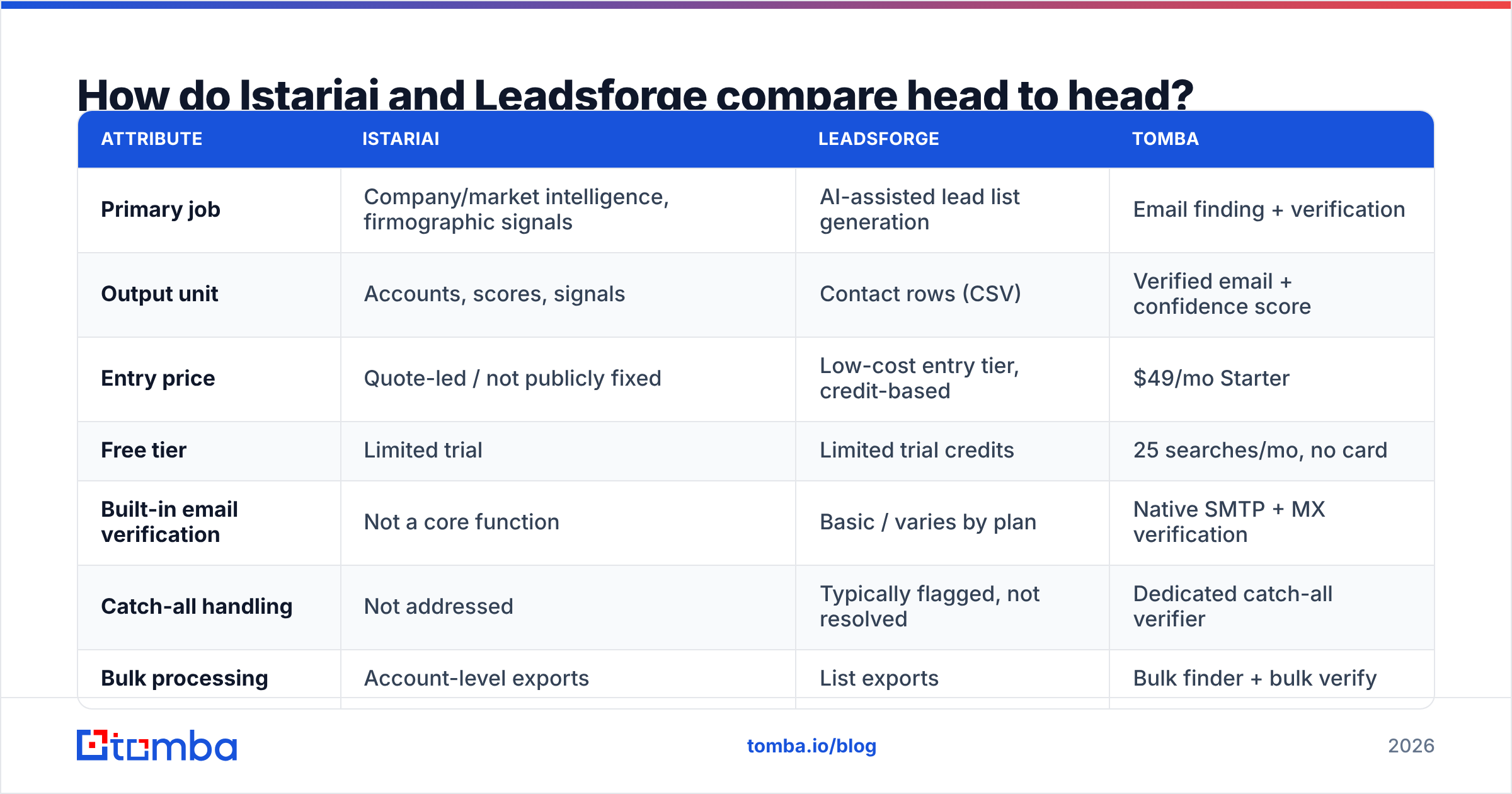
Istariai vs Leadsforge: how do they compare head to head?#
A note before the table. Both vendors are smaller and newer than the Apollo/ZoomInfo tier, and both have changed packaging more than once. Treat the figures below as directional. Confirm current terms on each vendor's own pricing page before you buy. Where I could not verify a claim independently, I say so rather than inventing a number.
| Attribute | Istariai | Leadsforge | Tomba |
|---|---|---|---|
| Primary job | Company/market intelligence, firmographic signals | AI-assisted lead list generation | Email finding + verification |
| Output unit | Accounts, scores, signals | Contact rows (CSV) | Verified email + confidence score |
| Entry price | Quote-led / not publicly fixed | Low-cost entry tier, credit-based | $49/mo Starter |
| Free tier | Limited trial | Limited trial credits | 25 searches/mo, no card |
| Built-in email verification | Not a core function | Basic / varies by plan | Native SMTP + MX verification |
| Catch-all handling | Not addressed | Typically flagged, not resolved | Dedicated catch-all verifier |
| Bulk processing | Account-level exports | List exports | Bulk finder + bulk verify |
| API access | Available on higher tiers | Available on higher tiers | On all paid plans |
| Native spreadsheet add-ons | Limited | Limited | Google Sheets, Excel, Airtable |
| Best for | Account selection and TAM research | Fast list assembly for SMB outbound | Turning known names into deliverable emails |
The honest read: these two are not really competitors. They compete for the same budget line, which is a different thing. A RevOps lead picking between them is usually choosing between "help me decide who to target" and "help me build the list faster." Three weeks in, they find that the emails still bounce.
How accurate is the data in each?#
This is where the marketing pages get loud and the evidence gets quiet.
Neither Istariai nor Leadsforge publishes a methodology you can audit. No sample size, no test corpus, no third-party verification, no breakdown of how catch-all domains are counted. That is not unique to them, since most of the category does the same thing. But it means their accuracy claims carry about as much weight as a restaurant calling itself "world famous."

Three things to check yourself, because the vendor won't do it for you:
1. How are catch-all domains counted? A catch-all server accepts every address at the domain, valid or not. Some vendors count those as "valid." That inflates the accuracy number while your bounce rate stays exactly the same. Ask them directly. If the answer is vague, assume they are counted as valid. A proper catch-all verifier resolves these with pattern confidence and secondary signals instead of shrugging.
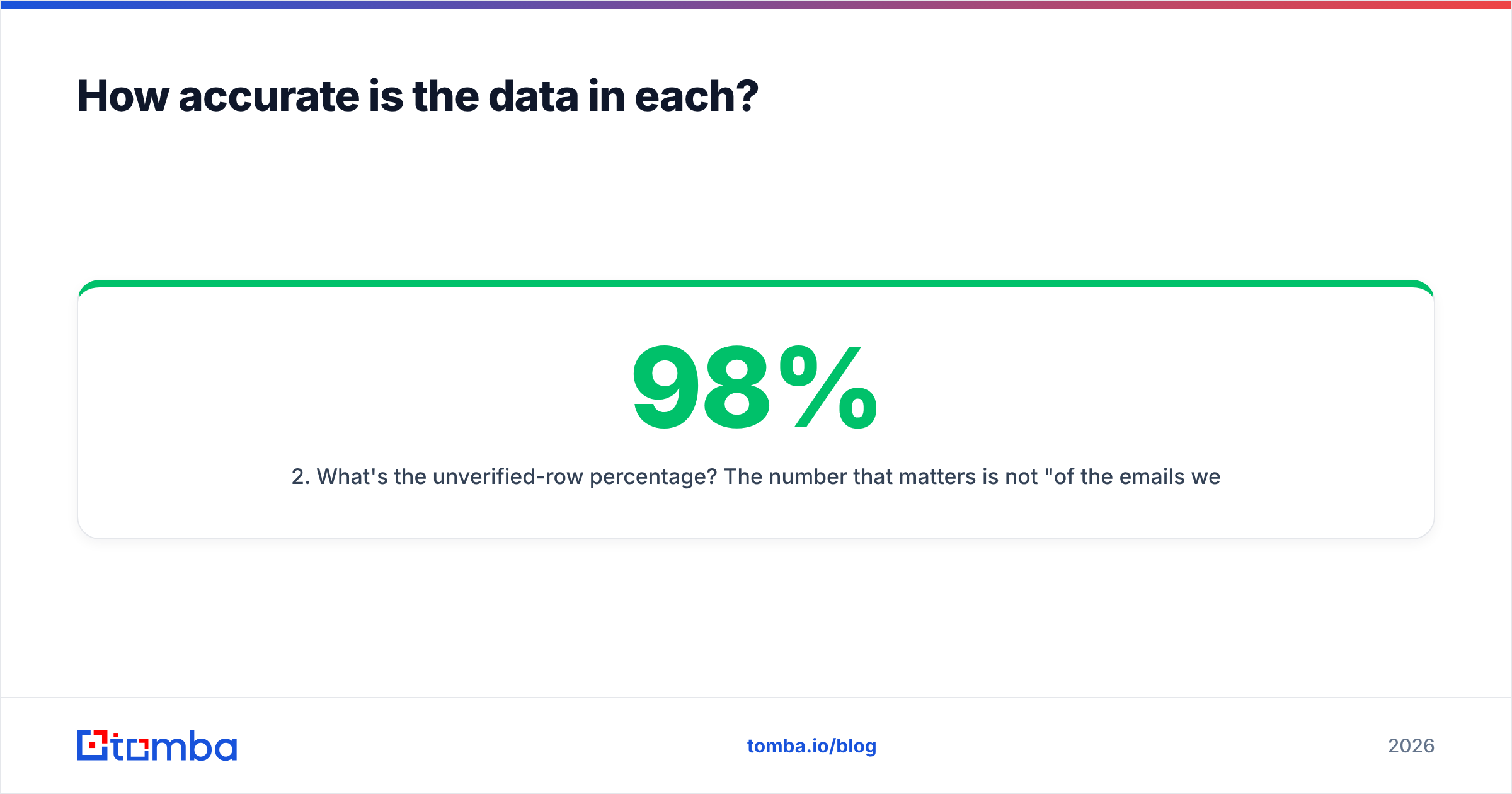
2. What's the unverified-row percentage? The number that matters is not "of the emails we returned, how many were right." It is "of the 1,000 people I asked about, how many came back with a deliverable address." A tool with 98% precision on a 30% hit rate is worse for your pipeline than one with 94% precision on a 70% hit rate.
3. Is verification happening at export or at ingest? Data verified six months ago, when it entered the database, is not verified data. Only a live check at export time reflects today's mail server. This is the biggest single driver of the bounce-rate gap between vendors. It is also why an email verifier step belongs in your workflow no matter which platform you buy.
Run the test on your own ICP. Take 200 contacts you can confirm yourself: customers, past leads, people whose addresses you already hold. Push them through each tool. Compare valid rate, catch-all rate, and unknowns. The result will not match either vendor's homepage, and that's the point.
What does each one actually cost?#
Istariai vs Leadsforge on price is a close match, and not in a good way. Both use the seat-plus-credits model that has become standard across the category. Both quote annually for anything beyond the entry tier. That combination creates two predictable problems.
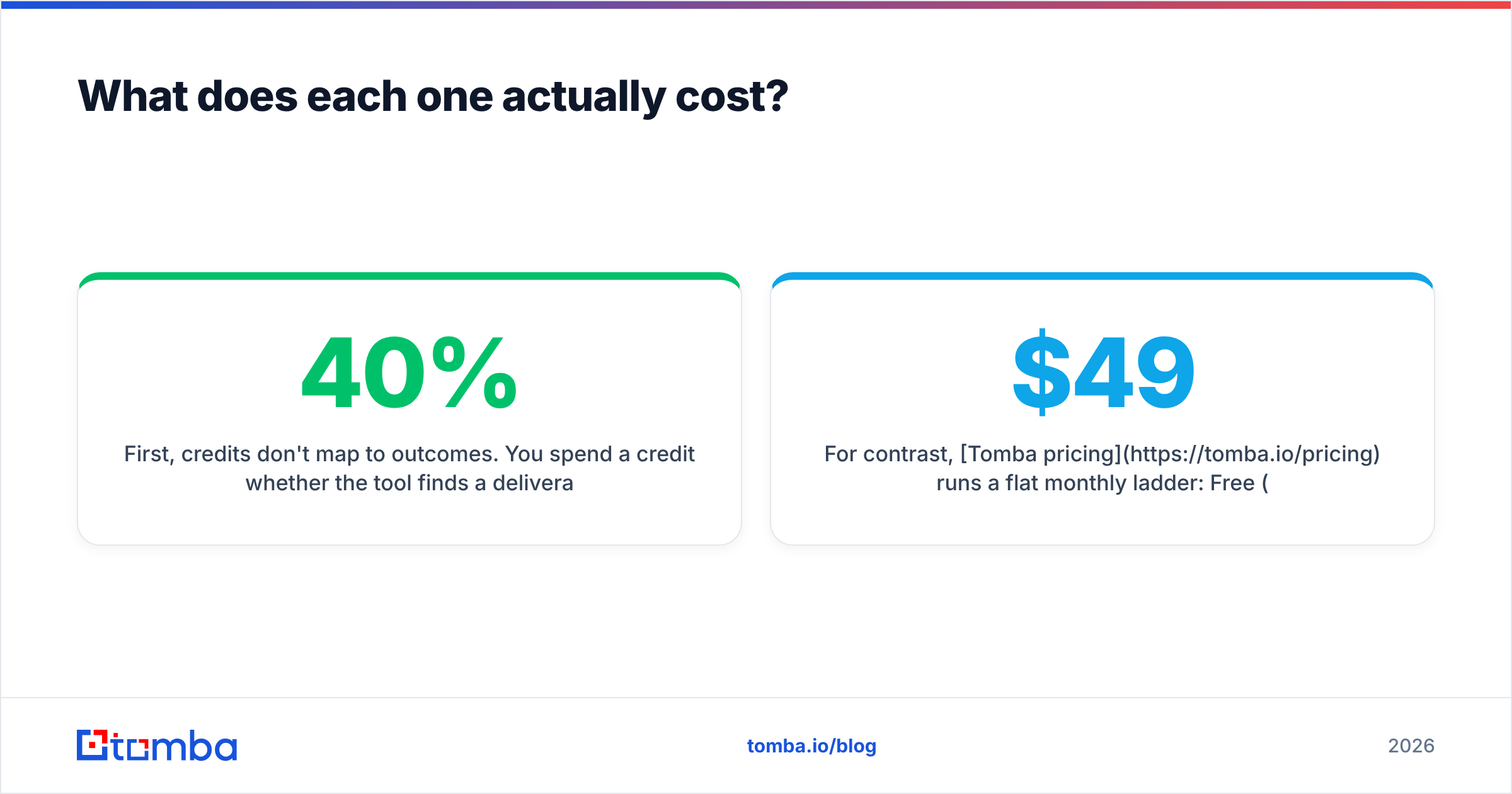
First, credits don't map to outcomes. You spend a credit whether the tool finds a deliverable email or returns nothing useful. On a 40% hit rate, your real cost per usable contact is 2.5x the sticker price. Second, seats punish the wrong behavior. Prospecting is spiky. A new campaign burns through a quarter's credits in two weeks. Annual seat commitments assume a flat consumption curve that no outbound team has ever had.

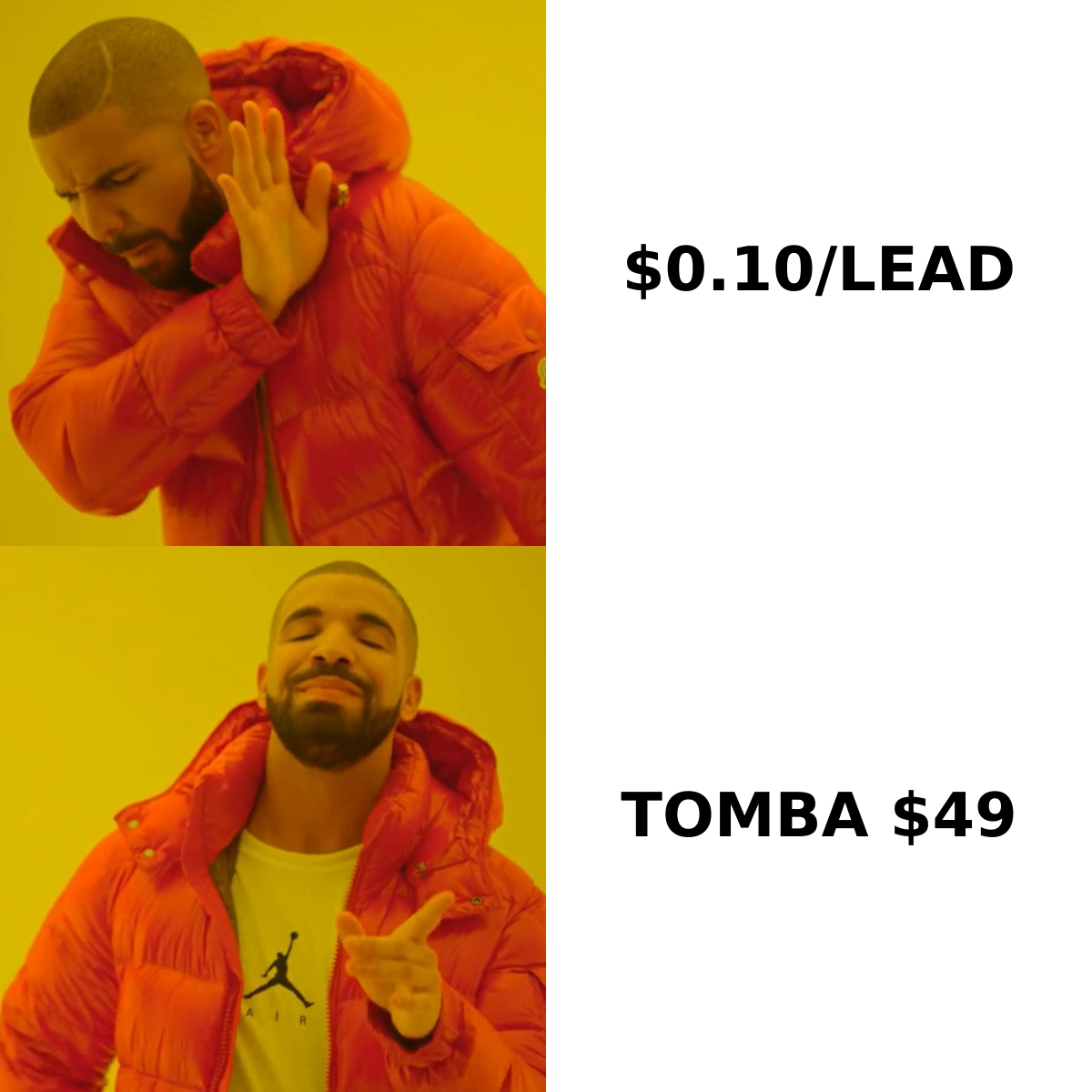
For contrast, Tomba pricing runs a flat monthly ladder: Free (25 searches/month), Starter at $49/mo, Growth at $99/mo, Pro at $249/mo, and custom Enterprise. There is no per-seat multiplier on the lower tiers, and verification is bundled rather than sold as a separate credit pool. For a two-to-five-person outbound team, that difference usually lands somewhere between "noticeable" and "the entire reason we switched."
Whichever way you go, do the arithmetic that vendors avoid:
- Total annual cost ÷ contacts you'll actually email = real cost per contact
- Multiply by your reply rate to get cost per reply
- Multiply by your reply-to-meeting rate to get cost per meeting
If cost per meeting exceeds what a meeting is worth to you, the tool is not the problem. The math is. HubSpot's sales research has decent public benchmarks for the reply and meeting rates to plug in if you don't have your own yet.
Which one fits your team better?#
Pick Istariai if your problem is target selection. You have budget for a sales motion but no clear view of which accounts are in-market. You want signals such as hiring, tech adoption, and expansion, rather than a bigger list. That is an ABM-shaped problem, and account intelligence is the right shape of answer.
Pick Leadsforge if your problem is throughput on a well-defined ICP. You already know exactly who you're selling to, the segment is broad, and the bottleneck is a human copy-pasting from LinkedIn into a sheet. AI list generation is genuinely faster than manual research for that job.
Pick neither if your problem is deliverability. If your reps already have the names and the companies, and your campaigns bounce at 8-15%, neither an account-intelligence platform nor a list-builder will fix that. You need finding and verification, which is a narrower and much cheaper purchase.
Pick a combination if you're at scale. The most effective stacks run intelligence for targeting, a finder-plus-verifier for contact resolution, and a sequencer for delivery. Three tools, each doing one job well, beats one platform doing three jobs at 60%.
It's also worth naming the peers honestly: BookYourData takes a different route again with pay-as-you-go, pre-verified B2B lists, which suits teams that want a one-time list without a subscription at all. Different structure, legitimate option, and worth a look if credits-and-seats is what's putting you off both tools here.

What are the main limitations of each?#
Istariai's limitation is the last mile. Signals tell you an account is interesting. They don't tell you the VP of Engineering's work email. You will still need a contact layer. Budgeting for the intelligence platform alone is how teams end up with a beautiful target list and no one to send it to.
Leadsforge's limitation is verification depth. Generating a list quickly and generating a deliverable list are different problems. Any tool that builds addresses from name-plus-domain patterns without a live mail-server check will produce plausible-looking addresses that bounce. Plausible is not deliverable.
Both share a transparency limitation. Neither documents data provenance in the detail that GDPR and CCPA reviews now require. If you sell into the EU, your legal team will ask where the data came from and on what lawful basis. "AI-powered" is not an answer that survives a DPA review. Tomba documents its data sources publicly for exactly this reason, and you should expect the same from anyone you buy from.
Both share a lock-in limitation. Annual contracts on credit-based pricing mean you commit before you know your real hit rate on your real ICP. Push for a monthly term on the first cycle, or at minimum a pilot with a measured exit. Cross-check current user reviews on G2 before committing. Read the two-star reviews specifically, since those describe the failure modes the five-star ones never mention.
What should you actually do next?#
Run the 200-contact test. Everything else in this Istariai vs Leadsforge comparison is context for reading those results.
Take a sample of accounts that look like your best customers. Push the same list through Istariai, Leadsforge, and a dedicated finder. Record four numbers for each: hit rate, valid rate, catch-all rate, and cost per usable contact. Then send a small campaign from each set and record the hard bounce rate after 48 hours. That is a two-week exercise that will save you a year of paying for the wrong tool.
For most teams I talk to, the result is the same. The intelligence layer is genuinely useful but optional. The list-builder is a convenience they can replicate with a decent domain search. The thing they actually needed all along was reliable contact resolution with verification baked in.
That's the gap Tomba fills. The Tomba Email Finder turns a name and a domain into a verified, deliverable work email, with live SMTP checking, catch-all resolution, and a confidence score on every result. Not a marketing percentage on a landing page. Start on the free tier with 25 searches a month, run it against the same 200 contacts you're testing everything else with, and let the bounce rate pick the winner.
Related guides#
// get started
Find, verify and enrich your first contacts today
Start on the free plan with 25 searches a month, then scale when your team is ready.
Free plan · No credit card required · GDPR & CCPA
Get the Tomba newsletter
Product and data updates
// about the author