Istari.ai vs LeadZen.ai (2026): B2B Data Tools Compared
Istari.ai mines the open web for company signals. LeadZen.ai hands you contacts. They solve different halves of the same problem — here is which one your pipeline actually needs, and where both leave a gap.
Istari.ai vs LeadZen.ai is the wrong way to frame the choice. One tool finds companies. The other finds people. Here is how to pick, and what both of them leave out.
TL;DR
- Istari.ai vs LeadZen.ai is not a head-to-head race. Istari.ai mines the open web and turns company websites into structured data. LeadZen.ai hands you names, emails and phone numbers.
- Pick Istari.ai if your question is "which companies should we target?" That means market mapping, TAM sizing and ICP scoring at scale.
- Pick LeadZen.ai if your question is "who do I email at this company, today?" It is built for SDRs, with a browser extension and credit-based pricing.
- Neither one checks email. Both hand you data you still have to test before you send. That is the job of a dedicated email verifier.
- The 2026 stack is one targeting tool plus one contact tool with checks built in. Paying two vendors for the same job is how teams waste their data budget.
What is Istari.ai?#
Istari.ai is a German data company based in Mannheim. It grew out of academic economic research. The core product is AI-based web mining.
Istari does not license a static contact list. It crawls company websites at scale. Language models then pull structured facts out of the page text. What does the company say it does? Which tools does it name? Does it talk about AI, hiring, green goals or new markets?
The output is not a lead list. It is a company-level dataset, sent by API or bulk export. It covers millions of firms. That includes the small firms most B2B databases miss, because nobody ever added them to a CRM.
The origin matters here. Istari.ai's first heavy users were economists and public agencies. They needed company labels they could defend and repeat. The paid product still has that DNA: wide coverage, an open method, strong European data, and a clear trail for why a company was tagged a certain way.
What it does not do: give you Jane Doe's mobile number.
What is LeadZen.ai?#
LeadZen.ai sits at the other end of the funnel. It is a B2B lead tool built for sales teams. You can search by name, company, domain or LinkedIn profile. There is a Chrome extension for work inside LinkedIn, plus bulk lookups and campaign features. Pricing runs on credits, and the pitch is simple: cheaper than the big US names.
Its strength is access. Entry cost is low, trials are fast, and coverage of India and the wider APAC region is deep. Apollo, ZoomInfo and Clearbit tend to thin out there. If you sell into India, Southeast Asia or the Gulf, that depth is the whole reason to look.
Its weakness is the one every contact aggregator shares. The data is only as fresh as the last refresh cycle. Mobile numbers and personal emails age fast.
Istari.ai vs LeadZen.ai: how do they differ?#
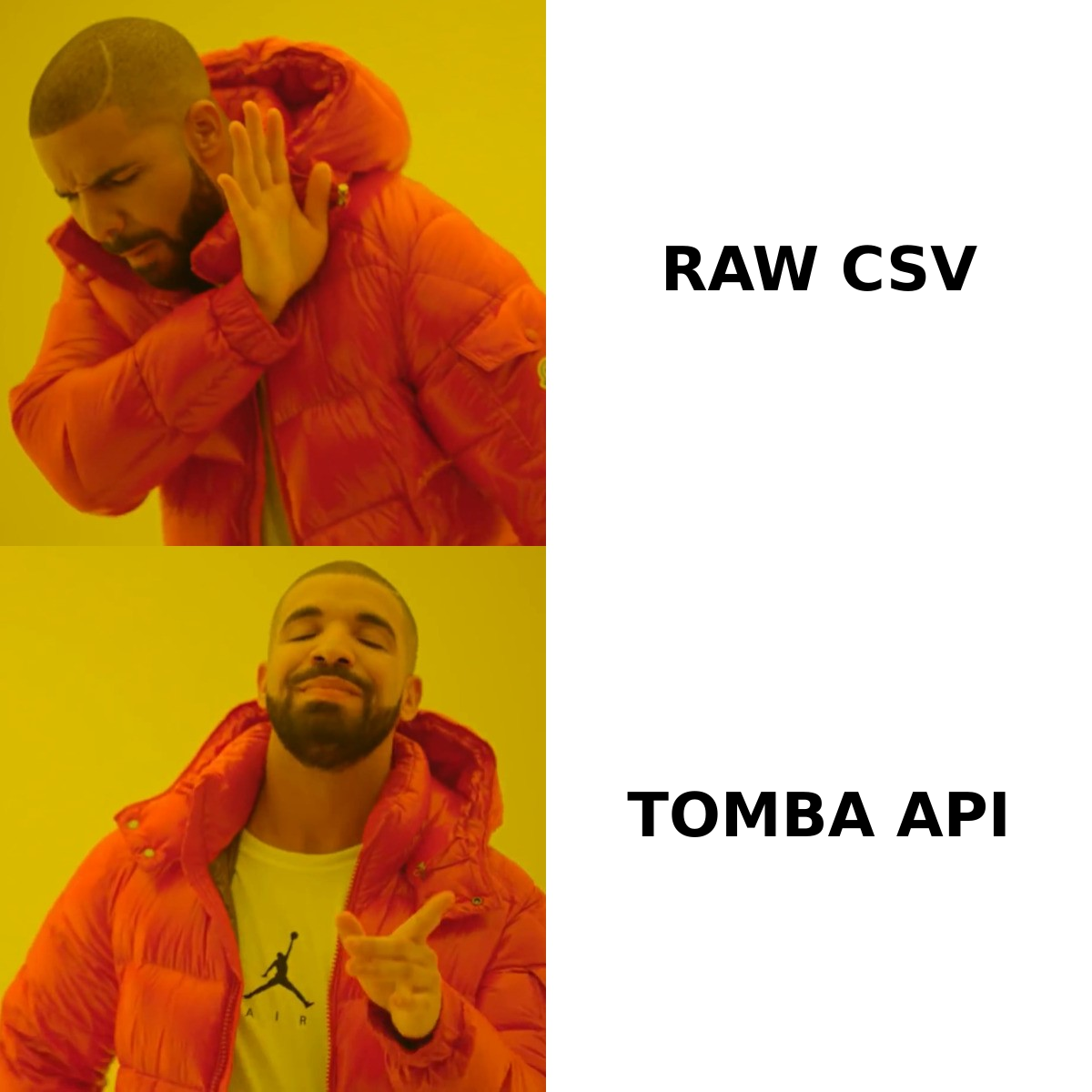
The clearest test is simple. What does each tool start with, and what does it hand back?
- Input unit — Istari.ai starts with a domain or company and returns facts about that company. LeadZen.ai starts with a person, company or LinkedIn URL and returns contact records.
- Data source — Istari.ai builds data by reading the live web, so freshness tracks crawl cadence. LeadZen.ai pools shared, licensed and scraped sources, so freshness tracks refresh cycles and user uploads.
- Who buys it — Istari.ai sells to RevOps, strategy and data teams. LeadZen.ai sells to SDRs, founders and small sales teams who need volume this quarter.
- Delivery — Istari.ai leans on API, bulk files and dataset licences. LeadZen.ai leans on the app, a browser add-on and CSV export.
- What you still need — Istari.ai leaves you without contacts. LeadZen.ai leaves you without checks. Both gaps are easy to fill. Budget for them up front, not in month two.
Read that list again. There is almost no overlap. If Istari.ai vs LeadZen.ai feels like a close call, you have probably not settled the real question: is your bottleneck targeting or reach?
Which one has better data accuracy?#
Accuracy is where Istari.ai vs LeadZen.ai stops being a like-for-like match. The word means something different for each tool. One number cannot cover both.
For Istari.ai, accuracy is a labelling question. If the system says a firm builds factory robots and runs an AI project, is that true? Web-mined labels can be audited. You can trace each claim back to the page text behind it. That beats a black-box score. The weak spot is the website itself. It may be stale, or it may oversell.
For LeadZen.ai, accuracy is a delivery question. Of 1,000 exported emails, how many land? Treat every contact database with care here, LeadZen and its bigger US rivals alike. Buyer reviews on G2 show that real hit rates run well below the marketing claims. Mobile numbers decay faster than emails do.
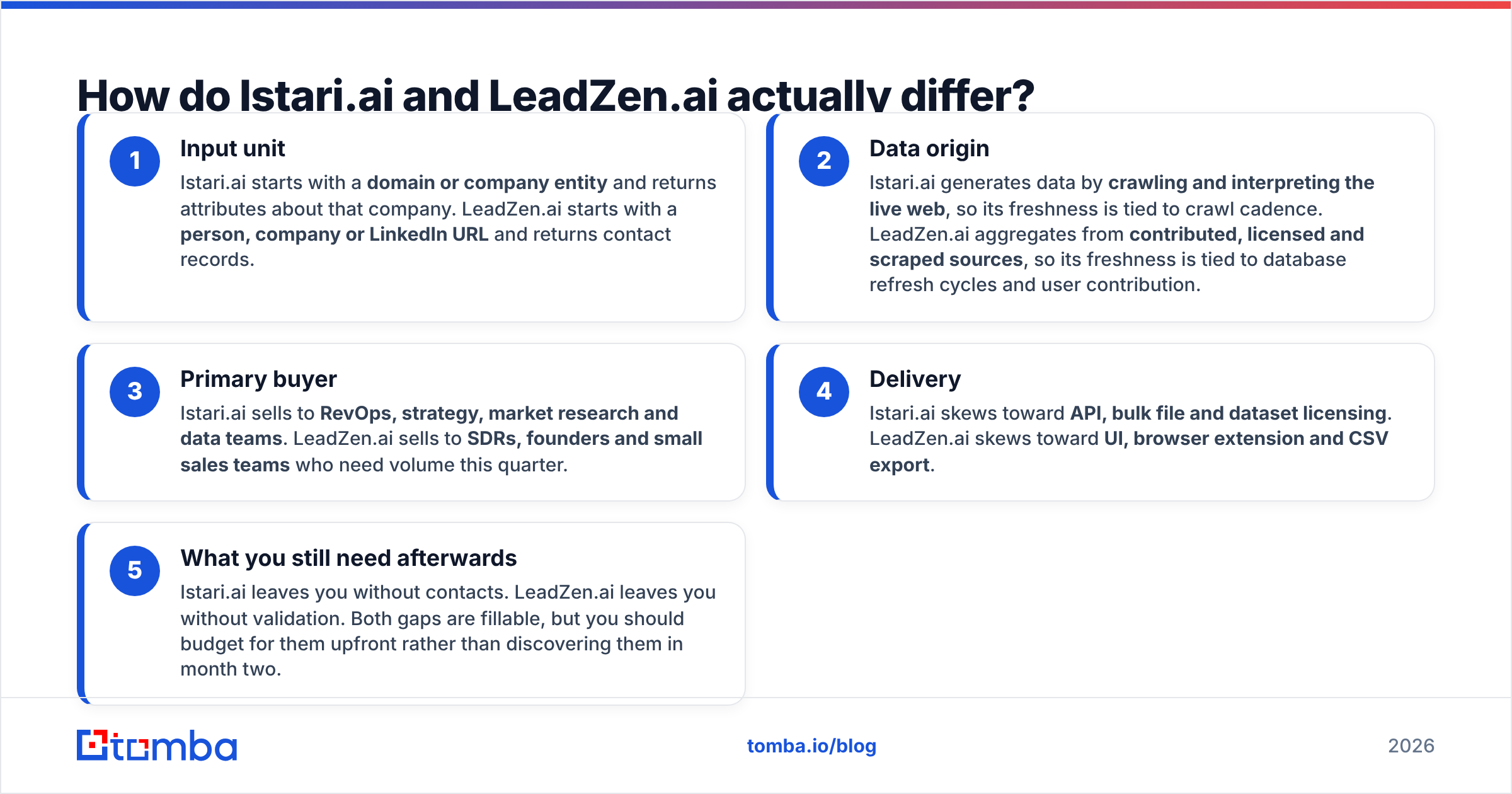
Three rules hold, no matter which vendor you pick:
- Never trust an export. Run every list through a check before it reaches your sequencer.
- Treat catch-all domains as their own class. They are neither valid nor invalid. Use a catch-all verifier that probes the pattern instead of guessing.
- Measure the vendor, not the claim. Export 200 records, test them yourself, and work out your own hit rate. Do this before you sign a deal, not after.
Istari.ai vs LeadZen.ai: pricing and features#
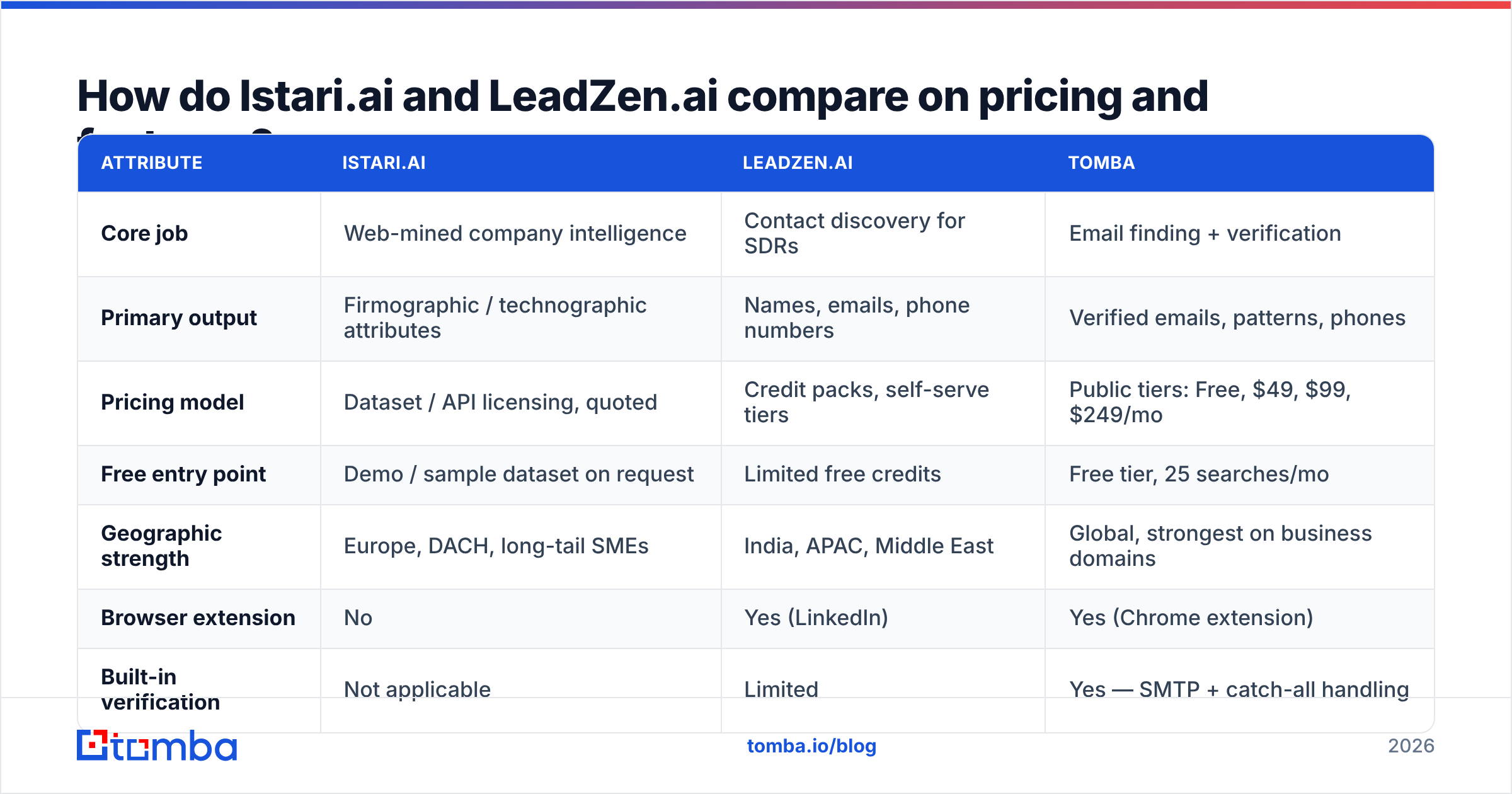
Both vendors quote rather than publish a full price grid, and both change packages often. Check their own pages before you budget. Tomba is the third column here because it fills the gap both tools leave: verified, pattern-aware contact search with public pricing.
| Attribute | Istari.ai | LeadZen.ai | Tomba |
|---|---|---|---|
| Core job | Web-mined company intelligence | Contact discovery for SDRs | Email finding + verification |
| Primary output | Firmographic / technographic attributes | Names, emails, phone numbers | Verified emails, patterns, phones |
| Pricing model | Dataset / API licensing, quoted | Credit packs, self-serve tiers | Public tiers: Free, $49, $99, $249/mo |
| Free entry point | Demo / sample dataset on request | Limited free credits | Free tier, 25 searches/mo |
| Geographic strength | Europe, DACH, long-tail SMEs | India, APAC, Middle East | Global, strongest on business domains |
| Browser extension | No | Yes (LinkedIn) | Yes (Chrome extension) |
| Built-in verification | Not applicable | Limited | Yes — SMTP + catch-all handling |
| API-first | Yes | Partial | Yes (Tomba API) |
| Best for | TAM mapping, ICP scoring, research | Volume prospecting on a budget | Accuracy-sensitive outbound at scale |
Two things stand out in that grid.
First, the two pricing models do not line up. Istari.ai is sold like a dataset: annual, negotiated, scoped by record volume and refresh rate. LeadZen.ai is sold like a SaaS tool: monthly, metered by credits, easy to cancel. A CFO who compares the two is weighing a data purchase against a software subscription.
Second, neither column scores well on built-in checks. That is not a knock on either vendor. It is how each category is built. Checking an email is a separate engineering problem: SMTP handshakes, greylisting, catch-all logic, role accounts. Specialist tools do it better.
Which tool should your team pick?#
Choose Istari.ai if:
- You are building an ICP and want evidence, not a hunch.
- You sell to European mid-market or industrial firms, where the long tail matters.
- You have a data team that can pull an API or a bulk file into your CRM.
- You need labels you can defend to a board or a research panel.
Choose LeadZen.ai if:
- Your bottleneck is raw contact volume and your budget is tight.
- You prospect in India, Southeast Asia or the Gulf.
- Your reps live inside LinkedIn and want one click, not an API key.
- You are happy to own the checks yourself.
Choose neither — or rather, add a third layer — if:
- Bounce rate is the thing that caps your outbound volume.
- You need email patterns for firms no database has indexed yet.
- You want pricing you can read on a public page, with no sales call.
So the honest Istari.ai vs LeadZen.ai answer is often "one of these, plus a verifier".
What do both tools leave out?#
The gap is the same on both sides. It is the last mile between "this company fits" and "this message reached a human inbox."
Istari.ai tells you that Company X is a 90-person logistics software firm with a fresh AI roadmap. Great targeting signal. It does not tell you that the VP of Operations sits at f.lastname@companyx.de.
LeadZen.ai tells you: Priya Sharma, VP Ops, priya.sharma@companyx.com. Useful. Then you learn the record is eleven months old, Priya moved on, and your sequencer eats a hard bounce. Your sender reputation drops a notch.
The fix is dull and mechanical:
- Pull the company's email pattern from live sources, not from a cached record.
- Build the address from that pattern plus the verified name.
- Check it, including catch-all domains that most tools quietly mark "valid".
- Only then push it to the sequencer.
That is what a finder-plus-verifier does. Tomba's domain search finds the pattern per company. The finder builds and tests the address. The verifier says whether it is safe to send. Tomba pricing is public: a free tier at 25 searches a month, Starter at $49/mo, Growth at $99/mo, Pro at $249/mo. So you can model cost per verified contact up front. Credit systems that charge for misses make that math harder.
Can you use them together?#
Yes. For a well-funded team, this is the strongest setup:
- Istari.ai builds and scores the account list. Web-mined signals become your fit score.
- LeadZen.ai, or any regional contact source, supplies people inside those accounts.
- A checking layer cleans the list before send, and fills the gaps the contact source missed.
Avoid one mistake. Do not buy two overlapping contact databases and call it coverage. Aggregators tend to overlap on the easy accounts and miss the same hard ones. Your second subscription then buys far less reach than the coverage chart implies. Run a 500-record overlap test before you renew anything.
What is the verdict on Istari.ai vs LeadZen.ai?#
Istari.ai wins on depth of intelligence. LeadZen.ai wins on speed and entry price. Neither wins on deliverability, because neither was built for it.
If you can only get one line item approved this quarter, pick by symptom. Good reply rates but too few accounts in the funnel? That is a targeting problem, so choose Istari.ai. Plenty of accounts but nobody to email? That is a reach problem, so choose LeadZen.ai. Plenty of emails but a bounce rate above 3%? Then Istari.ai vs LeadZen.ai is beside the point, and more database spend will not fix it.
Most teams we see in outbound audits sit in that third bucket. The best move is to stop buying records and start testing the ones you own. Run your list through Tomba Email Finder and its checking layer. Measure your true deliverable rate. Then decide whether you have a volume problem or a quality problem. Start on the free tier, test 25 records against your current export, and let the bounce numbers pick the winner.
Sources referenced: Istari.ai, LeadZen.ai, G2 buyer reviews.
Related guides#
Ready to find emails that actually work?
Join 150,000+ professionals who stopped guessing and started sending. Free credits on signup — no credit card required.
Get the Tomba newsletter
Practical outbound tactics and product updates — once every two weeks.
About the author