Istariai vs OneMoreLead: Which B2B Data Tool Wins in 2026?
Istari.ai mines the open web for company-level signals. OneMoreLead sells bulk US B2B contact records. They solve different problems - and most outbound teams need a third tool to turn either one into a deliverable inbox.
Istariai vs OneMoreLead is a choice between two different jobs. Istari.ai tells you which companies to target. OneMoreLead hands you contact lists in bulk. Most outbound teams need one of them, plus a way to check emails at send time.
TL;DR
- Istari.ai and OneMoreLead are not real competitors. One is a web-mining company-intelligence platform. The other is a bulk B2B contact database. The choice is a category decision, not a feature decision.
- Pick Istari.ai if your question is "which companies should we care about, and why?" It maps markets, classifies industries, and reads activity signals off company websites.
- Pick OneMoreLead if your question is "give me 20,000 US contacts in this job title band." It is built for volume list building in SMB and agency outbound.
- Neither tool promises that one person's email will land. That is a separate job. It belongs to a live email finder plus an email verifier at send time.
- The cheapest stack for most teams in 2026 has two halves. One signal or list source. Then per-contact checks before every send. Skip the second half and you get bounce rates above 30%.
Istariai vs OneMoreLead: what is each tool for?#
They sit at opposite ends of the B2B data pipeline.
Istari.ai is a company-intelligence platform built on large-scale web mining. The core idea is simple. A company's own website is the most current public description of what it does. So Istari.ai crawls millions of sites and runs NLP over them.
The output is structured data about each company: what it sells, which technologies and topics it talks about, and how its web presence changes over time. Teams use that for market mapping, industry classification, economic research, and account scoring. They do not use it to find Jane's mobile number.
OneMoreLead is the opposite shape. It is a B2B contact database you query with filters - industry, title, company size, geography - and export as a list. It advertises tens of millions of mostly US business profiles. Its buyers are SMB sales teams, agencies, and marketers who need volume without enterprise pricing. The pitch is access and price, not derived insight.
So the honest framing of Istariai vs OneMoreLead is insight engine versus list warehouse. Judge them on the same scorecard and one will always look broken. You would be grading a telescope against a bucket.
Istariai vs OneMoreLead: how do they compare head-to-head?#
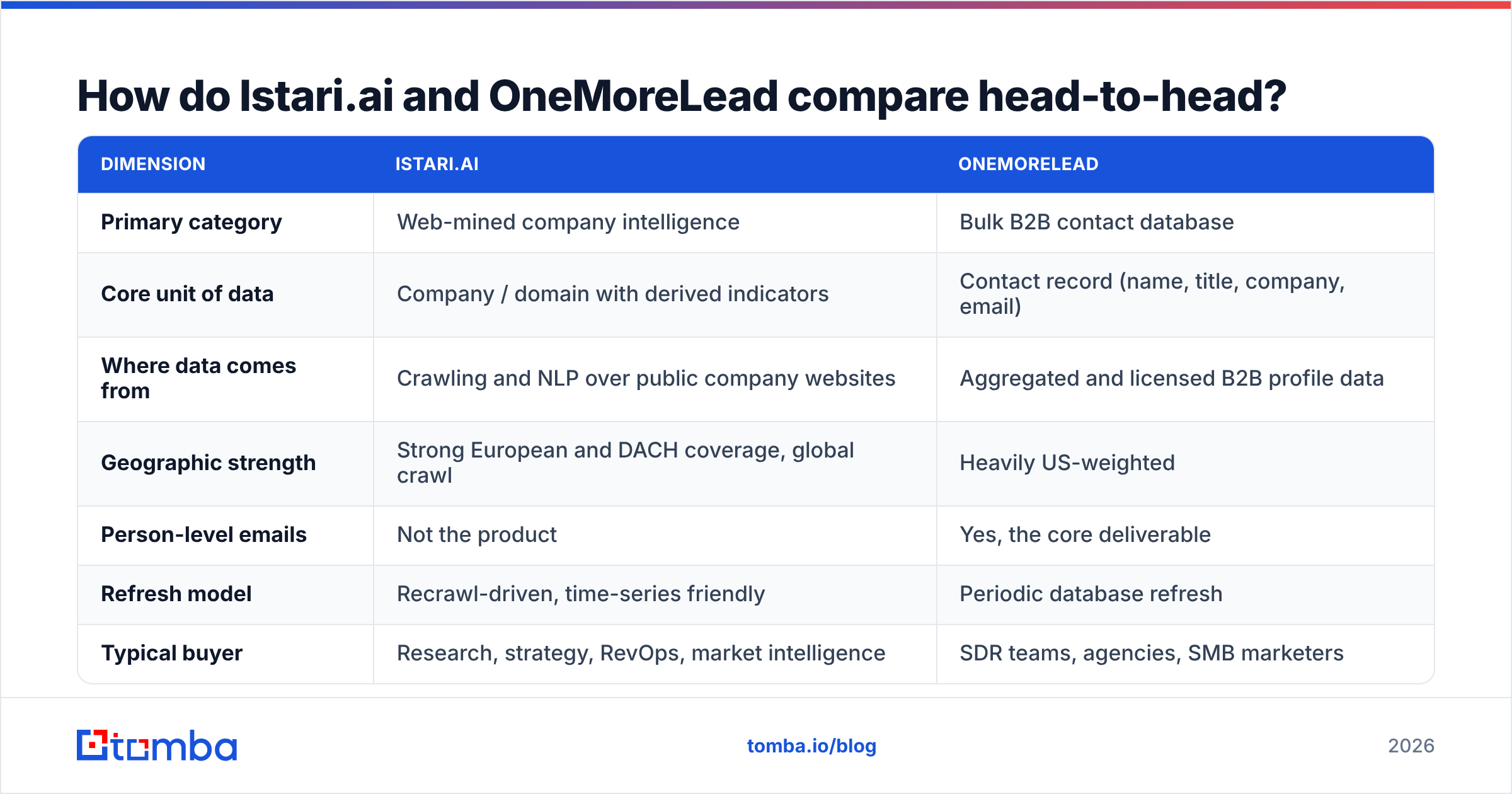
Here is the side-by-side on the points that change your workflow. Treat pricing as directional. Both vendors adjust packaging, so check their own pages before you budget.
| Dimension | Istari.ai | OneMoreLead |
|---|---|---|
| Primary category | Web-mined company intelligence | Bulk B2B contact database |
| Core unit of data | Company / domain with derived indicators | Contact record (name, title, company, email) |
| Where data comes from | Crawling and NLP over public company websites | Aggregated and licensed B2B profile data |
| Geographic strength | Strong European and DACH coverage, global crawl | Heavily US-weighted |
| Person-level emails | Not the product | Yes, the core deliverable |
| Refresh model | Recrawl-driven, time-series friendly | Periodic database refresh |
| Typical buyer | Research, strategy, RevOps, market intelligence | SDR teams, agencies, SMB marketers |
| Pricing model | Quote-based / project and API licensing | Published subscription tiers, SMB-priced |
| Realistic learning curve | Medium-high (you interpret indicators) | Low (filter, export, send) |
| What it does NOT solve | Deliverability of any individual address | Why a company is worth contacting |
The last two rows are the ones people skip and then regret.
Which one gives you a contactable lead?#
Neither, on its own. That is the uncomfortable answer. It is also why most teams run three tools instead of one.
A contactable lead needs four things to be true at the same time. Each source covers only part of the chain.
- Targeting - the company fits your ICP and has a reason to buy now. Istari.ai is built for this. OneMoreLead gives you firmographic filters, but little signal.
- Person identification - the right human at that company owns the problem. OneMoreLead delivers this at volume. Istari.ai does not.
- Address resolution - that person's current work email, at their current employer. Exports decay here. A record captured months ago knows nothing about last quarter's job change.
- Deliverability - the mailbox exists, accepts mail, and is not a trap or a role account. This is a send-time check, not a purchase-time check.
Steps 1 and 2 are a sourcing problem. Steps 3 and 4 are a verification problem. No static list solves them for long, because lists are snapshots and inboxes are live systems.
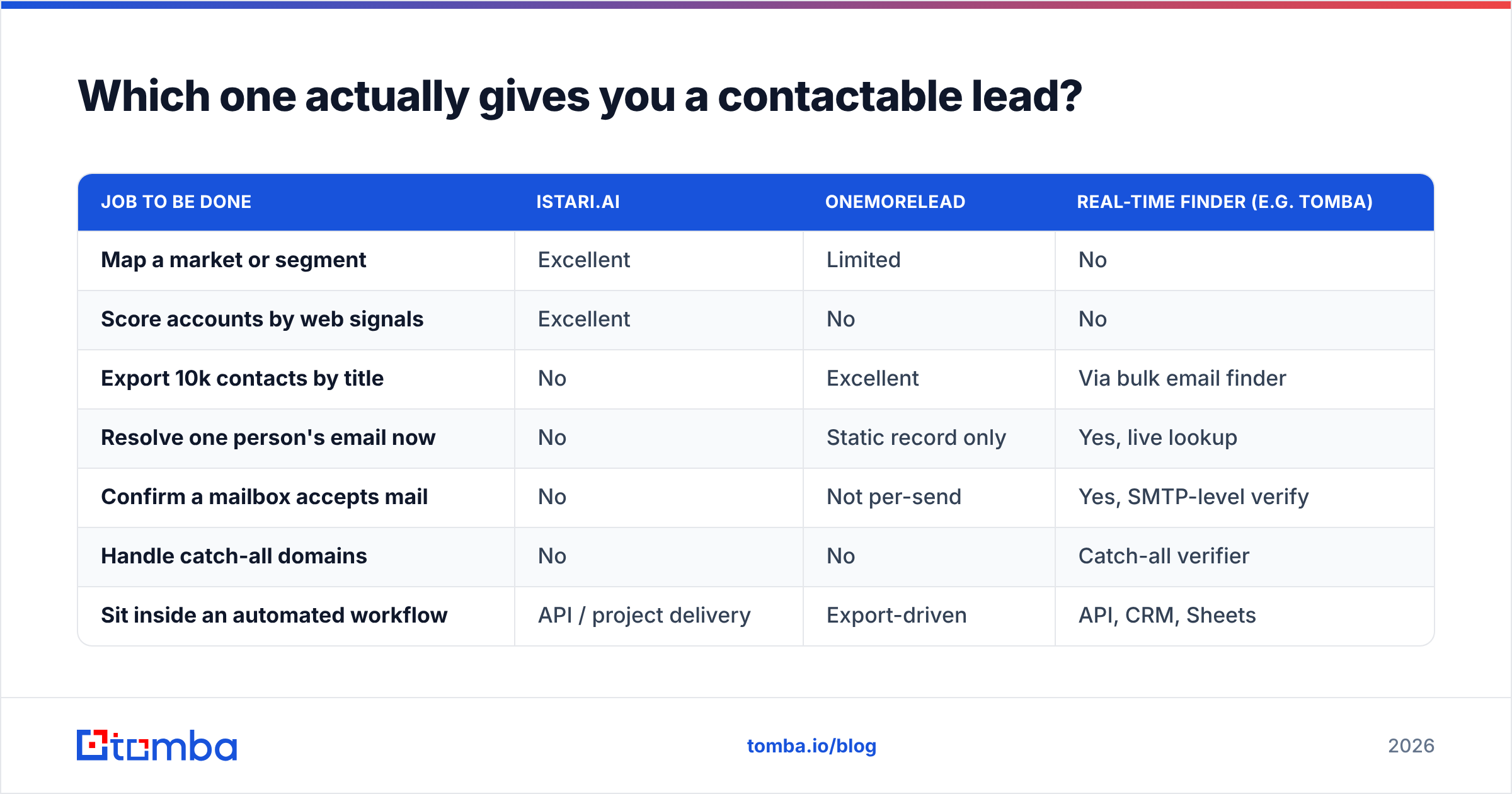
So the useful comparison is not two columns. It is three.
| Job to be done | Istari.ai | OneMoreLead | Real-time finder (e.g. Tomba) |
|---|---|---|---|
| Map a market or segment | Excellent | Limited | No |
| Score accounts by web signals | Excellent | No | No |
| Export 10k contacts by title | No | Excellent | Via bulk email finder |
| Resolve one person's email now | No | Static record only | Yes, live lookup |
| Confirm a mailbox accepts mail | No | Not per-send | Yes, SMTP-level verify |
| Handle catch-all domains | No | No | Catch-all verifier |
| Sit inside an automated workflow | API / project delivery | Export-driven | API, CRM, Sheets |
What does Istari.ai do well - and where does it stop?#
Where it is strong:
- Derived classification. Registry codes like SIC or NAICS are often years out of date. Istari.ai reads the industry and activity from what the company publishes today.
- Time series. It recrawls the same domains again and again, so you can watch change: new product language, new technology mentions, expansion signals. A point-in-time database cannot do that.
- European depth. Most US-first contact vendors thin out fast outside North America. A crawl does not care where a domain is registered, so DACH and wider EU coverage is a real edge.
- Research credibility. The method is closer to academic and statistical-office work than to a scraped-list business. That matters when your output has to survive a strategy team or a regulator.
Where it stops: it will not hand your SDR 500 verified inboxes. It tells you which 500 accounts deserve the effort. You still need names and addresses. Pair it with a domain search step to turn target domains into real people.
What does OneMoreLead do well - and where does it stop?#
Where it is strong:
- Price per record. Enterprise platforms start in four figures per seat per year. SMB-priced list access is a real unlock for a two-person team or an agency running client campaigns.
- Speed to first campaign. Filter, preview, export, load into your sequencer. You can go from signup to a live campaign the same afternoon.
- Volume filtering. Title, seniority, industry, headcount, and location cover the ICP most SMB teams define.
- Simplicity. There is no model layer to interpret. What you filter is what you get.
Where it stops: everything after export. A record that was right on ingest day is not automatically right on send day. B2B contact data decays at roughly 2-3% per month through job changes, restructures, and domain moves. Over a year, that is a quarter of your list.
Vendor "verified" flags describe the record at ingest. They say nothing about the mailbox at 9:14am, when your sequence fires. Export and send without your own check, and you inherit every stale row in the file. Then this happens:

A bounce rate above roughly 3% starts to damage your sender reputation. That damage is slow to repair. You get throttled on the next campaign too, including the one to your good contacts.
How should you judge data accuracy?#
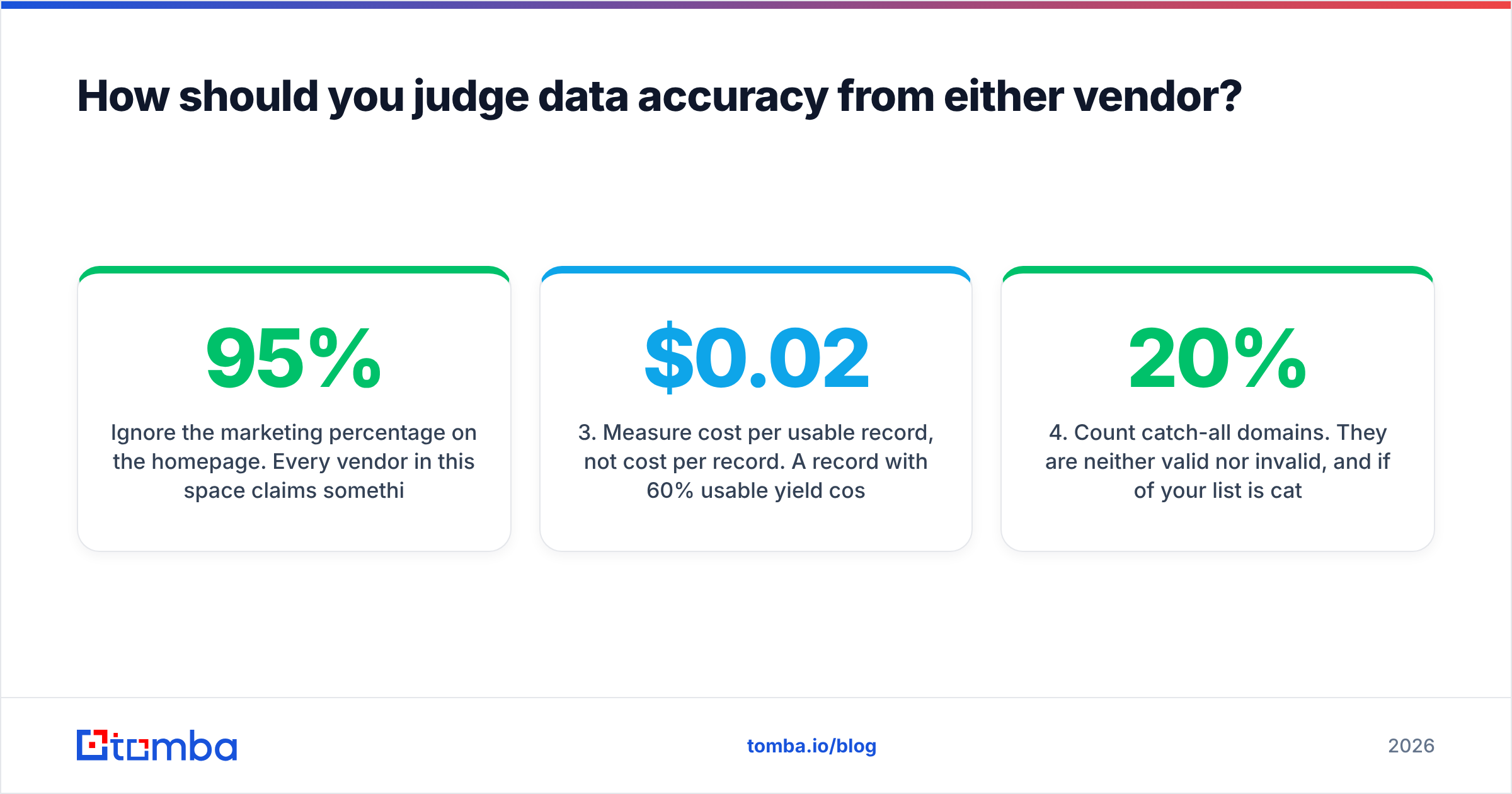
Ignore the percentage on the homepage. Every vendor claims 95% to 99%, with a method nobody publishes. Run your own test instead.
- Pull a 200-row sample that matches your real ICP, not a generic filter. Accuracy swings by segment. A vendor can be great on US SaaS mid-market and poor on European manufacturing.
- Check the verification layer on its own. Push the sample through an independent email verification pass. The gap between rows delivered and rows that survive is your true yield.
- Measure cost per usable record, not cost per record. A $0.02 record at 60% yield costs more than a $0.04 record at 95% yield.
- Count catch-all domains. They are neither valid nor invalid. If 20% of your list is catch-all, you need a catch-all finder plan, not a guess.
- Track decay over 60 days. Re-verify the same sample two months later. The delta tells you how often to refresh, and that drives your real annual cost.
Do this before you sign anything annual. Both vendors look different under your ICP than under their demo.
What does each one cost in practice?#
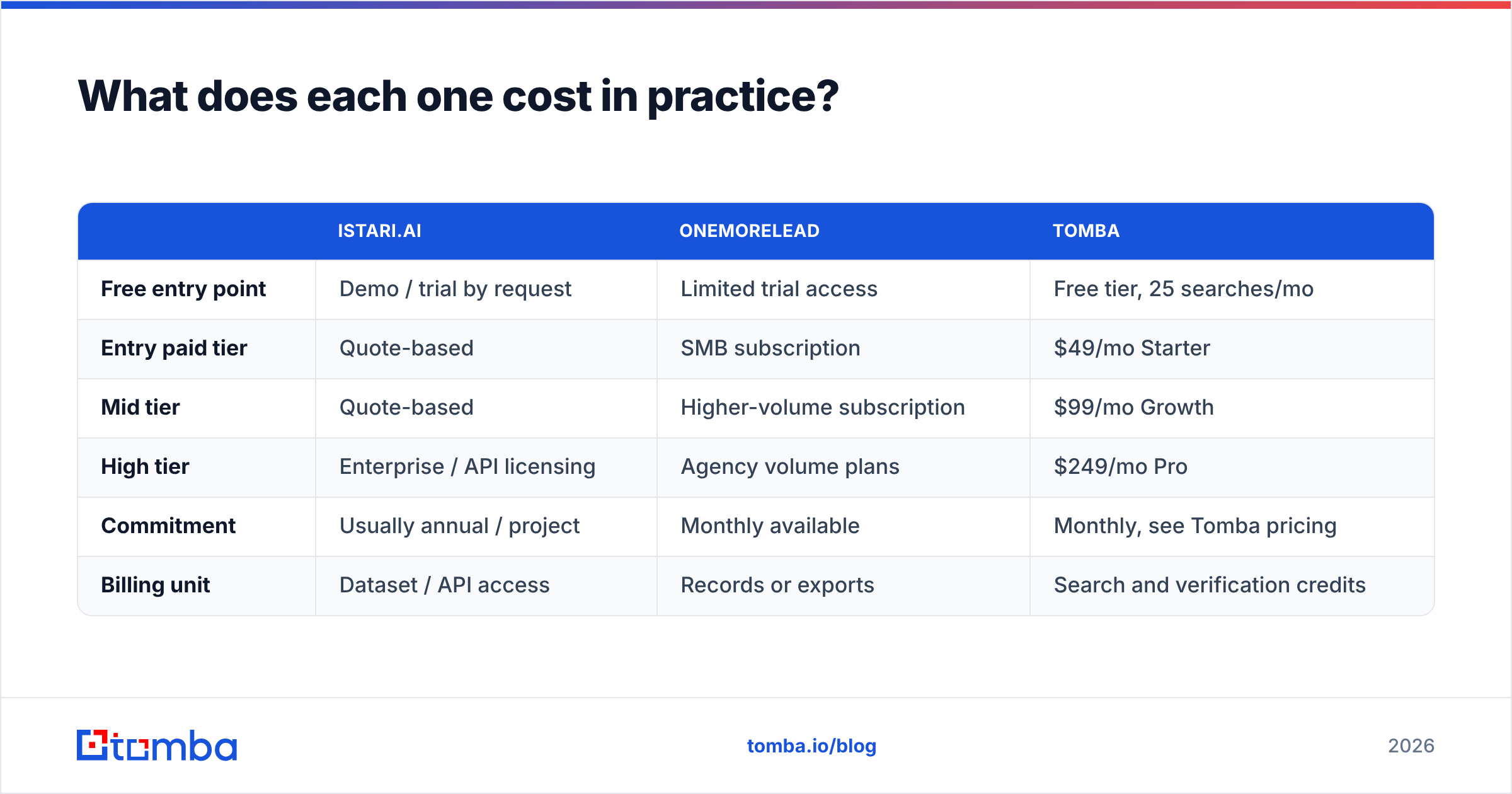
| Istari.ai | OneMoreLead | Tomba | |
|---|---|---|---|
| Free entry point | Demo / trial by request | Limited trial access | Free tier, 25 searches/mo |
| Entry paid tier | Quote-based | SMB subscription | $49/mo Starter |
| Mid tier | Quote-based | Higher-volume subscription | $99/mo Growth |
| High tier | Enterprise / API licensing | Agency volume plans | $249/mo Pro |
| Commitment | Usually annual / project | Monthly available | Monthly, see Tomba pricing |
| Billing unit | Dataset / API access | Records or exports | Search and verification credits |
The structure matters more than the numbers. Quote-based platforms price on the value of the dataset, so you commit before you know your yield. Credit-based tools price on what you use, so a bad month costs less. If you are early and unsure of your ICP, usage-based pricing is the cheaper mistake.
Which should you choose for your use case?#
- Market sizing, segmentation, or account scoring across Europe. Istari.ai. No bulk-list tool comes close on derived company signals or EU depth.
- An agency that needs 15,000 US contacts by Thursday. OneMoreLead. Filter, export, then verify before the first send. That last step is not optional.
- A two-person outbound team with a tight ICP. Neither, at first. Pick the 300 companies you want by hand or by signal. Then resolve contacts on demand with an email finder. Precision beats volume when you cannot afford to burn your domain.
- Contacts sourced from LinkedIn research. Use a LinkedIn finder on profiles you have already qualified, instead of buying a generic export.
- Pay-as-you-go verified lists without a subscription. BookYourData is a solid option in that lane. It is a simple, credit-based way to buy targeted contact data.
- Enriching an existing CRM. Skip list vendors. Run data enrichment on the records you already own. It is almost always cheaper than buying overlap twice.
What does a sane 2026 stack look like?#
Three layers. You can mix vendors at each one.
Layer 1 - Signal. Decide which accounts matter. Use Istari.ai, intent tools, product usage, or plain hand-picking. Output: a domain list.
Layer 2 - Resolution. Turn domains into people, and people into current addresses. Use domain search plus a live finder call. Output: named contacts with addresses resolved today, not last quarter.
Layer 3 - Deliverability. Verify every address at send time. Quarantine catch-alls and drop role accounts. Output: a list you can send to without hurting your domain. This primer on email deliverability covers the mechanics.
Bulk databases like OneMoreLead try to cover layers 2 and 3 in one purchase. That works until the data ages, which starts the moment you export.
Istari.ai owns layer 1 and leaves the rest to you. The teams with the best reply rates in 2026 do not have the biggest lists. They re-resolve addresses right before sending, every time. You can sanity-check any vendor on review sites like G2, where complaints tend to be about decay and refunds rather than raw coverage.
Final verdict: Istariai vs OneMoreLead#
Istari.ai wins on intelligence. OneMoreLead wins on volume and price. Neither wins on deliverability, because that is not a list problem. It is a send-time problem.
Buy Istari.ai if your bottleneck is knowing where to aim. Buy OneMoreLead if your bottleneck is raw contact volume on a small budget. Either way, plan for a verification layer on top. Price it in on day one, not after your first campaign gets throttled.
Want the resolution layer without an annual contract? Tomba Email Finder resolves current work emails from a name and domain in real time. It includes SMTP-level verification, catch-all handling, and an API that drops into your sequencer or CRM. Start on the free tier - 25 searches a month, no card - and test it against a sample from either vendor before you commit to anything larger.
Related guides#
// get started
Find, verify and enrich your first contacts today
Start on the free plan with 25 searches a month, then scale when your team is ready.
Free plan · No credit card required · GDPR & CCPA
// about the author