Istariai vs Sparklane: Which B2B Data Platform Wins in 2026?
Istari.ai mines the open web for industry signals. Sparklane predicts which accounts to call next. They solve different problems — here is which one fits your motion, and where both leave a gap.
Istariai vs Sparklane comes down to one question: do you need to map a market, or work a list? Here is the short answer, then the detail.
TL;DR
- Istari.ai is a web-mining and market-intelligence engine. It reads millions of company websites. It turns them into structured industry, technology and activity signals. You use it to understand a market.
- Sparklane is a predictive lead-generation platform built for European B2B teams. It scores accounts and serves up the ones that look ready to buy. You use it to build a call list.
- Neither is really an email-finding tool. Both give you accounts and context. Contact-level email coverage and verification are where most teams add a third tool.
- Pricing on both is quote-based. Expect a sales call, an annual commitment, and a seat- or volume-based model. Neither has a public price page.
- Maybe your real problem is simpler: you have the account list and you need verified addresses. A dedicated email finder at $49/mo solves that for far less than either platform.
What is Istari.ai and what does it actually do?#
Istari.ai is a German data-intelligence company. Its product is built around web mining at scale. It does not license a static firmographic database. Instead, it crawls company websites — millions of them, across many countries. AI then reads and classifies the text it finds. The output is a picture of what a company says it does right now. Not what a SIC code said three years ago.
That produces a few distinctive data types:
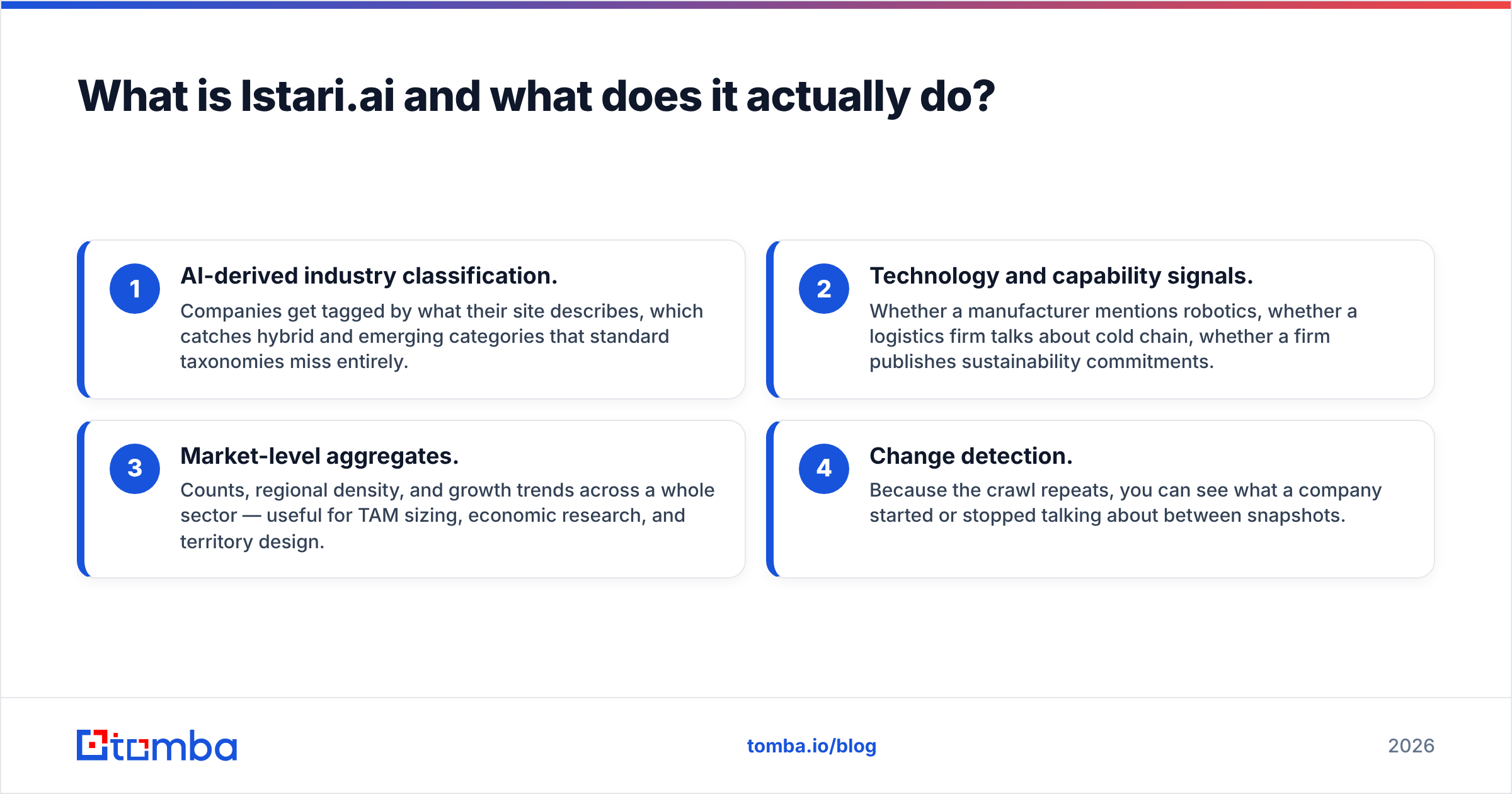
- AI-derived industry classification. Companies get tagged by what their own site describes. That catches hybrid and emerging categories. Standard taxonomies miss them.
- Technology and capability signals. Does a manufacturer mention robotics? Does a logistics firm talk about cold chain? Does a firm publish sustainability commitments?
- Market-level aggregates. Counts, regional density, and growth trends across a whole sector. Useful for TAM sizing, economic research, and territory design.
- Change detection. The crawl repeats. So you can see what a company started or stopped talking about between snapshots.
The typical Istari.ai buyer is not an SDR. It is a market researcher, a strategy team, an economic development agency, or a RevOps lead building a data-backed ICP. You can read their positioning on the official Istari.ai site. The wider category is summarised well on Wikipedia's sales intelligence entry.
The honest limit: web-mined signals are only as good as what a company publishes. Small firms with a one-page brochure site produce thin profiles. And a website tells you about the company. It does not tell you which VP of Operations to email on Tuesday.
What is Sparklane and who is it for?#
Sparklane is a French sales-intelligence platform. It sits at the opposite end of the funnel. The pitch is predictive lead generation. You define your ideal customer profile. The platform then surfaces accounts that look like your best customers and show buying signals: funding rounds, hiring activity, legal filings, leadership changes, published news.
Istari.ai hands you a market. Sparklane hands you a queue. The workflow is closer to what an SDR team actually lives in:
- Build or import an ICP definition
- Receive scored, ranked accounts that match it
- Get the trigger event that explains why now
- Push accounts and contacts into your CRM
- Work the list
Its data strength is European coverage, above all France and nearby markets. The sources are official registries, press, and business filings. That is a real differentiator. Many US-built prospecting tools carry thin, stale data on mid-market European firms. Sparklane does not. Their product pages are at sparklane-group.com. Peer reviews for the category sit on G2.
The honest limit: is your target market mostly North America or APAC? Then you are buying a platform whose core strength does not apply to you. Contact-level email coverage also varies by company size, as with most account tools. It is strong on mid-market and enterprise, and patchier on small firms.

Istariai vs Sparklane: how do they compare head-to-head?#
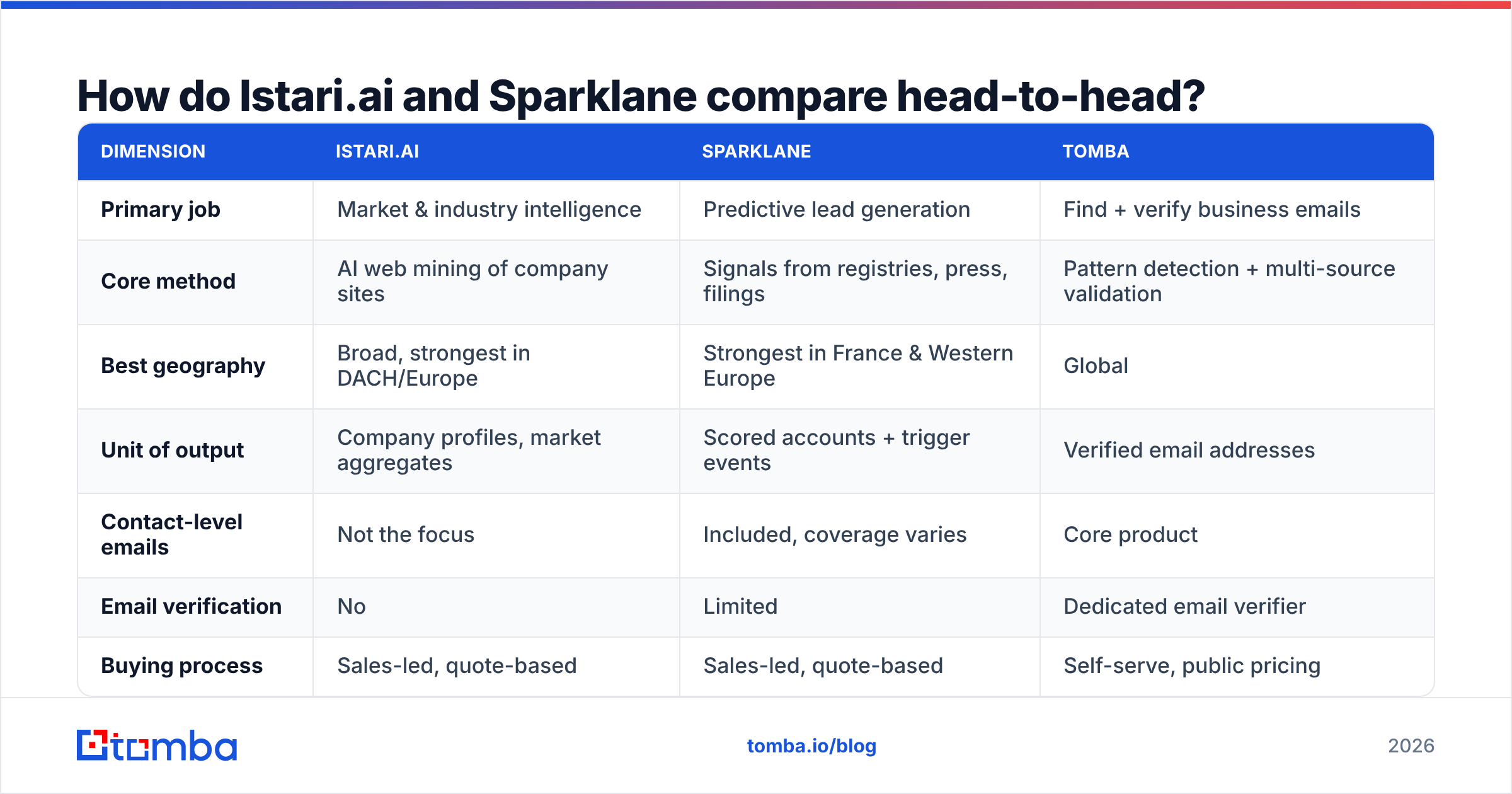
Here is the practical comparison. Treat the pricing rows as directional. Neither vendor publishes a standard rate card, so confirm current numbers with them direct.
| Dimension | Istari.ai | Sparklane | Tomba |
|---|---|---|---|
| Primary job | Market & industry intelligence | Predictive lead generation | Find + verify business emails |
| Core method | AI web mining of company sites | Signals from registries, press, filings | Pattern detection + multi-source validation |
| Best geography | Broad, strongest in DACH/Europe | Strongest in France & Western Europe | Global |
| Unit of output | Company profiles, market aggregates | Scored accounts + trigger events | Verified email addresses |
| Contact-level emails | Not the focus | Included, coverage varies | Core product |
| Email verification | No | Limited | Dedicated email verifier |
| Buying process | Sales-led, quote-based | Sales-led, quote-based | Self-serve, public pricing |
| Free entry point | Demo only | Demo / trial on request | 25 searches/mo free |
| Typical buyer | Research, strategy, RevOps | Sales leadership, SDR teams | SDRs, growth, developers |
| API access | Yes | Yes | Yes — Tomba API |
The table makes the real story obvious: these two products barely overlap. Comparing them is like comparing a geological survey to a drilling rig. One tells you where the oil probably is. The other gets it out of the ground. Teams that trial both often notice this mid-process. They were asking two different questions all along.
Which one has better data coverage?#
Neither, flat out — they cover different dimensions.
Istari.ai wins on breadth and freshness of descriptive data. It crawls rather than licenses. So it can profile long-tail companies that never show up in a curated B2B database. And it re-reads them on a cycle. Say you need to know how many firms in a region mention additive manufacturing. No traditional database gets you there.
Sparklane wins on decision-grade account signals. Registry data, funding events, and executive moves are structured, dated, and checkable. That is what a scoring model needs. Web text is noisy. A filed leadership change is not.
Ask yourself which failure mode hurts more:
- False positives in market sizing. You thought a segment had 4,000 companies. It really had 900. Lean toward Istari.ai's crawl breadth, then check a sample by hand.
- False positives in your call queue. Your reps burn a week on accounts that were never in-market. Lean toward Sparklane's signal scoring.
A third failure mode catches almost everyone, and neither platform prevents it: contact-level decay. B2B email data goes stale by roughly 2-3% per month as people change jobs. A list that was perfect in January is badly wrong by June. That holds whichever platform produced it. It is a verification problem, so it needs a verification tool. See how data sources and re-validation work in practice.
What does each one cost?#
Both vendors are sales-led. You will not find a checkout button on either site. Assume an annual contract by default.
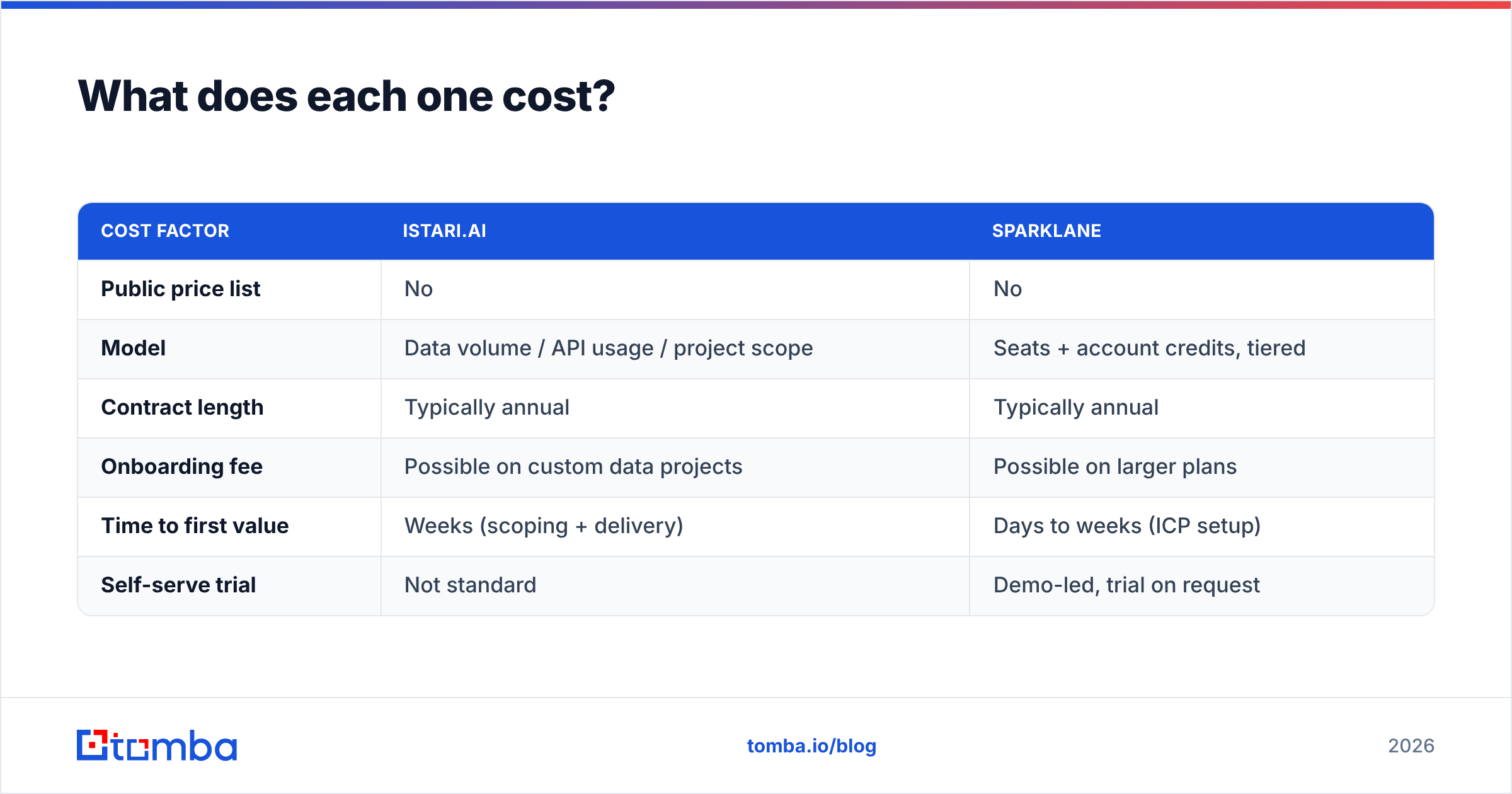
| Cost factor | Istari.ai | Sparklane |
|---|---|---|
| Public price list | No | No |
| Model | Data volume / API usage / project scope | Seats + account credits, tiered |
| Contract length | Typically annual | Typically annual |
| Onboarding fee | Possible on custom data projects | Possible on larger plans |
| Time to first value | Weeks (scoping + delivery) | Days to weeks (ICP setup) |
| Self-serve trial | Not standard | Demo-led, trial on request |
Say you are a two-person team, still testing whether outbound works at all. Both of these are the wrong shape of purchase. Sales-led annual contracts make sense once you know your motion works and you are scaling it. They make little sense while you are still finding product-market fit and need to send 300 emails this month to learn something.
That is the gap where usage-based tooling fits. Tomba pricing is public and self-serve: Free at 25 searches/mo, Starter at $49/mo, Growth at $99/mo, Pro at $249/mo, and custom Enterprise. You can run a full outbound test for the cost of a team lunch. No demo call first. Providers like BookYourData sit in a similar honest middle ground. They suit teams who would rather buy a targeted list outright than license a platform. Worth a look if your need is one-off rather than ongoing.
Do Istari.ai or Sparklane replace an email finder?#
No. It is worth being precise about why. This is the most common budgeting mistake in the category.
Account intelligence and contact data are different supply chains:
- Account intelligence answers which companies and why now. It comes from websites, filings, news, and registries. Both platforms are built for this.
- Contact data answers which human, at what address, verified when. It comes from pattern inference, public records, SMTP checks, and constant re-checking. Neither platform is built for that.
Most intelligence platforms do ship some contact data. It is often fine for large accounts, where email formats are well known and public. It gets thin exactly where mid-market outbound lives: 20-200 employee companies, non-English domains, and catch-all mail servers that accept everything and bounce later.
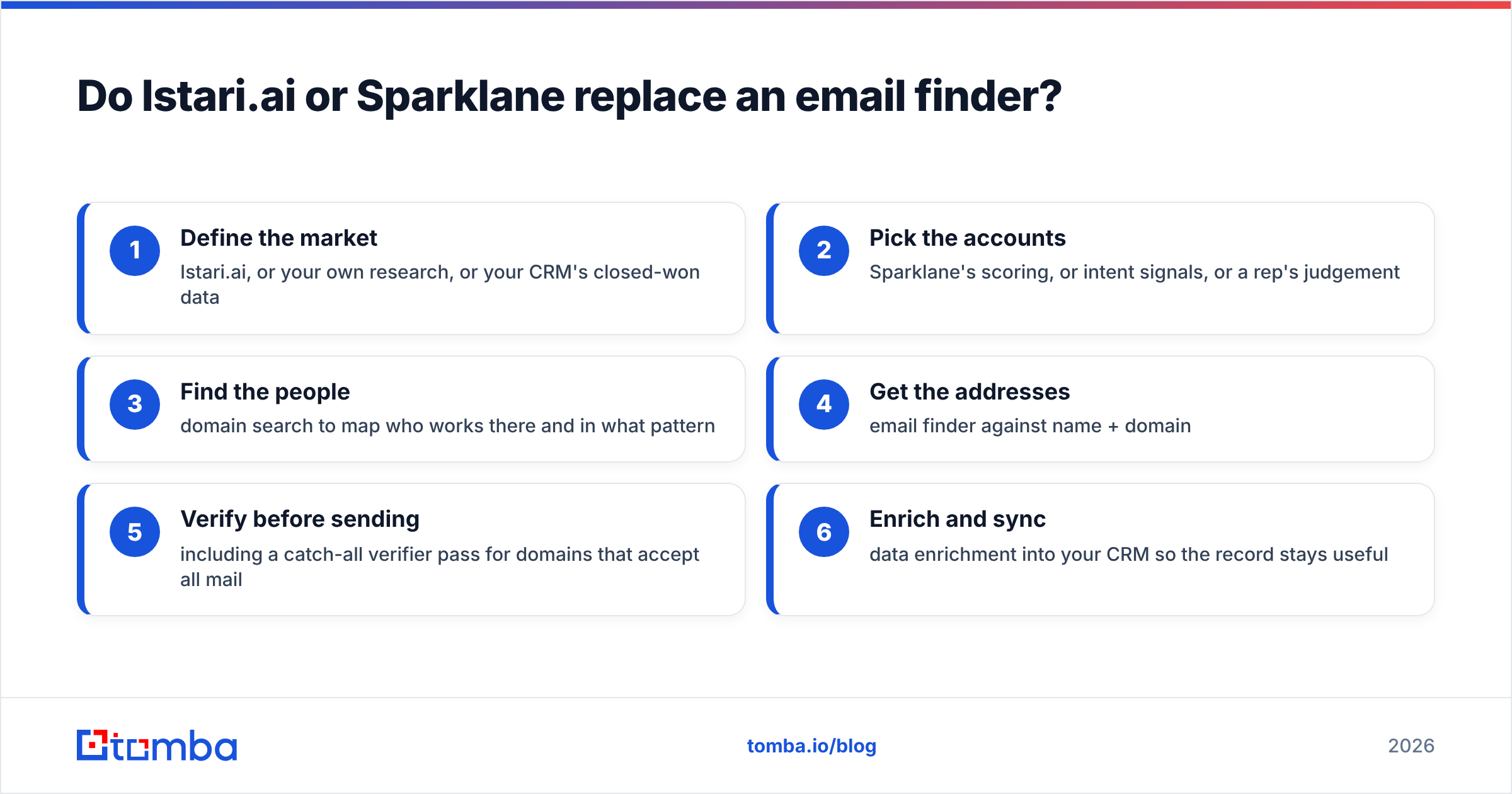
The practical stack looks like this:
- Define the market — Istari.ai, your own research, or your CRM's closed-won data
- Pick the accounts — Sparklane's scoring, intent signals, or a rep's judgement
- Find the people — domain search to map who works there and in what pattern
- Get the addresses — email finder against name + domain
- Verify before sending — including a catch-all verifier pass for domains that accept all mail
- Enrich and sync — data enrichment into your CRM so the record stays useful
Skip step 5 and your bounce rate does the damage. Mailbox providers read hard bounces as a sender-quality signal. One bad send can hurt inbox placement for weeks, even for good mail. No amount of account intelligence makes up for a burned sending domain.
Which should you choose in 2026?#
The Istariai vs Sparklane decision is not about which tool is better. Match the tool to the question you are stuck on.
Choose Istari.ai if:
- You need to size or segment a market, not work a list
- Standard industry codes do not describe your buyers well
- You want technology or capability signals pulled from company websites
- You have an analyst who will use structured data, and a multi-week timeline
- Your use case is research, policy, investment screening, or ICP definition
Choose Sparklane if:
- Your reps need a ranked queue with a reason to call today
- Your target market is France or Western Europe
- You want trigger events (funding, hiring, leadership change) to organise the work
- You already have SDR capacity, and the constraint is what to work, not how to reach
- You can commit to an annual, sales-led contract
Choose neither — yet — if:
- You have a list and no verified addresses
- You are testing whether outbound works before you commit budget
- Your volume is a few thousand contacts a month, not a data-science programme
- You want to start today without a demo call
That last group is bigger than vendors like to admit. Plenty of teams buy a $20-40k intelligence platform to fix what is really a $49/month contact-data problem. Six months later they find the expensive part of their pipeline was never account selection.
How do you test all three without wasting a quarter?#
Run a controlled comparison on a segment you already know:
- Pick 100 accounts you have already sold to or lost. You know the ground truth.
- Ask each vendor to produce that segment from your ICP during the demo. Do not accept a generic sample. Bring your own.
- Measure precision, not volume. How many of the 100 did they surface? How many junk accounts came with them?
- Pull 50 contacts from each platform and run them through a free email checker. Record the valid rate.
- Compare the total cost of getting one verified, reachable decision-maker. That is the only unit metric that matters.
Step 4 is the one nobody runs. It is also the one that changes minds. Say a platform surfaces beautiful accounts, but only 61% of its contacts are deliverable. Per real conversation, that costs more than a cheaper stack at 94%. Run the numbers on your own segment before you sign anything.
The bottom line#
Istariai vs Sparklane is not really a contest, because the two are not in the same race. Both are credible. Both are European. Both solve real problems — just not the same one. Istari.ai is the better pick when your question is what does this market look like. Sparklane is the better pick when your question is who do I call this week. Weighing one against the other only helps once you know which question is blocking you.
And whichever you pick, the last mile is the same. You still need a real, verified address for a real human. And it has to be correct on send day.
That is exactly what Tomba Email Finder does. Search by domain, name, or company. Get addresses scored for confidence. Verify them before they hit your sequence. Then push the results into your CRM through the API or a native integration. Start free with 25 searches a month. No demo call, no annual contract, no procurement cycle. If it does not beat the contact data your intelligence platform ships with, you have lost ten minutes.
Related guides#
// get started
Find, verify and enrich your first contacts today
Start on the free plan with 25 searches a month, then scale when your team is ready.
Free plan · No credit card required · GDPR & CCPA
// about the author